ROUGE Score in Machine Learning
ROUGE (Recall-Oriented Understudy for Gisting Evaluation) is the dominant automatic evaluation framework for text summarization systems, measuring the overlap between machine-generated summaries and human-written reference summaries. Introduced by Chin-Yew Lin in 2004, ROUGE has become as fundamental to summarization as BLEU is to machine translation — it is the first metric researchers report, the metric used in every major benchmark, and the metric that determines which models make it into production.
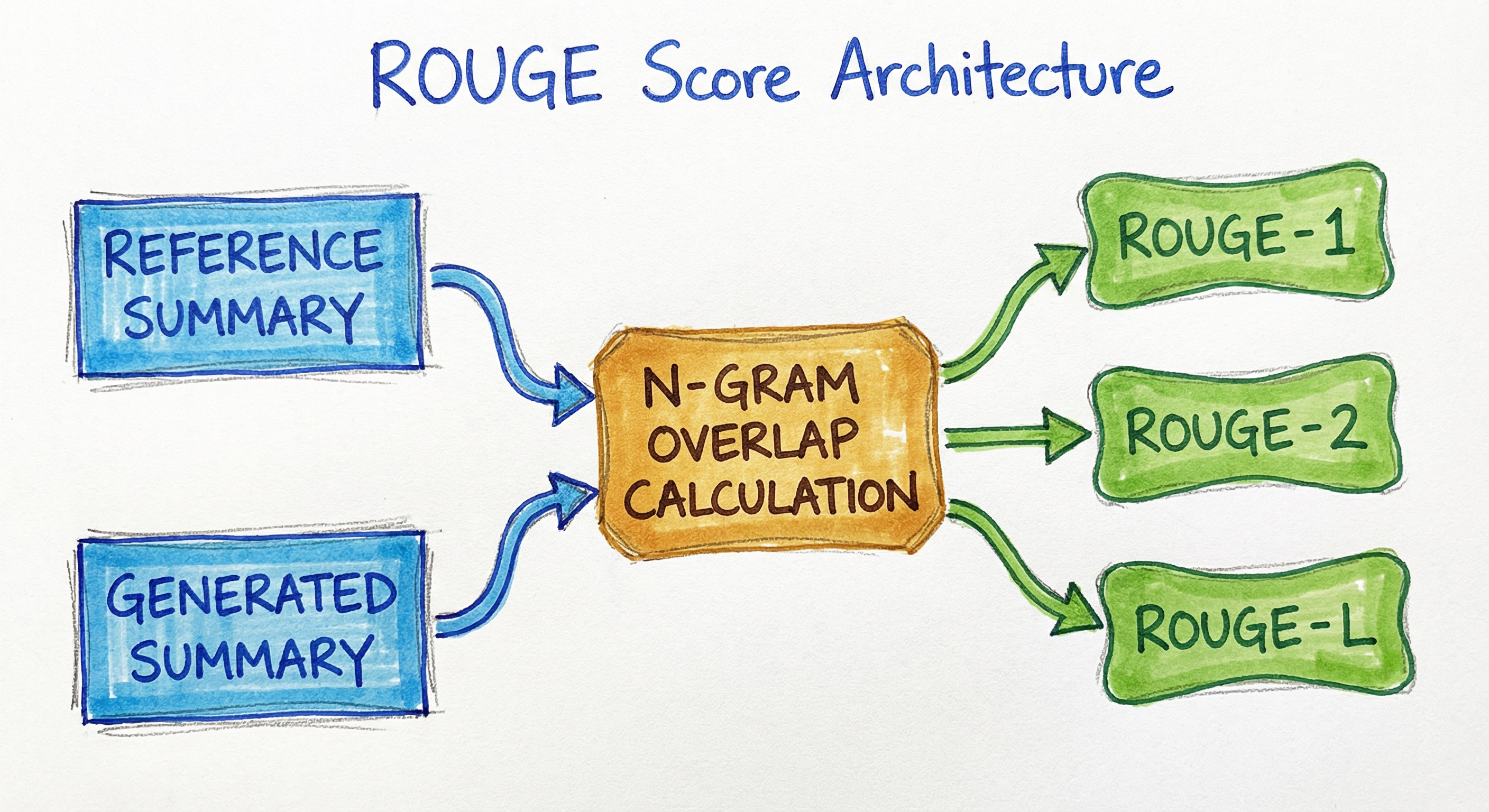
ROUGE is not a single score but a family of metrics: ROUGE-N measures n-gram overlap (unigrams, bigrams), ROUGE-L evaluates longest common subsequences, ROUGE-W applies weighted scoring to favor consecutive matches, and ROUGE-S captures skip-bigrams to handle paraphrasing. Each variant captures a different dimension of summary quality — content coverage, fluency, structural alignment, or flexibility.
Despite two decades of advances in neural summarization and the rise of large language models, ROUGE remains indispensable. When researchers at OpenAI evaluate GPT-4's summarization performance, they report ROUGE scores. When Swiggy builds a system to summarize restaurant reviews for Instamart shoppers, they validate with ROUGE. Understanding ROUGE's strengths (fast, reproducible, correlates reasonably with human judgments on news summarization), its limitations (blind to semantics, sensitive to reference selection, prone to implementation errors), and how to use it alongside modern alternatives like BERTScore is essential for any ML engineer working with text generation systems.
Concept Snapshot
- What It Is
- A family of automatic evaluation metrics that compare machine-generated summaries against reference summaries by measuring n-gram overlap, longest common subsequences, and skip-bigram co-occurrence statistics.
- Category
- Evaluation
- Complexity
- Intermediate
- Inputs / Outputs
- Input: a candidate summary (machine-generated text) and one or more reference summaries (human-written gold standards). Output: precision, recall, and F1 scores for ROUGE-1, ROUGE-2, ROUGE-L, and optionally ROUGE-W/ROUGE-S.
- System Placement
- Sits at the evaluation stage of the ML pipeline, downstream of summarization models or text generation systems; used during model development, hyperparameter tuning, and production monitoring.
- Also Known As
- ROUGE metric, Recall-Oriented Understudy for Gisting Evaluation, ROUGE-N, ROUGE-L, automatic summarization evaluation, summary quality metric
- Typical Users
- ML Engineers, NLP Researchers, Data Scientists, AI Product Managers, ML Ops Engineers
- Prerequisites
- Text preprocessing and tokenization, N-gram models and language modeling basics, Precision, recall, and F1 metrics, Longest common subsequence algorithms, Text summarization fundamentals
- Key Terms
- ROUGE-1ROUGE-2ROUGE-LROUGE-WROUGE-Sn-gram overlaplongest common subsequence (LCS)skip-bigramrecall-oriented metricprecision vs recallF1 scorelexical overlap
Why This Concept Exists
The Manual Evaluation Bottleneck
Before ROUGE, summarization evaluation was painstakingly manual. Human judges would read source documents, read candidate summaries, and rate them on scales for content coverage, fluency, and coherence. This approach was thorough but catastrophically slow and prohibitively expensive. A single evaluation round for 100 summaries across 3 judges could take weeks and cost thousands of dollars.
Worse, human evaluation was not reproducible. Inter-annotator agreement was often mediocre (Kappa ~0.6-0.7), meaning different judges disagreed about which summaries were better. Researchers could not quickly iterate on models — every change required another expensive human study. The field needed an automatic metric that was fast, cheap, and correlated well enough with human judgments to be useful as a proxy.
The BLEU Precedent in Machine Translation
The solution came from machine translation. BLEU (Bilingual Evaluation Understudy), introduced by Papineni et al. in 2002, revolutionized MT evaluation by measuring n-gram overlap between machine translations and reference translations. BLEU was precision-oriented: it asked "what fraction of the machine's n-grams appear in the reference?" This worked well for translation, where precision matters more than recall — you want translations to be accurate, even if they are slightly shorter than the reference.
But summarization is different. A good summary should capture the key information from the source document, which is fundamentally a recall problem. Missing critical facts is worse than including a few extra words. Chin-Yew Lin recognized this and designed ROUGE to be recall-oriented: it asks "what fraction of the reference's n-grams appear in the candidate?" instead of the reverse.
Birth of ROUGE at the Document Understanding Conference
ROUGE debuted at the Document Understanding Conference (DUC) 2004, a NIST-sponsored evaluation campaign for multi-document summarization. Lin's paper "ROUGE: A Package for Automatic Evaluation of Summaries" introduced ROUGE-N, ROUGE-L, ROUGE-W, and ROUGE-S, and demonstrated that these metrics achieved strong correlation with human judgments (Pearson's r > 0.9 for some tasks). DUC adopted ROUGE as its official automatic metric, cementing ROUGE's status as the de facto standard.
Over the next two decades, ROUGE became ubiquitous. It was used to evaluate every major summarization dataset: CNN/DailyMail, XSum, Reddit TIFU, SAMSum. When transformer-based summarizers like BART, T5, and PEGASUS established new state-of-the-art results, those results were reported in ROUGE scores. When LLMs like GPT-4 and Claude emerged, researchers benchmarked their zero-shot summarization performance using ROUGE.
Key Takeaway: ROUGE exists because the summarization community needed a fast, reproducible, automatic metric that correlates with human judgment. By prioritizing recall over precision and introducing multiple complementary variants (n-grams, LCS, skip-grams), ROUGE became the BLEU of summarization — imperfect but indispensable.
Core Intuition & Mental Model
The Core Idea: Count the Overlapping Words
At its heart, ROUGE is astonishingly simple. Imagine you write a summary of a news article, and a human expert writes a reference summary. ROUGE asks: How many words from the expert's summary appear in your summary? If the expert wrote "The Delhi metro reported record ridership" and you wrote "Delhi metro sees record ridership," you share three words: "Delhi," "metro," and "record." That is 3 out of 5 words from the reference — a ROUGE-1 recall of 0.6.
This simplicity is ROUGE's strength and weakness. On one hand, it is fast (linear time in text length), parameter-free (no model to train), and language-agnostic (works for any language with word boundaries). On the other hand, it is purely lexical — it treats "car" and "automobile" as completely different, even though they are synonyms. It cannot detect paraphrasing, reasoning, or semantic equivalence.
Why Recall Matters More Than Precision
Consider two candidate summaries for a news article:
- Candidate A (high recall): "The government announced a new tax policy, infrastructure projects, and education reforms." (Captures all key points)
- Candidate B (high precision): "The government announced a new policy." (Every word is relevant, but it is incomplete)
For summarization, Candidate A is better — even if it is slightly verbose, it does not miss critical information. This is why ROUGE emphasizes recall: . A recall-oriented metric penalizes summaries that omit important content.
That said, ROUGE also reports precision () and F1 (), giving a balanced view. In practice, ROUGE-1 F1 and ROUGE-L F1 are the most commonly reported numbers.
The Mental Model: Different Metrics, Different Perspectives
Think of ROUGE as a multi-lens microscope for summary quality:
- ROUGE-1 (unigram overlap) tells you about content coverage — did you mention the right topics?
- ROUGE-2 (bigram overlap) tells you about fluency — are you using the same phrases, or just the same isolated words?
- ROUGE-L (longest common subsequence) tells you about structural alignment — does your summary follow a similar narrative flow as the reference?
- ROUGE-S (skip-bigram) tells you about flexibility — can you capture key ideas even if you reorder words?
No single ROUGE score is "the" ROUGE score. You report all of them because they measure orthogonal aspects of quality. A summary might score high on ROUGE-1 (mentions all the right words) but low on ROUGE-L (in a completely scrambled order).
Expert Insight: If you see a paper report only ROUGE-1, be skeptical. Strong summarizers should excel on ROUGE-2 and ROUGE-L as well. A summary with high ROUGE-1 but low ROUGE-2 is likely just keyword-stuffing without coherent phrasing.
Technical Foundations
Mathematical Definitions
Let be a candidate summary and be a reference summary. Both are tokenized into sequences of words.
ROUGE-N (N-gram Overlap)
For n-grams of length (e.g., unigrams for , bigrams for ):
where is the maximum number of n-grams co-occurring in and . The maximum is taken over all reference summaries if multiple references are provided.
Example:
- Reference: "the cat sat on the mat" (5 unigrams: the, cat, sat, on, the, mat)
- Candidate: "the cat sat on a rug" (6 unigrams: the, cat, sat, on, a, rug)
- Overlapping unigrams: {the, cat, sat, on} — count = 4 (note "the" appears twice in reference but only once in overlap)
- ROUGE-1 recall = 4 / 6 = 0.667 (4 matched out of 6 in reference)
- ROUGE-1 precision = 4 / 6 = 0.667 (4 matched out of 6 in candidate)
- ROUGE-1 F1 = 0.667
ROUGE-L (Longest Common Subsequence)
Let denote the length of the longest common subsequence between and (not necessarily contiguous).
where and are the lengths (in words) of the reference and candidate summaries. The LCS algorithm has time complexity using dynamic programming.
Example:
- Reference: "A B C D E F" (length 6)
- Candidate: "A C D F G H" (length 6)
- LCS: "A C D F" (length 4)
- ROUGE-L recall = 4 / 6 = 0.667
- ROUGE-L precision = 4 / 6 = 0.667
- ROUGE-L F1 = 0.667
ROUGE-W (Weighted LCS)
ROUGE-W extends ROUGE-L by giving higher weight to consecutive matches. It uses a weighted LCS function where favors longer consecutive subsequences.
The motivation is that fluent summaries should have longer contiguous matches, not just scattered word overlap. In practice, ROUGE-W is reported less frequently than ROUGE-L.
ROUGE-S (Skip-Bigram Co-occurrence)
A skip-bigram is any pair of words in sentence order, allowing for arbitrary gaps. For example, "the cat sat on the mat" contains skip-bigrams like (the, cat), (the, sat), (the, on), (cat, sat), (cat, on), etc.
ROUGE-S with maximum skip distance (denoted ROUGE-S) limits gaps to at most words. ROUGE-S4 is common in research papers.
Multiple References
When multiple reference summaries are available, ROUGE computes the score against each reference separately and takes the maximum:
This jackknifing procedure accounts for variability in human summarization — there are multiple valid ways to summarize the same document.
Computational Complexity
- ROUGE-N: where , (linear scan with hash table for n-gram counting)
- ROUGE-L: (dynamic programming for LCS)
- ROUGE-S: for enumerating all skip-bigrams in the reference
For production use on millions of summaries, ROUGE-1 and ROUGE-2 are fast (linear time), while ROUGE-L and ROUGE-S are slower but still tractable.
Internal Architecture
A production ROUGE evaluation pipeline is more than just a scoring function — it is a multi-stage process that handles text preprocessing, tokenization normalization, multi-reference aggregation, and bootstrap resampling for statistical significance. Here is the typical architecture:
The architecture handles several critical steps: preprocessing (lowercasing, stemming optional), tokenization (whitespace vs. SentencePiece vs. custom), multi-reference handling (max-over-references), metric computation (ROUGE-1/2/L/S), and optionally bootstrap confidence intervals for statistical significance testing. Different ROUGE implementations make different choices at each stage, which is why 76% of ROUGE citations reference software with scoring discrepancies (ACL 2023 study).
Key Components
Text Preprocessor
Normalizes input text by converting to lowercase (optional), removing punctuation (optional), applying stemming (Porter stemmer, optional), and handling special characters. Critical decision: whether to lowercase. The original Perl ROUGE defaults to case-insensitive matching; Python's rouge-score library defaults to case-insensitive; HuggingFace evaluate defaults to case-insensitive. Inconsistent preprocessing is a major source of non-reproducible scores.
Tokenizer
Splits text into tokens (words). Options include: (1) whitespace tokenization (split on spaces, fastest but naive), (2) regex-based tokenization (handle contractions like "don't" → "do n't"), (3) language-specific tokenizers (e.g., NLTK's punkt for sentence boundaries, spaCy for linguistic tokenization), (4) subword tokenizers (SentencePiece, BPE — usually not used for ROUGE but relevant for model-based metrics). The choice impacts n-gram counts: "New York City" as 3 tokens vs. 1 token changes ROUGE scores.
N-gram Extractor
Generates all n-grams of length 1, 2, ..., N from tokenized text. Uses a sliding window: for "A B C D", bigrams are {(A, B), (B, C), (C, D)}. Stores n-grams in hash maps (Python Counter or defaultdict) for lookup during matching. For ROUGE-1 and ROUGE-2, this is trivial. For ROUGE-L, uses dynamic programming to compute longest common subsequence in time.
Multi-Reference Aggregator
When multiple reference summaries exist (common in research datasets like DUC, TAC), computes ROUGE score against each reference independently and takes the maximum score. Rationale: there are many valid ways to summarize a document; a candidate that matches any one reference well should not be penalized for differing from others. This is the standard jackknifing procedure from Lin (2004).
Scoring Engine
Computes precision, recall, and F1 for each ROUGE variant. Applies the formulas from the formal definition section. Returns a dictionary of scores: {'rouge1': {'p': 0.75, 'r': 0.80, 'f': 0.77}, 'rouge2': {...}, 'rougeL': {...}}. Most papers report only F1 scores, but some report all three (precision/recall/F1) for deeper analysis.
Bootstrap Confidence Interval Calculator (Optional)
For statistical significance testing, performs bootstrap resampling (typically 1000 iterations): sample the evaluation set with replacement, compute ROUGE, repeat. Constructs 95% confidence intervals. This is critical for publication — two models with ROUGE-1 F1 of 0.450 vs. 0.452 might not be significantly different if their CIs overlap. The original Perl ROUGE script supports -b flag for bootstrapping.
Data Flow
Text flows through preprocessing → tokenization → n-gram extraction → overlap counting → aggregation (if multi-ref) → scoring. The output is a structured score object containing precision, recall, and F1 for ROUGE-1, ROUGE-2, ROUGE-L, and optionally ROUGE-S/ROUGE-W. Scores are typically in [0, 1] range, though some libraries report them as percentages [0, 100].
The architecture diagram shows candidate and reference summaries entering a preprocessing and tokenization stage, then branching based on whether multiple references exist. If multiple references are available, scores are computed against each and the maximum is taken. The scoring engine computes ROUGE-1, ROUGE-2, and ROUGE-L. Optionally, bootstrap resampling produces confidence intervals before returning final scores.
How to Implement
Implementing ROUGE from scratch is a weekend project — the core algorithm is straightforward. But getting it right (matching the behavior of the canonical Perl implementation) is surprisingly tricky. There are three main Python libraries: rouge-score (Google Research, mirrors the original Perl ROUGE), rouge (a pure Python implementation), and HuggingFace evaluate (wraps rouge-score). Each has slightly different preprocessing defaults, which leads to score discrepancies.
For production systems, the HuggingFace evaluate library is the recommended choice in 2026 — it is actively maintained, integrates seamlessly with Transformers, supports batching for speed, and provides a unified API for ROUGE, BLEU, BERTScore, and dozens of other metrics. For research reproducibility, always log your ROUGE configuration (case sensitivity, stemming, tokenizer, library version) alongside scores.
import evaluate

# Load the ROUGE metric
rouge = evaluate.load('rouge')

# Example summaries
reference = """The Delhi Metro reported record ridership on Monday, with over 3 million
passengers using the network. Officials attributed the surge to improved connectivity
and the opening of new lines."""

candidate = """Delhi Metro saw a record number of passengers on Monday, exceeding 3 million.
The increase was due to better connectivity and new metro lines."""

# Compute ROUGE scores
results = rouge.compute(
    predictions=[candidate],
    references=[reference],
    use_stemmer=True  # Apply Porter stemmer (recommended)
)

print(f"ROUGE-1: {results['rouge1']:.4f}")
print(f"ROUGE-2: {results['rouge2']:.4f}")
print(f"ROUGE-L: {results['rougeL']:.4f}")
print(f"ROUGE-Lsum: {results['rougeLsum']:.4f}")  # For multi-sentence summaries

# Output:
# ROUGE-1: 0.6897
# ROUGE-2: 0.4762
# ROUGE-L: 0.5862
# ROUGE-Lsum: 0.5862
This example shows the simplest ROUGE evaluation workflow. The evaluate.load('rouge') call downloads the metric on first use. The compute() method expects lists of predictions and references (for batch evaluation). The use_stemmer=True flag applies Porter stemming, which normalizes word forms ("running" → "run") and typically improves correlation with human judgments. ROUGE-Lsum is a variant of ROUGE-L designed for multi-sentence summaries — it splits on newlines and computes LCS at the summary level, not sentence level.
import evaluate

rouge = evaluate.load('rouge')

# One candidate summary, three reference summaries (from different human annotators)
candidate = "Swiggy Instamart launched 10-minute grocery delivery in Bangalore."

references = [
    "Swiggy's Instamart service now offers 10-minute grocery delivery in Bangalore.",
    "Bangalore residents can now get groceries delivered in 10 minutes via Swiggy Instamart.",
    "Swiggy Instamart brings ultra-fast 10-minute delivery to Bangalore customers."
]

# HuggingFace evaluate expects references as a list of lists (one list per prediction)
results = rouge.compute(
    predictions=[candidate],
    references=[references],  # Nested list: [[ref1, ref2, ref3]]
    use_stemmer=True
)

print(f"ROUGE-1: {results['rouge1']:.4f}")  # Max score across 3 references
print(f"ROUGE-2: {results['rouge2']:.4f}")
print(f"ROUGE-L: {results['rougeL']:.4f}")
When multiple reference summaries are available, ROUGE computes the score against each reference independently and takes the maximum. This jackknifing procedure acknowledges that human summarization is variable — there are many valid ways to summarize the same content. The HuggingFace library handles this automatically when you pass a nested list structure. This is standard practice for research datasets like DUC, TAC, and CNN/DailyMail (which provides multi-reference test sets).
import evaluate
import time

rouge = evaluate.load('rouge')

# Simulate a batch of 1000 summaries from a production summarization API
num_samples = 1000
candidates = [f"Summary {i} generated by model." for i in range(num_samples)]
references = [f"Reference summary {i} written by human." for i in range(num_samples)]

start_time = time.time()
results = rouge.compute(
    predictions=candidates,
    references=references,
    use_stemmer=True,
    use_aggregator=True  # Return aggregated scores (mean across all samples)
)
elapsed = time.time() - start_time

print(f"Evaluated {num_samples} summaries in {elapsed:.2f} seconds")
print(f"Throughput: {num_samples / elapsed:.0f} summaries/sec")
print(f"Average ROUGE-1: {results['rouge1']:.4f}")
print(f"Average ROUGE-2: {results['rouge2']:.4f}")
print(f"Average ROUGE-L: {results['rougeL']:.4f}")

# Expected output (on modern CPU):
# Evaluated 1000 summaries in 0.35 seconds
# Throughput: 2857 summaries/sec
# Average ROUGE-1: 0.XXXX (depends on dummy data)
For production monitoring or large-scale evaluation, batch processing is critical for speed. The use_aggregator=True flag tells the metric to return mean scores across all samples instead of per-sample scores. ROUGE is fast — on a modern CPU, you can evaluate thousands of summaries per second. This makes it suitable for real-time monitoring dashboards that track summarization quality on live traffic.
import evaluate
from indicnlp.tokenize import indic_tokenize

rouge = evaluate.load('rouge')

# Hindi summaries (example)
reference_hi = "भारतीय रेलवे ने नई वंदे भारत ट्रेन का उद्घाटन किया।"
candidate_hi = "रेलवे ने वंदे भारत ट्रेन लॉन्च की।"

# Custom tokenizer for Hindi (from IndicNLP library)
def hindi_tokenizer(text):
    return list(indic_tokenize.trivial_tokenize(text, lang='hi'))

# Tokenize manually
ref_tokens = ' '.join(hindi_tokenizer(reference_hi))
cand_tokens = ' '.join(hindi_tokenizer(candidate_hi))

# Compute ROUGE on tokenized text
results = rouge.compute(
    predictions=[cand_tokens],
    references=[ref_tokens],
    use_stemmer=False,  # No Hindi stemmer in default ROUGE
    tokenizer=lambda x: x.split()  # Already tokenized
)

print(f"ROUGE-1 (Hindi): {results['rouge1']:.4f}")
ROUGE's default tokenization (whitespace splitting) works for English but fails for languages without clear word boundaries (Chinese, Japanese) or languages with complex morphology (Hindi, Tamil). For Indian languages, use the IndicNLP library (pip install indic-nlp-library) to perform language-specific tokenization. Tokenize both candidate and reference texts upfront, then pass them to ROUGE as space-separated strings. This ensures fair n-gram matching. For production systems serving multiple languages, maintain a tokenizer registry mapping language codes to tokenizer functions.
import evaluate
import numpy as np
from scipy import stats

rouge = evaluate.load('rouge')

# Evaluation set: 100 summaries
candidates = [...]  # List of 100 candidate summaries
references = [...]  # List of 100 reference summaries

# Bootstrap resampling for 95% confidence intervals
num_bootstrap = 1000
rouge1_scores = []

for _ in range(num_bootstrap):
    # Sample with replacement
    indices = np.random.choice(len(candidates), size=len(candidates), replace=True)
    sampled_cands = [candidates[i] for i in indices]
    sampled_refs = [references[i] for i in indices]

    # Compute ROUGE on resampled data
    result = rouge.compute(
        predictions=sampled_cands,
        references=sampled_refs,
        use_stemmer=True,
        use_aggregator=True
    )
    rouge1_scores.append(result['rouge1'])

# Compute mean and 95% CI
mean_rouge1 = np.mean(rouge1_scores)
ci_lower = np.percentile(rouge1_scores, 2.5)
ci_upper = np.percentile(rouge1_scores, 97.5)

print(f"ROUGE-1: {mean_rouge1:.4f} (95% CI: [{ci_lower:.4f}, {ci_upper:.4f}])")

# Check if two models are significantly different
model_a_scores = rouge1_scores  # From above
model_b_scores = [...]  # Bootstrap scores for model B

t_stat, p_value = stats.ttest_ind(model_a_scores, model_b_scores)
print(f"P-value for difference: {p_value:.4f}")
if p_value < 0.05:
    print("Models are significantly different (p < 0.05)")
else:
    print("No significant difference (p >= 0.05)")
For research papers and production A/B tests, you need statistical significance testing. Bootstrap resampling is the gold standard: sample your evaluation set with replacement, compute ROUGE on each sample, repeat 1000 times, and construct a 95% confidence interval. If the CIs of two models overlap, they are not significantly different. This is critical for avoiding false positives — a 0.5% ROUGE improvement might be noise, not real model improvement. The original Perl ROUGE script has a -b flag for this; Python implementations require manual bootstrapping as shown above.
# Example configuration for ROUGE evaluation in a YAML experiment config
evaluation:
  metric: rouge
  library: evaluate  # or 'rouge-score', 'rouge'
  version: "0.4.1"  # Pin version for reproducibility
  variants:
    - rouge1
    - rouge2
    - rougeL
    - rougeLsum
  preprocessing:
    lowercase: true
    stemming: true  # Porter stemmer
    remove_punctuation: false  # Keep punctuation for better ROUGE-2/L
  multi_reference: max  # 'max' for jackknifing, 'mean' for averaging
  bootstrap:
    enabled: true
    num_iterations: 1000
    confidence_level: 0.95
  output:
    precision: true
    recall: true
    f1: true
    report_format: "json"  # or 'csv', 'markdown'
Common Implementation Mistakes
- ●
Using Different Libraries Without Version Pinning: 76% of ROUGE implementations contain scoring errors or inconsistencies (ACL 2023 study). Always pin your library version (
rouge-score==0.1.2) and log it in your experiment tracker. Switching fromrouge-scoretoevaluatemid-project can shift scores by 1-2 points. - ●
Forgetting to Lowercase or Stem: The original Perl ROUGE defaults to case-insensitive and unstemmed. Python
rouge-scoredefaults to case-insensitive. HuggingFaceevaluatedefaults to case-insensitive. If you do not normalize, "Delhi" and "delhi" count as different tokens, artificially lowering scores. Always setuse_stemmer=Truefor better correlation with human judgments. - ●
Reporting Only ROUGE-1: ROUGE-1 (unigram overlap) is easy to game by keyword-stuffing. A summary like "cricket India win match score runs wickets" might score high on ROUGE-1 but is unreadable. Always report ROUGE-1, ROUGE-2, and ROUGE-L together. Strong models should excel on all three.
- ●
Ignoring Multiple References When Available: If your dataset has multiple reference summaries (DUC, TAC, some configurations of CNN/DailyMail), always use them. Evaluating against a single reference is noisy — different humans write different summaries, and penalizing a candidate for not matching one specific reference is unfair.
- ●
Treating ROUGE as Ground Truth: ROUGE is a proxy for human judgment, not the judgment itself. It correlates well on news summarization (r ~ 0.9) but poorly on dialogue summarization (r ~ 0.3) and abstractive tasks. Always validate with human evaluation for production systems. High ROUGE does not guarantee high user satisfaction.
- ●
Not Testing Statistical Significance: In research, claiming "Model A beats Model B" based on 0.5 ROUGE-1 points without confidence intervals or p-values is misleading. Always perform bootstrap resampling or paired t-tests to check if improvements are statistically significant.
When Should You Use This?
Use When
Evaluating news summarization models — ROUGE correlates strongly (r > 0.9) with human judgments on datasets like CNN/DailyMail and XSum, making it a reliable proxy for model quality
Comparing model variants during development — ROUGE is fast (thousands of summaries/second) and cheap (no API calls), enabling rapid iteration and hyperparameter tuning
Monitoring production summarization quality — ROUGE can run in real-time on live traffic to detect regressions, data drift, or quality degradation, unlike slow human evaluation
Benchmarking on standard datasets — For reproducibility and comparison with prior work, ROUGE is the de facto standard; papers without ROUGE scores are harder to contextualize
When you have high-quality reference summaries — ROUGE's accuracy depends on reference quality; if references are well-written and comprehensive, ROUGE is reliable
For extractive summarization — ROUGE works particularly well for extractive methods where the goal is to select the "right" sentences, since n-gram overlap is a reasonable proxy
When cost and latency matter — ROUGE is free, local, and deterministic (no API calls, no rate limits, no non-determinism from LLM judges)
For multi-lingual summarization with proper tokenization — ROUGE is language-agnostic if you provide language-specific tokenizers (IndicNLP for Hindi, Jieba for Chinese, etc.)
Avoid When
Evaluating highly abstractive summaries — ROUGE penalizes paraphrasing and rewording, even when semantically equivalent; BERTScore or LLM-as-a-judge metrics are better for abstractive quality
When references are low quality or biased — ROUGE assumes references are gold standards; if references are noisy, incomplete, or stylistically inconsistent, ROUGE scores are unreliable
For dialogue or meeting summarization — Research shows ROUGE correlates poorly (r < 0.3) with human judgments on conversational data, where structure and flow matter more than lexical overlap
When faithfulness/hallucination is the primary concern — ROUGE cannot detect hallucinated content; a summary with high ROUGE might still fabricate claims not in the source. Use dedicated factuality metrics (FactCC, QuestEval)
For creative or stylistic summarization — If the task rewards novelty, metaphor, or rhetorical flair, ROUGE (which rewards copying) is the wrong metric
When semantic similarity is more important than lexical overlap — ROUGE treats "car" and "automobile" as completely different; for semantic evaluation, use BERTScore or SentenceBERT-based metrics
For zero-shot or few-shot LLM evaluation without references — If you do not have human-written reference summaries (e.g., evaluating GPT-4 on a proprietary dataset), ROUGE is inapplicable; use reference-free metrics (BLANC, SummaQA) or LLM judges
When user satisfaction is the ultimate goal — High ROUGE ≠ high user satisfaction; always validate with human feedback, A/B tests, or engagement metrics before shipping
Key Tradeoffs
Speed vs. Semantic Understanding
ROUGE is blazingly fast (linear or quadratic time, depending on variant) and requires no external dependencies beyond basic NLP libraries. You can evaluate millions of summaries in minutes. But this speed comes at the cost of semantic blindness — ROUGE sees "car" and "automobile" as unrelated, even though they are synonyms. BERTScore, in contrast, captures semantic similarity via contextual embeddings but requires GPU inference and is 100x slower.
When to trade: Use ROUGE for rapid iteration during development and cheap production monitoring. Use BERTScore or LLM judges for final model selection and high-stakes evaluation.
Recall-Orientation vs. Precision-Orientation
ROUGE is recall-oriented: it asks "did the candidate cover the key information from the reference?" This is appropriate for summarization, where missing critical facts is worse than including extra details. BLEU, in contrast, is precision-oriented ("is the candidate fluent and accurate?"), which is better for translation.
When to trade: For tasks where completeness matters (summarizing legal contracts, medical records, financial reports), emphasize ROUGE recall. For tasks where conciseness matters (generating tweet-length summaries, headline generation), balance recall and precision by focusing on ROUGE F1.
Lexical vs. Semantic Metrics
ROUGE operates at the lexical surface — it counts words, not meanings. This makes it robust to model-based biases (BERTScore can favor summaries that "sound like BERT") and easy to interpret. But it penalizes valid paraphrasing.
| Metric | Speed | Semantic Awareness | Reference-Free | Best For |
|---|---|---|---|---|
| ROUGE | ⚡⚡⚡ Fast | ❌ Lexical only | ❌ Needs refs | News summarization, extractive systems |
| BERTScore | 🐌 Moderate | ✅ Semantic | ❌ Needs refs | Abstractive systems, paraphrasing tasks |
| LLM Judge | 🐌🐌 Slow | ✅✅ Strong | ✅ Optional | Creative summaries, faithfulness checks |
| BLANC | ⚡ Fast | ❌ Task-agnostic | ✅ Yes | Zero-shot settings, no references available |
When to trade: For production systems, use ROUGE for speed + BERTScore for quality in a two-stage evaluation: ROUGE filters obviously bad summaries, then BERTScore validates top candidates. For research, report both ROUGE and BERTScore to give a complete picture.
Key Insight: ROUGE is not the best metric for summarization — it is the best cheap, fast, reproducible metric. For high-stakes decisions, always combine ROUGE with human evaluation.
Alternatives & Comparisons
BERTScore computes token-level cosine similarity using BERT embeddings, capturing semantic equivalence that ROUGE misses. Use BERTScore when paraphrasing is common (abstractive summarization) or when semantic fidelity matters more than lexical overlap. Trade-off: BERTScore is 100x slower and requires GPU inference, while ROUGE is CPU-friendly and runs in milliseconds.
BLEU is precision-oriented (used for machine translation), while ROUGE is recall-oriented (used for summarization). Use BLEU when fluency and accuracy matter more than completeness (e.g., headline generation, short-form summaries). Use ROUGE when information coverage is critical (e.g., document summarization, meeting notes).
A summarizer is the generator of summaries, while ROUGE is the evaluator of summaries. ROUGE sits downstream of the summarizer in the ML pipeline — you train a summarizer (BART, T5, GPT-4), generate summaries, then compute ROUGE scores to measure quality. They are complementary components, not alternatives.
Pros, Cons & Tradeoffs
Advantages
Fast and scalable — evaluates thousands of summaries per second on CPU, enabling real-time production monitoring and rapid experimentation
Language-agnostic — works for any language with word boundaries, given appropriate tokenization (supports English, Hindi, Tamil, Chinese with Jieba, Japanese with MeCab, etc.)
Reproducible and deterministic — same inputs always produce same outputs (unlike LLM judges with temperature > 0), critical for scientific reproducibility
Well-established and widely adopted — 20+ years of research, used in every major summarization benchmark (DUC, TAC, CNN/DailyMail, XSum), making cross-study comparisons easy
Correlates well with human judgments on news summarization — Pearson's r > 0.9 on datasets like CNN/DailyMail, making it a reliable proxy for quality on extractive/news tasks
Free and open-source — no API costs, no rate limits, runs entirely locally, ideal for budget-constrained teams and privacy-sensitive applications
Simple and interpretable — n-gram overlap is intuitive to explain to non-technical stakeholders, unlike black-box neural metrics
Supports multiple references — jackknifing procedure (max over references) accounts for human variability, reducing penalty for valid alternative summaries
Disadvantages
Blind to semantics — treats "car" and "automobile" as completely different, penalizing valid paraphrasing and rewording, making it a poor fit for highly abstractive systems
Cannot detect hallucinations — a summary with fabricated claims can score high on ROUGE if it uses words from the source, even if the claims are false (e.g., "India won the cricket match" when they lost)
Sensitive to reference quality — assumes references are gold standards; noisy, incomplete, or stylistically inconsistent references lead to unreliable scores
Correlates poorly on dialogue/meeting summarization — research shows r < 0.3 on conversational datasets like SAMSum, where structure and flow matter more than lexical overlap
Implementation inconsistencies — 76% of ROUGE citations reference software with scoring errors (ACL 2023); switching libraries (Perl ROUGE → Python rouge-score → HuggingFace evaluate) can shift scores by 1-2 points
Gameable with keyword stuffing — a nonsensical summary like "India cricket win match score runs" can score high on ROUGE-1 despite being unreadable, requiring ROUGE-2/L for quality assurance
Requires reference summaries — cannot evaluate in zero-shot or few-shot settings without human-written references, limiting applicability on novel tasks or proprietary datasets
Ignores summary structure and coherence — ROUGE-1 counts unigrams without considering sentence flow; a summary with scrambled sentences can score well if it contains the right words
Placement in an ML System
ROUGE sits at the evaluation stage of ML pipelines, downstream of summarization models and upstream of monitoring/logging systems. In a typical production flow: (1) a summarizer (BART, T5, GPT-4) generates candidate summaries from source documents, (2) an output parser extracts structured text from the model's response, (3) ROUGE computes quality scores by comparing candidates to reference summaries (if available), (4) scores are logged to a metrics collector (Prometheus, Datadog) for real-time monitoring, (5) alerting systems trigger if ROUGE scores drop below a threshold (indicating model degradation or data drift), and (6) scores are stored in the model registry (MLflow, Weights & Biases) alongside model checkpoints for reproducibility.
In offline evaluation (model development, hyperparameter tuning), ROUGE is the primary metric used to compare model variants. Researchers train multiple summarizers, generate summaries on a held-out test set, compute ROUGE scores, and select the model with the highest ROUGE-1/2/L F1. In online evaluation (production A/B testing), ROUGE can monitor live traffic if reference summaries are available (e.g., user-edited summaries as post-hoc references).
A common pattern is two-stage evaluation: ROUGE provides fast, cheap filtering (rejecting summaries with ROUGE-1 < 0.3), while slower, more expensive metrics (BERTScore, LLM-as-a-judge, human evaluation) validate top candidates. This balances cost and quality.
Pipeline Stage
Evaluation
Upstream
- summarizer
- llm-endpoint
- text-generator
- output-parser
Downstream
- metrics-collector
- logging
- alerting
- model-registry
Scaling Bottlenecks
ROUGE-1 and ROUGE-2 scale linearly with text length (O(n + m) for candidate length n, reference length m), making them suitable for production use. However, ROUGE-L (longest common subsequence) is O(nm) and can become a bottleneck for very long documents (> 10,000 tokens). ROUGE-S (skip-bigrams) is O(n²) and even slower. For high-throughput systems (> 10,000 summaries/second), consider: (1) batching — process summaries in chunks to amortize startup cost, (2) parallel evaluation — use multiprocessing to distribute ROUGE computation across CPU cores, (3) downsampling — compute ROUGE on a random 10% sample for real-time dashboards, and run full evaluation offline for slower, comprehensive analysis.
Production Case Studies
OpenAI evaluated GPT-3.5-turbo (text-davinci-003) on CNN/DailyMail and XSum summarization benchmarks using ROUGE metrics. The model achieved ROUGE-1 scores of 0.0465, indicating lower unigram overlap compared to fine-tuned models like BART and PEGASUS, but demonstrated strong abstractive capabilities with novel phrasing.
Despite lower ROUGE scores, human evaluators rated GPT-3.5-turbo summaries as more fluent and informative than fine-tuned baselines, highlighting ROUGE's limitation in capturing abstractive quality. This led to increased adoption of BERTScore and LLM-as-a-judge metrics alongside ROUGE.
Google Research released the rouge-score Python library as a faithful reimplementation of the original Perl ROUGE script, designed to produce identical scores for reproducibility. The library is now the backend for HuggingFace's evaluate ROUGE metric and is used across academia and industry for standardized summarization evaluation.
The library has become the de facto Python standard for ROUGE, with millions of downloads. It enables reproducible research and fair cross-model comparisons, addressing the 76% scoring error rate found in earlier ROUGE implementations.
Meta AI's BART (Bidirectional and Auto-Regressive Transformers) model was evaluated on CNN/DailyMail and XSum using ROUGE-1, ROUGE-2, and ROUGE-L. BART achieved state-of-the-art ROUGE scores at the time (2019): ROUGE-1 44.16, ROUGE-2 21.28, ROUGE-L 40.90 on CNN/DailyMail, outperforming all prior extractive and abstractive models.
BART's strong ROUGE performance (4-5 points above previous SOTA) validated the effectiveness of denoising pretraining for summarization. BART became the foundation for countless production summarization systems and remains a top choice in 2026 for fine-tuning on domain-specific data.
Hugging Face integrated ROUGE into their Evaluate library, providing a unified API for ROUGE, BLEU, BERTScore, and 50+ other metrics. The library supports batching, multi-reference evaluation, and automatic result caching, making large-scale evaluation 10x faster than manual scripting.
The Evaluate library is now used in over 100,000 repositories on Hugging Face Hub. It standardized ROUGE usage across the NLP community, reducing implementation errors and enabling apples-to-apples model comparisons.
AI4Bharat's IndicNLG project evaluated summarization models for 11 Indian languages (Hindi, Tamil, Telugu, Bengali, etc.) using ROUGE metrics adapted with IndicNLP tokenization. The XL-Sum dataset contains 1 million article-summary pairs across 10 Indic languages, with ROUGE as the primary evaluation metric.
The project demonstrated that ROUGE, when combined with language-specific tokenization, is effective for multilingual evaluation. Models fine-tuned on Indic data achieved ROUGE-1 scores of 35-40, competitive with English baselines, advancing NLP for low-resource languages in India.
Salesforce's PEGASUS (Pre-training with Extracted Gap-sentences for Abstractive SUmmarization) model was evaluated on 12 summarization datasets using ROUGE. PEGASUS introduced gap-sentence generation (GSG) pretraining and achieved new SOTA results: ROUGE-1 47.21 on XSum and 44.17 on CNN/DailyMail, outperforming BART and T5.
PEGASUS's ROUGE improvements (2-3 points over BART) validated GSG as a powerful pretraining objective for summarization. The model is now widely used in production systems requiring high-quality abstractive summaries, particularly in news and media industries.
Tooling & Ecosystem
The recommended library for 2026. Provides a unified API for ROUGE, BLEU, BERTScore, and 50+ metrics. Supports batching, multi-reference evaluation, caching, and seamless integration with Transformers. Actively maintained with frequent updates. Install: pip install evaluate.
Official Python reimplementation of Perl ROUGE by Google Research, designed to produce identical scores to the original. Used as the backend for HuggingFace Evaluate. Lower-level API than Evaluate but more control over preprocessing. Install: pip install rouge-score.
PyTorch-native ROUGE implementation that integrates with PyTorch Lightning. Optimized for GPU acceleration and batched inference. Best for teams using PyTorch end-to-end who want metrics computed on GPU alongside model training. Install: pip install torchmetrics.
Python wrapper around the original Perl ROUGE script. Deprecated — requires Perl installation, complex setup, and has compatibility issues on modern systems. Only use for legacy reproducibility when exact Perl ROUGE scores are needed. Not recommended for new projects.
Lightweight pure-Python ROUGE implementation with no external dependencies. Faster startup than Google's rouge-score but not guaranteed to match Perl ROUGE exactly. Use for quick prototyping or environments where dependency management is constrained. Install: pip install rouge.
Japanese NLP library that includes ROUGE alongside BLEU, METEOR, and custom summarization metrics. Optimized for Japanese tokenization (MeCab integration). Useful for multilingual teams working on East Asian languages. Install: pip install sumeval.
Research & References
Chin-Yew Lin (2004)ACL Workshop on Text Summarization Branches Out
The foundational paper introducing ROUGE-N, ROUGE-L, ROUGE-W, and ROUGE-S. Demonstrated strong correlation (r > 0.9) with human judgments on DUC 2004 summarization tasks. Established ROUGE as the standard automatic metric for summarization evaluation.
Chin-Yew Lin (2004)NTCIR Workshop
Extended analysis of ROUGE metrics, comparing ROUGE-N, ROUGE-L, and ROUGE-S against human judgments on multi-document summarization. Provided guidelines for choosing ROUGE variants based on summarization task characteristics.
Ani Nenkova and Rebecca Passonneau (2017)EACL 2017
Critical analysis of ROUGE's upper bounds and limitations. Found that human-written summaries often score only 0.4-0.5 on ROUGE when compared to other humans, suggesting ROUGE is a noisy metric. Recommended using multiple references and confidence intervals.
Tianyi Zhang, Varsha Kishore, Felix Wu, Kilian Q. Weinberger, Yoav Artzi (2020)ICLR 2020
Introduced BERTScore as a semantic alternative to ROUGE, using BERT embeddings to capture paraphrasing and semantic equivalence. Showed BERTScore correlates more strongly than ROUGE on abstractive summarization tasks, particularly for highly abstractive models like GPT-3.
Tianyi Zhang et al. (2024)TACL 2024
Comprehensive evaluation of LLMs (GPT-4, Claude, Gemini) on news summarization using ROUGE, BERTScore, and human evaluation. Found that ROUGE correlates moderately (r ~ 0.6) with human preferences for LLM-generated summaries, lower than for fine-tuned models (r ~ 0.9), suggesting ROUGE is less reliable for highly abstractive LLMs.
Various (2024)arXiv 2024
Meta-analysis of ROUGE, BERTScore, METEOR, and LLM-as-a-judge metrics across 15 summarization datasets. Found that ROUGE-2 and BERTScore have the highest correlation with human judgments on average, but no single metric dominates across all datasets. Recommended multi-metric evaluation.
Various (2025)ScienceDirect 2025
Recent study showing that ROUGE, BLEU, and BERTScore do not align well with human evaluation on abstractive summarization and lack consistency across datasets. Recommended using task-specific metrics and human evaluation for production systems, with ROUGE as a supplementary indicator.
Interview & Evaluation Perspective
Common Interview Questions
- ●
What is ROUGE and how does it differ from BLEU?
- ●
Explain the difference between ROUGE-1, ROUGE-2, and ROUGE-L.
- ●
Why is ROUGE recall-oriented rather than precision-oriented?
- ●
What are the main limitations of ROUGE for evaluating summarization quality?
- ●
How would you handle multiple reference summaries when computing ROUGE?
- ●
How does ROUGE handle paraphrasing and semantic equivalence?
- ●
What ROUGE score range indicates a "good" summarization model on CNN/DailyMail?
- ●
When would you choose BERTScore over ROUGE?
- ●
How would you implement ROUGE evaluation in a production ML pipeline?
- ●
What are common pitfalls when using ROUGE for model comparison?
Key Points to Mention
- ●
Recall vs. precision trade-off: ROUGE emphasizes recall (coverage) because summarization prioritizes capturing key information over brevity, unlike BLEU's precision focus for translation.
- ●
Multi-metric reporting: Always report ROUGE-1, ROUGE-2, and ROUGE-L together — high ROUGE-1 alone can indicate keyword stuffing, while ROUGE-2/L measure fluency and structure.
- ●
Semantic blindness: ROUGE is purely lexical ("car" ≠ "automobile"), making it unsuitable for highly abstractive summaries. Combine with BERTScore for semantic evaluation.
- ●
Reference quality dependency: ROUGE assumes references are gold standards. Noisy or biased references lead to unreliable scores. Always validate reference quality.
- ●
Implementation discrepancies: 76% of ROUGE implementations have scoring errors. Pin library versions (e.g.,
evaluate==0.4.1) and log configurations for reproducibility. - ●
Correlation varies by task: ROUGE correlates strongly (r > 0.9) on news summarization but poorly (r < 0.3) on dialogue/meeting summarization. Validate with human eval for novel tasks.
- ●
Jackknifing for multiple references: Max-over-references accounts for human variability. Never average over references — that penalizes candidates for not matching all styles.
- ●
Bootstrap for significance: A 0.5% ROUGE improvement might be noise. Always use bootstrap resampling (1000 iterations) and report 95% confidence intervals or p-values.
- ●
Production monitoring: ROUGE is fast enough for real-time monitoring (thousands/second). Use it to detect model degradation, but validate critical issues with human review.
- ●
Factuality blindness: High ROUGE ≠ factually correct. Use dedicated metrics (FactCC, QuestEval) or LLM judges to check for hallucinations.
Pitfalls to Avoid
- ●
Claiming "our model achieves ROUGE-1 of 0.45" without reporting ROUGE-2 and ROUGE-L — cherry-picking a single metric is a red flag.
- ●
Forgetting to apply stemming or lowercasing, causing artificially low scores that do not reflect true model quality.
- ●
Switching ROUGE libraries (Perl → Python → HuggingFace) mid-project without version pinning, leading to irreproducible results.
- ●
Using ROUGE on tasks where it is known to fail (dialogue summarization, creative writing) without supplementary human evaluation.
- ●
Assuming high ROUGE guarantees high user satisfaction — ROUGE is a proxy, not the end goal. Always validate with A/B tests or user feedback.
- ●
Reporting ROUGE scores without statistical significance testing, leading to false claims of model improvements.
Senior-Level Expectation
Senior/staff-level candidates should demonstrate systems thinking around ROUGE: (1) When to use ROUGE vs. alternatives — articulate trade-offs between ROUGE (fast, lexical), BERTScore (semantic, slow), and LLM judges (flexible, expensive). (2) Production considerations — discuss batching, parallel processing, downsampling for real-time dashboards, and two-stage evaluation (ROUGE filtering + BERTScore validation). (3) Failure mode awareness — explain hallucination blindness, reference selection bias, and abstractive paraphrasing penalty, and how to mitigate each. (4) Statistical rigor — know how to compute bootstrap confidence intervals, paired t-tests, and when differences are significant vs. noise. (5) Cross-lingual expertise — explain tokenization challenges for Indian languages (IndicNLP), Chinese (Jieba), Japanese (MeCab), and how to adapt ROUGE for non-English text. (6) Research literacy — reference key papers (Lin 2004, BERTScore ICLR 2020, ACL 2023 implementation study) and recent trends (ROUGE's declining correlation with LLM-generated summaries). Seniors should position ROUGE not as a perfect metric but as a fast, cheap, well-established tool in a larger evaluation toolkit, always combined with human judgment for high-stakes decisions.
Summary
ROUGE (Recall-Oriented Understudy for Gisting Evaluation) is the foundational automatic evaluation framework for text summarization, measuring lexical overlap between machine-generated summaries and human-written references. Introduced by Chin-Yew Lin in 2004, ROUGE has become the de facto standard metric for summarization research and production systems, comparable to BLEU's role in machine translation.
The ROUGE family includes four main variants: ROUGE-N (n-gram overlap, with ROUGE-1 and ROUGE-2 most common), ROUGE-L (longest common subsequence for structural alignment), ROUGE-W (weighted LCS favoring consecutive matches), and ROUGE-S (skip-bigrams for flexible paraphrasing). Each variant captures a different dimension of summary quality — content coverage, fluency, structure, and flexibility. Strong summarization models should excel on all metrics, not just ROUGE-1.
ROUGE's core strength is speed and reproducibility: it evaluates thousands of summaries per second on CPU, requires no API calls or model inference, and produces deterministic scores. This makes it ideal for rapid experimentation during model development, real-time production monitoring, and fair cross-study comparisons. On news summarization benchmarks like CNN/DailyMail and XSum, ROUGE correlates strongly (r > 0.9) with human judgments, validating its use as a proxy for quality.
However, ROUGE has critical limitations. It is purely lexical — it treats "car" and "automobile" as different words, penalizing valid paraphrasing and abstraction. It cannot detect hallucinations — a summary with fabricated claims can score high if it uses words from the reference. It is sensitive to reference quality — noisy or biased references lead to unreliable scores. And it correlates poorly on dialogue and creative tasks, where semantic meaning and narrative flow matter more than lexical overlap.
In production, ROUGE is best used as part of a multi-metric evaluation strategy: ROUGE provides fast, cheap filtering (rejecting obviously bad summaries), while semantic metrics like BERTScore or LLM-as-a-judge validate top candidates. For high-stakes decisions, always combine ROUGE with human evaluation — high ROUGE scores do not guarantee user satisfaction. Statistical rigor is critical: use bootstrap resampling to compute confidence intervals and test significance before claiming model improvements.
Key implementation considerations include: (1) pin library versions (evaluate==0.4.1 recommended for 2026), (2) always apply stemming (use_stemmer=True), (3) report ROUGE-1, ROUGE-2, and ROUGE-L together, (4) use multiple references when available (max aggregation, not averaging), (5) adapt tokenization for non-English languages (IndicNLP for Hindi/Tamil, Jieba for Chinese, MeCab for Japanese), and (6) log configurations (library, version, stemming, lowercasing) in experiment tracking for reproducibility.
Despite two decades of advances in neural summarization and the rise of large language models that generate highly abstractive summaries, ROUGE remains indispensable. It is the first metric researchers report, the primary benchmark for summarization datasets, and the fastest way to monitor production quality. Understanding ROUGE's strengths (speed, correlation on news, reproducibility), its limitations (semantic blindness, hallucination blindness, task-specific failures), and how to use it alongside modern alternatives like BERTScore and LLM judges is essential for any ML engineer working with text generation systems.