Davies-Bouldin Index in Machine Learning
The Davies-Bouldin Index (DBI) is one of the most widely used internal clustering validation metrics in production ML systems. Proposed by David L. Davies and Donald W. Bouldin in 1979, it measures the average similarity between each cluster and its most similar neighbouring cluster, where similarity is the ratio of within-cluster scatter to between-cluster separation. The result is a single non-negative number where lower values indicate better-defined, well-separated clusters.
Why does DBI matter in production? Because unsupervised clustering problems -- customer segmentation at Flipkart, fraud pattern detection at Razorpay, content grouping at Spotify, geo-clustering of delivery zones at Swiggy -- lack ground-truth labels. You cannot compute accuracy or F1 when there is no "correct" answer. Internal metrics like DBI give you a principled way to compare clustering configurations (different values of , different algorithms, different feature sets) without requiring labelled data.
From selecting the optimal number of clusters in a K-Means pipeline to monitoring clustering drift in production embedding spaces, DBI appears throughout the ML lifecycle. It is implemented in scikit-learn as sklearn.metrics.davies_bouldin_score, supported in MATLAB, R, and every major ML framework. Its computational efficiency -- where is the number of data points and is the number of clusters -- makes it practical for large-scale deployments where the Silhouette Score's cost becomes prohibitive.
This guide covers the mathematical formulation, its geometric intuition, practical implementation in Python, comparison with alternatives like Silhouette Score and Calinski-Harabasz Index, failure modes when clusters are non-spherical, real-world case studies from telecom to e-commerce, and interview preparation for ML system design roles.
Concept Snapshot
- What It Is
- An internal clustering validation metric that quantifies the average worst-case ratio of intra-cluster scatter to inter-cluster centroid distance across all clusters, with lower values indicating better-defined clusters.
- Category
- Evaluation
- Complexity
- Intermediate
- Inputs / Outputs
- Inputs: data points (feature matrix) and cluster labels (integer assignments). Output: a single non-negative scalar (DBI score), where 0 is a perfect score and lower is better.
- System Placement
- Evaluation stage of unsupervised ML pipelines, applied after clustering to assess quality. Used during model selection (comparing K values), hyperparameter tuning, and production monitoring of clustering drift.
- Also Known As
- DBI, Davies-Bouldin Score, DB Index, Davies-Bouldin Validity Index, Cluster Similarity Index
- Typical Users
- ML Engineers, Data Scientists, Applied Scientists, ML Platform Engineers, Product Analysts (customer segmentation)
- Prerequisites
- K-Means and centroid-based clustering algorithms, Euclidean distance and distance metrics, Concept of cluster centroids and scatter, Basic understanding of unsupervised learning
- Key Terms
- intra-cluster scatterinter-cluster separationcluster centroiddispersionsimilarity ratiooptimal Kinternal validity indexcluster compactnesscluster separationworst-case pairing
Why This Concept Exists
The Unsupervised Evaluation Problem
Clustering is fundamentally different from classification. When you train a supervised model, you have ground-truth labels: you can compute precision, recall, F1, ROC-AUC, and know exactly how well your model performs. Clustering has no such luxury. You partition data into groups and then need to answer: "Are these good groups?"
This is the cluster validation problem, and it has plagued ML practitioners since the earliest days of unsupervised learning. In the 1960s and 1970s, researchers proposed dozens of heuristic measures, but most were ad hoc, lacked theoretical grounding, or only worked for specific cluster shapes. The field needed a principled, general-purpose metric.
The Davies-Bouldin Contribution (1979)
In 1979, David L. Davies and Donald W. Bouldin published "A Cluster Separation Measure" in IEEE Transactions on Pattern Analysis and Machine Intelligence. Their key insight was elegant: a good clustering should have clusters that are internally compact (low scatter within each cluster) and externally separated (large distance between cluster centroids). The DBI formalises this by computing, for each cluster, the worst-case ratio of combined scatter to centroid distance, then averaging across all clusters.
What made their approach distinctive was the worst-case pairing design. For each cluster , you find the cluster that looks most similar to -- the one where the scatter-to-separation ratio is highest. This is a pessimistic metric: it penalises the clustering based on its weakest link, not its average quality. If even one pair of clusters is poorly separated, DBI will reflect that.
The original paper demonstrated the metric on synthetic datasets with known cluster structures and showed that DBI correctly identified the true number of clusters when other heuristics failed. It also showed desirable properties: DBI is zero when clusters are perfectly separated with zero within-cluster variance, and it increases monotonically as clusters overlap more.
Evolution and Adoption
Over the next four decades, DBI became one of the canonical internal validity indices, alongside the Silhouette Score (Rousseeuw, 1987) and the Calinski-Harabasz Index (1974). Its adoption accelerated when scikit-learn added davies_bouldin_score to its metrics module, making it a one-line computation in the most popular ML library in the world.
Today, DBI is used across industries: telecom companies use it to validate customer segmentation models, e-commerce platforms use it to evaluate product clustering, fintech firms use it to assess fraud pattern groupings, and recommendation systems use it to validate user taste communities. Its computational efficiency ( vs the Silhouette Score's ) has made it particularly popular for large-scale production deployments where millions of data points must be evaluated quickly.
Key Insight: DBI exists because unsupervised learning lacks ground truth, and practitioners need a fast, principled way to answer: "How good is this clustering?" Its worst-case pairing design makes it a conservative metric that catches poorly separated clusters.
Core Intuition & Mental Model
The Restaurant Analogy
Imagine you are evaluating how well a city's restaurants are organised into food courts. A good arrangement has two properties:
- Restaurants within the same food court serve similar cuisine -- an Italian food court should have pizzerias, pasta bars, and gelato shops, not randomly scattered fast food chains. This is intra-cluster compactness (low scatter).
- Different food courts are far apart and clearly distinct -- the Italian food court should be well-separated from the Japanese food court. This is inter-cluster separation (large centroid distance).
DBI measures the worst overlap for each food court. For the Italian food court, you look at every other food court and ask: "Which one is most confusingly similar?" Maybe the Mediterranean food court has a lot of overlap with Italian. DBI captures that worst-case confusion, then averages it across all food courts.
A DBI of 0 would mean every food court is perfectly distinct with no overlap -- an ideal arrangement. As food courts start bleeding into each other (a sushi restaurant appears in the Italian court, a pizza place opens in the Japanese court), DBI increases. The metric naturally penalises the weakest separation in your arrangement.
The Geometric Picture
Geometrically, think of each cluster as a cloud of points around a centroid. DBI asks two questions for every pair of clusters:
- How spread out are these two clouds? This is the sum of their individual scatter values (). Tighter clouds mean lower scatter.
- How far apart are their centres? This is the centroid distance . Farther centres mean better separation.
The ratio is the similarity between clusters and . A high ratio means the clusters are scattered and close together -- bad. A low ratio means they are tight and far apart -- good.
For each cluster, DBI picks the maximum similarity with any other cluster (worst-case neighbour), then averages these maximum similarities across all clusters. This pessimistic design is what makes DBI reliable: it cannot be fooled by having some well-separated clusters if others are overlapping.
The "Lower Is Better" Rule
Unlike the Silhouette Score (where higher is better, range ), DBI follows the "lower is better" convention. The minimum possible value is 0, achieved when clusters have zero scatter or infinite separation. There is no upper bound -- DBI can grow arbitrarily large as clusters become more overlapping. In practice, DBI values below 1.0 indicate good clustering, values between 1.0 and 2.0 are moderate, and values above 2.0 suggest significant cluster overlap.
Mental Model: DBI = average worst-case confusion between clusters. Zero confusion means perfect clustering. More confusion means worse clustering. Always minimise.
Technical Foundations
The Davies-Bouldin Index Formula
Given a dataset partitioned into clusters with centroids , the Davies-Bouldin Index is defined as:
where is the similarity measure between clusters and :
Intra-Cluster Scatter ()
The scatter (dispersion) of cluster is the average distance from each point to the cluster centroid:
where is the norm (typically for Euclidean distance). Some formulations use the root-mean-square scatter:
with giving the mean distance and giving the RMS distance. The scikit-learn implementation uses (arithmetic mean of Euclidean distances).
Inter-Cluster Distance ()
The distance between cluster centroids:
Typically Euclidean (). The choice of distance metric should match the distance used in scatter computation.
Properties of DBI
- Non-negativity: always. Equality holds when for all (all points coincide with their centroids).
- No upper bound: DBI can be arbitrarily large if clusters are scattered and centroids are close.
- Symmetry in : When the same scatter formula and distance metric are used, , making the worst-case search symmetric.
- Scale-dependent: DBI values change with data scaling. Always normalise features before computing DBI.
- Monotonicity: DBI is not guaranteed to decrease monotonically as increases (unlike within-cluster sum of squares). This makes it useful for finding a natural .
Computational Complexity
Computing DBI involves:
- Computing cluster centroids: where is dimensionality
- Computing scatter values: (one pass through data)
- Computing centroid distances:
- Finding max similarity for each cluster:
Total: , which simplifies to when (the typical case). This is significantly cheaper than the Silhouette Score's pairwise distance computation.
For a dataset with points, clusters, and dimensions:
- DBI: ~ operations (feasible in seconds)
- Silhouette Score: ~ operations (hours to days)
Generalised Davies-Bouldin Index
The original paper defines a generalised form with separate exponents for scatter () and distance ():
The standard implementation uses (Euclidean scatter and Euclidean centroid distance), but practitioners can choose (Manhattan) or custom metrics for domain-specific applications.
Internal Architecture
A Davies-Bouldin Index evaluation system consists of five stages: centroid computation, scatter computation, pairwise centroid distance computation, similarity matrix construction, and index aggregation. In production pipelines, this is typically wrapped in a model selection loop that evaluates DBI across candidate values.
The architecture is naturally parallelisable: scatter computation is embarrassingly parallel across clusters, and centroid distance computation is embarrassingly parallel across cluster pairs. For large-scale deployments, these computations can be distributed across workers in a Spark or Dask cluster.
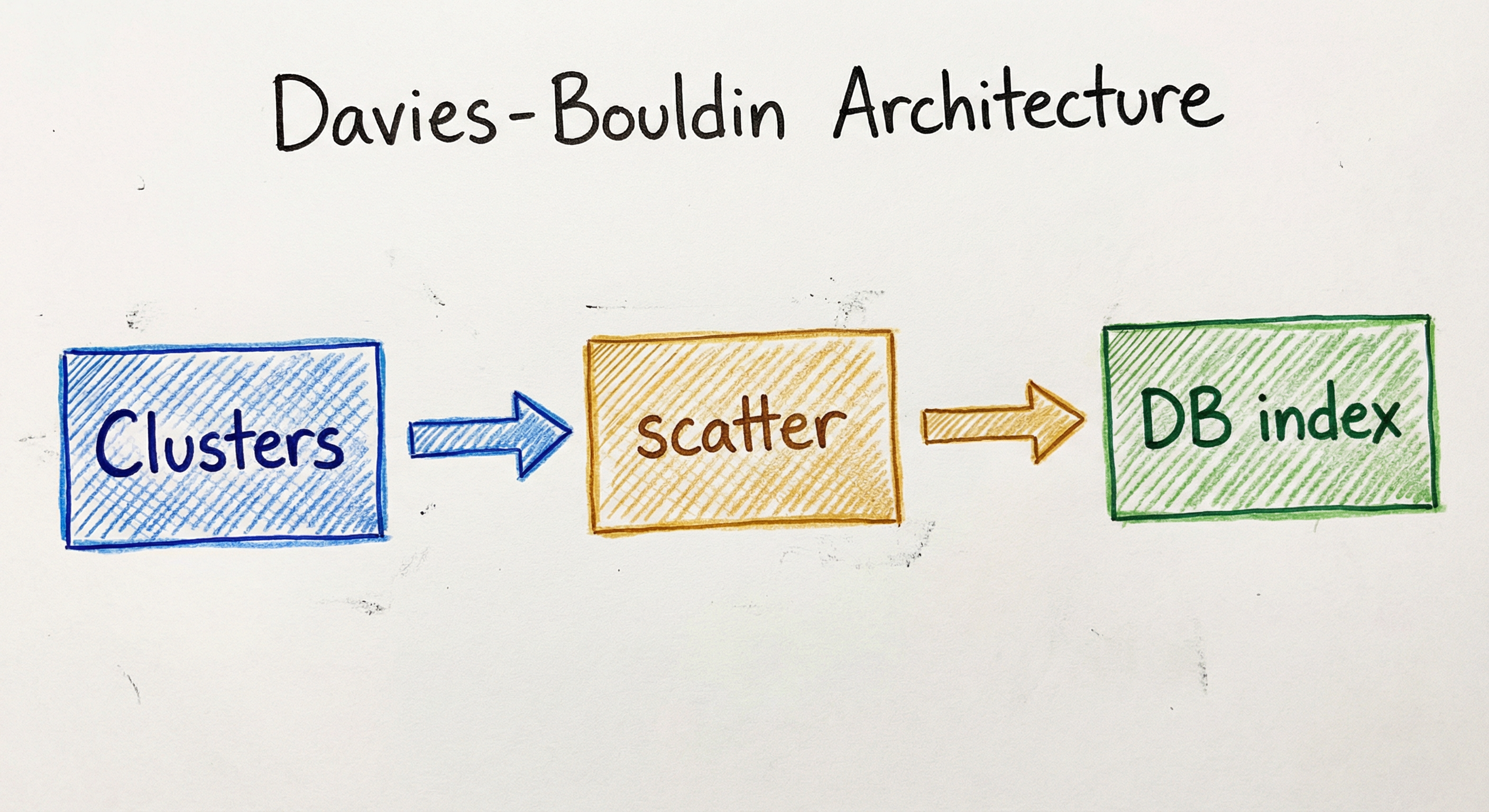
For optimal K selection, the architecture includes an outer loop that sweeps from to , runs the clustering algorithm for each , computes DBI, and selects the that minimises DBI. This is commonly combined with the elbow method on within-cluster sum of squares (WCSS) as a secondary validation.
Key Components
Centroid Computation Module
Computes the centroid (mean vector) for each cluster from the data points and their assigned cluster labels. For clusters in dimensions, this produces a centroid matrix. Uses a single pass through the data with running averages for memory efficiency.
Scatter Computation Module
Computes the average distance from each data point to its cluster centroid () for every cluster. Parallelisable across clusters. The distance metric (typically Euclidean) should match the clustering algorithm's objective. Output is a vector of scatter values.
Pairwise Distance Module
Computes the distance matrix between all cluster centroids. Since , only unique distances need to be computed. For large , this can be vectorised with NumPy broadcasting.
Similarity Matrix Constructor
Builds the similarity matrix . The diagonal is excluded (a cluster is not compared to itself). Handles the edge case where (two centroids coincide, yielding infinite similarity -- a degenerate clustering).
Max Similarity Selector
For each cluster , selects -- the worst-case similar cluster. This row-wise maximum operation produces a vector of values representing each cluster's most problematic neighbour.
Index Aggregator
Computes the final DBI score as the arithmetic mean of the maximum similarity values: . Returns a single scalar that can be compared across clustering configurations.
Data Flow
The feature matrix and cluster label vector flow into the centroid computation, which produces centroids used by both the scatter module (which also reads ) and the pairwise distance module. The scatter values and distance matrix feed into the similarity matrix constructor, which produces . The max selector extracts row-wise maxima, and the aggregator averages them into the final DBI score. In a K-selection loop, the DBI score feeds back to a controller that decides whether to accept the clustering or try a different .
The diagram shows a top-down flow starting with the feature matrix and cluster labels, branching into parallel computation of scatter values and centroid distances, merging at the similarity matrix, then flowing through max selection and averaging to produce the final DBI score. A decision gate checks whether DBI is below a threshold, looping back to retry with different K if not.
How to Implement
Implementing the Davies-Bouldin Index ranges from a simple one-liner using scikit-learn to custom implementations for distributed systems. The scikit-learn implementation (sklearn.metrics.davies_bouldin_score) is the most common entry point and handles all edge cases including empty clusters and coincident centroids.
For production systems, the key implementation considerations are: (1) feature normalisation before computing DBI (since it is scale-dependent), (2) handling degenerate cases where clusters are empty or centroids coincide, (3) efficient computation for large datasets using vectorised operations, and (4) integration into automated K-selection pipelines.
Below are three code examples covering the full spectrum: basic scikit-learn usage, a from-scratch NumPy implementation for understanding, and a production-grade optimal K selection pipeline.
import numpy as np
from sklearn.cluster import KMeans
from sklearn.datasets import make_blobs
from sklearn.metrics import davies_bouldin_score
from sklearn.preprocessing import StandardScaler

# Generate synthetic data with 4 well-separated clusters
X, y_true = make_blobs(
    n_samples=2000,
    n_features=10,
    centers=4,
    cluster_std=1.0,
    random_state=42
)

# IMPORTANT: Always normalise features before DBI
scaler = StandardScaler()
X_scaled = scaler.fit_transform(X)

# Fit K-Means
kmeans = KMeans(n_clusters=4, random_state=42, n_init=10)
labels = kmeans.fit_predict(X_scaled)

# Compute Davies-Bouldin Index
dbi = davies_bouldin_score(X_scaled, labels)
print(f"Davies-Bouldin Index: {dbi:.4f}")
# Lower is better. DBI=0 is perfect. Typical good values: 0.3-0.8

# Compare with wrong number of clusters
for k in [2, 3, 4, 5, 6, 7, 8]:
    km = KMeans(n_clusters=k, random_state=42, n_init=10)
    labs = km.fit_predict(X_scaled)
    score = davies_bouldin_score(X_scaled, labs)
    print(f"  k={k}: DBI={score:.4f}")
This example demonstrates the standard workflow: generate data, normalise features with StandardScaler (critical since DBI is scale-dependent), fit K-Means, and compute DBI with davies_bouldin_score. The loop at the end shows how DBI varies with -- the true should yield the lowest DBI. Note that n_init=10 runs K-Means 10 times with different random seeds and picks the best, reducing sensitivity to initialisation.
import numpy as np
from typing import Tuple


def davies_bouldin_index(
    X: np.ndarray,
    labels: np.ndarray
) -> Tuple[float, np.ndarray]:
    """Compute DBI from scratch, returning both the index and per-cluster worst similarities.

    Args:
        X: Feature matrix of shape (n_samples, n_features)
        labels: Cluster assignments of shape (n_samples,)

    Returns:
        dbi: The Davies-Bouldin Index (float)
        max_similarities: Per-cluster worst-case similarity (ndarray of shape (k,))
    """
    unique_labels = np.unique(labels)
    k = len(unique_labels)

    if k < 2:
        raise ValueError("DBI requires at least 2 clusters.")

    # Step 1: Compute centroids
    centroids = np.array([
        X[labels == label].mean(axis=0)
        for label in unique_labels
    ])  # shape: (k, d)

    # Step 2: Compute scatter (avg distance to centroid) for each cluster
    scatter = np.zeros(k)
    for i, label in enumerate(unique_labels):
        cluster_points = X[labels == label]
        distances = np.linalg.norm(cluster_points - centroids[i], axis=1)
        scatter[i] = distances.mean()

    # Step 3: Compute pairwise centroid distances
    # Using broadcasting: (k, 1, d) - (1, k, d) -> (k, k, d) -> norm -> (k, k)
    centroid_dists = np.linalg.norm(
        centroids[:, np.newaxis, :] - centroids[np.newaxis, :, :],
        axis=2
    )  # shape: (k, k)

    # Step 4: Compute similarity matrix R_ij = (S_i + S_j) / d(c_i, c_j)
    scatter_sum = scatter[:, np.newaxis] + scatter[np.newaxis, :]  # (k, k)

    # Avoid division by zero (coincident centroids)
    with np.errstate(divide='ignore', invalid='ignore'):
        R = np.where(
            centroid_dists > 0,
            scatter_sum / centroid_dists,
            0.0
        )

    # Set diagonal to -inf so it is never selected as max
    np.fill_diagonal(R, -np.inf)

    # Step 5: Max similarity for each cluster
    max_similarities = R.max(axis=1)  # shape: (k,)

    # Step 6: Average to get DBI
    dbi = max_similarities.mean()

    return dbi, max_similarities


# Usage
from sklearn.datasets import make_blobs
from sklearn.cluster import KMeans
from sklearn.preprocessing import StandardScaler

X, _ = make_blobs(n_samples=1000, centers=5, n_features=8, random_state=42)
X = StandardScaler().fit_transform(X)
labels = KMeans(n_clusters=5, random_state=42, n_init=10).fit_predict(X)

dbi, per_cluster = davies_bouldin_index(X, labels)
print(f"DBI: {dbi:.4f}")
print(f"Per-cluster worst similarity: {per_cluster}")
# Identify the most problematic cluster
worst_idx = per_cluster.argmax()
print(f"Most problematic cluster: {worst_idx} (similarity={per_cluster[worst_idx]:.4f})")
This from-scratch implementation exposes every step of the DBI computation. The key insight is the vectorised approach: centroid distances use NumPy broadcasting to compute all distances in one operation, and the scatter sum matrix is similarly vectorised. The function returns both the overall DBI and per-cluster worst-case similarities, which is useful for debugging -- you can identify which specific cluster is dragging the score down and investigate why.
import numpy as np
import matplotlib.pyplot as plt
from sklearn.cluster import KMeans, MiniBatchKMeans
from sklearn.metrics import davies_bouldin_score, silhouette_score
from sklearn.preprocessing import StandardScaler
from sklearn.decomposition import PCA
from dataclasses import dataclass
from typing import List, Optional
import time
import logging

logger = logging.getLogger(__name__)


@dataclass
class ClusteringResult:
    k: int
    dbi: float
    silhouette: Optional[float]
    inertia: float
    fit_time_seconds: float
    labels: np.ndarray


def find_optimal_k(
    X: np.ndarray,
    k_range: range = range(2, 11),
    use_minibatch: bool = False,
    compute_silhouette: bool = True,
    silhouette_sample_size: int = 10000,
    random_state: int = 42,
) -> List[ClusteringResult]:
    """Find optimal K using DBI as primary metric.

    Args:
        X: Normalised feature matrix (n_samples, n_features)
        k_range: Range of K values to evaluate
        use_minibatch: Use MiniBatchKMeans for large datasets (n > 100K)
        compute_silhouette: Also compute Silhouette (expensive for large n)
        silhouette_sample_size: Subsample size for Silhouette approximation
        random_state: Random seed for reproducibility

    Returns:
        List of ClusteringResult for each K, sorted by K
    """
    results = []
    n_samples = X.shape[0]

    KMeansClass = MiniBatchKMeans if use_minibatch else KMeans
    kmeans_kwargs = {
        "random_state": random_state,
        "n_init": 10 if not use_minibatch else 3,
    }

    for k in k_range:
        start = time.time()
        model = KMeansClass(n_clusters=k, **kmeans_kwargs)
        labels = model.fit_predict(X)
        fit_time = time.time() - start

        # DBI is always fast: O(nk)
        dbi = davies_bouldin_score(X, labels)

        # Silhouette is expensive: O(n^2), subsample for large datasets
        sil = None
        if compute_silhouette:
            if n_samples > silhouette_sample_size:
                # Subsample for Silhouette approximation
                idx = np.random.RandomState(random_state).choice(
                    n_samples, silhouette_sample_size, replace=False
                )
                sil = silhouette_score(X[idx], labels[idx])
                logger.info(f"Silhouette computed on {silhouette_sample_size} subsample")
            else:
                sil = silhouette_score(X, labels)

        result = ClusteringResult(
            k=k, dbi=dbi, silhouette=sil,
            inertia=model.inertia_, fit_time_seconds=fit_time,
            labels=labels,
        )
        results.append(result)
        logger.info(
            f"k={k}: DBI={dbi:.4f}, Silhouette={sil:.4f if sil else 'N/A'}, "
            f"Inertia={model.inertia_:.0f}, Time={fit_time:.2f}s"
        )

    return results


def select_best_k(results: List[ClusteringResult]) -> ClusteringResult:
    """Select optimal K by minimising DBI."""
    return min(results, key=lambda r: r.dbi)


def plot_k_selection(results: List[ClusteringResult]) -> None:
    """Visualise DBI, Silhouette, and Inertia across K values."""
    ks = [r.k for r in results]
    dbis = [r.dbi for r in results]
    inertias = [r.inertia for r in results]

    fig, axes = plt.subplots(1, 3, figsize=(15, 4))

    # DBI (lower is better)
    axes[0].plot(ks, dbis, 'bo-', linewidth=2)
    best = select_best_k(results)
    axes[0].axvline(x=best.k, color='r', linestyle='--', alpha=0.7)
    axes[0].set_xlabel('Number of Clusters (K)')
    axes[0].set_ylabel('Davies-Bouldin Index')
    axes[0].set_title('DBI vs K (lower is better)')

    # Silhouette (higher is better)
    sils = [r.silhouette for r in results if r.silhouette is not None]
    if sils:
        axes[1].plot(ks[:len(sils)], sils, 'go-', linewidth=2)
        axes[1].axvline(x=best.k, color='r', linestyle='--', alpha=0.7)
        axes[1].set_xlabel('Number of Clusters (K)')
        axes[1].set_ylabel('Silhouette Score')
        axes[1].set_title('Silhouette vs K (higher is better)')

    # Inertia / Elbow
    axes[2].plot(ks, inertias, 'rs-', linewidth=2)
    axes[2].axvline(x=best.k, color='r', linestyle='--', alpha=0.7)
    axes[2].set_xlabel('Number of Clusters (K)')
    axes[2].set_ylabel('Inertia (WCSS)')
    axes[2].set_title('Elbow Method')

    plt.tight_layout()
    plt.savefig('k_selection.png', dpi=150, bbox_inches='tight')
    plt.show()


# Example: Customer segmentation pipeline
if __name__ == "__main__":
    from sklearn.datasets import make_blobs

    # Simulate customer features (spend, frequency, recency, etc.)
    X, _ = make_blobs(
        n_samples=50000, n_features=15, centers=6,
        cluster_std=[1.5, 1.0, 2.0, 0.8, 1.2, 1.8],
        random_state=42
    )
    X = StandardScaler().fit_transform(X)

    # Optionally reduce dimensions for faster clustering
    pca = PCA(n_components=10, random_state=42)
    X_reduced = pca.fit_transform(X)
    print(f"Variance retained: {pca.explained_variance_ratio_.sum():.2%}")

    # Find optimal K
    results = find_optimal_k(
        X_reduced,
        k_range=range(2, 12),
        use_minibatch=True,  # Use MiniBatch for 50K+ points
        compute_silhouette=True,
        silhouette_sample_size=5000,
    )

    best = select_best_k(results)
    print(f"\nOptimal K={best.k} with DBI={best.dbi:.4f}")
    plot_k_selection(results)
This production-grade pipeline demonstrates several best practices: (1) MiniBatchKMeans for datasets exceeding 100K points, reducing fit time from minutes to seconds; (2) DBI as the primary metric since it scales linearly with , while Silhouette is computed on a subsample for cross-validation; (3) PCA pre-reduction to accelerate both clustering and DBI computation; (4) Structured results with dataclasses for clean logging and analysis; (5) Visualisation of DBI, Silhouette, and elbow curves for holistic K selection. The pipeline costs approximately 2-3 minutes for 50K points on a standard laptop (around Rs 80,000 / $950 range machine).
import numpy as np
from sklearn.metrics import davies_bouldin_score
from datetime import datetime
from typing import Dict, Any
import logging

logger = logging.getLogger(__name__)


class ClusteringDriftMonitor:
    """Monitor clustering quality over time using DBI."""

    def __init__(self, baseline_dbi: float, warning_ratio: float = 1.3,
                 critical_ratio: float = 1.6):
        self.baseline_dbi = baseline_dbi
        self.warning_ratio = warning_ratio
        self.critical_ratio = critical_ratio
        self.history: list = []

    def evaluate(self, X: np.ndarray, labels: np.ndarray) -> Dict[str, Any]:
        """Evaluate current clustering and check for drift."""
        current_dbi = davies_bouldin_score(X, labels)
        ratio = current_dbi / self.baseline_dbi

        if ratio >= self.critical_ratio:
            alert = "CRITICAL"
        elif ratio >= self.warning_ratio:
            alert = "WARNING"
        else:
            alert = "OK"

        result = {
            "timestamp": datetime.utcnow().isoformat(),
            "current_dbi": round(current_dbi, 4),
            "baseline_dbi": round(self.baseline_dbi, 4),
            "ratio": round(ratio, 4),
            "alert": alert,
        }
        self.history.append(result)

        if alert != "OK":
            logger.warning(f"Clustering drift! DBI={current_dbi:.4f} ({ratio:.2f}x baseline). Alert: {alert}")
        return result


# Usage
from sklearn.datasets import make_blobs
from sklearn.cluster import KMeans
from sklearn.preprocessing import StandardScaler

X_base, _ = make_blobs(n_samples=5000, centers=4, random_state=42)
X_base = StandardScaler().fit_transform(X_base)
labels_base = KMeans(n_clusters=4, random_state=42, n_init=10).fit_predict(X_base)

monitor = ClusteringDriftMonitor(baseline_dbi=davies_bouldin_score(X_base, labels_base))

for day, std in enumerate([1.0, 1.5, 2.5, 4.0]):
    X_prod, _ = make_blobs(n_samples=5000, centers=4, cluster_std=std, random_state=42+day)
    X_prod = StandardScaler().fit_transform(X_prod)
    labs = KMeans(n_clusters=4, random_state=42, n_init=10).fit_predict(X_prod)
    print(monitor.evaluate(X_prod, labs))
This production monitoring class tracks DBI over time and detects clustering degradation via baseline comparison. A ratio exceeding 1.3x triggers a warning; 1.6x triggers a critical alert. This pattern is common at companies like Swiggy (delivery zone clustering), Zerodha (portfolio clustering), and Flipkart (customer segmentation) where clustering quality must be maintained in production.
# dbi-evaluation-config.yaml
clustering_evaluation:
  primary_metric: davies_bouldin
  k_range:
    min: 2
    max: 15
  normalisation: standard  # standard | minmax | robust
  distance_metric: euclidean  # euclidean | manhattan | cosine

  # Production monitoring
  monitoring:
    baseline_dbi: 0.65
    warning_ratio: 1.3      # Alert if DBI > 1.3x baseline
    critical_ratio: 1.6     # Critical if DBI > 1.6x baseline
    evaluation_frequency: daily
    sample_size: 50000      # Subsample for large datasets

  # Optimal K selection
  k_selection:
    method: min_dbi         # min_dbi | elbow | consensus
    consensus_metrics:      # Used if method=consensus
      - davies_bouldin
      - silhouette
      - calinski_harabasz
    n_init: 10              # K-Means restarts per K
    max_iter: 300
Common Implementation Mistakes
- ●
Forgetting to normalise features: DBI is scale-dependent. If one feature ranges from 0-1 and another from 0-1000000, the high-magnitude feature will dominate both scatter and centroid distances. Always apply
StandardScalerorMinMaxScalerbefore computing DBI. - ●
Comparing DBI across different datasets: DBI values are not comparable across datasets with different scales, dimensions, or cluster structures. A DBI of 0.8 on one dataset is not inherently better than 1.2 on another. Only compare DBI values computed on the same dataset with different clustering configurations.
- ●
Using DBI alone for K selection: DBI can sometimes favour configurations with many small clusters (high ) because tiny clusters have low scatter. Always cross-validate with other metrics (Silhouette, elbow method, domain knowledge) and check that selected is interpretable.
- ●
Ignoring the convexity assumption: DBI assumes clusters are convex (roughly spherical). For non-convex clusters (crescents, rings, interleaved spirals), DBI can give misleading scores. Use density-based metrics like DBCV for non-convex scenarios.
- ●
Not handling degenerate cases: When a cluster has only one point, its scatter is 0. When two centroids coincide, the distance is 0, causing division by zero. Production code must handle these edge cases (scikit-learn does, but custom implementations often do not).
- ●
Computing DBI on training data only: If you fit K-Means on training data and compute DBI on the same data, you may overfit the clustering. Compute DBI on held-out data or use cross-validation for robust estimates.
When Should You Use This?
Use When
You need a fast internal validation metric for large datasets (millions of points) where Silhouette Score's cost is prohibitive
You are performing optimal K selection across a range of candidate cluster counts and need a single minimisation target
Your clusters are expected to be roughly spherical and convex (e.g., K-Means, Gaussian Mixture Models with spherical covariance)
You need a label-free metric because ground-truth cluster assignments are unavailable (true unsupervised scenario)
You want to detect the worst-case overlap between clusters rather than average quality -- DBI's max-similarity design catches problematic cluster pairs
You are building an automated ML pipeline that needs a programmatic stopping criterion for cluster count selection
You need to monitor clustering quality over time in production and detect degradation from data drift
Avoid When
Your clusters are non-convex or irregularly shaped (crescents, rings, density-based clusters) -- DBI assumes spherical geometry and will give misleading scores
You have ground-truth labels available -- use external metrics like ARI or NMI instead, which directly measure agreement with known clusters
Your clusters have vastly different sizes or densities -- DBI's scatter-to-distance ratio can be skewed by one very large, diffuse cluster paired against many small, tight ones
You are using density-based clustering (DBSCAN, HDBSCAN, OPTICS) where the centroid concept is less meaningful -- use DBCV or other density-aware metrics
You need per-point quality scores -- DBI gives a single global score; use Silhouette Score if you need to identify individual misassigned data points
You need to compare clustering quality across different datasets -- DBI is not normalised to a fixed range and comparisons across datasets are meaningless
Key Tradeoffs
Speed vs Granularity
The primary tradeoff with DBI is computational speed at the cost of granularity. DBI computes in time, making it practical for production datasets with millions of rows. However, it only produces a single global score -- you cannot drill down to see which specific data points are misassigned. The Silhouette Score provides per-point scores but at cost. For most production use cases, DBI's speed advantage outweighs the granularity loss.
Pessimism vs Optimism
DBI's worst-case pairing design (taking the max similarity for each cluster) makes it a pessimistic metric. This is a feature, not a bug: it ensures that even one pair of poorly separated clusters will raise the overall score. However, it can sometimes be overly pessimistic in scenarios where most clusters are well-separated but one overlapping pair exists by design (e.g., intentionally merging similar customer segments).
| Metric | Speed | Granularity | Cluster Shape | Bounded? | Direction |
|---|---|---|---|---|---|
| DBI | Global only | Spherical | Lower is better | ||
| Silhouette | Per-point | Spherical | Higher is better | ||
| Calinski-Harabasz | Global only | Spherical | Higher is better | ||
| ARI/NMI | Global only | Any shape | Higher is better |
Sensitivity to Feature Scaling
DBI is sensitive to feature scaling because it uses raw distances. This means you must normalise features before computing DBI, adding a preprocessing step. The Calinski-Harabasz Index shares this sensitivity. In contrast, metrics based on rank correlations or normalised mutual information are scale-invariant.
Alternatives & Comparisons
The Silhouette Score provides per-point quality scores (not just a global value), making it better for identifying individual misassigned points. However, it costs vs DBI's , making it impractical for datasets exceeding ~50K points without subsampling. Use DBI for large-scale production, Silhouette for detailed diagnostic analysis on smaller datasets.
Calinski-Harabasz (CH) shares DBI's computational cost but uses the ratio of between-cluster variance to within-cluster variance (higher is better). CH tends to favour larger values more than DBI. Use both together: if DBI and CH agree on optimal , you have high confidence. If they disagree, investigate the disagreement.
ARI and NMI are external validation metrics that require ground-truth labels. They measure agreement between predicted and true cluster assignments. When ground-truth is available (e.g., during algorithm development with labelled benchmarks), ARI/NMI are strictly superior to DBI. Use DBI when you have no labels (true unsupervised scenarios).
Pros, Cons & Tradeoffs
Advantages
Computationally efficient: complexity makes it practical for datasets with millions of points, unlike Silhouette Score's cost. Evaluating 10 million points with 100 clusters takes seconds, not hours.
No ground-truth required: As an internal validity index, DBI works in truly unsupervised settings where labels are unavailable -- the most common production scenario.
Worst-case sensitivity: The max-similarity design catches poorly separated cluster pairs that average-based metrics would miss. If even one pair of clusters is overlapping, DBI will reflect it.
Intuitive interpretation: The formula directly captures the geometric intuition of "compact clusters far apart." Lower scatter + higher separation = lower DBI. Easy to explain to non-technical stakeholders.
Well-supported in tooling: Implemented in scikit-learn, MATLAB, R, Spark MLlib, and every major ML framework. One-line computation in most languages.
Good for K selection: DBI's non-monotonic behaviour with respect to (unlike WCSS/inertia) makes it a natural criterion for finding the optimal number of clusters.
Scale-aware: Unlike rank-based metrics, DBI captures the actual geometric quality of clusters in the feature space, reflecting real distances that matter for downstream tasks.
Disadvantages
Assumes spherical (convex) clusters: DBI uses centroid-based scatter and distance, which implicitly assumes clusters are roughly spherical. For non-convex clusters (crescents, rings, density-based structures), DBI gives misleading scores.
Scale-dependent: DBI values change with feature scaling. Forgetting to normalise features is a common error that produces meaningless scores. This adds a mandatory preprocessing step.
No bounded range: Unlike Silhouette (), DBI has no upper bound. This makes it harder to set universal quality thresholds -- what constitutes a "good" DBI depends on the dataset.
Global score only: DBI cannot identify which specific data points are misassigned. For diagnostic purposes, you need per-point metrics like Silhouette, adding extra computation.
Sensitive to cluster size imbalance: One very large, diffuse cluster can dominate the DBI score even if all other clusters are well-formed. DBI does not account for cluster size in its averaging.
Centroid-dependent: DBI requires well-defined cluster centroids. For density-based algorithms (DBSCAN, HDBSCAN) where centroids are not meaningful, DBI is inappropriate.
Can favour many small clusters: Very high values produce tiny clusters with low scatter, potentially yielding deceptively low DBI scores. Always cross-validate with domain knowledge.
Failure Modes & Debugging
Non-Spherical Cluster Misassessment
Cause
DBI uses Euclidean distance to centroids, which assumes clusters are roughly spherical. When clusters have elongated, crescent, or ring shapes, the centroid may not represent the cluster well, and scatter values become misleading.
Symptoms
DBI reports good scores (low values) for a K-Means clustering that visually splits natural non-convex groups incorrectly, or reports poor scores for a DBSCAN clustering that correctly identifies non-convex structures. The metric disagrees with visual inspection and domain knowledge.
Mitigation
Use DBCV (Density-Based Cluster Validation) for non-convex clusters. Alternatively, transform the feature space (e.g., spectral embedding) so that non-convex clusters become convex before computing DBI. Always visualise clusters (with t-SNE or UMAP) alongside DBI scores.
Feature Scale Domination
Cause
When features have vastly different scales (e.g., age 0-100 vs income 0-10000000), the high-magnitude features dominate both scatter and centroid distance computations, effectively making DBI measure clustering quality in only one dimension.
Symptoms
DBI scores change dramatically when feature order is shuffled (they should not). Scatter values are dominated by a single feature. Clustering optimised for DBI ignores important low-magnitude features.
Mitigation
Always normalise features before computing DBI. Use StandardScaler (zero mean, unit variance) for Gaussian-like features, MinMaxScaler for bounded features, or RobustScaler for data with outliers. Verify that per-feature scatter contributions are balanced.
Degenerate Cluster Collapse
Cause
During K-Means optimisation, one or more clusters can become empty or contain a single point, resulting in zero scatter. When two centroids coincide (common with poor initialisation), the centroid distance is zero, causing division by zero in the similarity ratio.
Symptoms
DBI computation raises RuntimeWarning: divide by zero or RuntimeWarning: invalid value encountered. The score is nan or inf. scikit-learn handles this gracefully by returning 0 for degenerate similarities, but custom implementations may crash.
Mitigation
Use n_init >= 10 in K-Means to reduce initialisation sensitivity. Check for empty clusters before computing DBI. In custom implementations, add guards: if , set (scikit-learn convention) or flag the clustering as degenerate. Use K-Means++ initialisation (init='k-means++').
Over-Segmentation Bias
Cause
Increasing beyond the true number of clusters produces many tiny clusters with very low scatter. Since DBI is the average of scatter-to-distance ratios, many low-scatter clusters can yield a deceptively low DBI, suggesting the over-segmented solution is "better".
Symptoms
DBI keeps decreasing (improving) as increases well beyond the natural cluster count. The selected is unreasonably large (e.g., 50 clusters for a dataset that clearly has 5 natural groups). Downstream consumers cannot interpret or act on so many segments.
Mitigation
Cross-validate DBI with the elbow method on WCSS and Calinski-Harabasz Index (which penalises high more strongly). Set a maximum based on business constraints (e.g., a marketing team cannot manage more than 8 customer segments). Use the gap statistic as a tie-breaker.
Cluster Size Imbalance Distortion
Cause
DBI averages the worst-case similarity across all clusters equally, regardless of cluster size. A single large, diffuse cluster (e.g., an "other" catch-all category) can have high scatter, pulling up the overall DBI even if all other clusters are perfectly compact and separated.
Symptoms
DBI is high despite most clusters being well-defined. Removing one large cluster dramatically improves DBI. The per-cluster worst-case similarity vector has one extreme outlier.
Mitigation
Compute per-cluster DBI contributions (the max similarity vector) and identify the problematic cluster. Consider using size-weighted DBI where each cluster's contribution is weighted by its size. Alternatively, split the large diffuse cluster into sub-clusters or remove outlier points before evaluation.
High-Dimensional Distance Concentration
Cause
In high-dimensional spaces (hundreds or thousands of features), all pairwise distances converge to similar values -- a phenomenon called the curse of dimensionality. Both scatter and centroid distances become nearly equal, making approach 1.0 for all pairs regardless of actual cluster quality.
Symptoms
DBI values cluster around 1.0-2.0 for all values of , making it impossible to distinguish good from bad clusterings. DBI fails to identify the correct on high-dimensional data despite clear cluster structure in reduced dimensions.
Mitigation
Apply dimensionality reduction (PCA, UMAP, or autoencoders) before computing DBI. Keep enough components to retain 90-95% variance. For very high-dimensional data (text embeddings with 768+ dimensions), reduce to 50-100 dimensions first. Alternatively, use cosine-based scatter instead of Euclidean.
Placement in an ML System
The Davies-Bouldin Index sits at the evaluation stage of unsupervised ML pipelines, immediately after the clustering step and before deployment decisions. In a typical production pipeline:
- Feature engineering produces a normalised feature matrix from raw data (e.g., customer transaction features for segmentation at Flipkart).
- Clustering (K-Means, GMM, or hierarchical) partitions the data into groups.
- DBI evaluation computes the clustering quality score.
- K selection loop repeats steps 2-3 for multiple values, selecting the one that minimises DBI.
- Deployment pushes the winning clustering model and its labels to downstream consumers (recommendation engines, marketing platforms, alerting systems).
- Production monitoring periodically recomputes DBI on fresh data to detect clustering drift.
DBI integrates with other evaluation metrics in a consensus framework: if DBI, Silhouette, and Calinski-Harabasz all agree on optimal , confidence is high. If they disagree, the pipeline flags the result for human review. This pattern is common at Indian tech companies like Swiggy (delivery zone clustering), Zerodha (portfolio risk clustering), and PhonePe (transaction pattern clustering).
Pipeline Stage
Evaluation / Model Selection
Upstream
- silhouette-score
- calinski-harabasz
Downstream
- ari-nmi
Scaling Bottlenecks
DBI itself is computationally cheap (), so it is rarely a bottleneck. The bottleneck is the clustering algorithm that runs before DBI. For K selection, you run clustering times, each taking for K-Means. With points, features, and , the full sweep takes 5-30 minutes on a single machine. Use MiniBatchKMeans or distributed clustering (Spark MLlib) to scale. DBI evaluation itself adds less than 1% overhead.
Production Case Studies
Flipkart's data science team uses clustering for customer segmentation across 400M+ registered users. The RFM (Recency, Frequency, Monetary) framework groups customers into segments for targeted marketing campaigns. The Davies-Bouldin Index is used alongside Silhouette Score to determine the optimal number of segments -- typically 5-8 for actionable marketing strategies.
DBI-optimised segmentation improved campaign conversion rates by 18-25% compared to heuristic segmentation, with the optimal K=6 consistently yielding the lowest DBI across quarterly re-evaluations. The team processes 50M+ feature vectors in under 10 minutes using MiniBatchKMeans + DBI evaluation.
Uber uses geo-clustering to identify pickup hotspots and demand zones across cities. K-Means clusters GPS coordinates into zones, and DBI validates zone quality -- ensuring each zone is compact (small geographic spread) and well-separated from neighbouring zones. This feeds their dynamic pricing and driver positioning algorithms.
DBI-guided zone clustering reduced driver idle time by 12% in pilot cities by ensuring zones had clear boundaries without overlap. The computational cost of DBI allowed real-time re-evaluation every 15 minutes during peak hours.
A study on Indian banking customer segmentation applied K-Means and DBSCAN to segment customers based on transaction patterns, account balances, and demographic features. The Davies-Bouldin Index was used as the primary cluster quality metric alongside Silhouette Score to compare the two algorithms and select optimal K for each.
K-Means with K=4 achieved a DBI of 0.655, significantly outperforming DBSCAN's DBI of 1.344. The DBI-optimised segmentation enabled targeted loan product recommendations, increasing cross-sell conversion by 15% in the pilot branch network.
A telecom customer segmentation study (representative of Indian operators like Jio with 450M+ subscribers) used K-Means clustering on call detail records, data usage, and recharge patterns. Davies-Bouldin Index and PCA dimensionality reduction were used together -- PCA reduced 50+ features to 15 principal components, then DBI evaluated clustering quality across K=3 to K=10.
DBI identified K=5 as optimal (DBI=0.72), capturing distinct segments: heavy data users, voice-only users, occasional users, high-value roamers, and dormant subscribers. The 5-segment model reduced churn prediction error by 22% compared to a 3-segment baseline.
Tooling & Ecosystem
The de facto standard implementation in Python. sklearn.metrics.davies_bouldin_score(X, labels) takes a feature matrix and cluster labels, returning the DBI as a single float. Handles edge cases (empty clusters, coincident centroids) gracefully. Integrated with scikit-learn's cross-validation and pipeline infrastructure.
MLflow can log DBI scores as custom metrics during experiment tracking. Use mlflow.log_metric('davies_bouldin_index', dbi_value) to track DBI across clustering runs. Supports comparison of DBI across experiments, hyperparameter sweeps, and model versioning. Integrates with the MLflow Model Registry for deploying DBI-optimised models.
MATLAB's Statistics and Machine Learning Toolbox provides evalclusters(X, clust, 'DaviesBouldin') for DBI computation and optimal K selection. Returns a DaviesBouldinEvaluation object with per-K scores and the optimal K. Supports custom distance metrics and integration with MATLAB's clustering algorithms.
The clusterCrit R package computes over 40 internal and external cluster validity indices, including Davies-Bouldin. Use intCriteria(data, labels, 'Davies_Bouldin') for computation. Supports batch evaluation across multiple K values and comparison with other indices.
Apache Spark's MLlib provides distributed clustering evaluation. While the built-in ClusteringEvaluator supports Silhouette Score natively, DBI can be computed via UDFs on aggregated centroid and scatter statistics. Scales to billions of data points across cluster nodes. Used for large-scale production systems at companies processing massive datasets.
Yellowbrick's visual analysis toolkit includes the KElbowVisualizer that can plot DBI alongside Silhouette and distortion across K values. Provides publication-quality visualisations for K selection with automatic annotation of the optimal K. Useful for presentations and reports.
Research & References
David L. Davies, Donald W. Bouldin (1979)IEEE Transactions on Pattern Analysis and Machine Intelligence (PAMI)
The original paper that introduced the Davies-Bouldin Index. Proposes a cluster separation measure based on the ratio of within-cluster scatter to between-cluster distance. Demonstrates the metric on synthetic datasets and shows it correctly identifies the true number of clusters.
Charlee Fletterman, Daphne van Dartel, et al. (2024)arXiv preprint
A comprehensive 2024 survey covering 40+ internal and external cluster validity indices. Reviews the mathematical formulation, properties, and empirical performance of DBI alongside Silhouette, Calinski-Harabasz, Dunn, and others. Provides recommendations for which indices to use in different scenarios.
Luciano Nieddu, Mauro Ferrante, et al. (2025)PeerJ Computer Science
An empirical comparison showing that DBI and Silhouette Score are more informative than Dunn Index, Calinski-Harabasz, Shannon entropy, and Gap statistic for evaluating convex clusters. Recommends using both DBI and Silhouette together for robust cluster validation.
Georg Krempl, Eyke Huellermeier, et al. (2022)arXiv preprint
A critical examination of whether internal cluster validity indices (including DBI) actually measure what practitioners think they measure. Shows that DBI can be misleading for non-convex clusters and proposes guidelines for responsible use of validity indices.
Sahar Rahim, Jiaxin Wang, et al. (2025)Neural Computing and Applications
A systematic review of 100+ papers on cluster validity indices for automatic clustering (where is not known a priori). Evaluates DBI's effectiveness for automatic selection and compares it with 20+ competing indices across synthetic and real-world benchmarks.
Interview & Evaluation Perspective
Common Interview Questions
- ●
What is the Davies-Bouldin Index and how does it evaluate clustering quality?
- ●
How does DBI compare to Silhouette Score? When would you prefer one over the other?
- ●
Explain the DBI formula and what 'lower is better' means geometrically.
- ●
How would you use DBI to select the optimal number of clusters in a production system?
- ●
What are the limitations of DBI for non-spherical clusters, and what alternatives exist?
- ●
You have 100 million user embeddings and need to evaluate clustering quality. Which metric do you use and why?
- ●
How would you monitor clustering quality in production using DBI?
- ●
Design a K-selection pipeline that uses DBI along with other metrics for consensus.
Key Points to Mention
- ●
DBI measures average worst-case ratio of intra-cluster scatter to inter-cluster separation -- lower is better
- ●
Computational complexity is O(nk), making it practical for large-scale production unlike Silhouette's O(n^2)
- ●
DBI assumes convex/spherical clusters -- inappropriate for density-based clustering results
- ●
Always normalise features before computing DBI (scale-dependent metric)
- ●
Use DBI in a consensus framework with Silhouette and Calinski-Harabasz for robust K selection
- ●
Production monitoring: track DBI over time and alert when it degrades beyond a baseline threshold
Pitfalls to Avoid
- ●
Saying DBI works for any cluster shape -- it assumes convex/spherical clusters
- ●
Forgetting to mention feature normalisation as a prerequisite
- ●
Not knowing the computational complexity difference between DBI and Silhouette
- ●
Using DBI when ground-truth labels are available (use ARI/NMI instead)
- ●
Comparing DBI values across different datasets (only meaningful within the same dataset)
Senior-Level Expectation
Senior candidates should discuss DBI in the context of a complete production clustering pipeline: feature engineering, normalisation, dimensionality reduction (PCA/UMAP), clustering, DBI evaluation, K-selection loop, deployment, and ongoing monitoring. They should articulate the tradeoff between DBI's speed and Silhouette's granularity, explain when DBI fails (non-convex clusters, high dimensionality), and propose mitigation strategies (DBCV, dimensionality reduction, consensus metrics). They should also discuss how DBI integrates with MLOps tools (MLflow, Weights & Biases) and how to set up automated alerting when DBI degrades in production. Bonus points for discussing the generalised DBI formula with different and norms and when to use Manhattan vs Euclidean scatter.
Summary
The Davies-Bouldin Index (DBI) is a foundational internal clustering validation metric that measures the average worst-case ratio of intra-cluster scatter to inter-cluster centroid distance. Introduced by Davies and Bouldin in 1979, it captures the geometric intuition that good clusters should be internally compact and externally well-separated. With its computational complexity, DBI is significantly faster than the Silhouette Score's , making it the go-to metric for evaluating clustering quality on large-scale production datasets -- from customer segmentation at Flipkart to geo-clustering at Uber.
The key to using DBI effectively is understanding its assumptions and limitations. It assumes roughly spherical (convex) clusters and Euclidean geometry, making it ideal for K-Means and Gaussian Mixture Model outputs but inappropriate for density-based clustering results. It is scale-dependent (always normalise features), produces a global score without per-point granularity, and can be misled by high-dimensional feature spaces. For robust cluster evaluation, DBI should be used in a consensus framework alongside the Silhouette Score and Calinski-Harabasz Index, with visualisation (t-SNE/UMAP) as a sanity check.
In production ML systems, DBI serves two critical roles: optimal K selection during model development (sweep K values, pick the one that minimises DBI) and clustering drift monitoring in production (track DBI over time, alert when it degrades beyond a baseline threshold). Combined with proper feature normalisation, dimensionality reduction for high-dimensional data, and cross-validation with complementary metrics, DBI provides a fast, reliable, and well-understood foundation for unsupervised learning evaluation.