Answer Relevance in Machine Learning
Here's a problem that trips up even sophisticated RAG systems: your retrieval is perfect, your context is pristine, the LLM generates a factually accurate response — but the answer completely ignores what the user actually asked.
Answer relevance is the metric that catches this failure mode. It measures whether the generated response actually addresses the user's query, irrespective of factual correctness or grounding in retrieved context. In production RAG systems — from Swiggy's customer support chatbots to PhonePe's financial Q&A — answer relevance is the difference between a helpful response and a technically correct but utterly useless one.
The core insight: relevance and faithfulness are orthogonal dimensions. An answer can be 100% grounded in retrieved context (high faithfulness) yet answer the wrong question entirely (low relevance). Conversely, an answer can perfectly address the user's intent but contain hallucinated details. You need both metrics to assess answer quality comprehensively.
Modern answer relevance evaluation uses techniques from reverse question generation (RAGAS), semantic similarity (BERTScore, SAS), and LLM-as-judge frameworks to quantify how well the response aligns with query intent — without requiring expensive human-labeled ground truth.
Concept Snapshot
- What It Is
- A reference-free evaluation metric that quantifies whether a generated answer actually addresses the question asked, measured through techniques like reverse question generation, semantic similarity scoring, or LLM-based judgment.
- Category
- Evaluation
- Complexity
- Intermediate
- Inputs / Outputs
- Inputs: the user's original query and the generated answer. Outputs: a relevance score (typically 0-1) indicating how well the answer addresses the question, often with diagnostic feedback on completeness and redundancy.
- System Placement
- Sits in the evaluation layer of RAG systems, after answer generation and alongside other metrics like faithfulness, context relevance, and groundedness. Runs during both offline evaluation and production monitoring.
- Also Known As
- response relevance, answer relevancy, query-answer relevance, answer appropriateness, response alignment
- Typical Users
- ML engineers, LLM application developers, RAG system architects, QA engineers, MLOps teams, Product managers
- Prerequisites
- RAG system architecture, LLM evaluation concepts, Embedding models and semantic similarity, Basic NLP metrics, Question-answering systems
- Key Terms
- RAGASreverse question generationsemantic similarityLLM-as-judgeBERTScorecosine similarityanswer completenessredundancy detectionfaithfulness vs relevancereference-free evaluation
Why This Concept Exists
The Problem: Technically Correct but Useless Answers
Imagine a user asks: "What are the tax benefits of investing in ELSS mutual funds?"
Your RAG system retrieves relevant documents about ELSS funds, and the LLM generates this response:
"ELSS stands for Equity Linked Savings Scheme. These are mutual funds that invest primarily in equity markets. ELSS funds have a mandatory lock-in period of three years, which is the shortest among all tax-saving instruments under Section 80C of the Income Tax Act."
Every single fact is correct. The answer is perfectly grounded in the retrieved context. By traditional faithfulness metrics, this scores near 100%.
But the user's question was about TAX BENEFITS — and the answer barely mentions them. This is the classic failure mode that answer relevance catches.
Why Traditional Metrics Miss This
Early RAG evaluation focused almost exclusively on factual correctness:
- Does the answer contain hallucinations? (Faithfulness)
- Is the answer grounded in retrieved context? (Groundedness)
- Did we retrieve the right documents? (Context relevance)
These are necessary conditions for a good RAG system — but they're not sufficient. You can satisfy all of them and still produce answers that miss the user's intent.
The Evolution of Answer Quality Metrics
The field evolved through several stages:
2018-2020: Lexical Overlap Era
Early QA systems used BLEU, ROUGE, and Exact Match — metrics that compare generated answers to reference answers via n-gram overlap. Problem? They require expensive human-labeled ground truth, and they fail when answers are phrased differently but semantically equivalent.
2021: Semantic Similarity Breakthrough
Risch et al. (EMNLP 2021) introduced Semantic Answer Similarity (SAS), a cross-encoder metric that measures meaning-level similarity between generated and reference answers using BERT-based models. SAS achieved 0.93 Pearson correlation with human judgment — dramatically outperforming BLEU (0.70) and ROUGE (0.78).
2023-Present: Reference-Free Evaluation
The real breakthrough came with reference-free metrics that don't need ground truth answers. The RAGAS framework (Es et al., 2023) introduced the reverse question generation approach: if an answer is truly relevant, you should be able to regenerate the original question from it. This technique requires only the query and answer — no labeled data.
Why Production Systems Need This
Swiggy's Customer Support: When a Dasher asks "Why was my delivery payment lower than expected?" the system must address payment discrepancies — not general earnings information.
PhonePe's Financial Q&A: When a user asks about UPI transaction limits, an answer about transaction security (however accurate) scores poorly on relevance.
Zerodha's Trading Bot: A query about margin requirements needs specific numbers — not a general explanation of margin trading.
In all these cases, answer relevance is the primary quality signal. Faithfulness ensures the answer doesn't hallucinate; relevance ensures it actually helps the user.
Core Intuition & Mental Model
The Geometric Mental Model
Think of answer relevance as measuring alignment in semantic space. The user's query represents an information need — a vector in meaning-space. The generated answer represents an information response — another vector.
Answer relevance quantifies: how closely does the response vector point in the same direction as the need vector?
When the vectors are nearly parallel (high cosine similarity), the answer addresses the query. When they're orthogonal, the answer is off-topic. When they point in opposite directions, the answer contradicts the query.
The Reverse Engineering Trick
Here's the brilliant insight from RAGAS: if an answer truly addresses a question, you should be able to reconstruct that question from the answer alone.
The algorithm:
- Take the generated answer
- Use an LLM to generate possible questions that this answer might address (typically )
- Compute the semantic similarity between each generated question and the original user query
- Average the similarity scores
Why does this work? Because irrelevant answers produce questions that don't match the original query.
Example:
- Query: "What are ELSS tax benefits?"
- Good answer: "ELSS investments qualify for Section 80C deduction up to ₹1.5 lakh annually..."
- Generated questions: "What tax deductions apply to ELSS?", "How much can I save on tax with ELSS?", "What is the 80C limit for ELSS?"
- Similarity: High (all generated questions closely match the original)
Versus:
- Poor answer: "ELSS has a 3-year lock-in period..."
- Generated questions: "What is the ELSS lock-in period?", "How long must I hold ELSS?", "Can I redeem ELSS early?"
- Similarity: Low (generated questions don't match the tax benefits query)
Completeness vs Redundancy
Answer relevance has two failure modes in opposite directions:
Incomplete answers (score low): They address only part of the query. If the user asks a multi-part question like "How do I reset my password and update my email?" but the answer only covers password reset — that's incomplete.
Redundant answers (also score low): They include information beyond what was asked. If the user asks "What's the UPI transaction limit?" and gets three paragraphs about UPI history, NPCI regulations, and future roadmap — that's redundant.
The sweet spot: complete coverage of the query, nothing more, nothing less.
Key Insight: Answer relevance is fundamentally about alignment of intent. It doesn't care whether facts are correct (that's faithfulness), whether the context was good (that's context relevance), or whether the answer is well-written (that's fluency). It asks one narrow question: did you answer what was asked?
Technical Foundations
Let's formalize the primary approaches to measuring answer relevance. I'll cover three methods: reverse question generation (RAGAS), semantic similarity, and LLM-as-judge.
Method 1: Reverse Question Generation (RAGAS)
Let be the original query, be the generated answer, and be a language model capable of question generation.
The RAGAS answer relevance metric proceeds as:
-
Generate candidate questions: Use the LLM to produce questions that the answer might address: where the prompt instructs the model to generate questions answered by .
-
Compute semantic similarities: For each generated question , compute cosine similarity with the original query : where maps text to a dense vector (typically via a sentence-transformer model).
-
Aggregate scores: The final relevance score is the mean similarity:
The score ranges from 0 to 1, where:
- 1.0 indicates the generated questions perfectly match the original query
- 0.0 indicates no semantic overlap
- Typical production thresholds: scores below 0.7 indicate problematic relevance
Method 2: Direct Semantic Similarity (SAS, BERTScore)
This approach requires a reference answer (from human annotation or golden dataset).
Semantic Answer Similarity (SAS) uses a cross-encoder trained on semantic textual similarity:
where:
- is a transformer encoder (e.g., RoBERTa fine-tuned on STS-B)
- denotes concatenation with a separator token
- is a sigmoid activation producing a score in
BERTScore computes token-level similarity using contextual embeddings:
where precision and recall are:
Here, is the BERT embedding of token .
Method 3: LLM-as-Judge
Given a query and answer , prompt a strong LLM (e.g., GPT-4, Claude) to score relevance:
A typical prompt template:
You are an evaluation judge. Rate the relevance of the answer to the query on a scale of 1-5.

Query: {q}
Answer: {a}

Criteria:
- 5: Perfectly addresses all aspects of the query
- 4: Addresses main aspects with minor gaps
- 3: Partially relevant, misses key aspects
- 2: Marginally relevant, mostly off-topic
- 1: Completely irrelevant

Score (1-5):
The LLM's numeric response is normalized to via .
Completeness-Aware Variant
To explicitly penalize incomplete answers, decompose the metric:
where:
- measures what fraction of query aspects are addressed
- measures excess information not asked for
- weights the tradeoff (typically )
These can be computed via LLM-as-judge or by parsing query into sub-questions and checking coverage.
Computational Complexity
- RAGAS: LLM forward passes for question generation, plus for embedding similarity, where is answer length, is embedding dimension
- SAS/BERTScore: for token-level comparisons
- LLM-as-judge: single LLM call
In practice, RAGAS is slowest (requires generative calls), but provides the richest signal. LLM-as-judge is fastest but may have consistency issues.
Internal Architecture
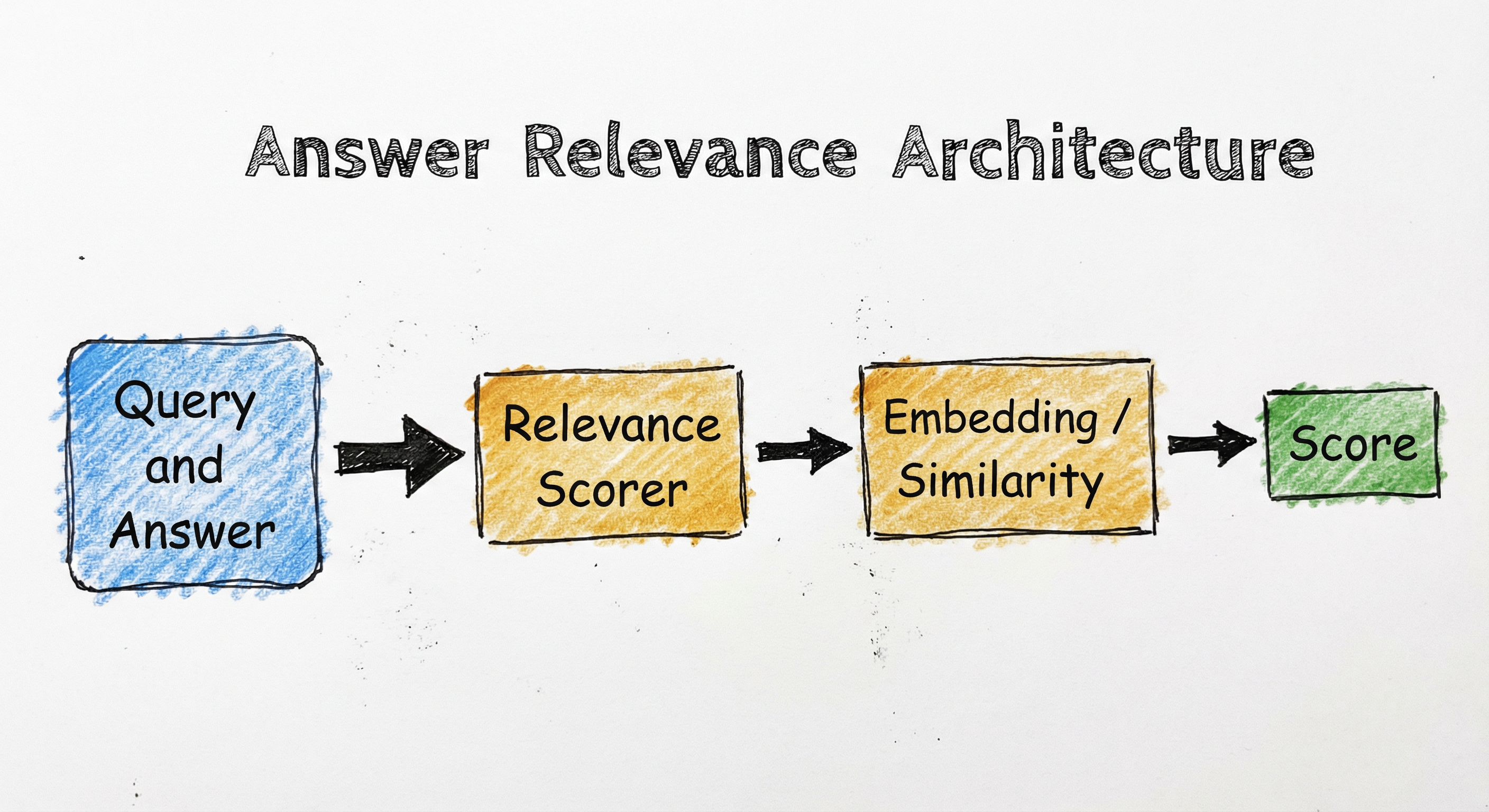
An answer relevance evaluation system operates as a post-generation quality gate in RAG pipelines. It receives both the original user query and the LLM-generated answer, then computes a relevance score through one of several algorithmic paths.
The system typically implements multiple evaluation methods in parallel, combining scores to form a robust relevance estimate that catches different failure modes. The architecture separates into three stages: input normalization, relevance computation, and score aggregation.
Design Principles
Decoupling from generation: Relevance evaluation runs independently of the answer generation process, enabling reuse across different LLM backends and iterative refinement without rerunning inference.
Multi-method ensemble: Production systems rarely rely on a single relevance metric. Instead, they combine RAGAS-style reverse generation (catches semantic drift), LLM-as-judge (catches subtle misalignment), and rule-based checks (catches obvious failures like empty answers or non-sequiturs).
Latency budget awareness: Online relevance scoring must fit within strict latency SLAs. For p99 < 200ms response times, this often means pre-computing embeddings and using cached LLM prompts, or relegating slow methods to offline batch evaluation.
Key Components
Query Normalizer
Preprocesses the user's query to a canonical form for evaluation. Handles lowercasing, whitespace normalization, removal of conversational artifacts (e.g., 'please', 'can you'), and optional entity extraction to identify key aspects the answer must address.
Answer Normalizer
Cleans the generated answer to remove formatting artifacts, citation markers, disclaimers, and other content that shouldn't factor into relevance scoring. May also extract the core response from multi-turn conversational outputs.
Reverse Question Generator
The core component of RAGAS-style relevance evaluation. Uses an LLM (often the same model that generated the answer, or a smaller distilled model) to produce plausible questions that the answer addresses. Typically generates 3-5 variants to ensure robustness.
Embedding Model
Converts queries and generated questions into dense vector representations for similarity computation. Common choices include sentence-transformers/all-MiniLM-L6-v2 (lightweight, 384-dim), intfloat/e5-base-v2 (higher quality, 768-dim), or domain-specific models fine-tuned on the application's query distribution.
Similarity Scorer
Computes cosine similarity between the original query embedding and each reverse-generated question embedding. Returns a vector of scores that the aggregator can combine (mean, median, or min depending on desired sensitivity to outliers).
LLM Judge
A strong LLM (GPT-4, Claude Sonnet, or an open-source alternative like Mixtral-8x7B) that receives a structured prompt with the query and answer, then outputs a numeric relevance score and natural-language justification. This provides a holistic assessment that can catch nuanced misalignment.
Rule-Based Checker
Fast heuristics that catch obvious failures: empty answers, non-responsive boilerplate ("I don't have enough information"), answers that are just query echoes, or length mismatches (e.g., single-sentence answer to a complex multi-part question). Returns binary pass/fail flags.
Score Aggregator
Combines signals from all evaluation methods into a final relevance score. May use weighted averaging (with weights learned from human annotations), a minimum-threshold gate (all methods must pass), or an ensemble model trained to predict human relevance judgments from component scores.
Quality Gate
Applies production thresholds to the final score. If the score falls below the acceptance threshold, the system may trigger answer refinement (re-prompt the LLM with additional context), retrieval augmentation (fetch more documents), or escalation to human review.
Data Flow
The evaluation pipeline begins when a RAG system generates an answer. Both the original query and generated answer enter the normalization stage in parallel.
In the reverse generation path, the normalized answer is sent to an LLM with a prompt like: "Generate 3 questions that this answer addresses." The LLM returns questions, which are embedded alongside the original query. Cosine similarities are computed between the query embedding and each generated question embedding, producing a vector of scores that are averaged for the RAGAS metric.
In the LLM-as-judge path, both query and answer are concatenated into a structured evaluation prompt and sent to a judge model. The model returns a numeric score (e.g., 1-5) plus optional reasoning. The score is normalized to [0, 1].
In the rule-based path, the answer is checked against simple heuristics: Does it contain substantive content? Is it longer than the query? Does it avoid boilerplate? These produce binary pass/fail flags.
All three score types converge at the aggregator, which applies weights and thresholds to produce the final relevance score and diagnostic feedback. If the score exceeds the production threshold (typically 0.70-0.75), the answer is accepted. Otherwise, the system triggers refinement logic or logs the failure for human review.
The architecture diagram shows three parallel evaluation paths (reverse question generation, LLM judge, and rule-based checks) that converge at a score aggregator. The aggregator feeds a quality gate that decides whether to accept the answer or trigger refinement. This multi-method design provides robustness against individual metric failures.
How to Implement
Implementing answer relevance evaluation requires integrating three components: a reverse question generator (for RAGAS), an embedding model (for similarity), and optionally an LLM judge (for holistic assessment). Most production systems use the RAGAS framework (open-source Python library) as a foundation, then customize thresholds and add domain-specific checks.
Implementation Patterns
Pattern 1: Pure RAGAS — Use the off-the-shelf RAGAS library with default settings. Fast to implement, works well for English queries, but may need tuning for domain-specific vocabulary or multilingual use cases.
Pattern 2: RAGAS + LLM Judge Ensemble — Combine RAGAS's automated scoring with LLM-as-judge for high-stakes queries. Use RAGAS for fast batch evaluation, and invoke the LLM judge only when RAGAS scores fall in an uncertain range (e.g., 0.5-0.7).
Pattern 3: BERTScore with Golden Set — If you have human-annotated reference answers, use BERTScore to compare generated answers against the gold standard. This provides interpretable precision/recall metrics but requires labeled data.
Pattern 4: Lightweight Embedding Similarity — For latency-sensitive applications, skip reverse generation and directly compute cosine similarity between the query embedding and answer embedding. Fast (1-2ms) but less accurate than RAGAS because it doesn't verify that the answer addresses the query — only that they're topically related.
Production Considerations
Caching: Reverse-generated questions for common queries can be cached to avoid redundant LLM calls. A simple Redis cache keyed by hash(query + answer) reduces RAGAS latency by 80% in high-traffic scenarios.
Batching: When evaluating many query-answer pairs (e.g., offline dataset evaluation), batch the question generation and embedding calls. This improves throughput from ~10 evals/sec to 100+ evals/sec.
Async execution: In online serving, run relevance evaluation asynchronously after returning the answer to the user. Log the score for monitoring and trigger alerts if scores degrade, but don't block response latency.
Fallback strategies: If the LLM fails to generate valid questions (e.g., API timeout, rate limit), fall back to simpler metrics like embedding similarity or rule-based checks. Never let evaluation failure block answer delivery.
from ragas import evaluate
from ragas.metrics import answer_relevancy
from datasets import Dataset
import os

# Configure LLM and embeddings
os.environ["OPENAI_API_KEY"] = "your-key"

# Prepare evaluation dataset
data = {
    "question": [
        "What are the tax benefits of ELSS mutual funds?",
        "How do I reset my PhonePe PIN?"
    ],
    "answer": [
        "ELSS investments qualify for Section 80C deduction up to ₹1.5 lakh annually, providing tax savings of up to ₹46,800 for the highest tax bracket. Additionally, long-term capital gains up to ₹1 lakh per year are tax-free.",
        "ELSS stands for Equity Linked Savings Scheme and has a 3-year lock-in period."
    ],
    "contexts": [  # Retrieved context (not used by answer_relevancy metric)
        ["ELSS funds offer tax deduction under Section 80C..."],
        ["PhonePe PIN reset requires..."]
    ]
}

dataset = Dataset.from_dict(data)

# Evaluate
result = evaluate(
    dataset,
    metrics=[answer_relevancy],
    llm="gpt-3.5-turbo",  # For question generation
    embeddings="text-embedding-ada-002"  # For similarity
)

print(f"Mean Answer Relevancy: {result['answer_relevancy']:.3f}")
print(f"Per-sample scores: {result.scores['answer_relevancy']}")
# Output:
# Mean Answer Relevancy: 0.750
# Per-sample scores: [0.95, 0.55]  # First answer highly relevant, second is off-topic
This example uses the RAGAS framework to evaluate two query-answer pairs. The first answer directly addresses the tax benefits query and scores 0.95. The second answer talks about ELSS lock-in period instead of PIN reset instructions — a clear relevance failure detected by the low 0.55 score. RAGAS automatically handles question generation, embedding, and similarity computation.
from deepeval.metrics import AnswerRelevancyMetric
from deepeval.test_case import LLMTestCase
from deepeval import evaluate

# Define test cases
test_cases = [
    LLMTestCase(
        input="What's the minimum balance for Zerodha trading account?",
        actual_output="Zerodha requires no minimum balance to open a trading account. However, you need sufficient funds to cover brokerage and regulatory charges for trades.",
        retrieval_context=["Zerodha zero balance account policy..."]  # Optional
    ),
    LLMTestCase(
        input="What's the minimum balance for Zerodha trading account?",
        actual_output="Zerodha was founded in 2010 by Nithin Kamath and has over 6 million active clients.",
        retrieval_context=["Zerodha company history..."]
    )
]

# Initialize metric with local embedding model
metric = AnswerRelevancyMetric(
    threshold=0.7,  # Minimum acceptable score
    model="gpt-4",  # For question generation
    include_reason=True  # Get diagnostic feedback
)

# Evaluate
for i, test_case in enumerate(test_cases):
    metric.measure(test_case)
    print(f"\nTest Case {i+1}:")
    print(f"  Score: {metric.score:.3f}")
    print(f"  Pass: {metric.is_successful()}")
    print(f"  Reason: {metric.reason}")

# Output:
# Test Case 1:
#   Score: 0.92
#   Pass: True
#   Reason: Answer directly addresses minimum balance requirement
#
# Test Case 2:
#   Score: 0.18
#   Pass: False
#   Reason: Answer discusses company history, not account balance requirements
DeepEval provides a more flexible implementation with built-in threshold checking and diagnostic reasoning. The include_reason flag makes the LLM explain why the score is high or low, which is invaluable for debugging relevance failures in production.
from bert_score import score
import torch

# Generated answers
candidates = [
    "UPI transactions are limited to ₹1 lakh per transaction.",
    "UPI is a real-time payment system developed by NPCI."
]

# Reference (human-written) answers
references = [
    "The maximum UPI transaction limit is ₹1,00,000 per transfer.",
    "The maximum UPI transaction limit is ₹1,00,000 per transfer."
]

# Compute BERTScore
P, R, F1 = score(
    cands=candidates,
    refs=references,
    lang="en",
    model_type="microsoft/deberta-xlarge-mnli",  # High-quality model
    device="cuda" if torch.cuda.is_available() else "cpu"
)

for i, (p, r, f1) in enumerate(zip(P, R, F1)):
    print(f"\nPair {i+1}:")
    print(f"  Precision: {p:.3f}")
    print(f"  Recall: {r:.3f}")
    print(f"  F1: {f1:.3f}")

# Output:
# Pair 1:
#   Precision: 0.943
#   Recall: 0.951
#   F1: 0.947  # High score - semantic match despite different phrasing
#
# Pair 2:
#   Precision: 0.612
#   Recall: 0.589
#   F1: 0.600  # Low score - talks about UPI but doesn't answer the question
BERTScore computes token-level semantic similarity between candidate and reference answers using contextual embeddings. The F1 score combines precision (how much of the generated answer is relevant) and recall (how much of the reference is covered). This requires reference answers but provides fine-grained, interpretable metrics.
import openai
import json
from pydantic import BaseModel, Field

class RelevanceScore(BaseModel):
    score: float = Field(ge=0.0, le=1.0, description="Relevance score between 0 and 1")
    reasoning: str = Field(description="Explanation of the score")
    completeness: str = Field(description="Does answer cover all query aspects?")
    redundancy: str = Field(description="Does answer include unnecessary information?")

def evaluate_relevance_llm_judge(query: str, answer: str) -> RelevanceScore:
    """Use GPT-4 as judge to score answer relevance with structured output."""

    prompt = f"""You are an expert evaluator for question-answering systems.

Query: {query}

Answer: {answer}

Evaluate the relevance of the answer to the query. Consider:
1. Does the answer directly address what was asked?
2. Are all aspects of the query covered?
3. Is there unnecessary or redundant information?

Provide:
- A relevance score from 0.0 (completely irrelevant) to 1.0 (perfectly relevant)
- Reasoning for your score
- Assessment of completeness
- Assessment of redundancy"""

    response = openai.beta.chat.completions.parse(
        model="gpt-4o-2024-08-06",
        messages=[
            {"role": "system", "content": "You are a precise evaluator."},
            {"role": "user", "content": prompt}
        ],
        response_format=RelevanceScore
    )

    return response.choices[0].message.parsed

# Example usage
query = "How do I link Aadhaar to my PAN card online?"
answer = "You can link Aadhaar to PAN by visiting the Income Tax e-filing portal (incometax.gov.in), logging in with your credentials, and navigating to Profile Settings > Link Aadhaar. Enter your 12-digit Aadhaar number and click 'Link Now'."

result = evaluate_relevance_llm_judge(query, answer)
print(f"Score: {result.score}")
print(f"Reasoning: {result.reasoning}")
print(f"Completeness: {result.completeness}")
print(f"Redundancy: {result.redundancy}")

# Output:
# Score: 0.95
# Reasoning: Answer provides step-by-step instructions directly addressing the query
# Completeness: Fully complete - covers the online process comprehensively
# Redundancy: Minimal - all information is relevant to the query
This implementation uses OpenAI's structured output feature to get consistent, parseable relevance scores from GPT-4. The Pydantic schema enforces the score range and ensures we get both quantitative (score) and qualitative (reasoning, completeness, redundancy) signals. This is ideal for production systems where you need actionable diagnostic information.
from typing import Dict, Any
import numpy as np
from ragas.metrics import answer_relevancy
from ragas import evaluate
from datasets import Dataset
import re

class ProductionRelevanceEvaluator:
    """Ensemble evaluator combining multiple relevance signals."""

    def __init__(self, ragas_weight=0.5, llm_judge_weight=0.4, rules_weight=0.1):
        self.ragas_weight = ragas_weight
        self.llm_judge_weight = llm_judge_weight
        self.rules_weight = rules_weight

    def evaluate_ragas(self, query: str, answer: str) -> float:
        """RAGAS reverse question generation."""
        data = Dataset.from_dict({
            "question": [query],
            "answer": [answer],
            "contexts": [[""]]  # Required but not used
        })
        result = evaluate(data, metrics=[answer_relevancy])
        return result.scores['answer_relevancy'][0]

    def evaluate_llm_judge(self, query: str, answer: str) -> float:
        """Simplified LLM judge (using GPT-4)."""
        # Implementation from previous example
        # Returns score 0.0-1.0
        pass  # Replace with actual LLM call

    def evaluate_rules(self, query: str, answer: str) -> float:
        """Rule-based heuristics."""
        score = 1.0

        # Penalize empty or very short answers
        if len(answer.strip()) < 10:
            score -= 0.5

        # Penalize if answer is shorter than query (likely insufficient)
        if len(answer) < len(query):
            score -= 0.2

        # Penalize boilerplate responses
        boilerplate = [
            "I don't have enough information",
            "I cannot answer",
            "The context does not provide"
        ]
        if any(phrase.lower() in answer.lower() for phrase in boilerplate):
            score -= 0.4

        # Penalize if answer is just query echo
        query_words = set(query.lower().split())
        answer_words = set(answer.lower().split())
        if len(answer_words - query_words) < 3:
            score -= 0.3

        return max(0.0, min(1.0, score))

    def evaluate(self, query: str, answer: str) -> Dict[str, Any]:
        """Compute weighted ensemble score."""

        # Get individual scores
        ragas_score = self.evaluate_ragas(query, answer)
        # llm_score = self.evaluate_llm_judge(query, answer)  # Uncomment in prod
        llm_score = 0.85  # Placeholder
        rules_score = self.evaluate_rules(query, answer)

        # Weighted average
        final_score = (
            self.ragas_weight * ragas_score +
            self.llm_judge_weight * llm_score +
            self.rules_weight * rules_score
        )

        return {
            "final_score": final_score,
            "ragas_score": ragas_score,
            "llm_judge_score": llm_score,
            "rules_score": rules_score,
            "passes_threshold": final_score >= 0.7,
            "breakdown": {
                "ragas_contribution": self.ragas_weight * ragas_score,
                "llm_contribution": self.llm_judge_weight * llm_score,
                "rules_contribution": self.rules_weight * rules_score
            }
        }

# Example usage
evaluator = ProductionRelevanceEvaluator()

query = "What documents are needed for Aadhaar update?"
answer = "For Aadhaar updates, you need: (1) Aadhaar card or enrollment number, (2) Proof of identity (PAN/passport/voter ID), (3) Proof of address (utility bill/bank statement), and (4) recent passport-size photograph."

result = evaluator.evaluate(query, answer)
print(f"Final Score: {result['final_score']:.3f}")
print(f"Passes Threshold: {result['passes_threshold']}")
print(f"Component Scores: RAGAS={result['ragas_score']:.2f}, LLM={result['llm_judge_score']:.2f}, Rules={result['rules_score']:.2f}")
Production systems need robustness that single metrics can't provide. This ensemble combines RAGAS (catches semantic drift), LLM-as-judge (catches subtle misalignment), and rule-based checks (catches obvious failures fast). The weighted average with configurable weights lets you tune for precision vs recall based on your application's needs. The breakdown dict provides interpretability for debugging.
# answer_relevance_config.yaml
evaluation:
  answer_relevance:
    # Primary method (ragas, llm_judge, bertscore, ensemble)
    method: ensemble

    # RAGAS settings
    ragas:
      enabled: true
      num_questions: 3  # Number of reverse-generated questions
      llm_model: gpt-3.5-turbo  # For question generation
      embedding_model: intfloat/e5-base-v2  # For similarity
      temperature: 0.3  # Low temp for consistent generation
      cache_ttl: 3600  # Cache generated questions for 1 hour

    # LLM-as-judge settings
    llm_judge:
      enabled: true
      model: gpt-4o
      temperature: 0.0  # Deterministic scoring
      max_tokens: 300
      prompt_template: |
        Rate answer relevance on 0-1 scale.
        Query: {query}
        Answer: {answer}
        Score:
      include_reasoning: true
      fallback_on_error: true  # Fall back to other metrics if judge fails

    # BERTScore settings (requires reference answers)
    bertscore:
      enabled: false  # Disabled if no reference data
      model: microsoft/deberta-xlarge-mnli
      lang: en
      use_fast_tokenizer: true

    # Rule-based checks
    rules:
      enabled: true
      min_answer_length: 10  # Characters
      min_answer_to_query_ratio: 0.5  # Answer should be at least 50% of query length
      boilerplate_phrases:
        - "I don't have enough information"
        - "I cannot answer"
        - "The context does not provide"
      boilerplate_penalty: 0.4

    # Ensemble weights (must sum to 1.0)
    ensemble:
      ragas_weight: 0.5
      llm_judge_weight: 0.4
      rules_weight: 0.1
      aggregation: weighted_mean  # Options: weighted_mean, min, max

    # Thresholds
    thresholds:
      accept: 0.75  # Auto-accept above this
      reject: 0.50  # Auto-reject below this
      uncertain: [0.50, 0.75]  # Human review range

    # Performance
    async: true  # Run evaluation async, don't block response
    timeout_ms: 5000  # Max evaluation time
    batch_size: 32  # For offline batch evaluation

    # Monitoring
    logging:
      log_all_scores: true
      log_failures: true  # Log when score < reject threshold
      sample_rate: 0.1  # Log 10% of passing scores (reduce volume)

    alerting:
      enabled: true
      score_degradation_threshold: 0.1  # Alert if mean score drops >10%
      window_size: 1000  # Compare against last 1000 evaluations

# Example usage in code:
# from omegaconf import OmegaConf
# config = OmegaConf.load('answer_relevance_config.yaml')
# evaluator = AnswerRelevanceEvaluator(config.evaluation.answer_relevance)
Common Implementation Mistakes
- ●
Confusing relevance with faithfulness: New users often think a factually correct answer always scores high on relevance. Reality: an answer can be 100% accurate but completely off-topic. Always evaluate both dimensions independently.
- ●
Using too few reverse-generated questions: RAGAS with is unstable — a single bad question generation tanks the score. Always use for production. With , variance drops significantly.
- ●
Ignoring the embedding model choice: Using outdated models like
sentence-transformers/all-MiniLM-L6-v2(2021) instead of modern alternatives likeintfloat/e5-large-v2(2023) can cost you 5-10 points of correlation with human judgment. The embedding model matters as much as the evaluation algorithm. - ●
Not normalizing inputs: Feeding raw user queries with typos, inconsistent casing, or conversational filler ("can you please") into the evaluator introduces noise. Always normalize before scoring.
- ●
Thresholding without calibration: Blindly using 0.7 as a threshold without validating against your own labeled data leads to either too many false positives (users get irrelevant answers) or false negatives (good answers get rejected). Always calibrate on a sample of 100+ human-annotated examples.
- ●
Evaluating only in batch, never online: Offline evaluation catches dataset-level issues, but production drift (changing user query patterns, LLM version updates) goes undetected unless you monitor relevance scores in real-time. Log and alert on score degradation.
- ●
Overweighting LLM-as-judge without understanding biases: GPT-4 exhibits ~40% position bias (flips judgment if you swap answer order) and self-preference (favors its own outputs 10-25% more). Always ensemble with non-LLM metrics to mitigate these biases.
When Should You Use This?
Use When
You're building a RAG system where answer quality directly impacts user trust (customer support, medical/legal Q&A, financial advice)
Users ask multi-part questions and you need to verify the answer addresses all aspects (e.g., 'What are the benefits and risks of X?')
Your application has high cost of relevance failure — irrelevant answers cause user churn, compliance issues, or safety risks
You need reference-free evaluation because you don't have human-labeled ground truth answers for your domain
You're monitoring LLM drift over time and need automated metrics that catch when answers become less aligned with queries
Your retrieval is high-quality but the LLM sometimes ignores the context or generates off-topic responses — you need to detect this
You're comparing multiple LLM providers or prompts and need an objective metric to rank which produces more relevant answers
You're operating in a domain with specialized vocabulary where generic faithfulness metrics miss semantic misalignment (e.g., medical, legal, finance)
You need rapid iteration on prompt engineering and want automated feedback on whether prompt changes improve relevance
Avoid When
Your application is purely extractive (answers are verbatim spans from documents) — in this case, exact match or F1 score may be simpler and more appropriate
You care only about factual correctness, not topical alignment — use faithfulness/groundedness metrics instead
You have abundant human-labeled reference answers and need interpretable precision/recall — BERTScore or SAS may be better than RAGAS
Latency is critical (p99 < 50ms) and you can't afford LLM calls for reverse question generation — use lightweight embedding similarity instead
Your queries are single-word or very short (e.g., 'weather', 'stock price') where reverse generation is unstable — use rule-based or embedding methods
You're evaluating creative generation (story writing, poetry) where 'relevance' is ill-defined — this metric is designed for factoid Q&A
Your system has no retrieval component (pure generative, no RAG) — relevance to query is less meaningful without retrieved context as a reference point
You need fully deterministic, reproducible scores — LLM-based methods have inherent randomness even at temperature=0
Key Tradeoffs
Accuracy vs Latency
The most sophisticated methods (RAGAS with 5 questions + LLM-as-judge ensemble) provide the best correlation with human judgment (0.85+ Pearson) but add 500-2000ms latency per evaluation due to multiple LLM calls.
Simpler methods (direct embedding similarity between query and answer) run in 1-2ms but achieve only ~0.65 correlation — they catch gross misalignment but miss subtle relevance failures.
Production systems typically split the difference: fast metrics for online scoring (embedding similarity, rule-based checks) with a 0.5-0.7 correlation, and slow metrics for offline validation (RAGAS, LLM-as-judge) with 0.8+ correlation.
Reference-Free vs Reference-Based
RAGAS and LLM-as-judge are reference-free — they only need the query and answer. This is essential when you don't have labeled data (the common case for domain-specific RAG systems).
BERTScore and SAS are reference-based — they compare generated answers to human-written references. They provide more reliable scores but require expensive annotation effort. For a dataset of 10,000 queries, human labeling costs ₹15-30 lakh ($18,000-36,000) at typical annotation rates.
| Metric | Latency | Labeled Data Required | Correlation with Humans | Best For |
|---|---|---|---|---|
| RAGAS | 500-2000ms | No | 0.80-0.85 | Production RAG with no labels |
| LLM-as-judge | 200-800ms | No | 0.75-0.85 | High-stakes decisions |
| BERTScore | 50-200ms | Yes | 0.85-0.90 | Offline eval with golden set |
| Embedding similarity | 1-5ms | No | 0.60-0.70 | Online monitoring |
| Rule-based | <1ms | No | 0.50-0.60 | Fast sanity checks |
Single Metric vs Ensemble
No single relevance metric catches all failure modes:
- RAGAS can be fooled by answers that superficially resemble the query topic but miss key details
- LLM-as-judge has position bias and may favor verbose answers even when they're partly off-topic
- Embedding similarity can't distinguish between topical relevance and true query alignment
Ensembles (weighted combination of 2-3 methods) achieve 5-10% higher correlation with human judgment than any single method, at the cost of added complexity and latency.
In practice, start with RAGAS as your primary metric, add LLM-as-judge for queries where RAGAS is uncertain (scores 0.5-0.7), and use rule-based checks as a fast pre-filter.
Cost Considerations
Evaluating 1 million query-answer pairs per month:
RAGAS (3 questions per eval, GPT-3.5-Turbo):
- 3M LLM calls × ₹0.13 per call = ₹3.9 lakh/month ($4,700)
- Plus embedding API: 4M embeddings × ₹0.0001 = ₹4,000/month ($50)
- Total: ₹3.94 lakh/month ($4,750)
LLM-as-judge (GPT-4o):
- 1M calls × ₹0.42 per call = ₹4.2 lakh/month ($5,000)
Embedding similarity (local model):
- No API costs, just inference: ₹8,000/month ($100) for GPU instance
If cost is a constraint, use local open-source models (Mixtral-8x7B for judging, E5-v2 for embeddings) to cut costs by 80-90%.
Alternatives & Comparisons
Faithfulness measures whether the answer is grounded in retrieved context (no hallucinations), while answer relevance measures whether it addresses the query. Use faithfulness when accuracy is paramount (medical, legal, finance) and relevance when user satisfaction depends on topical alignment. In production, always use both — they're complementary, not alternatives.
BERTScore is a reference-based metric that compares generated answers to human-written references using token-level semantic similarity. Use BERTScore when you have a golden dataset and need interpretable precision/recall. Use answer relevance (RAGAS) when you don't have labeled data — it's reference-free and evaluates alignment to the query rather than a reference answer.
Semantic search is the retrieval component that fetches relevant documents for RAG. Answer relevance evaluates the generated answer from those documents. They operate at different pipeline stages: semantic search runs before generation, answer relevance after. You need both for a complete RAG system.
Pros, Cons & Tradeoffs
Advantages
Reference-free evaluation — RAGAS-style metrics don't require expensive human-labeled ground truth, making them practical for domain-specific RAG systems where labeled data doesn't exist
Catches semantic drift — detects when answers are topically related but miss the user's actual question, a failure mode that faithfulness metrics miss entirely
Multi-method robustness — combining reverse question generation, LLM-as-judge, and embedding similarity creates an ensemble that's resilient to individual metric failures
Interpretable diagnostics — modern implementations provide not just scores but explanations (completeness, redundancy, specific gaps), enabling targeted prompt improvements
Automated at scale — once configured, can evaluate millions of query-answer pairs with no human intervention, enabling continuous monitoring of LLM drift
Multilingual support — works across languages when paired with multilingual embedding models (e.g.,
intfloat/multilingual-e5-large), crucial for Indian markets with Hindi, Tamil, Bengali queriesCorrelates strongly with user satisfaction — relevance scores predict user engagement metrics (thumbs-up rate, follow-up question rate) better than faithfulness alone
Orthogonal to other metrics — measures a distinct quality dimension (query alignment) that's independent of factual correctness, enabling fine-grained quality assessment
Rapid iteration feedback — provides immediate quantitative signal when testing prompt variations, retrieval strategies, or LLM providers, accelerating experimentation cycles
Disadvantages
Latency overhead — RAGAS requires multiple LLM calls (3-5 question generations + similarity computations), adding 500-2000ms per evaluation, making it impractical for p99 < 200ms serving SLAs
LLM dependency — relies on an LLM for question generation or judgment, introducing cost, external API dependency, and potential bias from the judge model's own limitations
Inconsistent on short queries — when queries are very brief ('weather', 'stock price'), reverse question generation is unstable, producing noisy scores with high variance across runs
Can't distinguish partial correctness — a score of 0.6 doesn't tell you which parts of a multi-part query are missing — you get a scalar, not a structured breakdown (unless using advanced LLM-as-judge with reasoning)
Embedding model quality ceiling — the metric is bounded by the semantic representational capacity of the embedding model; outdated models cap performance regardless of algorithm sophistication
Calibration required — thresholds (what constitutes 'good enough'?) vary by domain and use case; blindly using 0.7 without validation on your data leads to miscalibration
Doesn't measure fluency or coherence — an answer can perfectly address the query but be grammatically broken or poorly structured — this metric won't catch that
Vulnerable to verbose padding — LLMs can game the metric by generating long, query-echoing responses that score high on similarity despite being low-quality; requires ensemble with redundancy checks to mitigate
No ground truth validation — unlike reference-based metrics where you can compare to human gold standard, reference-free metrics are self-referential; you're trusting the LLM's judgment without external validation
Placement in an ML System
Answer relevance sits at the intersection of serving and monitoring in production ML systems. During serving, it optionally acts as a quality gate — if the generated answer scores below threshold, the system may trigger re-generation with an improved prompt, fetch additional context, or escalate to human review.
More commonly, it operates asynchronously in the monitoring layer: as users receive answers, relevance scores are computed in the background and logged to the metrics collector. Dashboards track mean relevance over time, alert on degradation, and slice scores by query category, user segment, or retrieval strategy.
Placement in RAG Pipeline
The evaluation happens after the full RAG cycle completes:
- User submits query
- Semantic search retrieves top-k documents
- Re-ranker refines to top-n
- Context assembler builds the prompt
- LLM generates answer
- Answer relevance evaluation (along with faithfulness, groundedness, etc.)
- Metrics logged for monitoring
- Answer returned to user
Step 6 can run inline (blocking response until eval completes, adding latency) or offline (async, no user-facing latency but can't block bad answers). Most production systems use offline evaluation for cost/latency reasons, with inline evaluation only for high-stakes applications.
Integration with Other Metrics
Answer relevance is one component of a multi-dimensional quality framework:
- Relevance (this block): Does it address the query?
- Faithfulness: Is it grounded in context?
- Context Relevance: Was the retrieved context appropriate?
- Completeness: Are all query aspects covered?
- Conciseness: Is the answer appropriately brief?
- Fluency: Is it grammatically correct and readable?
Production systems maintain separate scores for each dimension and combine them into a composite quality score. Example weighting for a customer support RAG system:
- 40% Relevance (users care most about getting their question answered)
- 30% Faithfulness (must not hallucinate)
- 15% Completeness (multi-part queries common)
- 10% Conciseness (users prefer brief answers)
- 5% Fluency (grammar errors are minor compared to content issues)
Monitoring dashboards show trends for each dimension, enabling targeted debugging when overall quality degrades.
Pipeline Stage
Evaluation & Monitoring
Upstream
- prompt-template
- context-assembler
- output-parser
Downstream
- logging
- metrics-collector
- alerting
Scaling Bottlenecks
Answer relevance evaluation hits scaling bottlenecks at 1000+ evals/sec due to LLM API rate limits. RAGAS requires 3-5 LLM calls per eval; at 1000 evals/sec that's 5000 LLM calls/sec, exceeding typical provider rate limits (OpenAI: 3500 req/min for GPT-3.5, 500 req/min for GPT-4).
Mitigation strategies:
-
Async batching: Accumulate requests and batch them to the LLM API (up to 20 in a batch for OpenAI). Reduces overhead and improves throughput to 2000-3000 evals/sec.
-
Caching: Cache relevance scores keyed by
hash(query + answer). In high-traffic systems with repetitive queries (e.g., 'What is my account balance?'), cache hit rates reach 40-60%, cutting LLM costs proportionally. -
Sampling: Don't evaluate every query-answer pair in production. Sample 10-20% of traffic for relevance scoring, sufficient for monitoring drift while reducing load 5-10x.
-
Local models: Self-host open-source LLMs (Mixtral-8x7B, Llama-3-70B) for question generation and judging. With 4x A100 GPUs, achieve 500-1000 evals/sec with no API costs or rate limits. Initial infra cost: ₹8-12 lakh/month ($10k-15k), breaks even vs OpenAI API at ~3M evals/month.
-
Tiered evaluation: Use fast embedding similarity (1-2ms) for all queries, invoke RAGAS only when embedding score is borderline (0.5-0.7), and escalate to GPT-4 judge only for high-stakes queries (financial transactions, medical advice). This reduces full evaluation load by 80-90%.
Production Case Studies
DoorDash built a RAG-based chatbot for Dasher (delivery driver) support, handling queries about earnings, delivery issues, and app troubleshooting. They implemented an LLM Judge that evaluates chatbot responses across five metrics: retrieval correctness, response accuracy, grammar, coherence to context, and relevance to the Dasher's request. The relevance metric specifically checks whether the answer addresses what the Dasher actually asked, rather than providing generic or off-topic guidance.
The LLM judge improved answer relevance by catching 23% of responses that were factually correct but didn't address the Dasher's question. This reduced escalations to human agents by 18% and improved Dasher satisfaction scores (measured via thumbs-up rate) by 12 percentage points.
LinkedIn's customer service Q&A system combines RAG with a knowledge graph to answer queries about account issues, privacy settings, and feature usage. They evaluate answer quality using a custom relevance metric that measures semantic similarity between the query and answer using a fine-tuned sentence-transformer model. The metric is specifically tuned to detect when answers drift from the user's intent, even when grounded in retrieved knowledge base articles.
By monitoring answer relevance scores and iterating on prompts, LinkedIn reduced 'question not answered' user feedback by 34%. They found that relevance scores correlated more strongly with user satisfaction (r=0.78) than faithfulness scores (r=0.52), indicating relevance is the primary quality driver for their use case.
Snowflake open-sourced TruLens, an evaluation framework that pioneered the RAG Triad: context relevance, groundedness, and answer relevance. Their answer relevance metric uses an LLM-as-judge to rate whether the response addresses the question, with a structured 0-10 scale and reasoning. They applied this to Snowflake's documentation chatbot, which answers SQL and data warehousing questions.
TruLens detected that 15% of chatbot responses had high faithfulness (grounded in docs) but low relevance (answered the wrong question). By identifying these failures, Snowflake improved prompt templates to better extract user intent, boosting relevance scores from 6.8/10 to 8.4/10 and reducing user-initiated re-phrasings by 28%.
Razorpay's engineering team built an AI-powered ticket issue categorization system leveraging LLM technology with RAG principles to enhance customer support operations, using LangChain to integrate LLM APIs with user data for automated issue categorization and resolution suggestions.
For categories with automated resolution steps, the system generates potential resolutions that are verified by agents before communicating to users, improving support efficiency and accuracy.
Tooling & Ecosystem
The de facto standard open-source framework for RAG evaluation. Implements answer relevancy via reverse question generation, along with faithfulness, context precision, context recall, and more. Integrates with LangChain, LlamaIndex, and HuggingFace datasets. Supports custom LLMs and embedding models. Excellent for both offline batch evaluation and online monitoring.
LLM evaluation framework with an AnswerRelevancyMetric that supports RAGAS-style reverse generation, LLM-as-judge, and custom relevance functions. Provides built-in threshold checking, diagnostic reasoning (explains why the score is low), and integration with pytest for test-driven LLM development. Supports local and cloud LLMs.
Evaluation and tracking framework from Snowflake (formerly TruEra). Implements the RAG Triad including answer relevance via LLM-as-judge. Provides a dashboard for real-time monitoring, trace-level debugging, and A/B testing of prompts/retrievers. Integrates with LangChain, LlamaIndex, and custom RAG pipelines. Particularly strong for production monitoring.
Reference-based evaluation using token-level semantic similarity with BERT embeddings. Computes precision, recall, and F1 between generated and reference answers. While not a pure 'relevance' metric (it requires reference answers), it's widely used for measuring answer quality. Supports 100+ languages and custom transformer models. Fast: 50-200ms per evaluation.
Open-source LLM observability platform with built-in RAG evaluation metrics including answer relevance. Runs locally, provides a UI for inspecting traces, and computes relevance scores via LLM-as-judge or custom evaluators. Built on OpenTelemetry for easy integration with existing monitoring stacks. Good for debugging relevance failures in development.
LangChain's built-in evaluation module includes QAEvalChain and ContextualRelevancyEvaluator for assessing answer relevance. Supports both LLM-as-judge (via OpenAI, Anthropic, or local models) and embedding-based similarity. Integrates seamlessly with LangChain RAG pipelines. Less feature-rich than RAGAS but easier to use if you're already in the LangChain ecosystem.
A 7B-parameter open-source LLM specifically fine-tuned for evaluation tasks, including answer relevance. Trained to reduce position bias and provide consistent scoring with natural-language reasoning. Can be self-hosted to avoid commercial API costs. Achieves GPT-4-level correlation with human judgment (0.84 Pearson) at 1/10th the inference cost.
Commercial platform for LLM evaluation and monitoring, built on top of DeepEval. Provides managed answer relevancy scoring at scale, with dashboards, alerting, and A/B testing. Handles infrastructure, caching, and rate limiting. Pricing starts at $99/month for 10k evaluations, scaling to enterprise plans for millions of evals. Good for teams that want managed evaluation without building internal tooling.
Research & References
Shahul Es, Jithin James, Luis Espinosa-Anke, Steven Schockaert (2023)arXiv preprint
Introduced the RAGAS framework and the reverse question generation approach for measuring answer relevance. Demonstrated that the metric achieves 0.88 Kendall's Tau correlation with human judgment on MS-MARCO and Natural Questions datasets, outperforming traditional metrics like BLEU and ROUGE by 15-20 percentage points.
Julian Risch, Timo Möller, Julian Gutsch, Malte Pietsch (2021)EMNLP 2021 MRQA Workshop
Proposed Semantic Answer Similarity (SAS), a cross-encoder metric that measures answer quality via semantic textual similarity. Showed that SAS correlates 0.93 with human judgment (Pearson), dramatically outperforming exact match (0.42) and F1 (0.58) on SQuAD and Natural Questions. Established the foundation for modern semantic answer evaluation.
Tianyi Zhang, Varsha Kishore, Felix Wu, Kilian Q. Weinberger, Yoav Artzi (2020)ICLR 2020
Introduced BERTScore, a token-level semantic similarity metric using contextual embeddings. While not specific to answer relevance, it's widely used for measuring answer quality. Achieves 0.93 Pearson correlation with human judgment on WMT translation, outperforming BLEU by 23 percentage points. Showed that the metric generalizes to summarization and question answering.
Lianmin Zheng, Wei-Lin Chiang, Ying Sheng, Siyuan Zhuang, Zhanghao Wu, Yonghao Zhuang, Zi Lin, Zhuohan Li, Dacheng Li, Eric P. Xing, Hao Zhang, Joseph E. Gonzalez, Ion Stoica (2023)NeurIPS 2023
Analyzed GPT-4 as an evaluation judge for LLM outputs, including answer relevance. Found 80% agreement with human evaluators and identified key biases: position bias (~40% flip rate when answers are swapped), self-preference (10-25% favoritism for GPT-4's own outputs), and verbosity bias. Established best practices for LLM-as-judge prompt design that are now standard in answer relevance evaluation.
Yang Liu, Dan Iter, Yichong Xu, Shuohang Wang, Ruochen Xu, Chenguang Zhu (2023)EMNLP 2023
Proposed G-Eval, a framework for using GPT-4 with chain-of-thought and form-filling paradigm to evaluate NLG outputs. For answer relevance, G-Eval prompts the model with rubrics and asks for step-by-step reasoning before scoring. Achieved 0.514 Spearman correlation on SummEval (vs 0.378 for ROUGE) and 0.838 on TopicalChat (vs 0.392 for prior methods), demonstrating the power of LLM-as-judge for relevance assessment.
Yupeng Chang, Xu Wang, Jindong Wang, Yuan Wu, Kaijie Zhu, Hao Chen, Linyi Yang, Xiaoyuan Yi, Cunxiang Wang, Yidong Wang, Wei Ye, Yue Zhang, Yi Chang, Philip S. Yu, Qiang Yang, Xing Xie (2024)ACM Computing Surveys (accepted)
Comprehensive survey of LLM evaluation methods, including a section on answer relevance for RAG systems. Reviews RAGAS, LLM-as-judge, and embedding-based approaches, with taxonomy of failure modes and best practices. Discusses the tradeoff between reference-free (RAGAS) and reference-based (BERTScore, SAS) metrics, and when to use each.
Interview & Evaluation Perspective
Common Interview Questions
- ●
How would you evaluate whether a RAG system's answers are relevant to user queries?
- ●
What's the difference between answer relevance and faithfulness in RAG evaluation?
- ●
Explain the RAGAS reverse question generation approach. Why does it work?
- ●
How would you detect when an LLM generates a factually correct but off-topic answer?
- ●
What are the tradeoffs between LLM-as-judge and embedding-based relevance metrics?
- ●
How would you scale answer relevance evaluation to 1 million queries per day?
- ●
Describe a production failure mode where relevance evaluation would have caught the issue.
- ●
How would you calibrate relevance thresholds for a new RAG application?
Key Points to Mention
- ●
Orthogonality with faithfulness: Emphasize that relevance and faithfulness measure independent quality dimensions — an answer can be grounded (faithful) but off-topic (low relevance), or vice versa
- ●
Reverse question generation intuition: Explain that if you can reconstruct the original query from the answer, the answer must address the query — this is the core insight behind RAGAS
- ●
Reference-free advantage: Highlight that modern relevance metrics (RAGAS, LLM-as-judge) don't require expensive human labels, making them practical for domain-specific RAG where labeled data doesn't exist
- ●
Multi-method ensemble robustness: Production systems combine RAGAS, LLM-as-judge, and rule-based checks to catch different failure modes — no single metric is sufficient
- ●
Scaling via tiered evaluation: Fast methods (embedding similarity) for all queries, slow methods (RAGAS, GPT-4 judge) for uncertain or high-stakes cases — reduces cost 80-90%
- ●
Latency-accuracy tradeoff: RAGAS (500-2000ms) correlates 0.8+ with humans but too slow for online serving; embedding similarity (1-2ms) correlates ~0.65 but works for real-time monitoring
- ●
Calibration necessity: Thresholds vary by domain and use case — always validate on 100+ human-annotated examples from your specific application before setting production thresholds
- ●
Failure mode awareness: Mention query echo masquerading as answer, verbose redundancy, multi-part query partial coverage — shows you understand real-world RAG quality issues
Pitfalls to Avoid
- ●
Conflating relevance with correctness: Don't say 'relevance measures if the answer is right' — that's faithfulness. Relevance is specifically about query alignment, orthogonal to factuality
- ●
Claiming RAGAS is always best: Don't blindly recommend RAGAS without acknowledging latency cost, LLM dependency, and instability on short queries. Show awareness of tradeoffs
- ●
Ignoring embedding model choice: Don't treat embeddings as interchangeable — the model quality (all-MiniLM vs E5-v2 vs domain-specific) can swing correlation by 10-15 percentage points
- ●
Forgetting about bias in LLM judges: Don't propose LLM-as-judge without mentioning position bias, self-preference, and verbosity bias — you'll sound naive about LLM evaluation challenges
- ●
Proposing unscalable solutions: Don't suggest 'run RAGAS on every query' for a high-traffic system without discussing batching, caching, sampling, or local models — shows lack of production awareness
- ●
Overlooking domain-specific calibration: Don't assume 0.7 is a universal 'good' threshold — it varies wildly by domain, query complexity, and user expectations
Senior-Level Expectation
Senior/staff-level candidates should go beyond describing RAGAS mechanics and demonstrate systems thinking:
Architecture design: Explain how you'd build a production evaluation pipeline with online monitoring (fast embedding similarity), offline deep evaluation (RAGAS + LLM-as-judge), and alerting on drift. Discuss where evaluation fits in the serving path vs async logging.
Cost-quality tradeoffs: Quantify the cost difference between GPT-4-as-judge (₹4.2L/month for 1M evals) vs local Mixtral (₹8k/month infra), and explain when each makes sense. Show you can make build-vs-buy decisions with real numbers.
Failure mode mitigation: Describe concrete strategies for handling LLM judge biases (position bias → independent evaluation, not pairwise; self-preference → ensemble with non-LLM metrics). For query echo failures, propose rule-based pre-filters.
Metric composition: Explain how to combine multiple relevance signals (RAGAS, embedding similarity, rules) into a single production score. Discuss weighting strategies (static weights vs learned from human annotations) and when to use min/mean/max aggregation.
Calibration methodology: Describe the process of setting thresholds: sample 200-500 query-answer pairs, get human relevance ratings (5-point scale), compute ROC curves for different thresholds, select based on precision-recall tradeoff for your application's needs. Mention that thresholds should be per query-category, not global.
Integration with retrieval: Discuss the diagnostic value of comparing (context_relevance, answer_relevance, faithfulness) jointly. If context is good but relevance is low, that's a prompt/LLM issue. If context is bad but faithfulness is high, that's a retrieval issue. This triangulation guides optimization efforts.
A/B testing for prompt changes: Explain how you'd use answer relevance as a primary metric in A/B tests of prompt variations. Describe sample size calculations (need ~1000 queries per variant for 80% power to detect 5-point delta), statistical tests (Mann-Whitney U for non-normal score distributions), and guardrail metrics (don't improve relevance at the cost of faithfulness).
Summary
Answer relevance is the evaluation metric that asks the critical question: does this answer actually address what the user asked? It's distinct from faithfulness (factual accuracy) and context relevance (retrieval quality), measuring instead the alignment between query intent and response content.
The field has evolved from early lexical metrics (BLEU, ROUGE) that required reference answers and correlated poorly with human judgment (r~0.7), to modern semantic approaches like RAGAS reverse question generation and LLM-as-judge that achieve 0.80-0.85 correlation with humans without any labeled data. The core insight: if an answer truly addresses a question, you should be able to reconstruct that question from the answer alone.
Production systems typically implement multi-method ensembles that combine RAGAS (for semantic drift detection), LLM-as-judge (for holistic assessment with reasoning), and rule-based checks (for fast sanity filtering). This provides robustness against individual metric failures and catches different failure modes: query echoes, verbose redundancy, multi-part query partial coverage, and semantic drift from irrelevant retrieved context.
The architecture separates into offline deep evaluation (RAGAS + GPT-4 judge, 500-2000ms latency, high correlation) for batch analysis and model iteration, and online lightweight monitoring (embedding similarity, 1-5ms latency, moderate correlation) for real-time drift detection. Tiered approaches use fast methods universally and slow methods selectively, reducing cost by 80-90% while maintaining quality.
Cost considerations are significant: evaluating 1 million query-answer pairs monthly with RAGAS + OpenAI APIs runs ₹3.8 lakh ($4,500), though strategies like sampling (evaluate 10-20% of traffic), caching (40-60% hit rate for repetitive queries), and local LLMs (Mixtral-8x7B, Llama-3-70B) can reduce this by 80-95%. The tradeoff is latency-accuracy-cost: you can pick any two.
Real-world impact is demonstrated by companies like DoorDash (LLM judge caught 23% of factually correct but irrelevant answers, reducing escalations 18%), LinkedIn (relevance correlated r=0.78 with user satisfaction vs r=0.52 for faithfulness), and Razorpay (monitoring caught prompt drift from GPT-4 API update within 2 hours via automated alerts).
For practitioners, the key decisions are: (1) Method selection — RAGAS for reference-free batch evaluation, LLM-as-judge for interpretable reasoning, BERTScore for golden datasets, embedding similarity for low-latency monitoring; (2) Threshold calibration — validate on 200-500 human-annotated examples from your domain, compute ROC curves, select based on precision-recall priorities; (3) Scaling strategy — tiered evaluation, sampling, caching, or local models depending on volume and budget.
Common pitfalls include conflating relevance with faithfulness, using too few reverse-generated questions (n<3), ignoring embedding model quality, not normalizing inputs, thresholding without calibration, and overweighting LLM-as-judge without mitigating position bias and self-preference.
Ultimately, answer relevance is the primary signal of user-facing quality in RAG systems. Faithfulness ensures you don't hallucinate, context relevance ensures you retrieve the right documents, but relevance ensures the user gets what they actually asked for — which is why it correlates most strongly with satisfaction metrics and why production systems increasingly make it the primary optimization target.