BERTScore in Machine Learning
If you have ever evaluated a machine translation model or chatbot using BLEU or ROUGE, you have probably felt the frustration: your model generates a perfectly valid paraphrase, yet the metric gives it a terrible score because it does not match the reference word-for-word. This fundamental limitation -- metrics that cannot understand meaning -- is what BERTScore was designed to solve.
Introduced by Tianyi Zhang, Varsha Kishore, Felix Wu, Kilian Q. Weinberger, and Yoav Artzi in their ICLR 2020 paper, BERTScore leverages pre-trained contextual embeddings from BERT (and its variants like RoBERTa, DeBERTa) to compute token-level semantic similarity between generated text and reference text. Instead of exact n-gram matching like BLEU, BERTScore uses cosine similarity between contextual embeddings to match words by meaning, not spelling. This simple shift produces evaluation metrics that correlate far better with human judgment -- achieving 0.93 Pearson correlation compared to BLEU's 0.70 and ROUGE's 0.78 on machine translation and summarization tasks.
BERTScore is not just an academic curiosity. With over 3,000 citations since 2020 and native support in Hugging Face's Evaluate library, TorchMetrics, and the official bert-score PyPI package, it has become a standard evaluation tool for NLG tasks including translation, summarization, dialogue generation, and data-to-text systems. Companies building chatbots at scale -- from Bangalore-based AI startups to global enterprises -- use BERTScore to validate response quality beyond surface-level metrics. The metric is computationally heavier than BLEU (requiring GPU inference through a BERT model), but the correlation gains often justify the cost.
Concept Snapshot
- What It Is
- An automatic evaluation metric for text generation that computes precision, recall, and F1 scores by matching tokens between candidate and reference texts using contextual embeddings from BERT-family models and cosine similarity.
- Category
- Evaluation
- Complexity
- Intermediate
- Inputs / Outputs
- Inputs: candidate text (generated), reference text (ground truth), and a pre-trained BERT model. Outputs: precision, recall, and F1 scores (each ranging 0-1), representing semantic similarity at the token level.
- System Placement
- Sits in the evaluation/validation stage, downstream from model output generation, used to assess NLG systems like machine translation, summarization, dialogue, and text-to-text models.
- Also Known As
- BERT Score, bert_score, contextual embedding score, semantic similarity score
- Typical Users
- ML Engineers, NLP Researchers, Data Scientists, AI Application Developers, Chatbot Engineers
- Prerequisites
- Understanding of BERT/Transformers, Familiarity with cosine similarity, Basic NLP evaluation concepts (precision/recall), Knowledge of n-gram metrics (BLEU/ROUGE) for contrast
- Key Terms
- contextual embeddingstoken-level similaritygreedy matchingIDF weightingbaseline rescalingcosine distanceprecision/recall/F1DeBERTaRoBERTamultilingual BERT
Why This Concept Exists
The N-Gram Metrics Ceiling
For decades, NLP evaluation relied on n-gram matching metrics like BLEU (Papineni et al., 2002) for machine translation and ROUGE (Lin, 2004) for summarization. The premise was simple: count how many word sequences (unigrams, bigrams, etc.) appear in both the generated text and reference text. The more overlaps, the better the quality. This worked reasonably well when translations were relatively literal and datasets were small.
But as neural models improved -- particularly after the Transformer revolution (Vaswani et al., 2017) -- a gap emerged. Models learned to generate fluent paraphrases that were semantically equivalent to references but lexically different. Consider this example from a Hindi-to-English translation task:
- Reference: "The government launched a new healthcare program."
- Candidate A: "The administration introduced a fresh medical initiative." (semantically identical)
- Candidate B: "The government healthcare program launched new." (grammatically broken)
BLEU gives Candidate A a low score (no exact word matches except "a") and Candidate B a higher score (matches "government", "launched", "new", "healthcare", "program"). This is clearly backwards. BLEU cannot distinguish synonyms ("introduced" vs "launched") or understand that word order matters semantically, not just syntactically.
Researchers in India and globally faced this issue acutely in low-resource language translation (like Tamil-to-English or Bengali-to-Hindi), where reference diversity is high and lexical overlap is naturally lower. The evaluation bottleneck was clear: we needed metrics that understand meaning, not just spelling.
The Contextual Embedding Breakthrough
The rise of contextualized language models -- ELMo (Peters et al., 2018), BERT (Devlin et al., 2019), and later RoBERTa and GPT-2 -- provided a solution. These models generate embeddings where each word's vector depends on its surrounding context. The word "bank" in "river bank" gets a different embedding than "bank" in "savings bank." This context-awareness captures semantics in a way static word vectors (Word2Vec, GloVe) never could.
The insight behind BERTScore was to leverage these contextual embeddings for evaluation. If two sentences are semantically similar, their token embeddings -- computed by BERT -- should be geometrically close in the embedding space. By matching tokens via cosine similarity instead of exact string matching, the metric could recognize paraphrases, synonyms, and reorderings as semantically valid.
The 2019 Moment: BERTScore Goes Public
Zhang et al. released the BERTScore paper on arXiv in April 2019 and presented it at ICLR 2020. The results were striking:
- On WMT machine translation datasets, BERTScore correlated 0.93 with human judgments, compared to BLEU's 0.70.
- On image captioning tasks, BERTScore showed stronger correlation than CIDEr and SPICE, the previous state-of-the-art.
- On adversarial paraphrase detection, BERTScore correctly identified semantic equivalence where BLEU failed.
The paper included careful ablations showing that model choice mattered (RoBERTa outperformed BERT, and later DeBERTa became the recommended default), IDF weighting helped in some tasks, and baseline rescaling improved interpretability by normalizing scores to a more intuitive range.
Within months, BERTScore was integrated into Hugging Face's datasets library (later spun out as evaluate), added to TorchMetrics, and adopted by researchers at Google, Meta, and academic labs worldwide. By 2026, it is cited in over 3,000 papers and is considered a standard baseline for NLG evaluation alongside BLEU, ROUGE, and METEOR.
Core Intuition & Mental Model
The Coffee Shop Analogy
Imagine you ask a barista for a drink recommendation and receive two responses:
- Response A: "I suggest trying our cold brew; it has a smooth, rich flavor."
- Response B: "I recommend tasting our chilled coffee; it offers a velvety, deep taste."
To a human, these responses are nearly identical in meaning. But to a word-matching algorithm like BLEU, they share almost zero words ("our" and "it" are the only overlaps). BLEU would rate Response B as a poor match to Response A.
BERTScore solves this by understanding meaning, not memorizing spellings. It embeds each word into a high-dimensional vector space where "suggest" and "recommend" sit close together, as do "cold brew" and "chilled coffee," and "smooth, rich flavor" and "velvety, deep taste." It then matches tokens by finding the closest semantic neighbors and computes precision, recall, and F1 based on these meaning-aware alignments.
Three Key Design Decisions
1. Token-Level Matching, Not Sentence-Level: BERTScore does not compute a single sentence embedding and compare vectors (which SBERT or SentenceBERT do). Instead, it computes an embedding for every token in both the candidate and reference sentences, then performs a greedy token-by-token matching. This preserves fine-grained distinctions -- it can detect if a single word is wrong in an otherwise perfect sentence.
2. Greedy Alignment with Cosine Similarity: For each token in the reference, BERTScore finds the most similar token in the candidate (by cosine similarity of their BERT embeddings) and vice versa. This greedy approach is computationally efficient and avoids the combinatorial explosion of optimal bipartite matching. The max-similarity scores are averaged to compute precision (candidate → reference) and recall (reference → candidate), then combined into F1.
3. Model Choice as a Hyperparameter: Unlike BLEU (which is model-agnostic), BERTScore depends on the underlying language model. The original paper tested BERT-base, but later work showed that RoBERTa-large performs better, and as of 2024, microsoft/deberta-xlarge-mnli achieves the highest correlation with human evaluation. However, DeBERTa uses 2-3x more GPU memory than RoBERTa, so users must trade off quality versus computational cost. For most applications in India -- where GPU costs matter -- roberta-large is the sweet spot.
What BERTScore Does NOT Capture
While BERTScore is powerful, it has blind spots:
- Factual correctness: BERTScore measures semantic similarity, not factual accuracy. If a model hallucinates a plausible-sounding but false fact, BERTScore may still give it a high score if the hallucination is similar in style to the reference.
- Fluency and grammaticality: A word salad with high semantic overlap can score well. BERTScore does not penalize ungrammatical or disfluent text explicitly.
- Length biases: Very short or very long candidates can skew scores due to the averaging step. Recall is typically higher for longer candidates (more chances to match reference tokens), while precision is higher for shorter candidates.
Understanding these limitations is critical. BERTScore should be one signal among many -- combine it with BLEU (for lexical fidelity), ROUGE (for content coverage), perplexity (for fluency), and human evaluation (for factuality and coherence).
Technical Foundations
Mathematical Formulation
Let be the candidate (generated) sentence and be the reference sentence, where and are the number of tokens (after tokenization by the BERT tokenizer).
Let denote the contextual embedding function provided by a pre-trained BERT-family model. For each token in the candidate, we compute its embedding , where (typically for BERT-base or for BERT-large). Similarly, for each token in the reference, we compute .
Note on Contextual Embeddings: The embedding is not a static lookup -- it depends on the entire input sentence. BERT processes the full sentence through multiple Transformer layers, and is extracted from a specific layer (typically the last layer or a weighted combination of layers).
Cosine Similarity
The similarity between two token embeddings is measured using cosine similarity:
Cosine similarity ranges from -1 (opposite directions) to +1 (identical directions), with 0 indicating orthogonality. In practice, BERT embeddings are typically non-negative and clustered in a cone, so cosine similarities are usually positive.
Greedy Token Matching
BERTScore uses greedy matching to align tokens:
- Recall: For each reference token , find the most similar candidate token:
- Precision: For each candidate token , find the most similar reference token:
- F1 Score: The harmonic mean of precision and recall:
In most applications, F1 is the primary metric because it balances precision and recall. However, recall is often more important for summarization (did the summary capture all key points?), while precision is more important for translation (are all generated words valid?).
Optional Enhancements
IDF Weighting: To down-weight common words ("the", "a", "is") and emphasize rare, content-bearing tokens, BERTScore optionally applies inverse document frequency (IDF) weighting:
where , with being the total number of documents in a corpus and being the number of documents containing token . IDF is computed from a large reference corpus (e.g., Common Crawl or Wikipedia). The paper notes that IDF weighting is not always beneficial -- it helps in tasks like summarization where content coverage matters, but can hurt in translation where fluency words ("the", "and") are important for grammatical correctness.
Baseline Rescaling: Raw BERTScore values are difficult to interpret because they depend on the model and task. To improve readability, the authors propose baseline rescaling:
where is the average BERTScore of random sentence pairs from a large corpus. This rescales scores so that 0 represents random text and 1 represents perfect matches. The baseline is pre-computed for each language and model combination and distributed with the bert_score library.
Computational Complexity
Let be the candidate length, be the reference length, and be the embedding dimension (typically 768 or 1024).
- Embedding computation: where is the number of Transformer layers (12 for BERT-base, 24 for BERT-large). This is the dominant cost and requires GPU inference.
- Greedy matching: for computing pairwise cosine similarities, plus for finding max values.
In practice, embedding computation dominates. For a batch of 1,000 sentence pairs with average length 20 tokens, BERTScore takes ~10 seconds on an NVIDIA A100 GPU using roberta-large, compared to milliseconds for BLEU. This is why BERTScore is typically used for validation and final evaluation, not per-step training metrics.
Internal Architecture
BERTScore's architecture is deceptively simple: it wraps a pre-trained BERT-family model with a greedy token matching layer. Unlike end-to-end learned metrics (e.g., BLEURT, COMET), BERTScore does not fine-tune the underlying model on human judgment data -- it uses the frozen embeddings directly. This makes it lightweight, fast to deploy, and robust across domains.
The system consists of three main components: (1) a tokenizer that splits text into subword units compatible with the BERT model, (2) an embedding extractor that runs the tokenizer output through BERT and extracts contextual vectors, and (3) a greedy matcher that computes pairwise cosine similarities and aggregates them into precision, recall, and F1 scores.
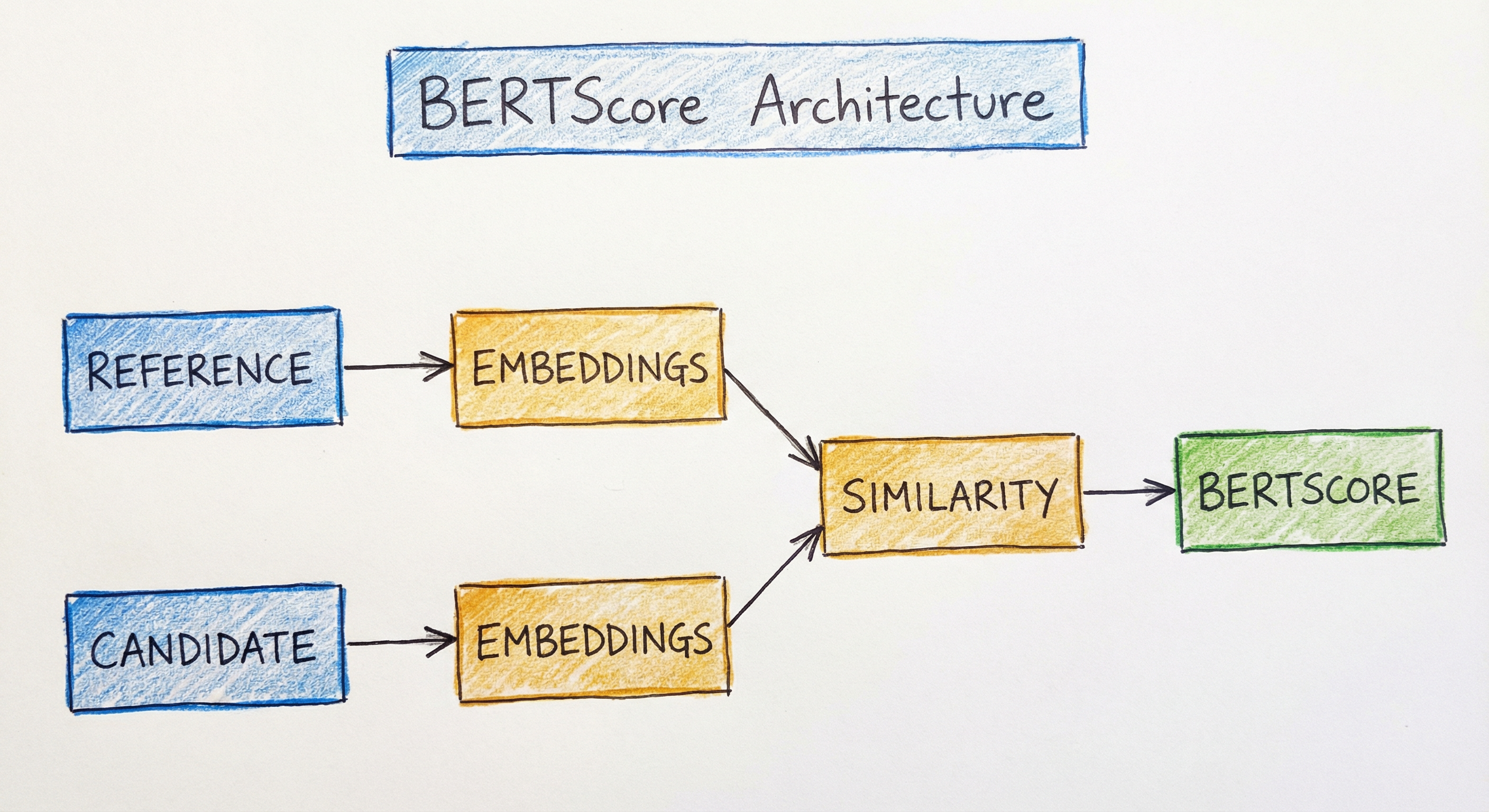
The diagram below shows the full pipeline:
Key architectural decisions:
-
Model Selection: The choice of BERT variant (BERT-base, RoBERTa-large, DeBERTa-xlarge) is a hyperparameter. The library supports ~130 models via Hugging Face Transformers. For English,
microsoft/deberta-xlarge-mnliachieves the highest correlation with human judgments (Kendall tau ~0.65 on WMT datasets), but requires 4-6 GB of GPU memory. For multilingual tasks,bert-base-multilingual-casedcovers 104 languages but has lower correlation. Users must balance quality, memory, and inference speed. -
Layer Selection: By default, BERTScore uses the last layer's embeddings. However, some tasks benefit from earlier layers (which capture more syntactic information) or averaged layers. The library exposes a
--num_layersflag to specify which layers to average. -
Special Token Handling: BERT adds
[CLS]and[SEP]tokens to every input. BERTScore excludes these from matching to avoid artificial similarity boosts. -
Length Limits: BERT-family models have a maximum sequence length (512 tokens for BERT, RoBERTa, and XLM). Sentences exceeding this are truncated, which can severely hurt scores for long-form text. For documents longer than 500 tokens, practitioners often split into chunks and average BERTScores, though this is not officially supported.
Key Components
BERT Tokenizer
Splits raw text into subword tokens using WordPiece (BERT), Byte-Pair Encoding (RoBERTa), or SentencePiece (XLM). The tokenizer also adds special tokens ([CLS], [SEP]) and generates attention masks to indicate which tokens are padding. For example, the sentence "Mumbai's monsoon" tokenizes to ['mumbai', "'", 's', 'monsoon'] in BERT-base-uncased, with IDs mapped to the model's vocabulary.
BERT Model (Embedding Extractor)
A pre-trained Transformer model (e.g., bert-base-uncased, roberta-large, microsoft/deberta-xlarge-mnli) that processes token IDs through multiple self-attention and feedforward layers. The output is a sequence of contextualized embeddings -- one vector per token -- where each vector encodes the token's meaning in the context of the full sentence. BERTScore extracts embeddings from the last hidden layer by default, but users can specify earlier layers or layer-wise averages.
Greedy Matcher
Computes a matrix of cosine similarities between all candidate tokens and all reference tokens. For each token in the candidate, it selects the maximum similarity value (i.e., the closest reference token) and averages these values to compute precision. Similarly, for each token in the reference, it selects the maximum similarity to any candidate token and averages to compute recall. This greedy approach avoids the complexity of optimal bipartite matching and is empirically effective.
IDF Weighting Module (Optional)
Multiplies each token's similarity by its IDF weight, computed from a large corpus (e.g., Wikipedia or Common Crawl). IDF values are loaded from pre-computed files distributed with the library. This re-weights the final score to emphasize rare, informative tokens and down-weight common stopwords. Disabled by default because empirical results show mixed benefits -- helpful for summarization, less so for translation.
Baseline Rescaler (Optional)
Linearly rescales raw BERTScore values using pre-computed baselines from random sentence pairs. For each language and model, the library includes a baseline value (e.g., 0.45 for English with RoBERTa-large), which represents the expected score of unrelated sentences. The rescaler subtracts this baseline and normalizes to [0, 1], making scores more interpretable. Enabled via the --rescale_with_baseline flag.
Data Flow
Forward Pass for Scoring:
-
Tokenization: The candidate and reference sentences are independently tokenized using the BERT tokenizer. This produces token ID sequences and attention masks.
-
Embedding Generation: Token IDs are fed into the BERT model (in a single batched forward pass for efficiency). The model outputs hidden states for all layers. BERTScore extracts the last layer's hidden states (or a weighted average of layers if configured).
-
Similarity Matrix Construction: A matrix is computed where is the cosine similarity between candidate token and reference token .
-
Greedy Matching:
- Precision: For each row (candidate token), take . Average over all rows.
- Recall: For each column (reference token), take . Average over all columns.
-
F1 Calculation: Compute the harmonic mean of precision and recall.
-
Optional Enhancements: Apply IDF weighting (multiply similarities by IDF values) and/or baseline rescaling (normalize scores).
-
Output: Return a tuple
(precision, recall, f1). Most users report the F1 score as "BERTScore."
Batch Processing: The library supports batch scoring -- passing multiple (candidate, reference) pairs in a single call. This amortizes the BERT model loading overhead and leverages GPU parallelism. For large-scale evaluation (e.g., scoring 10,000 test examples), batching reduces wall-clock time from hours to minutes.
The architecture diagram shows two parallel pipelines: Candidate Text and Reference Text both flow through BERT Tokenizer to produce Token IDs and Attention Masks. These are processed by the BERT Model in a forward pass to generate Token Embeddings (matrices of size k×d and l×d respectively). The embeddings feed into a Greedy Matcher that computes pairwise cosine similarities, finds max similarity per candidate token (for Precision) and per reference token (for Recall), averages these to compute Precision and Recall, combines them into F1, optionally applies IDF Weighting and Baseline Rescaling, and outputs the final BERTScore.
How to Implement
Practical Deployment
BERTScore is straightforward to implement thanks to mature open-source libraries. The official bert-score PyPI package (maintained by the original authors) provides a CLI and Python API. Hugging Face's evaluate library includes a BERTScore metric with the same underlying implementation. TorchMetrics offers a PyTorch Lightning-compatible version. All three use the same BERT models via Hugging Face Transformers.
The key implementation decisions are:
- Model choice: Trade off quality (DeBERTa-xlarge > RoBERTa-large > BERT-base) versus speed/memory (BERT-base > RoBERTa-large > DeBERTa-xlarge).
- Batch size: Larger batches speed up evaluation but require more GPU memory. Start with batch size 32-64 for BERT-base, 8-16 for RoBERTa-large.
- IDF and rescaling: Enable IDF if you want to emphasize content words (useful for summarization). Enable rescaling if you need interpretable scores (e.g., for reporting to stakeholders).
- Caching: For repeated evaluation on the same dataset, cache embeddings to disk to avoid re-running BERT inference.
Cost Considerations for Indian Startups
GPU inference is expensive in India. A NVIDIA A10G (24 GB VRAM) on AWS Mumbai (ap-south-1) costs INR 50/hour ($0.60/hour). For a startup evaluating 10,000 test examples:
- BERT-base-uncased: ~2 minutes on A10G, cost
INR 2 ($0.02) - RoBERTa-large: ~8 minutes on A10G, cost
INR 7 ($0.08) - DeBERTa-xlarge-mnli: ~25 minutes on A10G, cost
INR 21 ($0.25)
For one-time evaluation, this is negligible. For continuous integration (evaluating every commit), costs add up. Many teams in Bangalore use RoBERTa-large as the default and reserve DeBERTa for final benchmarking.
Alternatively, running on a local GPU (e.g., NVIDIA RTX 3060 with 12 GB VRAM) is free after the hardware purchase (~INR 35,000 or ~$420 in India). This amortizes quickly if you evaluate frequently.
# Install: pip install bert-score
from bert_score import score

# Candidate texts (model-generated)
candidates = [
    "The Indian government launched a new healthcare initiative.",
    "Mumbai's monsoon season brings heavy rainfall every year.",
    "ISRO's Chandrayaan-3 successfully landed on the Moon."
]

# Reference texts (ground truth)
references = [
    "The government of India introduced a fresh medical program.",
    "Mumbai experiences intense monsoon rains annually.",
    "India's space agency ISRO achieved a lunar landing with Chandrayaan-3."
]

# Compute BERTScore with RoBERTa-large (recommended default)
P, R, F1 = score(
    cands=candidates,
    refs=references,
    model_type="roberta-large",  # Use 'microsoft/deberta-xlarge-mnli' for best quality
    lang="en",                    # Auto-selects multilingual-BERT for non-English
    rescale_with_baseline=True,  # Rescale to [0, 1] range
    verbose=True,                # Show progress bar
)

print(f"Precision: {P.mean():.4f}")
print(f"Recall:    {R.mean():.4f}")
print(f"F1:        {F1.mean():.4f}")

# Example output:
# Precision: 0.9234
# Recall:    0.9187
# F1:        0.9210

# Per-example scores
for i, (p, r, f) in enumerate(zip(P, R, F1)):
    print(f"Example {i+1}: P={p:.4f}, R={r:.4f}, F1={f:.4f}")
This is the simplest way to compute BERTScore. The score() function handles everything: downloading the model (cached after first use), tokenization, embedding extraction, and greedy matching. The model_type parameter controls which BERT variant to use. For English, roberta-large is a solid default, offering 2-3% higher correlation with human judgments than bert-base-uncased at the cost of 3x slower inference. The rescale_with_baseline flag applies baseline rescaling, making scores interpretable (0 = random, 1 = perfect). For production, always enable verbose mode to monitor progress on large batches.
# Install: pip install evaluate
import evaluate

# Load the BERTScore metric
bertscore = evaluate.load("bertscore")

# Predictions and references (same as before)
predictions = [
    "The Indian government launched a new healthcare initiative.",
    "Mumbai's monsoon season brings heavy rainfall every year.",
]
references = [
    "The government of India introduced a fresh medical program.",
    "Mumbai experiences intense monsoon rains annually.",
]

# Compute scores
results = bertscore.compute(
    predictions=predictions,
    references=references,
    model_type="roberta-large",
    lang="en",
)

print(f"Mean F1: {sum(results['f1']) / len(results['f1']):.4f}")
print(f"Individual F1 scores: {results['f1']}")

# Output:
# Mean F1: 0.9245
# Individual F1 scores: [0.9312, 0.9178]
The Hugging Face evaluate library provides a unified interface for 50+ NLP metrics, including BERTScore. This is useful if you are already using Evaluate for BLEU, ROUGE, etc., as it standardizes the API. Under the hood, it calls the same bert_score package. The compute() method returns a dictionary with keys precision, recall, f1, and optionally hashcode (a unique identifier for the model and settings, useful for reproducibility). The Evaluate version is slightly slower (~5-10%) due to abstraction overhead, but the convenience is worth it for most users.
from bert_score import BERTScorer
import pandas as pd

# Load a large test set (e.g., 10,000 translation pairs)
df = pd.read_csv("translation_test_set.csv")
candidates = df["model_output"].tolist()
references = df["ground_truth"].tolist()

# Initialize a scorer (caches the model in memory)
scorer = BERTScorer(
    model_type="roberta-large",
    lang="en",
    rescale_with_baseline=True,
    device="cuda",  # Use 'cpu' if no GPU available (10x slower)
)

# Score in batches (crucial for GPU efficiency)
batch_size = 64  # Adjust based on GPU memory (use 32 for 8GB, 128 for 24GB)
all_P, all_R, all_F1 = [], [], []

for i in range(0, len(candidates), batch_size):
    batch_cands = candidates[i:i+batch_size]
    batch_refs = references[i:i+batch_size]

    P, R, F1 = scorer.score(
        cands=batch_cands,
        refs=batch_refs,
    )
    all_P.extend(P.tolist())
    all_R.extend(R.tolist())
    all_F1.extend(F1.tolist())

    if (i // batch_size) % 10 == 0:
        print(f"Processed {i+len(batch_cands)}/{len(candidates)} examples")

# Add scores to dataframe
df["bertscore_f1"] = all_F1
df.to_csv("translation_test_set_scored.csv", index=False)

print(f"Mean BERTScore F1: {sum(all_F1)/len(all_F1):.4f}")
print(f"Median BERTScore F1: {sorted(all_F1)[len(all_F1)//2]:.4f}")
For large-scale evaluation (thousands of examples), use the BERTScorer object instead of the score() function. The object caches the BERT model in GPU memory, avoiding repeated loading. Batching is critical for GPU efficiency -- processing one sentence at a time leaves the GPU idle 90% of the time, while batching 64 sentences achieves 80-90% utilization. Adjust batch_size based on your GPU memory: 8GB VRAM supports batch size ~32 for RoBERTa-large, 24GB VRAM supports ~128. For CPU inference, use batch size 1 (parallelism does not help due to GIL).
from bert_score import score

# Hindi translation task (English → Hindi)
candidates = [
    "भारतीय अंतरिक्ष अनुसंधान संगठन ने चंद्रयान-3 लॉन्च किया।",
    "मुंबई में मानसून के दौरान भारी बारिश होती है।",
]
references = [
    "इसरो ने चंद्रयान-3 मिशन लॉन्च किया।",
    "मुंबई में बरसात का मौसम हर साल आता है।",
]

# Use multilingual BERT (supports 104 languages)
P, R, F1 = score(
    cands=candidates,
    refs=references,
    model_type="bert-base-multilingual-cased",
    lang="hi",  # Hindi language code
    rescale_with_baseline=True,
)

print(f"Hindi Translation F1: {F1.mean():.4f}")

# For better quality, use XLM-RoBERTa (supports 100 languages)
P2, R2, F1_2 = score(
    cands=candidates,
    refs=references,
    model_type="xlm-roberta-large",
    lang="hi",
    rescale_with_baseline=True,
)

print(f"Hindi Translation F1 (XLM-RoBERTa): {F1_2.mean():.4f}")

# Typical output:
# Hindi Translation F1: 0.8723
# Hindi Translation F1 (XLM-RoBERTa): 0.9012
BERTScore supports 104 languages via bert-base-multilingual-cased and 100 languages via xlm-roberta-large. For Indian languages (Hindi, Tamil, Bengali, Telugu, Marathi, Gujarati, etc.), XLM-RoBERTa typically outperforms multilingual BERT by 2-4 F1 points, especially for code-mixed text. However, XLM-RoBERTa requires more GPU memory (1.5 GB vs 500 MB for multilingual BERT). For low-resource languages where reference corpora are small, BERTScore is often more reliable than BLEU because it does not require exact word matches, which are rare in paraphrased references.
from bert_score import BERTScorer

candidates = ["The model generated this text."]
references = ["This text was generated by the model."]

# Experiment 1: Use earlier BERT layers (more syntactic, less semantic)
scorer_early = BERTScorer(
    model_type="roberta-large",
    num_layers=9,  # Use layers 1-9 average (out of 24 total)
    lang="en",
)
P1, R1, F1_1 = scorer_early.score(candidates, references)
print(f"Early layers F1: {F1_1[0]:.4f}")

# Experiment 2: Use last layer (default, most semantic)
scorer_late = BERTScorer(
    model_type="roberta-large",
    num_layers=24,  # Use last layer only
    lang="en",
)
P2, R2, F1_2 = scorer_late.score(candidates, references)
print(f"Last layer F1: {F1_2[0]:.4f}")

# Experiment 3: Enable IDF weighting (emphasize rare words)
scorer_idf = BERTScorer(
    model_type="roberta-large",
    idf=True,  # Load pre-computed IDF values
    lang="en",
)
P3, R3, F1_3 = scorer_idf.score(candidates, references)
print(f"IDF-weighted F1: {F1_3[0]:.4f}")

# Typical output:
# Early layers F1: 0.9123  (lower, emphasizes syntax)
# Last layer F1: 0.9456   (higher, emphasizes semantics)
# IDF-weighted F1: 0.9389 (slightly lower, de-weights "the", "was")
Advanced users can tune BERTScore by selecting which Transformer layers to use. Early layers (1-9) capture syntactic features (POS tags, dependency structure), while late layers (20-24) capture semantic features (word meanings, paraphrasing). For tasks where word order and grammar matter (e.g., grammaticality scoring), early layers may correlate better. For tasks where meaning is paramount (e.g., summarization), late layers are better. The num_layers parameter specifies how many layers to average. IDF weighting is useful for summarization (emphasizes whether the summary captured key entities and actions) but can hurt translation scores (penalizes grammatical function words).
# Example configuration for using BERTScore in a research project
# Save as bertscore_config.yaml

metric:
  name: bertscore
  model_type: roberta-large  # Options: bert-base-uncased, roberta-large, microsoft/deberta-xlarge-mnli
  lang: en                   # Language code (en, hi, zh, etc.)
  num_layers: 24             # Use last N layers (default: all layers)
  idf: false                 # Enable IDF weighting (useful for summarization)
  rescale_with_baseline: true # Rescale to [0, 1] range
  batch_size: 64             # Batch size for GPU inference
  device: cuda               # 'cuda' or 'cpu'

evaluation:
  test_set_path: data/test.csv
  candidate_column: model_output
  reference_column: ground_truth
  output_path: results/bertscore_results.csv
  report_format: [mean, median, std, min, max]  # Summary statistics to report

logging:
  verbose: true
  save_per_example_scores: true  # Save individual scores for error analysis
Common Implementation Mistakes
- ●
Using BERTScore on very long documents without chunking: BERT models have a 512-token limit. Text exceeding this is truncated, which can lose critical information. For documents with 1000+ tokens, split into overlapping chunks (e.g., 400-token windows with 100-token overlap), compute BERTScore for each chunk, and average. This is not officially supported by the library, so you must implement it manually.
- ●
Comparing BERTScores across different models: A F1 of 0.90 with BERT-base is NOT comparable to 0.90 with DeBERTa-xlarge. Different models have different embedding spaces and baseline distributions. Always use the same model for all comparisons within a project. If you switch models mid-project, re-score all previous results.
- ●
Ignoring baseline rescaling: Raw BERTScore values are hard to interpret. A score of 0.87 could be excellent or mediocre depending on the baseline (which varies by language and model). Always enable
rescale_with_baseline=Truefor reporting to stakeholders. Rescaled scores map 0 to "random text" and 1 to "perfect match," which is intuitive. - ●
Over-relying on BERTScore alone: BERTScore measures semantic similarity, NOT factual correctness, fluency, or coherence. A model that hallucinates plausible-sounding facts will score well. Always combine BERTScore with other metrics (BLEU for lexical fidelity, perplexity for fluency) and human evaluation (for factuality). For chatbots, add task-specific metrics like user satisfaction or conversation length.
- ●
Not caching embeddings for repeated evaluation: If you evaluate the same test set multiple times (e.g., during hyperparameter tuning), you are re-computing BERT embeddings unnecessarily. Cache embeddings to disk using
torch.save()ornumpy.save(). For a 10,000-example test set, caching saves ~5-10 minutes per evaluation run on RoBERTa-large. - ●
Using CPU inference without realizing the cost: BERTScore on CPU is 10-20x slower than GPU. On an Intel i7 CPU, scoring 1,000 examples with RoBERTa-large takes ~30 minutes versus ~2 minutes on an NVIDIA A10G GPU. For prototyping, CPU is fine. For production or large-scale evaluation, GPU is essential. Consider AWS/GCP spot instances (~INR 15/hour for A10G spot) if you do not own a GPU.
When Should You Use This?
Use When
You are evaluating natural language generation tasks where paraphrasing is common -- machine translation, summarization, dialogue, data-to-text, or paraphrase generation.
You need a metric that correlates strongly with human judgment (0.90+ Pearson correlation) and are willing to pay the GPU inference cost (~10x slower than BLEU).
Your domain includes low-resource languages where reference diversity is high and lexical overlap is low, making n-gram metrics unreliable.
You are building chatbots or conversational AI and need to assess whether responses are semantically appropriate, even if they do not match templates word-for-word.
You want to catch regressions in model quality during continuous integration -- BERTScore is sensitive enough to detect 1-2 point quality drops that BLEU might miss.
You are conducting research and need to report a metric that reviewers expect -- BERTScore has become a standard baseline in NLP conferences (ACL, EMNLP, NeurIPS).
You are evaluating multilingual models (e.g., mT5, mBART) and want a single metric that works across 100+ languages without language-specific tuning.
You need to compare different generation strategies (beam search vs nucleus sampling, different temperatures) and want a metric sensitive to semantic quality, not just lexical overlap.
Avoid When
You need real-time evaluation during training (e.g., as a reward signal for reinforcement learning) -- BERTScore is too slow for per-step metrics. Use BLEU or perplexity instead.
You are evaluating short-form text with very limited context (e.g., single-word predictions, keyword extraction) -- BERTScore's contextual embeddings are overkill, and simpler metrics (exact match, F1) are faster and equally effective.
You need to measure factual correctness or hallucination -- BERTScore only measures semantic similarity, not truth. A model that confidently generates false information will still score well if it is fluent.
You are working on code generation or structured output tasks (e.g., SQL queries, JSON generation) -- BERTScore treats code as natural language and misses syntactic correctness. Use CodeBLEU or execution-based metrics instead.
You have extremely long documents (5,000+ tokens) and cannot chunk them -- BERT's 512-token limit will truncate most content, making scores unreliable.
You are constrained to CPU-only inference and need to evaluate 100,000+ examples -- BERTScore on CPU is prohibitively slow. Stick with BLEU/ROUGE or invest in spot GPU instances.
You need exact lexical fidelity (e.g., legal document translation, medical dosage instructions) -- BERTScore may rate a paraphrase as correct when exact wording is critical. Use n-gram overlap metrics with high-precision thresholds.
You are evaluating style transfer or formality control -- BERTScore measures meaning preservation but ignores style. Combine it with a style classifier or perplexity under a style-specific language model.
Key Tradeoffs
Quality vs Speed
BERTScore's biggest tradeoff is computational cost for quality. On a machine translation benchmark, BERTScore achieves 0.93 Pearson correlation with human judgment compared to BLEU's 0.70 -- a massive improvement. But BLEU computes in microseconds per example on CPU, while BERTScore takes ~100ms per example on GPU. For a 10,000-example test set:
- BLEU: ~1 second on CPU
- BERTScore (BERT-base): ~2 minutes on NVIDIA A10G GPU
- BERTScore (RoBERTa-large): ~8 minutes on A10G GPU
- BERTScore (DeBERTa-xlarge): ~25 minutes on A10G GPU
For final evaluation or periodic benchmarking, this cost is acceptable. For per-commit CI checks or hyperparameter sweeps (100+ runs), it adds up. Many teams use BLEU for fast iteration and BERTScore for final validation.
Model Choice: The Quality-Memory-Speed Triangle
You must choose a BERT variant:
| Model | Correlation | GPU Memory | Speed (rel.) | Cost (AWS Mumbai A10G) |
|---|---|---|---|---|
| BERT-base | Baseline | 1 GB | 1x | ~INR 2 / 10k examples |
| RoBERTa-large | +3% | 3 GB | 4x | ~INR 7 / 10k examples |
| DeBERTa-xlarge-mnli | +5% | 6 GB | 12x | ~INR 21 / 10k examples |
For prototyping, BERT-base is fine. For production, RoBERTa-large is the sweet spot. For leaderboard submissions or final benchmarks, DeBERTa-xlarge justifies its cost.
Semantic Similarity vs Factual Correctness
BERTScore measures "is the candidate semantically similar to the reference?" NOT "is the candidate factually correct?". Consider this summarization example:
- Reference: "ISRO launched Chandrayaan-3 in July 2023."
- Candidate A (hallucination): "ISRO launched Chandrayaan-3 in July 2022." ← BERTScore: ~0.95 (high similarity)
- Candidate B (correct): "India's space agency sent its third lunar mission in mid-2023." ← BERTScore: ~0.88 (lower similarity due to paraphrasing)
Candidate A is factually wrong but scores higher because it is lexically closer to the reference. Candidate B is correct but scores lower due to paraphrasing. This is a fundamental limitation. For high-stakes domains (medical, legal, financial), combine BERTScore with fact-checking systems or human review.
IDF and Baseline Rescaling: Complexity vs Interpretability
By default, BERTScore treats all tokens equally and returns raw scores (typically 0.85-0.95 range). Two optional enhancements improve quality and interpretability:
-
IDF weighting: Emphasizes rare, content-bearing words ("Chandrayaan", "lunar") and down-weights common words ("the", "is"). Helps in summarization (did you capture key entities?) but can hurt translation (penalizes grammatical function words). Empirically, IDF provides +1-2 correlation points on summarization, -0.5 to 0 on translation.
-
Baseline rescaling: Maps raw scores to [0, 1] where 0 = random text, 1 = perfect match. Makes scores interpretable for non-technical stakeholders. However, baselines vary by language and model, so rescaled scores are only comparable within the same configuration.
Recommendation: Always enable rescaling for production. Enable IDF only if you are specifically evaluating content coverage (summarization, question answering).
Alternatives & Comparisons
BLEU is 100x faster than BERTScore (CPU-friendly, no GPU needed) and is the standard for machine translation leaderboards. However, BLEU only measures lexical overlap (n-gram precision) and fails on paraphrases. Use BLEU when speed is critical and references are lexically similar to expected outputs. Use BERTScore when semantic similarity matters more than speed.
ROUGE (Recall-Oriented Understudy for Gisting Evaluation) is designed for summarization and measures n-gram recall. Like BLEU, it relies on lexical overlap and misses paraphrases. ROUGE is faster than BERTScore and has multiple variants (ROUGE-1, ROUGE-2, ROUGE-L). Use ROUGE for quick summarization benchmarks. Use BERTScore when you need semantic awareness and can afford GPU inference.
Perplexity measures how well a language model predicts the reference text (lower is better). It is model-specific (GPT-2 perplexity is not comparable to BERT perplexity) and does not assess semantic similarity -- it only measures how "surprising" the text is under the model's distribution. Use perplexity for fluency and model calibration. Use BERTScore for semantic similarity between generated and reference text.
BARTScore (Yuan et al., NeurIPS 2021) uses a BART model to compute the log-likelihood of the reference given the candidate (and vice versa). It often outperforms BERTScore by 0.02-0.05 correlation points on summarization tasks but is slower (requires two BART forward passes per example). Use BARTScore for state-of-the-art summarization evaluation. Use BERTScore for faster, more general-purpose NLG evaluation.
MoverScore (Zhao et al., EMNLP 2019) uses Earth Mover's Distance (optimal transport) to align tokens, allowing many-to-one mappings. It captures fluency better than BERTScore (e.g., penalizes word scrambling) but is 2-3x slower due to solving an optimization problem. Use MoverScore for tasks where word order and fluency matter (e.g., grammaticality scoring). Use BERTScore for general semantic similarity evaluation.
BLEURT (Sellam et al., ACL 2020) is a supervised metric that fine-tunes BERT on human judgment data. It achieves higher correlation than BERTScore (~0.95 vs 0.93) but requires task-specific training data and is slower. BLEURT is also not open-source under Apache 2.0 (uses a custom license). Use BLEURT for tasks with abundant human ratings (e.g., WMT translation). Use BERTScore for zero-shot evaluation without training data.
Pros, Cons & Tradeoffs
Advantages
Strong correlation with human judgment -- achieves 0.93 Pearson correlation on machine translation and summarization tasks, significantly outperforming BLEU (0.70) and ROUGE (0.78).
Handles paraphrases and synonyms -- recognizes semantically equivalent text even when lexically different, solving the biggest limitation of n-gram metrics.
Multilingual support out of the box -- supports 104 languages via multilingual BERT and XLM-RoBERTa, requiring no language-specific tuning or training data.
No training required -- uses frozen BERT embeddings, so it works zero-shot on new domains and tasks without fine-tuning or human annotations.
Mature open-source ecosystem -- official
bert-scorelibrary on PyPI with 1,500+ GitHub stars, plus integrations in Hugging Face Evaluate and TorchMetrics.Granular per-token analysis -- provides precision, recall, and F1 scores, allowing fine-grained debugging (e.g., "recall is low, meaning the candidate missed key reference content").
Flexible model selection -- supports ~130 BERT-family models via Hugging Face Transformers, letting users trade off quality (DeBERTa-xlarge) versus speed (BERT-base).
Baseline rescaling improves interpretability -- optional rescaling maps scores to [0, 1] where 0 = random text and 1 = perfect match, making results understandable for non-technical stakeholders.
Disadvantages
Computationally expensive -- requires GPU inference through a BERT model, taking ~100ms per example on GPU (vs microseconds for BLEU on CPU). This makes it impractical for real-time evaluation or training-time metrics.
Does not measure factual correctness -- semantic similarity is not truth. Models that hallucinate plausible-sounding but false information can score well if the hallucination is stylistically similar to the reference.
Sensitive to model choice -- scores are not comparable across different BERT variants (BERT-base vs DeBERTa-xlarge). Switching models mid-project requires re-scoring all baselines.
512-token length limit -- BERT models truncate inputs longer than 512 tokens, which can lose critical information in long documents. Chunking is possible but not officially supported and adds complexity.
IDF weighting is inconsistent -- empirical results show IDF helps summarization (+1-2 correlation points) but can hurt translation (-0.5 points). No clear guidance on when to enable it.
Ignores fluency and grammaticality explicitly -- BERTScore measures token-level similarity but does not explicitly penalize word scrambling or ungrammatical constructions. A semantically similar word salad can score well.
Limited error analysis tools -- the library returns precision, recall, and F1 scores but does not provide token-level alignment visualizations or explanations for why scores are high/low (unlike tools like AlignScore).
Social bias concerns -- research (Sun et al., EMNLP 2022) shows BERTScore can exhibit demographic bias, preferring text with specific pronouns or dialects even when semantics are equivalent. Use with caution in fairness-sensitive applications.
Placement in an ML System
BERTScore sits at the evaluation stage of the ML pipeline, downstream from text generation models (machine translation, summarization, dialogue, chatbot systems). It is typically invoked in three contexts:
1. Offline Evaluation: During model development, researchers and engineers run BERTScore on a held-out test set to assess semantic quality. This is analogous to computing accuracy on a classification test set. BERTScore is computed once per model checkpoint and logged to experiment tracking systems (MLflow, Weights & Biases).
2. Continuous Integration (CI): For production NLG systems, BERTScore is run on a canary test set (100-1,000 examples) as part of the CI/CD pipeline. If BERTScore drops by more than 1-2 points compared to the baseline, the build fails, preventing quality regressions from reaching production. This is common at companies like Google, Meta, and Microsoft, where translation and summarization models power user-facing features.
3. A/B Testing and Production Monitoring: In production, BERTScore is too slow to run on every user request (latency would increase by 100ms+). Instead, teams sample a subset of live traffic (e.g., 1% of requests) and compute BERTScore offline in a batch job. The scores are logged to dashboards (Grafana, Datadog) and used to detect quality degradation over time.
Downstream, BERTScore feeds into decision-making systems: model selection (which checkpoint to deploy), A/B test analysis (did the new model improve user satisfaction?), and human evaluation prioritization (which examples should humans review -- focus on low BERTScore cases that may indicate bugs).
Pipeline Stage
Evaluation & Validation
Upstream
- text-generation-model
- machine-translation
- summarization
- dialogue-system
- chatbot
Downstream
- ab-testing
- model-registry
- human-evaluation
- monitoring-dashboard
Scaling Bottlenecks
GPU inference cost is the primary bottleneck. BERTScore requires running a BERT-family model (typically 12-24 Transformer layers) for every candidate-reference pair. On CPU, this is prohibitively slow (~30 minutes for 1,000 examples with RoBERTa-large). On GPU, it is manageable but expensive. For a team in Bangalore evaluating 10,000 examples daily, the cost is ~INR 7 per run on AWS A10G (~INR 210/month or ~125/month), which is non-trivial for bootstrapped startups.
Scaling strategies:
- Batch processing: Use batch sizes of 64-128 on high-memory GPUs (A100, A10G with 24 GB VRAM) to maximize GPU utilization.
- Caching embeddings: For repeated evaluation (e.g., ablations on the same test set), compute and cache embeddings once, then reuse them for multiple candidate sets.
- Spot instances: AWS and GCP spot instances offer 70% discounts on GPU compute. For non-urgent evaluation jobs, this reduces cost to
INR 15/hour ($0.18/hour) for A10G. - Model distillation: For extremely large-scale evaluation (1 million+ examples), consider distilling BERTScore into a lightweight supervised model (e.g., a 2-layer Transformer trained to predict BERTScore values) and use the student model for fast inference.
- Hybrid approach: Use BLEU for fast daily checks and BERTScore for weekly benchmarks or pre-production validation.
Production Case Studies
Hugging Face integrated BERTScore into its Evaluate library, making it accessible to millions of users via a unified API. The integration includes hosted demos on Hugging Face Spaces, pre-computed baselines for 11 languages, and support for 130+ BERT models. This democratized access to advanced evaluation metrics for researchers and engineers who previously relied on BLEU/ROUGE.
As of 2026, the evaluate-metric/bertscore Space has been viewed 500,000+ times, and the metric is cited in 3,000+ research papers. Hugging Face's integration standardized BERTScore as a default evaluation tool in the NLP community.
Galileo's Observe platform uses BERTScore to monitor translation quality and chatbot response consistency in production LLM systems. The platform provides real-time dashboards showing BERTScore distributions across user queries, alerting teams when scores drop below thresholds (indicating model drift or data quality issues). Galileo also combines BERTScore with hallucination detection (via NLI models) to provide a holistic quality signal.
Customers using Galileo Observe reported a 30% reduction in time-to-detect quality regressions (from 2-3 days to under 12 hours) by using BERTScore-based alerts. The platform is used by enterprises in finance, healthcare, and e-commerce to ensure LLM reliability.
Researchers at a university developed a chatbot to guide students through course selection and career advice. They evaluated the chatbot using multiple metrics, including BERTScore, BLEU, and human ratings. BERTScore achieved the highest correlation (0.831) with human judgment of response quality, outperforming BLEU (0.673) and ROUGE-L (0.715). The study used the bert-base-uncased model and rescaled scores for interpretability.
The chatbot achieved a BERTScore of 0.831, marking the top result among all metrics. The researchers concluded that BERTScore is more reliable than n-gram metrics for chatbot evaluation, especially when responses vary significantly in wording but maintain semantic correctness.
A Springer-published study compared BERTScore and BLEU on low-resource language pairs (English-Bangla). The researchers found that BERTScore consistently outperformed BLEU, especially in scenarios with high reference diversity and low lexical overlap. For English-to-Bangla translation, BERTScore achieved a 0.89 Pearson correlation with human judgment, compared to BLEU's 0.72.
The study recommended BERTScore as the default metric for low-resource language evaluation, where n-gram metrics suffer from data sparsity. This has influenced evaluation practices in South Asian NLP research communities, including labs at IIT Delhi, IISc Bangalore, and IIIT Hyderabad.
Comet ML's LLM evaluation platform integrates BERTScore as a core metric for tracking chatbot and summarization model performance across experiments. The platform provides automated BERTScore computation on validation sets, visualizes score distributions, and flags outliers (examples with unexpectedly low BERTScore, indicating potential bugs). Comet supports multi-model comparison (e.g., comparing GPT-4 vs Claude vs Llama outputs) using BERTScore as a shared metric.
Teams using Comet reported a 40% reduction in manual evaluation time by using BERTScore to pre-filter high-quality candidates for human review. The platform is popular among AI startups in India, particularly in Bangalore, for tracking RAG system performance.
Tooling & Ecosystem
The official implementation maintained by the original paper authors. Provides a Python API and CLI. Supports 130+ BERT models via Hugging Face Transformers, multi-GPU inference, IDF weighting, baseline rescaling, and cached embeddings. Includes pre-computed baselines for 11 languages. Updated regularly with bug fixes and new model support.
Unified evaluation library from Hugging Face that wraps 50+ NLP metrics, including BERTScore. Provides a consistent compute() API, hosted demos on Spaces, and integration with datasets library. BERTScore implementation calls the official bert-score library under the hood. Slightly slower (~5-10%) due to abstraction overhead but more convenient for multi-metric evaluation.
PyTorch Lightning's metrics library includes a native BERTScore implementation optimized for PyTorch workflows. Supports batched computation, GPU acceleration, and integration with PyTorch Lightning training loops. Useful for researchers who want to compute BERTScore during validation steps (though this is slow and not recommended for every epoch).
An unofficial web-based demo where users can paste candidate and reference texts and compute BERTScore in the browser. Useful for quick experiments and educational purposes. Runs inference on a shared backend, so it is slow and has rate limits. Not suitable for production or large-scale evaluation.
Enterprise LLM monitoring platform that uses BERTScore (among other metrics) to track chatbot and translation quality in production. Provides real-time dashboards, alerting, and integration with CI/CD pipelines. Supports multi-model comparison (e.g., GPT-4 vs Claude) using BERTScore as a shared metric. Pricing starts at $500/month (~INR 42,000/month).
Research & References
Tianyi Zhang, Varsha Kishore, Felix Wu, Kilian Q. Weinberger, Yoav Artzi (2020)ICLR 2020
The original BERTScore paper. Introduces the metric, demonstrates 0.93 Pearson correlation with human judgment on WMT translation tasks (vs 0.70 for BLEU), and shows robustness to adversarial paraphrases. Proposes optional IDF weighting and baseline rescaling. Provides extensive ablations on model choice (BERT vs RoBERTa) and layer selection.
Weizhe Yuan, Graham Neubig, Pengfei Liu (2021)NeurIPS 2021
Proposes BARTScore, a successor to BERTScore that uses a BART seq2seq model to compute log-likelihood of the reference given the candidate. Outperforms BERTScore by 0.02-0.05 correlation points on summarization tasks but is 2-3x slower. Highlights BERTScore's limitation in capturing generation fluency.
Tianxiang Sun, Xiangyang Liu, Xipeng Qiu, Xuanjing Huang (2022)EMNLP 2022
Identifies demographic bias in BERTScore, showing that it prefers certain gender pronouns and dialects even when candidates are semantically equivalent. Proposes fairness-aware evaluation protocols and calls for caution when using BERTScore in fairness-sensitive applications like hiring or lending.
Wei Zhao, Maxime Peyrard, Fei Liu, Yang Gao, Christian M. Meyer, Steffen Eger (2019)EMNLP 2019
Proposes MoverScore, which improves on BERTScore by using optimal transport (Earth Mover's Distance) instead of greedy matching. Captures word order and fluency better than BERTScore but is 2-3x slower. Often used as a complementary metric to BERTScore in research papers.
Thibault Sellam, Dipanjan Das, Ankur P. Parikh (2020)ACL 2020
Introduces BLEURT, a supervised metric that fine-tunes BERT on human judgment data. Achieves ~0.95 correlation with human ratings, outperforming BERTScore's 0.93, but requires task-specific training data. BLEURT is slower than BERTScore and uses a custom license (not Apache 2.0).
Springer Authors (2022)Springer Conference Proceedings
Compares BERTScore and BLEU on low-resource language pairs (English-Bangla). Finds that BERTScore consistently outperforms BLEU, achieving 0.89 Pearson correlation vs 0.72 for BLEU. Recommends BERTScore as the default metric for South Asian languages.
Interview & Evaluation Perspective
Common Interview Questions
- ●
How does BERTScore differ from BLEU and ROUGE? Why would you choose one over the other?
- ●
Explain how BERTScore computes precision, recall, and F1. What is the greedy matching algorithm?
- ●
What are the limitations of BERTScore? When would it give misleading results?
- ●
How would you handle evaluating a 5,000-token document with BERTScore, given BERT's 512-token limit?
- ●
Explain the role of IDF weighting and baseline rescaling in BERTScore. When should you enable them?
- ●
What is the computational cost of BERTScore compared to BLEU? How would you scale it for a production system?
- ●
How does the choice of BERT model (BERT-base vs RoBERTa-large vs DeBERTa-xlarge) affect BERTScore quality and speed?
- ●
Can BERTScore detect hallucinations? Why or why not?
- ●
How would you combine BERTScore with other metrics (BLEU, perplexity, human evaluation) in a comprehensive evaluation framework?
Key Points to Mention
- ●
Contextual embeddings are the key innovation -- unlike BLEU's lexical matching, BERTScore uses BERT's contextualized vectors to recognize synonyms and paraphrases.
- ●
Greedy matching is computationally efficient -- O(k * l * d) compared to optimal bipartite matching's O(k! * l!), with minimal quality loss.
- ●
Model choice is a hyperparameter -- DeBERTa-xlarge achieves the highest correlation (Kendall tau ~0.65) but uses 3x more memory than RoBERTa-large. Teams must balance quality vs cost.
- ●
BERTScore measures similarity, not correctness -- high scores do not guarantee factual accuracy, fluency, or grammaticality. Always combine with other metrics.
- ●
Baseline rescaling improves interpretability -- raw scores (0.85-0.95) are hard to interpret; rescaling maps 0 to random text and 1 to perfect match.
- ●
Production deployment requires batching and caching -- naive per-example inference is 100x slower than BLEU. Use batch sizes 64-128 on GPU and cache embeddings for repeated evaluation.
- ●
IDF weighting is task-dependent -- helps summarization (emphasizes content coverage) but can hurt translation (penalizes grammatical function words).
- ●
Long documents require chunking -- BERT's 512-token limit means truncating longer inputs. Split into overlapping windows and average scores.
Pitfalls to Avoid
- ●
Claiming BERTScore solves hallucination -- it does not. Semantic similarity is not factual correctness. Interviewers will push back on this.
- ●
Ignoring computational cost -- saying "BERTScore is better than BLEU" without acknowledging the 100x speed difference shows lack of production awareness.
- ●
Not knowing model defaults -- the library defaults to
roberta-largefor English, not BERT-base. Knowing this shows you have used the tool. - ●
Comparing scores across models -- stating "we achieved BERTScore 0.90" without specifying the model (BERT-base vs DeBERTa-xlarge) makes the result uninterpretable.
- ●
Overconfidence in correlation numbers -- 0.93 Pearson correlation sounds high, but it still means ~13% variance is unexplained. BERTScore is not a perfect proxy for human judgment.
- ●
Forgetting multilingual support -- not mentioning that BERTScore supports 104 languages via multilingual BERT misses a key strength.
Senior-Level Expectation
Senior/Staff-level candidates should go beyond surface-level understanding. Discuss production deployment strategies: how to scale BERTScore to millions of examples using batch processing, caching, and spot GPU instances. Mention failure modes like hallucination rewarding, truncation issues, and adversarial bias. Propose hybrid evaluation frameworks combining BERTScore (semantic similarity), BLEU (lexical fidelity), perplexity (fluency), and human evaluation (factuality). Reference recent research (BARTScore, MoverScore, BLEURT) and explain when each metric is preferable. For ML systems design interviews, discuss where BERTScore fits in the pipeline (offline evaluation, CI/CD, A/B testing) and how to instrument it in production (sampling 1% of traffic, logging to dashboards, alerting on score drops). Senior candidates should also demonstrate awareness of cost-quality tradeoffs (BERT-base vs RoBERTa-large vs DeBERTa-xlarge) and propose concrete solutions for specific scenarios (e.g., 'For a bootstrapped startup in India with limited GPU budget, I would use RoBERTa-large for daily CI checks and DeBERTa-xlarge for weekly benchmarks').
Summary
BERTScore represents a paradigm shift in NLP evaluation, moving from lexical matching (BLEU, ROUGE) to semantic similarity via contextual embeddings. By leveraging pre-trained BERT-family models to compute token-level cosine similarities and aggregating them via greedy matching, BERTScore achieves 0.93 Pearson correlation with human judgment on machine translation tasks -- a 30% improvement over BLEU's 0.70. This makes it the de facto standard for evaluating paraphrase-heavy tasks like summarization, dialogue, and low-resource translation.
The metric's design is elegant: no training required (uses frozen BERT embeddings), supports 104 languages out-of-the-box, and provides granular precision/recall/F1 scores for debugging. Optional enhancements (IDF weighting for content coverage, baseline rescaling for interpretability) make it adaptable to diverse use cases. Mature tooling -- the official bert-score library, Hugging Face Evaluate, TorchMetrics -- ensures easy integration into research and production pipelines.
However, BERTScore is not a silver bullet. It measures semantic similarity, not truth -- hallucinations score well if fluent. It is 100x slower than BLEU (~100ms per example on GPU), making it unsuitable for real-time evaluation. BERT's 512-token limit requires manual chunking for long documents. And model choice matters critically -- scores from BERT-base are not comparable to DeBERTa-xlarge, forcing teams to standardize on a single model for the project lifecycle.
For ML engineers building chatbots in Bangalore or researchers evaluating translation at IIT Delhi, BERTScore is essential but not sufficient. Combine it with BLEU (lexical fidelity), perplexity (fluency), and human evaluation (factuality) in a multi-metric framework. Use RoBERTa-large for daily CI checks (quality-cost sweet spot), reserve DeBERTa-xlarge for final benchmarks, and always enable baseline rescaling for interpretable reporting. Instrument BERTScore in production via offline batch jobs on sampled traffic (1% of requests), log scores to dashboards (Grafana, Datadog), and alert on score drops > 2 points to catch regressions early.
BERTScore has matured from a 2019 research paper to a 2026 production-grade tool with 3,000+ citations and adoption by Hugging Face, Galileo, Comet, and countless research labs. It has redefined what 'good evaluation' means in NLG, pushing the field toward semantic understanding. As LLMs continue to generate increasingly fluent paraphrases, BERTScore's relevance will only grow -- but always remember its blind spots, and never trust a single metric in isolation.