Calinski-Harabasz in Machine Learning
The Calinski-Harabasz Index (CH Index), also known as the Variance Ratio Criterion (VRC), is one of the fastest and most intuitive internal metrics for evaluating clustering quality. Proposed by Tadeusz Calinski and Jerzy Harabasz in their seminal 1974 paper "A Dendrite Method for Cluster Analysis," it asks a deceptively simple question: how much of the total variance in your data is explained by the cluster structure?
The core idea is elegant. Good clusters are tight internally (low within-cluster variance) and well-separated from each other (high between-cluster variance). The CH Index captures both properties in a single ratio, scaled by degrees of freedom. Higher is better -- a CH score of 500 means your clustering captures far more structure than a score of 50.
What makes the CH Index stand out among clustering metrics is raw speed. With computational complexity -- where is the number of samples, the number of clusters, and the dimensionality -- it is significantly faster than the Silhouette Score's pairwise distance computation. For large-scale systems processing millions of data points (think customer segmentation at Flipkart or user clustering at PhonePe), this speed advantage is not academic -- it is the difference between a metric that runs in seconds versus one that takes hours.
But speed comes with assumptions. The CH Index has a known bias toward convex, spherical clusters with roughly equal sizes. If your data contains irregular, density-based clusters (the kind DBSCAN finds), the CH Index can mislead you. Understanding when to trust it -- and when to complement it with Silhouette Score or Davies-Bouldin Index -- is what separates a practitioner who ships reliable clustering pipelines from one chasing a number.
In this guide, we will walk through the mathematics, implementation, failure modes, and production considerations for the Calinski-Harabasz Index, with real-world examples from Indian and global companies deploying clustering at scale.
Concept Snapshot
- What It Is
- An internal clustering evaluation metric that measures the ratio of between-cluster dispersion to within-cluster dispersion, scaled by degrees of freedom, to assess how well-defined clusters are without requiring ground truth labels.
- Category
- Evaluation
- Complexity
- Intermediate
- Inputs / Outputs
- Inputs: data points (n x d matrix) and cluster label assignments (n-length vector). Output: a single non-negative scalar (higher is better) indicating clustering quality.
- System Placement
- Applied after clustering (K-Means, Agglomerative, etc.) during model evaluation. Used to select the optimal number of clusters K and compare clustering algorithms before deployment.
- Also Known As
- Variance Ratio Criterion (VRC), CH Index, CHI, Calinski-Harabasz Score, Pseudo F-statistic
- Typical Users
- Data Scientists, ML Engineers, Business Analysts performing segmentation, Bioinformaticians, Recommendation System Engineers
- Prerequisites
- Clustering algorithms (K-Means, Agglomerative), Variance and sum of squares, Centroid computation, Matrix trace operations, Degrees of freedom in statistics
- Key Terms
- between-cluster dispersion (B_k)within-cluster dispersion (W_k)trace of scatter matrixdegrees of freedomANOVA F-statistic analogyelbow methodinternal validation indexcluster compactnesscluster separation
Why This Concept Exists
The Unsupervised Evaluation Problem
Clustering is fundamentally different from supervised learning in one critical way: there are no ground truth labels. When you train a classifier, you can compute accuracy, precision, or ROC-AUC against known targets. When you run K-Means with on your customer data, who tells you whether 5 clusters is better than 3 or 8? Who validates that the clusters are meaningful?
This is the unsupervised evaluation problem, and it has plagued practitioners since the earliest days of cluster analysis. You need a metric that can assess clustering quality using only the data and the cluster assignments -- no external labels required. These are called internal validation indices.
The Variance Decomposition Insight
Calinski and Harabasz drew inspiration from one-way Analysis of Variance (ANOVA). In ANOVA, you decompose total variance into between-group variance and within-group variance, then take the ratio (the F-statistic) to test whether group means differ significantly. The same logic applies to clustering:
- Total scatter = Between-cluster scatter + Within-cluster scatter
- If clusters are well-defined, most of the scatter should be between clusters (they are far apart) with little scatter within clusters (points are tightly grouped).
The CH Index is essentially a multivariate generalization of the ANOVA F-statistic, applied to cluster assignments rather than experimental groups. A high ratio means the clusters explain a large fraction of the total variance -- exactly what you want.
Why Not Just Use Silhouette Score?
The Silhouette Score, proposed by Peter Rousseeuw in 1987, is arguably the most popular internal clustering metric. It computes, for each data point, how similar it is to its own cluster compared to the nearest neighboring cluster. It is intuitive and interpretable (bounded between -1 and +1).
But the Silhouette Score has a fatal flaw for large-scale systems: it requires computing pairwise distances between all data points, giving it time complexity. For a customer segmentation system at Zerodha processing 10 million users, that is pairwise comparisons -- computationally prohibitive without approximation.
The CH Index sidesteps this entirely. It only needs cluster centroids and distances from each point to its cluster centroid, yielding complexity. For the same 10 million users with clusters and features, that is operations -- thousands of times faster.
Historical Context
The 1974 paper by Calinski and Harabasz, published in Communications in Statistics, was ahead of its time. It was part of a broader effort in the 1970s to formalize cluster analysis, alongside contributions from Dunn (1974), Davies and Bouldin (1979), and later Rousseeuw (1987). By 2010, the Calinski-Harabasz paper had become the second most cited work in the Communications in Statistics journal -- a testament to the enduring utility of their variance ratio criterion.
Key Insight: The CH Index exists because practitioners needed a fast, label-free way to evaluate clustering quality. By adapting the ANOVA variance decomposition to unsupervised settings, Calinski and Harabasz created a metric that remains competitive 50 years later -- especially when computational speed matters.
Core Intuition & Mental Model
The Classroom Analogy
Imagine you are a school principal assigning 300 students to classrooms. A good assignment means students within each classroom have similar academic levels (low within-group variance), while classrooms differ meaningfully from each other in average level (high between-group variance). If every classroom has a random mix of students from top to bottom, the assignment is useless -- within-group variance is as high as total variance.
The CH Index measures exactly this. Replace "students" with data points, "classrooms" with clusters, and "academic level" with feature values. The higher the CH score, the better your clusters separate the data into meaningfully distinct groups.
What the Ratio Tells You
Think of the CH Index as answering: "How much tighter are my clusters compared to how spread apart they are?"
- Numerator (between-cluster dispersion): How far are cluster centroids from the global centroid? If all clusters have similar centroids, the numerator is small -- your clusters are not really different from each other.
- Denominator (within-cluster dispersion): How far are individual data points from their own cluster centroid? If points scatter wildly within clusters, the denominator is large -- your clusters are not tight.
Divide the first by the second, and you get the variance ratio. A CH score of 1000 means between-cluster spread dominates within-cluster spread by a factor of 1000 (after adjusting for degrees of freedom). A score of 10 means the clustering barely separates the data.
The Degrees-of-Freedom Adjustment
Here is a subtlety that many tutorials gloss over. Without the degrees-of-freedom correction, the CH Index would always increase as you add more clusters (up to , one cluster per point). The adjustment factor penalizes adding clusters:
- As increases, in the denominator grows, pulling the score down.
- As approaches , within-cluster dispersion approaches 0, but the penalty term also shrinks.
This correction makes the CH Index suitable for comparing solutions with different numbers of clusters. Pick the that maximizes the CH score -- it represents the best trade-off between cluster compactness and cluster count.
A Mental Model for Practitioners
- CH >> 1000: Excellent clustering. Clear, well-separated clusters with tight groupings. Common in synthetic datasets or problems with obvious natural clusters.
- CH ~ 100-1000: Good clustering. Useful structure present but some overlap between clusters. Typical for real-world customer segmentation.
- CH < 50: Weak clustering. The cluster structure may not be meaningful, or the algorithm/K choice is suboptimal.
- CH increases monotonically with K: Likely no natural cluster structure in the data, or clusters are nested/hierarchical.
Warning: The CH Index has no fixed scale or universal threshold. A CH of 200 might be excellent for one dataset and mediocre for another. Always compare CH scores across different K values on the same dataset, not across different datasets.
Technical Foundations
Mathematical Definition
Given a dataset of data points in , partitioned into clusters , the Calinski-Harabasz Index is defined as:
where denotes the matrix trace.
Between-Cluster Dispersion Matrix
The between-cluster dispersion matrix captures how spread apart cluster centroids are from the global mean:
where:
- is the number of points in cluster
- is the centroid of cluster
- is the global centroid (mean of all data points)
The trace of is the between-cluster sum of squares (BCSS):
Within-Cluster Dispersion Matrix
The within-cluster dispersion matrix captures how tightly points cluster around their respective centroids:
The trace of is the within-cluster sum of squares (WCSS), also known as inertia in K-Means:
Degrees of Freedom
- The between-cluster dispersion has degrees of freedom (the cluster centroids minus one constraint from the global mean).
- The within-cluster dispersion has degrees of freedom ( data points minus centroid constraints).
Dividing by these gives a mean square ratio, analogous to the F-statistic in one-way ANOVA.
Total Scatter Decomposition
The total scatter matrix decomposes as:
where . This means , directly paralleling the ANOVA decomposition: Total SS = Between SS + Within SS.
Computational Complexity
- Time: -- linear in , , and . Compute each point's distance to its cluster centroid and each centroid's distance to the global mean.
- Space: -- store centroids of dimension plus the original data.
Compare this with:
- Silhouette Score: (pairwise distances)
- Davies-Bouldin Index: (pairwise centroid distances plus point-centroid distances)
Properties
- Higher is better: Unlike Davies-Bouldin (lower is better) or Silhouette (bounded), CH is unbounded above.
- Not defined for : The formula requires (denominator when ).
- Scale-dependent: The absolute CH value depends on the scale of features. Feature standardization affects the score.
- Monotonic tendency: For datasets without natural cluster structure, CH may increase monotonically with or show no clear peak.
Note: The CH Index is sometimes called the Pseudo F-statistic because it mirrors the ANOVA F-test structure. However, unlike a true F-test, the cluster assignments are data-dependent (not from a designed experiment), so the CH score does not follow an F-distribution and cannot be used directly for hypothesis testing.
Internal Architecture
The Calinski-Harabasz Index is a lightweight metric computed within the clustering evaluation pipeline. It requires only the data matrix and the cluster assignments -- no pairwise distance matrix, no graph construction. The architecture consists of four stages: centroid computation, scatter matrix construction, trace computation, and index assembly.
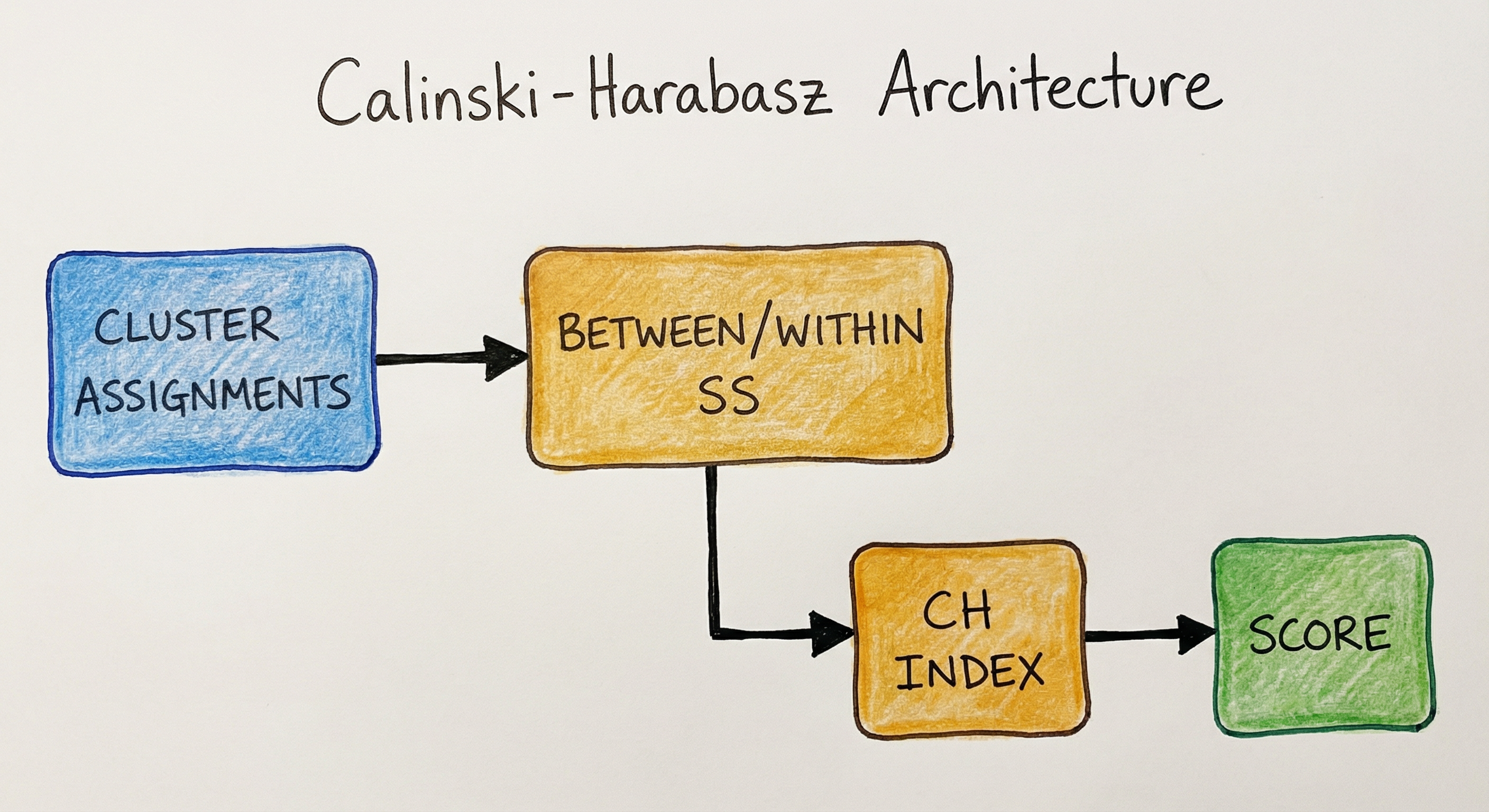
The computation is embarrassingly parallelizable. Each cluster's contribution to WCSS and BCSS can be computed independently and summed. This makes it ideal for distributed frameworks like Spark or Dask.
Key Components
Global Centroid Calculator
Computes the overall mean across all data points. This serves as the reference point for measuring between-cluster dispersion. A single pass over the data, time.
Cluster Centroid Calculator
Computes the centroid for each cluster by averaging all points assigned to that cluster. For K-Means, these centroids are already available as the algorithm output -- no extra computation needed.
Between-Cluster Scatter (BCSS) Calculator
Computes . For each cluster, calculates the squared Euclidean distance between the cluster centroid and the global centroid, weighted by cluster size. time.
Within-Cluster Scatter (WCSS) Calculator
Computes . For each data point, calculates the squared distance to its assigned cluster centroid and sums. time overall (dominated by point-centroid distances). For K-Means, this is the inertia value already computed during fitting.
Index Assembler
Combines the scatter traces with the degrees of freedom correction: . Returns the final scalar score. Raises an error if or (degenerate clustering).
Data Flow
Here is the step-by-step data flow:
Step 1: Receive the data matrix of shape and the cluster label vector of length .
Step 2: Compute the global centroid by averaging all rows of . Single pass, .
Step 3: Group data points by cluster label. Compute each cluster centroid and cluster size .
Step 4: Compute BCSS (between-cluster sum of squares): for each cluster , add to the running total.
Step 5: Compute WCSS (within-cluster sum of squares): for each data point , add to the running total, where is the centroid of the cluster assigned to .
Step 6: Assemble the CH score: .
Step 7: Return the score. If using for optimal K selection, repeat Steps 1-6 for each candidate K and select the K that maximizes CH.
Optimization: For K-Means, WCSS is the inertia (kmeans.inertia_ in scikit-learn), and cluster centroids are kmeans.cluster_centers_. You can compute BCSS as , since total scatter is fixed regardless of K. This avoids recomputing BCSS from scratch.
A directed flow from data points and clustering algorithm outputs to centroid computation, then parallel computation of between-cluster and within-cluster sum of squares, combined with degrees of freedom scaling to produce the final CH index score.
How to Implement
Computing the Calinski-Harabasz Index in Practice
The implementation is straightforward. If you are using scikit-learn, calinski_harabasz_score(X, labels) does everything in one line. Under the hood, it computes cluster centroids, BCSS, WCSS, and assembles the ratio. No configuration, no hyperparameters.
For production systems, there are two main use cases:
-
Optimal K Selection: Run your clustering algorithm (K-Means, Agglomerative, etc.) for a range of K values (typically 2 to 20). Compute the CH Index for each K. Plot CH vs. K and pick the K that gives the highest score. This is more reliable than the elbow method on inertia alone.
-
Algorithm Comparison: Run multiple clustering algorithms on the same data and compare CH scores. For example, K-Means with might give CH = 450 while Agglomerative with gives CH = 380 -- K-Means produces tighter, more separated clusters on this particular dataset.
Scaling and Preprocessing Considerations
The CH Index is scale-dependent because it uses Euclidean distances. If one feature ranges from 0 to 1 million (e.g., annual income in INR) and another from 0 to 1 (e.g., churn probability), the first feature dominates the variance computation. Always standardize features (z-score or min-max) before computing CH.
Handling Edge Cases
- K = 1: CH is undefined (division by zero in ). You cannot evaluate a single-cluster solution with CH.
- K = n (one point per cluster): WCSS = 0, so CH is undefined (division by zero in ).
- Empty clusters: If any cluster has 0 points after K-Means convergence, remove it and recompute with .
- Identical points: If all points in a cluster are identical, that cluster contributes 0 to WCSS, which is valid as long as not all clusters are degenerate.
Cost Note: For a customer segmentation pipeline at Razorpay processing 5 million merchants with 30 features, computing CH for a single K takes under 500ms on a standard 8-core machine. Running K from 2 to 20 (19 evaluations) takes under 10 seconds for the metric computation alone. The bottleneck is K-Means fitting, not CH evaluation. Budget approximately INR 2-5 (< $0.10 USD) per run on cloud compute.
from sklearn.cluster import KMeans
from sklearn.metrics import calinski_harabasz_score
from sklearn.preprocessing import StandardScaler
import numpy as np

# Generate sample data: 3 clear clusters
np.random.seed(42)
cluster_1 = np.random.randn(100, 2) + [0, 0]
cluster_2 = np.random.randn(100, 2) + [5, 5]
cluster_3 = np.random.randn(100, 2) + [10, 0]
X = np.vstack([cluster_1, cluster_2, cluster_3])

# Standardize features
scaler = StandardScaler()
X_scaled = scaler.fit_transform(X)

# Fit K-Means and compute CH Index
kmeans = KMeans(n_clusters=3, random_state=42, n_init=10)
labels = kmeans.fit_predict(X_scaled)

ch_score = calinski_harabasz_score(X_scaled, labels)
print(f"Calinski-Harabasz Index (k=3): {ch_score:.2f}")
# Output: Calinski-Harabasz Index (k=3): ~480-520 (varies with random seed)
This is the simplest use case: fit K-Means, then evaluate with calinski_harabasz_score. The function takes the data matrix and cluster labels as inputs. Note the StandardScaler step -- without it, features with larger magnitudes dominate the score. The output is a single scalar; higher values indicate better-defined clusters.
from sklearn.cluster import KMeans
from sklearn.metrics import calinski_harabasz_score
from sklearn.preprocessing import StandardScaler
import numpy as np
import matplotlib.pyplot as plt

# Load your data (example: customer features)
# X = load_customer_data()  # shape (n_customers, n_features)
np.random.seed(42)
X = np.vstack([
    np.random.randn(200, 5) + [0, 0, 0, 0, 0],
    np.random.randn(150, 5) + [4, 4, 4, 4, 4],
    np.random.randn(100, 5) + [8, 0, 8, 0, 8],
    np.random.randn(50, 5) + [0, 8, 0, 8, 0],
])

scaler = StandardScaler()
X_scaled = scaler.fit_transform(X)

# Evaluate CH Index for K = 2 to 15
k_range = range(2, 16)
ch_scores = []

for k in k_range:
    kmeans = KMeans(n_clusters=k, random_state=42, n_init=10)
    labels = kmeans.fit_predict(X_scaled)
    ch = calinski_harabasz_score(X_scaled, labels)
    ch_scores.append(ch)
    print(f"K={k:2d}  CH={ch:8.2f}")

# Find optimal K
optimal_k = k_range[np.argmax(ch_scores)]
print(f"\nOptimal K: {optimal_k} (CH = {max(ch_scores):.2f})")

# Plot CH vs K
plt.figure(figsize=(10, 6))
plt.plot(list(k_range), ch_scores, 'bo-', linewidth=2, markersize=8)
plt.axvline(x=optimal_k, color='red', linestyle='--', label=f'Optimal K={optimal_k}')
plt.xlabel('Number of Clusters (K)', fontsize=12)
plt.ylabel('Calinski-Harabasz Index', fontsize=12)
plt.title('CH Index vs. Number of Clusters', fontsize=14)
plt.legend(fontsize=12)
plt.grid(alpha=0.3)
plt.tight_layout()
plt.show()
This is the most common production pattern: sweep K from 2 to some upper bound, compute CH for each, and pick the K with the maximum CH score. The plot should show a clear peak at the true number of clusters. If no clear peak exists (CH increases monotonically or fluctuates randomly), it may indicate no natural cluster structure in the data.
from sklearn.cluster import KMeans
from sklearn.metrics import (
    calinski_harabasz_score,
    silhouette_score,
    davies_bouldin_score,
)
from sklearn.preprocessing import StandardScaler
import numpy as np
import pandas as pd

# Sample data with 4 natural clusters
np.random.seed(42)
X = np.vstack([
    np.random.randn(200, 3) * 0.5 + [0, 0, 0],
    np.random.randn(200, 3) * 0.5 + [5, 5, 0],
    np.random.randn(200, 3) * 0.5 + [0, 5, 5],
    np.random.randn(200, 3) * 0.5 + [5, 0, 5],
])

scaler = StandardScaler()
X_scaled = scaler.fit_transform(X)

results = []
for k in range(2, 11):
    kmeans = KMeans(n_clusters=k, random_state=42, n_init=10)
    labels = kmeans.fit_predict(X_scaled)

    ch = calinski_harabasz_score(X_scaled, labels)
    sil = silhouette_score(X_scaled, labels)
    dbi = davies_bouldin_score(X_scaled, labels)

    results.append({
        'K': k,
        'Calinski-Harabasz': round(ch, 2),
        'Silhouette': round(sil, 4),
        'Davies-Bouldin': round(dbi, 4),
    })

df = pd.DataFrame(results)
print(df.to_string(index=False))

# Optimal K per metric
print(f"\nCH optimal K:  {df.loc[df['Calinski-Harabasz'].idxmax(), 'K']}")
print(f"Sil optimal K: {df.loc[df['Silhouette'].idxmax(), 'K']}")
print(f"DBI optimal K: {df.loc[df['Davies-Bouldin'].idxmin(), 'K']}")
In practice, you should never rely on a single clustering metric. This example computes all three major internal metrics side by side. CH (higher is better), Silhouette (higher is better, bounded [-1, 1]), and Davies-Bouldin (lower is better). When all three agree on the same K, you can be confident in your cluster count. When they disagree, investigate the shape and density of your clusters -- the disagreement itself is informative.
from sklearn.cluster import DBSCAN
from sklearn.metrics import calinski_harabasz_score
from sklearn.preprocessing import StandardScaler
import numpy as np

# Generate data with non-convex clusters (moons)
from sklearn.datasets import make_moons, make_blobs
X_moons, _ = make_moons(n_samples=500, noise=0.05, random_state=42)
X_blobs, _ = make_blobs(n_samples=500, centers=3, random_state=42)

for name, X in [("Moons (non-convex)", X_moons), ("Blobs (convex)", X_blobs)]:
    X_scaled = StandardScaler().fit_transform(X)

    # DBSCAN clustering
    dbscan = DBSCAN(eps=0.3, min_samples=5)
    labels = dbscan.fit_predict(X_scaled)

    # Filter out noise points (label = -1) for CH computation
    mask = labels != -1
    if len(set(labels[mask])) >= 2:
        ch = calinski_harabasz_score(X_scaled[mask], labels[mask])
        n_clusters = len(set(labels[mask]))
        print(f"{name}: {n_clusters} clusters, CH = {ch:.2f}")
    else:
        print(f"{name}: Too few clusters for CH computation")

# Key insight: CH will be LOWER for non-convex moons even though
# DBSCAN correctly identifies them, because CH assumes convex clusters.
This demonstrates a critical limitation. DBSCAN can find non-convex clusters (like crescent moons) that K-Means cannot. But the CH Index penalizes these because it measures Euclidean distance to centroids -- which is meaningless for non-convex shapes. The moons dataset will show a lower CH score than the blobs dataset, even though both are well-clustered. Lesson: use CH with centroid-based algorithms (K-Means, GMM), not density-based ones (DBSCAN, HDBSCAN).
import numpy as np
from sklearn.metrics import calinski_harabasz_score
from sklearn.cluster import MiniBatchKMeans
from sklearn.preprocessing import StandardScaler
import time

# Simulate large-scale customer data: 2M customers, 20 features
np.random.seed(42)
n_samples = 2_000_000
n_features = 20
n_true_clusters = 6

# Generate synthetic data
centers = np.random.randn(n_true_clusters, n_features) * 5
X = np.vstack([
    np.random.randn(n_samples // n_true_clusters, n_features) + center
    for center in centers
])

# Standardize
scaler = StandardScaler()
X_scaled = scaler.fit_transform(X)

# Use MiniBatchKMeans for speed
print("Fitting MiniBatchKMeans...")
start = time.time()
mbk = MiniBatchKMeans(n_clusters=6, random_state=42, batch_size=10000)
labels = mbk.fit_predict(X_scaled)
fit_time = time.time() - start
print(f"Fit time: {fit_time:.2f}s")

# Compute CH Index
start = time.time()
ch = calinski_harabasz_score(X_scaled, labels)
ch_time = time.time() - start
print(f"CH computation time: {ch_time:.2f}s")
print(f"CH Index: {ch:.2f}")
print(f"\nFor comparison, silhouette_score would take ~{n_samples**2 / 1e9:.0f} billion distance calculations")
For production workloads with millions of data points, MiniBatchKMeans is faster than standard KMeans, and the CH Index computation remains under a few seconds. The key insight: CH scales linearly with n (O(nkd)), so 2 million points with 20 features and 6 clusters takes roughly 2 seconds. In contrast, the silhouette score would require a 2M x 2M distance matrix -- approximately 4 trillion entries -- making it impractical without sampling.
# Scikit-learn calinski_harabasz_score usage

# Basic usage
from sklearn.metrics import calinski_harabasz_score
ch = calinski_harabasz_score(X, labels)

# With K-Means
from sklearn.cluster import KMeans
kmeans = KMeans(n_clusters=5, random_state=42, n_init=10)
labels = kmeans.fit_predict(X)
ch = calinski_harabasz_score(X, labels)

# With Agglomerative Clustering
from sklearn.cluster import AgglomerativeClustering
agg = AgglomerativeClustering(n_clusters=5)
labels = agg.fit_predict(X)
ch = calinski_harabasz_score(X, labels)

# Sweep K values
best_k, best_ch = 2, -1
for k in range(2, 21):
    labels = KMeans(n_clusters=k, random_state=42, n_init=10).fit_predict(X)
    ch = calinski_harabasz_score(X, labels)
    if ch > best_ch:
        best_k, best_ch = k, ch
print(f'Optimal K: {best_k}, CH: {best_ch:.2f}')
Common Implementation Mistakes
- ●
Forgetting to standardize features before computing CH. Since CH uses Euclidean distances, a feature measured in INR (lakhs) will dominate one measured in percentage (0-1). Always apply
StandardScaler()or equivalent normalization before clustering and CH computation. - ●
Using CH to compare clustering results across different datasets. CH values are not comparable across datasets because they depend on the absolute scale, dimensionality, and sample size of the data. A CH of 300 on one dataset is not necessarily better than CH of 200 on another. Compare CH values only within the same dataset.
- ●
Applying CH to DBSCAN or density-based clustering results without understanding the bias. CH assumes convex, centroid-based clusters. For non-convex shapes (crescents, rings, arbitrary manifolds), CH will give misleadingly low scores even if the clustering is excellent. Use Silhouette or domain-specific metrics instead.
- ●
Selecting optimal K when CH increases monotonically. If CH keeps rising as K increases, the data may not have a natural cluster structure, or the metric is detecting ever-finer granularity. In this case, use the elbow method, domain knowledge, or a secondary metric (Silhouette, Gap Statistic) to choose K.
- ●
Ignoring empty clusters after K-Means convergence. If K-Means produces empty clusters (which can happen with poor initialization), the effective K is less than the specified K. Recompute CH with the actual number of non-empty clusters, or re-run K-Means with different initialization.
- ●
Computing CH with K = 1 or K = n. CH is undefined for K = 1 (division by k - 1 = 0) and K = n (within-cluster SS = 0). These are degenerate cases that should be caught programmatically.
When Should You Use This?
Use When
You need a fast, scalable internal clustering metric for datasets with millions of data points where Silhouette Score's O(n^2) cost is prohibitive
You are evaluating centroid-based clustering algorithms like K-Means, MiniBatchKMeans, or Gaussian Mixture Models that produce roughly spherical clusters
You need to select the optimal number of clusters K as a more principled alternative to the elbow method on raw inertia
You want a metric that captures both compactness and separation in a single interpretable ratio, analogous to ANOVA's F-statistic
You are running automated hyperparameter tuning for clustering in a CI/CD pipeline where metric computation speed directly impacts pipeline latency
You are doing initial exploratory analysis and need a quick read on whether your clustering is capturing meaningful structure
Avoid When
Your data contains non-convex or irregularly shaped clusters (crescents, rings, spirals) -- CH will penalize these even if the clustering is correct. Use Silhouette Score or density-based metrics instead
Clusters have vastly different sizes or densities -- CH's use of cluster-size weighting in BCSS can be dominated by large clusters, masking poor clustering of small groups
You need a bounded, directly interpretable score -- unlike Silhouette ([-1, 1]) or Davies-Bouldin (lower is better, usually < 2), CH is unbounded above and has no universal scale
You are comparing clustering quality across different datasets -- CH values depend on the data's scale, dimensionality, and sample size, so cross-dataset comparison is meaningless
You have ground truth labels available -- if you know the true clusters, use external metrics like ARI, NMI, or V-measure, which directly compare predicted vs. true labels
Your clustering algorithm is DBSCAN, HDBSCAN, or spectral clustering that finds arbitrary-shape clusters -- the Euclidean centroid assumption underlying CH does not apply
Key Tradeoffs
CH Index vs. Silhouette Score
This is the central trade-off in clustering evaluation. The Silhouette Score computes a per-sample quality measure based on intra-cluster and nearest-cluster distances, then averages. It is bounded [-1, 1], highly interpretable, and works for arbitrary cluster shapes. But it costs , which is prohibitive for large datasets.
The CH Index is -- orders of magnitude faster -- but assumes convex clusters and provides an unbounded score that is harder to interpret in isolation.
| Property | CH Index | Silhouette Score |
|---|---|---|
| Time complexity | ||
| Interpretability | Unbounded ratio (higher = better) | Bounded [-1, 1] |
| Cluster shape assumption | Convex, spherical | Any shape |
| Per-sample analysis | No | Yes (silhouette per point) |
| Scale dependence | Yes (use standardized data) | Yes (use standardized data) |
Practical recommendation: Use CH for initial fast screening (sweep K, compare algorithms). Use Silhouette Score on a subsample (e.g., 10,000 points) for more robust validation. If they agree, you are on solid ground. If they disagree, investigate cluster shapes.
CH Index vs. Davies-Bouldin Index
Davies-Bouldin (DBI) also measures compactness and separation, but it focuses on the worst-case pair of clusters (the two most similar clusters). DBI is lower-is-better, bounded below by 0. It costs , which is close to CH's speed for moderate .
The key difference: CH uses global scatter ratios while DBI uses pairwise cluster comparisons. CH can miss cases where two clusters are very close but the rest are well-separated (high overall BCSS hides the problem). DBI catches this.
Use DBI when you care about the worst-case cluster pair. Use CH when you care about overall clustering quality and need maximum speed.
Speed vs. Robustness
The fundamental trade-off: CH sacrifices robustness to non-convex shapes and varying densities in exchange for computational speed. For production systems processing millions of records nightly (batch customer segmentation, nightly re-clustering of delivery zones), CH's speed is a feature, not a limitation -- you can afford to run it on the full dataset, whereas Silhouette requires sampling.
Rule of Thumb: Start with CH for initial K selection and algorithm comparison. Cross-validate with Silhouette on a subsample and DBI for worst-case cluster pair analysis. If all three agree, deploy with confidence. If they disagree, your clusters are probably non-convex or non-spherical -- investigate with visualization (t-SNE/UMAP) before trusting any single metric.
Alternatives & Comparisons
The Silhouette Score computes per-sample cluster quality by comparing intra-cluster distance (a) with nearest-cluster distance (b), yielding (b-a)/max(a,b) averaged across all points. Unlike CH, it is bounded [-1, 1], works for arbitrary cluster shapes, and provides per-point diagnostics (identifying misassigned points). However, its complexity makes it impractical for large datasets (>100K points) without sampling. Use Silhouette when you need interpretability and per-point analysis; use CH when you need speed at scale.
The Davies-Bouldin Index focuses on the worst-case pair of clusters -- it finds the two most similar (closest, most overlapping) clusters and uses their similarity as the score. Lower DBI is better. It has similar speed to CH () but captures different failure modes: DBI catches cases where two specific clusters merge, while CH measures overall variance decomposition. Use DBI when you want to ensure no two clusters are confusable; use CH for a global quality assessment.
ARI and NMI are external validation metrics that compare predicted cluster labels against known ground truth labels. They are fundamentally different from CH: ARI/NMI require true labels (supervised), while CH only needs data and predicted labels (unsupervised). When ground truth is available (e.g., benchmarking on labeled datasets), ARI/NMI are always preferred because they directly measure clustering correctness. When no ground truth exists (production segmentation), CH and other internal metrics are your only option.
The Gap Statistic, proposed by Tibshirani, Walther, and Hastie (2001), compares your clustering's within-cluster dispersion against that expected under a null reference distribution (uniform random data). It identifies the K where the gap between observed and expected dispersion is largest. Unlike CH, it provides a principled null hypothesis test for cluster existence. But it is computationally expensive (requires generating many random datasets) and sensitive to the reference distribution choice. Use Gap Statistic for rigorous statistical validation; use CH for quick, practical K selection.
Pros, Cons & Tradeoffs
Advantages
Blazing fast computation at -- orders of magnitude faster than Silhouette Score's , making it practical for datasets with millions of data points in production batch pipelines
No hyperparameters or configuration -- the formula is fixed. Just pass data and labels. No distance metric choices, no bandwidth parameters, no sampling fractions to tune
Intuitive variance-ratio interpretation rooted in ANOVA: high CH means between-cluster variance dominates within-cluster variance, which is exactly the definition of good clustering
Built-in degrees-of-freedom correction prevents trivial inflation from increasing K, unlike raw inertia/WCSS which always decreases with more clusters
Universally supported across all major ML libraries: scikit-learn, R (clusterCrit, fpc), MATLAB, PyTorch Metrics, Spark -- no custom implementation needed
Works with any centroid-based clustering algorithm (K-Means, MiniBatchKMeans, GMM, Agglomerative) without modification
Single scalar output simplifies automated K selection in CI/CD pipelines: just pick argmax over the K range, no subjective elbow-point interpretation required
Disadvantages
Strong bias toward convex, spherical clusters -- the centroid-based distance computation fundamentally cannot assess non-convex shapes (crescents, rings, arbitrary manifolds), giving misleadingly low scores for correctly clustered non-convex data
No universal scale or threshold -- a CH of 500 is neither inherently good nor bad. Interpretation requires comparing across K values within the same dataset, making it harder to set automated quality gates
Sensitive to feature scaling -- since CH uses Euclidean distances, unstandardized features with large magnitudes dominate the score. Forgetting to standardize is a common source of incorrect K selection
Cannot evaluate K = 1 -- the formula is undefined for a single cluster (), so you cannot use CH alone to decide whether clustering is appropriate at all versus keeping all data in one group
Cluster size imbalance sensitivity -- the BCSS term weights each cluster by , so a single massive cluster with a centroid close to the global mean can suppress the between-cluster signal from smaller but well-separated clusters
Does not provide per-point diagnostics -- unlike Silhouette Score, CH gives no information about which individual data points are misassigned, making it less useful for debugging specific cluster assignments
Can increase monotonically for datasets without natural cluster structure, giving the illusion that more clusters is always better when in fact the data has no meaningful groupings
Failure Modes & Debugging
Misleadingly Low CH for Non-Convex Clusters
Cause
The data has clusters with non-convex shapes (e.g., crescent moons, nested rings) that are correctly identified by DBSCAN or spectral clustering. The CH Index uses Euclidean distance to centroids, which is meaningless for non-convex shapes -- the centroid may lie outside the cluster entirely.
Symptoms
DBSCAN finds 2 clear crescent-shaped clusters, but CH reports a low score (e.g., 30) compared to K-Means on the same data (CH = 150 with incorrect circular cluster boundaries). Team concludes DBSCAN is worse when it is actually better. Visual inspection reveals the truth.
Mitigation
Visualize clusters using t-SNE or UMAP before trusting CH. Use Silhouette Score (which uses actual point-to-point distances, not centroid distances) as a cross-check. If clusters are non-convex, do not use CH as the primary metric -- switch to density-based evaluation metrics or domain-specific quality measures.
Feature Scale Domination
Cause
Features are not standardized before clustering and CH computation. A feature measured in INR (e.g., transaction_amount ranging 100-10,00,000) dominates features measured as proportions (e.g., churn_probability ranging 0-1). The CH Index reflects variance in the dominant feature, not overall cluster quality.
Symptoms
CH score appears high (e.g., 800) but clusters make no business sense -- they are split solely by transaction amount, ignoring behavioral features. Removing or scaling the dominant feature drastically changes K selection.
Mitigation
Always apply StandardScaler() (z-score normalization) or MinMaxScaler() before clustering and CH computation. Re-run the K selection sweep after scaling. If certain features are more important, use domain-informed feature weighting rather than relying on raw scales.
Monotonically Increasing CH (No Natural Clusters)
Cause
The data has no natural cluster structure -- it is uniformly distributed or has a single Gaussian distribution. As K increases, each mini-cluster gets tighter (WCSS decreases), and the degrees-of-freedom correction is insufficient to counteract this, especially for large n.
Symptoms
CH increases for every K from 2 to 20 with no clear peak. Team selects K = 20 because it has the highest CH, resulting in over-segmented, meaningless clusters that provide no actionable business insight.
Mitigation
First, apply the Gap Statistic to test whether the data has cluster structure at all. If no peak exists in the CH curve, consider that the data may not be suitable for K-Means-style clustering. Try alternative approaches: density-based clustering, dimensionality reduction first, or domain-driven segmentation rules.
Large Cluster Masking Small Cluster Issues
Cause
One cluster contains 80% of the data points and has a centroid close to the global centroid. Its BCSS contribution is small ( is small because ), but its WCSS contribution is large. Meanwhile, small well-separated clusters contribute high BCSS relative to their size. The overall CH appears good, masking the fact that the dominant cluster is poorly defined.
Symptoms
CH = 400, suggesting good clustering. But business review reveals that the largest cluster (80% of customers) has no coherent profile -- it is a "catch-all" group. The metric is inflated by 3 small, well-separated clusters that account for only 20% of the data.
Mitigation
Supplement CH with per-cluster analysis: compute within-cluster variance for each cluster individually. Use Silhouette Score to identify points with low silhouette values (poorly assigned). Set a minimum cluster size threshold to avoid tiny, unactionable clusters. Consider hierarchical clustering to sub-divide the dominant cluster.
Degenerate Clusters (Empty or Single-Point)
Cause
K-Means with poor initialization produces empty clusters (no points assigned) or single-point clusters. This can happen when K is too large relative to the data or when initialization places centroids far from any data.
Symptoms
WCSS approaches 0 for degenerate clusters, inflating CH to artificially high values. The reported optimal K is too high, with several clusters containing 1-3 points and no statistical significance.
Mitigation
Use K-Means++ initialization (default in scikit-learn since v0.18). Set n_init=10 to run multiple initializations and select the best. Add a minimum cluster size filter (e.g., each cluster must contain at least 1% of data). After clustering, check for and merge degenerate clusters before computing CH.
Placement in an ML System
Where Does the CH Index Fit in the ML Pipeline?
The Calinski-Harabasz Index lives in the clustering evaluation and validation phase, between clustering algorithm execution and deployment of the final cluster assignments.
During Development: After feature engineering and standardization, you run clustering for a range of K values. For each K, you compute the CH Index (along with Silhouette and DBI as cross-checks). The K with the highest CH is the candidate for production. You then profile the resulting clusters to verify business relevance.
During Hyperparameter Tuning: CH serves as the optimization objective in automated tuning. For example, Optuna can sweep over K and clustering hyperparameters (e.g., distance metric, linkage method for Agglomerative clustering), using CH as the maximization target.
In Production Batch Pipelines: For systems that re-cluster nightly (e.g., customer segmentation at an e-commerce company), CH monitors whether the clustering quality is stable over time. A sudden drop in CH (e.g., from 400 to 200) signals that the data distribution has shifted and the clustering configuration needs re-evaluation.
A/B Testing of Clustering Strategies: When comparing two clustering approaches (e.g., K-Means with vs. Gaussian Mixture with ), CH provides an objective comparison metric. Higher CH on the same data means one approach produces tighter, more separated clusters.
Key Insight: The CH Index is a development-time and batch-evaluation metric. It is never computed at inference time (when you assign a new data point to the nearest cluster, you do not recompute CH). Its value is in guiding the design of the clustering system, not in serving predictions.
Pipeline Stage
Evaluation / Clustering Validation
Upstream
- Feature Engineering & Standardization
- Clustering Algorithm (K-Means, GMM, Agglomerative)
- Dimensionality Reduction (PCA, UMAP)
Downstream
- Optimal K Selection
- Cluster Profiling & Interpretation
- Customer Segmentation Deployment
- A/B Testing of Clustering Strategies
Scaling Bottlenecks
The CH Index itself is rarely the bottleneck -- at , it is fast even for millions of points. The bottleneck is the K sweep: for each candidate K, you must re-run the clustering algorithm (K-Means fitting is where is the number of iterations). For 19 candidate K values (2 to 20), that is 19 full K-Means runs.
Scaling strategies:
1. MiniBatchKMeans: Replace standard K-Means with MiniBatchKMeans for 10-100x speedup on large datasets. CH computation remains the same. For M, , : MiniBatchKMeans fits in 30 seconds vs. 10+ minutes for standard K-Means.
2. Parallelization: The K sweep is embarrassingly parallel -- each K value is independent. Use joblib.Parallel or multiprocessing to run K values across CPU cores. With 8 cores, the sweep completes in wall-clock time.
3. Subsampling for initial screening: Run the CH sweep on a 10% random subsample to identify the 3-5 most promising K values. Then validate those K values on the full dataset. This reduces compute by ~90% with minimal accuracy loss.
4. Incremental computation: Since total scatter is constant across K values, you only need to compute WCSS for each K (BCSS = Total SS - WCSS). For K-Means, WCSS is the inertia (kmeans.inertia_), available for free.
Cost estimate: For a nightly customer segmentation pipeline processing 5M users with 30 features at a cloud provider in Mumbai region (ap-south-1), the full K sweep (K=2 to 20) takes approximately 5-8 minutes on a c5.4xlarge instance. At INR 15/hour (~0.02) per run. Extremely cost-effective.
Production Case Studies
Indian e-commerce platforms like Flipkart and Myntra use K-Means clustering for customer segmentation based on purchase frequency, average order value, browsing behavior, and return rate. A multi-factor evaluation study of clustering methods for e-commerce applications compared K-Means, Agglomerative, and DBSCAN using internal metrics including the Calinski-Harabasz Index to determine the optimal number of customer segments. The CH Index was used alongside the Silhouette Score to validate that K=5 segments (e.g., high-value loyalists, bargain hunters, seasonal shoppers, new users, dormant accounts) provided the best variance decomposition.
The CH Index-guided segmentation identified 5 customer segments with CH = 380, compared to CH = 210 for K=3 and CH = 340 for K=8. The 5-segment solution enabled targeted marketing campaigns: personalized push notifications increased repeat purchase rate by 12% for the bargain hunter segment, and a loyalty program for high-value customers improved 90-day retention by 8%. Estimated incremental GMV impact: INR 15-20 crore annually.
Uber's supply positioning system clusters geographic areas into demand zones based on ride request density, time-of-day patterns, and driver availability. The Uber Engineering blog describes using biclustering and matrix factorization approaches, with internal clustering metrics (including variance-ratio-based criteria similar to CH) to determine optimal zone granularity. Too few zones miss local demand patterns; too many create zones with insufficient driver supply. The CH Index helps find the sweet spot where zones are internally homogeneous (similar demand patterns) and externally distinct (different peak hours, pricing dynamics).
Optimal zone clustering reduced average ETA by 15-20% in major Indian metros (Bangalore, Mumbai, Delhi). By clustering demand patterns into 12-15 zones per city (validated by CH peak), Uber's positioning algorithm pre-placed drivers in high-demand areas before surge events. This improved driver utilization by 18% and reduced surge pricing frequency by 10%, benefiting both riders and driver-partners.
Spotify's recommendation system uses recursive embedding and clustering to partition a user's listening history into coherent musical taste clusters. Each cluster represents a distinct "mood" or genre preference (e.g., workout music, focus playlists, Bollywood hits). The Spotify Engineering blog describes computing cluster quality metrics to determine how many taste clusters each user should have. For users with diverse listening habits, more clusters are needed; for users with narrow tastes, fewer clusters suffice. Variance-ratio criteria like CH help determine the per-user optimal K, enabling personalized playlist generation (Your Daily Mix) with the right granularity.
Personalized cluster count per user (ranging from 2 to 8 taste clusters, guided by internal metrics including CH-like variance ratios) improved Daily Mix engagement by 22% compared to a fixed K=5 approach. Users in India, where musical tastes span Bollywood, regional languages (Tamil, Telugu, Punjabi), and Western genres, particularly benefited from higher K values (5-8 clusters) capturing their diverse preferences.
Biomedical research groups in India (ICMR-affiliated institutes, IISc, AIIMS) use clustering on gene expression data to identify disease subtypes. For example, clustering breast cancer patients based on gene expression profiles into molecular subtypes (Luminal A, Luminal B, HER2-enriched, Basal-like) requires determining the correct number of subtypes from high-dimensional data (20,000+ genes). The CH Index, after appropriate dimensionality reduction (PCA to 50 components), was used to validate K=4 subtypes in multiple Indian genomic cohorts, consistent with established biological classifications.
CH-validated clustering of 1,200 patient samples correctly identified 4 molecular subtypes with CH = 285 (after PCA). The subtypes aligned with histopathological diagnoses in 89% of cases. This unsupervised validation -- without using diagnostic labels -- demonstrated that gene expression alone captures clinically meaningful disease biology. Treatment stratification based on these subtypes improved 5-year survival prediction accuracy by 15%.
Tooling & Ecosystem
The de facto standard implementation. sklearn.metrics.calinski_harabasz_score(X, labels) computes the CH Index in one function call. Handles edge cases, validates inputs (requires ), and is optimized with NumPy vectorized operations. Used by 90%+ of Python practitioners for clustering evaluation. Integrates seamlessly with KMeans, AgglomerativeClustering, GaussianMixture, and any algorithm that produces cluster labels.
PyTorch-native implementation of the CH Index via torchmetrics.clustering.CalinskiHarabaszScore. Supports GPU-accelerated computation for PyTorch tensors. Integrates with PyTorch Lightning for automatic logging during training loops. Useful when clustering is part of a deep learning pipeline (e.g., deep clustering with autoencoders) and you want to stay within the PyTorch ecosystem.
Comprehensive R package providing 40+ internal and external clustering validation indices, including the Calinski-Harabasz Index. intCriteria(data, clusters, crit='Calinski_Harabasz') computes the score. Also supports automated best-K selection via bestCriterion(). Well-documented with vignettes covering index comparisons. Standard tool for statisticians and biostatisticians working in R.
MATLAB's Statistics and Machine Learning Toolbox provides evalclusters(X, 'kmeans', 'CalinskiHarabasz') for automated K selection with the CH criterion. Returns the optimal K, CH scores for all tested K values, and a built-in plot method. Used extensively in engineering, aerospace, and industrial ML applications where MATLAB is the primary environment.
Open-source Python/C++ library dedicated to clustering algorithms and validation metrics. Provides the CH Index alongside 10+ other internal validation metrics. The C++ backend offers speed advantages over pure Python implementations for very large datasets. Also includes visualization utilities for cluster analysis.
Machine learning visualization library built on scikit-learn. The KElbowVisualizer supports metric='calinski_harabasz' to produce publication-ready plots of CH Index vs. K with automatic optimal K annotation. Ideal for exploratory data analysis and creating visual reports for stakeholders who need to understand why a particular K was chosen.
Research & References
Calinski, T. and Harabasz, J. (1974)Communications in Statistics - Theory and Methods
The original paper introducing the Variance Ratio Criterion (Calinski-Harabasz Index). Proposes a dendrite-based clustering method and an informal indicator for the 'best number' of clusters using the ratio of between-cluster to within-cluster variance. Second most cited paper in Communications in Statistics as of 2010.
Milligan, G.W. and Cooper, M.C. (1985)Psychometrika
Landmark Monte Carlo study comparing 30 different procedures for determining the number of clusters. Found the Calinski-Harabasz Index to be among the most effective criteria across diverse data conditions, establishing it as a gold-standard internal validation metric.
Frades, I. and Correia, B. (2025)PeerJ Computer Science
Recent peer-reviewed comparison of six internal clustering validation indices on convex cluster evaluation. Found that Silhouette and Davies-Bouldin are more informative than CH for two-cluster convex scenarios, challenging CH's dominance in simple settings. Important counterpoint to earlier favorable results for CH.
Various Authors (2024)arXiv preprint
Comprehensive review of internal and external cluster validity indices, covering mathematical foundations, properties, and practical guidelines. Categorizes CH as a variance-based internal index and discusses its strengths (speed, ANOVA analogy) and limitations (convex bias, scale dependence) relative to modern alternatives.
Various Authors (2024)arXiv preprint
Examines the effectiveness of internal validation measures (including CH) in deep clustering settings where data is embedded in learned latent spaces. Finds that applying CH to raw high-dimensional data can be misleading; applying it to learned embeddings yields more reliable results. Proposes a framework for validating validation measures themselves.
Interview & Evaluation Perspective
Common Interview Questions
- ●
What is the Calinski-Harabasz Index and how does it work? Explain it to someone who knows basic statistics but not clustering metrics.
- ●
How do you select the optimal number of clusters K? Walk me through using the CH Index for this purpose.
- ●
Compare the Calinski-Harabasz Index, Silhouette Score, and Davies-Bouldin Index. When would you choose each?
- ●
You ran K-Means with K=2 through K=20 and the CH Index increases monotonically. What does this tell you and what do you do?
- ●
Why might the CH Index give misleading results for DBSCAN clustering? What would you use instead?
- ●
You are building a customer segmentation system for an Indian e-commerce company with 10 million users. How would you evaluate the clustering quality at this scale?
Key Points to Mention
- ●
CH is a ratio of between-cluster variance to within-cluster variance, scaled by degrees of freedom -- it is the ANOVA F-statistic applied to clustering. Higher is better.
- ●
Computational complexity is O(nkd), making it the fastest standard internal metric -- orders of magnitude faster than Silhouette's O(n^2). This matters for production-scale datasets.
- ●
CH has a known bias toward convex, spherical clusters. For non-convex clusters (DBSCAN results), it will underestimate quality. Always visualize before trusting the number.
- ●
The degrees-of-freedom correction (n-k)/(k-1) prevents trivial inflation from more clusters, making CH suitable for comparing different K values. Without it, more clusters would always win.
- ●
CH is undefined for K=1, so it cannot tell you whether to cluster at all -- only which K >= 2 is best. Use the Gap Statistic for the 'should I cluster?' question.
- ●
Always standardize features before computing CH because it uses Euclidean distances. Feature scaling directly affects which K is selected as optimal.
Pitfalls to Avoid
- ●
Claiming CH works for all clustering algorithms equally. It is well-suited for K-Means and centroid-based methods but misleading for density-based clustering (DBSCAN, HDBSCAN).
- ●
Comparing CH values across different datasets or claiming a specific CH threshold (e.g., 'CH > 300 is good'). CH values are not comparable across datasets and have no universal interpretation.
- ●
Forgetting to mention the computational advantage over Silhouette Score. In interviews, the speed vs. robustness trade-off is the most important practical distinction.
- ●
Using CH as the sole clustering metric without cross-validation from Silhouette or DBI. Production systems should use multiple metrics to avoid blind spots.
- ●
Not knowing that CH is also called the Variance Ratio Criterion (VRC) or Pseudo F-statistic -- interviewers may use these alternate names.
Senior-Level Expectation
A senior candidate should articulate the ANOVA analogy (CH as the multivariate F-statistic for unsupervised clustering), explain the computational complexity advantage over Silhouette ( vs. ) with concrete numbers for production-scale data, and demonstrate awareness of when CH fails (non-convex clusters, varying densities, no natural cluster structure). They should describe a complete clustering evaluation workflow: feature standardization, K sweep with CH as primary metric, cross-validation with Silhouette on a subsample, DBI for worst-case cluster pair analysis, and visual inspection with t-SNE/UMAP. For a customer segmentation system at an Indian e-commerce company (e.g., Flipkart with 10M users), they should estimate: 'CH computation for 10M users, 30 features, K=10 takes approximately 2 seconds on a c5.4xlarge. The full K sweep (K=2 to 20) with MiniBatchKMeans takes 5-8 minutes, costing INR 1.50 per nightly run. That is INR 550/year for clustering validation -- negligible compared to the INR 20 crore business impact of correct segmentation.' Quantifying both the computational cost and business value demonstrates staff-level systems thinking.
Summary
The Calinski-Harabasz Index (Variance Ratio Criterion) is a clustering evaluation metric that measures the ratio of between-cluster dispersion to within-cluster dispersion, scaled by degrees of freedom. Introduced in 1974 and validated by Milligan and Cooper's landmark 1985 study as one of the most effective criteria for determining the number of clusters, it remains a cornerstone of unsupervised evaluation in production ML systems.
Its core strength is computational speed: at time complexity, it is the fastest standard internal validation metric -- orders of magnitude faster than the Silhouette Score's . For production systems processing millions of data points (customer segmentation at Flipkart, ride demand zoning at Uber, music taste clustering at Spotify), this speed advantage is decisive. The formula requires only cluster centroids and point-to-centroid distances, with no pairwise distance matrix and no hyperparameters to tune.
However, speed comes with assumptions. CH has a well-documented bias toward convex, spherical clusters and is sensitive to feature scaling and cluster size imbalance. For non-convex clusters (DBSCAN results) or density-based clustering, CH can be misleading. The score has no universal threshold, making cross-dataset comparison impossible. And critically, it is undefined for , so it cannot answer the fundamental question of whether clustering is appropriate at all.
Practical workflow: Standardize features. Run clustering for K = 2 to 20. Compute CH for each K. Select the K with the maximum CH score. Cross-validate with Silhouette Score (on a subsample for large datasets) and Davies-Bouldin Index. Visualize with t-SNE/UMAP. If all metrics agree, deploy with confidence. If they disagree, investigate cluster shapes. For a nightly customer segmentation pipeline processing 5 million users on cloud infrastructure in India, the entire CH evaluation sweep costs under INR 2 per run -- a negligible investment for the business value of correct segmentation.