Faithfulness in Machine Learning
Let's start with a question that keeps ML engineers up at night: how do you know your RAG system isn't making things up?
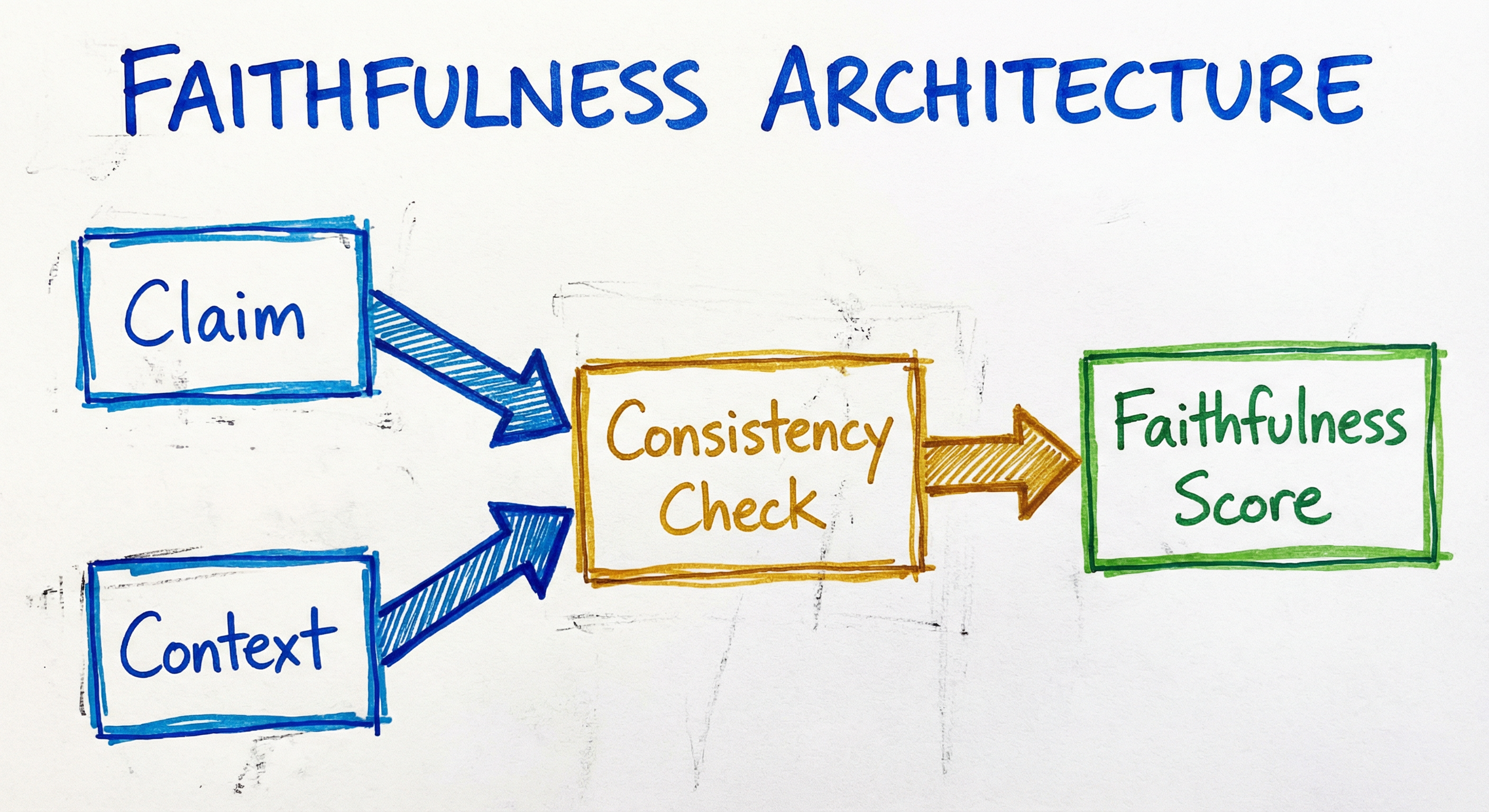
Faithfulness is the evaluation metric that measures whether a generated answer is factually grounded in the retrieved context — not whether it's correct in the absolute sense, but whether every claim it makes can be traced back to the source documents you provided.
In RAG (Retrieval-Augmented Generation) systems, the LLM is supposed to synthesize information from retrieved passages, NOT fabricate details from its parametric memory. Faithfulness evaluation detects when the model crosses that line — when it hallucinates facts, invents citations, or blends retrieved evidence with memorized knowledge to produce plausible-sounding fabrications.
Why This Matters More Than You Think
The stakes are concrete and immediate. A healthcare RAG system that fabricates drug dosages based on partial context could endanger patients. A legal research assistant that misattributes case law creates liability exposure. A customer support chatbot that invents product specifications erodes trust and increases return rates.
Modern faithfulness evaluation typically employs one of three approaches: NLI-based verification (using natural language inference models like DeBERTa to check entailment), atomic fact extraction (breaking responses into verifiable claims and scoring each independently), or LLM-as-judge frameworks (using strong models to evaluate weaker ones).
This block sits at the intersection of retrieval quality and generation safety — it's the critical checkpoint that separates grounded, trustworthy RAG systems from confident-sounding hallucination engines. Let's dig into how it actually works.
Concept Snapshot
- What It Is
- A RAG evaluation metric that quantifies the degree to which a generated answer is factually consistent with and supported by the retrieved source context, detecting hallucinations and unsupported claims.
- Category
- Evaluation
- Complexity
- Intermediate
- Inputs / Outputs
- Inputs: a generated answer (text) and the retrieved context/source documents (text or document list). Outputs: a faithfulness score (typically 0.0-1.0) indicating the proportion of claims supported by the context.
- System Placement
- Applied after the LLM generates a response in a RAG pipeline, typically alongside answer relevance and context recall metrics. Can run online (per-request) or offline (batch evaluation).
- Also Known As
- factual consistency, grounding evaluation, hallucination detection, context adherence, attribution accuracy, source fidelity
- Typical Users
- ML engineers, RAG system architects, LLM evaluators, QA/test engineers, AI safety engineers, NLP researchers
- Prerequisites
- RAG pipeline architecture, Natural language inference (NLI), Claim extraction and decomposition, LLM evaluation frameworks, Prompt engineering for judges
- Key Terms
- faithfulness scoreatomic fact verificationNLI entailmentclaim extractionLLM-as-judgehallucinationgroundingfactual consistencysupported claimscontext adherenceFActScoreRAGASHHEM
Why This Concept Exists
The Hallucination Problem in RAG
Large language models are trained on massive text corpora and develop rich internal representations of facts, concepts, and relationships. That's their strength — but it's also the root of the faithfulness problem.
When you build a RAG system, you're explicitly telling the model: "Here's the relevant context. Base your answer on this, not on your training data." BUT the model doesn't have a natural boundary between retrieved information and parametric knowledge. It will happily blend the two, or worse, confidently hallucinate details that sound consistent with the context but aren't actually stated anywhere in the source documents.
The Research That Forced the Issue
Min et al. (EMNLP 2023) demonstrated the severity of this problem with FActScore, evaluating ChatGPT-generated biographies and finding a faithfulness score of only 58% — meaning 42% of atomic facts in the generated text were unsupported by the knowledge source. That's not an edge case. That's the baseline behavior.
Researchers at Vectara built a dedicated hallucination leaderboard and found that even frontier models like GPT-4 and Claude produce hallucinated content in summarization tasks when the pressure to be concise conflicts with the need to be accurate.
Why Traditional Metrics Miss This
You might think standard QA evaluation metrics (BLEU, ROUGE, BERTScore) would catch hallucinations. They don't. Here's why:
- BLEU/ROUGE measure n-gram overlap with a reference answer. A hallucinated response can have high lexical overlap if it's close to the reference phrasing.
- BERTScore measures semantic similarity. A plausible hallucination embedded in an otherwise correct answer will still score highly.
- Answer relevance checks if the response addresses the query. A relevant but unfaithful answer passes this test.
None of these metrics verify that the generated content is grounded in the provided context. That's the specific job faithfulness was designed to do.
The Production Imperative
In production RAG systems — especially in regulated industries like healthcare, finance, legal, and e-governance — you need statement-level attribution. It's not enough to know the answer is "mostly right." You need to identify which specific claims are grounded and which are fabricated.
Faithfulness evaluation exists because RAG promises explainability and verifiability. If you can't measure whether the system honors that promise, you're just building a more complex hallucination generator with citations attached.
Key Insight: Faithfulness is orthogonal to correctness. A model can produce a factually incorrect answer that is perfectly faithful to incorrect retrieved context, or a correct answer that is unfaithful because it relies on parametric memory instead of the provided sources.
Core Intuition & Mental Model
The Decomposition Principle
The central insight behind faithfulness evaluation is deceptively simple: break the answer into atomic claims, then verify each claim independently against the context.
An atomic claim is a single, self-contained factual statement. For example, the sentence "Claude Sonnet 4.5 was released by Anthropic in January 2025" contains three atomic claims:
- Claude Sonnet 4.5 was released
- It was released by Anthropic
- The release happened in January 2025
If the retrieved context only states "Anthropic released a new model in early 2025," then claims 1 and 2 are supported, but claim 3 (the specific month) is hallucinated.
The Entailment Check
Once you've extracted atomic claims, faithfulness evaluation reduces to an entailment problem: for each claim, does the context logically entail it?
This is exactly what Natural Language Inference (NLI) models are trained to do. Given a premise (the context) and a hypothesis (the claim), an NLI model outputs one of three labels:
- Entailment: the premise logically implies the hypothesis
- Contradiction: the premise contradicts the hypothesis
- Neutral: the premise neither confirms nor denies the hypothesis
For faithfulness, we count claims with entailment labels as supported and claims with contradiction or neutral labels as unsupported.
The Arithmetic of Faithfulness
The final faithfulness score is the ratio:
A score of 1.0 means every claim is grounded. A score of 0.5 means half the claims are hallucinated. That was pretty simple, wasn't it?
Why This Works (and When It Doesn't)
The approach works because it isolates the verification problem. Instead of asking "Is this 200-word answer faithful?" — which is subjective and complex — you ask "Is this 8-word claim entailed by the context?" 20 times. Each question is tractable.
BUT this approach has a critical assumption: the claim extraction must be accurate and complete. If the extractor misses claims or lumps multiple claims together, the faithfulness score becomes meaningless. We'll revisit this in the failure modes section.
Mental Model: Think of faithfulness evaluation as a fact-checking audit. You're not judging whether the answer is good or helpful — you're checking whether every receipt (claim) has a matching line item in the invoice (context).
Technical Foundations
Let's formalize the faithfulness evaluation process step by step.
Problem Setup
Let be a query, be a set of retrieved context documents, and be the answer generated by the LLM conditioned on and :
The faithfulness evaluation problem is to quantify the degree to which is grounded in .
Atomic Claim Extraction
Define an extractor function that maps an answer to a set of atomic statements:
where each is a minimal, self-contained factual claim. The extractor can be:
- A rule-based dependency parser (extracts subject-verb-object triples)
- An instruction-tuned LLM (prompted to decompose the answer)
- A specialized claim extraction model
Entailment Verification
For each claim , we evaluate whether the context entails it using a verification function :
1 & \text{if } C \models s_i \\ 0 & \text{otherwise} \end{cases}$$ where $C \models s_i$ denotes that the context $C$ logically entails the statement $s_i$. In practice, $\psi$ is often implemented as: - An NLI model $f_{\text{NLI}}(\text{premise}=C, \text{hypothesis}=s_i) \rightarrow \{\text{entail}, \text{contradict}, \text{neutral}\}$ with $\psi = 1$ iff the prediction is "entail" - An LLM-as-judge prompted to score whether the claim is supported - A retrieval + matching system that checks if the claim appears (or is paraphrased) in $C$ ### Faithfulness Score The faithfulness score is the fraction of supported claims: $$\text{Faithfulness}(a, C) = \frac{1}{|S|} \sum_{i=1}^{|S|} \psi(s_i, C)$$ This ranges from 0 (no claims supported) to 1 (all claims supported). ### RAGAS Faithfulness Metric The widely-used RAGAS framework implements this as: $$F = \frac{|\{s \in S : \text{LLM}_\text{judge}(s, C) = \text{supported}\}|}{|S|}$$ where the judge is a capable LLM (e.g., GPT-4, Claude) prompted to verify each claim. ### FActScore Variant FActScore (Min et al., 2023) extends this with retrieval: $$\text{FActScore} = \frac{1}{|S|} \sum_{i=1}^{|S|} \mathbb{1}[\text{Retrieval}(s_i) \text{ verifies } s_i]$$ where each claim is verified against a knowledge base (e.g., Wikipedia) via retrieval + entailment. ### Complexity For an answer with $m$ claims and context of length $L$: - Claim extraction: $O(m)$ (linear in response length) - Entailment checking with NLI: $O(m \cdot L)$ (each claim checked against full context) - LLM-as-judge: $O(m \cdot T)$ where $T$ is the inference time per claim Typical production latency: 200-1000ms for NLI-based, 2-5 seconds for LLM-as-judge (depending on claim count).Internal Architecture
Faithfulness evaluation systems follow a three-stage pipeline: claim extraction, verification, and aggregation. The architecture varies significantly depending on whether you're using NLI models, LLM-as-judge, or hybrid approaches.
Online vs. Offline Evaluation
Online evaluation runs in the serving path, adding 200ms-5s latency per request but enabling real-time guardrails (block unfaithful responses before they reach users).
Offline evaluation runs in batch over logged interactions or test sets, used for model selection, A/B testing, and regression detection.
Most production systems use hybrid: lightweight NLI-based checks online, comprehensive LLM-as-judge evaluation offline.
Key Components
Claim Extractor
Decomposes the generated answer into atomic, verifiable factual statements. Implemented as a rule-based parser, prompted LLM (e.g., 'Extract all factual claims as a numbered list'), or fine-tuned claim decomposition model.
Entailment Verifier
For each atomic claim, determines whether the retrieved context entails it. Typically an NLI model (DeBERTa, RoBERTa-MNLI) or an LLM-as-judge prompted with the context and claim.
Context Retriever (for FActScore variant)
For each claim, retrieves supporting evidence from an external knowledge base (e.g., Wikipedia, PubMed). Used when the original RAG context is insufficient or when verifying against a ground truth source.
Aggregator
Computes the final faithfulness score by counting supported claims and dividing by total claims. May also provide claim-level annotations for fine-grained debugging.
Threshold Gate (optional)
In online systems, compares the faithfulness score to a threshold (e.g., 0.8) and blocks responses below the threshold or triggers a fallback response indicating uncertainty.
Data Flow
Here's how data flows through a typical faithfulness evaluation pipeline:
Claim Extraction Path: The generated answer is sent to the claim extractor, which outputs a structured list of atomic statements (typically 3-15 claims for a 100-200 word answer).
Verification Path: Each claim is paired with the full retrieved context and sent to the entailment verifier. The verifier outputs a binary label (supported/unsupported) or a probability score for each claim.
Aggregation Path: The verifier outputs are collected and aggregated into a single faithfulness score. In advanced systems, claim-level labels are stored for downstream analysis (e.g., identifying which types of claims are frequently hallucinated).
Guardrail Path (Online): If the faithfulness score falls below a configured threshold, the response is either blocked (with a fallback message) or flagged for human review.
The claim extraction and verification stages can run in parallel (batch all claims at once) or sequentially (extract claims, then verify). Batching improves throughput by 3-5x but requires more memory.
A directed flow from 'User Query' through 'Retrieval' and 'LLM Generator' to produce a 'Generated Answer', which feeds into a parallel 'Faithfulness Evaluation' pipeline consisting of 'Claim Extractor' -> 'Atomic Claims' -> 'Entailment Verifier' (also receiving 'Context') -> 'Aggregator' -> 'Faithfulness Score'.
How to Implement
Implementation Approaches
There are three primary implementation patterns for faithfulness evaluation, each with distinct tradeoffs:
Option A: NLI-based verification — Use a pretrained natural language inference model like DeBERTa-MNLI or RoBERTa-large-MNLI. Fast (50-200ms per claim), deterministic, and cheap, but limited by the NLI model's understanding of nuanced claims.
Option B: LLM-as-judge — Prompt a strong LLM (GPT-4, Claude Opus, o3-mini) to extract claims and verify them. Higher accuracy (84% balanced accuracy for o3-mini per FaithJudge benchmarks), but slower (2-5s total) and more expensive (₹5-15 per evaluation at India pricing).
Option C: Specialized models — Use purpose-built faithfulness models like Vectara's HHEM (Hughes Hallucination Evaluation Model) or FaithLens. These are trained specifically for hallucination detection and offer a balance of speed and accuracy.
For startups in India, I typically recommend starting with RAGAS (LLM-as-judge) for offline evaluation and HHEM or DeBERTa-NLI for online guardrails.
Cost Note: At current Azure OpenAI pricing (~₹420 per 1M input tokens for GPT-4o-mini), evaluating faithfulness with LLM-as-judge costs approximately ₹8-12 per 1000 evaluations. NLI models running on a CPU cost effectively zero marginal cost after initial setup.
from ragas import evaluate
from ragas.metrics import faithfulness
from datasets import Dataset

# Prepare evaluation data
data = {
    "question": ["What is the capital of France?"],
    "answer": ["The capital of France is Paris, which has a population of 12 million."],
    "contexts": [["Paris is the capital and most populous city of France."]],
}
dataset = Dataset.from_dict(data)

# Run faithfulness evaluation
result = evaluate(dataset, metrics=[faithfulness])

print(f"Faithfulness Score: {result['faithfulness']:.3f}")
# Output: Faithfulness Score: 0.500
# Explanation: "Paris is the capital" is supported (1/2 claims)
#              but "population of 12 million" is hallucinated (0/2)
RAGAS uses an LLM (GPT-4 or configurable) to extract claims from the answer, then prompts the LLM to verify each claim against the context. The score is the ratio of verified claims to total claims. This example would score 0.5 because the population claim is unsupported.
from transformers import pipeline
import numpy as np

# Load NLI model
nli_model = pipeline(
    "text-classification",
    model="cross-encoder/nli-deberta-v3-base",
    device=0  # GPU
)

def extract_claims(answer: str) -> list[str]:
    """Simple claim extraction (use LLM for production)"""
    # In production, use an LLM to extract atomic claims
    # For demo, we'll manually split
    return [
        "Paris is the capital of France",
        "Paris has a population of 12 million"
    ]

def evaluate_faithfulness(answer: str, context: str) -> float:
    claims = extract_claims(answer)
    supported = 0

    for claim in claims:
        # NLI check: does context entail claim?
        result = nli_model(f"{context} [SEP] {claim}")[0]

        # DeBERTa outputs: entailment, neutral, contradiction
        if result['label'] == 'entailment' and result['score'] > 0.7:
            supported += 1

    return supported / len(claims) if claims else 0.0

context = "Paris is the capital and most populous city of France."
answer = "The capital of France is Paris, which has a population of 12 million."

score = evaluate_faithfulness(answer, context)
print(f"Faithfulness: {score:.2f}")  # Output: 0.50
This approach uses a cross-encoder NLI model to directly score whether the context entails each claim. DeBERTa-v3-base is fast (20-30ms per claim on GPU) and achieves 90%+ accuracy on well-formed entailment pairs. The 0.7 threshold filters low-confidence predictions.
from transformers import AutoTokenizer, AutoModelForSequenceClassification
import torch

# Load HHEM-2.1 (Vectara's hallucination model)
tokenizer = AutoTokenizer.from_pretrained("vectara/hallucination_evaluation_model")
model = AutoModelForSequenceClassification.from_pretrained(
    "vectara/hallucination_evaluation_model"
)
model.eval()

def hhem_score(context: str, response: str) -> float:
    """Returns probability that response is faithful to context."""
    # HHEM expects [CLS] context [SEP] response [SEP] format
    inputs = tokenizer(
        context,
        response,
        return_tensors="pt",
        padding=True,
        truncation=True,
        max_length=512,
    )

    with torch.no_grad():
        outputs = model(**inputs)
        # Sigmoid to get probability
        prob = torch.sigmoid(outputs.logits[0][0]).item()

    return prob

context = "Paris is the capital and most populous city of France."
answer = "The capital of France is Paris, which has a population of 12 million."

faithfulness = hhem_score(context, answer)
print(f"HHEM Faithfulness: {faithfulness:.3f}")  # Output: ~0.65
print(f"Hallucination Risk: {1 - faithfulness:.3f}")  # Output: ~0.35
HHEM is a specialized DeBERTa-based model trained specifically on hallucination detection. Unlike generic NLI models, it's fine-tuned to detect subtle factual inconsistencies in RAG contexts. The output is a probabilistic faithfulness score — 0.8 means 80% confident the response is faithful.
from factscore.factscorer import FactScorer

# Initialize FActScore with Wikipedia as knowledge source
fs = FactScorer(openai_key="your-api-key")

# Generate a biography (or any long-form text)
generation = """
Marie Curie was a Polish physicist who won two Nobel Prizes.
She discovered polonium and radium in 1898.
She was the first woman to win a Nobel Prize.
"""

# Evaluate against Wikipedia
result = fs.get_score(
    topics=["Marie Curie"],
    generations=[generation],
    gamma=10  # penalty for unsupported facts
)

print(f"FActScore: {result['score'][0]:.3f}")
print(f"Supported facts: {result['num_facts_per_response'][0]}")
print(f"Total facts: {result['respond_length'][0]}")

# The system retrieves Wikipedia articles, extracts atomic facts,
# and verifies each against the retrieved passages
FActScore goes beyond the RAG context by retrieving from an external knowledge base (Wikipedia) to verify each atomic fact. This is ideal for biographical or encyclopedic content where ground truth exists. The gamma parameter controls how harshly to penalize unsupported facts.
# RAGAS Faithfulness Configuration (Python)
from ragas.metrics import faithfulness
from ragas.llms import LangchainLLMWrapper
from langchain_openai import AzureChatOpenAI

# Configure LLM for judging
judge_llm = AzureChatOpenAI(
    deployment_name="gpt-4o-mini",
    temperature=0.0,  # Deterministic for evaluation
)

# Configure faithfulness metric
faithfulness_metric = faithfulness
faithfulness_metric.llm = LangchainLLMWrapper(judge_llm)

# Threshold configuration for production guardrails
FAITHFULNESS_THRESHOLD = 0.85  # Block responses below this
HIGH_STAKES_THRESHOLD = 0.95   # Medical/legal/financial
LOW_STAKES_THRESHOLD = 0.70    # General chatbot
Common Implementation Mistakes
- ●
Using generic similarity metrics (BERTScore, cosine similarity) as proxies for faithfulness — these measure semantic overlap, not factual grounding. A hallucinated answer can have high semantic similarity if it uses similar vocabulary.
- ●
Failing to handle claim extraction errors. If the extractor misses claims or lumps multiple facts into one claim, the faithfulness score becomes meaningless. Always validate claim extraction quality on a sample before trusting aggregate scores.
- ●
Ignoring the difference between 'not mentioned' (neutral) and 'contradicted' — both are unfaithful, but contradictions are more severe. Some systems only flag contradictions, missing hallucinations by omission or addition.
- ●
Not accounting for paraphrase and inference. If the context says 'Paris has over 2 million residents' and the answer says 'Paris is a major city,' that's a valid inference. Overly strict entailment checks create false negatives.
- ●
Running LLM-as-judge evaluation in the online serving path without latency budgets. A 3-second faithfulness check before every response is a non-starter for user-facing applications. Use fast NLI models online, expensive LLM judges offline.
- ●
Skipping threshold calibration. A faithfulness score of 0.7 might be acceptable for a chatbot but unacceptable for medical advice. Calibrate thresholds to your domain's risk tolerance.
- ●
Not logging claim-level scores in production. Aggregate faithfulness scores hide which types of claims are frequently hallucinated. Instrument your system to log and analyze failure patterns.
When Should You Use This?
Use When
Your RAG system serves high-stakes domains (healthcare, legal, finance, e-governance) where hallucinations create liability or safety risks
You need to verify that generated answers are grounded in retrieved documents, not the model's parametric memory
You're building a citation-based system where every claim must be attributable to a source document
You need to detect and mitigate hallucinations in long-form generation (summaries, reports, explanations) where fabricated details can hide in otherwise correct text
You're A/B testing different RAG configurations (chunking strategies, retrieval methods, LLM models) and need a metric to quantify grounding quality
Avoid When
Your system performs creative generation where faithfulness to source material is not required (poetry, storytelling, brainstorming)
You're evaluating purely extractive QA where the answer is a direct span from the context — simpler exact-match metrics suffice
Your retrieval quality is so poor that most contexts are irrelevant — faithfulness scores will be artificially high (the model ignores bad context and generates from memory, which may be correct but unfaithful)
You need real-time evaluation at <50ms latency and don't have GPU infrastructure for fast NLI models — faithfulness checks add 200ms-5s depending on implementation
Your primary concern is answer relevance or helpfulness rather than factual grounding — use answer relevance metrics instead
Key Tradeoffs
The Accuracy-Latency Tradeoff
NLI models (DeBERTa, RoBERTa-MNLI) offer 50-200ms evaluation time but achieve 85-90% agreement with human judges on clear-cut cases. They struggle with nuanced claims requiring multi-hop reasoning.
LLM-as-judge (GPT-4, Claude, o3-mini) reaches 84-92% human alignment (per FaithJudge benchmarks) but adds 2-5 seconds and costs ₹8-15 per evaluation. For a RAG system serving 10,000 queries/day, that's ₹80,000-150,000/day (~$1,000-1,800/day) just for evaluation.
Specialized models (HHEM, FaithLens) split the difference: 100-300ms latency, 88-90% accuracy, and free marginal cost after deployment.
The Coverage-Precision Tradeoff
Claim extraction is the critical bottleneck. Rule-based extractors are fast but miss complex claims. LLM-based extractors are comprehensive but add latency and cost.
If you extract too few claims, faithfulness scores are overly optimistic (missing hallucinated details). If you over-extract or create ambiguous claims, verification becomes unreliable.
The Cost-Value Equation
For most production systems, I recommend a two-tier approach:
- Online: Fast NLI-based checks (HHEM or DeBERTa) with a 0.8 threshold to block egregious hallucinations (~₹0.01 per query)
- Offline: LLM-as-judge evaluation on a sample of production traffic (1-5%) to catch subtle issues (~₹500-2,500/day for 10K daily queries)
High-stakes systems (medical, legal) justify 100% LLM-as-judge evaluation. Low-stakes systems (general chatbots) can rely entirely on NLI models.
Rule of Thumb: If a hallucination costs more than ₹10 in support time, refunds, or liability, you can afford to spend ₹10-15 on LLM-as-judge evaluation per query.
Alternatives & Comparisons
Answer relevance measures whether the generated response addresses the user's query, while faithfulness measures whether the response is grounded in the retrieved context. These are orthogonal dimensions. A system can have high relevance but low faithfulness (answering the question correctly but using parametric knowledge instead of retrieved context) or high faithfulness but low relevance (accurately summarizing irrelevant context). Production RAG systems should measure both.
Context recall evaluates the retrieval stage: did we retrieve all the relevant passages needed to answer the query? Faithfulness evaluates the generation stage: is the generated answer grounded in the retrieved passages? Context recall is upstream; faithfulness is downstream. Low context recall can cause the model to hallucinate due to missing information, but high context recall doesn't guarantee faithfulness.
Semantic similarity metrics measure how close the generated answer is to a reference answer in embedding space. They do NOT verify grounding in context. A hallucinated answer can score high on BERTScore if it's semantically similar to the reference. Faithfulness explicitly checks entailment between claims and context, making it a stronger signal for RAG systems.
Pros, Cons & Tradeoffs
Advantages
Directly measures the core promise of RAG systems — grounding generation in retrieved sources — rather than relying on proxy metrics like perplexity or similarity.
Claim-level decomposition enables fine-grained debugging: you can identify which specific facts are hallucinated and trace them back to retrieval failures, model biases, or prompt issues.
Works without reference answers or ground truth labels. You only need the generated response and the retrieved context, making it practical for production evaluation where ground truth is expensive or unavailable.
Modular design allows mixing and matching components: use rule-based claim extraction with LLM verification, or LLM extraction with NLI verification, optimizing for your latency and accuracy requirements.
Correlation with human judgments is strong (84-92% for LLM-as-judge, 85-90% for NLI models) on clear factual claims, making it a reliable automated proxy for human evaluation.
Threshold-based guardrails are straightforward to implement: block responses with faithfulness <0.8 and route to human review or fallback responses, creating immediate safety improvements.
Disadvantages
Claim extraction is error-prone: missing claims leads to inflated scores (you don't penalize hallucinations you didn't extract), and overly granular extraction creates noisy verification. The entire metric hinges on extraction quality.
NLI models struggle with nuanced claims requiring multi-hop reasoning, commonsense inference, or domain-specific knowledge. A claim like 'The drug is contraindicated for pregnant women' requires understanding medical terminology that generic NLI models may lack.
LLM-as-judge approaches are expensive (₹8-15 per evaluation) and slow (2-5s per evaluation), making real-time online evaluation impractical for high-throughput systems without significant infrastructure investment.
Faithfulness scores are not comparable across different claim extractors or verification models. A score of 0.85 with DeBERTa may not mean the same thing as 0.85 with GPT-4-as-judge. Changing your evaluation stack invalidates historical benchmarks.
The metric is agnostic to the severity of hallucinations. A fabricated drug dosage (high risk) and a fabricated publication year (low risk) both count as one unsupported claim. You need domain-specific weighting to prioritize critical facts.
Ignores omissions: if the context states 'The drug has severe side effects' but the answer says 'The drug is safe and effective,' faithfulness doesn't penalize leaving out the side effects. It only checks whether stated claims are supported, not whether all relevant information is included.
Failure Modes & Debugging
Claim extraction incompleteness
Cause
The claim extractor misses complex or implicit factual claims in the generated answer, or fails to decompose compound sentences into atomic statements. Rule-based extractors often miss claims embedded in subordinate clauses.
Symptoms
Faithfulness scores are artificially high despite visible hallucinations. Manual inspection reveals that hallucinated facts were never extracted as claims, so they weren't verified. This is the most common silent failure mode.
Mitigation
Validate claim extraction quality on a labeled sample (50-100 examples) before trusting faithfulness scores. Use LLM-based extractors (GPT-4 with a structured output schema) for comprehensive claim coverage. Log extracted claims alongside scores so human reviewers can audit extraction quality.
NLI model domain mismatch
Cause
Generic NLI models (trained on MultiNLI, SNLI) encounter domain-specific terminology or reasoning patterns they weren't trained on — medical jargon, legal precedent, financial calculations, or Indian regional context.
Symptoms
Correct claims are marked as unsupported (false negatives) or hallucinated claims are marked as supported (false positives) when the claim involves specialized knowledge. Faithfulness scores don't correlate with domain expert assessments.
Mitigation
Fine-tune NLI models on domain-specific data (e.g., medical NLI datasets like MedNLI for healthcare RAG). For critical domains, use LLM-as-judge with domain-specific prompts. Maintain a human-labeled evaluation set from your domain and track correlation between automated scores and expert judgments.
Paraphrase and inference rigidity
Cause
The context implies a fact through inference (e.g., 'Paris has over 2 million residents' implies 'Paris is a major city'), but strict entailment checkers only accept claims that are explicitly stated. This creates false negatives.
Symptoms
Faithfulness scores are lower than human judges would assign. Perfectly reasonable inferences are penalized as hallucinations. The system over-flags valid answers as unfaithful.
Mitigation
Use entailment models that support inference rather than strict surface-form matching. LLM-as-judge approaches are more robust to paraphrase and inference. Configure prompts to allow 'reasonably inferred' claims, not just explicitly stated ones. Monitor false negative rates on a validation set.
Cross-document contradiction blindness
Cause
The retrieved context contains contradictory information across multiple documents (e.g., one source says 'Released in 2023,' another says 'Released in 2024'). The model blends both, producing an answer that is technically grounded in the context but factually inconsistent.
Symptoms
High faithfulness scores despite contradictory or confusing answers. Users report that the system gives conflicting information. Manual review shows the context itself is contradictory, and the model faithfully reproduced the contradiction.
Mitigation
Implement contradiction detection in the retrieval stage before generation (flag when retrieved documents contradict each other). Add a separate metric for internal consistency that checks whether the answer contains contradictory claims. In LLM-as-judge prompts, explicitly ask 'Does the answer blend contradictory information from the context?'
Citation hallucination
Cause
The model generates factually correct statements that are grounded in the context BUT fabricates or misattributes citations (e.g., 'According to Smith et al. (2023)...' when the source is actually Jones 2022). Faithfulness checks verify the claim but not the attribution.
Symptoms
Faithfulness scores are high, but cited sources are incorrect or non-existent. This is particularly dangerous in academic or legal RAG systems where citation integrity matters. Users lose trust when they try to verify sources and find mismatches.
Mitigation
Extend faithfulness evaluation to check citation accuracy: extract citations from the answer and verify that they appear in the context with the correct attribution. Use separate citation-specific metrics (e.g., 'citation precision') alongside faithfulness. In LLM-as-judge prompts, explicitly verify 'Is the citation correctly attributed?'
Threshold miscalibration for domain risk
Cause
Using a one-size-fits-all faithfulness threshold (e.g., 0.8) across domains with vastly different risk profiles. A 0.8 threshold might be acceptable for a general chatbot but catastrophic for medical advice.
Symptoms
High-stakes domains experience hallucination incidents that pass the faithfulness gate. Post-incident analysis shows the response had a faithfulness score of 0.82 (above threshold), but the 18% hallucination included a critical dosage error.
Mitigation
Calibrate thresholds per domain and risk level: 0.95+ for medical/legal/financial, 0.85+ for customer support, 0.70+ for general chat. Implement claim-level severity weighting (critical claims like dosages must have 100% support, while minor claims can tolerate some hallucination). Monitor production incidents and adjust thresholds based on real-world failure costs.
Placement in an ML System
Where Does Faithfulness Sit in the RAG Pipeline?
Faithfulness evaluation sits after generation and before the response is returned to the user. In the canonical RAG pipeline:
- User query arrives
- Retrieval stage finds relevant documents
- Re-ranker (optional) refines the candidate set
- Context assembler formats retrieved passages
- LLM generates an answer conditioned on context
- Faithfulness evaluator checks grounding ← You are here
- Response filter applies threshold-based guardrails
- Answer is returned to user (or blocked if unfaithful)
In offline evaluation pipelines, faithfulness runs in batch over logged query-context-answer triples, feeding into A/B testing, model selection, and regression detection workflows.
Integration Patterns
Pattern 1: Inline Guardrail — Faithfulness check runs synchronously in the serving path. If score < threshold, block the response and return a fallback. Adds 200ms-5s latency. Used in high-stakes domains.
Pattern 2: Async Logging — Faithfulness check runs asynchronously (queued after response is sent). Scores are logged for offline analysis. Zero impact on user-facing latency. Used for monitoring and debugging.
Pattern 3: Sampling Gate — Random sample (1-10%) of responses get inline faithfulness checks. Rest are logged for async evaluation. Balances safety and latency.
Key Insight: Faithfulness is the quality gate for RAG systems. Everything upstream (retrieval, ranking, context assembly) determines what information is available. Faithfulness determines whether the model actually used that information or hallucinated instead.
Pipeline Stage
Evaluation / Quality Assurance
Upstream
- LLM (Generator)
- Context Assembler
- Re-Ranker
Downstream
- Response Filter / Guardrail
- User Interface
- Logging / Analytics
Scaling Bottlenecks
The primary bottleneck is verification latency. For a system serving 10,000 queries/day:
- NLI-based (DeBERTa):
200ms/query × 10K = 33 GPU-minutes/day (₹500/month on Azure NC6) - LLM-as-judge (GPT-4o-mini):
3s/query × 10K = 500 minutes/day (₹80,000/day at ₹8/query)
Sampling is the standard mitigation: evaluate 5-10% of traffic with LLM-as-judge, 100% with fast NLI models.
LLM-based claim extraction adds 500ms-2s per response. For high-throughput systems, batch extraction is critical: accumulate 10-50 responses, extract claims in parallel, achieving 5-10× throughput improvement.
Claim-level logging for debugging multiplies storage requirements: instead of storing one score per response, you store N scores for N claims plus the claim text. For 100K evaluations/day with average 8 claims/response, that's 800K claim records/day (~2GB/day uncompressed). Use columnar storage (Parquet) and retention policies (keep claim-level data for 30 days, aggregate scores indefinitely).
Production Case Studies
Researchers evaluated faithfulness in agentic RAG systems for e-governance applications using data from the European Commission's Press Corner. The study employed a modular, multi-pipeline framework for statement-level faithfulness evaluation, characterizing hallucination and redundancy across both simple and agentic RAG pipelines. The framework assessed not only the frequency but also the source-aware detectability of hallucinated content in government communications.
The study revealed that agentic RAG pipelines (those using tool-calling and multi-step reasoning) exhibited different hallucination patterns compared to simple RAG systems. Statement-level evaluation enabled fine-grained identification of which types of claims (policy details, dates, attributions) were most susceptible to hallucination, informing targeted improvements in prompt engineering and retrieval strategies for government applications.
OpenAI researchers introduced FaithJudge, an LLM-as-a-judge framework leveraging diverse human-annotated hallucination examples, and FaithBench, a benchmark for evaluating LLM faithfulness in RAG across summarization, question-answering, and data-to-text generation tasks. The benchmark tested multiple judge models (GPT-4, Claude, o3-mini) against human annotations to establish reliability standards for automated faithfulness evaluation.
The o3-mini-high judge achieved 84% balanced accuracy and 82.1% F1-macro score, demonstrating that smaller reasoning models can approach human-level faithfulness judgment at significantly lower cost than GPT-4. The research established that LLM-as-judge approaches with curated example pools outperform zero-shot prompting by 8-12 percentage points in agreement with human evaluators.
Cleanlab benchmarked multiple hallucination detection methods in production RAG systems, comparing custom-trained models (HHEM, Prometheus, Lynx), LLM-as-judge approaches, and their Trustworthy Language Model (TLM) framework across finance (FinQA), legal, and general knowledge domains. The study evaluated precision, recall, latency, and cost across 10,000+ query-answer pairs with ground truth hallucination labels.
TLM and LLM-as-judge detected incorrect AI responses with the highest precision and recall on FinQA (95%+ precision), outperforming custom-trained models on complex financial reasoning tasks. However, HHEM demonstrated superior performance on straightforward factual claims with 10× lower latency (120ms vs 1.2s) and effectively zero marginal cost. The findings validated a two-tier approach: fast specialized models for online guardrails, expensive LLM judges for offline analysis.
Tooling & Ecosystem
Open-source RAG evaluation framework with LLM-as-judge faithfulness metrics. Supports claim extraction, verification, and scoring using GPT-4, Claude, or custom LLMs. Integrates with LangChain and LlamaIndex. Ideal for offline evaluation and benchmarking.
Specialized DeBERTa-based model trained for hallucination detection in RAG systems. Outputs probabilistic faithfulness scores (0-1 range where 0.8 = 80% confident response is faithful). Fast (100-200ms on CPU) and free to use. HHEM-2.1 is the latest version with improved accuracy.
Unit-testing framework for LLMs with native faithfulness metrics. Supports RAGAS-style LLM-as-judge evaluation and integrates with Pytest for CI/CD pipelines. Provides threshold-based assertions (e.g., assert faithfulness > 0.85) for automated testing.
Fine-grained atomic evaluation framework for long-form generation. Extracts atomic facts, retrieves supporting evidence from Wikipedia, and verifies each fact. Designed for biographical and encyclopedic content. Slower (5-10s per evaluation) but highly accurate.
Commercial platform wrapping any base LLM with self-reflection, consistency checks, and probabilistic trustworthiness scoring. Detects hallucinations, quantifies uncertainty, and provides confidence intervals. Used in production by finance and legal tech companies.
Pretrained natural language inference models for entailment checking. Fast (20-50ms per claim on GPU, 100-200ms on CPU) and accurate (90%+ on MNLI benchmark). Use for lightweight faithfulness checks in production. Available in base (140M params) and large (435M params) sizes.
Open-source LLM observability framework with faithfulness tracking. Instruments RAG pipelines to log context, responses, and faithfulness scores per request. Supports HHEM, RAGAS, and custom evaluators. Provides dashboards for monitoring faithfulness drift over time.
Research & References
Sewon Min, Kalpesh Krishna, Xinxi Lyu, Mike Lewis, Wen-tau Yih, Pang Koh, Mohit Iyyer, Luke Zettlemoyer, Hannaneh Hajishirzi (2023)EMNLP 2023
Introduced FActScore, which decomposes long-form generations into atomic facts and verifies each against Wikipedia using retrieval and LLM verification. Demonstrated that ChatGPT achieves only 58% faithfulness on biographical generation, establishing the need for fine-grained factual evaluation. Provided an automated implementation with <2% error rate compared to human judgments.
Manveer Singh Tamber, Ruiqi Zhang, Ilia Sucholutsky, Thomas L. Griffiths (2025)EMNLP 2025 Industry Track
Presented FaithJudge, an LLM-as-judge framework with human-annotated hallucination examples, and FaithBench, a comprehensive RAG faithfulness benchmark. Showed o3-mini-high achieves 84% balanced accuracy and 82.1% F1 on faithfulness detection. Established that example-augmented LLM judges outperform zero-shot approaches by 8-12 points in human agreement.
Lilian Weng (2024)Blog Post (Technical Reference)
Comprehensive survey of hallucination types, detection methods, and mitigation strategies. Covered extrinsic hallucinations (conflicting with provided context, relevant to RAG), intrinsic hallucinations (self-contradictory), claim extraction approaches (rule-based, LLM-based), and verification methods (NLI, QA-based, retrieval-based). Widely cited as a reference for hallucination taxonomy.
Huajian Zhang, Yumo Xu, Laura Perez-Beltrachini (2024)arXiv preprint
Proposed fine-grained NLI-based faithfulness metrics for diverse summarization tasks (news, dialogue, long-form). Demonstrated that claim-level NLI verification outperforms sentence-level approaches by 12-15% in correlation with human judgments. Showed that domain-specific NLI models (e.g., dialogue-NLI for conversation summarization) improve faithfulness detection accuracy by 8-10%.
Multiple authors (Amazon Science) (2025)ACL 2025 Findings
Introduced GaRAGe, a large-scale RAG benchmark with 2366 questions and 35K+ human-annotated grounding passages. Provided fine-grained annotations indicating which retrieved passages support which parts of answers, enabling claim-level faithfulness evaluation. Demonstrated that planning-based decomposition approaches showed little improvement in grounding performance, suggesting limits to decomposition-only strategies.
Multiple authors (2024)arXiv preprint
Presented a scalable method for real-time token-level hallucination detection in 70B parameter models. Targeted entity-level hallucinations (names, dates, citations) rather than claim-level, enabling streaming detection during generation. Demonstrated that entity-level detection outperforms semantic entropy baselines at lower computational cost, suitable for production latency constraints.
Multiple authors (2024)SemEval 2024
Established benchmarks for clinical NLI with emphasis on faithfulness and consistency in medical contexts. Demonstrated that DeBERTa-based models with domain-specific fine-tuning achieve 90%+ accuracy on clinical entailment tasks. Showed that data augmentation and multi-task learning improve robustness to semantically altered inputs, critical for medical RAG applications.
Interview & Evaluation Perspective
Common Interview Questions
- ●
What is faithfulness in RAG systems, and how does it differ from answer relevance?
- ●
How would you implement faithfulness evaluation for a production RAG system serving 10,000 queries per day?
- ●
What are the tradeoffs between NLI-based and LLM-as-judge approaches for faithfulness?
- ●
Walk me through the claim extraction and verification pipeline for faithfulness scoring.
- ●
How do you handle cases where the retrieved context contains contradictory information?
- ●
What faithfulness threshold would you set for a medical diagnosis RAG system vs. a general chatbot?
Key Points to Mention
- ●
Faithfulness measures grounding in retrieved context, while answer relevance measures query-answer alignment. Both are essential and orthogonal — a system needs high scores on both to be production-ready.
- ●
Claim extraction quality is the critical bottleneck. Use LLM-based extractors for comprehensive coverage (GPT-4 with structured output schemas), not rule-based parsers that miss complex claims. Always validate extraction on a labeled sample.
- ●
NLI models (DeBERTa) offer 50-200ms latency and 85-90% accuracy, suitable for online guardrails. LLM-as-judge (GPT-4, o3-mini) achieves 84-92% accuracy but adds 2-5s latency and ₹8-15 cost per evaluation — use offline for benchmarking.
- ●
Production systems use a two-tier approach: fast NLI checks inline (block responses with faithfulness <0.8), expensive LLM-as-judge on a 5-10% sample offline for monitoring drift and catching subtle issues.
- ●
Threshold calibration is domain-specific: 0.95+ for high-stakes (medical, legal, financial), 0.85+ for customer support, 0.70+ for general chat. Monitor production incidents and adjust thresholds based on real failure costs.
- ●
Common failure modes include claim extraction errors (missing hallucinated facts), NLI domain mismatch (generic models failing on specialized terminology), and citation hallucination (correct facts with wrong attributions).
Pitfalls to Avoid
- ●
Claiming that semantic similarity metrics (BERTScore, cosine similarity) measure faithfulness — they measure semantic overlap, not factual grounding. A hallucinated answer can score high on BERTScore if it uses similar vocabulary.
- ●
Ignoring the cost and latency of LLM-as-judge in production. Evaluating every request with GPT-4 at ₹8-15 per call costs ₹80K-150K per day for 10K queries. Always discuss cost-performance tradeoffs.
- ●
Not accounting for claim extraction errors in the faithfulness pipeline. If the extractor misses hallucinated claims, the score is artificially high. Extraction quality determines metric reliability.
- ●
Using a single faithfulness threshold across all domains. A medical RAG system needs 0.95+, a chatbot can tolerate 0.70. Context matters.
- ●
Forgetting that faithfulness is orthogonal to correctness: a model can faithfully reproduce incorrect information from bad retrieval, or correctly answer using parametric memory (high correctness, low faithfulness).
Senior-Level Expectation
A senior candidate should discuss the full evaluation lifecycle: claim extraction strategies (LLM vs. rule-based, structured output schemas), verification approaches (NLI models, LLM-as-judge, specialized models like HHEM), latency-accuracy tradeoffs with concrete numbers (NLI: 50-200ms at 85-90% accuracy; LLM-as-judge: 2-5s at 84-92% accuracy), cost modeling (₹8-15 per LLM-as-judge evaluation, ₹0.01 per NLI check), threshold calibration per domain risk profile, integration patterns (inline guardrails vs. async logging vs. sampling), failure mode mitigation (extraction errors, domain mismatch, citation hallucination), and monitoring strategies (claim-level logging, drift detection, false positive/negative tracking). The ability to design a production faithfulness system under budget and latency constraints — especially in cost-sensitive markets like India — separates senior engineers from mid-level ones. Bonus: discussing multi-lingual faithfulness challenges for Indian languages (Hindi, Tamil, Bengali) and the scarcity of NLI models for those languages.
Summary
Let's recap the core concepts of faithfulness evaluation:
-
Faithfulness measures whether a generated answer is factually grounded in the retrieved context — not whether it's correct in an absolute sense, but whether every claim can be traced back to the source documents. It's the critical quality gate for RAG systems that separates grounded responses from confident hallucinations.
-
The standard approach is atomic fact decomposition: break the answer into minimal factual claims, verify each claim against the context using NLI models or LLM-as-judge, and compute the ratio of supported claims to total claims. This provides fine-grained, interpretable evaluation.
-
NLI models (DeBERTa, HHEM) offer 50-200ms latency at 85-90% accuracy, suitable for online guardrails. LLM-as-judge (GPT-4, o3-mini) achieves 84-92% accuracy at 2-5s latency and ₹8-15 cost per evaluation, ideal for offline benchmarking.
-
Production systems use a two-tier approach: fast NLI checks inline to block egregious hallucinations (faithfulness <0.8), expensive LLM-as-judge on a 5-10% sample offline to monitor drift and catch subtle issues.
-
Threshold calibration is domain-specific: 0.95+ for high-stakes (medical, legal, financial), 0.85+ for enterprise knowledge, 0.70+ for general chat. Adjust based on real production failure costs.
-
The critical failure mode is claim extraction errors — missed claims lead to inflated scores. Always validate extraction quality on labeled samples. The entire metric hinges on extraction accuracy.
Faithfulness is orthogonal to both answer relevance (query-answer alignment) and correctness (absolute truth). A system can be relevant but unfaithful (answers using parametric memory), faithful but irrelevant (grounded in off-topic context), or faithful but incorrect (grounded in wrong retrieval). Measure all three dimensions to understand RAG quality comprehensively. Moving on to the next evaluation metric, remember: faithfulness tells you if the model is playing by the rules — using the context you provided, not making things up.