BLEU Score in Machine Learning
If you have ever built a machine translation system or evaluated an LLM on text generation tasks, you have almost certainly encountered the BLEU score. It is the metric that democratized machine translation evaluation, transforming what was once an expensive, time-consuming human judgment process into a fast, reproducible, automatic calculation that runs in milliseconds.
BLEU (Bilingual Evaluation Understudy) is an automatic metric for evaluating the quality of machine-translated text by comparing it to one or more human reference translations. Introduced by Kishore Papineni, Salim Roukos, Todd Ward, and Wei-Jing Zhu at IBM Research in their seminal 2002 ACL paper, BLEU revolutionized the field by providing a metric that correlated well with human judgments while being fast, inexpensive, and language-independent.
The core insight behind BLEU is deceptively simple: good translations share n-grams with professional human translations. By measuring n-gram precision -- how many 1-word, 2-word, 3-word, and 4-word sequences from a machine translation appear in the reference translations -- and combining this with a brevity penalty to punish excessively short outputs, BLEU produces a single score between 0 and 1 that estimates translation quality. A BLEU score of 0.30 or higher is generally considered acceptable, while scores above 0.50 indicate high-quality translation.
Despite being over two decades old, BLEU remains ubiquitous in 2026. The annual Conference on Machine Translation (WMT) still uses it as a baseline metric alongside modern alternatives like COMET. OpenAI's GPT-4 translation benchmarks report BLEU scores. Google Translate, Microsoft Translator, and DeepL all validate improvements using BLEU. Yet the metric is also heavily criticized: it ignores semantic meaning, penalizes valid paraphrasing, struggles with single-sentence evaluation, and has become less reliable as neural MT systems produce fluent outputs that diverge from rigid reference translations. Understanding when BLEU works -- and when it fails catastrophically -- is essential for any ML engineer building or evaluating language systems.
Concept Snapshot
- What It Is
- A metric that automatically evaluates machine-generated text by measuring n-gram overlap (1-grams through 4-grams) with human reference translations, combined with a brevity penalty to prevent artificially short outputs from achieving high precision scores.
- Category
- Evaluation - NLP
- Complexity
- Intermediate
- Inputs / Outputs
- Inputs: generated text (candidate translation) and one or more reference translations (human-written). Outputs: BLEU score from 0 to 1, where 1 indicates perfect n-gram match and 0 indicates zero overlap.
- System Placement
- Sits at the evaluation stage after text generation completes, downstream from the translation model or language generation system, typically used during model development, hyperparameter tuning, and benchmark reporting.
- Also Known As
- Bilingual Evaluation Understudy, BLEU metric, corpus-BLEU, sentence-BLEU, BLEU-4, BLEU-N
- Typical Users
- ML Researchers, NLP Engineers, Translation System Developers, LLM Evaluators, Data Scientists, MT Quality Analysts
- Prerequisites
- Understanding of precision and recall, Basic NLP concepts (tokenization, n-grams), Familiarity with machine translation or text generation tasks
- Key Terms
- n-gram precisionbrevity penaltymodified precisionclipped countsgeometric meanBLEU-1 through BLEU-4corpus-level vs sentence-levelSacreBLEUtokenization dependency
Why This Concept Exists
The Problem: Evaluating Translation Was Expensive and Inconsistent
Before 2002, machine translation systems were evaluated almost exclusively through human judgment. Professional translators would read candidate translations and rate them on scales like 1-5 for adequacy (does the translation preserve the meaning?) and fluency (does it read like natural language?). This process had three crippling problems:
Problem 1: Cost and Speed. Human evaluation was prohibitively expensive and slow. A research team at IBM or Google could spend weeks and thousands of dollars (or lakhs of rupees for Indian research groups) to evaluate a single model variant. Iterating on hyperparameters, testing architectural changes, or comparing dozens of models became economically infeasible. Imagine waiting two weeks and spending $5,000 (~INR 4.2 lakh) every time you wanted to test whether increasing your transformer's attention heads from 8 to 12 improved translation quality.
Problem 2: Reproducibility. Different evaluators produced different scores for the same translation. One annotator might rate a translation as 4/5 while another gave it 3/5, introducing noise that made comparing systems difficult. Publishing a paper claiming "our system achieves 3.8/5 adequacy" was scientifically weak because another lab could not reproduce that evaluation without hiring the same annotators.
Problem 3: Research Velocity. The field of machine translation was advancing rapidly in the early 2000s with statistical MT methods improving monthly. But without fast, reproducible evaluation, researchers could not iterate quickly. The feedback loop from "train model" to "evaluate quality" to "analyze failures" to "improve model" was measured in weeks, not hours.
The 2002 Breakthrough: Papineni et al.'s Core Insight
Kishore Papineni and his colleagues at IBM Research asked a foundational question: What makes a good translation? Their answer: a good translation shares word sequences (n-grams) with how professional human translators would translate the same text. If your machine translation of "La casa es azul" produces "The house is blue," and a professional translator also wrote "The house is blue," that is strong evidence your translation is correct -- even without understanding Spanish or English semantics.
This insight led to the BLEU algorithm, which measures precision of n-grams (unigrams, bigrams, trigrams, 4-grams) between a candidate translation and one or more reference translations. By comparing up to 4-grams, BLEU captures both word-level adequacy (unigrams check if the right words are present) and fluency (longer n-grams check if word order and phrasing match natural language).
Why BLEU Became Universal
The 2002 ACL paper demonstrated that BLEU scores correlated strongly with human judgments at the corpus level (Pearson correlation around 0.7-0.8), while being:
- Fast: Computing BLEU for an entire test set takes seconds, not weeks
- Cheap: No human annotators required, making it free to run unlimited evaluations
- Reproducible: The same candidate and reference always produce the same score
- Language-independent: BLEU works for any language with word boundaries (though tokenization matters enormously)
By 2005, BLEU had become the default metric for machine translation research. The Workshop on Machine Translation (WMT), launched in 2006, used BLEU as its primary automatic metric for ranking systems. Every major MT paper published since 2002 reports BLEU scores. It became the "ImageNet accuracy" of machine translation -- a single number that let researchers compare systems, track progress over time, and communicate quality to non-experts.
Key Takeaway: BLEU exists because the machine translation research community needed a fast, reproducible, automatic metric to replace expensive human evaluation during iterative model development. It traded perfect accuracy for speed and reproducibility, enabling the rapid progress that led from phrase-based statistical MT in the 2000s to neural MT in the 2010s to LLM-based translation in the 2020s.
Core Intuition & Mental Model
Think of It as Measuring Ingredient Overlap in Recipes
Here is an intuitive way to understand BLEU. Imagine you ask a novice chef and a professional chef to both cook the same dish -- let's say chicken biryani. You do not taste either dish yourself, but you have the professional chef's recipe written down as the "reference."
To evaluate the novice's biryani without tasting it, you could compare their ingredient list to the professional's:
- Unigram precision: What percentage of the novice's individual ingredients (chicken, rice, saffron, cardamom) appear in the professional's recipe?
- Bigram precision: What percentage of the novice's ingredient pairs ("basmati rice", "fried onions") appear in the professional's recipe?
- Trigram precision: What percentage of longer sequences ("marinated chicken pieces") match?
If the novice uses 90% of the same ingredients in similar combinations, they probably made decent biryani -- even though you never tasted it. That is BLEU's core logic applied to machine translation: measure what fraction of the machine translation's word sequences (n-grams) appear in human reference translations.
The Two Pieces: Precision and Brevity
BLEU combines two complementary signals:
1. Modified N-gram Precision. For each n-gram size (n=1,2,3,4), BLEU counts how many n-grams from the candidate translation appear in the reference(s), divided by the total number of n-grams in the candidate. The "modified" part is crucial: each reference n-gram can be matched at most once, preventing gaming the metric by repeating words. If the reference says "the cat sat on the mat" and your candidate says "the the the the," you only get credit for one "the," not four.
2. Brevity Penalty. Pure precision has a fatal flaw: extremely short translations get artificially high scores. If the reference is "The cat sat on the mat" and you output just "cat mat," you achieve 100% precision (both words appear in the reference) despite missing critical information. BLEU applies an exponential penalty when the candidate is shorter than the reference, forcing systems to produce complete translations.
Why Geometric Mean Matters
BLEU does not simply average the precision scores for unigrams, bigrams, trigrams, and 4-grams. Instead, it uses a geometric mean (multiply the four precision scores and take the fourth root). This is a subtle but critical design choice.
The geometric mean is much more sensitive to any single n-gram precision dropping to zero than an arithmetic mean would be. If your translation has 80% unigram precision, 60% bigram precision, 40% trigram precision, but 0% 4-gram precision (no 4-word sequences match), the geometric mean collapses toward zero. This harshly penalizes translations that have the right words but completely wrong phrasing -- exactly the behavior you want when evaluating fluency.
The Intuitive Failure Mode
Here is where BLEU's intuition breaks down. Suppose the reference translation is "The house is blue" and your system outputs "The home is blue." These sentences are semantically identical -- "house" and "home" are synonyms -- but BLEU treats them as completely different n-grams. Your unigram precision drops from 100% to 75% just because you used a synonym. This is why BLEU struggles with modern neural MT systems that produce fluent, valid translations using different phrasing than the reference.
Technical Foundations
The Mathematical Formulation
Let us formalize BLEU precisely. Given a candidate translation and a set of reference translations , BLEU computes:
where:
- is the maximum n-gram size (typically 4, giving "BLEU-4")
- are weights for each n-gram precision (typically uniform: )
- is the modified n-gram precision for n-grams of length
- is the brevity penalty
The exponential of the weighted log-sum is equivalent to the geometric mean when weights are uniform:
Modified N-gram Precision
For n-grams of length , the modified precision is defined as:
In plain language:
- Numerator: For each n-gram in the candidate, count how many times it appears, but cap ("clip") this count at the maximum number of times it appears in any single reference. Sum these clipped counts.
- Denominator: Total number of n-grams in the candidate.
The clipping operation prevents gaming the metric by repeating n-grams. If the reference says "the cat" once and your candidate says "the the the cat cat," the clipped count for "the" is 1 (appears 3 times in candidate, but only 1 time in reference, so clip to 1).
Brevity Penalty
The brevity penalty is defined as:
1 & \text{if } c > r \\ e^{1 - r/c} & \text{if } c \leq r \end{cases}$$ where: - $c$ is the length (number of tokens) in the candidate translation - $r$ is the "effective reference length," typically the length of the reference that is closest to $c$ When the candidate is longer than the reference ($c > r$), no penalty is applied ($\text{BP} = 1$). When the candidate is shorter, an exponential penalty reduces the score. For example, if the candidate is half the length of the reference ($c = r/2$), then $\text{BP} = e^{1-2} = e^{-1} \approx 0.368$, reducing the final BLEU score by ~63%. ### Corpus-Level vs Sentence-Level BLEU **Corpus-BLEU** (the original formulation) computes precision across an entire test corpus: $$p_n = \frac{\sum_{i=1}^{M} \sum_{\text{ngram} \in c_i} \text{Count}_{\text{clip}}(\text{ngram})}{\sum_{i=1}^{M} \sum_{\text{ngram} \in c_i} \text{Count}(\text{ngram})}$$ where $M$ is the number of sentences in the corpus. All n-gram counts are summed across sentences before computing the ratio. **Sentence-BLEU** applies the formula to individual sentences, but this often produces misleadingly low scores (frequently zero) because short sentences have limited n-gram overlap. To address this, smoothing techniques are used: - **Add-k smoothing**: Add a small constant $k$ (e.g., 0.1) to the numerator of $p_n$ to prevent zero precision - **Epsilon smoothing**: Replace zero counts with a small epsilon value - **Method 3 (Chen & Cherry 2014)**: Increase the numerator count by 1 and denominator count by 1 for unseen n-grams The Python NLTK library implements seven smoothing methods, with Method 3 showing the best correlation with human judgment at the sentence level. ### Computational Complexity Computing BLEU is very efficient: - **Tokenization**: $O(L)$ where $L$ is the total number of tokens across all sentences - **N-gram extraction**: $O(L \cdot N)$ where $N$ is the maximum n-gram size (typically 4) - **Count aggregation**: $O(L \cdot N)$ using hash tables to store n-gram counts - **Overall**: $O(L)$ linear time in the corpus size, making it extremely fast even for large test sets (millions of tokens evaluated in seconds) > **Implementation Note**: The original `mteval-v13a.pl` Perl script from NIST implements BLEU with specific tokenization rules. Because tokenization choices dramatically affect scores, SacreBLEU was introduced to standardize the entire pipeline (tokenization + BLEU computation) to ensure reproducibility across papers and systems.Internal Architecture
BLEU is not a standalone system but rather a scoring function applied to pre-generated translations. However, understanding its internal computational architecture helps debug unexpected scores and optimize evaluation pipelines for large-scale experiments.
The BLEU computation pipeline consists of four sequential stages: preprocessing and tokenization, n-gram extraction, precision calculation with clipping, and final score aggregation with brevity penalty. Modern implementations like SacreBLEU package all four stages into a single standardized pipeline to ensure reproducibility.
The key architectural decision in BLEU is the separation of concerns: tokenization is language-specific (handling compound words in German, particles in Japanese, etc.), while n-gram counting and precision computation are language-agnostic. This separation allowed BLEU to scale across dozens of languages with minimal changes.
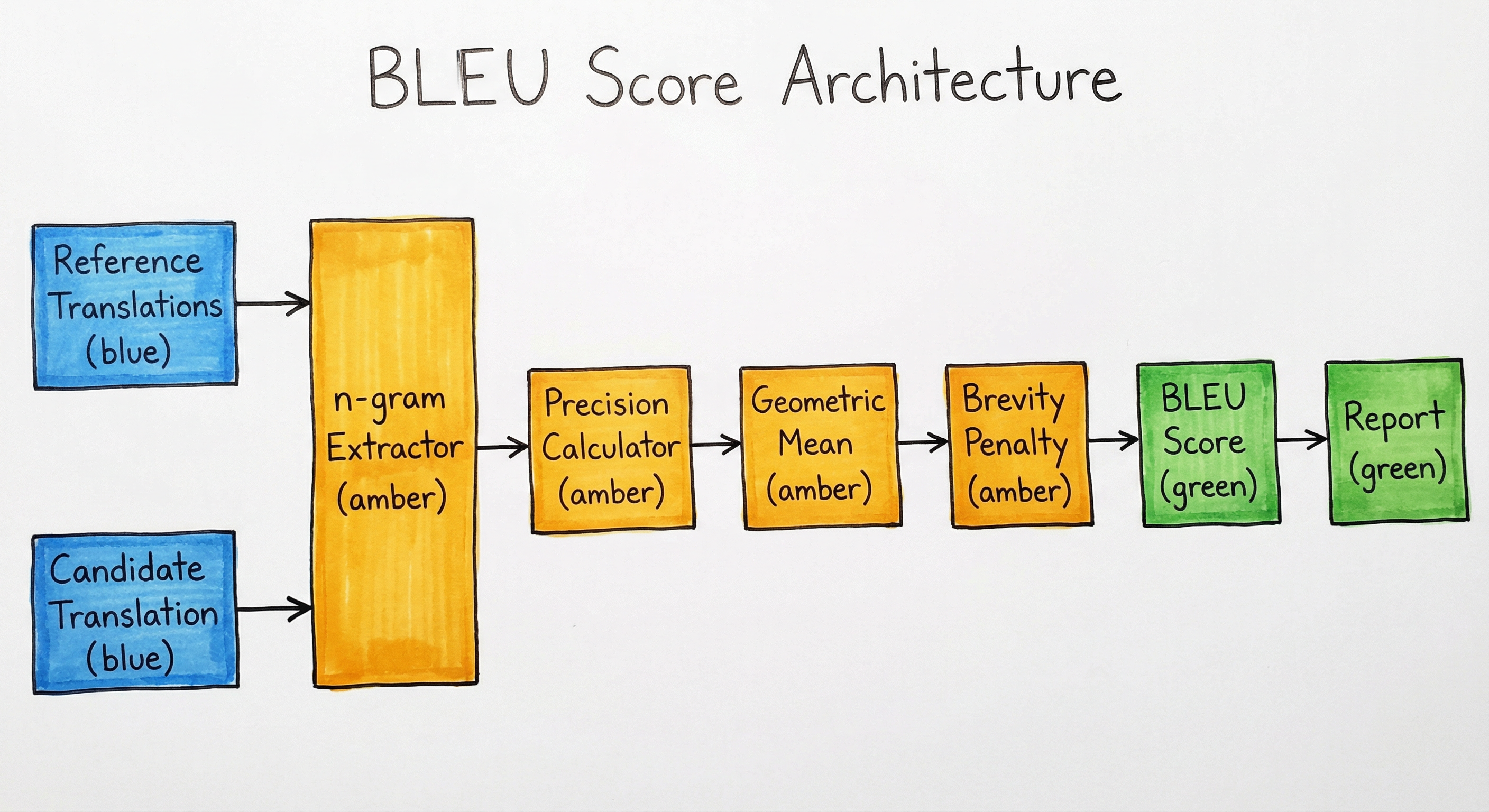
The critical bottleneck in large-scale evaluation is not the mathematical computation (which is and extremely fast), but rather tokenization inconsistency across implementations. A translation evaluated with Moses tokenizer vs. Penn Treebank tokenizer vs. whitespace splitting can produce BLEU scores that differ by 2-5 absolute points -- a huge variance that makes cross-paper comparisons meaningless.
Key Components
Tokenizer
Splits raw text into tokens (words, subwords, or characters depending on the language). The choice of tokenizer has an enormous impact on BLEU scores -- different tokenization of punctuation, contractions, or whitespace can change scores by multiple points. SacreBLEU standardizes this by using the WMT-standard tokenizer (tokenizer_13a) by default.
N-gram Extractor
Generates all n-grams of length 1, 2, 3, and 4 from the tokenized text. For a sentence with tokens, this produces unigrams, bigrams, trigrams, and 4-grams. N-grams are typically represented as tuples of strings for efficient hashing and comparison.
Count Aggregator
Builds hash tables (dictionaries) mapping each n-gram to its count in the candidate translation and in each reference translation. For multiple references, the maximum count across all references is retained for each n-gram. This enables the clipping operation in the next stage.
Clipping Engine
Implements the modified precision calculation by comparing candidate n-gram counts to reference n-gram counts and clipping each candidate count at the reference maximum. Prevents gaming the metric by repeating n-grams. This is the core innovation that distinguishes BLEU from naive precision metrics.
Precision Calculator
Computes the ratio of clipped n-gram counts (numerator) to total candidate n-gram counts (denominator) for each n-gram size (n=1,2,3,4). Handles edge cases like zero precision by either applying smoothing (sentence-BLEU) or propagating zero (corpus-BLEU, where a single zero precision tanks the entire score).
Geometric Mean Combiner
Combines the four precision scores (p_1, p_2, p_3, p_4) using a geometric mean, typically implemented as to avoid numerical underflow when multiplying very small probabilities. This is where BLEU's sensitivity to any single zero precision comes from.
Brevity Penalty Module
Computes the brevity penalty by comparing candidate length to the closest reference length. For corpus-level BLEU, aggregates lengths across the entire test set before computing the penalty. For sentence-level BLEU, applies the penalty per-sentence, though this can be overly harsh for short sentences.
Score Aggregator
Multiplies the geometric mean of n-gram precisions by the brevity penalty to produce the final BLEU score in the range [0, 1]. Most implementations report this as a percentage (0-100) for readability. Also reports individual n-gram precisions and the brevity penalty separately for diagnostic purposes.
Data Flow
Evaluation Workflow:
-
Input Stage: User provides candidate translations (model outputs) and reference translations (human-written gold standard). For corpus-level evaluation, these are lists of sentences; for sentence-level, single sentences.
-
Tokenization: Both candidate and reference texts are tokenized using the same tokenizer (critical for consistency). Tokenization handles punctuation, contractions, casing, and whitespace. SacreBLEU applies WMT-standard tokenizer_13a to ensure reproducibility.
-
N-gram Extraction: For each tokenized sentence, extract all n-grams of length 1 through 4. A 10-token sentence produces 10 unigrams, 9 bigrams, 8 trigrams, and 7 4-grams, totaling 34 n-grams.
-
Count Aggregation: Build dictionaries mapping n-grams to their counts. For multiple references, maintain a dictionary per reference and compute max counts across references for each n-gram.
-
Clipping Operation: For each n-gram in the candidate, clip its count at the maximum count observed in any reference. Sum these clipped counts (numerator) and sum unclipped candidate counts (denominator).
-
Precision Calculation: Divide clipped counts by total counts for each n-gram size, yielding p_1, p_2, p_3, p_4. Handle zeros with smoothing (sentence-level) or propagate zero (corpus-level).
-
Geometric Mean: Compute (or equivalently to avoid underflow).
-
Brevity Penalty: Compare candidate length to closest reference length . If , set BP = 1. If , compute .
-
Final Score: Multiply geometric mean by brevity penalty. Return BLEU score in [0,1], often reported as 0-100 for readability.
Parallelization: For large corpora, n-gram extraction and counting can be parallelized across sentences since they are independent operations. The final aggregation step (summing clipped counts across the corpus) requires synchronization but is trivial compared to extraction.
The architecture diagram shows two parallel streams: candidate translation and reference translation both flow through tokenization and n-gram extraction. The extracted n-grams build count dictionaries which feed into the clipping engine that computes modified precision. This flows into precision calculation for each n-gram size, then to a geometric mean combiner. In parallel, tokenized candidate length and reference length feed into a brevity penalty module. Finally, the geometric mean and brevity penalty are multiplied to produce the final BLEU score.
How to Implement
Three Primary Ways to Compute BLEU in Python
BLEU has been implemented in dozens of libraries across multiple languages, but three Python implementations dominate in 2026:
1. SacreBLEU (Recommended for Research). The gold standard for reproducible BLEU evaluation. Introduced by Matt Post in 2018 to address the reproducibility crisis caused by different tokenization schemes. SacreBLEU standardizes tokenization, downloads canonical test sets, and reports a version string to ensure comparability across papers. If you are publishing research, use SacreBLEU.
2. Hugging Face Evaluate Library. Provides a clean interface to SacreBLEU and other metrics with a unified API. Returns precision breakdown, BLEU score, and brevity penalty in a single call. Ideal for quick experiments and integration with Hugging Face transformers training loops.
3. NLTK (Good for Teaching/Prototyping). NLTK's sentence_bleu() and corpus_bleu() are easy to use and well-documented, making them great for learning how BLEU works. However, they do not standardize tokenization, making them unsuitable for comparing results across papers.
The Tokenization Reproducibility Problem
Here is why SacreBLEU exists: suppose you train a German-to-English translation model and report a BLEU score of 32.5. Another researcher tries to reproduce your work and gets 30.1 -- a 2.4-point drop that seems like a significant regression. But the difference might just be that you used Moses tokenization while they used whitespace splitting.
Pre-SacreBLEU papers rarely specified tokenization details, making cross-paper comparisons nearly meaningless. Post (2018) solved this by bundling tokenization, BLEU computation, and test set versioning into a single command-line tool that outputs a signature string like BLEU+case.mixed+lang.en-de+numrefs.1+smooth.exp+tok.13a+version.2.0.0 -- ensuring anyone running the same command on the same data gets the exact same score.
Cost Context: All three implementations are free and open-source. For Indian ML teams, the only cost is compute time, which is negligible -- evaluating a 3,000-sentence WMT test set takes under 1 second on a single CPU core.
from sacrebleu import corpus_bleu

# Candidate translations (your model's outputs)
candidates = [
    "The house is blue.",
    "I enjoy playing cricket.",
    "Mumbai is a large city.",
]

# Reference translations (human-written gold standard)
# Note: references is a list of lists -- each inner list is one reference set
references = [[
    "The house is blue.",
    "I like playing cricket.",
    "Mumbai is a big city.",
]]

# Compute corpus-level BLEU
bleu = corpus_bleu(candidates, references)

print(f"BLEU score: {bleu.score:.2f}")  # e.g., 54.23
print(f"Precision breakdown: {bleu.precisions}")  # [p_1, p_2, p_3, p_4]
print(f"Brevity penalty: {bleu.bp:.3f}")  # e.g., 1.000 (no penalty)
print(f"Signature: {bleu.signature}")
# BLEU+case.mixed+numrefs.1+smooth.exp+tok.13a+version.2.3.1

# For sentence-level BLEU with smoothing
from sacrebleu import sentence_bleu

sent_bleu = sentence_bleu(
    "The house is blue.",
    ["The house is blue."],
    smooth_method="exp",  # Exponential smoothing for sentence-level
)
print(f"Sentence BLEU: {sent_bleu.score:.2f}")  # 100.0 (perfect match)
This is the standard way to compute BLEU in 2026 for any research publication. SacreBLEU automatically handles tokenization using the WMT-standard tokenizer_13a (same as used in official WMT evaluations), applies exponential smoothing for zero counts, and returns a signature string that uniquely identifies the evaluation configuration. The references parameter is a list of lists because BLEU supports multiple references -- if you have three human translators, you would pass references = [ref1_list, ref2_list, ref3_list] where each list contains all sentences from that translator.
from sacrebleu import corpus_bleu

# Candidate translations
candidates = [
    "The movie was excellent.",
    "He is traveling to Delhi tomorrow.",
]

# Multiple reference translations (3 human translators)
reference1 = [
    "The film was excellent.",
    "He is going to Delhi tomorrow.",
]
reference2 = [
    "The movie was great.",
    "He will travel to Delhi tomorrow.",
]
reference3 = [
    "The movie was superb.",
    "Tomorrow he is traveling to Delhi.",
]

# References must be a list of reference sets
references = [reference1, reference2, reference3]

bleu = corpus_bleu(candidates, references)
print(f"BLEU with 3 references: {bleu.score:.2f}")

# Compare to single reference
bleu_single = corpus_bleu(candidates, [reference1])
print(f"BLEU with 1 reference: {bleu_single.score:.2f}")

# Multi-reference BLEU is typically 5-15 points higher because
# valid paraphrasing is captured by alternative references
Multiple references dramatically improve BLEU's reliability by capturing valid paraphrasing. The candidate "The movie was excellent" gets credit if any reference uses "movie" and "excellent," even if individual references vary ("film" vs "movie," "excellent" vs "great" vs "superb"). This is why WMT competitions provide 2-4 references per sentence. However, collecting multiple professional translations is expensive -- for a 3,000-sentence test set with 3 references, you need 9,000 human translations, costing thousands of dollars.
import evaluate

# Load the BLEU metric (backed by SacreBLEU)
bleu_metric = evaluate.load("bleu")

predictions = [
    "The cat sat on the mat",
    "I love eating biryani",
]
references = [[
    "The cat is sitting on the mat",
    "I enjoy eating biryani",
]]

# Compute BLEU
results = bleu_metric.compute(
    predictions=predictions,
    references=references,
    smooth=True,  # Apply smoothing for sentence-level
)

print(f"BLEU: {results['bleu']:.4f}")  # e.g., 0.5623
print(f"Precisions: {results['precisions']}")  # [p_1, p_2, p_3, p_4]
print(f"Brevity penalty: {results['brevity_penalty']:.3f}")
print(f"Length ratio: {results['length_ratio']:.3f}")
print(f"Translation length: {results['translation_length']}")
print(f"Reference length: {results['reference_length']}")
The Hugging Face evaluate library provides a cleaner API than raw SacreBLEU, returning all diagnostic information in a single dictionary. This is particularly useful when evaluating models during training -- you can log BLEU, individual n-gram precisions, and brevity penalty to TensorBoard or Weights & Biases for monitoring. The smooth=True parameter applies smoothing, making it suitable for sentence-level evaluation.
from nltk.translate.bleu_score import sentence_bleu, corpus_bleu
from nltk.translate.bleu_score import SmoothingFunction

# Sentence-level BLEU with smoothing
reference = [["the", "cat", "sat", "on", "the", "mat"]]
candidate = ["the", "cat", "is", "on", "the", "mat"]

smooth = SmoothingFunction()

# Method 3 (Chen & Cherry 2014) -- recommended for sentence-level
score = sentence_bleu(
    reference,
    candidate,
    weights=(0.25, 0.25, 0.25, 0.25),  # Uniform weights for BLEU-4
    smoothing_function=smooth.method3,
)
print(f"Sentence BLEU (smoothed): {score:.4f}")

# Corpus-level BLEU
list_of_references = [
    [["the", "cat", "sat", "on", "the", "mat"]],
    [["I", "love", "playing", "cricket"]],
]
list_of_candidates = [
    ["the", "cat", "is", "on", "the", "mat"],
    ["I", "enjoy", "playing", "cricket"],
]

corpus_score = corpus_bleu(
    list_of_references,
    list_of_candidates,
    weights=(0.25, 0.25, 0.25, 0.25),
)
print(f"Corpus BLEU: {corpus_score:.4f}")

# BLEU-1 (unigrams only) -- measures adequacy
bleu1 = sentence_bleu(reference, candidate, weights=(1, 0, 0, 0))
print(f"BLEU-1: {bleu1:.4f}")  # High score = right words

# BLEU-4 (up to 4-grams) -- measures adequacy + fluency
bleu4 = sentence_bleu(reference, candidate, weights=(0.25, 0.25, 0.25, 0.25))
print(f"BLEU-4: {bleu4:.4f}")  # High score = right words in right order
NLTK's implementation is more educational because it exposes all the internal parameters: weights for each n-gram size, smoothing methods, and separate sentence vs corpus functions. The key insight: BLEU-1 checks if the right words are present (adequacy), while BLEU-4 checks if they appear in natural phrase sequences (fluency). A translation with high BLEU-1 but low BLEU-4 has correct vocabulary but broken grammar. Note that NLTK expects pre-tokenized input (lists of tokens), while SacreBLEU handles tokenization internally.
from sacrebleu import corpus_bleu

candidates = [
    "I am learning machine translation.",
    "The book is on the table.",
]
references = [[
    "I am studying machine translation.",
    "The book is on the desk.",
]]

# BLEU-1: Only unigrams (adequacy)
bleu1 = corpus_bleu(candidates, references, max_ngram_order=1)
print(f"BLEU-1 (adequacy): {bleu1.score:.2f}")

# BLEU-2: Up to bigrams (adequacy + local fluency)
bleu2 = corpus_bleu(candidates, references, max_ngram_order=2)
print(f"BLEU-2: {bleu2.score:.2f}")

# BLEU-3: Up to trigrams
bleu3 = corpus_bleu(candidates, references, max_ngram_order=3)
print(f"BLEU-3: {bleu3.score:.2f}")

# BLEU-4: Up to 4-grams (default, best fluency measure)
bleu4 = corpus_bleu(candidates, references, max_ngram_order=4)
print(f"BLEU-4 (adequacy + fluency): {bleu4.score:.2f}")

# Typical pattern: BLEU-1 > BLEU-2 > BLEU-3 > BLEU-4
# If BLEU-1 is high but BLEU-4 is low, the translation has
# correct words but incorrect phrasing/grammar
Different BLEU variants emphasize different translation qualities. BLEU-1 focuses purely on vocabulary overlap -- does the translation use the right words? BLEU-4 (the standard) balances vocabulary with fluency by requiring 4-word sequences to match. In practice, a translation with BLEU-1 = 70 but BLEU-4 = 30 likely has correct content but reads awkwardly, while BLEU-1 = 60 and BLEU-4 = 55 indicates fluent, natural output.
import json
from sacrebleu import corpus_bleu
from pathlib import Path

def evaluate_translation_model(model_output_file, reference_file):
    """
    Evaluate a machine translation model using SacreBLEU.

    Args:
        model_output_file: Path to JSONL file with model outputs
        reference_file: Path to JSONL file with human references

    Returns:
        Dictionary with BLEU score and diagnostics
    """
    # Load model outputs
    candidates = []
    with open(model_output_file) as f:
        for line in f:
            data = json.loads(line)
            candidates.append(data["translation"])

    # Load references (supporting multiple references per sentence)
    references = []
    with open(reference_file) as f:
        for line in f:
            data = json.loads(line)
            # data["references"] is a list of alternative translations
            references.append(data["references"])

    # Transpose references for SacreBLEU format
    # From: [{"references": [ref1, ref2]}, ...]
    # To: [[all ref1s], [all ref2s]]
    num_refs = len(references[0])
    refs_transposed = []
    for i in range(num_refs):
        refs_transposed.append([item[i] for item in references])

    # Compute BLEU
    bleu = corpus_bleu(candidates, refs_transposed)

    return {
        "bleu_score": bleu.score,
        "bleu_1": bleu.precisions[0],
        "bleu_2": bleu.precisions[1],
        "bleu_3": bleu.precisions[2],
        "bleu_4": bleu.precisions[3],
        "brevity_penalty": bleu.bp,
        "length_ratio": bleu.sys_len / bleu.ref_len,
        "candidate_length": bleu.sys_len,
        "reference_length": bleu.ref_len,
        "signature": bleu.signature,
        "num_sentences": len(candidates),
    }

# Example usage
results = evaluate_translation_model(
    "model_outputs.jsonl",
    "wmt_references.jsonl",
)

print(f"BLEU: {results['bleu_score']:.2f}")
print(f"Brevity Penalty: {results['brevity_penalty']:.3f}")
print(f"Signature: {results['signature']}")

# Save results for reproducibility
with open("evaluation_results.json", "w") as f:
    json.dump(results, f, indent=2)
This production-ready evaluation pipeline demonstrates best practices: loading data from JSONL files (standard format for MT datasets), supporting multiple references per sentence, transposing reference format to match SacreBLEU's expectations, computing comprehensive diagnostics (not just the top-level BLEU score), and saving the signature string for reproducibility. If you report BLEU = 32.5 in a paper, you should also report the signature so others can verify your exact evaluation configuration.
# Example SacreBLEU configuration for WMT evaluation
# This YAML shows how to specify evaluation parameters
# (SacreBLEU typically runs from command line, not config files)

metrics:
  bleu:
    smooth_method: exp        # Exponential smoothing for sentence-level
    smooth_value: null        # Auto-select smoothing value
    tokenize: 13a             # WMT-standard tokenizer (mteval-v13a.pl)
    lowercase: false          # Preserve case (use true for case-insensitive)
    force: false              # Don't force download of test sets
    effective_order: true     # Use effective order for short sentences

test_sets:
  - name: wmt22/en-de
    source_lang: en
    target_lang: de
    num_references: 1
  - name: wmt22/en-hi
    source_lang: en
    target_lang: hi
    num_references: 2

# Command-line usage:
# cat model_outputs.txt | sacrebleu reference.txt --metrics bleu --tokenize 13a
#
# Output includes signature for reproducibility:
# BLEU = 32.45 | BP = 0.985 | ratio = 0.985 | hyp_len = 61245 | ref_len = 62178
# Signature: BLEU+case.mixed+numrefs.1+smooth.exp+tok.13a+version.2.3.1
Common Implementation Mistakes
- ●
Using different tokenization for training and evaluation: If you train your model with BPE tokenization but evaluate BLEU on whitespace-tokenized text, scores will be artificially deflated. Always ensure the evaluation tokenization matches your model's training tokenization, or use SacreBLEU's standardized tokenizer to avoid this issue entirely.
- ●
Comparing BLEU scores across papers without checking tokenization: A BLEU score of 32.5 from one paper is not directly comparable to 30.1 from another paper unless both used the same tokenization scheme. Pre-SacreBLEU papers often omitted tokenization details, making cross-paper comparisons unreliable. Always check the evaluation signature or methodology section.
- ●
Interpreting sentence-level BLEU without smoothing: Sentence-level BLEU frequently produces zero scores for short sentences because even one missing 4-gram causes the geometric mean to collapse to zero. Always apply smoothing (Chen & Cherry Method 3 or exponential smoothing) when evaluating individual sentences. Only corpus-level BLEU is reliable without smoothing.
- ●
Treating BLEU as a semantic similarity metric: BLEU measures n-gram overlap, not meaning. A translation using synonyms ("house" → "home") or paraphrasing ("I enjoy playing" → "I like to play") is heavily penalized despite being semantically correct. For semantic evaluation, use BERTScore or COMET instead.
- ●
Reporting only BLEU without human evaluation: High BLEU scores do not guarantee translation quality, especially for neural MT systems that produce fluent outputs with subtle errors. WMT competitions rank systems primarily on human evaluation, using BLEU only as a fast proxy. For production deployment decisions, always validate with human judgment.
- ●
Using BLEU for non-translation tasks without caution: BLEU was designed for machine translation where references exist. Applying it to open-ended generation (chatbot responses, creative writing) produces unreliable scores because there are infinite valid outputs. Use BLEU only when comparing against specific reference texts.
- ●
Ignoring the brevity penalty diagnostic: If your model achieves high BLEU but the brevity penalty is below 0.9, your translations are systematically too short -- likely omitting important information. Always check the BP value, not just the final score.
- ●
Mixing corpus-level and sentence-level averaging: Computing sentence-level BLEU for each sentence and then averaging those scores is mathematically different from computing corpus-level BLEU (which aggregates all n-gram counts first). The former (macro-averaging) treats all sentences equally, while the latter (micro-averaging) weights longer sentences more heavily. Standard practice is corpus-level BLEU.
When Should You Use This?
Use When
You are evaluating machine translation systems and need a fast, reproducible metric that correlates reasonably well with human judgment at the corpus level -- BLEU remains the standard baseline in 2026 despite newer alternatives
You need to compare your system to published baselines from the literature, most of which report BLEU scores -- using BLEU ensures your results are directly comparable to prior work
You are iterating rapidly during model development and need instant feedback on whether changes improve quality -- BLEU evaluates thousands of sentences in seconds, enabling tight feedback loops
Your test set has multiple human reference translations (2-4 references) -- BLEU's reliability improves dramatically with more references, capturing valid paraphrasing
You are evaluating corpus-level quality across hundreds or thousands of sentences rather than individual sentence quality -- this is where BLEU's statistical properties shine
Your translation task is close-to-literal translation (technical documentation, legal text, news) rather than creative adaptation where many valid phrasings exist
You need to monitor translation quality over time (e.g., detecting regressions after model updates) and want a stable, well-understood metric
You want to participate in WMT shared tasks or compare against WMT benchmarks, which still use BLEU as a primary automatic metric alongside human evaluation
Avoid When
You are evaluating single sentences or very short texts -- sentence-level BLEU is unreliable and often produces zero scores even for good translations unless heavy smoothing is applied
You need to measure semantic equivalence or meaning preservation -- BLEU penalizes valid synonyms and paraphrasing, making it unsuitable for evaluating semantic fidelity (use BERTScore or COMET instead)
Your task involves creative or diverse text generation (chatbots, story generation, marketing copy) where many valid outputs exist -- BLEU requires specific reference texts and cannot evaluate open-ended generation
You are evaluating low-resource languages without professional reference translations -- BLEU's reliability depends critically on high-quality human references
You need to detect critical errors like factual inaccuracies, negation mistakes, or entity hallucinations -- BLEU's n-gram matching cannot distinguish between "The fund grew 20%" and "The fund shrank 20%"
You are building a user-facing production system where perceived translation quality matters more than benchmark scores -- BLEU's correlation with human judgment is moderate (0.7-0.8), so supplement with human evaluation
Your model produces neural MT outputs that diverge from references but are fluent -- modern NMT systems often generate valid translations using different phrasing than references, causing BLEU to underestimate quality
You need a metric that handles morphologically rich languages (Turkish, Finnish, Hungarian) gracefully -- BLEU's word-level n-grams struggle with languages where a single word can have dozens of valid inflected forms (consider character-level metrics like chrF instead)
Key Tradeoffs
The Core Tradeoff: Speed vs. Meaning
BLEU's fundamental design decision is to trade semantic understanding for computational speed and reproducibility. This manifests in several concrete tradeoffs:
| Dimension | BLEU | Modern Alternatives (BERTScore, COMET) |
|---|---|---|
| Evaluation speed | Milliseconds for 3,000 sentences | Seconds to minutes (requires GPU for neural models) |
| Semantic awareness | None (pure surface form n-gram matching) | High (trained on human judgments, captures paraphrasing) |
| Correlation with human judgment | 0.70-0.80 (corpus-level) | 0.85-0.93 (sentence-level and corpus-level) |
| Reproducibility | Perfect (same inputs always give same output) | High (deterministic but model-dependent) |
| Setup complexity | Trivial (pip install sacrebleu) | Moderate (requires downloading BERT/XLM-R models) |
| Interpretability | High (can manually inspect n-gram overlaps) | Low (neural models are black boxes) |
| Multiple references | Required for reliability (1 ref is weak, 3+ is good) | Works well with single reference |
| Sentence-level reliability | Poor without smoothing | Excellent |
The Single Reference Problem
BLEU's reliability degrades sharply when evaluating against only one reference translation. The original 2002 paper assumed 4 references, but most modern test sets provide only 1-2 due to annotation cost. With a single reference, any valid paraphrasing is penalized:
- Reference: "The house is blue"
- Candidate: "The home is blue" → BLEU penalizes "home" vs "house"
- Candidate: "The blue house" → BLEU penalizes word order change
Both candidates are semantically correct, but BLEU treats them as worse than the reference. This is why modern neural metrics (trained on human judgments) outperform BLEU significantly.
The Neural MT Divergence Problem
Statistical MT systems from the 2000s-2010s produced translations that were often close in phrasing to references, making BLEU a reasonable proxy for quality. Modern neural MT systems (especially LLM-based translators like GPT-4) produce fluent, natural translations that can diverge significantly from reference phrasing while being semantically equivalent or even better.
This causes a phenomenon where BLEU underestimates neural MT quality. A system with BLEU = 35 might receive higher human ratings than a system with BLEU = 38 if the former produces more natural (but divergent) phrasing. This is why WMT evaluations now rank systems primarily on human judgment, using BLEU only as a fast screening tool.
When to Supplement BLEU
Here is a practical decision tree:
- Research/Development (Fast Iteration): Use BLEU as your primary metric for daily experiments. It is fast enough to run after every model checkpoint.
- Pre-Deployment Validation: Supplement BLEU with a neural metric (COMET or BERTScore) to catch semantic issues BLEU misses.
- Production Deployment Decision: Conduct human evaluation on a 200-500 sentence sample before deployment. High BLEU is necessary but not sufficient for production quality.
- Academic Publication: Report both BLEU (for comparability) and a modern metric (for accuracy), plus qualitative human evaluation on edge cases.
Rule of Thumb for Indian ML Teams: BLEU is still the right choice for internal development velocity -- it is free, fast, and easy to debug. But before deploying a translation system for customer-facing use (whether for Flipkart product descriptions, Swiggy restaurant translations, or legal document translation), validate with 100-200 human judgments from native speakers. BLEU = 35 might be excellent for technical docs but inadequate for marketing copy.
Alternatives & Comparisons
ROUGE (Recall-Oriented Understudy for Gisting Evaluation) is similar to BLEU but measures recall instead of precision -- what fraction of reference n-grams appear in the candidate. ROUGE is designed for summarization, where coverage of reference content matters more than avoiding extra words. Choose ROUGE over BLEU for summarization tasks; choose BLEU for translation where precision (avoiding hallucinations) is critical.
BERTScore uses BERT embeddings to compute semantic similarity between candidate and reference tokens, achieving 0.93 correlation with human judgment (vs. BLEU's 0.70). Choose BERTScore over BLEU when you need semantic evaluation that handles synonyms and paraphrasing, or when evaluating single sentences. Choose BLEU when you need instant evaluation (BERTScore requires GPU inference) or when comparing to established benchmarks that report BLEU.
Perplexity measures how well a language model predicts a sequence, computing the exponentiated cross-entropy. It evaluates the model's probability distribution, not the quality of generated text. Choose perplexity for evaluating language model training (pre-training, fine-tuning); choose BLEU for evaluating generated outputs against references. Perplexity does not require references but also does not measure generation quality.
Pros, Cons & Tradeoffs
Advantages
Blazing fast evaluation -- computing BLEU for a 3,000-sentence WMT test set takes under 1 second on a CPU, enabling rapid iteration during model development. This is 100-1000x faster than neural metrics like BERTScore or COMET that require GPU inference.
Perfect reproducibility -- identical inputs always produce identical outputs, with no randomness or model version dependencies. SacreBLEU's signature strings ensure anyone can verify your exact evaluation setup, addressing the reproducibility crisis in MT research.
Language-independent (with caveats) -- BLEU's n-gram matching works for any language with word boundaries. The same algorithm evaluates English, Hindi, German, or Japanese without language-specific tuning, though tokenization quality varies significantly across languages.
Well-established benchmarks -- two decades of research papers report BLEU scores, making it easy to compare your system to prior work. WMT test sets, OPUS corpora, and standard benchmarks all provide BLEU baselines.
Interpretable and debuggable -- you can manually inspect which n-grams matched or failed, making it easy to understand why a translation scored poorly. Neural metrics are black boxes that provide a score without explanation.
Zero computational cost -- BLEU runs on CPU with negligible memory requirements. For Indian startups and academic labs without GPU budgets, this is a massive advantage over neural metrics that require A100s or cloud inference.
Balances adequacy and fluency -- unigram precision measures vocabulary overlap (adequacy) while 4-gram precision measures phrase structure (fluency), providing a holistic quality signal from a single metric.
Disadvantages
No semantic understanding -- BLEU treats "house" and "home" as completely different despite being synonyms. It cannot recognize paraphrasing, making it unreliable for neural MT systems that produce fluent rephrasing rather than literal translations.
Reference dependency -- BLEU quality degrades sharply with fewer references. Single-reference BLEU has correlation ~0.60 with human judgment, while 4-reference BLEU reaches ~0.80. Collecting multiple references is expensive (thousands of dollars for standard test sets).
Unreliable for short texts -- sentence-level BLEU frequently produces zero scores even for good translations because a single missing 4-gram causes the geometric mean to collapse. Smoothing techniques help but introduce their own biases.
Tokenization dependency -- different tokenization schemes produce scores that differ by 2-5 absolute points. Pre-SacreBLEU papers often did not specify tokenization, making cross-paper comparisons unreliable. Even with SacreBLEU, tokenizer_13a struggles with languages like Chinese and Japanese.
Cannot detect critical errors -- BLEU cannot distinguish "The fund grew 20%" from "The fund shrank 20%" if n-grams mostly match. Factual errors, negation mistakes, and entity hallucinations receive similar scores to correct translations with minor phrasing differences.
Poor correlation with human judgment for neural MT -- modern NMT systems achieve high fluency with phrasing that diverges from references, causing BLEU to underestimate quality. Studies show BLEU's correlation with human judgment dropped from 0.80 (statistical MT era) to 0.60-0.70 (neural MT era).
Handles morphologically rich languages poorly -- languages like Finnish or Turkish have dozens of valid inflections for each word. BLEU's word-level n-grams cannot capture that "talossa" (in the house) and "talosta" (from the house) are related forms, treating them as completely different words.
Failure Modes & Debugging
Synonym Blindness
Cause
BLEU performs exact string matching of n-grams without understanding that words like "house"/"home", "big"/"large", or "start"/"begin" are semantically equivalent. Any lexical variation is penalized equally regardless of whether the meaning is preserved.
Symptoms
A translation using synonyms throughout receives a low BLEU score (e.g., 20-30) despite being semantically perfect. The individual n-gram precisions show low overlap (p_1 might be 60% instead of 90%), and human evaluators rate the translation as high quality while BLEU rates it poorly.
Mitigation
Use BERTScore or COMET for semantic evaluation, which use contextualized embeddings to recognize synonyms. Alternatively, provide multiple reference translations (3-4 references) covering different valid phrasings -- this dramatically improves BLEU's reliability by capturing paraphrasing in the reference set.
Sentence-Level Zero Scores
Cause
Sentence-level BLEU uses a geometric mean of n-gram precisions (p_1, p_2, p_3, p_4). If any single precision is zero (e.g., no 4-grams match), the geometric mean becomes zero, resulting in BLEU = 0 even if the translation is 80% correct. This is especially common for short sentences where even one word change eliminates all 4-gram matches.
Symptoms
Evaluating individual sentences produces BLEU = 0.0 for translations that are clearly good. The precision breakdown shows something like [0.75, 0.60, 0.40, 0.00], where the zero 4-gram precision collapses the entire score. Corpus-level BLEU for the same translations is reasonable (e.g., 35).
Mitigation
Never use unsmoothed BLEU for sentence-level evaluation. Apply smoothing techniques: Chen & Cherry (2014) Method 3 (add-one smoothing) or exponential smoothing (SacreBLEU's smooth_method='exp'). These add small epsilon values to prevent zero precision from collapsing the score. Alternatively, only report corpus-level BLEU, which aggregates n-gram counts across all sentences before computing precision.
Critical Error Invisibility
Cause
BLEU's n-gram matching cannot distinguish between translations that are mostly correct but contain a critical error (wrong negation, opposite meaning, entity substitution). If 90% of n-grams match but the remaining 10% reverse the meaning, BLEU still reports a high score.
Symptoms
Reference: "The fund increased by 20%." Candidate: "The fund decreased by 20%." → BLEU = 0.85 (85% of n-grams match). Human evaluation rates this as a critical failure, but BLEU sees it as high quality. This is catastrophic for domains like medical or legal translation where a single word error can reverse meaning.
Mitigation
Supplement BLEU with semantic metrics (BERTScore, COMET) that use embeddings to detect semantic divergence. For production systems, implement rule-based validators that check for negation consistency, entity preservation, and numerical accuracy. Always conduct human evaluation on a sample (200-500 sentences) before deployment, focusing on edge cases and critical errors.
Tokenization Variance
Cause
BLEU scores depend critically on how text is tokenized (split into words/tokens). Different tokenization of punctuation, contractions, hyphenation, or whitespace produces different n-grams, causing scores to vary by 2-5 absolute points. Pre-SacreBLEU papers rarely specified tokenization, making cross-paper comparisons unreliable.
Symptoms
Your model achieves BLEU = 32.5 with Moses tokenization, but a collaborator reports BLEU = 30.1 using Penn Treebank tokenization on the same outputs. Published baselines cannot be reproduced because tokenization details were omitted. Comparisons across papers show inconsistent rankings.
Mitigation
Always use SacreBLEU for evaluation, which standardizes tokenization (tokenizer_13a by default). Report the SacreBLEU signature string in papers: BLEU+case.mixed+numrefs.1+smooth.exp+tok.13a+version.2.3.1. For non-standard languages, explicitly document the tokenizer used. Never compare BLEU scores across papers unless tokenization is identical.
Neural MT Divergence Underestimation
Cause
Modern neural MT systems (especially LLM-based translators like GPT-4) produce fluent, natural translations that diverge significantly from reference phrasing. They use different but equally valid word choices and sentence structures. BLEU interprets this divergence as low quality, even when human evaluators prefer the neural translation.
Symptoms
A neural MT system achieves BLEU = 35 while an older statistical MT system achieves BLEU = 38, but human evaluation ranks the neural system higher. The neural system has lower n-gram overlap (especially for 3-grams and 4-grams) because it rephrases more creatively, but the output reads more fluently.
Mitigation
Do not rely solely on BLEU for neural MT evaluation. Use neural metrics like COMET (Crosslingual Optimized Metric for Evaluation of Translation) that are trained on human judgments and correlate better with modern MT quality (0.85-0.93 correlation vs. BLEU's 0.60-0.70). Conduct human evaluation to verify that lower BLEU is not masking higher actual quality.
Placement in an ML System
BLEU sits at the evaluation checkpoint after text generation completes, serving as a fast quality gate during model development. In a typical ML system for machine translation, BLEU appears in three places:
1. Training Loop Evaluation: Compute BLEU on a held-out validation set after each epoch or every N steps to monitor training progress. If BLEU plateaus or degrades, trigger early stopping. This requires fast evaluation (seconds, not minutes) to avoid slowing training.
2. Hyperparameter Tuning: When sweeping hyperparameters (learning rate, model size, beam width, temperature), BLEU provides the objective function for optimization. Run each configuration, evaluate BLEU on a dev set, pick the best. For a large sweep (100+ configurations), BLEU's speed is essential.
3. A/B Testing and Deployment: Before deploying a new model to production, evaluate BLEU on the test set to ensure it does not regress compared to the current production model. A BLEU drop of 2+ absolute points is typically considered significant enough to block deployment.
BLEU is upstream from final deployment decisions but downstream from model outputs. It connects the generation system to the decision-making process (deploy vs. iterate vs. abandon). For systems serving millions of users (Google Translate, Microsoft Translator, DeepL), even a 0.5-point BLEU improvement can justify deployment because it represents billions of improved translations.
In Indian ML contexts, BLEU is particularly valuable for low-resource language pairs (English-Hindi, English-Tamil) where human evaluation is expensive. A team at an Indian startup building multilingual support for their app can use BLEU to iterate quickly during development, then conduct targeted human evaluation (100-200 sentences per language) only before final deployment.
Pipeline Stage
Evaluation
Upstream
- llm-model
- encoder-decoder
- translation-model
- text-generation
Downstream
- ab-testing
- model-selection
- hyperparameter-tuning
Scaling Bottlenecks
BLEU itself scales trivially (linear in corpus size, evaluates millions of tokens per second), but collecting high-quality reference translations is the bottleneck. A standard WMT test set with 3,000 sentences requires professional translators, costing $5,000-15,000 (~INR 4.2-12.6 lakh) per language pair per reference. Multi-reference evaluation (3-4 references) multiplies this cost. For low-resource languages like Tamil, Assamese, or Punjabi, finding qualified professional translators can take months. This is why most production systems evaluate on single-reference test sets despite knowing that BLEU reliability degrades significantly.
Production Case Studies
Meta's No Language Left Behind (NLLB-200) project built a single neural MT model supporting 200 languages, evaluated using BLEU as the primary automatic metric. The model achieved an average 44% BLEU improvement over previous state-of-the-art systems across low-resource languages. For some African and Indian languages, NLLB-200's translations were over 70% more accurate (measured by BLEU and human evaluation). Meta built the FLORES-200 dataset, enabling BLEU evaluation across 40,000 language pair directions.
NLLB-200 powers translation for 25 billion Facebook/Instagram posts daily. BLEU served as the fast screening metric during development, validated by human evaluation on a subset. The project demonstrated BLEU's continued relevance for large-scale neural MT development despite its limitations.
OpenAI's GPT-4 technical report includes machine translation benchmarks evaluated with BLEU across multiple language pairs. However, research papers like "BLEU Meets COMET" (2023) showed that combining traditional BLEU with neural metrics like COMET provides more robust evaluation. The study found that BLEU detects critical errors (repeated words, missing entities) that neural metrics miss, while neural metrics capture semantic equivalence that BLEU misses.
Industry consensus in 2026 is emerging around hybrid evaluation: use BLEU for fast iteration and regression detection, use COMET/BERTScore for semantic quality, and use human evaluation for final deployment decisions. BLEU remains essential in the evaluation toolkit but no longer stands alone.
The foundational BLEU paper by Papineni et al. introduces the Bilingual Evaluation Understudy metric for automatic evaluation of machine translation, using n-gram overlap and brevity penalty to measure translation quality correlation with human judgements.
BLEU became one of the first metrics to claim high correlation with human quality judgements and remains one of the most popular automated, inexpensive metrics for MT evaluation since its 2002 publication.
The annual Workshop on Machine Translation (WMT), the premier MT research competition, has used BLEU as a primary automatic metric since 2006. WMT 2024 rankings combine automatic metrics (BLEU, chrF, COMET) with human evaluation (Direct Assessment + Scalar Quality Metrics). Human evaluation consistently shows that the best BLEU system is not always the best system overall, with correlation around 0.70-0.75 at the system level.
WMT's approach represents the gold standard for MT evaluation: use BLEU for fast ranking and regression detection, use neural metrics for semantic quality, and use human evaluation for final system rankings. This multi-metric approach is now standard across industry and academia.
Tooling & Ecosystem
The gold standard for reproducible BLEU evaluation in 2026. Introduced by Matt Post in 2018 to address the reproducibility crisis in MT research. Standardizes tokenization (WMT tokenizer_13a by default), downloads canonical test sets (WMT, FLORES, etc.), and outputs a signature string for exact reproducibility. Supports BLEU, chrF, chrF++, and TER metrics. Available as both a Python library and command-line tool.
Unified interface for 100+ evaluation metrics including BLEU (backed by SacreBLEU), ROUGE, BERTScore, METEOR, and custom metrics. Returns comprehensive diagnostic information (precision breakdown, brevity penalty, length ratio) in a single call. Integrates seamlessly with Hugging Face transformers training loops for automatic evaluation during fine-tuning.
Provides sentence_bleu() and corpus_bleu() functions with seven smoothing methods (including Chen & Cherry 2014's recommended Method 3). Great for educational purposes and understanding BLEU internals, but does not standardize tokenization. Supports custom n-gram weights (e.g., BLEU-1, BLEU-2) and detailed precision breakdowns.
The classic statistical MT toolkit includes the original multi-bleu.perl script used in pre-neural MT research. Historically important but deprecated for new research -- use SacreBLEU instead for reproducibility. Includes the Moses tokenizer, which is still widely referenced but produces scores incompatible with WMT-standard tokenization.
PyTorch Lightning's metrics library provides BLEUScore with GPU-accelerated computation for large-scale evaluation. Supports batched evaluation, multi-reference BLEU, and integration with PyTorch training loops. Particularly useful when evaluating millions of translations where CPU-based SacreBLEU becomes a bottleneck.
GPU-vectorized BLEU implementation (2024 research) enabling per-sentence in-training evaluation during neural MT training. Computes BLEU on GPU batches during backpropagation, allowing BLEU-based loss functions or real-time monitoring. Achieves 100-1000x speedup over CPU-based evaluation for large batches.
Research & References
Kishore Papineni, Salim Roukos, Todd Ward, Wei-Jing Zhu (2002)ACL 2002
The original BLEU paper introducing n-gram precision with brevity penalty. Demonstrated 0.99 correlation with human judgment at the corpus level across five MT systems. This foundational work enabled the rapid progress in MT research over the next two decades by providing fast, reproducible evaluation.
Matt Post (2018)WMT 2018
Introduced SacreBLEU to address the reproducibility crisis in MT evaluation. Showed that different tokenization schemes produce BLEU scores varying by 1.8 points on average, making cross-paper comparisons unreliable. Argued for standardized evaluation pipelines with version strings to ensure reproducibility.
Boxing Chen, Colin Cherry (2014)WMT 2014
Systematically compared seven smoothing techniques for sentence-level BLEU, introducing three new methods. Method 3 (add-one smoothing) achieved the best correlation with human judgment (0.72) at the sentence level, addressing BLEU's tendency to produce zero scores for short texts.
Chris Callison-Burch, Miles Osborne, Philipp Koehn (2006)EACL 2006
Critical analysis of BLEU's limitations, showing that increases in BLEU do not always correspond to genuine quality improvements. Found that BLEU's correlation with human judgment drops for neural MT systems that produce fluent but divergent translations. Argued for supplementing BLEU with human evaluation.
Chrysoula Zerva, Tânia Vaz, José G. C. de Souza, André F. T. Martins (2023)EAMT 2023
Demonstrated that combining traditional BLEU with neural metrics like COMET produces more robust evaluation than either alone. BLEU catches repetition and missing content that neural metrics miss, while COMET captures semantic equivalence that BLEU misses. Proposed hybrid evaluation as best practice for 2023+.
Tom Kocmi, Christian Federmann, Roman Grundkiewicz, et al. (2021)WMT 2021
Large-scale meta-evaluation of automatic MT metrics on WMT 2021 data, finding that neural metrics (COMET, BLEURT) correlate significantly better with human judgment (0.85-0.89) than BLEU (0.65-0.70) at the system level. BLEU remains useful for regression detection but is no longer the best single metric for quality assessment.
Interview & Evaluation Perspective
Common Interview Questions
- ●
Explain how BLEU score is calculated. What are the key components?
- ●
What is the difference between BLEU-1, BLEU-2, BLEU-3, and BLEU-4? Why use BLEU-4 as the standard?
- ●
Why does BLEU use a geometric mean instead of an arithmetic mean for combining n-gram precisions?
- ●
What is the brevity penalty and why is it necessary? How is it computed?
- ●
What are the main limitations of BLEU for evaluating neural machine translation systems?
- ●
When would you use BLEU vs. ROUGE vs. BERTScore? How do they differ?
- ●
How does having multiple reference translations improve BLEU reliability?
- ●
Why is sentence-level BLEU unreliable? What smoothing techniques address this?
- ●
How would you design an evaluation pipeline for a production machine translation system? Would you rely solely on BLEU?
- ●
What is SacreBLEU and why is it important for reproducible research?
Key Points to Mention
- ●
Modified n-gram precision with clipping: Emphasize that BLEU clips candidate n-gram counts at the maximum reference count to prevent gaming the metric by repeating words. This is what makes it "modified" precision rather than naive precision.
- ●
Geometric mean sensitivity: Explain that using a geometric mean (rather than arithmetic mean) makes BLEU extremely sensitive to any single n-gram precision dropping to zero. This harshly penalizes translations with correct words but completely broken phrasing.
- ●
Brevity penalty prevents gaming: Without the brevity penalty, outputting just high-confidence words ("cat mat") would achieve 100% precision. The exponential penalty forces systems to produce complete translations.
- ●
Corpus-level vs. sentence-level: Clarify that BLEU was designed for corpus-level evaluation (aggregating n-gram counts across thousands of sentences) and becomes unreliable at the sentence level without smoothing.
- ●
Tokenization matters enormously: Mention that different tokenization schemes can change BLEU scores by 2-5 points, which is why SacreBLEU standardization is critical for reproducibility.
- ●
BLEU is a precision metric, ROUGE is recall: This distinction is important -- BLEU measures what fraction of the candidate appears in references (avoiding hallucinations), while ROUGE measures what fraction of references appears in the candidate (coverage).
- ●
Modern limitations with neural MT: Discuss that neural MT systems produce fluent translations with different phrasing than references, causing BLEU to underestimate quality. This is why metrics like COMET (trained on human judgments) correlate better with modern MT quality.
- ●
Multiple references dramatically improve reliability: A single reference gives correlation ~0.60 with human judgment; 4 references reach ~0.80. Explain the practical tradeoff: multiple references are expensive to collect but significantly improve metric quality.
Pitfalls to Avoid
- ●
Claiming BLEU measures semantic similarity: BLEU is purely surface-form n-gram matching. It does not understand meaning and heavily penalizes valid synonyms and paraphrasing. Conflating BLEU with semantic metrics like BERTScore is a red flag.
- ●
Ignoring tokenization when comparing scores: Never compare BLEU scores across papers or systems without verifying identical tokenization. Saying "our model achieves BLEU 32 vs. their 30" is meaningless if tokenization differs.
- ●
Recommending BLEU for single-sentence evaluation without smoothing: Unsmoothed sentence-level BLEU frequently produces zero scores. Always mention smoothing techniques (Chen & Cherry Method 3 or exponential smoothing) if discussing sentence-level evaluation.
- ●
Forgetting to mention the brevity penalty: Some candidates explain only n-gram precision and forget the brevity penalty, which is equally important. BLEU without BP would be trivially gamed by outputting single words.
- ●
Overstating BLEU's correlation with human judgment: In the neural MT era, BLEU's correlation dropped to 0.60-0.70 at the system level. Do not cite the original 2002 paper's 0.99 correlation (which was on 5 statistical MT systems) as evidence that BLEU is perfect.
- ●
Not mentioning modern alternatives: Failing to acknowledge that neural metrics like COMET and BERTScore correlate better with human judgment (0.85-0.93 vs. 0.60-0.70) suggests unfamiliarity with recent research.
Senior-Level Expectation
Senior and staff-level candidates should discuss production deployment considerations beyond just metric calculation. This includes: (1) Hybrid evaluation strategies -- using BLEU for fast iteration during development, neural metrics (COMET/BERTScore) for semantic validation, and human evaluation (200-500 sentences) before production deployment. (2) Cost-quality tradeoffs -- acknowledging that collecting multiple references is expensive ($5K-15K per language pair) and discussing strategies like single-reference BLEU during development, multi-reference for final benchmarking. (3) Domain-specific considerations -- explaining that BLEU works better for literal translation tasks (technical docs, news) than creative tasks (marketing, literature), and how to adjust evaluation accordingly. (4) A/B testing integration -- describing how to use BLEU as an early signal in A/B tests (e.g., deploy to 5% of traffic if BLEU improves by 2+ points, monitor user engagement), while acknowledging that user metrics (engagement, retention) are the ultimate quality signal. (5) Failure mode mitigation -- discussing specific checks for critical errors (negation, entity preservation, numerical accuracy) that BLEU cannot detect. Expect candidates to reference real systems (Google Translate, DeepL, WMT benchmarks) and cite specific BLEU scores as reference points.
Summary
BLEU (Bilingual Evaluation Understudy) remains one of the most influential metrics in natural language processing history, fundamentally enabling the rapid progress of machine translation research over the past two decades. Introduced by Papineni et al. in 2002, BLEU solved a critical bottleneck: expensive, slow, irreproducible human evaluation was blocking research velocity. By providing a fast, automatic metric based on n-gram precision and brevity penalty, BLEU enabled researchers to iterate quickly, compare systems objectively, and track progress across the field.
The metric's core insight is elegant: good translations share word sequences (n-grams) with professional human translations. BLEU measures modified n-gram precision (clipping counts to prevent gaming) for 1-grams through 4-grams, combines them via geometric mean (which harshly penalizes broken phrasing), and applies a brevity penalty to prevent systems from outputting only high-confidence words. This balances adequacy (right words) and fluency (right word order) in a single score from 0 to 1.
BLEU's strengths are undeniable: it evaluates thousands of sentences in milliseconds, is perfectly reproducible, works across languages, requires no expensive infrastructure (pure CPU, no neural models), and has established two decades of benchmarks for comparison. SacreBLEU's 2018 introduction standardized tokenization and test sets, addressing the reproducibility crisis and ensuring modern BLEU scores are comparable across papers and systems.
However, BLEU's limitations have become increasingly apparent in the neural MT era. It measures surface-form n-gram overlap without semantic understanding, heavily penalizing valid synonyms and paraphrasing. Sentence-level BLEU is unreliable without smoothing, frequently producing zero scores for short texts. BLEU cannot detect critical errors like negation mistakes ("increased" vs. "decreased"), entity hallucinations, or numerical inaccuracies -- problems that make the metric unsuitable as the sole quality gate for production systems. Modern neural MT systems produce fluent translations that diverge from reference phrasing, causing BLEU to underestimate quality (correlation with human judgment dropped from 0.80 in the statistical MT era to 0.60-0.70 for neural MT).
In 2026, industry best practice has converged on hybrid evaluation strategies: use BLEU for fast iteration during model development (it remains unmatched for speed and debuggability), supplement with neural metrics like COMET or BERTScore for semantic validation (achieving 0.85-0.93 correlation with human judgment), and conduct targeted human evaluation (200-500 sentences) before production deployment. BLEU is necessary but no longer sufficient -- it provides a fast signal for regression detection and rough quality estimation, but critical decisions require richer evaluation.
For ML engineers building translation systems, BLEU remains an essential tool in 2026. It enables rapid experimentation during training (evaluate every checkpoint in seconds), provides a common language for comparing to published baselines (nearly every MT paper reports BLEU), and serves as an effective quality gate for catching regressions (a BLEU drop of 2+ points is a strong signal to investigate). But BLEU must be paired with an understanding of its failure modes, supplemented with semantic metrics and human evaluation, and never used as the sole criterion for deploying user-facing translation systems. The metric that democratized MT research in 2002 remains valuable in 2026 -- but only when used with appropriate caution and modern complementary tools.