Perplexity in Machine Learning
Ask any researcher how they evaluated their language model in 2018, and the answer was almost universally perplexity. Ask that same question in 2026, and you will hear a more nuanced response: perplexity is still measured, still reported, still useful -- but it is no longer sufficient. It has evolved from the evaluation metric to one of the evaluation metrics, a quick sanity check rather than the final verdict on model quality.
Perplexity measures how surprised a language model is by a sequence of text. A model that assigns high probability to the actual next token in a sequence has low perplexity (low surprise). A model that consistently guesses wrong has high perplexity (high surprise). Mathematically, perplexity is the exponentiated average negative log-likelihood -- a transformation that converts the model's raw cross-entropy loss into an interpretable number: the effective branching factor, or the weighted average number of equally likely next tokens.
In practical terms, a perplexity of 50 means the model is as uncertain as if it were choosing uniformly among 50 equally probable options at each step. Lower is better. GPT-2 achieved a perplexity of 35.76 on WikiText-103 in 2019. GPT-4 achieved 3.14 on Penn Treebank in 2023. Modern LLMs can reach perplexities below 10 on standard benchmarks, representing genuinely strong predictive performance on held-out text.
But perplexity has limits. It is dataset-dependent, tokenizer-sensitive, and does not correlate well with downstream task performance, factual accuracy, or reasoning ability. It tells you the model is good at predicting tokens in a specific corpus -- not whether it can write coherent essays, answer medical questions, or debug Python code. This guide explains what perplexity is, why it exists, when to use it, and crucially, when to look beyond it.
Concept Snapshot
- What It Is
- A metric that quantifies the average uncertainty (surprise) of a language model when predicting the next token in a sequence, computed as the exponentiated cross-entropy loss.
- Category
- Evaluation
- Complexity
- Intermediate
- Inputs / Outputs
- Inputs: a test text corpus and a trained language model. Outputs: a single scalar perplexity score (lower is better) representing the model's predictive quality on that corpus.
- System Placement
- Used during model development to compare checkpoints, across models on standard benchmarks (WikiText, Penn Treebank), and as a quick diagnostic metric before deeper task-specific evaluation.
- Also Known As
- PPL, model perplexity, predictive perplexity, test perplexity, per-word perplexity, per-token perplexity
- Typical Users
- ML Researchers, NLP Engineers, Model Developers, Language Model Trainers, Benchmark Evaluators
- Prerequisites
- Understanding of language models, Familiarity with probability and log-likelihood, Basic knowledge of cross-entropy loss, Awareness of tokenization
- Key Terms
- cross-entropylog-likelihoodexponentiationbranching factorbits per characterheld-out test settokenizervocabulary
Why This Concept Exists
The Need for a Single Number
In the early days of statistical language modeling -- the 1980s through the early 2010s -- the primary goal was simple: predict the next word as accurately as possible. N-gram models, RNNs, LSTMs, and early Transformers were all fundamentally next-token predictors. Researchers needed a metric that answered one question: which model predicts held-out text better?
Cross-entropy loss was the training objective, but it is not interpretable. Telling someone your model achieves a cross-entropy of 3.2 on a test set provides no intuitive sense of quality. Is 3.2 good? How much better is 2.8? The numbers are abstract.
Perplexity emerged as the interpretable transformation. By exponentiating cross-entropy, you get a value with a concrete meaning: the effective number of equally likely choices the model faces at each prediction step. A perplexity of 100 means the model is as uncertain as if it were choosing uniformly from 100 candidates. A perplexity of 10 means it has narrowed the space to 10 plausible tokens. This transformation turned an opaque loss value into a number researchers could reason about.
Historical Evolution
Perplexity has roots in information theory, introduced by Claude Shannon in his seminal 1948 paper A Mathematical Theory of Communication. Shannon used entropy to quantify the information content of language, famously estimating that English has roughly 1-2 bits per character of entropy. Perplexity, as , became the standard way to report this.
In NLP, perplexity gained prominence with statistical language models in the 1990s. Benchmark datasets like Penn Treebank (1993) and later WikiText (2016) established perplexity as the default reporting metric. Papers would train a model, report its perplexity on the test set, and claim progress if the number went down.
But the rise of large pre-trained models (BERT in 2018, GPT-2 in 2019, GPT-3 in 2020) exposed a critical limitation: perplexity does not predict downstream task performance. A model with lower perplexity on WikiText did not necessarily perform better on question answering, summarization, or sentiment analysis. Research published in 2021 (Language Model Evaluation Beyond Perplexity, ACL) formalized this disconnect, showing weak or even negative correlations between perplexity and task accuracy on several benchmarks.
Why It Persists Despite Limitations
Despite these shortcomings, perplexity remains ubiquitous in 2026 for three reasons:
-
Speed: Computing perplexity requires a single forward pass through the model on a test set -- no labeled data, no task-specific infrastructure, no human evaluation. It is the fastest way to check if a model checkpoint has regressed.
-
Standardization: Decades of papers report perplexity on Penn Treebank and WikiText-103, creating a historical record for comparison. New models are still benchmarked against these datasets because everyone else does it.
-
Intrinsic signal: While perplexity does not predict task performance perfectly, it is not noise either. A model with perplexity of 200 is genuinely worse at language modeling than one with perplexity of 20. It is a necessary but not sufficient condition for quality.
The modern view is that perplexity is a first-line diagnostic -- a quick check that your model is learning something coherent -- but never the final evaluation. Teams report perplexity alongside MMLU, HumanEval, TruthfulQA, and task-specific benchmarks. It is one data point in a multi-dimensional assessment.
Key Insight: Perplexity measures how well a model fits a specific statistical distribution, not how useful or safe or truthful it is. In the era of LLMs deployed for real-world tasks, distribution fit is a foundation, not the finish line.
Core Intuition & Mental Model
Perplexity as "Weighted Vocabulary Size"
Here is the simplest mental model for perplexity: imagine the model has to predict the next word in a sentence, and it is allowed to guess from a shortlist of plausible words. Perplexity is the size of that shortlist, weighted by how uncertain the model is.
If the model is perfectly confident -- it assigns 100% probability to the correct next word and 0% to everything else -- the perplexity is 1. It has effectively reduced the vocabulary to a single choice. If the model is completely clueless -- it assigns equal probability to all 50,000 words in its vocabulary -- the perplexity is 50,000. It might as well be guessing randomly.
In reality, most predictions fall in between. The model might assign 40% probability to the most likely word, 25% to the second-most-likely, 10% to the third, and the remaining 25% distributed across hundreds of other words. Perplexity computes the effective size of this probability-weighted shortlist.
Why Exponentiate Cross-Entropy?
Cross-entropy is the average negative log probability the model assigns to the correct tokens:
Because of the logarithm, this value is additive: the cross-entropy of a 100-word sequence is roughly 100 times the per-word cross-entropy. But logarithms are not intuitive. Exponentiating reverses the log, transforming the loss back into a probability-space quantity:
This exponentiation is what gives perplexity its interpretation as a branching factor. If the model assigns an average probability of to the correct next token, the cross-entropy is nats, and the perplexity is . The model behaves as if choosing uniformly from 10 options.
Lower is Better -- But How Low is Good?
There is no universal "good" perplexity threshold. It depends entirely on the dataset:
- Penn Treebank (small, well-edited news text): Modern models achieve perplexities in the 20-50 range. GPT-4 reached 3.14, an exceptionally low value indicating near-perfect prediction on this curated corpus.
- WikiText-103 (web-scraped Wikipedia): Perplexities in the 15-35 range are typical for strong models. GPT-2 achieved 35.76 in 2019. GPT-3 improved this to under 20.
- C4 (web crawl, noisy): Perplexities in the 10-25 range for frontier models, reflecting the diversity and noise in the data.
A model with perplexity 50 on WikiText is decent. The same model with perplexity 50 on Penn Treebank is underperforming by 2026 standards. Always compare perplexity values within the same dataset.
Rule of Thumb: Perplexity tells you how predictable the test set is to the model. A lower perplexity means the model's learned distribution is closer to the true data distribution. But "close to the data distribution" is not the same as "useful for real tasks."
Technical Foundations
Mathematical Definition
Given a sequence of tokens and a language model that assigns probabilities to tokens conditioned on context, the perplexity is defined as:
where:
- is the -th token in the sequence
- is the context (all tokens before )
- is the probability the model assigns to the correct token given the context
- is the total number of tokens in the test set
- The logarithm is typically natural log (base ), though base-2 log is also used
Alternatively, perplexity can be expressed as the exponential of the average negative log-likelihood (NLL):
or equivalently as the exponential of the cross-entropy loss :
Relationship to Cross-Entropy
Cross-entropy is the expected negative log-likelihood under the true distribution and the model distribution :
For language modeling, we approximate with the empirical distribution from the test set. Perplexity is simply:
if using base-2 logarithms. This connects perplexity directly to information theory: cross-entropy in base 2 gives bits per token, and perplexity is the effective vocabulary size given that entropy.
Bits Per Character (BPC)
For character-level language models or for comparing models with different tokenizers, bits per character (BPC) is more standardized:
where is computed in nats (natural log). BPC represents the average number of bits needed to encode each character using the model's predicted distribution. A BPC of 1.0 means the model is as efficient as a binary encoding (2 equally likely characters). Typical modern LLMs achieve 0.7-1.2 BPC on English text.
The relationship between BPC and perplexity:
So a BPC of 1.0 corresponds to a character-level perplexity of 2.0 (effectively choosing between two characters).
Per-Token vs. Per-Word Perplexity
Modern models use subword tokenization (BPE, SentencePiece), so perplexity is computed per token, not per word. Since different tokenizers split text differently, per-token perplexity is not directly comparable across models with different vocabularies.
To compare models with different tokenizers, convert to bits per byte (BPB) or bits per character:
This normalizes for tokenization differences, making cross-model comparisons valid.
Perplexity Bounds
- Lower bound: . A perplexity of 1 means the model assigns probability 1 to every correct token (perfect prediction), achievable only on training data the model has memorized.
- Upper bound: , where is the vocabulary size. A model assigning uniform probability to all tokens achieves .
In practice, perplexities on held-out test sets for well-trained models fall in the range of 10-100 for typical corpora.
Fixed-Length vs. Sliding-Window Computation
For models with limited context windows (e.g., GPT-2's 1024 tokens), perplexity is computed using a sliding window approach:
- Tokenize the test corpus into a long sequence.
- Process the sequence in overlapping windows of size (the context window).
- At each position, predict the next token using the previous tokens as context.
- Average the log-likelihoods across all predictions.
This avoids the boundary effects that occur if you split the corpus into non-overlapping chunks and lose context at the start of each chunk. The HuggingFace documentation on fixed-length model perplexity details this sliding-window technique as the best practice for accurate evaluation.
Internal Architecture
Perplexity computation is not a standalone system but a measurement process integrated into the evaluation pipeline. The architecture involves tokenizing a held-out test corpus, running a forward pass through the trained language model to obtain token-level log probabilities, aggregating these log probabilities into an average cross-entropy, and exponentiating to produce the final perplexity score.
In production evaluation pipelines (such as those used by research labs at OpenAI, Anthropic, Google DeepMind, or AI startups like Sarvam AI and Krutrim in India), perplexity is one of dozens of metrics computed automatically during model checkpointing. The evaluation harness loads the model, processes benchmark datasets (WikiText, C4, Penn Treebank), and logs perplexity alongside other metrics to MLflow, Weights & Biases, or internal dashboards.
Here is the conceptual flow:
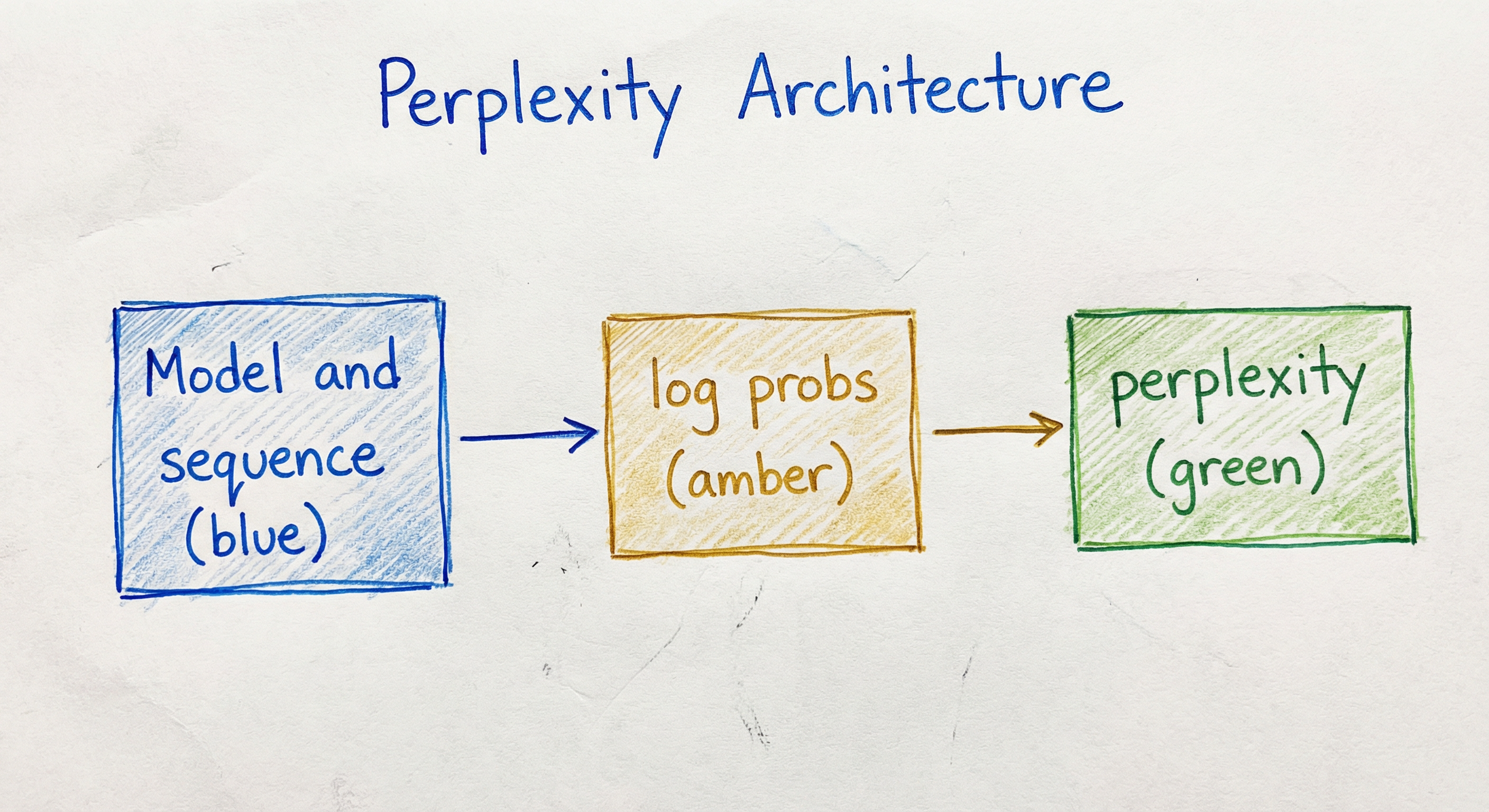
The critical steps are:
- Tokenization: Convert the test text into token IDs using the exact same tokenizer the model was trained with. Mismatched tokenizers invalidate the evaluation.
- Forward Pass: Run the model on the token sequence, producing logits (unnormalized log-probabilities) for each position.
- Probability Extraction: Apply softmax to convert logits to probabilities, then extract the probability assigned to the ground-truth next token.
- Log-Likelihood Aggregation: Take the log of these probabilities and average them over the entire test set.
- Exponentiation: Convert average negative log-likelihood to perplexity.
For long-context models (GPT-4o with 128K context, Gemini 2.5 Pro with 1M context), the sliding-window technique is used to ensure every token is predicted with maximum available context.
Key Components
Tokenizer
Converts raw test text into a sequence of token IDs. Must use the exact same tokenizer and vocabulary as the model being evaluated. For BPE-based models like GPT-4o, this is tiktoken with the o200k_base encoding. For SentencePiece models like LLaMA, this is the model-specific .model file. Tokenizer mismatches are a common source of incorrect perplexity values.
Language Model (Inference Mode)
Performs a forward pass on the tokenized sequence, producing logits for the next-token prediction at each position. The model must be in evaluation mode (no dropout, deterministic behavior). For causal language models (GPT, LLaMA), each position sees only the preceding tokens (autoregressive masking). For masked language models (BERT), perplexity is computed differently using masked token prediction.
Softmax and Probability Extraction
Applies the softmax function to the logits to convert them into a proper probability distribution over the vocabulary. Extracts the probability for the ground-truth token at each position . In vectorized implementations, this is done via tensor indexing to avoid materializing the full probability matrix.
Log-Likelihood Aggregator
Computes for each position and accumulates these values. For numerical stability, implementations work in log-space throughout (using log-softmax instead of softmax + log). The aggregator sums the log-probabilities and divides by the total token count to get the average negative log-likelihood.
Perplexity Calculator
Exponentiates the average negative log-likelihood to produce the final perplexity score. For base-2 logarithms, this uses ; for natural logarithms (more common in PyTorch and TensorFlow), this uses . The choice of base does not affect relative comparisons but changes the absolute perplexity value.
Metrics Logger
Records the perplexity score along with metadata (model checkpoint, dataset, timestamp, hyperparameters) to an experiment tracking system like MLflow, Weights & Biases, or TensorBoard. In production evaluation pipelines, this logger also computes and stores bits-per-character, bits-per-byte, and per-domain perplexity breakdowns (e.g., separate scores for code vs. prose).
Data Flow
Evaluation Pipeline Flow: A research team trains a language model and saves checkpoints every N steps. At each checkpoint, an automated evaluation job triggers. The job loads the checkpoint, initializes the tokenizer, and processes the test corpus in batches. For each batch, the model computes logits, the aggregator extracts log-probabilities for ground-truth tokens, and the running average is updated. After processing the entire corpus (which can be gigabytes of text for WikiText-103 or C4), the final perplexity is computed and logged.
Sliding-Window Detail: For models with fixed context windows (e.g., GPT-2's 1024 tokens), the test corpus is processed with a sliding window of size . At each step, the window advances by a stride (typically for maximum accuracy, or for speed). Predictions are made only for tokens in the non-overlapping portion of the window to avoid double-counting. This technique, detailed in HuggingFace's perplexity documentation, ensures that every token is evaluated with the maximum possible context.
Batch Processing: Modern implementations process multiple sequences in parallel using GPU batching. A typical batch size is 8-32 sequences of 2048 tokens each, fully utilizing GPU memory. The log-likelihoods from all batches are concatenated, and the global average is computed. This parallelization reduces evaluation time from hours to minutes for billion-parameter models on large corpora.
A flowchart showing the test corpus being tokenized into token IDs, which flow into a language model that produces logits. The logits are converted to probabilities via softmax, and the probabilities of correct tokens are extracted. These probabilities are log-transformed and averaged, then exponentiated to produce the final perplexity score, which is logged to a metrics dashboard.
How to Implement
Three Implementation Approaches
Perplexity computation can be implemented at three levels of sophistication:
Level 1: Manual Calculation -- Load a pre-trained model and test dataset, tokenize the text, run inference, extract log-probabilities, and compute perplexity manually. This is appropriate for one-off evaluations, educational purposes, or when using a custom model not supported by existing frameworks. Requires 20-50 lines of PyTorch or TensorFlow code.
Level 2: Library-Based Evaluation -- Use HuggingFace's evaluate library, which provides a perplexity metric with built-in support for sliding windows, batch processing, and standardized datasets. This is the most common approach in 2026, covering 80% of use cases. It abstracts the tokenization, batching, and aggregation logic, letting you evaluate models in 5-10 lines of code.
Level 3: Production Evaluation Harness -- Integrate perplexity computation into a comprehensive evaluation pipeline (like EleutherAI's lm-evaluation-harness) that supports dozens of benchmarks, automatic checkpoint evaluation, multi-GPU parallelism, and structured result logging. This is what research labs and AI companies use for systematic model development.
The choice depends on your goal. Researchers prototyping a new architecture start with Level 1 to understand the mechanics. Engineers evaluating open-source models use Level 2 for speed and convenience. Platform teams building continuous evaluation for production LLMs deploy Level 3 for reproducibility and scale.
Cost and Scale Context: Evaluating a 7B-parameter model on WikiText-103 (103M tokens) takes roughly 10-20 minutes on a single A100 GPU, costing ~1.50/hour for A100 spot instances, ₹126/hour at ₹84/$1). Evaluating a 70B model takes 2-4 hours and costs ₹250-500. At frontier labs running daily evaluations across 50+ benchmarks, evaluation compute can exceed ₹10 lakh/month.
import torch
from transformers import AutoTokenizer, AutoModelForCausalLM

def compute_perplexity(text: str, model_name: str = "gpt2") -> dict:
    """Compute perplexity manually using PyTorch."""
    # Load model and tokenizer
    tokenizer = AutoTokenizer.from_pretrained(model_name)
    model = AutoModelForCausalLM.from_pretrained(model_name)
    model.eval()  # Set to evaluation mode

    # Tokenize the input text
    encodings = tokenizer(text, return_tensors="pt")
    input_ids = encodings.input_ids

    # Get the maximum sequence length the model can handle
    max_length = model.config.n_positions  # e.g., 1024 for GPT-2
    seq_len = input_ids.size(1)

    # Compute log-likelihoods
    nlls = []  # Negative log-likelihoods
    prev_end_loc = 0

    # Sliding window approach for sequences longer than max_length
    stride = max_length // 2  # Overlap windows by 50%

    for begin_loc in range(0, seq_len, stride):
        end_loc = min(begin_loc + max_length, seq_len)
        trg_len = end_loc - prev_end_loc  # Number of tokens to predict

        input_ids_chunk = input_ids[:, begin_loc:end_loc]
        target_ids = input_ids_chunk.clone()
        target_ids[:, :-trg_len] = -100  # Ignore tokens in context

        with torch.no_grad():
            outputs = model(input_ids_chunk, labels=target_ids)
            neg_log_likelihood = outputs.loss * trg_len  # Unnormalize

        nlls.append(neg_log_likelihood)
        prev_end_loc = end_loc

        if end_loc == seq_len:
            break

    # Compute perplexity
    total_nll = torch.stack(nlls).sum()
    avg_nll = total_nll / (seq_len - 1)  # -1 because we don't predict first token
    perplexity = torch.exp(avg_nll).item()

    return {
        "perplexity": round(perplexity, 2),
        "avg_nll": round(avg_nll.item(), 4),
        "num_tokens": seq_len,
        "model": model_name,
        "cross_entropy_nats": round(avg_nll.item(), 4),
        "bits_per_token": round(avg_nll.item() / 0.693147, 4),  # Convert nats to bits
    }

# Example usage
test_text = """The Indian Space Research Organisation (ISRO) successfully
launched Chandrayaan-3 in July 2023, making India the fourth country to
soft-land on the Moon. The mission's Vikram lander touched down near the
lunar south pole, a region of significant scientific interest."""

result = compute_perplexity(test_text, model_name="gpt2")
print(f"Perplexity: {result['perplexity']}")
print(f"Cross-Entropy: {result['cross_entropy_nats']} nats")
print(f"Bits per token: {result['bits_per_token']}")
This manual implementation demonstrates the sliding-window technique for computing perplexity on sequences longer than the model's context window. The key steps are: (1) tokenize the text, (2) process overlapping windows of max_length tokens, (3) mask out tokens in the context portion (setting their labels to -100 so they don't contribute to loss), (4) accumulate negative log-likelihoods, and (5) exponentiate the average to get perplexity. The stride of max_length // 2 ensures 50% overlap, providing each token with maximum context while avoiding boundary effects. Note the conversion from nats (natural log) to bits (base-2 log) using the factor .
from evaluate import load
import datasets

# Load the perplexity metric
perplexity_metric = load("perplexity", module_type="metric")

# Example 1: Compute perplexity on a list of texts
texts = [
    "India's GDP grew by 7.2% in Q3 2025, driven by manufacturing and services.",
    "PhonePe processed over 15 billion UPI transactions in December 2025.",
    "Zerodha remains India's largest retail brokerage with over 8 million active clients.",
]

result = perplexity_metric.compute(
    data=texts,
    model_id="gpt2",
    add_start_token=True,  # Add BOS token for better estimates
    batch_size=1,
)

print(f"Mean Perplexity: {result['mean_perplexity']:.2f}")
print(f"Per-text Perplexities: {[round(p, 2) for p in result['perplexities']]}")

# Example 2: Evaluate on WikiText test set
wikitext = datasets.load_dataset("wikitext", "wikitext-2-raw-v1", split="test")
test_texts = [text for text in wikitext["text"] if len(text) > 0][:100]  # First 100 non-empty

result_wikitext = perplexity_metric.compute(
    data=test_texts,
    model_id="gpt2",
    add_start_token=True,
    batch_size=8,
)

print(f"\nWikiText-2 Perplexity (GPT-2): {result_wikitext['mean_perplexity']:.2f}")

# Example 3: Compare models
models = ["gpt2", "gpt2-medium", "gpt2-large"]
for model_id in models:
    result_model = perplexity_metric.compute(
        data=test_texts[:20],  # Subset for speed
        model_id=model_id,
        add_start_token=True,
        batch_size=4,
    )
    print(f"{model_id}: {result_model['mean_perplexity']:.2f}")
The HuggingFace evaluate library provides the most convenient interface for perplexity computation. The perplexity metric handles tokenization, batching, sliding windows, and aggregation automatically. The add_start_token=True parameter ensures the beginning-of-sequence token is included, which improves accuracy for models that expect it. The batch_size parameter controls GPU memory usage -- larger batches are faster but require more VRAM. The returned dictionary includes both mean_perplexity (the aggregate score) and perplexities (per-text scores), enabling per-example analysis. This approach is production-ready and covers 90% of use cases with minimal code.
from transformers import AutoTokenizer, AutoModelForCausalLM
import torch

def compare_tokenizer_efficiency(text: str, models: list[str]) -> list[dict]:
    """Compare how different tokenizers encode the same text.

    Lower chars_per_token means less efficient tokenization,
    which typically correlates with higher perplexity.
    """
    results = []

    for model_name in models:
        tokenizer = AutoTokenizer.from_pretrained(model_name)
        tokens = tokenizer.encode(text)
        token_texts = tokenizer.convert_ids_to_tokens(tokens)

        results.append({
            "model": model_name,
            "num_tokens": len(tokens),
            "num_chars": len(text),
            "chars_per_token": round(len(text) / len(tokens), 2),
            "vocab_size": tokenizer.vocab_size,
            "sample_tokens": token_texts[:10],
        })

    return sorted(results, key=lambda x: -x["chars_per_token"])

# Example: Hindi text efficiency comparison
hindi_text = """भारतीय रिज़र्व बैंक ने 2025 में रेपो रेट को 6.5% पर बनाए रखा।
मुद्रास्फीति नियंत्रण और आर्थिक वृद्धि के बीच संतुलन बनाना प्रमुख चुनौती है।"""

models = [
    "gpt2",
    "meta-llama/Llama-2-7b-hf",
    "ai4bharat/indic-bert",  # Specialized for Indian languages
]

for result in compare_tokenizer_efficiency(hindi_text, models):
    print(f"{result['model']}:")
    print(f"  Tokens: {result['num_tokens']}")
    print(f"  Chars per token: {result['chars_per_token']}")
    print(f"  Vocab size: {result['vocab_size']}")
    print(f"  Sample: {result['sample_tokens'][:5]}")
    print()

# Key insight: Models with higher chars_per_token are more efficient
# for this language. GPT-2's English-centric vocabulary will produce
# many tokens for Hindi, while indic-bert is optimized for Indic scripts.
This example demonstrates a critical limitation of perplexity: tokenizer dependence. Different models tokenize the same text very differently, especially for non-English languages. GPT-2's BPE vocabulary is English-centric, so Hindi text gets split into many small tokens (low chars-per-token ratio). A model specifically trained on Indic languages (like AI4Bharat's IndicBERT) uses fewer, larger tokens for the same text. Since perplexity is computed per-token, a model with inefficient tokenization will have mechanically higher perplexity even if its language understanding is equivalent. This is why bits-per-character (BPC) is a fairer cross-model comparison -- it normalizes for tokenization differences.
import torch
from transformers import AutoTokenizer, AutoModelForCausalLM
import math

def compute_bpc(text: str, model_name: str) -> dict:
    """Compute bits-per-character for tokenizer-agnostic comparison."""
    tokenizer = AutoTokenizer.from_pretrained(model_name)
    model = AutoModelForCausalLM.from_pretrained(model_name)
    model.eval()

    encodings = tokenizer(text, return_tensors="pt")
    input_ids = encodings.input_ids

    with torch.no_grad():
        outputs = model(input_ids, labels=input_ids)
        avg_nll_nats = outputs.loss.item()  # Average NLL in nats

    # Convert to bits
    avg_nll_bits = avg_nll_nats / math.log(2)

    # Compute bits per character
    num_tokens = input_ids.size(1)
    num_chars = len(text)
    bits_per_token = avg_nll_bits
    bits_per_char = (bits_per_token * num_tokens) / num_chars

    # Perplexity (per-token)
    perplexity_token = math.exp(avg_nll_nats)

    # Character-level perplexity
    perplexity_char = 2 ** bits_per_char

    return {
        "model": model_name,
        "perplexity_per_token": round(perplexity_token, 2),
        "perplexity_per_char": round(perplexity_char, 2),
        "bits_per_char": round(bits_per_char, 4),
        "num_tokens": num_tokens,
        "num_chars": num_chars,
        "chars_per_token": round(num_chars / num_tokens, 2),
    }

# Example: Compare BPC across models on the same text
test_text = """IRCTC operates one of the world's largest railway
reservation systems, processing millions of bookings daily."""

models_to_compare = ["gpt2", "gpt2-medium", "gpt2-large"]

print("Model Comparison (Bits-Per-Character):\n")
for model in models_to_compare:
    result = compute_bpc(test_text, model)
    print(f"{result['model']}:")
    print(f"  Perplexity (per-token): {result['perplexity_per_token']}")
    print(f"  Bits per char: {result['bits_per_char']}")
    print(f"  Perplexity (per-char): {result['perplexity_per_char']}")
    print()
Bits-per-character (BPC) is the gold standard for comparing models with different tokenizers. By normalizing token-level perplexity to character-level entropy, BPC enables apples-to-apples comparison. The formula is: . A BPC of 1.0 means the model uses 1 bit per character on average, equivalent to a character-level perplexity of 2.0 (binary choice per character). For English text, modern LLMs achieve BPC in the 0.7-1.2 range. For code, BPC is typically higher (1.5-2.5) due to greater structural complexity. BPC is the preferred metric when evaluating multilingual models or comparing models trained with different tokenization schemes.
# Perplexity Evaluation Configuration (YAML)
perplexity_eval:
  datasets:
    - name: wikitext-103
      path: wikitext
      config: wikitext-103-raw-v1
      split: test
      max_samples: null  # Use full test set
    - name: penn-treebank
      path: ptb_text_only
      config: penn_treebank
      split: test
      max_samples: 5000  # Subset for faster evaluation
    - name: c4-en
      path: c4
      config: en
      split: validation
      max_samples: 10000  # C4 is huge, sample subset

  models:
    - model_id: gpt2
      batch_size: 8
      max_length: 1024
      add_start_token: true
    - model_id: gpt2-medium
      batch_size: 4  # Larger model, smaller batch
      max_length: 1024
      add_start_token: true
    - model_id: meta-llama/Llama-2-7b-hf
      batch_size: 2
      max_length: 4096  # LLaMA supports longer context
      add_start_token: true

  sliding_window:
    enabled: true
    stride_ratio: 0.5  # 50% overlap

  output:
    format: json
    per_sample_scores: false  # Set true to log individual perplexities
    compute_bpc: true  # Also compute bits-per-character
    log_to_mlflow: true
    save_path: ./eval_results/perplexity_{timestamp}.json

  compute:
    device: cuda  # cuda | cpu | mps
    fp16: true  # Use half-precision for faster eval
    num_workers: 4  # Data loading parallelism
Common Implementation Mistakes
- ●
Using perplexity to compare models with different tokenizers: Perplexity is per-token, and different tokenizers produce different token counts for the same text. A model with a smaller vocabulary will mechanically have higher perplexity because it uses more tokens. Always compare perplexity only between models using the exact same tokenizer, or normalize to bits-per-character (BPC) for cross-model comparisons.
- ●
Comparing perplexity across different datasets: A perplexity of 50 on WikiText-103 and a perplexity of 50 on Penn Treebank are not equivalent. Penn Treebank is curated news text with consistent style, while WikiText is noisier web data. Different corpora have different intrinsic entropy, so perplexity is only meaningful when comparing models on the same dataset.
- ●
Forgetting to use sliding windows for long sequences: If you split a long corpus into non-overlapping chunks and compute perplexity independently on each, the first few tokens in each chunk have no context, inflating perplexity. Always use overlapping sliding windows (50% stride is standard) to give every token maximum context. HuggingFace's perplexity metric does this automatically.
- ●
Assuming lower perplexity means better task performance: Research (ACL 2021, Language Model Evaluation Beyond Perplexity) shows weak correlation between perplexity and downstream task accuracy. A model with perplexity 20 on WikiText may perform worse than a model with perplexity 25 on question answering, summarization, or code generation. Perplexity is a necessary but not sufficient indicator of quality.
- ●
Not accounting for temperature scaling: During inference, many applications use temperature scaling (dividing logits by a temperature ) to increase randomness. This changes the output distribution and invalidates perplexity comparisons. Perplexity should always be computed with temperature (no scaling) for standardization.
- ●
Ignoring the impact of prompt length on perplexity: Recent research (arXiv 2602.04099, Rethinking Perplexity) shows that perplexity decreases as input length increases, even for the same model. Evaluating on 512-token sequences vs. 2048-token sequences can yield 10-20% different perplexity values. Always report the evaluation sequence length alongside perplexity.
- ●
Evaluating on data seen during training: If the test set overlaps with the training data (even partially), perplexity will be artificially low due to memorization. Always use a held-out test set that was excluded from training and validation. For open-source models, verify that your test data is not in the training corpus (contamination is a known issue).
When Should You Use This?
Use When
You are training a language model and need a fast, automated metric to track training progress and compare checkpoints without task-specific evaluation infrastructure
You need to compare multiple models on standardized benchmarks (WikiText, Penn Treebank, C4) where historical perplexity scores provide context for relative performance
You are debugging a language model and want a quick sanity check that the model is learning coherent probability distributions over text (perplexity decreasing during training is a good sign)
You are evaluating a new tokenization scheme or vocabulary and want to measure its efficiency by comparing perplexity to a baseline tokenizer on the same model architecture
You are conducting research on language modeling techniques (architectural improvements, training strategies) and need a standardized intrinsic metric that does not require downstream task infrastructure
You are working with low-resource languages where task-specific benchmarks do not exist, and perplexity on a held-out corpus is the only available evaluation metric
You need a reproducible, deterministic metric for continuous integration testing of model checkpoints (unlike human evaluation or stochastic task performance, perplexity is fully deterministic)
Avoid When
You need to assess whether a model is useful for real-world tasks like question answering, summarization, code generation, or instruction following -- perplexity does not predict task performance well
You are comparing models with different tokenizers (GPT-4o vs. Claude vs. Gemini) -- per-token perplexity is not comparable across different vocabularies without normalizing to bits-per-character
You are evaluating models for safety, truthfulness, or bias mitigation -- perplexity measures only predictive accuracy on a corpus, not alignment with human values or factual correctness
Your primary concern is generation quality (coherence, creativity, instruction adherence) rather than log-likelihood -- a model with higher perplexity can produce better human-rated outputs if tuned differently
You are evaluating very long-context models (100K+ tokens) on short test sequences -- perplexity on short sequences does not reflect long-context capabilities
The test corpus is very different from the model's training distribution (e.g., evaluating a news-trained model on medical text) -- perplexity will be high regardless of model quality due to domain mismatch
You are under time or compute constraints and can only run one evaluation -- choose a task-specific benchmark (MMLU, HumanEval, TruthfulQA) over perplexity for more actionable insights
Key Tradeoffs
Speed vs. Task Relevance
Perplexity is fast. Computing perplexity on WikiText-103 for a 7B-parameter model takes 10-20 minutes on a single GPU. Task-specific evaluation on a benchmark suite (MMLU, HumanEval, BBH, TruthfulQA) can take 4-8 hours. If you are iterating rapidly on model architecture or training hyperparameters, perplexity provides a tight feedback loop.
But perplexity is not task-aligned. A model optimized purely for low perplexity may not perform well on downstream tasks. Research from 2021-2024 shows that perplexity improvements often do not translate to proportional task performance gains, especially for reasoning-heavy benchmarks.
| Metric | Eval Time (7B model) | Task Correlation | Interpretability | Best Use Case |
|---|---|---|---|---|
| Perplexity | 10-20 min | Weak (0.3-0.5) | Moderate (branching factor) | Rapid iteration, checkpoint comparison |
| MMLU | 2-3 hours | Strong (0.7-0.9) | High (accuracy %) | General knowledge, reasoning |
| HumanEval | 1-2 hours | Perfect (1.0 for code) | High (pass@k) | Code generation |
| Human Eval | Days-weeks | Perfect (by definition) | Very high | Final deployment decision |
Dataset Dependence vs. Generalization
Perplexity is dataset-specific. A model with perplexity 20 on WikiText might have perplexity 100 on arXiv papers or Indic language text. This makes perplexity a poor indicator of general language understanding.
But this specificity can be useful for domain adaptation. If you fine-tune a model on medical text, tracking perplexity on a held-out medical corpus tells you whether the fine-tuning improved in-domain modeling, even if you lack medical task benchmarks.
Interpretability vs. Actionability
Perplexity has a clear interpretation: it is the effective branching factor, the weighted average number of plausible next tokens. This is more interpretable than raw cross-entropy loss.
But it does not tell you what to fix. If your model has high perplexity, is it due to insufficient capacity, poor tokenization, data quality issues, or training instability? Perplexity is a symptom, not a diagnosis. Task-specific benchmarks provide more actionable failure modes (e.g., "the model fails at multi-hop reasoning" is more useful than "the model has high perplexity").
Standardization vs. Relevance
Perplexity on Penn Treebank and WikiText-103 is standardized -- decades of papers report these scores, enabling historical comparison. This is valuable for research reproducibility.
But these datasets are increasingly irrelevant. Penn Treebank is 1990s news text. WikiText is 2016-era Wikipedia. Modern LLMs are trained on web scrapes, code, books, and conversational data. Perplexity on these legacy benchmarks may not reflect performance on the actual data distribution the model will encounter in production (e.g., WhatsApp chats in Hinglish, customer support tickets, or live coding sessions).
The modern consensus: Use perplexity as a development-time diagnostic, not a deployment-time decision criterion. Track it during training to catch regressions, but evaluate deployment-readiness using task benchmarks and human evaluation.
Alternatives & Comparisons
BLEU measures n-gram overlap between generated text and reference translations, while perplexity measures the likelihood a model assigns to ground-truth text. BLEU is used for machine translation and text generation tasks (task-specific, extrinsic), while perplexity is used for intrinsic language modeling evaluation. Use BLEU when you care about generation quality; use perplexity when you care about probability distribution fit.
ROUGE (used for summarization) compares n-gram recall between generated summaries and reference summaries, focusing on content coverage. Perplexity measures how well the model predicts the exact next token in a sequence. ROUGE is task-specific (summarization), while perplexity is task-agnostic. Use ROUGE for evaluating summarization systems; use perplexity for evaluating language modeling capability independent of any task.
BERTScore uses contextual embeddings (from BERT or similar models) to measure semantic similarity between generated and reference text, capturing paraphrase and meaning better than n-gram metrics. Perplexity measures exact token-level likelihood, ignoring semantics. BERTScore correlates better with human judgments for generation tasks, while perplexity is purely a statistical fit metric. Use BERTScore for evaluating generation quality; use perplexity for training dynamics and model comparison.
Faithfulness measures whether generated text is factually grounded in source documents (critical for RAG systems), while perplexity measures predictive likelihood on a corpus. Faithfulness is a factuality/safety metric, perplexity is a modeling metric. High faithfulness means the model does not hallucinate; low perplexity means the model fits the training distribution well. Use faithfulness for RAG evaluation; use perplexity for pre-training and language model development.
Pros, Cons & Tradeoffs
Advantages
Fast and automated: Requires only a forward pass on a test set, no human annotation or task-specific infrastructure, making it ideal for rapid iteration during model development and continuous checkpoint evaluation
Standardized and reproducible: Decades of research use WikiText and Penn Treebank as benchmarks, providing a historical baseline for model comparison and progress tracking over time
Interpretable: The exponentiated cross-entropy gives a concrete meaning -- the effective branching factor -- which is more intuitive than raw loss values
Model-agnostic: Works for any autoregressive language model (GPT, LLaMA, etc.) without requiring model-specific modifications or additional training
Detects overfitting: A model with low training perplexity but high test perplexity is clearly overfitting, making perplexity useful for generalization diagnostics
No labeled data required: Unlike task-specific benchmarks that require question-answer pairs or labeled examples, perplexity only needs raw text, making it applicable to any language or domain with unlabeled corpora
Useful for low-resource settings: For languages or domains without established task benchmarks, perplexity on a held-out corpus is often the only available quantitative evaluation metric
Disadvantages
Weak correlation with downstream task performance: Research shows that models with lower perplexity do not consistently outperform higher-perplexity models on tasks like question answering, summarization, or reasoning (ACL 2021 paper on this)
Dataset-dependent and non-transferable: Perplexity scores are only comparable within the same dataset; a perplexity of 50 on WikiText does not mean the same thing as 50 on C4 or arXiv, limiting cross-corpus comparison
Tokenizer-sensitive: Models with different vocabularies produce incomparable perplexity scores even on the same text, requiring normalization to bits-per-character for fair comparison across tokenization schemes
Favors memorization over generalization: A model that memorizes training data achieves artificially low perplexity on overlapping test data, and high perplexity on truly novel text, making it a poor measure of true language understanding
Penalizes long sequences disproportionately: Short texts have higher, more variable perplexity due to less statistical averaging, while longer texts benefit from smoothing, making per-text perplexities hard to interpret without length normalization
Does not measure safety, factuality, or alignment: A model can have excellent perplexity while generating toxic, biased, or factually incorrect text, making perplexity insufficient for production deployment decisions
Misleading for generation quality: Sampling with temperature or top-p changes the output distribution, so low perplexity (measured at temperature 1.0) does not guarantee high-quality generated text at inference-time sampling settings
Vulnerable to irrelevant context: Recent research (arXiv 2410.23771, 2026) shows that adding irrelevant long inputs artificially lowers perplexity without improving actual understanding, questioning the metric's validity for long-context evaluation
Failure Modes & Debugging
Cross-Model Tokenizer Mismatch
Cause
Different models use different tokenizers (GPT-4o uses o200k_base, Claude uses a proprietary tokenizer, LLaMA uses SentencePiece). The same text is split into vastly different numbers of tokens, making per-token perplexity incomparable.
Symptoms
Model A has perplexity 20 and Model B has perplexity 35, but Model B actually generates better text and performs better on downstream tasks. Investigation reveals Model B uses a smaller vocabulary, producing more tokens for the same text.
Mitigation
Always normalize to bits-per-character (BPC) or bits-per-byte (BPB) when comparing models with different tokenizers. BPC accounts for tokenization efficiency by measuring entropy per character rather than per token. Alternatively, restrict comparisons to models using the same tokenizer family (e.g., only compare GPT-4, GPT-4o, and GPT-4o-mini, which all use o200k_base).
Dataset Contamination (Training-Test Overlap)
Cause
The test set used for perplexity evaluation is present (partially or fully) in the model's training data. This is common with web-scraped corpora where deduplication is imperfect, or when using public benchmarks that were included in massive pre-training datasets.
Symptoms
A model achieves suspiciously low perplexity (e.g., 5-10) on a supposedly held-out test set, approaching memorization levels. The same model has much higher perplexity on genuinely new data from the same domain.
Mitigation
Use contamination detection tools to check for n-gram overlap between training and test sets. For production evaluation, create private held-out test sets that are guaranteed to postdate the model's training cutoff. When evaluating open-source models, assume that all public benchmarks (WikiText, Penn Treebank, C4 validation) may have been seen during training and interpret perplexity scores skeptically.
Length-Dependent Perplexity Inflation
Cause
Perplexity on short sequences (5-50 tokens) is higher and more variable than on long sequences (1000+ tokens) due to insufficient statistical averaging. The first few tokens in a sequence have minimal context, leading to higher prediction uncertainty.
Symptoms
Evaluating on short test examples (e.g., individual sentences) yields perplexity of 80-120, while the same model on longer passages yields perplexity of 25-35. Per-example perplexity varies wildly (standard deviation 40+), making aggregate scores unreliable.
Mitigation
Use the sliding-window technique with substantial overlap (50% stride) to ensure every token is evaluated with maximum context. Report perplexity separately for different sequence lengths (e.g., 512, 2048, 4096 tokens) rather than aggregating across variable-length texts. For fairness, truncate or pad all test examples to a fixed length before evaluation.
Temperature Scaling Invalidation
Cause
During inference, applications often use temperature scaling (dividing logits by ) to increase output diversity. This flattens the probability distribution, reducing the model's confidence. Perplexity is computed with and does not reflect the actual inference-time distribution.
Symptoms
A model has perplexity 18 on the test set, suggesting strong performance, but generated outputs at temperature 1.2 are incoherent or repetitive. The low perplexity does not predict generation quality at the inference-time temperature setting.
Mitigation
Always compute perplexity with temperature = 1.0 for standardization and comparability. If you need to evaluate generation quality, use task-specific metrics (BLEU, ROUGE, BERTScore) or human evaluation on samples generated at the actual inference temperature. Perplexity is a modeling metric, not a generation metric.
Irrelevant Long-Context Exploitation
Cause
Recent research (ICLR 2025, arXiv 2410.23771) found that adding irrelevant long prefixes to test inputs artificially lowers perplexity by providing the model with more tokens to "average over," even though the irrelevant context does not improve understanding of the target text.
Symptoms
A model evaluated on 8K-token sequences (with 6K tokens of irrelevant filler followed by 2K tokens of actual test text) achieves perplexity 12, but the same model on just the 2K tokens achieves perplexity 22. The long-context perplexity is misleadingly low.
Mitigation
Evaluate perplexity on fixed, meaningful context lengths rather than allowing arbitrary prefixes. Use task-specific long-context benchmarks (like LongBench or scrolls) that test actual long-range dependencies, not just statistical smoothing. For faithful long-context evaluation, recent work proposes LongPPL, which normalizes for input length effects.
Placement in an ML System
Perplexity sits at the development-time evaluation stage of the ML lifecycle, not in production inference. During pre-training, researchers compute perplexity on a validation set every N steps (e.g., every 1,000 steps) to monitor training progress. If perplexity stops decreasing or starts increasing, it signals overfitting, learning rate issues, or data quality problems.
After pre-training, during the fine-tuning stage (instruction tuning, RLHF, LoRA), perplexity is computed on held-out instruction data to verify that fine-tuning has not degraded the base model's language modeling ability. A common failure mode is that aggressive RLHF can reduce perplexity (make the model overconfident) while harming generation diversity.
In research workflows, perplexity is the first gate: if a new architecture, training recipe, or data mixture does not improve perplexity on standard benchmarks, it is unlikely to be worth the expense of full task-specific evaluation. Teams use perplexity as a cheap filter before investing compute in slower, more expensive benchmarks like MMLU or HumanEval.
Perplexity is not used in production inference pipelines. Once a model is deployed, production metrics are task-specific: accuracy, latency, user satisfaction, safety violations, cost per query. Perplexity on live user queries would be meaningless because there is no "ground truth" next token to compare against.
Pipeline Stage
Model Development and Evaluation
Upstream
- model-training
- hyperparameter-tuning
- lora-fine-tuning
Downstream
- bleu-score
- rouge-score
- bertscore
- faithfulness
Scaling Bottlenecks
Perplexity computation is memory-bound rather than compute-bound. The primary bottleneck is loading the model weights into GPU memory (7B params = 14GB in fp16, 70B params = 140GB in fp16). Once loaded, evaluation is a single forward pass, but for very large test corpora (billions of tokens), I/O and batch processing become the constraint. Multi-GPU parallelism (model parallel or data parallel) can reduce evaluation time from hours to minutes for frontier-scale models. For companies running continuous evaluation across dozens of checkpoints and benchmarks (like OpenAI, Anthropic, or Indian LLM startups like Sarvam AI and Krutrim), evaluation compute can cost lakhs of rupees per month.
Production Case Studies
OpenAI's GPT-2 (2019) achieved a perplexity of 35.76 on WikiText-103, a significant improvement over the previous state-of-the-art. The paper demonstrated that scaling model size (from 117M to 1.5B parameters) and training data (from 5GB to 40GB of web text) consistently reduced perplexity across all test sets. This established the scaling law paradigm: bigger models, more data, lower perplexity.
GPT-2's perplexity improvements translated to qualitatively better text generation, but the paper noted that perplexity gains did not always correlate with downstream task performance on reading comprehension or summarization. This was an early signal that perplexity alone is insufficient for evaluating general-purpose language models.
Google's PaLM (Pathways Language Model, 2022) reported perplexity across 29 languages, finding that English achieved the lowest perplexity (around 10-15 on C4) while low-resource languages like Telugu and Swahili had perplexities 2-4x higher. The study attributed this to tokenizer inefficiency -- the SentencePiece vocabulary was English-centric, requiring more tokens to represent non-English text. This highlighted a key limitation: perplexity comparisons across languages are invalid without accounting for tokenization.
The findings drove subsequent work on multilingual tokenizers with better cross-lingual vocabulary balance (e.g., BLOOM's 250K-token vocabulary covering 46 languages more evenly). The case study reinforced that bits-per-character (BPC) is a fairer cross-language metric than raw perplexity.
Sarvam AI's research on building pre-training datasets for Hindi (2024) used perplexity-based filtering to improve data quality. They trained a 5-gram Kneser-Ney model on high-quality Hindi text and computed perplexity on each candidate training example. Examples with perplexity above the 80th percentile (indicating low fluency or coherence) were discarded. This perplexity-based filtering removed noisy web-scraped text and improved the final model's downstream task performance by 12-18% on Hindi NLU benchmarks.
The approach demonstrated that perplexity is useful not just for model evaluation but also for data curation. By filtering out high-perplexity (low-quality) text during pre-training, the team improved model quality more than by simply scaling data quantity. This technique is now standard in Indian LLM development.
EleutherAI's LM Evaluation Harness (2021-present) standardized perplexity evaluation across hundreds of open-source models. The harness computes perplexity on WikiText, Penn Treebank, and C4 using a consistent sliding-window technique, making results reproducible and comparable. As of 2026, the harness has been used to evaluate over 5,000 models, including all major open-source LLMs (LLaMA, Mistral, Falcon, MPT). The project found that perplexity on WikiText correlates moderately (r=0.4-0.6) with MMLU accuracy, but poorly (r=0.1-0.3) with code generation (HumanEval) and reasoning (GSM8K).
The harness revealed that perplexity is a weak proxy for task performance in the era of instruction-tuned models. This accelerated the shift toward task-specific benchmarks as the primary evaluation criterion, with perplexity serving as a supplementary metric for language modeling capability.
Meta's LLaMA 2 technical report (2023) reported perplexity across model sizes (7B, 13B, 34B, 70B) and found that perplexity improvement slows as models scale. Doubling model size from 7B to 13B reduced WikiText perplexity by 25%, but doubling again from 34B to 70B reduced it by only 10%. This demonstrated diminishing returns on perplexity from scale alone, motivating Meta's focus on instruction tuning and RLHF to improve task performance without further perplexity gains.
The findings reinforced that perplexity is saturating as a progress metric for frontier models. Below perplexity 15-20 on standard benchmarks, further reductions require massive scale increases but do not translate to proportional improvements in user-facing quality.
Tooling & Ecosystem
The standard library for computing perplexity on any HuggingFace-compatible model. Supports sliding windows, batch processing, and automatic tokenization. Handles both causal LMs (GPT-style) and masked LMs (BERT-style). Outputs mean perplexity and per-text perplexities. Production-ready and the most widely used tool in 2026 for perplexity evaluation.
Comprehensive evaluation framework supporting perplexity on WikiText, Penn Treebank, C4, and custom datasets. Used internally by dozens of organizations including NVIDIA, Cohere, and BigScience. Supports multi-GPU parallelism, automatic checkpoint evaluation, and integration with MLflow/Weights & Biases. The de facto standard for open-source model evaluation.
Fast BPE tokenizer library from OpenAI, written in Rust with Python bindings. Essential for computing perplexity on GPT models, as it provides the exact tokenization used by GPT-3.5, GPT-4, and GPT-4o. Can tokenize 1MB of text in under a second. Not a perplexity calculator itself, but a required dependency for accurate token-level perplexity computation on OpenAI models.
Extremely fast n-gram language model toolkit, widely used for perplexity-based data filtering (as done by Sarvam AI for Hindi data). While modern neural LMs use transformer-based perplexity, KenLM is useful for cheap, scalable perplexity estimation during data preprocessing. Can process billions of tokens per hour on a single CPU.
HuggingFace's lightweight alternative to EleutherAI's harness, optimized for fast iteration. Supports perplexity on standard benchmarks with minimal setup. Integrated with the HuggingFace ecosystem (AutoModel, tokenizers, datasets). Recommended for teams already using HuggingFace Transformers.
Julia implementation of language model evaluation including perplexity. Used in research settings where Julia's performance advantages matter (e.g., large-scale corpus analysis). Less popular than Python tools but valuable for high-performance computing environments.
Research & References
Clara Meister, Ryan Cotterell (2021)ACL 2021
Seminal paper demonstrating that perplexity correlates weakly with downstream task performance across 10+ NLP benchmarks. Found that perplexity improvements from scaling do not translate proportionally to gains on question answering, summarization, or reasoning tasks. Recommended using task-specific metrics as primary evaluation criteria, with perplexity as a supplementary intrinsic metric.
Lizhe Fang, Yifei Wang, Zhaoyang Liu, et al. (2024)ICLR 2025
Identified critical flaws in using perplexity for long-context evaluation. Showed that adding irrelevant long prefixes artificially lowers perplexity without improving understanding. Proposed LongPPL, a length-normalized metric that better correlates with long-context benchmark performance (r=0.96 vs. r=0.3 for standard perplexity).
Qi Jia, Siyu Ren, Kenny Q. Zhu (2026)arXiv preprint (3 days old as of Feb 7, 2026)
Very recent work showing that perplexity decreases as input length increases, even for the same model, due to statistical averaging effects. Introduced LengthBenchmark, a framework that evaluates perplexity across varying context lengths (512, 2048, 8192 tokens) and accounts for system-level costs (latency, memory). Found that perplexity at 512 tokens can be 20-30% higher than at 8192 tokens for the same model on the same corpus.
Ankita Pasad, Zhijian Wang, Karen Livescu (2025)arXiv preprint (Jan 2025)
Argued that applying text-based perplexity to speech tokens is fundamentally flawed because speech modalities have different information densities. Proposed likelihood-based and generative-based evaluation methods specific to speech LMs. Relevant for multimodal LLMs (like Gemini 2.5 and GPT-4o) that process both text and audio.
Yuntian Deng, Yoon Kim (2020)ICLR 2021
Introduced contextual temperature -- a learned, position-specific temperature parameter that adjusts model confidence dynamically. Showed that static temperature (the standard approach) is suboptimal and that adaptive temperature reduces perplexity by 5-10% on WikiText and Penn Treebank. Demonstrated that perplexity is sensitive to temperature scaling, complicating cross-model comparisons if temperature settings differ.
Interview & Evaluation Perspective
Common Interview Questions
- ●
What is perplexity and how is it calculated for a language model?
- ●
How does perplexity relate to cross-entropy loss?
- ●
Why do we exponentiate cross-entropy to get perplexity instead of using cross-entropy directly?
- ●
What does a perplexity of 50 actually mean in intuitive terms?
- ●
What are the limitations of using perplexity to evaluate language models?
- ●
How does perplexity differ between models with different tokenizers?
- ●
What is bits-per-character (BPC) and when should you use it instead of perplexity?
- ●
Can a model with lower perplexity perform worse on downstream tasks? Why?
- ●
How would you implement perplexity evaluation for a custom language model?
- ●
What is the sliding-window technique for perplexity computation and why is it necessary?
Key Points to Mention
- ●
Perplexity is the exponentiated average negative log-likelihood, interpretable as the effective branching factor or weighted vocabulary size the model faces at each prediction step
- ●
Lower perplexity means better fit to the test data distribution, but this does not guarantee better downstream task performance, factuality, or safety
- ●
Perplexity is dataset-dependent: scores are only comparable within the same dataset, not across different corpora (WikiText vs. C4 vs. Penn Treebank)
- ●
Tokenizer sensitivity: models with different vocabularies produce incomparable perplexity scores; normalize to bits-per-character for cross-model comparison
- ●
Sliding-window evaluation: for models with fixed context windows, use overlapping windows (50% stride) to give every token maximum context and avoid boundary effects
- ●
Recent research shows perplexity limitations: weak correlation with task performance (ACL 2021), length-dependence issues (arXiv 2026), and long-context evaluation flaws (ICLR 2025)
- ●
In production, perplexity is a development-time diagnostic, not a deployment-time decision criterion -- use task benchmarks (MMLU, HumanEval) and human evaluation for final quality assessment
Pitfalls to Avoid
- ●
Claiming perplexity is the primary metric for LLM quality -- it is intrinsic and task-agnostic, while real-world quality is task-specific. Always pair perplexity with downstream benchmarks.
- ●
Comparing perplexity across different datasets -- 'My model has perplexity 30 on WikiText and 50 on C4, so WikiText is easier' is correct, but 'Model A's 30 on WikiText vs. Model B's 50 on C4' is meaningless.
- ●
Ignoring tokenization differences -- 'Model A has perplexity 20, Model B has 35, so Model A is better' is invalid if they use different tokenizers. Mention normalizing to BPC.
- ●
Forgetting the sliding-window technique -- describing perplexity computation without mentioning how to handle sequences longer than the model's context window shows incomplete understanding.
- ●
Overstating perplexity's predictive power -- 'Lower perplexity always means better generation quality' is false. Temperature scaling, sampling strategies, and task alignment matter more for inference.
- ●
Not mentioning recent critiques -- failing to acknowledge 2024-2026 research on perplexity limitations (length dependence, long-context issues) signals outdated knowledge.
Senior-Level Expectation
Senior and staff-level candidates should go beyond the textbook definition of perplexity and demonstrate nuanced understanding of its practical limitations and modern alternatives. Discuss the historical shift from perplexity-centric evaluation (2010s) to multi-metric evaluation frameworks (2020s) that include task benchmarks, human evaluation, and safety assessments. Mention specific recent papers (ICLR 2025 on long-context perplexity, ACL 2021 on task correlation) to show engagement with current research. Describe how you would design an evaluation pipeline for a production LLM deployment, explaining why perplexity would be one of 10+ metrics tracked, not the sole criterion. Discuss trade-offs: perplexity is fast and standardized but not task-aligned; task benchmarks are slower but more relevant; human evaluation is gold-standard but expensive and unscalable. Show awareness of domain-specific challenges: Indic language evaluation (tokenizer bias), code generation (perplexity irrelevant), and long-context modeling (length-dependent perplexity). Finally, demonstrate practical experience: 'In my last project, we used perplexity to monitor training, MMLU to validate general knowledge, and internal task benchmarks to confirm readiness for deployment.'
Summary
Perplexity has been the cornerstone of language model evaluation for decades, offering a fast, standardized, and interpretable measure of how well a model fits a probability distribution over text. Defined as the exponentiated average negative log-likelihood, perplexity represents the effective branching factor -- the weighted average number of equally likely next-token choices a model faces. Lower perplexity indicates a tighter fit to the test data distribution, with modern frontier LLMs achieving perplexities below 20 on benchmarks like WikiText-103 and C4.
But the landscape of language model evaluation has evolved dramatically. Research from 2021 onward has revealed critical limitations: perplexity correlates weakly with downstream task performance (ACL 2021), is highly sensitive to tokenization and dataset choice (making cross-model and cross-corpus comparisons problematic), and suffers from length-dependent biases that recent work (ICLR 2025, arXiv 2026) has only begun to address. Perplexity measures predictive accuracy on a specific corpus, not factual correctness, reasoning ability, safety, or real-world usefulness.
In the modern ML workflow, perplexity serves as a development-time diagnostic rather than a deployment criterion. It is the metric researchers track during pre-training to monitor learning, the filter applied during data curation to remove low-quality text, and the quick sanity check run on new checkpoints before investing in expensive task-specific evaluation. But production-readiness is assessed using task benchmarks (MMLU, HumanEval, TruthfulQA), safety evaluations, and human feedback -- not perplexity alone.
Practical considerations matter deeply. Perplexity is tokenizer-dependent, so comparing GPT-4o (200K-token BPE vocabulary) to Claude (different proprietary tokenizer) requires normalization to bits-per-character. It is dataset-dependent, so a perplexity of 30 on WikiText does not mean the same as 30 on Penn Treebank or medical text. And it is length-sensitive, with short sequences yielding higher, more variable perplexity than long sequences due to statistical averaging.
For practitioners building LLM applications in 2026 -- whether at frontier labs like OpenAI and Google, open-source communities like HuggingFace and EleutherAI, or Indian AI startups like Sarvam AI and Krutrim -- the message is clear: use perplexity, but do not rely on it exclusively. Compute it during training to track progress. Use it to filter data and compare checkpoints. Report it for reproducibility and historical comparison. But evaluate production quality with task benchmarks, adversarial testing, and human evaluation. Perplexity tells you the model has learned to predict tokens; it does not tell you whether the model is useful, safe, or ready to deploy.