Catalog Coverage in Machine Learning
Here is a question that most recommendation system engineers eventually confront: your model has a 0.92 NDCG score, your click-through rate is up 15%, and your A/B test looks great -- so why are 80% of your catalog items never being recommended to anyone?
This is the coverage problem. Accuracy metrics like NDCG, precision, and recall tell you how well your system ranks the items it does recommend, but they say nothing about how much of your catalog those recommendations actually span. A system that recommends the same 200 popular items to every user can score perfectly on accuracy while leaving hundreds of thousands of items -- and their sellers, creators, or suppliers -- completely invisible.
Catalog coverage (also called item coverage or aggregate diversity) measures the percentage of items in your catalog that your recommender system actually surfaces to users. It is the simplest and most powerful diagnostic for popularity bias: if your coverage is 5%, your system is ignoring 95% of your inventory.
Coverage belongs to the family of "beyond accuracy" metrics -- alongside diversity, novelty, and serendipity -- that evaluate the broader health of a recommendation ecosystem. For multi-sided marketplaces like Flipkart, Swiggy, or Amazon, low coverage is not just a technical curiosity; it means sellers are not getting exposure, users are stuck in filter bubbles, and the platform is leaving revenue on the table. In this guide, we will dissect every dimension of coverage: what it measures, how to compute it, when it matters, and how to improve it without sacrificing accuracy.
Concept Snapshot
- What It Is
- A beyond-accuracy evaluation metric that measures the fraction of items in a catalog that a recommendation system surfaces to at least one user over a given period, quantifying how broadly the system utilizes available inventory.
- Category
- Evaluation
- Complexity
- Beginner
- Inputs / Outputs
- Inputs: the set of all recommendations generated (per user or aggregated) and the full item catalog. Outputs: a coverage score between 0 and 1 (or 0% to 100%), where 1.0 means every catalog item was recommended at least once.
- System Placement
- Used as an offline evaluation metric alongside accuracy metrics (NDCG, precision, recall) and as an online monitoring metric in production recommendation systems. Evaluated after the recommendation model generates ranked lists.
- Also Known As
- Item Coverage, Aggregate Diversity, Recommendation Coverage, Catalog Utilization, Inventory Coverage
- Typical Users
- ML Engineers, Recommendation System Engineers, Product Managers, Marketplace Strategists, Data Scientists, Fairness & Ethics Researchers
- Prerequisites
- Basic recommendation system concepts, Understanding of accuracy metrics (precision, recall, NDCG), Familiarity with popularity distributions (power-law, long-tail), Basic probability and statistics
- Key Terms
- catalog coverageprediction coverageuser coverageGini indexlong-tail itemspopularity biasaggregate diversityitem exposureShannon entropyfilter bubble
Why This Concept Exists
The Accuracy Trap
In the early days of recommendation system research (late 1990s to mid-2000s), evaluation was dominated by a single question: how accurately can we predict ratings? The Netflix Prize (2006-2009) cemented this worldview -- a $1 million reward for improving RMSE on movie ratings. Teams optimized relentlessly for prediction accuracy.
But here is what nobody measured: the winning algorithms recommended almost exclusively popular movies. A system that predicts everyone will like The Shawshank Redemption (they probably will) scores great on RMSE but adds zero value. Users already know about popular items. The recommendation system's job is to surface items users would not have found on their own.
This realization triggered a paradigm shift. Researchers began asking: beyond accuracy, what else should a recommender do well?
The Birth of Coverage as a Metric
The concept of coverage in recommendation systems was formalized across several landmark papers. Herlocker et al. (2004) in their influential ACM TOIS survey "Evaluating Collaborative Filtering Recommender Systems" defined prediction coverage as the percentage of items for which the system can make predictions. Ge, Delgado-Battenfeld, and Jannach (2010) at RecSys formally introduced coverage as a quality metric in "Beyond Accuracy: Evaluating Recommender Systems by Coverage and Serendipity," arguing that a system covering only popular items fails to serve the full user population.
The key insight was that coverage captures something fundamentally different from accuracy. You can have a system with perfect accuracy on the items it recommends, but if it only recommends 3% of the catalog, it is ignoring the vast majority of inventory. This matters for three distinct stakeholders:
- Users: Low coverage means filter bubbles. Users see the same popular items repeatedly and never discover niche content that might genuinely delight them.
- Item providers (sellers, artists, creators): On platforms like Amazon, Flipkart, Spotify, or JioSaavn, low coverage means long-tail sellers and emerging artists get zero visibility. This creates an unfair marketplace.
- The platform itself: Low coverage means underutilized inventory. If your e-commerce catalog has 10 million products but your recommender only surfaces 100,000, you are losing potential sales on 9.9 million items.
The Marketplace Imperative
Coverage became especially critical with the rise of multi-sided marketplaces. When Swiggy or Zomato recommends restaurants, they must balance user satisfaction (accuracy) with restaurant fairness (coverage). A system that only recommends the top 50 restaurants in a city will have great click-through rates -- but it will starve smaller restaurants of orders, eventually driving them off the platform. This reduces catalog diversity, which in turn reduces user choice, creating a vicious cycle.
Key Insight: Coverage is not just an academic metric -- it is an economic and ethical necessity for any platform that depends on a healthy supplier ecosystem. Low coverage is a leading indicator of marketplace failure.
Core Intuition & Mental Model
The Library Analogy
Imagine a city library with 100,000 books. The librarian's job is to recommend books to visitors. Now consider two librarians:
Librarian A recommends the same 50 bestsellers to everyone. Visitors are generally happy -- these are popular books for a reason. But 99,950 books sit untouched on the shelves. New authors never get discovered. Niche readers with specific interests leave empty-handed.
Librarian B recommends based on individual taste profiles, drawing from 40,000 different books over the course of a year. Some recommendations miss (lower accuracy), but visitors regularly discover books they love that they would never have found on their own. New authors get exposure. The library justifies its entire collection.
Catalog coverage is the metric that distinguishes these two librarians. Librarian A has coverage of 0.05% (50 out of 100,000). Librarian B has coverage of 40%. Accuracy metrics would rate Librarian A higher, but coverage reveals the deeper truth about which system is actually serving its purpose.
The Three Dimensions of Coverage
Coverage is not a single number -- it has three dimensions:
-
Catalog coverage (item coverage): What fraction of items get recommended? This is the most common definition. If your catalog has 1 million items and your system recommends 50,000 distinct items across all users, your catalog coverage is 5%.
-
Prediction coverage: What fraction of items can the system generate predictions for? A collaborative filtering model cannot make predictions for items with zero interactions (cold-start). If 200,000 out of 1 million items have no interaction data, prediction coverage is 80%.
-
User coverage: What fraction of users receive at least one recommendation? Some systems cannot generate recommendations for users with no history (cold-start users). If 5% of users get no recommendations, user coverage is 95%.
All three dimensions matter, but catalog coverage is the most revealing diagnostic for popularity bias and marketplace health.
Why Coverage and Accuracy Fight Each Other
Here is the fundamental tension: optimizing for accuracy pushes your system toward popular items (because popular items have more training data and are safer bets), while optimizing for coverage pushes your system toward long-tail items (which are riskier recommendations with less data). This is not a bug -- it is an inherent tradeoff that every recommendation system must navigate.
Think of it like a stock portfolio. Recommending only popular items is like investing only in blue-chip stocks: safe, predictable returns. Recommending long-tail items is like investing in startups: higher risk, but higher potential upside for discovery and engagement. The best systems find the right balance for their specific context.
Mental Model: Coverage is the recommendation system equivalent of "biodiversity" in an ecosystem. Just as a forest with only one species of tree is fragile and uninteresting, a recommendation system that surfaces only popular items is brittle and stale. Healthy ecosystems -- and healthy recommendation systems -- have high coverage.
Technical Foundations
The Mathematics of Coverage
Let us formalize the three types of coverage and related distribution metrics.
1. Catalog Coverage (Item Coverage)
Given a recommendation system that generates recommendation lists for a set of users , and an item catalog with items:
where is the set of items recommended to user .
Properties:
- Range: (or )
- A value of 1.0 means every item in the catalog was recommended to at least one user
- Does not account for how often each item is recommended -- just whether it appears at all
- Independent of recommendation quality (an item can be badly recommended and still count)
Top-K variant: When each user receives a list of recommendations:
where is the top- recommendation list for user .
2. Prediction Coverage
where is the set of items for which the model can generate a prediction (non-null score). This is particularly relevant for collaborative filtering models where items with zero interactions cannot receive scores.
3. User Coverage
The fraction of users who receive at least one recommendation.
4. Gini Index (Distribution Uniformity)
Catalog coverage tells you how many items get recommended, but not how uniformly. The Gini index measures the inequality of item exposure:
where is the recommendation frequency of item (sorted in ascending order).
Properties:
- Range:
- : perfectly uniform distribution (every item recommended equally often)
- : maximum inequality (one item gets all recommendations)
- High Gini + high coverage = many items recommended but with extreme popularity skew
- Low Gini + high coverage = many items recommended relatively uniformly (ideal)
5. Shannon Entropy (Diversity of Exposure)
An alternative to Gini for measuring distribution uniformity:
where is the probability of item being recommended.
Properties:
- Range:
- Maximum entropy occurs when all items are recommended equally (uniform distribution)
- Higher entropy indicates more even distribution of recommendations
- Can be normalized: to get a range
6. Worked Example
Suppose we have a catalog of items and 5 users, each receiving top-3 recommendations:
| User | Recommendations |
|---|---|
| {A, B, C} | |
| {A, B, D} | |
| {A, C, E} | |
| {A, B, F} | |
| {A, C, D} |
Catalog Coverage@3 = (60%)
Items G, H, I, J were never recommended -- they are in the "dead zone."
Item frequency: A=5, B=3, C=3, D=2, E=1, F=1, G-J=0
Notice item A dominates (recommended to every user). Even though coverage is 60%, the distribution is heavily skewed. The Gini index for the recommended items would be high, indicating that even the "covered" items have unequal exposure.
Implementation Note: Always report coverage alongside a distribution metric (Gini or entropy). Coverage alone can be misleading -- a system with 80% coverage but Gini = 0.95 is still dominated by a handful of popular items.
Internal Architecture
Catalog coverage is a metric, not a deployable service, but computing it at scale requires a well-designed pipeline. In production, coverage is typically computed as a batch job that aggregates recommendation logs over a time window (daily, weekly, monthly) and compares recommended item sets against the full catalog.
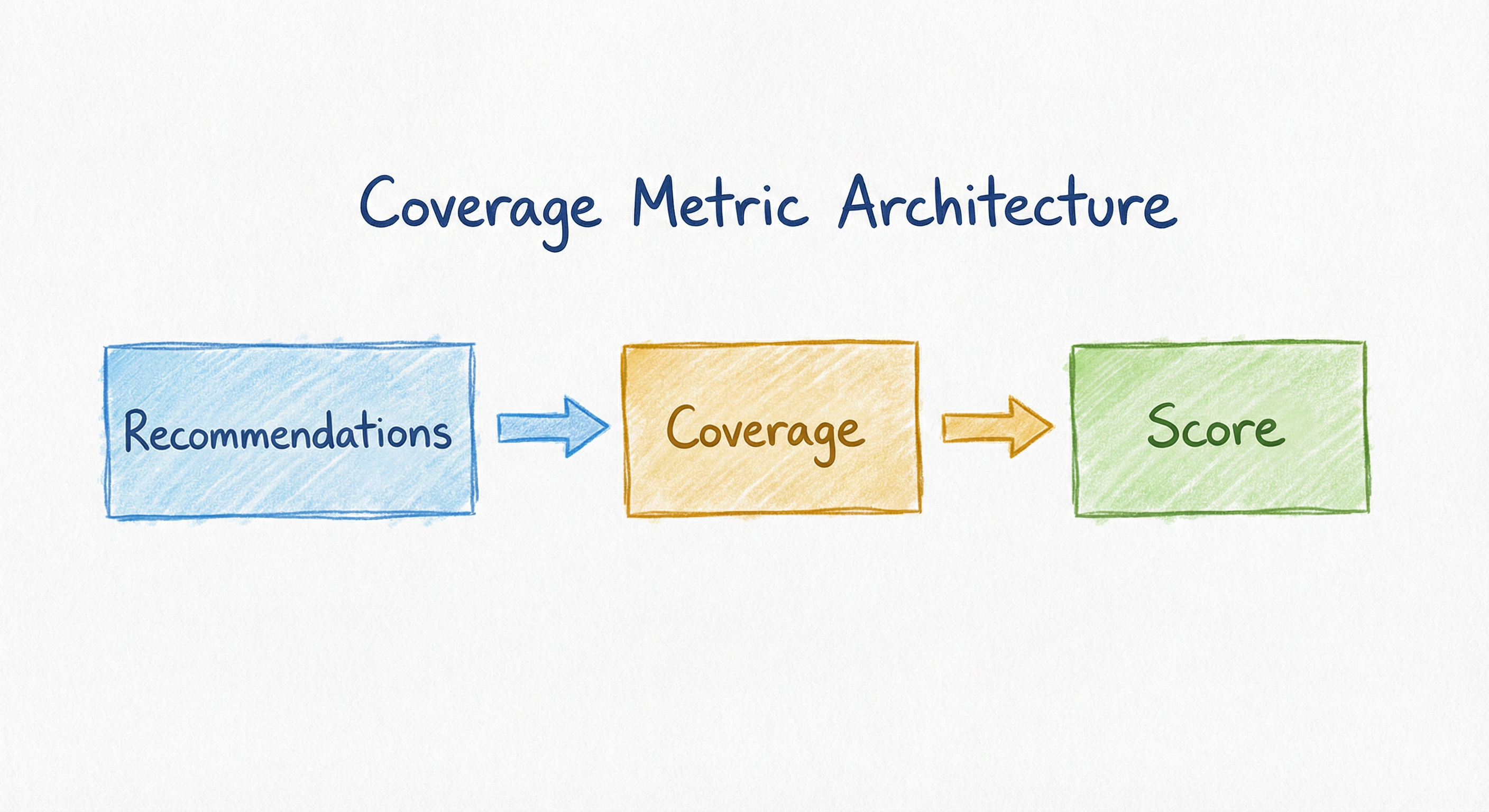
The architecture has two main data inputs: (1) recommendation logs that record which items were shown to which users, and (2) the item catalog that represents the complete inventory. The coverage calculator joins these sources, deduplicates item IDs, and computes the metrics. In production systems, this runs as a scheduled ETL job (daily or weekly) rather than a real-time computation.
Key Components
Recommendation Logs
Captures every recommendation event: which items were shown to which users, at what position, and with what timestamp. This is the raw data source for coverage computation. Stored in event stores like Kafka, BigQuery, or Azure Event Hubs.
Item Catalog Registry
The authoritative source of all items available for recommendation. Must include active/inactive status, category metadata, and creation dates. Coverage is computed against active items only -- recommending a discontinued product should not count.
Coverage Calculator
The core computation engine that deduplicates recommended items, joins against the catalog, and computes catalog coverage, Gini index, Shannon entropy, and per-category breakdowns. Typically implemented as a Spark or Pandas batch job.
Per-Category Coverage Analyzer
Breaks down coverage by item category (e.g., electronics, fashion, groceries) to identify which segments have low coverage. A system with 60% overall coverage might have 90% coverage for electronics but only 5% for niche categories like musical instruments.
Monitoring Dashboard
Visualizes coverage metrics over time, overlaid with accuracy metrics and business KPIs. Enables teams to track whether coverage is improving or degrading as models are updated. Tools like Grafana, Evidently AI, or custom dashboards.
Alert & Rebalancing Trigger
Fires alerts when coverage drops below a configured threshold (e.g., below 10% for any category). Can trigger automated rebalancing actions like increasing exploration rate or activating diversity re-ranking.
Data Flow
Here is the data flow for computing coverage in a production recommendation system:
Step 1: Collect recommendation events. Every time the recommendation model serves results to a user, log the event: {user_id, [item_id_1, item_id_2, ..., item_id_K], timestamp}. Store in an append-only event log.
Step 2: Define the evaluation window. Coverage is computed over a time window: daily (for operational monitoring), weekly (for trend analysis), or monthly (for strategic reviews). Pull all recommendation events within the window.
Step 3: Extract unique recommended items. Deduplicate across all users and all events to get the set of items that appeared in at least one recommendation list during the window.
Step 4: Join against the active catalog. Pull the current active item catalog (excluding discontinued, out-of-stock, or suspended items). Compute coverage = |recommended items intersection active catalog| / |active catalog|.
Step 5: Compute distribution metrics. Count how many times each recommended item appeared (frequency). Sort frequencies and compute Gini index and Shannon entropy.
Step 6: Segment analysis. Repeat Steps 3-5 per item category, per price tier, per seller, or per any other segmentation relevant to the business.
Step 7: Report and alert. Push metrics to the monitoring dashboard. Compare against thresholds and historical baselines. Alert on regressions.
A directed flow from 'Recommendation Model' to 'Recommendation Logs', which feeds into a 'Coverage Calculator'. Separately, 'Item Catalog DB' also feeds the Coverage Calculator. The calculator outputs three metrics: 'Catalog Coverage Score', 'Gini Index', and 'Per-Category Coverage', all flowing into a 'Monitoring Dashboard', which connects to 'Alerts & Rebalancing'.
How to Implement
Three Levels of Coverage Computation
Coverage is one of the simplest metrics to implement -- at its core, it is a set operation (unique recommended items divided by total catalog items). The complexity comes from scale (computing coverage over billions of recommendation events) and context (segmenting by category, time window, and user cohort).
Level 1: Basic catalog coverage. Count unique recommended items, divide by catalog size. One line of Python with sets.
Level 2: Coverage with distribution analysis. Add Gini index and entropy to understand not just how many items are covered, but how uniformly they are distributed.
Level 3: Production coverage monitoring. Segment by category, compute trends over time, set up alerts for regressions, and track coverage alongside accuracy metrics in a unified dashboard.
All three levels are straightforward to implement. The biggest challenge is not computation but data plumbing -- ensuring your recommendation logs capture every item shown to every user, with proper deduplication.
Cost Note: Computing coverage itself is essentially free (set operations on item IDs). The cost is in storing and processing recommendation logs. For a platform with 10 million daily active users each receiving 20 recommendations, that is 200 million events per day. On Azure Blob Storage, storing 30 days of logs costs roughly INR 5,000-10,000 (120) per month. Processing with Spark on Azure Databricks adds INR 20,000-50,000 (600) per month for a daily batch job.
import numpy as np
from typing import Dict, List, Set, Tuple


def catalog_coverage(
    recommendations: Dict[str, List[str]],
    catalog: Set[str]
) -> float:
    """Compute catalog coverage: fraction of catalog items recommended.

    Args:
        recommendations: {user_id: [item_id, ...]} for all users
        catalog: set of all item IDs in the catalog

    Returns:
        Coverage score between 0 and 1
    """
    recommended_items = set()
    for user_id, items in recommendations.items():
        recommended_items.update(items)

    # Only count items that are actually in the catalog
    covered = recommended_items & catalog
    return len(covered) / len(catalog) if catalog else 0.0


def gini_index(item_frequencies: np.ndarray) -> float:
    """Compute Gini index of item recommendation frequencies.

    Args:
        item_frequencies: array of recommendation counts per item
                          (including zeros for unrecommended items)

    Returns:
        Gini index between 0 (perfect equality) and 1 (max inequality)
    """
    sorted_freq = np.sort(item_frequencies)
    n = len(sorted_freq)
    if n == 0 or sorted_freq.sum() == 0:
        return 0.0
    index = np.arange(1, n + 1)
    return (2 * np.sum(index * sorted_freq) - (n + 1) * np.sum(sorted_freq)) / (
        n * np.sum(sorted_freq)
    )


def shannon_entropy(item_frequencies: np.ndarray) -> Tuple[float, float]:
    """Compute Shannon entropy of item exposure distribution.

    Args:
        item_frequencies: array of recommendation counts per item

    Returns:
        (entropy, normalized_entropy) where normalized is in [0, 1]
    """
    total = item_frequencies.sum()
    if total == 0:
        return 0.0, 0.0
    probs = item_frequencies[item_frequencies > 0] / total
    entropy = -np.sum(probs * np.log2(probs))
    max_entropy = np.log2(len(item_frequencies)) if len(item_frequencies) > 1 else 1.0
    return entropy, entropy / max_entropy


# ── Example Usage ───────────────────────────────────────────────────
catalog_items = {f"item_{i}" for i in range(1000)}  # 1000-item catalog

# Simulated recommendations: 500 users, top-10 each
np.random.seed(42)
popular_items = [f"item_{i}" for i in range(50)]   # 50 popular items
long_tail = [f"item_{i}" for i in range(50, 1000)]  # 950 long-tail items

recs = {}
for u in range(500):
    # 80% chance of picking popular, 20% long-tail (realistic skew)
    user_recs = []
    for _ in range(10):
        if np.random.random() < 0.8:
            user_recs.append(np.random.choice(popular_items))
        else:
            user_recs.append(np.random.choice(long_tail))
    recs[f"user_{u}"] = user_recs

coverage = catalog_coverage(recs, catalog_items)
print(f"Catalog Coverage: {coverage:.2%}")
# Output: Catalog Coverage: ~58.60%

# Compute item frequencies for Gini
from collections import Counter
all_recs = [item for items in recs.values() for item in items]
freq_counter = Counter(all_recs)
freqs = np.array([freq_counter.get(f"item_{i}", 0) for i in range(1000)])

gini = gini_index(freqs)
print(f"Gini Index: {gini:.4f}")
# Output: Gini Index: ~0.8753 (highly unequal)

entropy, norm_entropy = shannon_entropy(freqs)
print(f"Shannon Entropy: {entropy:.2f} bits (normalized: {norm_entropy:.4f})")
This from-scratch implementation shows the three core coverage metrics. catalog_coverage performs a simple set intersection to count unique recommended items. gini_index measures how uniformly items are recommended -- a Gini of 0.87 means extreme inequality (popular items dominate). shannon_entropy provides an alternative uniformity measure. Notice that even with 58% coverage (586 items recommended), the Gini index reveals that most recommendations concentrate on the 50 popular items.
# pip install recmetrics
import recmetrics
import pandas as pd
import numpy as np
import matplotlib.pyplot as plt

# Simulated recommendation data
np.random.seed(42)

# Full catalog of 5000 items
catalog = list(range(5000))

# Generate recommendations for 1000 users (top-10 lists)
# Skewed toward popular items (items 0-99 are popular)
recommendations = []
for user_id in range(1000):
    user_recs = []
    for _ in range(10):
        if np.random.random() < 0.7:
            user_recs.append(np.random.randint(0, 100))       # popular
        else:
            user_recs.append(np.random.randint(100, 5000))    # long-tail
    recommendations.append(user_recs)

# Compute prediction coverage using recmetrics
# prediction_coverage: % of catalog that appears in recommendations
coverage = recmetrics.prediction_coverage(
    predicted=recommendations,
    catalog=catalog
)
print(f"Prediction Coverage: {coverage:.2f}%")
# Output: ~48.2%

# Compute catalog coverage (same as prediction_coverage in this lib)
cat_cov = recmetrics.catalog_coverage(
    predicted=recommendations,
    catalog=catalog,
    k=10
)
print(f"Catalog Coverage @10: {cat_cov:.2f}%")

# Visualize the long-tail distribution
all_recommended = [item for user_recs in recommendations for item in user_recs]
item_counts = pd.Series(all_recommended).value_counts().sort_values(ascending=False)

plt.figure(figsize=(12, 5))
plt.subplot(1, 2, 1)
plt.plot(range(len(item_counts)), item_counts.values)
plt.xlabel("Item Rank (by frequency)")
plt.ylabel("Recommendation Count")
plt.title("Long-Tail Distribution of Recommendations")
plt.yscale("log")

plt.subplot(1, 2, 2)
recmetrics.long_tail_plot(
    test=pd.DataFrame({"item": all_recommended}),
    column="item",
    percentage=0.33,
    title="Long Tail of Recommendations"
)
plt.tight_layout()
plt.savefig("coverage_analysis.png", dpi=150)
print("Saved coverage_analysis.png")
The recmetrics library provides ready-made functions for prediction_coverage and catalog_coverage. The long-tail plot is especially useful for visual diagnostics: it shows the classic power-law distribution where a small number of items get most recommendations. The log-scale frequency plot makes the skew immediately visible. This is the quickest path to a coverage analysis in a Jupyter notebook.
from pyspark.sql import SparkSession
from pyspark.sql import functions as F
from pyspark.sql.window import Window
from datetime import datetime, timedelta

spark = SparkSession.builder \
    .appName("CoverageMonitoring") \
    .getOrCreate()

# ── Load recommendation logs ──────────────────────────────────────
# Schema: user_id, item_id, position, timestamp, model_version
rec_logs = spark.read.parquet("s3://data/recommendation_logs/")

# Filter to last 7 days
window_start = datetime.now() - timedelta(days=7)
recent_recs = rec_logs.filter(
    F.col("timestamp") >= F.lit(window_start)
)

# ── Load active catalog ───────────────────────────────────────────
catalog = spark.read.parquet("s3://data/item_catalog/") \
    .filter(F.col("status") == "active")

total_items = catalog.count()
print(f"Active catalog size: {total_items:,}")

# ── Compute overall catalog coverage ─────────────────────────────
recommended_items = recent_recs.select("item_id").distinct()
covered_items = recommended_items.join(
    catalog.select("item_id"),
    on="item_id",
    how="inner"
)
coverage = covered_items.count() / total_items
print(f"Catalog Coverage (7-day): {coverage:.2%}")

# ── Per-category coverage ─────────────────────────────────────────
category_coverage = catalog.groupBy("category").agg(
    F.countDistinct("item_id").alias("total_items")
).join(
    covered_items.join(
        catalog.select("item_id", "category"),
        on="item_id"
    ).groupBy("category").agg(
        F.countDistinct("item_id").alias("covered_items")
    ),
    on="category",
    how="left"
).fillna(0, subset=["covered_items"]) \
 .withColumn("coverage", F.col("covered_items") / F.col("total_items")) \
 .orderBy("coverage")

print("\nPer-Category Coverage (ascending):")
category_coverage.show(20, truncate=False)

# ── Gini index via Spark ──────────────────────────────────────────
item_freq = recent_recs.groupBy("item_id").agg(
    F.count("*").alias("freq")
)

# Include zero-frequency items from catalog
all_item_freq = catalog.select("item_id").join(
    item_freq, on="item_id", how="left"
).fillna(0, subset=["freq"])

# Compute Gini using window function
windowed = all_item_freq.withColumn(
    "rank", F.row_number().over(Window.orderBy("freq"))
)
n = total_items
total_freq = all_item_freq.agg(F.sum("freq")).collect()[0][0]

gini_num = windowed.agg(
    F.sum(F.col("rank") * F.col("freq") * 2 - (n + 1) * F.col("freq"))
).collect()[0][0]

gini = gini_num / (n * total_freq) if total_freq > 0 else 0
print(f"\nGini Index: {gini:.4f}")

# ── Write metrics for monitoring ──────────────────────────────────
metrics = {
    "date": datetime.now().isoformat(),
    "window_days": 7,
    "catalog_size": total_items,
    "covered_items": covered_items.count(),
    "coverage": coverage,
    "gini_index": gini
}

metrics_df = spark.createDataFrame([metrics])
metrics_df.write.mode("append").parquet("s3://data/coverage_metrics/")
print("Metrics written to S3")
This PySpark implementation handles the scale of a production recommendation system with millions of users and items. Key design choices: (1) filtering to a 7-day window for operational monitoring, (2) joining against the active catalog to exclude discontinued items, (3) per-category coverage breakdown to identify underserved segments, (4) Gini computation using window functions to avoid collecting all data to the driver. The metrics are written to S3 for downstream dashboarding.
import numpy as np
from collections import Counter
from typing import List, Dict, Tuple


class CoverageAwareReranker:
    """Post-processing re-ranker that boosts long-tail items to improve
    catalog coverage while maintaining acceptable accuracy.

    Uses a simple interpolation between relevance score and item rarity.
    """

    def __init__(
        self,
        item_frequencies: Dict[str, int],
        catalog_size: int,
        lambda_coverage: float = 0.3,  # Weight for coverage boost
    ):
        """
        Args:
            item_frequencies: {item_id: count} of past recommendations
            catalog_size: total number of items in catalog
            lambda_coverage: interpolation weight (0 = pure accuracy,
                             1 = pure coverage optimization)
        """
        self.item_freq = item_frequencies
        self.catalog_size = catalog_size
        self.lam = lambda_coverage

        # Compute max frequency for normalization
        self.max_freq = max(item_frequencies.values()) if item_frequencies else 1

    def rarity_score(self, item_id: str) -> float:
        """Score inversely proportional to recommendation frequency.
        Never-recommended items get the highest rarity score."""
        freq = self.item_freq.get(item_id, 0)
        return 1.0 - (freq / self.max_freq)

    def rerank(
        self,
        candidates: List[Tuple[str, float]],
        top_k: int = 10
    ) -> List[Tuple[str, float]]:
        """Re-rank candidates by interpolating relevance and rarity.

        Args:
            candidates: [(item_id, relevance_score), ...]
            top_k: number of items to return

        Returns:
            Re-ranked list of (item_id, combined_score) tuples
        """
        reranked = []
        for item_id, relevance in candidates:
            rarity = self.rarity_score(item_id)
            combined = (1 - self.lam) * relevance + self.lam * rarity
            reranked.append((item_id, combined))

        reranked.sort(key=lambda x: x[1], reverse=True)
        return reranked[:top_k]


# ── Example Usage ───────────────────────────────────────────────────
# Historical recommendation frequencies (popular items have high counts)
hist_freq = {f"item_{i}": 1000 - i * 10 for i in range(100)}

reranker = CoverageAwareReranker(
    item_frequencies=hist_freq,
    catalog_size=10000,
    lambda_coverage=0.3  # 30% weight on coverage
)

# Candidates from the base model (sorted by relevance)
candidates = [
    ("item_0", 0.95),   # Very popular, high relevance
    ("item_1", 0.90),   # Popular, high relevance
    ("item_50", 0.85),  # Medium popularity
    ("item_99", 0.80),  # Less popular
    ("item_500", 0.75), # Long-tail (not in history)
    ("item_999", 0.70), # Long-tail
]

original = [(item, score) for item, score in candidates]
reranked = reranker.rerank(candidates, top_k=5)

print("Original ranking:")
for item, score in original[:5]:
    print(f"  {item}: relevance={score:.2f}")

print("\nRe-ranked (lambda=0.3):")
for item, score in reranked:
    print(f"  {item}: combined={score:.2f}, rarity={reranker.rarity_score(item):.2f}")
This re-ranker demonstrates the most common approach to improving coverage: post-processing the recommendation model's output to boost long-tail items. The lambda_coverage parameter controls the accuracy-coverage tradeoff. At lambda=0 you get pure relevance ranking; at lambda=1 you get pure rarity ranking. In practice, lambda=0.2 to 0.4 significantly improves coverage with minimal accuracy loss. This is the approach described in Abdollahpouri et al. (2019) for managing popularity bias.
# Coverage monitoring configuration (YAML)
coverage_monitoring:
  enabled: true
  window_days: 7

  # Thresholds for alerting
  thresholds:
    overall_coverage_min: 0.15        # Alert if <15% catalog covered
    category_coverage_min: 0.05       # Alert if any category <5%
    gini_index_max: 0.95              # Alert if Gini >0.95

  # Segmentation dimensions
  segments:
    - category
    - price_tier
    - seller_tier
    - item_age_bucket   # new, medium, old

  # Re-ranking configuration
  reranking:
    enabled: true
    lambda_coverage: 0.25             # Coverage boost weight
    min_long_tail_fraction: 0.2       # At least 20% of recs from long-tail
    long_tail_threshold_percentile: 80  # Items below 80th percentile popularity

  # Reporting
  schedule: "0 6 * * *"              # Daily at 6 AM
  output_path: "s3://metrics/coverage/"
  dashboard_url: "https://grafana.internal/d/rec-coverage"
Common Implementation Mistakes
- ●
Counting discontinued or out-of-stock items in the catalog denominator: If your catalog includes 500,000 items but 200,000 are discontinued, your true denominator should be 300,000. Inflating the denominator with unrecommendable items makes coverage look artificially low and leads to misguided optimization.
- ●
Computing coverage over too short a time window: Coverage over 1 hour will be low even for a great system (not enough users have been served yet). Use at least 7 days for meaningful coverage. Monthly windows give the most stable picture. Daily coverage is useful for monitoring trends, not absolute values.
- ●
Ignoring the Gini index and reporting only coverage percentage: A system with 70% coverage sounds healthy, but if 90% of recommendations go to the same 100 items, the effective coverage is much lower. Always pair coverage with a distribution metric (Gini or entropy).
- ●
Treating coverage as a goal in itself without balancing accuracy: Blindly maximizing coverage (e.g., randomly recommending items) will reach 100% coverage with terrible user experience. Coverage must be optimized as a constraint or secondary objective alongside accuracy.
- ●
Not segmenting coverage by category or item type: Overall coverage of 50% might mask the fact that electronics has 95% coverage while books has 2%. Category-level coverage is where actionable insights live.
- ●
Confusing prediction coverage with catalog coverage: Prediction coverage measures what your model can score; catalog coverage measures what it actually recommends. A model might be able to score 90% of items (high prediction coverage) but still only recommend 10% (low catalog coverage) because it always picks the highest-scored popular items.
When Should You Use This?
Use When
You operate a multi-sided marketplace (e-commerce, food delivery, content platform) where suppliers need fair exposure and low coverage means supplier churn
Your recommendation system has been optimized for accuracy for a long time and you suspect popularity bias -- coverage is the quickest diagnostic
You are evaluating recommendation algorithms during development and need a beyond-accuracy metric to complement NDCG/precision/recall
Regulatory or fairness requirements mandate equitable item exposure (e.g., EU Digital Services Act provisions on algorithmic transparency for marketplaces)
Your business model depends on long-tail revenue (the Amazon model: millions of niche products each selling small volumes add up to significant revenue)
You want to detect filter bubbles and ensure users are exposed to diverse content, not just the same popular items repeatedly
You are building or evaluating a content discovery system (music, video, articles) where surfacing new and niche content is a product goal
Avoid When
Your catalog is small (fewer than 100 items) and users will naturally see most of it through browsing -- coverage becomes trivially high and uninformative
You are building a highly specialized recommendation system where only a small subset of items is ever appropriate (e.g., medical drug recommendations where safety limits choices)
Your primary concern is cold-start accuracy and you have not yet achieved baseline recommendation quality -- fix accuracy first, then worry about coverage
The items in your catalog are not substitutable (e.g., replacement parts for specific machines) -- coverage is not meaningful when items serve entirely different functions
You are evaluating a re-ranking model on a pre-filtered candidate set where the candidate generator already determines coverage -- measure coverage at the candidate generation stage instead
Key Tradeoffs
The Core Tradeoff: Coverage vs. Accuracy
This is the most important tradeoff in recommendation system evaluation, and there is no universal answer.
Why accuracy hurts coverage: Accuracy-optimized models learn that popular items are safe bets. Item A with 10,000 interactions has a well-estimated relevance score; item B with 3 interactions has a noisy, uncertain score. The model rationally prefers A, even when B might be more relevant for some users. This is not a bug -- it is rational behavior under uncertainty.
Why coverage helps the business: Chris Anderson's "Long Tail" theory (2004) showed that Amazon makes a significant fraction of revenue from niche products that physical bookstores cannot stock. If your recommender ignores the long tail, you leave that revenue on the table.
Finding the Balance
| Strategy | Coverage Impact | Accuracy Impact | Best For |
|---|---|---|---|
| Pure accuracy optimization | Low (5-15%) | Maximum | Short-term engagement |
| Diversity re-ranking (lambda=0.2-0.3) | Medium (20-40%) | 2-5% drop | Balanced marketplaces |
| Exploration-exploitation (epsilon-greedy) | Medium-High (30-50%) | 3-8% drop | Content discovery |
| Multi-objective optimization | High (40-60%) | 5-10% drop | Fairness-critical platforms |
| Random recommendations | 100% | Terrible | Never (except as a baseline) |
The sweet spot for most production systems is a diversity re-ranking approach where you post-process the accuracy-optimized model's output to boost underrepresented items. At lambda=0.25, you typically see coverage improve from 10% to 35% with only a 3% drop in NDCG. This is almost always a worthwhile trade.
Short-Term vs. Long-Term Thinking
Accuracy metrics capture short-term user satisfaction. Coverage captures long-term ecosystem health. A system with 5% coverage might show great A/B test results for 3 months, but over a year, users will complain about repetitive recommendations, suppliers will leave the platform, and the catalog will shrink -- further reducing coverage in a vicious cycle.
Key Insight: Coverage is a long-term investment. Accept a small accuracy hit today to maintain a healthy, diverse ecosystem tomorrow. The platforms that get this balance right (Spotify's Discover Weekly, Netflix's genre exploration) build stronger user loyalty than those that chase pure engagement.
Alternatives & Comparisons
Diversity measures how different items within a single recommendation list are from each other (intra-list diversity), while coverage measures how many unique items appear across all recommendation lists (inter-list breadth). You can have high diversity (each list contains varied items) but low coverage (the same varied items appear in every list). Use diversity for per-user experience quality; use coverage for catalog-level health.
Novelty measures whether recommended items are surprising or unexpected to the user (often based on item popularity -- less popular items are more novel). Coverage measures whether the system uses the full catalog. High novelty implies good coverage (recommending obscure items covers more catalog), but high coverage does not imply novelty (you could cover 80% of the catalog by recommending popular items to different user segments). Use novelty for user-level surprise; use coverage for platform-level breadth.
Hit rate measures accuracy: what fraction of users got at least one relevant item in their recommendation list. It is an accuracy metric, not a coverage metric. A system with perfect hit rate (every user sees something relevant) can still have terrible coverage (always showing the same 10 popular items). Use hit rate for recommendation quality; use coverage for catalog utilization. They measure fundamentally different things and should be tracked together.
NDCG measures ranking quality -- how well items are ordered by relevance. Coverage measures catalog breadth -- how many items are recommended at all. NDCG can be perfect (NDCG=1.0) while coverage is terrible (only popular items, perfectly ranked). These are complementary, not competing, metrics. Always report NDCG alongside coverage to get both the quality and breadth picture.
Pros, Cons & Tradeoffs
Advantages
Simplest beyond-accuracy metric: Computing coverage requires only a set operation (unique items / total items), making it trivial to implement and explain to non-technical stakeholders. No complex formulas, no hyperparameters.
Directly actionable diagnostic for popularity bias: If coverage is 5%, you know immediately that 95% of your catalog is invisible. This gives product and engineering teams a clear target to improve and a simple number to track.
Critical for marketplace health: On platforms like Flipkart, Swiggy, or Amazon, low coverage means suppliers are not getting exposure. Tracking coverage helps prevent the vicious cycle of supplier churn leading to reduced catalog leading to lower user satisfaction.
Complements accuracy metrics perfectly: Coverage tells you what accuracy metrics miss -- the breadth of your recommendation system. Together, NDCG + coverage give you both quality and breadth, the two dimensions that matter most.
Supports fairness and regulatory compliance: As regulators (EU Digital Services Act, India's proposed Digital Competition Bill) scrutinize algorithmic marketplaces, demonstrating fair item exposure via coverage metrics helps with compliance and transparency reporting.
Cheap to compute at any scale: Even at the scale of billions of recommendation events, coverage is a simple distinct count followed by a division. No expensive model inference, no GPU compute -- just a Spark SQL query.
Disadvantages
Binary counting ignores exposure frequency: An item recommended once to one user and an item recommended 10,000 times both count equally toward coverage. A system with 80% coverage could still have 99% of recommendations going to the same 100 items. Must pair with Gini or entropy to get the full picture.
No quality signal: Coverage counts items regardless of whether they were good recommendations. Randomly assigning items achieves 100% coverage with terrible user experience. Coverage must be a secondary metric alongside accuracy.
Sensitive to catalog definition: What counts as the 'catalog'? Including discontinued, out-of-stock, or region-restricted items inflates the denominator and makes coverage look artificially low. Requires careful catalog curation.
Time-window dependent: Coverage over 1 day is much lower than over 30 days, simply because fewer users have been served. This makes absolute coverage values hard to interpret without context. Always specify the time window.
Does not capture user-level experience: A platform with 60% coverage might achieve this by giving each user the same narrow set of items (each user sees 50 popular items, but different users see slightly different sets). Per-user diversity can be poor even when aggregate coverage is high.
Can incentivize gaming: If teams are measured on coverage, they might add irrelevant long-tail items to recommendation lists to inflate the number. Need guardrails (e.g., minimum relevance threshold for items to count toward coverage).
Failure Modes & Debugging
Popularity Feedback Loop
Cause
The recommendation model is trained on interaction data (clicks, purchases). Popular items get more interactions, so the model learns to recommend them more, which generates more interactions, further reinforcing their dominance. This positive feedback loop steadily erodes coverage over time.
Symptoms
Coverage decreases monotonically with each model retrain cycle. Gini index increases over time. New items never accumulate enough interactions to break into recommendation lists. The set of frequently recommended items shrinks over successive model versions.
Mitigation
Implement exploration strategies: epsilon-greedy (show random items X% of the time), Thompson sampling (sample from uncertainty-aware score distributions), or contextual bandits. Add a temporal decay to interaction counts so old popular items gradually lose their advantage. Use coverage-aware re-ranking as a post-processing step to boost long-tail items. Monitor coverage trend over retrain cycles and alert on sustained decreases.
Cold-Start Coverage Collapse
Cause
Collaborative filtering models cannot generate predictions for items with zero or very few interactions. When new items are added to the catalog (which happens continuously in e-commerce), they have no interaction history and are therefore invisible to the model. This creates a growing pool of unrecommendable items.
Symptoms
Prediction coverage drops as the catalog grows. New items have near-zero impressions even weeks after being added. Coverage is much higher for old items than for items added in the last 30 days. The 'dead zone' (items with zero recommendations) grows over time.
Mitigation
Use hybrid models that combine collaborative filtering (good for established items) with content-based features (good for cold-start items). Implement a new item boost: guarantee new items a minimum number of impressions in their first N days. Use knowledge graphs or item attribute similarity to generate initial scores for new items. Some platforms use a dedicated 'New Arrivals' recommendation slot that bypasses the main model entirely.
Category Desertification
Cause
Overall coverage looks acceptable (e.g., 40%), but it is unevenly distributed across categories. Popular categories like electronics or fashion have 80% coverage, while niche categories like musical instruments or industrial supplies have 1%. The overall metric masks severe per-category problems.
Symptoms
Suppliers in niche categories complain about zero visibility. User search queries in certain categories return low-quality results. Category-level analysis reveals extreme variance in coverage. Users interested in niche categories churn because recommendations never surface relevant items.
Mitigation
Always compute and monitor per-category coverage alongside overall coverage. Set category-specific thresholds (e.g., minimum 10% coverage for every category). Implement category-aware re-ranking that ensures each recommendation list includes items from underrepresented categories. Use separate recommendation models or candidate generators for different category verticals.
Stale Coverage Measurement
Cause
Coverage is computed against an outdated catalog snapshot. Items have been added, removed, or marked out-of-stock since the last catalog sync. The coverage metric no longer reflects reality.
Symptoms
Coverage suddenly jumps or drops after catalog updates without any model changes. Recommendations include items that are no longer available. Coverage percentage disagrees between teams using different catalog snapshots.
Mitigation
Ensure the catalog used for coverage computation is refreshed at least daily and synced with the live inventory system. Filter out items with status != 'active'. Log the catalog snapshot version alongside each coverage computation for reproducibility.
Coverage Inflation Through Irrelevant Recommendations
Cause
Teams gaming the coverage metric by adding random or minimally-relevant long-tail items to recommendation lists. Coverage increases, but user experience degrades because irrelevant items pollute the recommendations.
Symptoms
Coverage increases but accuracy metrics (NDCG, click-through rate, conversion rate) decline. Users report seeing unrelated items in their recommendations. Average relevance score of recommended items drops while coverage improves.
Mitigation
Implement a minimum relevance threshold: items below a model score threshold do not count toward coverage, even if shown. Track coverage conditioned on user engagement (only count items that received at least one click or interaction). Use a composite metric that multiplies coverage by average accuracy (e.g., CoverageScore = Coverage * NDCG) so that inflating coverage at the cost of quality is penalized.
Survivorship Bias in Coverage Computation
Cause
Coverage is computed only on users who received recommendations, ignoring users who were not served (cold-start users, users in unsupported regions, or users filtered out by eligibility rules). This inflates the apparent coverage by excluding the hardest-to-serve population.
Symptoms
Coverage looks healthy in dashboards but user complaints about missing recommendations persist. Significant fraction of users (especially new users) report seeing generic or no recommendations. User coverage is much lower than item coverage.
Mitigation
Always report user coverage alongside item coverage. Track the fraction of users who received zero recommendations and treat them as a priority cohort. Ensure coverage computations include all active users in the denominator, not just those who triggered the recommendation model.
Placement in an ML System
Where Does Coverage Sit in the ML Pipeline?
Catalog coverage is an evaluation metric, not a component of the inference path. It sits in the monitoring and evaluation layer, computed periodically over recommendation logs. However, it influences the inference path indirectly through feedback loops.
Evaluation time: After training a new recommendation model, compute coverage on a held-out test set alongside accuracy metrics (NDCG, precision, recall). Models with significantly lower coverage than the baseline should be investigated before deployment.
A/B testing: When comparing recommendation algorithms in production, track coverage as a guardrail metric. A new model that improves NDCG by 2% but drops coverage from 30% to 10% may be harmful in the long run -- the accuracy gain does not justify the coverage regression.
Production monitoring: Compute coverage daily (7-day rolling window) and alert on drops. Coverage regression often indicates model bugs (e.g., a feature encoding error that makes long-tail items unscorable) or data issues (e.g., missing item metadata).
Feedback to the model: Coverage metrics directly inform exploration policies. If coverage is low, increase the exploration rate (epsilon-greedy) or activate the diversity re-ranker. Some systems use coverage as a constraint during model training (e.g., multi-objective optimization with coverage as a regularizer).
Key Insight: Think of coverage as a health check for your recommendation ecosystem. Just as you monitor CPU usage and error rates for system health, monitor coverage for recommendation health. It is a leading indicator of long-term platform quality -- problems show up in coverage before they show up in user churn.
Pipeline Stage
Evaluation / Metrics
Upstream
- Recommendation Model
- Candidate Generation
- Re-ranking Layer
- Item Catalog / Inventory System
Downstream
- Monitoring Dashboard
- Exploration Policy (epsilon-greedy, Thompson sampling)
- Diversity Re-ranker
- Supplier Fairness Reports
- Model Selection / A/B Testing
Scaling Bottlenecks
Coverage computation is cheap. The core operation is COUNT(DISTINCT item_id) over recommendation logs, which is in the number of log entries with constant space (using HyperLogLog for approximate distinct counts at extreme scale). For a platform with 1 billion recommendation events per month, a HyperLogLog sketch uses ~12 KB of memory and gives 99.7% accuracy on the distinct count.
The real bottleneck is not compute -- it is data freshness. Recommendation logs must be available for processing within hours (not days) for coverage monitoring to be actionable. If your data pipeline has a 48-hour lag, you cannot detect coverage regressions caused by a bad model deployment until it is too late.
| Scale | Approach | Cost Estimate (INR/month) |
|---|---|---|
| < 1M events/day | Pandas on a single machine | Free (existing infra) |
| 1M - 100M events/day | PySpark on 4-node cluster | INR 15,000 - 50,000 |
| 100M - 1B events/day | Spark on managed service (Databricks/EMR) | INR 50,000 - 2,00,000 |
| > 1B events/day | Streaming approximate (HyperLogLog + Flink) | INR 1,00,000 - 5,00,000 |
For most Indian startups and mid-size companies (Swiggy, Meesho, Myntra scale), a daily PySpark batch job on a 4-8 node cluster is sufficient and costs under INR 50,000/month (~$600).
Batch coverage (computed daily or weekly) is standard for reporting and alerting. Real-time coverage (streaming computation) is rarely needed but useful for: (1) detecting model deployment failures that suddenly drop coverage, (2) real-time dashboards during high-traffic events (Diwali sale, Big Billion Days). Implement real-time coverage using Kafka Streams or Apache Flink with a HyperLogLog sketch for approximate distinct item counts.
Production Case Studies
Spotify published research on the tradeoff between relevance, fairness, and satisfaction in their two-sided marketplace. Their recommendation system must balance user satisfaction (relevance) with artist exposure (coverage). Studies showed that algorithm-driven listening on Spotify was associated with reduced consumption diversity -- users settled into 'filter bubbles' of familiar genres. To combat this, Spotify introduced features like Discover Weekly (algorithmic exploration), which deliberately surfaces less popular tracks to improve artist coverage. Their research explicitly uses catalog coverage and artist reach metrics to evaluate fairness across their 100+ million track catalog.
Spotify's Discover Weekly feature, launched in 2015 and continually improved, surfaces tracks from a much broader portion of the catalog than standard recommendation feeds. Research indicated that algorithmic exploration features increased the number of distinct artists listened to per user by 15-25%, directly improving artist coverage. However, recent criticism (2024-2025) suggests that Spotify's AutoPlay and AI DJ features may be reverting toward popularity bias, showing the ongoing tension between coverage and engagement.
Netflix faces a classic coverage challenge: their catalog of 7,000+ titles must serve 260+ million subscribers with diverse tastes. Their recommendation system uses personalized artwork (showing different poster images for the same title to different users) to increase the effective coverage of their catalog. A thriller fan might see a suspenseful frame from a movie, while a comedy fan sees a humorous frame from the same movie -- making the same title appeal to different audience segments. Netflix's 'Gems for You' row explicitly targets long-tail content discovery, surfacing titles that match user taste but have low overall popularity. Internal research tracks catalog utilization (what percentage of titles receive meaningful viewership) as a key health metric.
Personalized artwork increased click-through rates by ~20% across the catalog, with the largest gains on lesser-known titles that previously struggled to attract attention. The 'Gems for You' feature increased viewing hours of long-tail content. Netflix reports that over 80% of content watched is discovered through recommendations, and their goal is to ensure this discovery spans the full catalog breadth -- not just trending titles.
Flipkart operates one of India's largest product catalogs with 150+ million products from hundreds of thousands of sellers. Their recommendation team explicitly tracks catalog coverage alongside relevance metrics. The challenge is acute in India's marketplace model: small sellers and regional artisans listing handmade products compete with large brands for visibility. Low coverage means these sellers get no recommendations, no traffic, and eventually leave the platform. Flipkart uses a hybrid recommendation approach combining collaborative filtering (for established products) with content-based visual similarity (for new and niche products), specifically to improve coverage for long-tail items. Their Level 2 Ranking layer balances relevance with diversity to ensure broader catalog exposure.
Flipkart's hybrid approach improved product coverage from approximately 8% to 25% across their full catalog during Big Billion Days, their largest sale event. The visual similarity model was particularly effective for fashion (where new styles constantly enter the catalog and have zero interaction history), improving coverage in fashion by 3x. This translated to a measurable increase in GMV from long-tail sellers.
Swiggy's restaurant recommendation system must balance user satisfaction with restaurant fairness across 500+ cities in India. A coverage problem in food delivery is particularly severe: if the system only recommends the top 50 restaurants in a city, smaller restaurants get zero orders, cannot sustain their business, and eventually close. This reduces catalog diversity for users. Swiggy addresses this by tracking restaurant coverage (what fraction of active restaurants received at least one recommendation-driven order per week) as a key marketplace health metric. They implement zone-based diversity constraints ensuring that recommendations include restaurants across different price tiers, cuisines, and geographic zones.
Swiggy's zone-based diversity constraints improved restaurant coverage from roughly 40% to 65% in major metro areas (Delhi, Mumbai, Bangalore). New restaurants (listed within the last 30 days) saw a 2x increase in recommendation-driven impressions after implementing a new-restaurant boost in the re-ranking layer. This improved partner retention and expanded the variety of cuisine options available to users.
Tooling & Ecosystem
Python library specifically designed for evaluating recommender systems. Provides prediction_coverage() and catalog_coverage() functions, plus a long_tail_plot() visualization for diagnosing popularity bias. Lightweight and easy to use for initial analysis.
Comprehensive recommendation library with 94+ algorithms and built-in evaluation metrics including item coverage, Gini index, Shannon entropy, and tail percentage. Supports reproducible experiments with standardized data loading, model training, and evaluation pipelines. The go-to framework for academic recommendation research.
ML monitoring platform with built-in support for recommendation metrics including coverage, diversity, novelty, and popularity bias detection. Provides pre-built dashboards for tracking coverage trends over time and comparing coverage across model versions. Useful for production monitoring.
Python scikit for building and evaluating recommender systems. While focused on rating prediction algorithms (SVD, KNN, etc.), it provides coverage computation as part of its evaluation framework. Good for collaborative filtering experiments where prediction coverage (items the model can score) matters.
Python toolkit for reproducible recommender system experiments. Includes evaluation functions for top-N metrics, and its evaluation harness makes it easy to compute coverage across different algorithm configurations. Well-documented and maintained by GroupLens research (the team behind MovieLens).
Collection of recommendation algorithms, evaluation utilities, and best practices from Microsoft Research. Includes diversity and coverage metrics in the evaluation module, along with fairness-aware recommendation examples. Supports both Python and Spark backends for scale.
Research & References
Ge, M., Delgado-Battenfeld, C., & Jannach, D. (2010)ACM RecSys 2010
The foundational paper on coverage as a recommendation quality metric. Introduced formal definitions of catalog coverage and serendipity, and demonstrated that beyond-accuracy metrics reveal important quality dimensions that RMSE and precision miss. Showed that popular collaborative filtering algorithms have dramatically different coverage profiles.
Herlocker, J. L., Konstan, J. A., Terveen, L. G., & Riedl, J. T. (2004)ACM Transactions on Information Systems (TOIS), Vol. 22, No. 1
The seminal survey on evaluating collaborative filtering systems. Defined prediction coverage (fraction of items for which the system can make predictions) and discussed its importance alongside accuracy. Established the evaluation framework that subsequent beyond-accuracy research built upon.
Abdollahpouri, H., Burke, R., & Mobasher, B. (2019)AAAI FLAIRS 2019
Proposes a personalized re-ranking approach to combat popularity bias and improve long-tail item coverage. Shows that a simple post-processing step can significantly increase the representation of non-popular items in recommendation lists while maintaining acceptable accuracy. Directly addresses the coverage-accuracy tradeoff with a practical solution.
Abdollahpouri, H., Mansoury, M., Burke, R., Mobasher, B., & Malthouse, E. (2024)User Modeling and User-Adapted Interaction (Springer)
Comprehensive 2024 survey covering all dimensions of popularity bias including its impact on coverage, diversity, and fairness. Reviews Gini index, catalog coverage, and other metrics for detecting and measuring popularity bias. Categorizes mitigation strategies (pre-processing, in-processing, post-processing) with analysis of their coverage impact.
Al-Ghuribi, S. M. & Mohd Noah, S. A. (2024)arXiv preprint
Extensive 2024 survey covering 25+ evaluation metrics for recommendation systems, organized into accuracy, diversity, novelty, coverage, and fairness categories. Provides formal definitions for catalog coverage, prediction coverage, weighted catalog coverage, and their relationships to other beyond-accuracy metrics.
Interview & Evaluation Perspective
Common Interview Questions
- ●
Your recommendation system has a 0.90 NDCG but only 5% catalog coverage. What is the problem and how would you fix it?
- ●
Explain the difference between catalog coverage, prediction coverage, and user coverage.
- ●
How would you measure and improve catalog coverage for a marketplace like Flipkart or Amazon?
- ●
What is the Gini index in the context of recommendations, and why does coverage alone not tell the full story?
- ●
Describe the tradeoff between recommendation accuracy and catalog coverage. How would you find the right balance?
- ●
A new item is added to the catalog but never gets recommended. What could cause this and how would you fix it?
- ●
How would you set up coverage monitoring for a food delivery platform like Swiggy?
Key Points to Mention
- ●
Coverage measures catalog breadth (what fraction of items get recommended), while accuracy metrics like NDCG measure ranking quality (how well recommended items are ordered). They capture orthogonal dimensions and must be tracked together.
- ●
Always pair coverage with a distribution metric (Gini index or Shannon entropy). A system with 70% coverage but Gini=0.95 is still dominated by popular items -- the coverage number alone is misleading.
- ●
The popularity feedback loop is the primary cause of low coverage: popular items get more interactions, which trains the model to recommend them more, generating even more interactions. Break this loop with exploration (epsilon-greedy, Thompson sampling) or coverage-aware re-ranking.
- ●
For marketplaces, coverage is an economic necessity, not just a nice-to-have metric. Low coverage means suppliers leave the platform, reducing catalog diversity, which reduces user choice -- a vicious cycle.
- ●
Cold-start items (new items with no interactions) are invisible to collaborative filtering models. Hybrid models (collaborative + content-based) and new-item boost policies are essential for maintaining coverage as the catalog grows.
- ●
Coverage monitoring should be segmented by category -- overall coverage can mask severe per-category problems. Set category-level thresholds and alert on violations.
Pitfalls to Avoid
- ●
Treating coverage as a standalone metric without considering accuracy -- maximizing coverage is trivial (recommend random items), but the point is to cover the catalog with relevant recommendations.
- ●
Confusing coverage with diversity -- diversity measures within a single recommendation list, coverage measures across all lists. They are complementary but distinct concepts.
- ●
Claiming that collaborative filtering alone can achieve high coverage -- by definition, it cannot score items with zero interactions (cold-start problem).
- ●
Ignoring the time window when discussing coverage -- daily coverage is always lower than monthly coverage. Always specify the measurement window.
- ●
Not mentioning the Gini index or distribution analysis -- this is the most common oversight and suggests surface-level understanding.
Senior-Level Expectation
A senior candidate should discuss coverage as part of a broader recommendation quality framework that includes accuracy (NDCG, precision), coverage (catalog, prediction, user), diversity (intra-list), novelty, and fairness. They should articulate the business case for coverage: marketplace health, supplier retention, long-tail revenue, regulatory compliance. They should explain the coverage-accuracy tradeoff with specific strategies (re-ranking, exploration-exploitation, multi-objective optimization) and quantify the expected impact (e.g., 'lambda=0.25 re-ranking typically improves coverage from 10% to 35% with 3% NDCG drop'). They should discuss monitoring architecture: what to track (coverage, Gini, per-category breakdowns), how often (daily rolling 7-day windows), and what to alert on (category-level thresholds). Finally, they should connect coverage to cold-start strategies (hybrid models, content-based fallbacks, new-item boost) and explain how coverage degrades over time without active intervention.
Summary
Let us recap the key points about catalog coverage:
What it is: Catalog coverage measures the fraction of items in your catalog that your recommendation system actually surfaces to users. It is the simplest and most direct diagnostic for popularity bias: if coverage is 5%, your system is ignoring 95% of your inventory. The metric ranges from 0 to 1, where 1.0 means every item was recommended at least once.
Why it matters: For multi-sided marketplaces (Flipkart, Swiggy, Amazon), low coverage means suppliers are invisible, creating an unfair marketplace that eventually drives them away. For content platforms (Spotify, Netflix, JioSaavn), low coverage means users are stuck in filter bubbles, missing content they would enjoy. Coverage captures a dimension that accuracy metrics (NDCG, precision, recall) completely miss -- the breadth of your system's reach.
The key tradeoff: Accuracy optimization pushes toward popular items (safe bets with lots of training data). Coverage optimization pushes toward long-tail items (risky recommendations with less data). The practical solution is post-processing re-ranking that blends relevance with item rarity. At lambda=0.25, you typically improve coverage from 10% to 35% with only a 3% NDCG drop -- almost always a worthwhile trade.
What to report alongside coverage: Always pair coverage with a distribution metric (Gini index or Shannon entropy). Coverage alone is misleading because it treats one-time recommendations the same as items recommended 10,000 times. The Gini index reveals whether your 'covered' items are exposed uniformly or concentrated on a few popular ones. Also segment coverage by category -- overall coverage can mask severe per-category problems.
Implementation in practice: Coverage is trivially cheap to compute (a set operation on item IDs). The real investment is in (1) ensuring your recommendation logs capture every recommendation event, (2) maintaining an accurate active catalog, and (3) building monitoring dashboards that track coverage trends over time with per-category breakdowns. For production systems, use a 7-day rolling window for daily monitoring and set alerts for category-level coverage drops below thresholds.
Catalog coverage is the recommendation system equivalent of biodiversity: a healthy ecosystem recommends broadly, not just the same popular items. Track it, monitor it, and invest in exploration strategies to keep it healthy.