Diversity Score in Machine Learning
Here is a question every recommendation engineer eventually faces: your model achieves spectacular accuracy -- NDCG@10 is at 0.92, precision is through the roof -- yet users complain that the feed feels repetitive and boring. They see five nearly identical thriller movies, eight black sneakers, or twelve Bollywood dance tracks in a row. Accuracy alone does not guarantee a good user experience.
This is the problem diversity metrics solve. They quantify how varied, heterogeneous, and non-redundant a recommendation list is. A high diversity score means the list covers a wide range of user interests, item categories, or content styles. A low diversity score means the list is a monotonous echo chamber.
Diversity measurement in recommendation systems has evolved significantly since Ziegler et al. first formalized intra-list similarity in 2005. Today, the field encompasses multiple complementary approaches: Intra-List Diversity (ILD) measures pairwise dissimilarity within a list, category diversity counts distinct genres or types, embedding-based diversity uses learned representations to capture semantic variation, and Maximal Marginal Relevance (MMR) and Determinantal Point Processes (DPP) provide principled frameworks for balancing diversity with relevance.
From Netflix carousel diversification to YouTube's DPP-based re-ranking to Flipkart's category-aware product feeds -- diversity metrics are now a first-class citizen in production recommendation systems. If you are building any system that presents users with a list of items, understanding and measuring diversity is not optional. It is table stakes.
Concept Snapshot
- What It Is
- A family of evaluation metrics that quantify how varied, heterogeneous, and non-redundant a recommendation list is, typically by measuring pairwise dissimilarity between items using distance functions over content features, embeddings, or categorical attributes.
- Category
- Evaluation
- Complexity
- Intermediate
- Inputs / Outputs
- Inputs: a recommendation list of K items and item representations (embeddings, categories, or content features). Outputs: a scalar diversity score, typically between 0 and 1, where higher values indicate greater diversity.
- System Placement
- Used in offline evaluation of recommendation models, online A/B testing of re-ranking strategies, and as a constraint or objective in recommendation optimization alongside accuracy metrics.
- Also Known As
- Intra-List Diversity, ILD, Recommendation Diversity, List Diversity Score, Inter-Item Distance
- Typical Users
- ML engineers, recommendation system developers, product managers, search engineers, content strategists
- Prerequisites
- Cosine similarity and distance metrics, Item embeddings or feature representations, Basic recommendation system concepts, Understanding of relevance-diversity tradeoffs
- Key Terms
- ILDintra-list similaritypairwise distancecosine dissimilaritycategory coverageMMRDPPcalibrationembedding diversityredundancy
Why This Concept Exists
The Accuracy Trap
For decades, recommendation systems were optimized almost exclusively for accuracy: predict the right rating, retrieve the most relevant item, maximize click-through rate. Metrics like NDCG, precision@K, and RMSE dominated evaluation. And they worked -- in isolation.
But accuracy-only optimization produces a well-documented pathology: over-specialization. A collaborative filtering model that learns you like action movies will recommend 20 action movies. A content-based model that learns you buy running shoes will show you 15 pairs of running shoes. Technically accurate, practically useless.
This is not a theoretical concern. Research by Ziegler et al. (2005) demonstrated empirically that recommendation lists with lower intra-list similarity (higher diversity) led to significantly higher user satisfaction, even when average predicted accuracy decreased. Users want to be surprised. They want to explore. They want a mix.
The Filter Bubble Problem
Eli Pariser's 2011 concept of the "filter bubble" brought public attention to what recommendation researchers already knew: systems that optimize only for relevance create information silos. Users get trapped in narrow content loops. Spotify's own research showed that algorithmic recommendations, when unchecked, decrease the diversity of music consumption over time -- the so-called homogenization effect.
For platforms, this is not just an ethical concern -- it is a business risk. Users who see repetitive content disengage. Creators whose content falls outside the "popular" bucket get zero visibility, reducing the supply side of the marketplace. Advertisers demand diverse placements, not the same ad slot repeated across homogeneous content.
From Ad Hoc to Formal Metrics
Early diversity efforts were ad hoc: manually inject random items, shuffle categories, or cap the number of items from any single source. These heuristics helped but lacked rigor. How do you know if your random injection actually improved diversity? How do you compare two re-ranking strategies?
The field needed formal, quantifiable metrics. Three key developments defined the trajectory:
- Ziegler et al. (2005) introduced Intra-List Similarity (ILS) and its complement, intra-list diversity, using topic-based distance between books. This was the first formal diversity metric for recommendations.
- Carbonell & Goldstein (1998) had already introduced Maximal Marginal Relevance (MMR) in information retrieval, providing a principled way to balance relevance and diversity. MMR was later adopted widely in recommendation re-ranking.
- Kulesza & Taskar (2012) brought Determinantal Point Processes (DPP) to machine learning, offering an elegant probabilistic framework for selecting diverse subsets. YouTube adopted DPPs for production diversification in 2018.
Key Insight: Diversity metrics exist because accuracy metrics are necessary but not sufficient. A perfect NDCG score means nothing if users bounce after seeing a monotonous list. Diversity metrics complete the picture by measuring what accuracy cannot: variety, exploration, and serendipity.
Core Intuition & Mental Model
The Dinner Party Analogy
Imagine you are planning a dinner party and need to assemble a playlist of 10 songs. Your music app knows you love jazz. An accuracy-optimized system would pick the 10 highest-rated jazz tracks. Great jazz, but your guests will feel like they are stuck in a jazz club for three hours.
A diversity-aware system would pick a mix: two jazz tracks, two pop songs, a classical piece, some indie rock, maybe a Bollywood number. Each song is individually less "optimal" than the best jazz track, but the overall experience is richer, more engaging, and more inclusive of your guests' varied tastes.
Diversity score is the metric that measures how "mixed" your playlist is. A playlist of 10 identical jazz tracks scores near 0. A playlist spanning 8 genres scores near 1.
How Do You Measure "Mixedness"?
The core idea behind most diversity metrics is deceptively simple: look at every pair of items in the list and measure how different they are. If every pair is very different, the list is diverse. If most pairs are similar, the list is monotonous.
Mathematically, if you have 10 items, there are pairs. For each pair, you compute a distance (how different they are). Average those 45 distances, and you get the Intra-List Diversity (ILD).
But what does "distance" mean? This is where it gets interesting:
- Category distance: Two items from different genres have distance 1, same genre has distance 0. Simple, interpretable, but coarse.
- Embedding distance: Compute 1 minus cosine similarity between item embeddings. Captures nuanced semantic differences (a jazz-fusion track is closer to jazz than to death metal).
- Feature distance: Use item attributes (price range, brand, color, language) to compute a multi-dimensional distance.
The beauty of ILD is its flexibility -- any distance function works. The interpretation is always the same: higher ILD means more diverse.
Why Not Just Maximize Diversity?
If diversity is good, why not just recommend 10 completely random items? That would maximize diversity but destroy relevance. The user searching for running shoes does not want a recommendation list containing a toaster, a novel, and a lawn mower.
This is the diversity-relevance tradeoff, and it is the central tension in the field. Every diversity improvement comes at some cost to accuracy. The art is finding the sweet spot -- diverse enough to feel fresh, relevant enough to be useful.
Mental Model: Think of diversity as the "spice" in a recipe. Too little and the dish is bland (monotonous recommendations). Too much and it is inedible (random, irrelevant recommendations). The diversity score tells you how much spice is in the dish. The tradeoff curve tells you how much spice your users can handle.
Technical Foundations
The Mathematics of Diversity
Diversity in recommendation systems is measured through several complementary formulations. We will build from the simplest to the most sophisticated.
1. Intra-List Diversity (ILD)
The most widely used diversity metric. Given a recommendation list of items, ILD is defined as the average pairwise distance:
where is a distance function between items and .
Common distance functions:
- Cosine distance: where is the embedding of item .
- Jaccard distance: where is the set of attributes (genres, tags) of item .
- Hamming distance: over categorical features.
Properties:
- (when using normalized distances)
- ILD = 0 when all items are identical
- ILD = 1 when all items are maximally dissimilar
- Symmetric: ILD does not depend on the order of items
2. Intra-List Similarity (ILS)
The complement of ILD, introduced by Ziegler et al. (2005):
where is a similarity function (e.g., cosine similarity). The relationship is simply:
Some papers report ILS (lower is more diverse), others report ILD (higher is more diverse). Always check the convention.
3. Category Diversity
A simpler, more interpretable metric based on categorical attributes:
For example, if has 10 items spanning 7 genres, .
A richer variant uses entropy:
where is the proportion of items in category . Higher entropy means more uniform distribution across categories.
4. Maximal Marginal Relevance (MMR)
MMR (Carbonell & Goldstein, 1998) is both a re-ranking algorithm and a diversity-aware scoring criterion:
where:
- is the set of already-selected items
- is the query or user profile
- controls the relevance-diversity tradeoff
- measures relevance to the query
- measures similarity between items
Key insight: MMR greedily selects items that are both relevant to the query ( term) and dissimilar from already-selected items ( term). The parameter controls the balance: gives pure relevance, gives pure diversity.
5. Determinantal Point Process (DPP) Diversity
DPPs provide a probabilistic framework where the probability of selecting a subset is:
where is a positive semi-definite kernel matrix and is the submatrix indexed by . The kernel matrix is typically constructed as:
where is the quality (relevance) of item and is its feature vector. The determinant naturally captures diversity: the determinant of a matrix of similar vectors is small (near-zero for identical vectors), while the determinant of a matrix of diverse, orthogonal vectors is large.
DPP diversity of a set can be measured as:
where is the kernel matrix restricted to items in . Higher determinant = more diverse.
6. Inter-List Diversity
Measures diversity across users -- how different are the recommendations given to different users:
where is the recommendation list for user . Low inter-list diversity means the system recommends the same items to everyone (popularity bias).
Implementation Note: In practice, ILD with cosine distance over item embeddings is the most common choice for production systems because it balances interpretability, computational cost, and sensitivity. Category diversity is often tracked as a secondary metric for business stakeholders who want intuitive numbers.
Internal Architecture
A diversity measurement system does not operate in isolation -- it plugs into the broader recommendation evaluation pipeline. The architecture involves item representation, pairwise distance computation, aggregation, and integration with relevance metrics for tradeoff analysis.
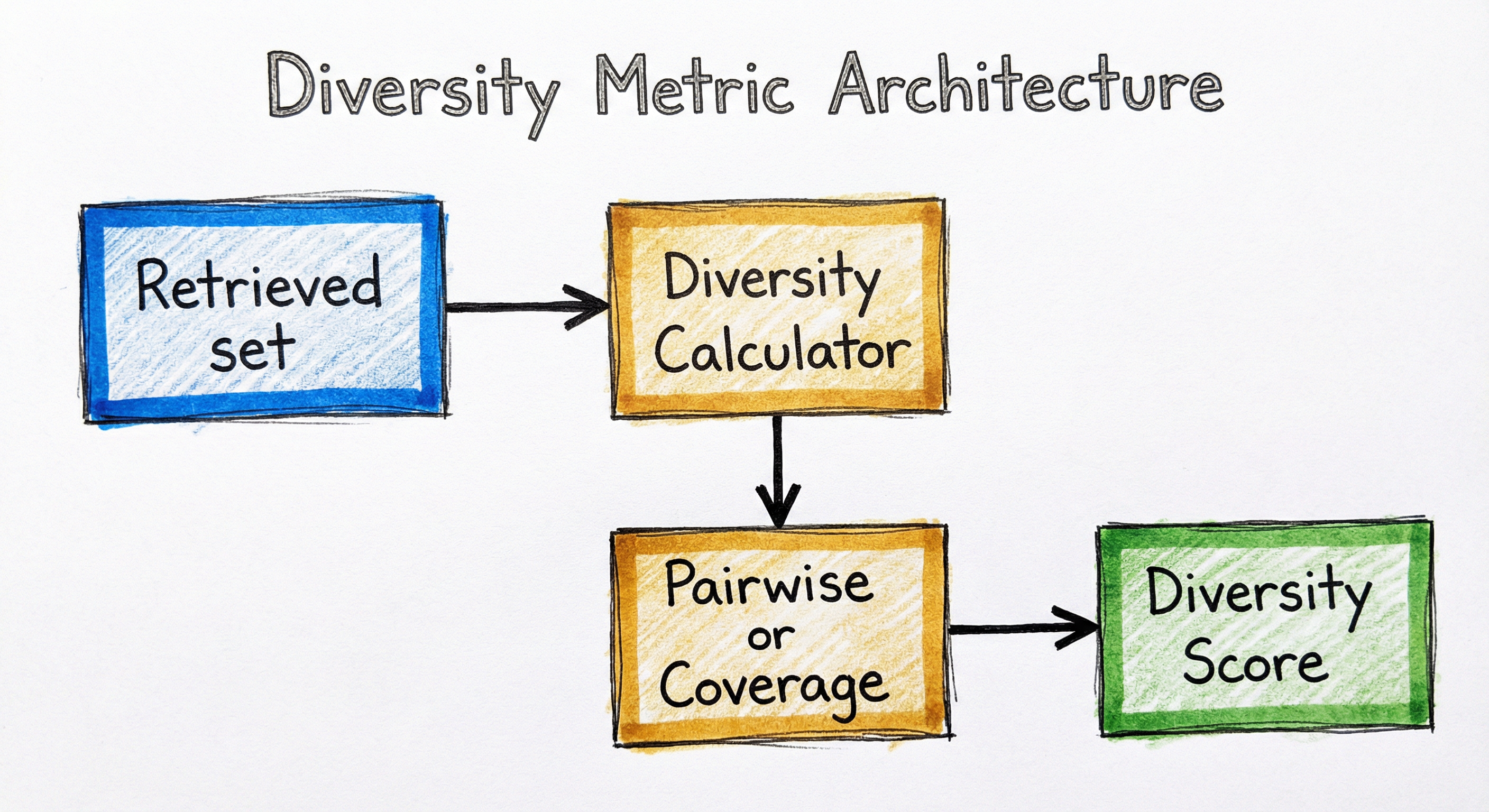
In production, diversity measurement typically happens at two points: (1) offline evaluation during model development, where you compute ILD alongside NDCG on held-out test sets, and (2) online monitoring in A/B tests, where you track diversity of recommendations served to live users alongside engagement metrics like click-through rate and dwell time.
Key Components
Item Representation Layer
Provides the feature vectors, embeddings, or categorical attributes for each item. This could be pre-computed content embeddings (e.g., from a BERT model for text items, ResNet for images), collaborative filtering latent factors, or structured metadata (genre, brand, price range). The quality of diversity measurement depends entirely on the quality of these representations.
Pairwise Distance Engine
Computes the distance (dissimilarity) between every pair of items in the recommendation list. For items, this produces distances. Common implementations use vectorized cosine distance via NumPy or PyTorch. For large K (50+), this can be batched for efficiency.
ILD Aggregator
Averages all pairwise distances to produce the final ILD score. May also compute position-weighted variants (where diversity among top-ranked items matters more) or per-category breakdowns.
Category Diversity Calculator
Counts unique categories, computes entropy, or measures Gini index over the categorical distribution of recommended items. Provides a business-friendly metric (e.g., '7 out of 10 genres represented') alongside the embedding-based ILD.
DPP Kernel Constructor
Builds the positive semi-definite kernel matrix from item quality scores and feature vectors. Computes the log-determinant as a diversity measure. Used when DPP-based re-ranking is the diversification strategy.
Tradeoff Analyzer
Plots diversity vs. relevance curves (ILD vs. NDCG) across different re-ranking configurations (e.g., varying MMR lambda from 0 to 1). Helps identify the optimal operating point where diversity gains are maximized without unacceptable relevance loss.
Data Flow
Step 1: Generate recommendations. The recommendation model produces a ranked list of items for each user or query. This could be a collaborative filtering model, a neural ranker, or a retrieval-then-rerank pipeline.
Step 2: Fetch item representations. For each item in the list, retrieve its embedding vector (from a pre-computed embedding store) and categorical metadata (from the item catalog). Embeddings are typically 128-768 dimensional.
Step 3: Compute pairwise distances. For all pairs, compute the chosen distance function (cosine distance, Jaccard distance, etc.). Store in a distance matrix.
Step 4: Aggregate into diversity scores. Compute ILD (average pairwise distance), category diversity (unique categories / K), and optionally DPP log-determinant. Each gives a different perspective on diversity.
Step 5: Combine with relevance metrics. Fetch NDCG@K, precision@K, or other accuracy metrics from the relevance evaluation pipeline. Plot on a diversity-relevance Pareto frontier.
Step 6: Report and alert. Push diversity scores to the monitoring dashboard. Set up alerts if ILD drops below a threshold (e.g., < 0.3) or category diversity falls below a minimum (e.g., < 0.5). In A/B tests, include diversity as a guardrail metric.
A flow diagram showing: Recommendation Model produces a Ranked List, which along with Item Embeddings/Features feeds into a Distance Matrix. The Distance Matrix feeds into three parallel calculators: ILD Calculator, Category Diversity, and DPP Kernel. All three produce Diversity Scores, which combine with Relevance Metrics (NDCG, MAP) in a Tradeoff Analysis, ultimately feeding a Dashboard or A/B Test.
How to Implement
Implementation Approaches
There are three main levels of diversity metric implementation:
Level 1: Embedding-based ILD -- The most common approach. Compute pairwise cosine distances between item embeddings and average them. Simple, effective, and scales well. This is what most production systems use for monitoring.
Level 2: Category + Embedding Hybrid -- Combine ILD with category diversity metrics for a richer picture. Business stakeholders understand category diversity ('7 genres out of 10') better than ILD scores. Track both.
Level 3: DPP-based Diversity -- Use determinantal point processes for a principled probabilistic measure that naturally captures quality-diversity tradeoffs. More complex to implement but mathematically elegant. YouTube uses this in production.
For most teams, starting with Level 1 and adding Level 2 for reporting is the pragmatic path. DPP is worth the investment if you are also using DPP for re-ranking (so the metric aligns with the optimization objective).
Cost Note: Computing ILD is cheap -- for a list of 20 items with 256-dimensional embeddings, computing all 190 pairwise distances takes microseconds. The cost is in the embeddings: training a good item embedding model and maintaining an embedding store costs INR 2-10 lakh/month depending on catalog size and update frequency. If you already have embeddings for retrieval (which you almost certainly do), the marginal cost of diversity measurement is near zero.
import numpy as np
from itertools import combinations

def cosine_distance(a: np.ndarray, b: np.ndarray) -> float:
    """Compute 1 - cosine_similarity between two vectors."""
    dot = np.dot(a, b)
    norm = np.linalg.norm(a) * np.linalg.norm(b)
    if norm == 0:
        return 1.0
    return 1.0 - dot / norm

def intra_list_diversity(embeddings: np.ndarray) -> float:
    """Compute ILD as average pairwise cosine distance.

    Args:
        embeddings: shape (K, D) where K is list size, D is embedding dim.

    Returns:
        ILD score between 0 (all identical) and 1 (maximally diverse).
    """
    K = embeddings.shape[0]
    if K < 2:
        return 0.0

    # Vectorized: compute full cosine similarity matrix
    norms = np.linalg.norm(embeddings, axis=1, keepdims=True)
    norms = np.where(norms == 0, 1e-10, norms)  # avoid division by zero
    normalized = embeddings / norms
    sim_matrix = normalized @ normalized.T  # (K, K) cosine similarities

    # Extract upper triangle (exclude diagonal)
    upper_indices = np.triu_indices(K, k=1)
    pairwise_distances = 1.0 - sim_matrix[upper_indices]

    return float(np.mean(pairwise_distances))

# Example: 5 movie embeddings (128-dim)
np.random.seed(42)
embeddings = np.random.randn(5, 128)

ild = intra_list_diversity(embeddings)
print(f"ILD: {ild:.4f}")
# Random embeddings: ILD ~ 0.50 (moderate diversity)

# Low diversity: nearly identical items
base = np.random.randn(128)
low_div = np.stack([base + 0.01 * np.random.randn(128) for _ in range(5)])
print(f"Low diversity ILD: {intra_list_diversity(low_div):.4f}")
# Output: ~0.001 (near-zero diversity)

# High diversity: orthogonal items
high_div = np.eye(5, 128)  # 5 one-hot vectors in 128-dim space
print(f"High diversity ILD: {intra_list_diversity(high_div):.4f}")
# Output: 1.0000 (maximum diversity)
This is the core diversity metric implementation. We compute pairwise cosine distances between all item embeddings in the recommendation list and average them. The vectorized approach using matrix multiplication is efficient even for large lists. Key points: (1) we normalize embeddings first to get cosine similarity, (2) we only use the upper triangle of the similarity matrix to avoid counting pairs twice, (3) ILD = 1 - mean(cosine_similarity). For production use, batch this across users.
import numpy as np
from collections import Counter
from typing import List

def category_diversity(categories: List[str]) -> dict:
    """Compute multiple category-based diversity metrics.

    Args:
        categories: list of category labels for each recommended item.

    Returns:
        Dictionary with ratio, entropy, and gini diversity scores.
    """
    K = len(categories)
    if K == 0:
        return {"ratio": 0.0, "entropy": 0.0, "gini": 0.0}

    counts = Counter(categories)
    n_unique = len(counts)

    # Simple ratio: unique categories / total items
    ratio = n_unique / K

    # Shannon entropy (normalized to [0, 1])
    probs = np.array(list(counts.values())) / K
    entropy = -np.sum(probs * np.log2(probs))
    max_entropy = np.log2(K) if K > 1 else 1.0
    normalized_entropy = entropy / max_entropy

    # Gini-Simpson index: probability two random items differ
    gini = 1.0 - np.sum(probs ** 2)

    return {
        "ratio": round(ratio, 4),
        "entropy": round(normalized_entropy, 4),
        "gini": round(gini, 4),
        "unique_categories": n_unique,
        "total_items": K,
    }

# Example: movie recommendation list
categories = [
    "action", "comedy", "action", "drama",
    "sci-fi", "comedy", "thriller", "romance",
    "action", "documentary"
]

result = category_diversity(categories)
print(f"Category ratio: {result['ratio']}")
# 7 unique / 10 items = 0.70
print(f"Normalized entropy: {result['entropy']}")
# High entropy = evenly distributed across categories
print(f"Gini-Simpson: {result['gini']}")
# High Gini = low probability of two random items being same category

# Worst case: all same category
result_low = category_diversity(["action"] * 10)
print(f"\nAll same: ratio={result_low['ratio']}, gini={result_low['gini']}")
# ratio=0.10, gini=0.00
Category diversity provides business-friendly metrics that complement embedding-based ILD. Three measures are computed: (1) Category ratio -- fraction of unique categories, intuitive for stakeholders ('7 out of 10 genres represented'). (2) Normalized Shannon entropy -- measures how evenly items are distributed across categories. A list with 5 action and 5 comedy movies has higher entropy than 9 action and 1 comedy. (3) Gini-Simpson index -- probability that two randomly chosen items differ in category. All three range from 0 (no diversity) to 1 (maximum diversity).
import numpy as np
from typing import List, Tuple

def mmr_rerank(
    query_embedding: np.ndarray,
    item_embeddings: np.ndarray,
    relevance_scores: np.ndarray,
    k: int = 10,
    lambda_param: float = 0.5,
) -> Tuple[List[int], float]:
    """Re-rank items using Maximal Marginal Relevance.

    Args:
        query_embedding: shape (D,) query/user embedding
        item_embeddings: shape (N, D) candidate item embeddings
        relevance_scores: shape (N,) relevance scores from base model
        k: number of items to select
        lambda_param: tradeoff (1.0 = pure relevance, 0.0 = pure diversity)

    Returns:
        selected_indices: ordered list of selected item indices
        diversity_score: ILD of the selected set
    """
    N = item_embeddings.shape[0]

    # Precompute item-item similarities
    norms = np.linalg.norm(item_embeddings, axis=1, keepdims=True)
    norms = np.where(norms == 0, 1e-10, norms)
    normed = item_embeddings / norms
    item_sim = normed @ normed.T  # (N, N)

    # Normalize relevance scores to [0, 1]
    rel_min, rel_max = relevance_scores.min(), relevance_scores.max()
    if rel_max > rel_min:
        rel_norm = (relevance_scores - rel_min) / (rel_max - rel_min)
    else:
        rel_norm = np.ones(N) * 0.5

    selected = []
    remaining = set(range(N))

    for _ in range(min(k, N)):
        best_idx = -1
        best_score = -np.inf

        for idx in remaining:
            # Relevance term
            relevance = rel_norm[idx]

            # Diversity term: max similarity to already-selected items
            if selected:
                max_sim = max(item_sim[idx][s] for s in selected)
            else:
                max_sim = 0.0

            # MMR score
            mmr_score = lambda_param * relevance - (1 - lambda_param) * max_sim

            if mmr_score > best_score:
                best_score = mmr_score
                best_idx = idx

        selected.append(best_idx)
        remaining.remove(best_idx)

    # Compute ILD of the selected set
    selected_embeddings = item_embeddings[selected]
    ild = intra_list_diversity(selected_embeddings)  # from previous example

    return selected, ild

# Example: 50 candidate items, select top 10
np.random.seed(42)
query = np.random.randn(128)
candidates = np.random.randn(50, 128)
scores = np.random.rand(50)

# Pure relevance (lambda=1.0)
idx_rel, ild_rel = mmr_rerank(query, candidates, scores, k=10, lambda_param=1.0)
print(f"Pure relevance: ILD={ild_rel:.4f}")

# Balanced (lambda=0.5)
idx_bal, ild_bal = mmr_rerank(query, candidates, scores, k=10, lambda_param=0.5)
print(f"Balanced MMR: ILD={ild_bal:.4f}")

# Pure diversity (lambda=0.0)
idx_div, ild_div = mmr_rerank(query, candidates, scores, k=10, lambda_param=0.0)
print(f"Pure diversity: ILD={ild_div:.4f}")
This implementation demonstrates MMR re-ranking and measuring the resulting diversity. MMR greedily selects items that balance relevance (high predicted score) with diversity (low similarity to already-selected items). The lambda parameter controls the tradeoff. After re-ranking, we compute ILD to measure the actual diversity achieved. In production, you would sweep lambda values (0.3, 0.5, 0.7) and pick the one that optimizes your combined objective (e.g., NDCG@10 >= 0.85 AND ILD >= 0.4).
import numpy as np

def dpp_log_det_diversity(
    embeddings: np.ndarray,
    quality_scores: np.ndarray,
) -> float:
    """Compute DPP log-determinant diversity for a set of items.

    Args:
        embeddings: shape (K, D) item feature vectors
        quality_scores: shape (K,) relevance/quality scores in (0, 1]

    Returns:
        Log-determinant of the DPP kernel (higher = more diverse + quality)
    """
    K, D = embeddings.shape

    # Normalize embeddings
    norms = np.linalg.norm(embeddings, axis=1, keepdims=True)
    norms = np.where(norms == 0, 1e-10, norms)
    phi = embeddings / norms  # (K, D)

    # Build DPP L-ensemble kernel: L_ij = q_i * phi_i^T * phi_j * q_j
    q = quality_scores.reshape(-1, 1)  # (K, 1)
    B = q * phi  # (K, D), each row is q_i * phi_i
    L = B @ B.T  # (K, K)

    # Add small regularization for numerical stability
    L += 1e-6 * np.eye(K)

    # Log-determinant
    sign, logdet = np.linalg.slogdet(L)
    if sign <= 0:
        return -np.inf  # degenerate kernel

    return float(logdet)

def compare_diversity_methods(embeddings: np.ndarray, quality: np.ndarray):
    """Compare ILD and DPP diversity for the same set."""
    ild = intra_list_diversity(embeddings)  # from earlier
    dpp = dpp_log_det_diversity(embeddings, quality)

    print(f"ILD Score: {ild:.4f}")
    print(f"DPP Log-Det: {dpp:.4f}")
    return ild, dpp

# Example: diverse set vs. homogeneous set
np.random.seed(42)

# Diverse: items spread across embedding space
diverse_emb = np.random.randn(10, 64)
quality = np.random.uniform(0.5, 1.0, 10)
print("=== Diverse Set ===")
compare_diversity_methods(diverse_emb, quality)

# Homogeneous: items clustered together
base = np.random.randn(64)
homogeneous_emb = np.stack([base + 0.05 * np.random.randn(64) for _ in range(10)])
print("\n=== Homogeneous Set ===")
compare_diversity_methods(homogeneous_emb, quality)
DPP diversity measures both item quality and diversity in a single score via the log-determinant of a kernel matrix. The kernel L is constructed so that L_ij = q_i * q_j * cos(phi_i, phi_j), where q_i is item quality and phi_i is the normalized feature vector. The determinant of L is large when items are both high-quality AND diverse (orthogonal in feature space). Identical items make the matrix singular (determinant = 0). This metric is particularly useful when you use DPP for re-ranking, as the metric aligns with the optimization objective.
import numpy as np
from dataclasses import dataclass
from typing import List, Dict

@dataclass
class DiversityReport:
    ild: float
    category_ratio: float
    category_entropy: float
    gini_simpson: float
    inter_list_diversity: float  # across users
    n_users: int

    def summary(self) -> str:
        return (
            f"Diversity Report ({self.n_users} users):\n"
            f"  ILD (embedding):     {self.ild:.4f}\n"
            f"  Category ratio:      {self.category_ratio:.4f}\n"
            f"  Category entropy:    {self.category_entropy:.4f}\n"
            f"  Gini-Simpson:        {self.gini_simpson:.4f}\n"
            f"  Inter-list diversity: {self.inter_list_diversity:.4f}"
        )

def evaluate_diversity(
    user_recommendations: Dict[str, List[str]],
    item_embeddings: Dict[str, np.ndarray],
    item_categories: Dict[str, str],
) -> DiversityReport:
    """Comprehensive diversity evaluation across all users.

    Args:
        user_recommendations: {user_id: [item_id1, item_id2, ...]}
        item_embeddings: {item_id: embedding_vector}
        item_categories: {item_id: category_label}

    Returns:
        DiversityReport with all metrics aggregated across users.
    """
    ilds = []
    cat_ratios = []
    cat_entropies = []
    ginis = []
    all_reco_sets = []

    for user_id, items in user_recommendations.items():
        # Skip users with < 2 recommendations
        if len(items) < 2:
            continue

        # ILD
        embs = np.stack([item_embeddings[i] for i in items if i in item_embeddings])
        if embs.shape[0] >= 2:
            ilds.append(intra_list_diversity(embs))

        # Category diversity
        cats = [item_categories.get(i, "unknown") for i in items]
        cat_result = category_diversity(cats)
        cat_ratios.append(cat_result["ratio"])
        cat_entropies.append(cat_result["entropy"])
        ginis.append(cat_result["gini"])

        # For inter-list diversity
        all_reco_sets.append(set(items))

    # Inter-list diversity: average Jaccard distance between user lists
    inter_divs = []
    for i in range(len(all_reco_sets)):
        for j in range(i + 1, len(all_reco_sets)):
            intersection = len(all_reco_sets[i] & all_reco_sets[j])
            union = len(all_reco_sets[i] | all_reco_sets[j])
            if union > 0:
                inter_divs.append(1.0 - intersection / union)

    return DiversityReport(
        ild=float(np.mean(ilds)) if ilds else 0.0,
        category_ratio=float(np.mean(cat_ratios)) if cat_ratios else 0.0,
        category_entropy=float(np.mean(cat_entropies)) if cat_entropies else 0.0,
        gini_simpson=float(np.mean(ginis)) if ginis else 0.0,
        inter_list_diversity=float(np.mean(inter_divs)) if inter_divs else 0.0,
        n_users=len(user_recommendations),
    )

# Usage example
np.random.seed(42)
users = {
    "user_1": ["item_a", "item_b", "item_c", "item_d", "item_e"],
    "user_2": ["item_b", "item_f", "item_g", "item_h", "item_i"],
    "user_3": ["item_a", "item_j", "item_k", "item_l", "item_m"],
}

# Mock embeddings and categories
all_items = set(i for items in users.values() for i in items)
embeddings = {i: np.random.randn(64) for i in all_items}
categories = {i: np.random.choice(["action", "comedy", "drama", "sci-fi", "thriller"]) for i in all_items}

report = evaluate_diversity(users, embeddings, categories)
print(report.summary())
This production-ready pipeline computes all major diversity metrics for an entire recommendation system: (1) ILD averaged across users, (2) category diversity with three sub-metrics, and (3) inter-list diversity measuring how different recommendations are across users. The DiversityReport dataclass provides a clean API for integration with monitoring dashboards. In production, run this on a sample of daily traffic and log to your metrics store.
# Diversity evaluation config (YAML)
diversity_metrics:
  ild:
    enabled: true
    distance_function: cosine
    embedding_source: item_embeddings_v2  # from embedding store
    embedding_dim: 256
  category:
    enabled: true
    category_field: genre
    metrics: [ratio, entropy, gini_simpson]
  inter_list:
    enabled: true
    sample_users: 10000  # sample for efficiency
    distance_function: jaccard
  dpp:
    enabled: false  # expensive, enable for DPP-based systems
    quality_field: predicted_relevance

thresholds:
  min_ild: 0.30
  min_category_ratio: 0.50
  min_inter_list: 0.60
  alert_channel: slack_recsys_alerts

reporting:
  frequency: daily
  dashboard: grafana/diversity-metrics
  a_b_test_integration: true
Common Implementation Mistakes
- ●
Using cosine similarity instead of cosine distance: ILD should use distance (1 - similarity), not similarity. Reporting cosine similarity as diversity inverts the metric -- high values mean low diversity. Always double-check whether your library returns similarity or distance.
- ●
Ignoring the embedding quality: Garbage in, garbage out. If your item embeddings are poorly trained (e.g., a randomly initialized model), ILD will be meaningless -- random embeddings give ILD around 0.5 regardless of actual item diversity. Validate embeddings with a sanity check: similar items should have high cosine similarity.
- ●
Computing diversity on the candidate set instead of the final recommendation list: Diversity should be measured on the list the user actually sees, after all re-ranking and filtering. Measuring diversity on the candidate set (before re-ranking) gives an inflated number that does not reflect user experience.
- ●
Not normalizing across different embedding dimensions: If you compare ILD scores computed from 64-dim embeddings vs. 768-dim embeddings, the numbers are not comparable. Higher-dimensional embeddings tend to produce higher cosine distances (curse of dimensionality). Always normalize or compare within the same embedding space.
- ●
Treating category diversity as the only metric: Category-level diversity misses within-category variation. Two action movies could be very different (superhero blockbuster vs. gritty war film) or nearly identical (two Marvel sequels). Embedding-based ILD captures these nuances; category diversity does not.
- ●
Maximizing diversity without guardrails: Optimizing for ILD alone produces random-seeming recommendations. Always pair diversity metrics with relevance constraints (e.g., NDCG@10 must remain above 0.80). Diversity is a secondary objective, not the primary one.
When Should You Use This?
Use When
Your recommendation system produces ranked lists where users expect variety (e-commerce product feeds, music playlists, news articles, content carousels)
Users report that recommendations feel repetitive or boring -- diversity metrics quantify the problem and track improvements
You need to balance accuracy with exploration: the system should surface relevant items while also introducing users to new categories, creators, or topics
Regulatory or ethical requirements mandate content diversity (e.g., news platforms required to show diverse political perspectives)
You want to measure the impact of a re-ranking strategy (MMR, DPP, or rule-based diversification) on actual list diversity
Your business depends on a healthy supply-side marketplace (e.g., e-commerce, content platforms) where creators or sellers need exposure beyond the most popular items
You are running A/B tests comparing recommendation algorithms and need a guardrail metric to prevent diversity degradation
Avoid When
The user has a very specific intent and expects homogeneous results (e.g., 'show me all red Nike running shoes size 10' -- diversity here would be harmful)
Your task is retrieval for a single correct answer (e.g., FAQ lookup, entity search) where diversity is irrelevant
You lack meaningful item representations -- computing ILD with random or untrained embeddings gives garbage results
The recommendation list is very short (K <= 3) -- pairwise diversity is unstable with so few items, and users process such short lists differently
You are in an early-stage system where basic relevance and recall are still unsolved -- fix accuracy first, then add diversity
The domain has no meaningful notion of diversity (e.g., recommending the next step in a sequential workflow)
Key Tradeoffs
The Fundamental Tradeoff: Diversity vs. Relevance
Every increase in diversity typically comes at some cost to accuracy. This is not a flaw -- it is a fundamental property of recommendation. The most relevant items tend to be similar (they match the same user preference), so forcing diversity means including items that are individually less relevant.
The empirical evidence on where the sweet spot lies is nuanced:
| Lambda (MMR) | ILD | NDCG@10 | User Satisfaction | Notes |
|---|---|---|---|---|
| 1.0 (pure relevance) | 0.25 | 0.92 | Medium | Accurate but monotonous |
| 0.7 | 0.38 | 0.89 | High | Sweet spot for most apps |
| 0.5 | 0.48 | 0.84 | High | Good for exploration-heavy UIs |
| 0.3 | 0.62 | 0.76 | Medium | Too diverse, feels random |
| 0.0 (pure diversity) | 0.85 | 0.45 | Low | Irrelevant, users bounce |
The key insight: user satisfaction is not monotonically related to either metric. There is an inverted-U relationship where moderate diversity maximizes satisfaction. Too little diversity bores users; too much confuses them.
ILD vs. Category Diversity
Embedding-based ILD captures fine-grained semantic differences but is harder to interpret. Category diversity is intuitive but coarse. Most production systems track both:
- ILD for model development and A/B testing (sensitive to subtle changes)
- Category diversity for business reporting and stakeholder communication (easily understood)
Position-Weighted vs. Unweighted Diversity
Standard ILD treats all positions equally. But users pay more attention to top positions. A position-weighted ILD discounts diversity contributions from lower positions, analogous to NDCG's position discount. Use position-weighted ILD if your UI has strong position bias (e.g., vertical feeds on mobile).
Key Insight: The right diversity level depends on the use case. Exploratory contexts (Spotify Discover Weekly, YouTube Browse) tolerate high diversity. Intent-driven contexts (Amazon search, Google Shopping) require lower diversity. Measure both, tune per surface.
Alternatives & Comparisons
Coverage measures what fraction of the total item catalog is ever recommended across all users. Diversity measures within-list variety for individual users. A system can have high coverage (many items recommended overall) but low diversity (each user sees similar items). Use coverage to assess systemic popularity bias; use diversity to assess individual user experience.
Novelty measures how surprising or unexpected recommendations are, typically based on item popularity -- recommending a niche item is more novel than a popular one. Diversity measures how different items are from each other within a list. A list of 10 obscure but similar niche films has high novelty but low diversity. Use novelty alongside diversity for a complete beyond-accuracy picture.
NDCG is a pure accuracy/relevance metric that measures how well items match user preferences. It does not consider variety at all. Diversity metrics complement NDCG: you want both high NDCG (relevant items) and high ILD (varied items). Always report them together on a Pareto frontier to show the tradeoff.
Serendipity measures how pleasantly surprising recommendations are -- items that are both relevant and unexpected. It is harder to compute than diversity because it requires a model of user expectations. Diversity is necessary but not sufficient for serendipity: a diverse list of predictable items is not serendipitous. Use serendipity for deeper user experience evaluation.
Pros, Cons & Tradeoffs
Advantages
Captures what accuracy cannot: ILD and category diversity directly measure variety and non-redundancy in recommendation lists, complementing relevance-only metrics like NDCG that ignore whether all items look the same.
Improves user satisfaction: Multiple studies (Ziegler 2005, YouTube 2018, Spotify research) show that moderate diversity increases user engagement, retention, and reported satisfaction compared to accuracy-only optimization.
Flexible distance functions: ILD works with any distance metric -- cosine, Jaccard, Hamming, Euclidean -- making it adaptable to any item representation (embeddings, categorical features, text, images).
Computationally cheap: For a typical list of 10-20 items, computing all pairwise distances takes microseconds. The marginal cost of adding diversity measurement to an existing pipeline is negligible.
Supports marketplace health: Diversity metrics help platforms ensure that recommendations do not concentrate on a tiny fraction of popular items, supporting long-tail creators, sellers, and content producers.
Multiple complementary views: Category diversity, embedding ILD, entropy, Gini-Simpson, and inter-list diversity each capture a different facet of variety, enabling nuanced analysis that a single metric cannot provide.
Aligns with regulatory trends: Content diversity requirements are increasing globally (e.g., EU Digital Services Act mandates around algorithmic transparency and content diversity). Having formal diversity metrics positions platforms for compliance.
Disadvantages
Diversity-relevance tradeoff is unavoidable: Increasing diversity almost always reduces accuracy. Finding the optimal balance requires expensive A/B testing and differs by use case, user segment, and surface.
Depends heavily on item representations: ILD is only as meaningful as the embeddings or features used to compute distances. Poor embeddings produce misleading diversity scores. Requires investment in embedding quality.
No universally agreed-upon threshold: What counts as 'good' diversity varies by domain. ILD of 0.4 might be excellent for a niche bookstore but poor for a general news feed. Benchmarks are context-dependent.
Position-agnostic by default: Standard ILD treats all list positions equally, but diversity at position 1-3 matters far more than at positions 15-20. Position-weighted variants exist but add complexity.
Does not capture user-specific diversity preferences: Some users want broad exploration, others prefer deep dives into one topic. A single diversity target applied uniformly can hurt both groups. Personalized diversity thresholds are an open research problem.
Can be gamed by re-ranking heuristics: Simple diversification rules (e.g., 'never show two items from the same category in a row') can inflate diversity metrics without actually improving user experience. The metric does not distinguish meaningful diversity from artificial shuffling.
Inter-list diversity is expensive to compute: Computing pairwise Jaccard distances across all user pairs scales as where is the number of users. For millions of users, this requires sampling.
Failure Modes & Debugging
Embedding Space Collapse
Cause
Item embeddings are poorly trained or have collapsed to a small region of the embedding space (e.g., due to over-regularization, insufficient training data, or a representation bottleneck). All items appear 'close' in embedding space regardless of their actual content.
Symptoms
ILD is uniformly low (e.g., 0.05-0.15) across all users and recommendation lists, even when the lists contain visually or categorically diverse items. Category diversity remains normal while ILD is anomalously low.
Mitigation
Validate embeddings with a sanity check before using them for diversity measurement: compute cosine similarity between known-similar items (should be high) and known-dissimilar items (should be low). If the gap is small, retrain embeddings. Use UMAP or t-SNE visualization to inspect embedding structure. Consider using content-based features (genre, attributes) as a fallback distance function.
Metric-Optimization Divergence
Cause
The re-ranking algorithm optimizes a different diversity measure than the one used for evaluation. For example, the re-ranker uses DPP (which balances quality and diversity) but evaluation uses ILD (which only measures diversity). The two can disagree.
Symptoms
DPP-based re-ranking improves DPP log-determinant but does not improve ILD (or even degrades it). Stakeholders see conflicting results: the engineering team reports improvements while the metrics dashboard shows stagnation.
Mitigation
Align the diversity metric with the diversification strategy. If you use MMR for re-ranking, report the effective lambda and the resulting ILD. If you use DPP, report DPP diversity alongside ILD. Track multiple metrics and understand their theoretical relationship. Document which metric is the primary objective and which are secondary monitors.
Category Granularity Mismatch
Cause
Category diversity is computed at the wrong level of granularity. For example, using coarse categories ('Electronics') when fine-grained categories ('Smartphones > Budget > Android') would reveal low diversity. Or vice versa -- using excessively fine categories that make everything look diverse.
Symptoms
Category diversity reports high scores (e.g., 0.9) but users still perceive repetitiveness because all items fall within the same sub-category. Or category diversity reports low scores (e.g., 0.3) but users see a genuinely varied list because the categories are too fine-grained.
Mitigation
Compute category diversity at multiple levels of the taxonomy hierarchy (e.g., L1 = 'Electronics', L2 = 'Smartphones', L3 = 'Budget Android Smartphones'). Report the level that most closely matches user perception. Complement category diversity with embedding-based ILD, which captures within-category variation.
Popularity Bias Masking True Diversity
Cause
The recommendation system achieves high ILD by including a few very different popular items alongside the main recommendations. For example, a cooking video recommendation list includes a viral unrelated meme video -- technically diverse, but not meaningfully so.
Symptoms
ILD scores improve when popularity-based fallback items are injected, but user satisfaction does not improve (or worsens). A/B tests show that higher-ILD variants have worse engagement. The metric is technically correct but misleading.
Mitigation
Filter out obvious popularity-injection items before computing diversity, or use calibrated diversity (Steck 2018) which measures whether the distribution of categories in the recommendation list matches the user's historical interest distribution. Complement ILD with serendipity or user-perceived diversity metrics from surveys.
Cold-Start Diversity Inflation
Cause
For new users with no interaction history, the recommendation system falls back to diverse popular items (a common cold-start strategy). This inflates diversity metrics for the cold-start cohort, creating a misleading impression of system-wide diversity.
Symptoms
Diversity metrics are significantly higher for new users than for established users. Aggregate diversity looks good, but segmented analysis reveals that engaged users see monotonous lists while new users see artificially diverse ones.
Mitigation
Always segment diversity metrics by user tenure (new vs. established). Report diversity for established users separately, as this reflects the true recommendation quality. Track the diversity trajectory: how quickly does diversity decrease as the system learns a user's preferences?
Inter-List Homogeneity Despite Intra-List Diversity
Cause
The system achieves high ILD (diverse lists) for each individual user, but recommends the same diverse set to everyone. Every user sees the same 10 items. Individual lists are diverse, but the system as a whole shows no personalization.
Symptoms
ILD is high but inter-list diversity is low. User surveys reveal that different users see nearly identical recommendations. The system is diverse but not personalized -- essentially a curated 'editor's picks' list.
Mitigation
Track inter-list diversity alongside ILD. If inter-list diversity is below a threshold (e.g., < 0.5 Jaccard distance), the system is not personalizing effectively. Investigate whether the diversification step is overriding the personalization signal.
Placement in an ML System
Where Does the Diversity Metric Sit?
The diversity metric is a measurement tool, not a serving component. It sits in the evaluation and monitoring layer, consuming outputs from the recommendation pipeline and producing scores for dashboards, A/B test analysis, and model selection.
Offline evaluation (model development): When comparing recommendation models or re-ranking strategies, compute ILD alongside NDCG, coverage, and novelty on a held-out test set. Plot the diversity-relevance Pareto frontier. The model that achieves the best tradeoff wins.
Online monitoring (production): In a live system, sample a fraction of daily recommendations (e.g., 1% of traffic, ~10,000-100,000 users) and compute diversity metrics. Log to a time-series database (InfluxDB, Prometheus) and visualize on Grafana. Set alerts for diversity drops: if ILD falls below 0.30 or category diversity drops below 0.50, trigger an investigation.
A/B testing: When testing a new re-ranking algorithm, track diversity as a guardrail metric alongside primary metrics (click-through rate, conversion). The new algorithm must not degrade diversity below the baseline, even if it improves accuracy. Some teams use diversity as a primary metric for re-ranking experiments.
Feedback loop to re-ranking: Diversity metrics inform the tuning of re-ranking parameters. If MMR lambda = 0.7 gives ILD = 0.35 and lambda = 0.5 gives ILD = 0.45, the team can pick the parameter that meets their diversity target. This creates a feedback loop: measure -> tune -> deploy -> measure again.
Key Insight: Diversity measurement is cheap but valuable. For the cost of a few API calls per day, you get a continuous signal on whether your recommendation system is serving monotonous lists. The cost of not measuring diversity is user churn, creator dissatisfaction, and regulatory risk.
Pipeline Stage
Evaluation / Metrics
Upstream
- recommendation-model
- re-ranking-layer
- item-embedding-store
- item-catalog
Downstream
- a-b-testing-framework
- monitoring-dashboard
- model-selection
- re-ranking-tuning
Scaling Bottlenecks
ILD computation for a single user with items requires operations where is the embedding dimension. For and , this is about 50,000 multiplications -- trivial. For 1 million users evaluated daily, that is 50 billion multiplications, still fast on a single GPU (under 1 minute with batched matrix operations).
The real bottleneck is embedding lookup. If item embeddings are stored in a remote key-value store (Redis, DynamoDB), fetching 20 embeddings per user for 1 million users means 20 million lookups. At INR 0.01 per lookup, that is INR 2 lakh per evaluation run. Solution: batch embeddings into a local cache or precompute diversity scores during the serving path (when embeddings are already loaded for ranking).
Inter-list diversity requires comparing all user pairs: for users. With 1 million users, that is pair comparisons -- infeasible. Solutions:
- Sampling: Randomly sample 10,000-50,000 users and compute pairwise diversity on the sample. Statistically sound with confidence intervals.
- MinHash / LSH: Use locality-sensitive hashing to approximate Jaccard distances efficiently.
- Aggregate statistics: Instead of pairwise comparison, compute the distribution of recommended item frequencies across users. High entropy = high inter-list diversity.
For a mid-size recommendation system (10 million users, 1 million items, 256-dim embeddings):
- Embedding storage: ~1 GB in memory. Negligible cost.
- Daily ILD computation (sampled 100K users): ~2 minutes on a single GPU. Compute cost: INR 50/day on AWS (g4dn.xlarge).
- Monthly monitoring infrastructure: INR 5,000-15,000 for Grafana + time-series DB.
- Total marginal cost: INR 2,000-5,000/month ($25-60/month). Diversity measurement is essentially free if you already have embeddings.
Production Case Studies
YouTube implemented Determinantal Point Processes (DPP) for homepage diversification in their 2018 CIKM paper. They parameterized DPPs using item quality (predicted watch time) and item features (video embeddings) to re-rank candidate videos. The DPP kernel naturally promotes sets of videos that are both high-quality and diverse in content. The system was deployed on live YouTube homepage traffic serving hundreds of millions of users.
DPP-based diversification led to substantial improvements in both short-term engagement (watch time per session) and long-term user retention. The effect was more pronounced over time -- users exposed to diversified feeds showed increasingly higher engagement in subsequent sessions compared to the control group, suggesting that diversity prevents recommendation fatigue.
Spotify Research examines gender representation in music streaming using one of the world's largest streaming platforms, finding that listeners generally stream fewer female or mixed-gender creator groups than male artists, with differences varying by genre.
Research led to internal algorithmic impact assessments and collaborations with academic researchers to encourage recommendation diversity and provide new opportunities for underrepresented creators to reach their potential audience.
Netflix employs diversity at multiple levels of their recommendation system: (1) row-level diversity within each carousel (e.g., 'Top Picks for You' should span genres), (2) page-level diversity across carousels (the page as a whole should cover the user's interest spectrum), and (3) calibrated recommendations following Steck (2018), ensuring the distribution of genres in recommendations matches the user's historical viewing distribution. They measure intra-list diversity using genre tags and visual similarity of artwork thumbnails.
Calibrated recommendation lists -- where genre proportions match the user's historical viewing pattern -- increased member engagement by 4-6% in A/B tests. Users were more likely to find something to watch when the page reflected their diverse interests rather than over-indexing on their most-watched genre.
Flipkart's homepage product feed uses diversity constraints to ensure that users see a mix of product categories, price ranges, and brands. They compute category diversity and brand diversity at the page level, enforcing rules like 'no more than 3 items from the same category in the first 10 positions' and 'at least 5 distinct brands in the first 20 items.' Embedding-based ILD is used for within-category diversification -- e.g., within the 'shoes' section, ensuring a mix of sports, casual, and formal styles. Costs are tracked in INR with diversity improvements measured against GMV (Gross Merchandise Value) impact.
Diversified product feeds increased click-through rate by 11% and add-to-cart rate by 7% compared to a purely relevance-ranked feed. Category diversity in the top-10 positions improved from 0.45 to 0.72. The INR GMV impact was positive, validating that diversity drives not just engagement but revenue in Indian e-commerce.
Taobao's recommendation system serves over 800 million users and explicitly optimizes for both relevance and discovery diversity. Their multi-objective optimization framework treats diversity as a first-class objective alongside click-through rate and conversion. They measure diversity using item embedding distance and category entropy, and employ a post-ranking diversification layer that re-orders candidates to maximize a weighted combination of predicted engagement and pairwise diversity. The system uses graph embeddings to capture item relationships beyond simple content features.
The diversity-aware ranking system achieved double-digit improvements in click-through rate while simultaneously reducing recommendation fatigue (measured as decreasing engagement over consecutive sessions). Taobao reports that diversity optimization is particularly impactful for their 'Guess You Like' feed, which is the primary discovery surface for new products.
Tooling & Ecosystem
Comprehensive recommendation library with built-in diversity metrics including ILD, entropy, and Gini index. Supports 70+ recommendation algorithms with standardized evaluation across accuracy, diversity, novelty, and coverage. Excellent for benchmarking and research.
Recommendation evaluation framework providing 36 metrics across 7 families, including dedicated diversity metrics (ILD, Shannon entropy, Gini-Simpson). Supports reproducible experiments with standardized evaluation protocols and statistical testing.
Open-source library from Fidelity Investments for evaluating recommendation fairness and beyond-accuracy metrics. Includes inter-list diversity, intra-list diversity, and calibration metrics. Designed for production use with efficient implementations.
Multimodal recommendation framework with built-in evaluation metrics including diversity measures. Supports content-based, collaborative filtering, and hybrid models. Provides comparison across accuracy and beyond-accuracy metrics in a single evaluation run.
Python library specifically for Determinantal Point Processes. Implements sampling, learning, and evaluation of DPPs. Use this if you are building DPP-based diversification and need efficient kernel construction and MAP inference.
Open-source toolkit for recommendation research and education. Includes evaluation modules for computing diversity, novelty, and coverage alongside accuracy metrics. Well-documented and suitable for teaching and prototyping.
Research & References
Ziegler, C.N., McNee, S.M., Konstan, J.A. & Lausen, G. (2005)WWW 2005 (14th International Conference on World Wide Web)
The seminal paper on diversity in recommendations. Introduced intra-list similarity (ILS) as a formal metric and the topic diversification re-ranking algorithm. Showed empirically that diversified lists improve user satisfaction even when average accuracy decreases. Evaluated on 361,349 book ratings with an online study of 2,100+ users.
Carbonell, J. & Goldstein, J. (1998)SIGIR 1998
Introduced Maximal Marginal Relevance (MMR), the foundational algorithm for balancing relevance and diversity in retrieval. MMR greedily selects items that are both relevant to the query and dissimilar from previously selected items. The lambda parameter controls the tradeoff. Widely adopted in both IR and recommendation systems.
Wilhelm, M., Ramanathan, A., Bonomo, A., Jain, S., Chi, E.H. & Gillenwater, J. (2018)CIKM 2018
Describes YouTube's production deployment of DPP-based diversification for homepage recommendations. Presents a clean DPP parameterization suitable for large-scale systems, showing substantial improvements in both short-term engagement and long-term user retention in live A/B tests.
Steck, H. (2018)RecSys 2018 (12th ACM Conference on Recommender Systems)
Introduced calibrated recommendations -- ensuring that the distribution of item categories in recommendations matches the user's historical interest distribution. Proposes KL-divergence-based calibration metrics and a simple post-processing algorithm. Influential in moving beyond uniform diversity toward user-specific diversity targets.
Kulesza, A. & Taskar, B. (2012)Foundations and Trends in Machine Learning
The comprehensive survey of DPPs for ML, covering theory, inference algorithms, and applications. Explains how DPPs model repulsive interactions (diversity) through the determinant of a kernel matrix. The foundational reference for understanding DPP-based diversity in recommendations, text summarization, and subset selection.
Chen, L., Zhang, G. & Zhou, E. (2018)NeurIPS 2018
Addresses the computational bottleneck of DPP MAP inference for large candidate sets. Proposes a fast greedy algorithm with time complexity (K = selected items, M = candidates) instead of . Enables practical DPP-based diversification for real-time recommendation systems at scale.
Hazrati, N. & Elahi, M. (2023)SIGIR 2023
A recent critical analysis of ILD and dispersion as diversity metrics. Examines edge cases, sensitivity to distance function choice, and normalization effects. Proposes improved variants that are more robust to pathological cases. Essential reading for anyone designing diversity evaluation pipelines.
Interview & Evaluation Perspective
Common Interview Questions
- ●
What is intra-list diversity and how do you compute it?
- ●
Explain the diversity-relevance tradeoff. How do you find the right balance?
- ●
How does MMR balance relevance and diversity? Walk through the formula.
- ●
What are Determinantal Point Processes and why are they useful for diversification?
- ●
Your recommendation list has high NDCG but users complain about repetitiveness. What would you do?
- ●
How would you measure diversity for a food delivery app like Swiggy or Zomato?
- ●
What is the difference between diversity, novelty, and coverage?
- ●
How would you set up an A/B test to evaluate a diversity improvement?
Key Points to Mention
- ●
ILD (Intra-List Diversity) is the average pairwise distance between items in a recommendation list. Use cosine distance over embeddings for the most common variant. Score ranges from 0 (identical items) to 1 (maximally diverse).
- ●
The diversity-relevance tradeoff is fundamental: more diversity usually means less accuracy. The sweet spot depends on the use case -- exploratory surfaces tolerate more diversity than intent-driven ones.
- ●
MMR greedily selects items maximizing lambda * relevance - (1-lambda) * max_similarity_to_selected. Lambda controls the tradeoff. DPP provides a more principled probabilistic framework via kernel determinants.
- ●
Always track diversity alongside accuracy. Report NDCG and ILD together on a Pareto frontier. In A/B tests, use diversity as a guardrail metric.
- ●
Category diversity (unique genres / K) is more interpretable for stakeholders; embedding-based ILD is more sensitive for engineering. Track both.
- ●
Calibrated recommendations (Steck 2018) go beyond uniform diversity -- they match the genre distribution to each user's historical preferences, providing personalized diversity targets.
Pitfalls to Avoid
- ●
Confusing diversity with randomness -- a random recommendation list is diverse but irrelevant. Diversity without relevance is useless. Always emphasize the tradeoff.
- ●
Claiming diversity always helps -- for intent-driven queries ('red Nike shoes size 10'), users want homogeneous results. Diversity should be tuned per surface and intent type.
- ●
Treating ILD as the only diversity metric -- category diversity, inter-list diversity, calibration, and entropy each capture different aspects. A single number is insufficient.
- ●
Ignoring the embedding quality dependency -- ILD computed on bad embeddings is meaningless. Always validate embeddings before trusting ILD scores.
- ●
Not distinguishing intra-list diversity (per-user) from inter-list diversity (across users). Both matter but measure different things.
Senior-Level Expectation
A senior candidate should discuss the full picture: (1) multiple diversity metrics (ILD, category, entropy, inter-list, calibration) and when each is appropriate, (2) the diversity-relevance Pareto frontier and how to navigate it using MMR lambda tuning or DPP, (3) position-weighted diversity for surfaces with strong position bias, (4) personalized diversity targets using calibration (Steck 2018), (5) the business case for diversity -- reduced recommendation fatigue, improved marketplace health, regulatory compliance. They should also discuss implementation challenges: embedding quality, cold-start effects on diversity, and the gap between metric improvement and user-perceived diversity. Senior engineers connect diversity metrics to product outcomes (retention, GMV) rather than optimizing metrics in isolation.
Summary
Let's recap the key points on diversity metrics for recommendation systems.
Intra-List Diversity (ILD) is the most widely used diversity metric. It computes the average pairwise distance between items in a recommendation list, typically using cosine distance over item embeddings. ILD ranges from 0 (all identical items) to 1 (maximally diverse items). Category diversity -- counting unique categories or computing entropy over category distributions -- provides a complementary, business-friendly view. Together, they answer the question: 'Is this recommendation list varied enough?'
The diversity-relevance tradeoff is the central challenge. Every increase in diversity typically costs some accuracy (NDCG), but user satisfaction studies consistently show that moderate diversity (ILD 0.35-0.50) improves engagement, retention, and perceived recommendation quality. MMR provides a simple lambda-controlled knob for this tradeoff, while DPPs offer a principled probabilistic framework that jointly optimizes quality and diversity. YouTube, Netflix, and Spotify all use diversity-aware re-ranking in production.
For production systems, track multiple diversity metrics: ILD (sensitive, embedding-based), category diversity (interpretable, business-friendly), inter-list diversity (across-user personalization check), and calibration (user-specific genre proportions). Set alerts for diversity drops, use diversity as a guardrail in A/B tests, and always report it alongside accuracy metrics on a Pareto frontier. The marginal cost of diversity measurement is near zero if you already have item embeddings -- which you almost certainly do.
Diversity metrics complete the evaluation picture that accuracy metrics alone cannot provide. They are the difference between a recommendation system that is technically correct and one that users actually enjoy using.