LoRA in Machine Learning
LoRA (Low-Rank Adaptation) is a parameter-efficient fine-tuning method that has fundamentally changed how we adapt large language models to downstream tasks. Instead of updating all the parameters in a pretrained model -- which for a 70B-parameter model means storing and updating 280 GB of weights in fp32 -- LoRA freezes the original weights and injects small, trainable low-rank matrices into specific layers.
The core insight is deceptively simple: the weight updates during fine-tuning have a low intrinsic rank. You don't need to update the entire weight matrix. Instead, you can decompose the update into two much smaller matrices and train those. For a rank adaptation on a 4096-dimensional layer, that's a reduction from 16.7 million parameters to just 131 thousand -- a 128x compression.
Since its introduction by Hu et al. in 2021, LoRA has become the default fine-tuning method for LLMs in both research and production. It powers everything from chatbot customization at Indian startups to enterprise document processing at Fortune 500 companies. When Meta releases a new Llama model, the community's first instinct is to LoRA-tune it on custom datasets -- often within hours of release.
What makes LoRA particularly compelling is the operational simplicity: the adapter weights are tiny (often 10-50 MB), can be hot-swapped at inference time, and the merged model has zero additional latency compared to the base model. No architectural changes, no inference overhead, just better task-specific performance.
Concept Snapshot
- What It Is
- A parameter-efficient fine-tuning technique that freezes pretrained model weights and injects trainable low-rank decomposition matrices into transformer layers, enabling task-specific adaptation with a fraction of the parameters.
- Category
- Model Training
- Complexity
- Intermediate
- Inputs / Outputs
- Inputs: pretrained base model + task-specific training data + LoRA config (rank, alpha, target modules). Outputs: small adapter weights (LoRA matrices A and B) that can be merged into the base model or served separately.
- System Placement
- Sits in the fine-tuning stage of the ML pipeline, after pretraining and before model serving. Typically applied after data preparation and before evaluation/deployment.
- Also Known As
- Low-Rank Adaptation, LoRA adapters, LoRA fine-tuning, Low-Rank Fine-tuning
- Typical Users
- ML Engineers, NLP Engineers, Applied Scientists, MLOps Engineers, AI Researchers
- Prerequisites
- Transformer architecture (attention mechanism, linear layers), Matrix decomposition basics (rank, SVD), Transfer learning and fine-tuning concepts, PyTorch or JAX fundamentals, GPU memory management basics
- Key Terms
- rank (r)alpha (scaling factor)target modulesadapter merginglow-rank decompositionfrozen weightstrainable parametersPEFT
Why This Concept Exists
The GPU Memory Wall
Full fine-tuning of large language models is staggeringly expensive. Let's do the math for a Llama 2 70B model:
- Model weights (fp16): 140 GB
- Optimizer states (Adam): 280 GB (2x model size for first and second moments)
- Gradients: 140 GB
- Activations (batch size 1, sequence length 2048): ~40 GB
Total: ~600 GB of GPU memory. That's 8x NVIDIA A100 80GB GPUs at minimum, costing roughly 1,800-$3,000 (~INR 1.5-2.5 lakh). For an Indian startup building a domain-specific chatbot, that's a significant fraction of their monthly cloud budget.
The Low-Rank Hypothesis
Aghajanyan et al. (2020) made a crucial empirical observation: pretrained language models have a low intrinsic dimensionality. When you fine-tune GPT-3 on a downstream task, the weight updates don't span the full parameter space -- they concentrate in a much lower-dimensional subspace. In their experiments, models could be fine-tuned effectively in a subspace with dimension as low as a few hundred, despite having millions of parameters.
This was the intellectual foundation for LoRA. If the update has low rank, why not enforce that structure from the start?
From Observation to Method
Hu et al. at Microsoft took this observation and turned it into a practical method in their 2021 paper. Instead of computing a full-rank update , they parameterized it as a product of two low-rank matrices: where and , with .
The beauty of this approach is that it doesn't change the model architecture at inference time. After training, you simply merge the adapter weights back into the base model: . The result is a standard transformer with no additional layers, no routing logic, and no inference overhead.
Why It Caught On So Quickly
Three factors drove LoRA's rapid adoption:
-
Dramatic cost reduction: Fine-tuning a 7B model with LoRA requires a single GPU with 16-24 GB VRAM -- a consumer RTX 4090 or a single cloud A10G. That's 25/hour.
-
Composability: Multiple LoRA adapters can coexist on the same base model, enabling multi-tenant serving where different customers get personalized model behavior without separate model copies.
-
Ecosystem support: Hugging Face's PEFT library made LoRA a three-line code change. The barrier to entry dropped from "you need a distributed training expert" to "you need a Colab notebook."
Key Takeaway: LoRA exists because fine-tuning weight updates are low-rank, and exploiting this structure reduces both the memory footprint and the number of trainable parameters by 100-10,000x -- making LLM adaptation accessible to teams with limited GPU budgets.
Core Intuition & Mental Model
The Analogy: Editing a Textbook
Imagine you have a massive physics textbook (the pretrained model) and you want to adapt it for a medical physics course. Full fine-tuning is like rewriting the entire textbook from scratch -- every chapter, every equation, every example. That's absurdly wasteful when 95% of the content (linear algebra, thermodynamics, wave mechanics) is perfectly fine as-is.
LoRA is like adding a thin overlay of sticky notes to the relevant pages. The original textbook stays untouched. Your sticky notes only modify the pages that need updating for the medical physics context. And here's the key: the sticky notes are small because the edits are sparse and correlated. You don't need a full page rewrite -- a compact correction is enough.
The Geometric Intuition
Think about what happens geometrically. A weight matrix defines a linear transformation in a -dimensional space. When you fine-tune, you're nudging this transformation to better align with your task.
But here's the insight: you're not nudging it in all directions simultaneously. The update is concentrated along a few key directions -- it lives in a low-dimensional subspace. LoRA explicitly captures these directions through the low-rank factorization .
With rank , you're saying: "The fine-tuning update can be described by 16 basis directions in the row space and 16 corresponding directions in the column space." That's a massive simplification, but empirically it works remarkably well.
Why Rank Matters
The rank is your expressiveness budget. A rank-1 update () can only shift the transformation along a single direction -- too constrained for most tasks. A rank-256 update approaches full fine-tuning expressiveness but with diminishing returns. The sweet spot, for most LLM fine-tuning tasks, is .
Here's what's surprising: even often captures 90%+ of the performance of full fine-tuning. The weight update really is that low-rank. This isn't a mathematical trick -- it's an empirical observation about how pretrained representations adapt to new tasks.
Mental Model: LoRA is dimensionality reduction applied to the fine-tuning update itself. Just as PCA captures most of the variance in data with a few principal components, LoRA captures most of the adaptation signal with a few rank-one matrices.
Technical Foundations
The Core Formulation
Let be a pretrained weight matrix in a transformer layer. In standard fine-tuning, we learn an update such that the new weight matrix is:
LoRA constrains to be low-rank by factorizing it as:
where and , with rank .
Forward Pass
During training, the modified forward pass for an input is:
The term is a scaling factor where is a hyperparameter. This scaling ensures that the magnitude of the LoRA update remains stable when you change the rank . In practice, many implementations use a fixed (commonly or ) and adjust independently.
Parameter Count Analysis
For a single linear layer:
- Full fine-tuning parameters:
- LoRA parameters:
- Compression ratio:
For a concrete example with (typical for Llama 7B attention layers) and :
- Full: parameters
- LoRA: parameters
- Compression: 128x
Across the entire model, applying LoRA to all attention layers (Q, K, V, O projections) of a 32-layer Llama 7B:
With and : approximately 16.8 million trainable parameters out of 7 billion total -- about 0.24% of the original model.
Initialization
The initialization strategy is critical for training stability:
- is initialized with a random Gaussian:
- is initialized to zero:
This ensures that at the start of training, , so the model begins from the exact pretrained weights. This is important because it means LoRA training starts from a known good point rather than a random perturbation.
Alpha Scaling and Learning Rate
The scaling factor deserves careful attention. The original paper sets as a constant (they used effectively making the scaling factor 1). The Hugging Face PEFT library defaults to .
The effective learning rate for the LoRA parameters is:
So doubling while keeping fixed halves the effective update magnitude. This is why practitioners often set or to maintain consistent update scales across different rank choices.
Rank Selection Theory
The optimal rank depends on the intrinsic dimensionality of the fine-tuning task. Aghajanyan et al. showed that this intrinsic dimension varies by task:
- Simple classification tasks: (rank suffices)
- Complex generation tasks: (rank needed)
- Multi-task or instruction tuning: (rank may help)
The rank acts as a regularizer: lower rank restricts the update space, reducing overfitting risk on small datasets. Higher rank increases expressiveness but may overfit if the training data is limited.
Practical Rule: Start with , . If the model underfits, double the rank. If it overfits, halve it. This simple binary search converges quickly in practice.
Internal Architecture
The architecture of LoRA is elegant in its simplicity. For each target weight matrix in the transformer, LoRA adds a parallel low-rank bypass path. During training, gradients flow through this bypass while the original weights remain frozen. During inference, the bypass is merged back into the main weight matrix, leaving zero architectural overhead.
The following diagram shows how LoRA decomposes the weight update for a single linear layer. The pretrained weight is frozen (no gradient computation), while the low-rank matrices and are trainable. The scaling factor controls the magnitude of the adaptation.
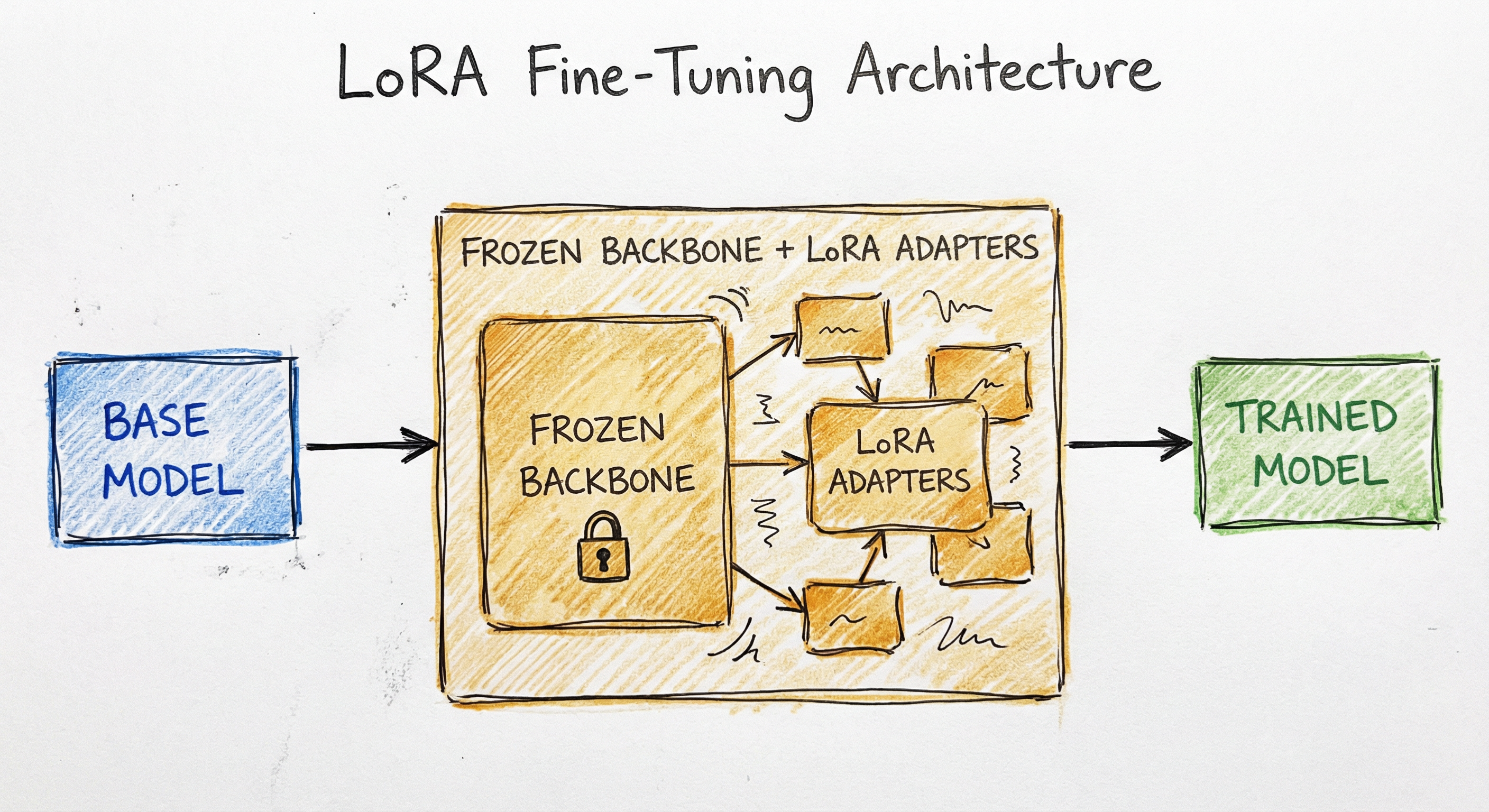
In a typical deployment, LoRA is applied to the query (), key (), value (), and output () projection matrices in each transformer attention layer. Some practitioners also apply it to the MLP layers (gate, up, and down projections), though the attention layers typically provide the best parameter-efficiency tradeoff.
Key Components
Frozen Base Weights (W₀)
The original pretrained weight matrices that remain completely unchanged during LoRA training. These capture the general knowledge from pretraining and are shared across all LoRA adapters. No gradients are computed for these weights, which is the primary source of memory savings.
Down-Projection Matrix (A)
A trainable matrix that projects the input from the original dimension down to the low-rank dimension . Initialized with random Gaussian values. This matrix learns which directions in the input space are most relevant for the task-specific adaptation.
Up-Projection Matrix (B)
A trainable matrix that projects back from the low-rank space to the output dimension . Initialized to zero so that at the start of training. This ensures training begins from the exact pretrained checkpoint.
Scaling Factor (alpha/r)
A constant multiplier applied to the LoRA output. The hyperparameter controls the magnitude of the adaptation relative to the pretrained weights. Keeps the update scale stable when varying the rank .
Target Module Selector
Configuration that specifies which weight matrices in the transformer receive LoRA adapters. Common targets include attention projections (q_proj, k_proj, v_proj, o_proj) and MLP layers (gate_proj, up_proj, down_proj). The choice of target modules significantly impacts both parameter count and task performance.
Adapter Merger
A post-training utility that computes and writes the result back into the model weights. After merging, the model is a standard transformer with no LoRA-specific components, enabling deployment with zero inference overhead.
Data Flow
Training Path: Input tokens are embedded and passed through transformer layers. At each LoRA-targeted layer, the input flows through two parallel paths: (1) the frozen weight matrix and (2) the LoRA bypass . The outputs are summed element-wise. Gradients flow only through the LoRA bypass (matrices and ), while requires no gradient storage -- saving ~60% of training memory.
Inference Path (Unmerged): Same as training but without gradient computation. The LoRA bypass adds a small computational overhead (two extra matrix multiplications per targeted layer). For rank on a 4096-dim layer, this overhead is typically <1% of total inference time.
Inference Path (Merged): After merging , the model is structurally identical to the original. There is literally zero inference overhead -- the adapted knowledge is baked into the weights. This is the preferred deployment mode for single-adapter serving.
A flowchart showing an input vector x flowing through two parallel paths: one through the frozen pretrained weight matrix W₀ (shown in gray), and another through the trainable LoRA matrices A (down-projection, green) then B (up-projection, green), followed by alpha/r scaling (orange). The two paths merge via addition to produce the output h.
How to Implement
Two Implementation Approaches
There are two primary ways to implement LoRA in practice:
Approach 1: Hugging Face PEFT -- The most popular option. The peft library wraps any Hugging Face model with LoRA adapters in a few lines of code. It handles target module selection, initialization, saving/loading, and merging. This is what you should use unless you have a specific reason not to.
Approach 2: Custom Implementation -- For research or non-standard architectures, you can implement LoRA directly by subclassing nn.Linear. This gives full control over initialization, scaling, and which layers to target, but requires more engineering effort.
For production deployments, the key decision is whether to serve the adapter separately (enabling hot-swapping between adapters for multi-tenant serving) or merge it into the base model (simpler deployment, zero overhead). Libraries like vLLM and TGI support both modes.
Cost Note: A full LoRA fine-tuning run on Llama 3 8B with a typical instruction dataset (50K examples) takes ~4 hours on a single A100 80GB GPU. That's approximately 192 (~INR 16,100). LoRA is 12x cheaper for this setup.
from transformers import AutoModelForCausalLM, AutoTokenizer, TrainingArguments
from peft import LoraConfig, get_peft_model, TaskType
from trl import SFTTrainer
from datasets import load_dataset

# Load base model and tokenizer
model_name = "meta-llama/Llama-3.1-8B"
tokenizer = AutoTokenizer.from_pretrained(model_name)
tokenizer.pad_token = tokenizer.eos_token

model = AutoModelForCausalLM.from_pretrained(
    model_name,
    torch_dtype="auto",
    device_map="auto",
)

# Configure LoRA
lora_config = LoraConfig(
    task_type=TaskType.CAUSAL_LM,
    r=16,                          # Rank
    lora_alpha=32,                 # Alpha scaling
    lora_dropout=0.05,             # Dropout on LoRA layers
    target_modules=[
        "q_proj", "k_proj", "v_proj", "o_proj",  # Attention
        "gate_proj", "up_proj", "down_proj",       # MLP
    ],
    bias="none",
)

# Wrap model with LoRA adapters
model = get_peft_model(model, lora_config)
model.print_trainable_parameters()
# Output: trainable params: 41,943,040 || all params: 8,072,204,288 || trainable%: 0.5195

# Load dataset
dataset = load_dataset("tatsu-lab/alpaca", split="train")

# Training arguments
training_args = TrainingArguments(
    output_dir="./lora-llama3-8b",
    num_train_epochs=3,
    per_device_train_batch_size=4,
    gradient_accumulation_steps=4,
    learning_rate=2e-4,
    warmup_ratio=0.03,
    lr_scheduler_type="cosine",
    logging_steps=10,
    save_strategy="steps",
    save_steps=500,
    bf16=True,
    gradient_checkpointing=True,
)

# Train
trainer = SFTTrainer(
    model=model,
    args=training_args,
    train_dataset=dataset,
    tokenizer=tokenizer,
    max_seq_length=2048,
)
trainer.train()

# Save adapter weights (only ~80 MB!)
model.save_pretrained("./lora-llama3-8b-adapter")
This is the standard production recipe for LoRA fine-tuning. Key decisions:
- rank=16: Good default for instruction tuning. Increase to 32-64 for complex domain adaptation.
- lora_alpha=32: Set to 2x rank for stable scaling. The effective scaling is alpha/r = 2.0.
- target_modules: We target both attention AND MLP layers. Targeting only attention (Q, V) works for simple tasks but including MLP layers gives better results for domain-specific adaptation.
- gradient_checkpointing=True: Essential for fitting the training run on a single GPU -- trades compute for memory.
- The saved adapter is only ~80 MB compared to the 16 GB base model.
from transformers import AutoModelForCausalLM, AutoTokenizer
from peft import PeftModel
import torch

# Load base model
base_model = AutoModelForCausalLM.from_pretrained(
    "meta-llama/Llama-3.1-8B",
    torch_dtype=torch.bfloat16,
    device_map="cpu",  # Merge on CPU to avoid GPU memory issues
)

# Load LoRA adapter
model = PeftModel.from_pretrained(
    base_model,
    "./lora-llama3-8b-adapter",
)

# Merge adapter into base model
model = model.merge_and_unload()

# Save merged model -- now a standard transformers model
model.save_pretrained("./llama3-8b-merged")
tokenizer = AutoTokenizer.from_pretrained("meta-llama/Llama-3.1-8B")
tokenizer.save_pretrained("./llama3-8b-merged")

# Deploy with vLLM (zero LoRA overhead)
# vllm serve ./llama3-8b-merged --dtype bfloat16
After training, you have two deployment options:
-
Merged deployment (shown here): Combine LoRA weights into the base model. The result is a standard model file with no adapter overhead. Best for single-purpose serving.
-
Unmerged deployment: Keep the adapter separate and load it dynamically. vLLM's multi-LoRA serving can handle dozens of adapters on a single base model simultaneously. Best for multi-tenant platforms where each customer has a custom adapter.
Merge on CPU to avoid running into GPU memory issues when both the base model and adapter are loaded simultaneously.
import torch
import torch.nn as nn
import math


class LoRALinear(nn.Module):
    """Drop-in replacement for nn.Linear with LoRA adaptation."""

    def __init__(
        self,
        in_features: int,
        out_features: int,
        rank: int = 16,
        alpha: float = 32.0,
        dropout: float = 0.0,
    ):
        super().__init__()
        self.in_features = in_features
        self.out_features = out_features
        self.rank = rank
        self.scaling = alpha / rank

        # Frozen pretrained weight (loaded from checkpoint)
        self.weight = nn.Parameter(torch.empty(out_features, in_features), requires_grad=False)

        # LoRA matrices
        self.lora_A = nn.Parameter(torch.empty(rank, in_features))
        self.lora_B = nn.Parameter(torch.zeros(out_features, rank))

        # Optional dropout on LoRA path
        self.lora_dropout = nn.Dropout(dropout) if dropout > 0 else nn.Identity()

        # Initialize A with Kaiming uniform (same as Hu et al.)
        nn.init.kaiming_uniform_(self.lora_A, a=math.sqrt(5))
        # B is already zero-initialized above

    def forward(self, x: torch.Tensor) -> torch.Tensor:
        # Original path (no gradient)
        h = nn.functional.linear(x, self.weight)

        # LoRA path
        lora_out = self.lora_dropout(x)
        lora_out = lora_out @ self.lora_A.T  # (batch, rank)
        lora_out = lora_out @ self.lora_B.T  # (batch, out_features)
        lora_out = lora_out * self.scaling

        return h + lora_out

    def merge_weights(self):
        """Merge LoRA weights into the base weight matrix."""
        with torch.no_grad():
            self.weight.add_(self.scaling * (self.lora_B @ self.lora_A))
        # After merging, LoRA matrices can be deleted
        del self.lora_A, self.lora_B


# Usage: replace a linear layer in a transformer
# original_layer = model.layers[0].self_attn.q_proj  # nn.Linear(4096, 4096)
# lora_layer = LoRALinear(4096, 4096, rank=16, alpha=32)
# lora_layer.weight.data = original_layer.weight.data.clone()
# model.layers[0].self_attn.q_proj = lora_layer
This from-scratch implementation shows exactly what's happening under the hood. Key implementation details:
- B is zero-initialized: This guarantees at initialization, so training starts from the pretrained checkpoint.
- A uses Kaiming initialization: Prevents vanishing gradients in the down-projection.
- Scaling is alpha/r: Applied as a constant multiplier, not a learnable parameter.
- merge_weights(): Folds the LoRA adaptation into the base weight. After calling this, the layer behaves identically to a standard
nn.Linearwith modified weights.
This implementation is useful for understanding LoRA internals, but for production use, prefer the PEFT library which handles edge cases, serialization, and multi-adapter scenarios.
# LoRA configuration (YAML format for reference)
model:
  name: meta-llama/Llama-3.1-8B
  dtype: bfloat16

lora:
  rank: 16
  alpha: 32
  dropout: 0.05
  target_modules:
    - q_proj
    - k_proj
    - v_proj
    - o_proj
    - gate_proj
    - up_proj
    - down_proj
  bias: none
  task_type: CAUSAL_LM

training:
  epochs: 3
  batch_size: 4
  gradient_accumulation_steps: 4
  learning_rate: 2e-4
  warmup_ratio: 0.03
  lr_scheduler: cosine
  max_seq_length: 2048
  gradient_checkpointing: true
  bf16: true

serving:
  merge_adapter: true
  deployment: vllm
  quantization: none  # or awq/gptq for inference optimization
Common Implementation Mistakes
- ●
Setting alpha equal to rank (alpha=r) by default: This gives a scaling factor of 1.0, which may be too aggressive for large ranks. The community convention has converged on alpha=2r (e.g., r=16, alpha=32) for stable training. If you see training loss spike, this is often the culprit.
- ●
Targeting only Q and V projections: The original LoRA paper tested primarily on Q and V, but subsequent work (and extensive community experimentation) shows that including K, O, and MLP layers (gate_proj, up_proj, down_proj) significantly improves performance for instruction tuning and domain adaptation. Don't blindly follow the 2021 defaults.
- ●
Using too high a learning rate: LoRA parameters converge faster than full fine-tuning because the parameter space is much smaller. A learning rate of 2e-4 to 5e-4 works well for most setups. Using the typical full fine-tuning rate of 2e-5 will make LoRA train too slowly, while 1e-3 can cause instability.
- ●
Forgetting gradient checkpointing: Without gradient checkpointing, activation memory can dominate even with LoRA's reduced parameter count. For a 7B model with sequence length 2048, activation memory alone can exceed 20 GB. Always enable
gradient_checkpointing=Truewhen fine-tuning on a single GPU. - ●
Merging adapters trained with different base models: LoRA adapters are tied to the specific base model checkpoint they were trained on. Merging an adapter trained on Llama 3 8B into Llama 3.1 8B will produce garbage outputs because the weight spaces have diverged. Always track the exact base model version alongside the adapter.
- ●
Not evaluating the unmerged model during training: Some training setups evaluate using the merged model at checkpoints, which adds computational overhead and can mask issues. Evaluate with the adapter attached (unmerged) during training, and only merge for final deployment.
When Should You Use This?
Use When
You need to fine-tune a model with 7B+ parameters and have limited GPU budget -- LoRA reduces memory requirements by 60-80% compared to full fine-tuning
You're building a multi-tenant system where each customer needs a personalized model but you can't afford to deploy separate full models per customer
Your fine-tuning dataset is small to medium (1K-100K examples) -- LoRA's implicit regularization through rank constraint helps prevent overfitting
You need to iterate quickly on fine-tuning experiments -- LoRA training is 3-10x faster than full fine-tuning, enabling more experiment cycles per day
You want zero inference overhead after deployment -- merged LoRA has identical latency to the base model, unlike adapter layers or prefix tuning
You need to version and A/B test different model adaptations -- LoRA adapters are small (10-100 MB) and can be swapped without reloading the base model
Your team has limited distributed training expertise -- LoRA often fits on a single GPU, avoiding the complexity of FSDP or DeepSpeed
Avoid When
Your model is small (<1B parameters) and full fine-tuning fits comfortably in memory -- the complexity of LoRA is unnecessary when the problem it solves doesn't exist
You need to fundamentally change the model's capabilities (e.g., adding a new language from scratch) -- low-rank updates may not have sufficient expressiveness for large distribution shifts
You have abundant compute and a large, high-quality dataset (>1M examples) -- full fine-tuning may yield better results when you can afford it and have enough data to avoid overfitting
You're training from scratch rather than adapting a pretrained model -- LoRA is specifically designed for the fine-tuning regime where pretrained weights exist
Your task requires adapting non-linear layers (e.g., LayerNorm, embedding tables) that don't have a natural low-rank decomposition -- LoRA only applies to linear transformations
You need maximum possible performance and the marginal quality difference between LoRA and full fine-tuning matters for your use case (e.g., safety-critical medical applications where every 0.1% accuracy counts)
Key Tradeoffs
The Core Tradeoff: Parameter Efficiency vs. Expressiveness
LoRA's fundamental tradeoff is simple: fewer trainable parameters means faster, cheaper training but a constrained update space. The rank is the dial that controls this tradeoff.
| Rank (r) | Trainable % (7B model) | Training Memory | Quality vs Full FT | Best For |
|---|---|---|---|---|
| 4 | ~0.06% | ~8 GB | 85-90% | Simple classification, sentiment |
| 16 | ~0.24% | ~12 GB | 92-97% | Instruction tuning, chat |
| 64 | ~0.96% | ~18 GB | 96-99% | Domain adaptation, code generation |
| 256 | ~3.8% | ~30 GB | 98-100% | Complex multi-task, approaching full FT |
Memory vs. Cost
LoRA's memory savings translate directly to cost savings. Here's a comparison for fine-tuning Llama 3 70B:
| Method | GPUs Required | Time (50K examples) | Cloud Cost (AWS) | Cost (INR) |
|---|---|---|---|---|
| Full Fine-tuning | 8x A100 80GB | ~24 hours | ~$768 | ~INR 64,500 |
| LoRA (r=16) | 2x A100 80GB | ~8 hours | ~$64 | ~INR 5,400 |
| QLoRA (r=16, 4-bit) | 1x A100 80GB | ~12 hours | ~$48 | ~INR 4,000 |
That's a 12-16x cost reduction with LoRA, which makes the difference between "we can experiment" and "we can't afford to try" for many Indian startups and research labs.
Quality Considerations
In practice, LoRA with matches full fine-tuning performance on most benchmarks within 1-2%. The cases where the gap widens are: (1) tasks requiring significant distribution shift from pretraining data, (2) very large, high-quality datasets where full fine-tuning can leverage the extra capacity, and (3) multi-modal adaptations where the model needs to learn fundamentally new representations.
Practitioner's Note: If you're debating between LoRA and full fine-tuning, start with LoRA. If the results aren't good enough after tuning rank and target modules, then consider full fine-tuning. The reverse order wastes money.
Alternatives & Comparisons
Full fine-tuning updates all model parameters and generally achieves the best possible task performance, but at 10-100x the cost and memory of LoRA. Choose full fine-tuning when you have abundant compute, large datasets (>500K examples), and need maximum quality. Choose LoRA when budget is constrained or datasets are smaller. For most production use cases in 2025-2026, LoRA is the pragmatic default.
QLoRA combines 4-bit quantization of the base model with LoRA adapters, reducing memory by an additional 3-4x compared to standard LoRA. QLoRA enables fine-tuning a 70B model on a single 48GB GPU. The quality tradeoff is minimal (typically <1% degradation). Choose QLoRA when GPU memory is the binding constraint; choose standard LoRA when you have sufficient VRAM and want slightly better quality and faster training speed.
Adapter layers (Houlsby et al., 2019) insert small feedforward modules between transformer layers. Unlike LoRA, adapters add inference latency because they introduce new sequential computation. LoRA has no inference overhead after merging. Choose adapters when you need to preserve the exact base model weights at inference time (no merging); choose LoRA for everything else.
Prefix tuning prepends learnable continuous vectors to the key and value sequences at each transformer layer. It uses even fewer parameters than LoRA but typically underperforms on complex tasks. Prefix tuning also consumes part of the context window. Choose prefix tuning for lightweight, low-complexity adaptations; choose LoRA for broader applicability and better quality.
Prompt tuning learns soft prompt embeddings prepended to the input (only at the input layer, unlike prefix tuning). It's the most parameter-efficient PEFT method but has the weakest performance, especially for smaller models. Choose prompt tuning for very simple classification tasks with large models (>10B); choose LoRA for nearly all other scenarios.
IA3 learns rescaling vectors (not matrices) for key, value, and feedforward activations. It trains even fewer parameters than LoRA (typically 10x fewer) but is less expressive. Choose IA3 for few-shot adaptation scenarios with very limited data; choose LoRA for standard fine-tuning with moderate to large datasets.
Pros, Cons & Tradeoffs
Advantages
Dramatic memory reduction: Training memory drops by 60-80% compared to full fine-tuning. A 7B model that requires 40+ GB for full fine-tuning fits in ~16 GB with LoRA, enabling training on consumer GPUs like the RTX 4090.
Zero inference overhead after merging: Once the LoRA weights are merged into the base model (), the model is architecturally identical to the original. No extra layers, no routing, no latency penalty. This is a major advantage over adapter layers and prefix tuning.
Tiny adapter files enable multi-tenant serving: A LoRA adapter is typically 10-100 MB compared to 14-140 GB for the full model. You can store thousands of customer-specific adapters and swap them dynamically, enabling personalized AI at a fraction of the infrastructure cost.
Strong regularization through rank constraint: The low-rank structure acts as an implicit regularizer, reducing overfitting risk on small datasets. This is particularly valuable for domain adaptation where labeled data is scarce (e.g., fine-tuning a medical QA model with only 5K examples).
Composability with other techniques: LoRA can be combined with quantization (QLoRA), gradient checkpointing, mixed-precision training, and data parallelism. This composability makes it the most versatile PEFT method.
Fast experimentation cycles: Training is 3-10x faster than full fine-tuning, enabling more iterations per day. An ML engineer at an Indian startup can run 5-10 LoRA experiments per day on a single A10G, compared to 1-2 full fine-tuning runs on a multi-GPU setup.
Broad ecosystem support: Supported by Hugging Face PEFT, LLaMA-Factory, Axolotl, Unsloth, Ludwig, and virtually every LLM training framework. First-class support in serving engines like vLLM, TGI, and SGLang.
Disadvantages
Quality gap on complex tasks: While LoRA matches full fine-tuning on most benchmarks, a 1-3% quality gap can persist on tasks requiring significant distribution shift or complex reasoning. For safety-critical applications, this gap may matter.
Rank selection requires experimentation: There's no universal formula for choosing the optimal rank. Too low means underfitting; too high means wasted parameters and potential overfitting. Binary search over rank values adds to the hyperparameter tuning burden.
Limited to linear layers: LoRA's low-rank decomposition only applies to linear transformations (weight matrices). Non-linear components like LayerNorm parameters, embedding tables, and the final language model head typically can't benefit from LoRA (though some can be unfrozen separately).
Adapter incompatibility across base model versions: LoRA adapters are tightly coupled to the specific base model checkpoint. A new model release (e.g., Llama 3 to Llama 3.1) invalidates all existing adapters, requiring retraining. This creates maintenance overhead for adapter libraries.
Multi-adapter inference complexity: While serving multiple LoRA adapters on a single base model is efficient, the implementation complexity of multi-adapter batching (different adapters in the same batch) is non-trivial. Only recent versions of vLLM and SGLang handle this well.
Not suitable for pretraining or large distribution shifts: LoRA assumes the pretrained weights are a good starting point and the required update is low-rank. For training from scratch or adapting to a completely new domain (e.g., code model to protein folding), the low-rank assumption breaks down.
Failure Modes & Debugging
Catastrophic Rank Underestimation
Cause
Rank set too low for the complexity of the task. For example, using for multi-task instruction tuning that requires the model to learn diverse behavior patterns spanning code generation, mathematical reasoning, and creative writing simultaneously.
Symptoms
Training loss plateaus early and the model shows good performance on simple subtasks but fails on complex ones. Evaluation metrics plateau at 80-85% of full fine-tuning performance despite extended training. The model may also exhibit "mode collapse" where it defaults to a narrow range of response styles.
Mitigation
Start with and increase to or if training loss plateaus prematurely. Monitor per-task metrics (not just aggregate loss) to detect subtask-specific underfitting. As a diagnostic, temporarily train with to establish an upper bound -- if the gap between and is large, you need higher rank.
Alpha-Rank Scaling Mismatch
Cause
The scaling factor produces updates that are too large (causing training instability) or too small (causing slow convergence). This commonly happens when practitioners change the rank without adjusting alpha proportionally, or use library defaults that don't match their setup.
Symptoms
Training loss spikes early and fails to recover (alpha too high), or training converges extremely slowly and underperforms despite sufficient epochs (alpha too low). Gradient norms may show abnormal patterns -- exploding or vanishing relative to a working baseline.
Mitigation
Use the convention as a starting point. If you change , always adjust proportionally. Monitor gradient norms for the LoRA parameters during the first 100 steps -- they should be in the same order of magnitude as the loss gradient. Some practitioners fix and adjust the learning rate instead.
Adapter-Base Model Version Mismatch
Cause
Loading a LoRA adapter trained on one base model version onto a different version (e.g., adapter trained on Llama 2 loaded onto Llama 3, or even minor revisions within the same family where weight initialization differs).
Symptoms
Model outputs are incoherent, gibberish, or dramatically worse than the base model without any adapter. The merged weights produce nonsensical distributions because the adapter was tuned relative to different base weights. There are usually no error messages -- the dimensions match but the weight spaces are incompatible.
Mitigation
Always store the exact base model identifier (including commit hash or version tag) alongside every adapter checkpoint. Implement a validation check that compares a hash of the base model weights at adapter load time. In production, use a model registry that enforces adapter-base compatibility.
Target Module Selection Causing Partial Adaptation
Cause
Applying LoRA only to attention Q and V projections (the original paper's primary configuration) when the task requires modifying MLP representations. This is particularly common for domain adaptation tasks where the model needs to shift its knowledge distribution, not just its attention patterns.
Symptoms
The model improves on tasks requiring different attention patterns (e.g., longer-range dependencies) but fails to update its factual knowledge or generation style. Domain-specific terminology or reasoning patterns don't improve despite training on relevant data.
Mitigation
For instruction tuning and domain adaptation, target all linear layers: Q, K, V, O projections AND gate, up, down projections in the MLP. The additional parameters from MLP targeting (roughly 2x more LoRA parameters) are almost always worth it. Measure per-module gradient norms to identify which modules benefit most from adaptation.
Multi-Adapter Serving Interference
Cause
In multi-tenant setups where different LoRA adapters are served on the same base model, batching requests with different adapters can cause incorrect adapter application if the serving framework doesn't properly isolate adapter weights per request.
Symptoms
Intermittent quality degradation that's hard to reproduce. Customer A occasionally gets responses styled like Customer B's adapter. In extreme cases, adapter weights from one request leak into another, producing a blend of two adaptations.
Mitigation
Use serving frameworks with proven multi-LoRA support (vLLM >= 0.4.0, SGLang). Implement per-request adapter validation in your serving layer. Run integration tests that verify adapter isolation under concurrent load. For critical applications, consider adapter merging and separate model deployments instead of runtime adapter swapping.
Overfitting on Small Datasets Despite Low Rank
Cause
Even with LoRA's implicit regularization, fine-tuning on very small datasets (<1K examples) with rank and many target modules can overfit. The total trainable parameter count (e.g., 40M for r=16 on all layers of a 7B model) may exceed what the dataset can support.
Symptoms
Training loss decreases steadily but validation loss diverges after a few hundred steps. The model memorizes training examples verbatim and generates responses that closely mirror specific training instances rather than generalizing.
Mitigation
For small datasets: reduce rank to , increase LoRA dropout to 0.1-0.15, reduce target modules to attention-only (Q, V), and use early stopping based on validation loss. Consider data augmentation or few-shot prompting as alternatives when data is extremely scarce.
Placement in an ML System
Where LoRA Fits in the ML System
In a typical LLM deployment pipeline, LoRA occupies the adaptation stage between pretrained model selection and production serving. The workflow looks like this:
- Data preparation: Task-specific training data is collected, cleaned, and formatted (typically in instruction-response pairs for chat models).
- Base model selection: A pretrained foundation model is chosen from a model hub (Hugging Face, model registry).
- LoRA fine-tuning: The adaptation stage where LoRA trains small adapter matrices on the task data.
- Evaluation: The adapted model is benchmarked against held-out test sets and domain-specific metrics.
- Deployment: The adapter is either merged into the base model for single-purpose serving, or deployed as a separate artifact for multi-adapter serving.
In larger organizations (like a Flipkart ML platform or a Razorpay fraud detection team), LoRA adapters are managed through a model registry that tracks adapter versions, their associated base models, training configurations, and evaluation metrics. This enables reproducibility and rollback -- critical for production ML systems.
Multi-Tenant Pattern: Companies like Cohere and together.ai serve dozens to hundreds of customer-specific LoRA adapters on shared GPU infrastructure. The base model is loaded once, and per-customer adapters are applied at request time. This is the most cost-efficient architecture for personalized AI at scale.
Pipeline Stage
Training / Fine-tuning
Upstream
- Data Preprocessing Pipeline (cleaned, formatted training data)
- Base Model Selection (pretrained checkpoint from model hub)
- Tokenizer Configuration
Downstream
- Model Evaluation & Benchmarking
- Adapter Storage / Model Registry
- Model Serving (vLLM, TGI, or custom inference)
Scaling Bottlenecks
The primary bottleneck during training is activation memory, not parameter memory. Even with LoRA's reduced trainable parameters, the forward pass still computes through all layers of the full model, generating activations that must be stored for backpropagation. For a 70B model with sequence length 4096, activation memory alone can reach 80+ GB without gradient checkpointing.
At serving time, the bottleneck shifts to multi-adapter management. Serving 1,000 different LoRA adapters on a single GPU requires loading the appropriate adapter per request, which introduces adapter-switching overhead. vLLM addresses this with continuous batching and pre-loaded adapter caching, but the cache size is bounded by GPU memory.
For distributed training of LoRA on very large models (100B+), the base model must still be sharded across GPUs using FSDP or DeepSpeed, even though only the LoRA parameters receive gradients. The communication overhead for all-reduce on LoRA gradients is minimal, but the base model weight sharding introduces the same complexity as full fine-tuning.
Production Case Studies
Microsoft Research authored the original LoRA paper, demonstrating the technique on GPT-3 175B. They showed that LoRA with rank 4 on GPT-3 matched or exceeded full fine-tuning performance on multiple NLU benchmarks while training 10,000x fewer parameters. The work was motivated by the practical impossibility of sharing full fine-tuned copies of 175B-parameter models -- each copy would require 350 GB of storage.
LoRA achieved comparable or better performance than full fine-tuning on WikiSQL (+0.4%), SAMSum, and MNLI benchmarks while reducing trainable parameters by 10,000x and GPU memory by 3x. The adapter checkpoint for GPT-3 was only 35 MB vs. 350 GB for the full model.
Meta's Llama model family has become the primary target for LoRA fine-tuning in the open-source community. While Meta performs full fine-tuning for their official Llama Chat models, they explicitly designed the Llama architecture and release strategy to support community LoRA adaptation. The Llama 3 model card documents recommended LoRA configurations, and the ecosystem of Llama LoRA adapters on Hugging Face Hub exceeds 10,000 adapters covering dozens of languages and domains.
The Llama + LoRA combination has democratized LLM customization. Indian language LoRA adapters for Hindi, Tamil, Bengali, and other languages have been created by the community, enabling localized AI applications that would not be economically viable with full fine-tuning.
The Stable Diffusion community popularized LoRA fine-tuning for image generation models, creating a massive ecosystem of style-specific and character-specific adapters. LoRA adapters for Stable Diffusion (typically 10-50 MB) allow artists and designers to customize the model's output style without retraining the full 1B+ parameter UNet. The Civitai platform hosts over 100,000 LoRA adapters for Stable Diffusion models.
LoRA reduced the cost of creating a custom Stable Diffusion style from several hours on an A100 (~0.50 / INR 42 in electricity). This 60x cost reduction enabled an explosion of creative AI applications and a thriving community marketplace.
Predibase built LoRAX, a multi-LoRA serving framework that enables serving hundreds of fine-tuned LoRA adapters on shared GPU infrastructure. Their "LoRA Land" initiative fine-tuned 25+ task-specific LoRA adapters on Mistral 7B and showed that specialized LoRA models consistently outperformed GPT-4 on domain-specific tasks while being 100x cheaper to serve.
Task-specific LoRA models on Mistral 7B outperformed GPT-4 on 25 out of 25 evaluated tasks, with an average improvement of 14 percentage points. Serving costs were reduced from 0.60/million tokens (LoRA-adapted Mistral 7B on shared infrastructure).
Tooling & Ecosystem
The de facto standard library for parameter-efficient fine-tuning. Supports LoRA, QLoRA, AdaLoRA, IA3, prefix tuning, and more. Integrates seamlessly with Hugging Face Transformers and the TRL library for RLHF/DPO training. Handles adapter saving, loading, merging, and multi-adapter composition.
High-performance LoRA training library that achieves 2-5x speedup over standard PEFT through custom Triton kernels and optimized memory management. Supports Llama, Mistral, Gemma, and Phi model families. Particularly popular in the Indian AI community for cost-efficient fine-tuning on single GPUs.
Production-grade fine-tuning framework that wraps PEFT, DeepSpeed, and FSDP into a YAML-configurable pipeline. Supports LoRA, QLoRA, full fine-tuning, DPO, RLHF, and multi-GPU training. Used by many startups and research labs for standardized training workflows.
Unified fine-tuning framework with a web UI for configuring and launching LoRA training jobs. Supports 100+ model architectures, multiple PEFT methods, and training paradigms (SFT, RLHF, DPO, PPO). Popular for its low barrier to entry -- you can configure and launch a LoRA training run entirely through the browser.
High-throughput LLM serving engine with first-class multi-LoRA support. Enables serving multiple LoRA adapters on a single base model with continuous batching. Supports dynamic adapter loading and unloading without server restarts. The standard choice for production LoRA deployment.
Fast serving framework with multi-LoRA support, radix attention for efficient prefix caching, and structured generation. Competitive with vLLM on throughput and often faster for multi-turn conversations. Growing adoption for LoRA serving in production.
The bitsandbytes library provides 4-bit and 8-bit quantization for loading base models in reduced precision, enabling QLoRA training. Combined with PEFT, it allows fine-tuning a 70B model on a single 48GB GPU -- a setup that would otherwise require 8 GPUs.
Research & References
Hu, Shen, Wallis, Allen-Zhu, Li, Wang, Wang & Chen (2021)ICLR 2022
The foundational LoRA paper. Demonstrated that fine-tuning weight updates have low intrinsic rank and proposed parameterizing updates as with . Achieved comparable performance to full fine-tuning on GPT-3 175B while training 10,000x fewer parameters.
Dettmers, Pagnoni, Holtzman & Zettlemoyer (2023)NeurIPS 2023
Introduced QLoRA, which combines 4-bit NormalFloat quantization of the base model with LoRA adapters. Enabled fine-tuning a 65B model on a single 48GB GPU. Introduced the Guanaco family of models that approached ChatGPT performance on the Vicuna benchmark.
Zhang, Chen, Bukharin, Karampatziakis, He, Cheng, Chen & Zhao (2023)ICLR 2023
Proposed adaptive rank allocation across layers and weight matrices using importance scoring based on singular value decomposition. Layers that need more adaptation capacity get higher rank, while less important layers are pruned to lower rank, improving parameter efficiency by 10-20% over uniform LoRA.
Hayou, Ghosh, Yu (2024)ICML 2024
Showed that using different learning rates for matrices A and B (specifically, a higher learning rate for B) improves LoRA convergence by 1-2% on downstream tasks. The fix is a one-line change: set the learning rate for B to be where is the rank.
Aghajanyan, Gupta & Shrivastava (2020)ACL 2021
The theoretical precursor to LoRA. Demonstrated that pretrained language models have a low intrinsic dimensionality -- fine-tuning objectives can be solved in a subspace with dimension 100-1000x smaller than the full parameter count. This directly motivated LoRA's low-rank parameterization.
Liu, Wang, Yin, Molchanov, Wang, Cheng & Chen (2024)ICML 2024
Decomposed the weight update into magnitude and direction components, applying LoRA only to the direction. This better mimics the learning pattern of full fine-tuning and consistently improves over standard LoRA by 1-3% across language and vision tasks without additional inference cost.
Zhao, Zhang, Chen, Schoenholz, Chen & Anandkumar (2024)ICML 2024
An alternative to LoRA that applies low-rank projection to gradients rather than weight updates, enabling full-rank weight updates with low-rank memory consumption. Useful for pretraining (where LoRA is not applicable) and achieves comparable memory efficiency to LoRA for fine-tuning.
Interview & Evaluation Perspective
Common Interview Questions
- ●
Explain how LoRA works. What is the key mathematical insight behind it?
- ●
How do you choose the rank r for LoRA? What factors influence this decision?
- ●
Compare LoRA with full fine-tuning -- when would you choose one over the other?
- ●
What is the role of the alpha scaling factor in LoRA? What happens if you set it incorrectly?
- ●
How would you deploy a system that serves multiple LoRA adapters for different customers on shared GPU infrastructure?
- ●
What are the limitations of LoRA? When does the low-rank assumption break down?
- ●
How does QLoRA extend LoRA? What additional memory savings does it provide?
- ●
Walk me through the training and deployment pipeline for a LoRA-adapted LLM.
Key Points to Mention
- ●
LoRA is grounded in the empirical observation that fine-tuning weight updates have low intrinsic rank (Aghajanyan et al. 2020). It's not just a compression trick -- there's a theoretical basis for why it works.
- ●
The weight update is parameterized as where and with . B is zero-initialized so training starts from the pretrained checkpoint.
- ●
Alpha/r scaling keeps the update magnitude stable across different rank choices. The convention is a good default. Changing rank without adjusting alpha is a common mistake.
- ●
After training, the adapter can be merged () for zero-overhead inference, or served separately for multi-tenant setups.
- ●
Target module selection matters: Q, K, V, O for attention + gate, up, down for MLP gives the best results for instruction tuning. The original paper's Q+V recommendation is outdated.
- ●
Cost comparison: LoRA fine-tuning Llama 3 8B costs ~INR 1,300 (192) for full fine-tuning -- a 12x reduction that makes experimentation accessible.
- ●
LoRA adapters are model-version-specific. Upgrading the base model invalidates all existing adapters.
Pitfalls to Avoid
- ●
Saying LoRA modifies the model architecture -- it does NOT. After merging, the model is structurally identical to the original. This is a key differentiator from adapter layers.
- ●
Confusing LoRA with quantization. LoRA is about reducing trainable parameters during fine-tuning. Quantization is about reducing model precision during inference. QLoRA combines both but they address different problems.
- ●
Claiming LoRA always matches full fine-tuning quality. There IS a quality gap, especially for tasks requiring large distribution shifts. Being honest about this shows engineering maturity.
- ●
Not discussing the practical aspects: adapter size, merging workflow, multi-adapter serving, version management. These operational concerns matter more than the math in a system design interview.
- ●
Forgetting to mention the initialization strategy (B=0, A=Gaussian) and why it matters for training stability.
Senior-Level Expectation
A senior/staff engineer should discuss LoRA at three levels: (1) Mathematical: articulate the low-rank decomposition, scaling properties, and connection to intrinsic dimensionality. (2) Engineering: cover the full lifecycle from data preparation through adapter management in a model registry, multi-LoRA serving with vLLM/SGLang, and adapter versioning/rollback. (3) System Design: reason about cost-performance tradeoffs for the specific use case, discuss when LoRA is insufficient and alternatives like full fine-tuning or QLoRA are warranted, and design a multi-tenant adapter serving architecture with proper isolation, caching, and failover. The ability to connect a Google Colab-level understanding to a production deployment plan -- with concrete cost estimates in INR and GPU hour calculations -- is what separates senior candidates.
Summary
What We Covered
LoRA (Low-Rank Adaptation) is a parameter-efficient fine-tuning technique that exploits the low intrinsic rank of fine-tuning weight updates. By decomposing the update as where and with , LoRA reduces trainable parameters by 100-10,000x, training memory by 60-80%, and training cost by 8-12x compared to full fine-tuning. After training, the adapter is merged back into the base model (), resulting in zero inference overhead -- the adapted model is structurally identical to the original.
The key decisions in a LoRA deployment are: rank selection ( is a strong default; increase for complex tasks, decrease for small datasets), alpha scaling ( for stable training), target modules (all attention + MLP layers for best results), and deployment mode (merged for single-purpose serving, unmerged for multi-tenant adapter swapping). Extensions like QLoRA (4-bit base model quantization), AdaLoRA (adaptive rank allocation), and DoRA (weight-decomposed adaptation) build on the core LoRA framework to address specific constraints.
LoRA has become the de facto standard for LLM customization because it sits at the optimal point on the cost-quality Pareto frontier for most production use cases. Whether you're an Indian startup fine-tuning Llama on a single RTX 4090 or an enterprise platform serving hundreds of customer-specific adapters on shared GPU infrastructure, LoRA provides the parameter efficiency, training speed, and deployment flexibility that makes LLM adaptation practical at any scale.