Federated Synthesis in Machine Learning
Federated Synthesis (Federated Synth) is a privacy-preserving technique for generating synthetic data from multiple distributed data sources without ever centralizing the raw data. Instead of gathering sensitive records from hospitals, banks, or user devices into a single location, federated synth trains a generative model -- such as a GAN or VAE -- across these distributed nodes using federated learning protocols. Each node trains locally on its own private dataset and shares only model updates (gradients or weight deltas) with a central aggregation server, which combines them to produce a global generative model capable of synthesizing realistic data that reflects the collective statistical properties of all participating nodes.
The motivation is straightforward: in many real-world settings, data cannot leave its source. Regulatory constraints (India's DPDP Act, GDPR, HIPAA), competitive concerns (banks refusing to share transaction data with rivals), and sheer data volume (petabytes distributed across mobile devices) all prevent centralization. Yet training high-quality ML models often requires diverse, representative data. Federated synth resolves this tension -- once the global generative model is trained, it can produce unlimited synthetic samples that capture cross-institutional patterns (e.g., fraud signatures that span multiple banks) without any party ever exposing its raw records.
The field was catalyzed by McMahan et al.'s 2017 paper on Federated Averaging (FedAvg), which established the foundational protocol for distributed model training. Augenstein et al. (2020) extended this to generative models, demonstrating that differentially private federated GANs and RNNs could generate useful synthetic text and images from private, decentralized datasets. Since then, federated synth has found applications in healthcare (multi-hospital patient record synthesis), finance (cross-bank fraud detection), telecommunications (network anomaly generation), and government (census-style synthetic population data). For Indian ML practitioners, federated synth is particularly relevant for scenarios like cross-bank UPI fraud modeling, multi-hospital clinical trial data sharing under DPDP Act constraints, and collaborative training across Aadhaar-connected services where data localization and privacy are non-negotiable.
Concept Snapshot
- What It Is
- A privacy-preserving technique that trains generative models (GANs, VAEs) across multiple distributed data holders using federated learning, producing synthetic data that captures cross-institutional statistical patterns without any party revealing its raw data.
- Category
- Data Generation / Privacy
- Complexity
- Advanced
- Inputs / Outputs
- Inputs: distributed private datasets across K nodes + federated learning protocol + optional DP parameters (epsilon, delta). Outputs: a global generative model + unlimited synthetic data samples reflecting the combined distribution of all participating nodes.
- System Placement
- Sits at the data preparation/augmentation stage of ML pipelines, upstream of model training. Typically deployed as a cross-organizational data collaboration layer before feature engineering, model building, or analytics.
- Also Known As
- Federated Synthetic Data Generation, Federated Generative Modeling, Distributed Synthetic Data, FL-GAN, Federated Data Synthesis, Privacy-Preserving Synthetic Data
- Typical Users
- ML Engineers, Privacy Engineers, Data Engineers, Research Scientists, Compliance Officers, Healthcare Informaticists
- Prerequisites
- Federated learning fundamentals (FedAvg, client-server architecture), Generative models (GANs, VAEs, diffusion models), Differential privacy basics (epsilon, delta, noise mechanisms), Distributed systems and network communication, Understanding of non-IID data distributions
- Key Terms
- Federated Averaging (FedAvg)secure aggregationnon-IID datacommunication roundsmodel poisoningprivacy budget (epsilon)client driftcross-silo vs cross-devicefederated GANfederated VAE
Why This Concept Exists
The Data Silo Problem
Modern ML thrives on data volume and diversity. A fraud detection model trained on transactions from a single bank sees only a narrow slice of fraud patterns. A clinical prediction model trained at one hospital reflects only that institution's patient demographics. A recommendation system built on one platform's user behavior misses cross-platform preferences. The best models would be trained on the combined data from all banks, all hospitals, all platforms -- but this centralization is almost never possible.
The barriers are formidable. Regulatory constraints prevent data movement: India's DPDP Act 2023 requires data fiduciaries to implement "reasonable security safeguards" and imposes strict consent requirements for data processing. The RBI mandates that payment system data be stored within India, and sharing raw UPI transaction data between banks would violate customer consent agreements. In healthcare, India's clinical establishments regulations and emerging health data management policies restrict sharing of electronic health records across institutions. Globally, GDPR's data minimization principle, HIPAA's minimum necessary standard, and China's PIPL create similar barriers.
Competitive concerns add another layer: even in the absence of regulation, banks will not share their customer transaction patterns with competing banks. Hospitals view patient data as a strategic asset. Telecom operators treat network usage data as proprietary. The data stays in its silo.
From Federated Learning to Federated Synthesis
Federated learning, introduced by McMahan et al. in "Communication-Efficient Learning of Deep Networks from Decentralized Data" (2017), provided the first practical solution to the data silo problem for model training. Instead of centralizing data, FedAvg keeps data on each node and sends model updates to a central server. The server aggregates updates to produce a global model.
However, standard federated learning produces a task-specific model (e.g., a fraud classifier). If the downstream task changes, the entire federated training process must be repeated. Federated synthesis takes a different approach: train a generative model (GAN, VAE) via federated learning, then use that model to generate synthetic data. This synthetic data can be used for any downstream task -- classification, regression, clustering, exploratory data analysis -- without repeating the expensive federated training.
Augenstein et al. (2020) at Google demonstrated this in "Generative Models for Effective ML on Private, Decentralized Datasets", showing that federated GANs with differential privacy could generate synthetic text and images useful for debugging and improving ML pipelines -- all without inspecting the private training data.
Evolution and Current State
The field has evolved rapidly:
-
2017-2018: Foundation -- McMahan et al. introduced FedAvg. Bonawitz et al. introduced Practical Secure Aggregation (CCS 2017), enabling cryptographic protection of individual client updates.
-
2019-2020: Federated generative models -- Augenstein et al. (ICLR 2020) demonstrated federated GANs and RNNs with differential privacy. Hardy et al. proposed MD-GAN for distributed GAN training. The Private FL-GAN framework combined federated learning with DP for synthetic tabular data.
-
2021-2023: Production adoption -- WeBank's FATE framework enabled federated synthetic data for credit scoring across Chinese banks. NVIDIA FLARE provided enterprise-grade federated learning with synthetic data capabilities. Healthcare consortia (HealthChain in the EU, national cancer data initiatives) adopted federated synthesis for multi-institutional clinical research.
-
2024-present: Maturity -- Flower framework reached production stability for federated generative modeling. Integration with foundation models enabled federated fine-tuning plus synthesis. Research shifted to addressing non-IID challenges, communication efficiency, and Byzantine-robust aggregation for federated GANs.
Indian Context: The National Health Authority's Ayushman Bharat Digital Mission (ABDM) creates a national health data exchange, but raw patient data sharing between hospitals remains restricted. Federated synth offers a path: hospitals contribute to a federated generative model without sharing patient records, producing synthetic data that enables multi-institutional clinical ML research. Similarly, the Reserve Bank of India's Account Aggregator framework connects financial data across banks but restricts raw data access -- federated synth could enable cross-bank fraud pattern generation for collective defense without violating data sharing restrictions.
Core Intuition & Mental Model
The Orchestra Without Sheet Music
Imagine five musicians in separate soundproof rooms. Each musician has their own collection of songs they've heard and can play. You want to create a new song that blends all their musical knowledge -- but you cannot bring the musicians together, and you cannot collect their song libraries. What do you do?
Here is the federated synth approach: you give each musician a blank composition notebook (the generative model). Each musician writes a draft composition based on their personal musical knowledge. They tear out the page and slide it under the door. A conductor in the hallway reads all five drafts, averages them into a combined composition, and slides copies back under each door. Each musician reads the combined draft, adjusts it based on their own expertise, and sends out a new version. After many rounds, the combined composition captures musical patterns from all five musicians -- even patterns that no single musician knew completely. You can then use this final composition to generate unlimited new songs.
The key insight: the conductor never heard any musician play. The musicians never met each other. Yet the final composition reflects collective musical knowledge. That is federated synthesis.
Why Not Just Aggregate Statistics?
You might wonder: why not just have each node compute summary statistics (mean, variance, histograms) and aggregate those? For simple analytics, this works. But ML models need to capture complex, high-dimensional correlations -- the relationship between age, income, transaction frequency, and fraud likelihood; the interaction between symptoms, lab values, medications, and patient outcomes. These correlations cannot be captured by simple statistics. A generative model learns the full joint distribution , preserving correlations, modes, and tail behaviors that summary statistics miss.
The Privacy Guarantee
Federated synth provides two layers of privacy protection:
- Data locality: Raw data never leaves its source node. The central server only sees model updates (gradients or weight deltas), not individual records.
- Optional differential privacy: By adding calibrated noise to model updates before transmission, each client's contribution is masked. Even if the model updates are intercepted, an adversary cannot determine whether any specific individual's data was used in training.
Combined with secure aggregation (where the server sees only the sum of client updates, not individual contributions), federated synth can provide strong privacy guarantees while generating useful synthetic data.
Mental Model: Think of federated synth as a blind sculptor. Each participant whispers a description of part of the statue they want (model updates). The sculptor never sees the raw material (data) but gradually shapes a statue (generative model) that captures everyone's vision. The final statue can then produce unlimited clay replicas (synthetic data) that reflect the combined artistic direction.
Technical Foundations
Federated Averaging for Generative Models
The Federated Averaging (FedAvg) algorithm, adapted for generative model training, proceeds as follows. Consider participating nodes (clients), each holding a private dataset of size , with total data .
Global objective: Train a generative model (parameterized by ) that minimizes a loss function aggregated across all nodes:
where is the local loss at node .
FedAvg update rule: At each communication round :
- Server broadcasts global model to a subset of clients (where ).
- Each selected client performs local SGD steps on , producing local weights .
- Server aggregates:
This weighted average ensures that nodes with more data have proportionally greater influence on the global model.
Federated GAN Training
For a federated GAN with generator and discriminator , the minimax objective becomes:
Two architectural patterns exist:
Pattern A (Federated Discriminator, Shared Generator): Each client trains a local discriminator on its private data. Generator updates are aggregated centrally. The discriminator never leaves the client, protecting data privacy.
Pattern B (Fully Federated): Both generator and discriminator are federated. Each client trains both networks locally and sends updates for both to the server. This is simpler but requires more communication.
Federated VAE Training
For a federated Variational Autoencoder with encoder and decoder , the federated ELBO objective is:
The KL divergence term regularizes the latent space, ensuring that the federated model learns a coherent shared latent representation across all nodes despite heterogeneous data distributions.
Differential Privacy in Federated Synth
To provide formal privacy guarantees, each client clips and noises its model update before transmission:
-
Clip: , then
-
Noise:
where is the clipping bound and is the noise multiplier. The total privacy guarantee after communication rounds, using the moments accountant, satisfies -DP with:
where is the client sampling rate.
Privacy Budget Composition Across Rounds
Each communication round consumes privacy budget. Under Renyi Differential Privacy (RDP), the composition across rounds with sampling rate and noise multiplier gives:
Converting to -DP: . The privacy budget is shared across all participants -- once exhausted, no more training rounds can proceed without degrading the collective privacy guarantee.
Internal Architecture
The federated synth architecture consists of a central aggregation server and distributed client nodes, each holding private data that cannot be shared. The system orchestrates iterative training of a generative model (GAN, VAE, or diffusion model) across these nodes using a communication protocol that transmits only model parameters, never raw data.
The architecture supports two deployment topologies:
-
Cross-silo federated synthesis: A small number (2-100) of institutional nodes (hospitals, banks, research labs) with reliable network connections, large local datasets, and persistent compute. Each node is an organization. This is the most common deployment for federated synth.
-
Cross-device federated synthesis: Millions of edge devices (phones, IoT sensors) with intermittent connectivity, small local datasets, and limited compute. Requires aggressive compression and fault tolerance. Less common for synthesis due to the compute demands of generative models.
For security, the architecture integrates three complementary mechanisms: secure aggregation (cryptographic protocol ensuring the server sees only the aggregate of client updates), differential privacy (noise addition bounding information leakage per client), and Byzantine-robust aggregation (defenses against malicious clients submitting poisoned updates).
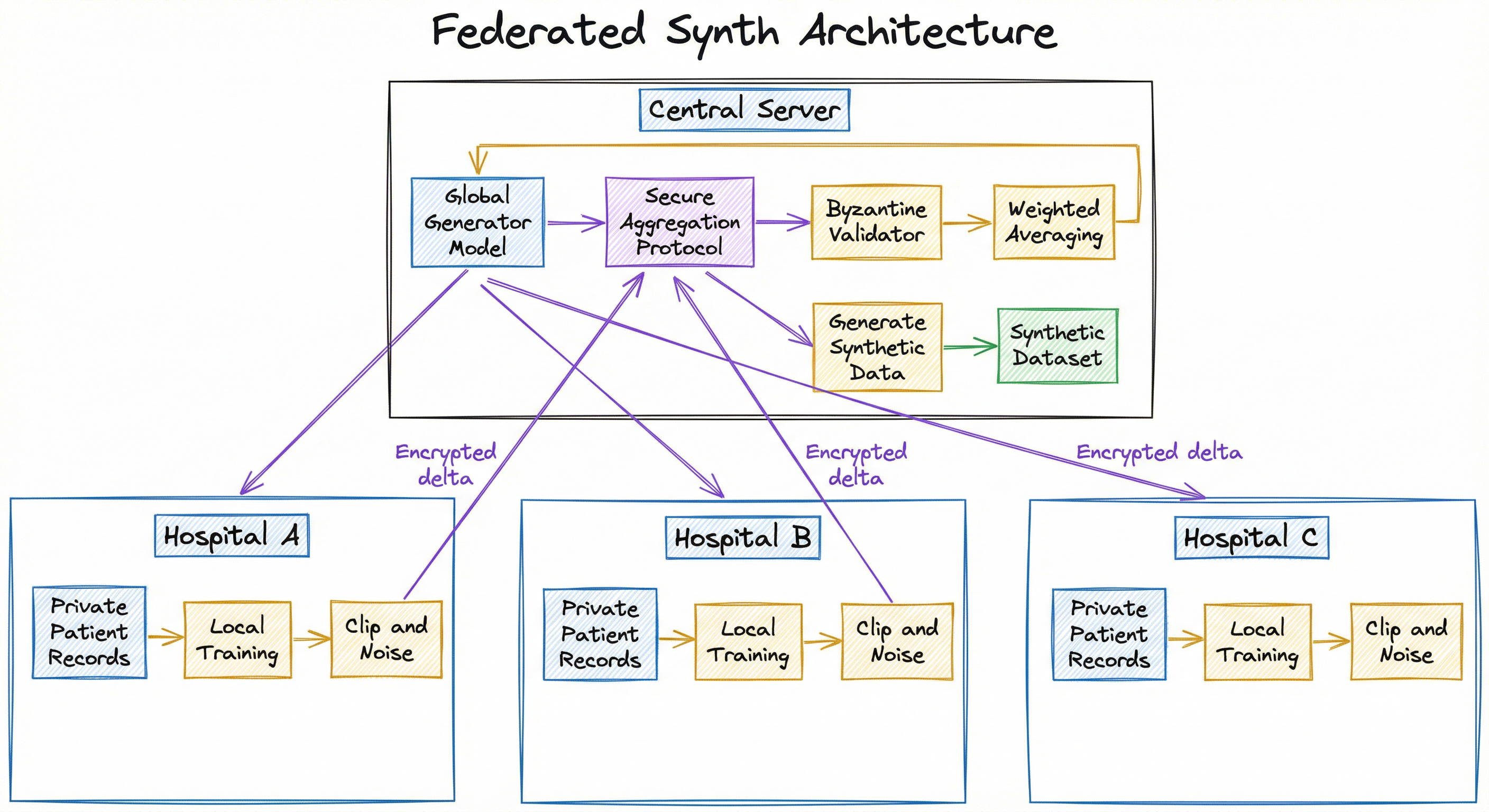
The training loop repeats for communication rounds. After convergence, the global generator is deployed to produce synthetic data. This synthetic data inherits the differential privacy guarantee of the training process via post-processing immunity -- any downstream use of the synthetic data is automatically privacy-preserving without additional budget expenditure.
Key Components
Aggregation Server
The central coordinator that orchestrates training rounds. In each round, it (1) selects a subset of client nodes to participate, (2) broadcasts the current global model parameters , (3) receives encrypted model updates from clients, (4) performs secure aggregation and Byzantine validation, and (5) computes the weighted average to produce . The server never accesses raw data -- it only processes model parameter deltas. In cross-silo settings, the server is typically deployed on a neutral cloud infrastructure agreed upon by all parties (e.g., a government data exchange or industry consortium platform).
Client Training Engine
Each client node runs a local training engine that performs epochs of SGD on its private dataset starting from the current global parameters . For federated GANs, this involves alternating generator and discriminator updates. For federated VAEs, this involves optimizing the ELBO loss locally. The engine computes the model delta and applies gradient clipping (bound norm to ) and optional DP noise injection before transmitting the update.
Secure Aggregation Module
Implements the cryptographic protocol from Bonawitz et al. (2017) that allows the server to compute the sum of client updates without learning any individual . Each client secret-shares its update with other clients using pairwise key agreements. The server receives masked updates that cancel out when summed, revealing only the aggregate. This protects against an honest-but-curious server and ensures individual client contributions remain hidden even without differential privacy.
Byzantine-Robust Aggregator
Defends against model poisoning attacks where malicious clients send corrupted updates designed to degrade the global model or inject backdoors. Instead of simple weighted averaging, uses robust aggregation rules: Krum (selects the update closest to other updates), trimmed mean (removes extreme values before averaging), or median (component-wise median of all updates). Critical for cross-silo settings where a compromised institution could poison the global generative model.
Privacy Accountant
Tracks the cumulative differential privacy expenditure across all communication rounds. Using Renyi Differential Privacy (RDP) or the moments accountant, it computes the total guarantee after rounds with noise multiplier and client sampling rate . Training halts when the privacy budget is exhausted. The accountant must track privacy at the user level (protecting each client's entire dataset) rather than the record level (protecting individual data points within a client).
Communication Compressor
Reduces the bandwidth cost of transmitting model updates between clients and server. Techniques include gradient quantization (reducing floating-point precision from 32-bit to 8-bit or 1-bit), sparsification (transmitting only the top- largest gradient components), and error feedback (accumulating compression residuals for future rounds). For a GAN with 50M parameters, uncompressed updates require ~200MB per round per client; compression can reduce this to 5-20MB with minimal quality loss.
Synthetic Data Generator
After federated training converges, this component uses the trained global generator to produce synthetic datasets. It samples from the prior distribution and passes through the generator to produce synthetic records . The generator can produce unlimited samples with no additional privacy cost (post-processing immunity). Quality validation includes statistical similarity tests (comparing marginal distributions, correlations, and downstream ML performance between synthetic and real data).
Data Flow
Federated Synth Training Flow:
-
Initialization: The aggregation server initializes the global generative model parameters (random initialization or pre-trained on public data). Set privacy budget , clipping bound , noise multiplier , local epochs , and number of communication rounds .
-
Client Selection: At each round , the server selects a random subset of clients from the total. Selection is random for privacy amplification (sampling reduces effective ).
-
Broadcast: Server sends current global parameters to all selected clients.
-
Local Training: Each client initializes its local model from and trains for epochs on its private data :
- For federated GAN: alternate discriminator updates (train on real local data + fake data from ) and generator updates (train to fool ).
- For federated VAE: optimize local ELBO with reconstruction loss and KL divergence.
- Compute model delta: .
-
Clip and Noise: Each client clips its delta: and adds DP noise: .
-
Secure Aggregation: Clients encrypt their updates using pairwise secret sharing. Server receives masked updates and computes the aggregate without seeing individual contributions.
-
Robust Aggregation: Server applies Byzantine-robust aggregation (e.g., trimmed mean) to the decrypted sum, filtering potential poisoning attacks.
-
Global Update: .
-
Privacy Accounting: Update the RDP accountant. If , stop training.
-
Synthesis: After training completes (either budget exhaustion or convergence), deploy to generate synthetic data: sample and compute for as many synthetic records as needed.
The diagram shows a central aggregation server connected to three client nodes (Hospital A, Hospital B, Hospital C). Each client node holds private patient records (blue) that feed into local training. After training, each client clips and noises its model update, then sends the encrypted delta to the server. The server processes updates through a secure aggregation module (purple), a Byzantine validator (red) that filters poisoned updates, and a weighted averaging component (amber) that produces the updated global model. The global model feeds back to clients for the next round. After training converges, the global generator produces synthetic data (green) for downstream ML tasks.
How to Implement
Implementation Approaches for Federated Synth
There are three main approaches to implementing federated synthetic data generation, each targeting different deployment scenarios:
Approach 1: Flower + PyTorch (Flexible, Framework-Agnostic) -- The Flower framework provides the most flexible foundation for federated generative model training. It supports any PyTorch/TensorFlow model, handles client orchestration, and integrates with differential privacy via Opacus. Best for research prototypes and custom generative architectures. Flower scored 84.75% in a 2024 comparative analysis of 15 FL frameworks.
Approach 2: NVIDIA FLARE (Enterprise, Production) -- NVIDIA FLARE is an enterprise-grade federated learning SDK with built-in support for secure aggregation, privacy accounting, and provisioning. It supports PyTorch, TensorFlow, and RAPIDS workflows. Best for production cross-silo deployments where institutional IT requirements (authentication, audit logging, data governance) must be satisfied.
Approach 3: WeBank FATE (Financial Sector) -- FATE (Federated AI Technology Enabler) is specifically designed for financial institutions, with built-in support for heterogeneous federated learning (vertical and horizontal), secure multi-party computation, and homomorphic encryption. WeBank demonstrated a 12% AUC improvement for credit scoring using federated learning with FATE. Best for banking and fintech applications.
Cost Considerations
Federated synth adds overhead compared to centralized training due to communication costs, local compute at each node, and the aggregation server:
| Component | Cross-Silo (5 hospitals) | Cross-Silo (20 banks) |
|---|---|---|
| Aggregation server (cloud) | $200-500/month (~INR 16,800-42,000) | $500-1,500/month (~INR 42,000-1.26L) |
| Per-node GPU (local training) | $100-300/month per node (~INR 8,400-25,200) | $200-500/month per node (~INR 16,800-42,000) |
| Communication bandwidth | Negligible (compressed updates) | 50-200GB/month total |
| Total for 100 rounds | ~$2,000-5,000 (~INR 1.7L-4.2L) | ~$10,000-25,000 (~INR 8.4L-21L) |
Compared to the alternative -- each institution training its own model in isolation -- federated synth's overhead is justified by the 10-30% improvement in synthetic data quality from cross-institutional pattern capture.
import flwr as fl
import torch
import torch.nn as nn
import torch.optim as optim
from torch.utils.data import DataLoader, TensorDataset
from collections import OrderedDict
from typing import List, Tuple
import numpy as np

# ── Generator and Discriminator ──────────────────────────
class Generator(nn.Module):
    def __init__(self, latent_dim: int = 64, output_dim: int = 20):
        super().__init__()
        self.net = nn.Sequential(
            nn.Linear(latent_dim, 128),
            nn.LeakyReLU(0.2),
            nn.Linear(128, 256),
            nn.LayerNorm(256),
            nn.LeakyReLU(0.2),
            nn.Linear(256, output_dim),
            nn.Tanh()
        )

    def forward(self, z: torch.Tensor) -> torch.Tensor:
        return self.net(z)

class Discriminator(nn.Module):
    def __init__(self, input_dim: int = 20):
        super().__init__()
        self.net = nn.Sequential(
            nn.Linear(input_dim, 256),
            nn.LeakyReLU(0.2),
            nn.Dropout(0.3),
            nn.Linear(256, 128),
            nn.LeakyReLU(0.2),
            nn.Dropout(0.3),
            nn.Linear(128, 1),
            nn.Sigmoid()
        )

    def forward(self, x: torch.Tensor) -> torch.Tensor:
        return self.net(x)

# ── Flower Client for Federated GAN ─────────────────────
class FederatedGANClient(fl.client.NumPyClient):
    def __init__(
        self,
        local_data: np.ndarray,
        latent_dim: int = 64,
        local_epochs: int = 5,
        batch_size: int = 64,
        lr: float = 2e-4
    ):
        self.latent_dim = latent_dim
        self.local_epochs = local_epochs
        self.batch_size = batch_size
        self.device = torch.device(
            "cuda" if torch.cuda.is_available() else "cpu"
        )

        input_dim = local_data.shape[1]
        self.generator = Generator(latent_dim, input_dim).to(self.device)
        self.discriminator = Discriminator(input_dim).to(self.device)
        self.opt_g = optim.Adam(self.generator.parameters(), lr=lr,
                                betas=(0.5, 0.999))
        self.opt_d = optim.Adam(self.discriminator.parameters(), lr=lr,
                                betas=(0.5, 0.999))
        self.criterion = nn.BCELoss()

        dataset = TensorDataset(
            torch.FloatTensor(local_data)
        )
        self.dataloader = DataLoader(
            dataset, batch_size=batch_size, shuffle=True
        )
        self.num_samples = len(local_data)

    def get_parameters(self, config) -> List[np.ndarray]:
        """Return generator parameters (only generator is federated)."""
        return [
            val.cpu().numpy()
            for val in self.generator.state_dict().values()
        ]

    def set_parameters(self, parameters: List[np.ndarray]):
        """Set generator parameters from server."""
        params_dict = zip(
            self.generator.state_dict().keys(), parameters
        )
        state_dict = OrderedDict(
            {k: torch.tensor(v) for k, v in params_dict}
        )
        self.generator.load_state_dict(state_dict, strict=True)

    def fit(
        self, parameters: List[np.ndarray], config: dict
    ) -> Tuple[List[np.ndarray], int, dict]:
        """Local GAN training for E epochs."""
        self.set_parameters(parameters)

        g_losses, d_losses = [], []
        for epoch in range(self.local_epochs):
            for (real_data,) in self.dataloader:
                real_data = real_data.to(self.device)
                bs = real_data.size(0)

                # Train Discriminator
                self.opt_d.zero_grad()
                real_labels = torch.ones(bs, 1, device=self.device)
                fake_labels = torch.zeros(bs, 1, device=self.device)

                d_real = self.discriminator(real_data)
                loss_real = self.criterion(d_real, real_labels)

                z = torch.randn(bs, self.latent_dim,
                                device=self.device)
                fake_data = self.generator(z).detach()
                d_fake = self.discriminator(fake_data)
                loss_fake = self.criterion(d_fake, fake_labels)

                d_loss = loss_real + loss_fake
                d_loss.backward()
                self.opt_d.step()

                # Train Generator
                self.opt_g.zero_grad()
                z = torch.randn(bs, self.latent_dim,
                                device=self.device)
                fake_data = self.generator(z)
                d_fake = self.discriminator(fake_data)
                g_loss = self.criterion(d_fake, real_labels)
                g_loss.backward()
                self.opt_g.step()

                g_losses.append(g_loss.item())
                d_losses.append(d_loss.item())

        metrics = {
            "g_loss": float(np.mean(g_losses)),
            "d_loss": float(np.mean(d_losses)),
        }
        return self.get_parameters(config), self.num_samples, metrics

    def evaluate(
        self, parameters: List[np.ndarray], config: dict
    ) -> Tuple[float, int, dict]:
        """Evaluate synthetic data quality."""
        self.set_parameters(parameters)
        z = torch.randn(self.num_samples, self.latent_dim,
                        device=self.device)
        with torch.no_grad():
            synthetic = self.generator(z)
            d_score = self.discriminator(synthetic).mean().item()
        return 1.0 - d_score, self.num_samples, {"d_score": d_score}

# ── Launch Federated Training ────────────────────────────
def start_server(num_rounds: int = 50, min_clients: int = 3):
    strategy = fl.server.strategy.FedAvg(
        fraction_fit=1.0,
        fraction_evaluate=0.5,
        min_fit_clients=min_clients,
        min_evaluate_clients=2,
        min_available_clients=min_clients,
    )
    fl.server.start_server(
        server_address="0.0.0.0:8080",
        config=fl.server.ServerConfig(
            num_rounds=num_rounds
        ),
        strategy=strategy,
    )

def start_client(local_data: np.ndarray, server_address: str):
    client = FederatedGANClient(local_data)
    fl.client.start_numpy_client(
        server_address=server_address,
        client=client,
    )

if __name__ == "__main__":
    import sys
    if sys.argv[1] == "server":
        start_server(num_rounds=50, min_clients=3)
    else:
        node_id = int(sys.argv[2])
        np.random.seed(node_id)
        local_data = np.random.randn(1000, 20)  # Replace with real data
        start_client(local_data, "127.0.0.1:8080")
This example implements a complete federated GAN using the Flower framework. Key design decisions:
- Only the generator is federated: The discriminator stays local at each client, trained on local real data. This is Pattern A from the formal definition -- it provides better privacy because discriminator weights (which encode information about real data) never leave the client.
FedAvgstrategy: The server uses weighted averaging based onnum_samplesreturned by each client, implementing .LayerNorminstead ofBatchNorm: BatchNorm is incompatible with federated learning because batch statistics differ across clients. LayerNorm normalizes within each sample independently.- Local epochs (
local_epochs=5): Each client trains for 5 local epochs before sending updates. More local epochs improve communication efficiency but can cause client drift (local models diverge too far from the global model). - The server and clients run as separate processes, communicating via gRPC. In production, each client would be a separate institution (hospital, bank).
import torch
import torch.nn as nn
import torch.optim as optim
import numpy as np
from torch.utils.data import DataLoader, TensorDataset
from opacus import PrivacyEngine
from opacus.validators import ModuleValidator
from typing import Tuple, Dict

# ── VAE Architecture ─────────────────────────────────────
class FederatedVAE(nn.Module):
    def __init__(self, input_dim: int = 20, latent_dim: int = 10):
        super().__init__()
        self.latent_dim = latent_dim

        # Encoder
        self.encoder = nn.Sequential(
            nn.Linear(input_dim, 128),
            nn.ReLU(),
            nn.Linear(128, 64),
            nn.ReLU()
        )
        self.fc_mu = nn.Linear(64, latent_dim)
        self.fc_logvar = nn.Linear(64, latent_dim)

        # Decoder
        self.decoder = nn.Sequential(
            nn.Linear(latent_dim, 64),
            nn.ReLU(),
            nn.Linear(64, 128),
            nn.ReLU(),
            nn.Linear(128, input_dim),
            nn.Sigmoid()
        )

    def encode(
        self, x: torch.Tensor
    ) -> Tuple[torch.Tensor, torch.Tensor]:
        h = self.encoder(x)
        return self.fc_mu(h), self.fc_logvar(h)

    def reparameterize(
        self, mu: torch.Tensor, logvar: torch.Tensor
    ) -> torch.Tensor:
        std = torch.exp(0.5 * logvar)
        eps = torch.randn_like(std)
        return mu + eps * std

    def decode(self, z: torch.Tensor) -> torch.Tensor:
        return self.decoder(z)

    def forward(
        self, x: torch.Tensor
    ) -> Tuple[torch.Tensor, torch.Tensor, torch.Tensor]:
        mu, logvar = self.encode(x)
        z = self.reparameterize(mu, logvar)
        return self.decode(z), mu, logvar

def vae_loss(
    recon_x: torch.Tensor,
    x: torch.Tensor,
    mu: torch.Tensor,
    logvar: torch.Tensor
) -> torch.Tensor:
    """ELBO loss = Reconstruction + KL divergence."""
    # Per-sample reconstruction loss (no reduction)
    recon_loss = nn.functional.binary_cross_entropy(
        recon_x, x, reduction='none'
    ).sum(dim=1)
    # Per-sample KL divergence
    kl_loss = -0.5 * torch.sum(
        1 + logvar - mu.pow(2) - logvar.exp(), dim=1
    )
    return recon_loss + kl_loss  # Shape: (batch_size,)

# ── DP-Federated Local Training ──────────────────────────
class DPFederatedVAETrainer:
    def __init__(
        self,
        local_data: np.ndarray,
        target_epsilon: float = 5.0,
        target_delta: float = 1e-5,
        local_epochs: int = 3,
        batch_size: int = 64,
        max_grad_norm: float = 1.0,
        lr: float = 1e-3
    ):
        self.device = torch.device(
            "cuda" if torch.cuda.is_available() else "cpu"
        )
        input_dim = local_data.shape[1]
        self.model = FederatedVAE(input_dim, latent_dim=10)
        self.model = ModuleValidator.fix(self.model)
        self.model = self.model.to(self.device)

        self.optimizer = optim.Adam(
            self.model.parameters(), lr=lr
        )

        dataset = TensorDataset(
            torch.FloatTensor(local_data)
        )
        self.dataloader = DataLoader(
            dataset, batch_size=batch_size, shuffle=True
        )

        # Attach DP privacy engine
        self.privacy_engine = PrivacyEngine()
        self.model, self.optimizer, self.dataloader = \
            self.privacy_engine.make_private_with_epsilon(
                module=self.model,
                optimizer=self.optimizer,
                data_loader=self.dataloader,
                target_epsilon=target_epsilon,
                target_delta=target_delta,
                epochs=local_epochs,
                max_grad_norm=max_grad_norm,
            )
        self.local_epochs = local_epochs

    def train_local(self) -> Dict[str, float]:
        """Run local DP-VAE training for E epochs."""
        self.model.train()
        total_loss = 0.0
        num_batches = 0

        for epoch in range(self.local_epochs):
            for (batch_data,) in self.dataloader:
                batch_data = batch_data.to(self.device)
                self.optimizer.zero_grad()

                recon, mu, logvar = self.model(batch_data)
                loss = vae_loss(recon, batch_data, mu, logvar)
                loss = loss.mean()  # Mean over batch
                loss.backward()
                self.optimizer.step()

                total_loss += loss.item()
                num_batches += 1

        epsilon = self.privacy_engine.get_epsilon(
            delta=1e-5
        )
        return {
            "avg_loss": total_loss / max(num_batches, 1),
            "epsilon_spent": epsilon,
        }

    def get_model_delta(
        self, global_params: Dict[str, torch.Tensor]
    ) -> Dict[str, torch.Tensor]:
        """Compute clipped model delta for federation."""
        local_params = {
            k: v.detach().cpu()
            for k, v in self.model.named_parameters()
        }
        delta = {
            k: local_params[k] - global_params[k]
            for k in global_params
        }
        return delta

    def generate_synthetic(
        self, n_samples: int = 1000
    ) -> np.ndarray:
        """Generate synthetic data from trained VAE."""
        self.model.eval()
        with torch.no_grad():
            z = torch.randn(
                n_samples, self.model.latent_dim,
                device=self.device
            )
            synthetic = self.model.decode(z)
        return synthetic.cpu().numpy()

# ── Usage Example ────────────────────────────────────────
if __name__ == "__main__":
    np.random.seed(42)
    local_data = np.random.rand(2000, 20).astype(np.float32)

    trainer = DPFederatedVAETrainer(
        local_data=local_data,
        target_epsilon=5.0,
        target_delta=1e-5,
        local_epochs=3,
        batch_size=64,
        max_grad_norm=1.0,
    )

    metrics = trainer.train_local()
    print(f"Local training: loss={metrics['avg_loss']:.4f}, "
          f"eps={metrics['epsilon_spent']:.2f}")

    synthetic = trainer.generate_synthetic(n_samples=500)
    print(f"Generated {synthetic.shape[0]} synthetic records, "
          f"dim={synthetic.shape[1]}")
This example demonstrates a differentially private federated VAE with Opacus integration:
- Per-sample loss (no reduction): The
vae_lossfunction returns per-sample losses (shape(batch_size,)), which is critical for Opacus to compute per-sample gradients for DP-SGD. The.mean()is applied after the per-sample computation. ModuleValidator.fix(): Ensures the VAE architecture is compatible with DP training (replaces any incompatible layers).make_private_with_epsilon(): Opacus auto-computes the noise multiplier to achieve within the specified epochs.get_model_delta(): Computes the difference between local and global parameters -- this delta is what gets sent to the aggregation server in federated learning.generate_synthetic(): After training, samples from the latent prior and decodes to produce synthetic records.- In a full federated deployment, the
DPFederatedVAETrainerruns on each client node. The aggregation server collects deltas, computes the weighted average, and broadcasts the updated global parameters. This code represents one client's local training component.
import numpy as np
from typing import Dict, List, Tuple, Optional
from dataclasses import dataclass, field
import copy

@dataclass
class ClientUpdate:
    """Update received from a federated client."""
    client_id: str
    delta: Dict[str, np.ndarray]  # Parameter name -> delta
    num_samples: int
    metrics: Dict[str, float]

@dataclass
class FedAvgServer:
    """Federated Averaging aggregation server."""
    global_params: Dict[str, np.ndarray]
    total_rounds: int = 100
    current_round: int = 0
    history: List[Dict[str, float]] = field(default_factory=list)

    def aggregate(
        self,
        updates: List[ClientUpdate],
        robust_method: str = "weighted_avg"
    ) -> Dict[str, np.ndarray]:
        """Aggregate client updates using specified method.

        Methods:
          - weighted_avg: Standard FedAvg (weight by num_samples)
          - trimmed_mean: Remove top/bottom 10% before averaging
          - median: Component-wise median (Byzantine-robust)
        """
        if not updates:
            return self.global_params

        if robust_method == "weighted_avg":
            return self._fedavg(updates)
        elif robust_method == "trimmed_mean":
            return self._trimmed_mean(updates, trim_ratio=0.1)
        elif robust_method == "median":
            return self._median(updates)
        else:
            raise ValueError(f"Unknown method: {robust_method}")

    def _fedavg(
        self, updates: List[ClientUpdate]
    ) -> Dict[str, np.ndarray]:
        """Standard FedAvg: w_{t+1} = sum(n_k/n * w_k)."""
        total_samples = sum(u.num_samples for u in updates)
        new_params = copy.deepcopy(self.global_params)

        for param_name in self.global_params:
            weighted_delta = np.zeros_like(
                self.global_params[param_name]
            )
            for update in updates:
                weight = update.num_samples / total_samples
                weighted_delta += weight * update.delta[param_name]
            new_params[param_name] = (
                self.global_params[param_name] + weighted_delta
            )

        return new_params

    def _trimmed_mean(
        self,
        updates: List[ClientUpdate],
        trim_ratio: float = 0.1
    ) -> Dict[str, np.ndarray]:
        """Trimmed mean: remove extreme values before averaging.

        Robust against up to `trim_ratio` fraction of Byzantine
        (malicious) clients.
        """
        new_params = copy.deepcopy(self.global_params)
        k = max(1, int(len(updates) * trim_ratio))

        for param_name in self.global_params:
            all_deltas = np.stack([
                u.delta[param_name].flatten()
                for u in updates
            ])  # Shape: (num_clients, param_size)

            # Sort along client axis and trim
            sorted_deltas = np.sort(all_deltas, axis=0)
            trimmed = sorted_deltas[k:-k] if k > 0 else sorted_deltas
            avg_delta = trimmed.mean(axis=0)

            new_params[param_name] = (
                self.global_params[param_name]
                + avg_delta.reshape(
                    self.global_params[param_name].shape
                )
            )

        return new_params

    def _median(
        self, updates: List[ClientUpdate]
    ) -> Dict[str, np.ndarray]:
        """Component-wise median (strongest Byzantine robustness)."""
        new_params = copy.deepcopy(self.global_params)

        for param_name in self.global_params:
            all_deltas = np.stack([
                u.delta[param_name].flatten()
                for u in updates
            ])
            median_delta = np.median(all_deltas, axis=0)

            new_params[param_name] = (
                self.global_params[param_name]
                + median_delta.reshape(
                    self.global_params[param_name].shape
                )
            )

        return new_params

    def run_round(
        self,
        updates: List[ClientUpdate],
        robust_method: str = "weighted_avg"
    ) -> Dict[str, float]:
        """Execute one federated averaging round."""
        self.global_params = self.aggregate(
            updates, robust_method
        )
        self.current_round += 1

        # Compute round metrics
        avg_metrics = {}
        for key in updates[0].metrics:
            values = [u.metrics[key] for u in updates]
            avg_metrics[key] = float(np.mean(values))
        avg_metrics["round"] = self.current_round
        avg_metrics["num_clients"] = len(updates)

        self.history.append(avg_metrics)
        return avg_metrics

# ── Usage Example ────────────────────────────────────────
if __name__ == "__main__":
    param_shapes = {
        "gen.layer1.weight": (128, 64),
        "gen.layer1.bias": (128,),
        "gen.layer2.weight": (20, 128),
        "gen.layer2.bias": (20,),
    }

    global_params = {
        name: np.random.randn(*shape).astype(np.float32)
        for name, shape in param_shapes.items()
    }

    server = FedAvgServer(
        global_params=global_params, total_rounds=50
    )

    # Simulate 50 training rounds
    for round_num in range(50):
        # Simulate 5 client updates
        updates = []
        for client_id in range(5):
            delta = {
                name: np.random.randn(*shape).astype(np.float32)
                       * 0.01
                for name, shape in param_shapes.items()
            }
            update = ClientUpdate(
                client_id=f"hospital_{client_id}",
                delta=delta,
                num_samples=np.random.randint(500, 5000),
                metrics={
                    "g_loss": np.random.uniform(0.5, 2.0),
                    "d_loss": np.random.uniform(0.3, 1.5),
                },
            )
            updates.append(update)

        metrics = server.run_round(
            updates, robust_method="trimmed_mean"
        )
        if (round_num + 1) % 10 == 0:
            print(
                f"Round {metrics['round']:3d}: "
                f"g_loss={metrics['g_loss']:.4f}, "
                f"d_loss={metrics['d_loss']:.4f}, "
                f"clients={metrics['num_clients']}"
            )
This example implements the aggregation server for federated synth with three aggregation strategies:
_fedavg(): Standard Federated Averaging -- computes . Each client's update is weighted by its dataset size, so larger institutions have proportionally more influence on the global model._trimmed_mean(): Byzantine-robust aggregation that sorts client updates component-wise and removes the top and bottom 10% before averaging. This defends against model poisoning attacks where a malicious client sends extreme updates to corrupt the global generator._median(): The most robust aggregation method -- takes the component-wise median of all client updates. Tolerates up to 50% malicious clients (compared to 10% for trimmed mean) but is less communication-efficient.
In production, this server would run as a persistent service with client authentication, TLS encryption, and audit logging. The global_params would be serialized and broadcast to clients at the start of each round.
# Federated Synth Configuration (YAML)
federation:
  topology: cross-silo              # cross-silo or cross-device
  num_clients: 5                     # Total participating institutions
  clients_per_round: 5               # Clients selected per round (m)
  num_rounds: 100                    # Total communication rounds (T)
  server_address: "0.0.0.0:8080"

generative_model:
  type: gan                           # gan, vae, or diffusion
  architecture:
    generator:
      latent_dim: 64
      hidden_layers: [128, 256]
      activation: leaky_relu
      output_activation: tanh
      normalization: layer_norm       # NOT batch_norm
    discriminator:
      hidden_layers: [256, 128]
      dropout: 0.3
      federated: false                # Keep discriminator local

training:
  local_epochs: 5                     # E (epochs per round per client)
  batch_size: 64
  learning_rate: 0.0002
  optimizer: adam
  betas: [0.5, 0.999]

privacy:
  enabled: true
  target_epsilon: 8.0                 # Total privacy budget
  target_delta: 1e-5
  max_grad_norm: 1.0                  # Clipping bound S
  noise_multiplier: auto              # Computed from epsilon/rounds
  accounting: rdp                     # RDP or moments accountant

security:
  secure_aggregation: true            # Bonawitz et al. protocol
  byzantine_robust: trimmed_mean      # weighted_avg, trimmed_mean, median
  trim_ratio: 0.1                     # For trimmed_mean
  tls_enabled: true
  client_authentication: mtls

communication:
  compression: quantize_8bit          # none, topk, quantize_8bit
  max_message_size_mb: 500
  timeout_seconds: 300
  retry_policy: exponential_backoff

output:
  synthetic_samples: 50000            # Records to generate
  output_format: parquet
  quality_checks:
    - marginal_distribution
    - correlation_matrix
    - downstream_ml_performance
Common Implementation Mistakes
- ●
GAN mode collapse in federated settings: Federated GANs are more prone to mode collapse than centralized GANs because each client only sees a subset of the data distribution. If one client has only fraud transactions and another only legitimate ones, the local discriminators diverge, and the generator learns to produce samples that fool only some discriminators. Solution: Use shared discriminator training (federate both G and D), apply mode-specific regularization, or initialize from a pre-trained generator on public data.
- ●
Ignoring non-IID data distribution across clients: Real-world federated data is almost always non-IID -- a rural hospital has different patient demographics than an urban tertiary care center. Standard FedAvg diverges or converges slowly on non-IID data because local optima differ across clients. Solution: Use FedProx (adds a proximal term penalizing divergence from the global model), SCAFFOLD (variance reduction), or normalize data locally before training.
- ●
Setting too many local epochs (client drift): More local SGD steps between communication rounds improves efficiency but causes client drift -- local models diverge too far from the global model, especially on non-IID data. For GANs, this is particularly destructive because the generator and discriminator fall out of sync across clients. Solution: Start with local epochs and tune upward. Use FedProx with proximal coefficient to limit drift.
- ●
Transmitting full model weights instead of deltas: Sending absolute model weights instead of deltas is a common implementation error that (1) increases communication cost and (2) breaks certain compression and DP mechanisms that assume delta-based updates. Solution: Always compute and transmit deltas. Apply compression and DP noise to the delta, not the full weights.
- ●
Not accounting for client dropout: In production federated settings, clients may drop out mid-round (network failure, hospital server maintenance, device going offline). Naive aggregation on partial results introduces bias toward available clients. Solution: Use Poisson sampling (each client participates independently with probability ) instead of fixed-size sampling. Implement secure aggregation protocols that tolerate dropouts (Bonawitz et al. 2017 handles up to 30% dropouts).
- ●
Using BatchNorm across federated clients: Like DP-SGD, federated learning is incompatible with BatchNorm because batch statistics differ across clients, causing the global model to have inconsistent normalization. Solution: Replace BatchNorm with LayerNorm, GroupNorm, or InstanceNorm. Alternatively, use FedBN which keeps BatchNorm statistics local and only federates other parameters.
When Should You Use This?
Use When
Multiple organizations hold complementary private datasets and want to build a shared generative model without centralizing data -- e.g., banks pooling fraud patterns, hospitals pooling clinical records, or telecom operators pooling network anomaly data
Regulatory constraints prevent data centralization -- India's DPDP Act, RBI data localization requirements, GDPR, HIPAA, or contractual data sharing agreements prohibit moving raw data to a central location
You need versatile synthetic data for multiple downstream tasks (classification, regression, EDA, feature engineering) rather than a single task-specific model -- federated synth produces a generative model that serves all future tasks
The participating organizations have heterogeneous data distributions (non-IID) that make simple statistics aggregation inadequate -- a generative model captures the full joint distribution including cross-institutional patterns
You want unlimited synthetic data with no additional privacy cost after training -- once the federated generative model is trained, synthetic data generation is free via post-processing immunity
The combined dataset across all nodes is too large to centralize (terabytes or petabytes distributed across many nodes) -- federated synth avoids data movement entirely
You need to demonstrate regulatory compliance through formal privacy guarantees -- federated synth with DP provides auditable parameters that satisfy DPDP Act "reasonable security safeguards"
Avoid When
Data can be centralized without regulatory, competitive, or logistical barriers -- centralized training of generative models is simpler, faster, and produces higher-quality synthetic data. Federated synth adds complexity that is only justified when centralization is impossible.
You only need a single task-specific model (e.g., a fraud classifier) and do not need synthetic data -- standard federated learning (FedAvg for classification/regression) is simpler than federated synthesis and avoids the additional complexity of training generative models
Participating nodes have very small datasets (< 500 records each) -- generative models require substantial data to learn meaningful distributions, and federated training adds noise that further reduces data efficiency. Simple statistics sharing with DP may be more useful.
There are fewer than 3 participating nodes -- secure aggregation provides weak guarantees with very few clients (the server can potentially infer individual contributions), and the diversity benefit of federation is minimal
You need real-time synthetic data generation during model serving -- federated synth is a batch training process requiring multiple communication rounds (hours to days). It is not suitable for on-the-fly synthesis.
The participating organizations cannot maintain persistent compute infrastructure -- each node needs GPU resources for local generative model training, which may be infeasible for small clinics, rural hospitals, or resource-constrained organizations in India
Data quality varies dramatically across nodes -- if some nodes have noisy, incomplete, or incorrectly labeled data, the federated generative model will learn from this noise. Unlike centralized training where you can clean the dataset, federated settings limit your ability to inspect or clean remote data.
Key Tradeoffs
Communication vs. Accuracy
The fundamental tradeoff in federated synth is between communication efficiency and synthetic data quality. More communication rounds and fewer local epochs produce a global model closer to the centralized optimum but require more network bandwidth and wall-clock time. Fewer rounds with more local epochs reduce communication but cause client drift, degrading model quality -- especially on non-IID data.
| Setting | Rounds (T) | Local Epochs (E) | Communication | Quality | Wall Time |
|---|---|---|---|---|---|
| High communication | 200 | 1 | ~400 model transmissions | Best | Hours-Days |
| Balanced | 50 | 5 | ~100 model transmissions | Good | Hours |
| Low communication | 10 | 20 | ~20 model transmissions | Moderate | Minutes-Hours |
Privacy vs. Utility
Adding differential privacy (clipping + noise) to federated updates degrades synthetic data quality. Stronger privacy (lower ) means more noise per round, which compounds across rounds. For federated GANs, this manifests as blurrier generated images, less diverse synthetic tabular records, and reduced downstream ML performance.
| Privacy Level | Epsilon | Typical Utility Impact | Suitable For |
|---|---|---|---|
| Strong | 1-3 | 15-25% downstream accuracy drop | Healthcare, Aadhaar-linked data |
| Moderate | 3-8 | 5-15% downstream accuracy drop | Financial data, UPI transactions |
| Weak | 8-20 | 2-5% downstream accuracy drop | Internal analytics, low-risk data |
| None (FL only) | Infinity | 0-2% drop vs centralized | Trusted consortium |
Cost: Federated vs. Centralized (India Context)
For a consortium of 5 Indian hospitals generating synthetic patient records:
| Approach | Infrastructure | Monthly Cost (INR) | Quality | Privacy |
|---|---|---|---|---|
| Centralized (if allowed) | 1 cloud GPU instance | ~INR 25,000 | Best | Depends on data handling |
| Federated (no DP) | 5 local + 1 server | ~INR 75,000-1.5L | Good (90-95% of centralized) | Data stays local |
| Federated + DP () | 5 local + 1 server | ~INR 75,000-1.5L | Moderate (80-90%) | Formal -DP |
| Each hospital alone | 5 isolated instances | ~INR 1.25L | Poor (limited diversity) | N/A |
Alternatives & Comparisons
Centralized DP trains a generative model with differential privacy on a single aggregated dataset. It produces higher-quality synthetic data than federated synth because the model sees the full data distribution without communication constraints. However, it requires centralizing all raw data first, which is often the very thing that is prohibited. Choose centralized DP when data can be aggregated (e.g., within a single organization). Choose federated synth when data cannot leave its source due to regulatory, competitive, or logistical constraints.
A standard GAN generator trains on centralized data without federation or privacy constraints, producing the highest-quality synthetic data but requiring full data access. It provides no privacy guarantees -- GANs can memorize and reproduce training examples. Choose standard GANs when data is not sensitive and centralization is possible. Choose federated synth when data is distributed across multiple private silos and cannot be centralized.
A standard VAE generator offers smoother latent spaces and more stable training than GANs but produces slightly blurrier outputs. Like standard GANs, it requires centralized data and provides no inherent privacy guarantees. Choose VAEs when you need stable training and interpretable latent spaces on centralized data. Choose federated synth when the data is distributed and cannot be centralized.
Privacy filters remove or mask identifiers (names, Aadhaar numbers, emails) from raw data before sharing. This is far simpler than federated synth but provides no formal privacy guarantee -- de-anonymization attacks can re-identify individuals from masked data. Privacy filters also require sharing the masked data, which may still violate data localization rules. Choose privacy filters for quick, low-risk data sharing. Choose federated synth when formal privacy guarantees are needed and data cannot leave its source.
Pros, Cons & Tradeoffs
Advantages
Data never leaves its source: Raw data stays on each node's infrastructure, satisfying data localization requirements (RBI mandates, DPDP Act, GDPR) and eliminating the risk of bulk data breaches during centralization. No data pipeline, no transfer, no central data lake.
Captures cross-institutional patterns: Unlike each institution training in isolation, federated synth learns the joint distribution across all participants. A fraud pattern visible across three banks but not within any single bank's data is captured by the federated generative model.
Unlimited synthetic data with no additional privacy cost: Once the federated generative model is trained, producing synthetic data is free -- post-processing immunity guarantees that any use of the synthetic data preserves the original -DP guarantee without additional budget expenditure.
Versatile output: The synthetic data can be used for any downstream task -- classification, regression, clustering, exploratory data analysis, feature engineering, model validation. This avoids re-running expensive federated training when new tasks arise.
Composable privacy guarantees: When combined with differential privacy and secure aggregation, federated synth provides mathematically provable privacy bounds that are auditable and defensible under regulatory scrutiny -- critical for DPDP Act compliance in India's banking and healthcare sectors.
Enables collaboration without trust: Competing organizations (rival banks, competing hospitals) can contribute to a shared generative model without revealing proprietary data or trusting each other. Secure aggregation ensures no participant learns another's contribution.
Disadvantages
Lower synthetic data quality than centralized training: The combination of communication constraints, non-IID data, optional DP noise, and federated averaging produces synthetic data that is typically 5-25% worse (measured by downstream ML accuracy) than an equivalent centralized generative model trained on the pooled data.
Complex infrastructure and coordination: Federated synth requires each participating node to maintain local GPU compute, network connectivity to the aggregation server, and software compatibility. Coordinating training schedules across institutions (especially across time zones in India's healthcare network) adds operational overhead.
Vulnerable to non-IID data challenges: When data distributions vary significantly across nodes (e.g., a pediatric hospital vs. a geriatric care center), FedAvg converges slowly or to a poor solution. Specialized algorithms (FedProx, SCAFFOLD) mitigate this but add complexity and hyperparameter tuning burden.
Communication bottleneck for large models: Each communication round requires transmitting the full generator model (potentially hundreds of MBs for image generation models) to all participating nodes. For cross-device settings with millions of nodes and limited bandwidth, this is prohibitive without aggressive compression.
Vulnerable to model poisoning attacks: A malicious participant can send corrupted model updates designed to degrade synthetic data quality, inject backdoors, or leak other participants' data through the global model. Byzantine-robust aggregation mitigates but does not eliminate this threat.
Privacy budget is shared and finite: The collective privacy budget is consumed by all communication rounds. More rounds improve model quality but spend more budget. With many participants wanting strong privacy (), the number of feasible training rounds may be too few for the generative model to converge.
Difficult to debug: When synthetic data quality is poor, diagnosing the cause (client drift? non-IID data? insufficient rounds? DP noise? poisoning?) is much harder than in centralized settings because you cannot inspect the training data from other nodes.
Failure Modes & Debugging
Mode Collapse in Federated GAN
Cause
Federated GAN training amplifies the standard GAN mode collapse problem. Each client's local discriminator only sees a subset of the data distribution, causing local generators to collapse to the modes visible in that client's data. When these collapsed generators are averaged, the global generator loses diversity -- it produces samples from a narrow mixture of modes rather than the full distribution. Non-IID data exacerbates this: if Client A has only class 1 data and Client B only class 2, local generators overfit to their respective classes, and the averaged generator produces poor samples for both.
Symptoms
Generated synthetic data covers fewer categories or modes than the real data across all nodes. Downstream classifiers trained on synthetic data have high accuracy for majority classes but near-zero for minority classes. The GAN loss oscillates or fails to decrease over communication rounds. Visual inspection (for image data) shows repetitive, low-diversity outputs.
Mitigation
Use federated conditional GAN (cGAN) where the generator is conditioned on class labels, ensuring all modes are explicitly represented. Apply mode regularization (minibatch discrimination, feature matching) during local training. Initialize the generator from a model pre-trained on public data with diverse modes. Use FedProx (proximal term) to prevent local generators from diverging too far from the global model between rounds.
Client Drift Due to Non-IID Data
Cause
When local data distributions differ significantly across clients (non-IID), multiple local SGD steps cause each client's model to drift toward its local optimum, which may be far from the global optimum. After aggregation, the averaged model is a poor compromise that does not perform well for any client's distribution. For generative models, this manifests as a generator that produces "average" samples that do not resemble any client's real data distribution -- blurry, generic, and statistically incoherent.
Symptoms
Global model loss increases or oscillates after aggregation despite decreasing during local training. Each client's local model performs well on its own data but poorly after receiving the aggregated global parameters. Synthetic data generated from the global model has unrealistic feature correlations -- mixing characteristics from different clients inappropriately (e.g., pediatric lab values with geriatric diagnosis codes).
Mitigation
Reduce local epochs to limit drift (at the cost of more communication rounds). Use FedProx which adds a proximal term to the local loss, penalizing divergence from the global model. Use SCAFFOLD (Stochastic Controlled Averaging for Federated Learning) which uses control variates to correct for client drift. Normalize data locally using common feature scaling agreed upon before training. Consider clustered federated learning that groups similar clients and trains separate models per cluster.
Model Poisoning by Malicious Client
Cause
A compromised or adversarial client sends carefully crafted model updates designed to corrupt the global generative model. Attacks include: (1) untargeted poisoning -- sending random large updates to degrade overall model quality; (2) targeted poisoning -- injecting a backdoor so the generator produces specific outputs when given a trigger input; (3) data extraction -- crafting updates that cause the global model to memorize and reproduce other clients' training data. In a federated synth setting, a compromised bank could poison the fraud detection synthetic data generator to miss specific fraud patterns.
Symptoms
Sudden degradation in synthetic data quality after a specific client joins. Global model loss spikes unexpectedly. Generated synthetic data contains patterns that should not exist given the legitimate clients' distributions. Byzantine-robust metrics (e.g., cosine similarity between client updates and the aggregate) flag outlier clients. In extreme cases, the global model diverges entirely.
Mitigation
Deploy Byzantine-robust aggregation (Krum, trimmed mean, or coordinate-wise median) instead of simple weighted averaging. Implement anomaly detection on client updates -- flag updates with unusually large norms, high divergence from the running average, or suspiciously low loss. Use secure aggregation with verifiable computation to ensure clients submit honest updates. Limit the influence of any single client by capping weight at regardless of dataset size. Maintain audit logs of per-client updates for forensic analysis.
Privacy Budget Exhaustion Before Convergence
Cause
The total differential privacy budget is exhausted before the federated generative model converges to acceptable quality. Each communication round consumes privacy budget proportional to (where is the noise multiplier). If too many rounds are needed (due to non-IID data, slow convergence, or overly ambitious model complexity) or is too low (weak noise), the budget runs out while the model is still underfit. This is particularly acute for federated GANs which require more rounds to stabilize than federated classifiers.
Symptoms
The privacy accountant reports approaching or exceeding while training metrics (FID score, downstream accuracy of synthetic data) are still poor. Training is forcibly halted, producing a generator that generates low-quality synthetic data. Stakeholders demand either weakening the privacy guarantee (increasing ) or accepting poor synthetic data quality.
Mitigation
Pre-train on public data: Initialize the generative model on a public dataset (e.g., UCI ML repository, public health statistics) before starting federated DP training. This dramatically reduces the number of federated rounds needed for convergence. Use larger with more local epochs: Counterintuitively, increasing noise per round but doing more local computation can use the budget more efficiently. Reduce model complexity: Smaller generators converge faster and require fewer rounds. Use VAEs instead of GANs (more stable convergence). Budget allocation: Reserve 80% of the budget for training and 20% for validation. Do not waste budget on early-stopping evaluations.
Communication Bottleneck and Straggler Clients
Cause
In cross-silo deployments, client nodes have heterogeneous compute capabilities and network bandwidth. A hospital with a single old GPU takes 10x longer to complete local training than a well-equipped research institution. The aggregation server must wait for the slowest client (straggler) to complete before proceeding to the next round. With large generative models (50M+ parameters), transmitting model updates over limited bandwidth further delays each round. Over 100+ rounds, this accumulates into days or weeks of total training time.
Symptoms
Most clients complete local training quickly but the system waits extended periods for 1-2 stragglers. Wall-clock time per round varies dramatically (e.g., 5 minutes to 2 hours). Total training time exceeds days for what should be a straightforward synthesis task. Clients with limited bandwidth experience timeouts or connection drops during model transmission.
Mitigation
Use asynchronous federated learning (FedBuff, AsyncFedAvg) where the server aggregates updates as they arrive rather than waiting for all clients. Implement client selection that avoids stragglers (probabilistically exclude slow clients). Apply model compression -- quantize updates to 8-bit or use top-k sparsification to reduce transmission size by 10-50x. Allow clients to do variable amounts of local work based on their compute capacity. Set per-round timeouts with graceful dropout handling.
Placement in an ML System
Where Federated Synth Fits in the ML Pipeline
Federated synth sits at the data collaboration and augmentation stage, upstream of traditional model training. Its role is to bridge the gap between distributed private data silos and the centralized data requirements of downstream ML tasks.
Typical placement in an Indian ML system:
-
Data Ingestion & Validation: Each participating node (hospital, bank, telco) ingests and validates its local data using standard pipelines. Data quality checks, schema validation, and feature engineering happen locally.
-
Federated Synthesis (this block): The nodes collaboratively train a federated generative model. The output is a global generator capable of producing synthetic data that reflects cross-institutional patterns.
-
Synthetic Data Generation: The trained generator produces synthetic datasets that are used as a drop-in replacement for the real data in downstream tasks.
-
Downstream ML: Standard model training (classification, regression, anomaly detection) proceeds on the synthetic data. The models are evaluated, registered in a model registry, and deployed for serving.
-
Responsible AI: Bias detectors and fairness checkers validate that the synthetic data (and models trained on it) do not amplify biases present in the original federated data.
Example: Cross-Bank Fraud Detection in India: Five Indian banks (SBI, HDFC, ICICI, Axis, Kotak) want to collaboratively detect UPI fraud. Each bank has its own fraud transaction data that cannot be shared due to RBI regulations and competitive concerns. Using federated synth, they train a federated GAN across their fraud datasets. The resulting generator produces synthetic fraud transaction data that captures fraud patterns spanning multiple banks. Each bank then trains its own fraud classifier on this synthetic data, achieving 15-20% better fraud detection than training on its own data alone.
Pipeline Stage
Data Generation / Privacy / Data Collaboration
Upstream
- data-ingestion
- data-validation
- feature-store
- differential-privacy
Downstream
- model-registry
- model-serving
- bias-detector
- fairness-checker
Scaling Bottlenecks
The primary bottleneck is communication overhead between the aggregation server and client nodes. Each round requires transmitting the full model (or compressed deltas) in both directions. For a GAN generator with 50M parameters at FP32, each round requires ~200MB upload per client and ~200MB download. Over 100 rounds with 10 clients, total communication reaches ~400GB.
Mitigation: Gradient quantization (FP32 to INT8 reduces 4x), top-k sparsification (transmit only the 1-10% largest components), and error feedback (accumulate quantization residuals). Combined, these reduce communication by 10-50x with <5% quality loss.
In Indian healthcare settings, compute resources vary dramatically: a premier institute like AIIMS may have an A100 GPU cluster, while a district hospital may have only a CPU workstation. The slowest client determines the round time, creating a bottleneck that scales with the number of clients.
Mitigation: Asynchronous aggregation (do not wait for all clients), variable local computation (allow weaker clients to do fewer epochs), and model distillation (train a small model on weak clients, full model on strong clients, and federate the outputs).
Secure aggregation protocols have communication complexity (each pair of clients exchanges keys) and computation at the server. For clients, this becomes a bottleneck. Byzantine-robust aggregation (trimmed mean, median) also scales linearly with .
Mitigation: Use hierarchical aggregation -- group clients into clusters of 10-20, aggregate within clusters, then aggregate cluster results. This reduces per-round complexity from to .
Production Case Studies
Google's research team demonstrated federated generative models for private, decentralized datasets (Augenstein et al., ICLR 2020). They trained differentially private federated RNNs and GANs on user data from mobile devices (simulated Gboard keyboard data) to generate synthetic text and images. The synthetic data was used to debug ML pipelines -- identifying data issues, class imbalances, and feature distribution problems -- without ever inspecting the private training data. This approach combined federated learning with user-level differential privacy ().
The federated generative models produced synthetic data sufficient for identifying and debugging common ML data issues across decentralized datasets. The approach demonstrated that synthetic data generated with formal DP guarantees could serve as a practical proxy for raw private data in ML development workflows, establishing the viability of federated synth for large-scale production systems.
WeBank, Tencent's digital bank, developed the FATE (Federated AI Technology Enabler) framework and deployed federated learning with synthetic data generation for cross-institutional credit scoring. WeBank's FL-Market combines federated learning, distributed ledger technology, and synthetic data generated through generative AI models. Each participating bank trains models not on original data but on synthetic data constructed to resemble the original without containing real individuals. The system supports both horizontal federation (same features, different users) and vertical federation (same users, different features).
WeBank's federated credit scoring model achieved a 12% improvement in AUC compared to using only a single bank's credit score data. The synthetic data approach eliminated the need for raw data sharing between banks while maintaining model quality. FATE has been adopted across financial institutions, healthcare organizations, and recommender systems globally, processing billions of records.
NVIDIA's FLARE (Federated Learning Application Runtime Environment) has been deployed for medical imaging research across hospital networks. In collaboration with King's College London and multiple NHS hospitals, NVIDIA demonstrated federated learning for brain tumor segmentation (BraTS challenge) across 71 sites on 6 continents. While primarily focused on task-specific models, the framework supports federated generative model training for synthetic medical image generation, enabling data augmentation for rare conditions without centralizing patient imaging data.
The federated approach achieved 99% of the accuracy of a centralized model trained on all data combined, while the data never left any individual hospital. This demonstrated that federated training can nearly match centralized performance for medical imaging tasks, making it a viable approach for synthetic medical data generation in settings where data sharing is prohibited by HIPAA, GDPR, or India's health data regulations.
The HealthChain project demonstrated federated GAN-based synthetic data generation for health registries, combining consortium blockchains, secure multi-party computation, and homomorphic encryption to generate synthetic electronic health records across multiple European hospital registries. Each hospital trained a local GAN on its patient records and contributed encrypted model updates to a shared synthetic data generator, enabling cross-institutional clinical research without violating GDPR requirements.
The federated synthetic EHR data enabled training of clinical prediction models with performance within 8-15% of models trained on real pooled data. The blockchain-based audit trail provided verifiable compliance with GDPR data processing requirements. The approach has been proposed as a model for India's Ayushman Bharat Digital Mission (ABDM), where federated synthetic data could enable multi-hospital research under DPDP Act compliance.
Tooling & Ecosystem
A framework-agnostic federated learning platform that supports PyTorch, TensorFlow, JAX, and scikit-learn. Flower provides client-server orchestration, customizable aggregation strategies (FedAvg, FedProx, FedBN), and integration with Opacus for differential privacy. Scored 84.75% in a 2024 comparative analysis of 15 FL frameworks. Best for research prototypes and custom federated generative model architectures.
Enterprise-grade federated learning SDK with built-in secure aggregation, privacy accounting, provisioning, and deployment tooling. Supports PyTorch, TensorFlow, RAPIDS, and NeMo workflows. Provides job management, audit logging, and role-based access control for production deployments. Used in healthcare (Clara), financial services, and government applications.
WeBank's federated learning framework designed specifically for financial institutions. Supports horizontal federation, vertical federation, and federated transfer learning. Built-in secure multi-party computation (MPC) and homomorphic encryption. Includes pre-built components for credit scoring, fraud detection, and recommendation systems. The most battle-tested FL framework in banking.
Google's federated learning framework built on TensorFlow. Provides high-level APIs for federated computation (including generative model training) and low-level APIs for custom federated algorithms. Includes integration with TensorFlow Privacy for differential privacy. Well-suited for teams already in the TensorFlow/Keras ecosystem.
OpenMined's open-source library for privacy-preserving machine learning that supports federated learning, differential privacy, and encrypted computation (homomorphic encryption, secure multi-party computation). PySyft wraps PyTorch and provides a privacy-first API where data access is controlled through access policies. Requires more manual FL strategy implementation than Flower or FLARE.
Meta's differential privacy library for PyTorch, commonly used as the DP component in federated synth pipelines. Provides per-sample gradient clipping, Gaussian noise addition, and RDP-based privacy accounting. Integrates with Flower and FLARE to add formal -DP guarantees to federated generative model training.
Research & References
McMahan, Moore, Ramage, Hampson & Arcas (2017)AISTATS 2017
The foundational paper introducing Federated Averaging (FedAvg), the core algorithm underlying all federated synth approaches. Demonstrated that iterative model averaging across distributed clients can reduce communication by 10-100x compared to synchronized SGD, while being robust to unbalanced and non-IID data -- the defining characteristics of real-world federated settings.
Augenstein, McMahan, Ramage, Ramaswamy, Kairouz, Chen, Mathews & Arcas (2020)ICLR 2020
Demonstrated that federated generative models (RNNs and GANs) trained with differential privacy on decentralized private data can produce synthetic data effective for debugging ML pipelines. Introduced a novel algorithm for differentially private federated GANs and showed the approach works for both text and image modalities on real-world user data.
Bonawitz, Ivanov, Kreuter, Marcedone, McMahan, Patel, Ramage, Segal & Seth (2017)ACM CCS 2017
Introduced a practical secure aggregation protocol for federated learning that allows the server to compute the sum of client updates without learning individual contributions. Handles client dropout gracefully (up to 30% dropouts), with communication expansion of only 1.73x for typical configurations. This is the cryptographic backbone of privacy-preserving federated synth deployments.
Kairouz, McMahan, Avent, Bellet, Bennis, Bhagoji, Bonawitz, Charles, Cormode, Cummings, et al. (2021)Foundations and Trends in ML
A comprehensive 210-page survey of federated learning covering optimization (non-IID data, convergence), privacy and security (model poisoning, inference attacks, differential privacy), communication efficiency, and open problems. Essential reference for understanding the challenges and research directions in federated synthesis -- particularly the sections on generative models, Byzantine robustness, and privacy-utility tradeoffs.
Xin, Yang, Li & Liu (2022)Neurocomputing
Proposed Private FL-GAN, a method to train GANs in a federated setting with differential privacy by strategically combining the Lipschitz condition with DP sensitivity bounds. Demonstrated that the approach generates high-quality synthetic tabular data without sacrificing privacy, with formal -DP guarantees at the user level.
Abadi, Chu, Goodfellow, McMahan, Mironov, Talwar & Zhang (2016)ACM CCS 2016
Introduced DP-SGD with per-sample gradient clipping and Gaussian noise addition, plus the moments accountant for tight privacy composition. While not federated-specific, DP-SGD is the foundational privacy mechanism used in all differentially private federated synth implementations -- each client runs DP-SGD locally before transmitting updates.
Interview & Evaluation Perspective
Common Interview Questions
- ●
What is federated synthetic data generation and how does it differ from standard federated learning?
- ●
Explain the FedAvg algorithm. Write the weighted aggregation formula and discuss when it fails.
- ●
How do you handle non-IID data in federated generative model training? What is client drift?
- ●
Compare federated GAN and federated VAE. Which would you choose for tabular medical data and why?
- ●
How does secure aggregation work? What privacy guarantees does it provide vs. differential privacy?
- ●
How would you design a federated synthetic data pipeline for cross-bank fraud detection in India under RBI regulations?
- ●
What is model poisoning in federated learning? How would you defend against it in a federated GAN?
- ●
Explain the privacy-utility tradeoff in federated synth. How does adding DP affect synthetic data quality?
Key Points to Mention
- ●
Federated synth trains a generative model (GAN/VAE) across distributed data holders, producing synthetic data that captures cross-institutional patterns. Unlike task-specific federated learning, the output is versatile synthetic data usable for any downstream task.
- ●
FedAvg aggregates local models by weighted average: . It works well on IID data but diverges on non-IID data -- mention FedProx and SCAFFOLD as solutions for client drift.
- ●
The architecture has three layers of privacy: (1) data locality (raw data never leaves), (2) secure aggregation (server sees only aggregate updates), and (3) differential privacy (formal bounds on information leakage). Each layer addresses a different threat model.
- ●
Non-IID data is the defining challenge. Real federated data is almost always non-IID -- a rural hospital sees different diseases than an urban one, a retail bank sees different fraud than an investment bank. This causes mode collapse in federated GANs and convergence issues in federated VAEs.
- ●
Communication efficiency is critical: each round transmits the full model to and from all clients. Mention gradient compression (quantization, sparsification) and reducing rounds via more local epochs (with the drift tradeoff).
- ●
For India: explain how federated synth enables cross-bank fraud detection without violating RBI data localization, and multi-hospital clinical research without violating DPDP Act consent requirements. Mention the Ayushman Bharat Digital Mission as a concrete context.
Pitfalls to Avoid
- ●
Claiming that federated learning alone provides privacy -- without DP or secure aggregation, gradient inversion attacks can reconstruct individual training examples from model updates. Always mention the additional privacy mechanisms needed.
- ●
Forgetting non-IID data challenges -- interviewers will push on this. Standard FedAvg fails on highly non-IID data. Have FedProx, SCAFFOLD, and clustered FL ready as solutions.
- ●
Treating federated synth as a drop-in replacement for centralized GAN training -- the quality gap is real (5-25% worse), and pretending it does not exist signals lack of practical experience.
- ●
Not mentioning model poisoning -- security is as important as privacy in federated settings. Explain Byzantine-robust aggregation (trimmed mean, Krum) and how they defend against adversarial clients.
- ●
Confusing user-level and record-level privacy -- federated DP typically provides user-level privacy (protecting each client's entire dataset), not record-level (protecting individual records within a client). This distinction matters for privacy accounting.
Senior-Level Expectation
A senior/staff engineer should discuss federated synth at three levels:
(1) Algorithm Design: Formalize the FedAvg objective , derive convergence conditions (bounded gradient dissimilarity, Lipschitz smoothness), and explain why non-IID data violates these conditions. Compare federated GAN architectures (federated generator + local discriminator vs. fully federated). Derive the privacy guarantee under RDP composition for rounds with client sampling rate .
(2) Systems Engineering: Design the complete infrastructure: aggregation server deployment (multi-region for availability), secure aggregation protocol (Bonawitz et al. key agreement, dropout tolerance), communication compression pipeline (quantize + sparsify + error feedback), client SDK (containerized, GPU-aware, checkpoint/resume for long rounds). Estimate costs for an Indian deployment: 5 hospitals at ~INR 75K-1.5L/month total, 20 banks at ~INR 8L-21L/month total.
(3) Governance and Production: Architect the organizational framework: consortium agreement (who contributes, who gets the model, what happens if a member leaves), privacy budget governance (who decides , how is it allocated across rounds), audit and compliance (logging per-round metrics, producing DPDP Act compliance reports), synthetic data validation (downstream ML performance benchmarking, bias auditing), and incident response (how to handle detected poisoning, what to do if the privacy budget is exceeded). Address the trust dynamics: competing banks must agree on aggregation rules, privacy parameters, and synthetic data access without a single party having unilateral control.
Summary
What We Covered
Federated Synthesis (Federated Synth) is a privacy-preserving technique for generating synthetic data from distributed data sources without centralizing raw data. Built on the foundation of McMahan et al.'s Federated Averaging algorithm (2017) and extended to generative models by Augenstein et al. (ICLR 2020), federated synth trains GANs, VAEs, or other generative architectures across multiple institutional nodes -- each holding private data that cannot be shared -- and produces a global generative model capable of synthesizing realistic data reflecting the combined statistical patterns of all participants.
The core algorithm is straightforward: each client trains locally on its private data for epochs and sends model updates (weight deltas) to a central aggregation server, which computes the weighted average and broadcasts the updated model for the next round. Three layers of privacy protection can be applied: data locality (raw data never leaves its source), secure aggregation (the server sees only the aggregate of client updates via the Bonawitz et al. cryptographic protocol), and differential privacy (noise addition provides formal bounds on information leakage). Key challenges include non-IID data (different clients have different distributions, causing client drift and mode collapse in federated GANs), communication efficiency (transmitting full models across hundreds of rounds requires compression), model poisoning (malicious clients can corrupt the global model, requiring Byzantine-robust aggregation like trimmed mean or Krum), and privacy budget management (DP budget is consumed by each round, limiting total training time).
For Indian ML practitioners, federated synth addresses critical needs under the DPDP Act 2023 and RBI data localization mandates. Cross-bank UPI fraud detection consortia can use federated GANs to generate synthetic fraud patterns without sharing raw transaction data. Multi-hospital clinical research networks under Ayushman Bharat can use federated VAEs to produce synthetic patient records for collaborative ML without violating health data privacy. Production tooling is mature: Flower provides flexible orchestration, NVIDIA FLARE offers enterprise-grade security, FATE supports financial-sector vertical federation, and Opacus integrates differential privacy. The total cost for a 5-institution cross-silo deployment runs approximately INR 75,000-1.5L/month -- a fraction of the cost of legal and compliance overhead that would be required for raw data sharing (if it were even possible). As India's data economy scales and regulatory enforcement tightens, federated synth will become an essential infrastructure component for privacy-preserving cross-institutional ML collaboration.