Differential Privacy in Machine Learning
Differential privacy (DP) is the gold standard mathematical framework for quantifying and bounding the privacy loss incurred when releasing information derived from sensitive datasets. Introduced by Cynthia Dwork, Frank McSherry, Kobbi Nissim, and Adam Smith in 2006, it provides a rigorous, worst-case guarantee that the output of a computation remains essentially unchanged whether or not any single individual's data is included in the dataset. This guarantee is parameterized by a privacy budget (epsilon) -- the smaller the , the stronger the privacy protection.
In the context of ML systems, differential privacy addresses a fundamental tension: models trained on sensitive data (medical records, financial transactions, user behavior) inevitably memorize details about individual training examples. Research has shown that language models, recommendation systems, and even simple classifiers can leak training data through model inversion attacks, membership inference attacks, and gradient analysis. Differential privacy provides a principled defense by adding carefully calibrated noise -- either to the data itself, to query results, or to gradients during training -- such that no adversary, regardless of computational power or auxiliary information, can confidently determine whether a specific individual was in the training set.
The practical impact of differential privacy extends far beyond theory. Apple deploys it to learn popular emoji usage from hundreds of millions of iPhones without tracking individual users. Google's RAPPOR system uses local DP to collect browsing statistics from Chrome. The U.S. Census Bureau adopted differential privacy for the 2020 Census to protect respondent confidentiality while releasing population statistics. Meta's Opacus library enables training PyTorch models with DP guarantees, and Google's TensorFlow Privacy provides equivalent capabilities in the TensorFlow ecosystem.
For Indian ML practitioners, differential privacy is becoming increasingly relevant as the Digital Personal Data Protection (DPDP) Act, 2023 mandates that organizations processing personal data implement "reasonable security safeguards" and limit data retention. DP provides a mathematically verifiable way to demonstrate compliance -- a property that traditional anonymization techniques like k-anonymity and data masking cannot offer. As India's data economy grows (projected to reach $25 billion / ~INR 2.1 lakh crore by 2027), DP will become essential for companies like Flipkart, Razorpay, PhonePe, and healthcare platforms handling Aadhaar-linked sensitive data.
Concept Snapshot
- What It Is
- A mathematical framework that provides a formal, quantifiable guarantee that the output of a computation on a dataset does not significantly change when any single individual's data is added or removed, parameterized by a privacy loss budget epsilon.
- Category
- Data Generation / Privacy
- Complexity
- Advanced
- Inputs / Outputs
- Inputs: sensitive dataset + query/model training procedure + privacy parameters (epsilon, delta). Outputs: privacy-preserving results (noisy statistics, private model weights, synthetic data) with formal privacy guarantees.
- System Placement
- Sits in the data preprocessing, model training, or output release stage of ML pipelines -- can be applied at data collection (local DP), during training (DP-SGD), or at query/release time (global DP).
- Also Known As
- DP, Epsilon-Delta Privacy, Statistical Disclosure Control, Privacy-Preserving Noise Addition, DP Mechanism
- Typical Users
- Privacy Engineers, ML Engineers, Data Scientists, Compliance Officers, Security Engineers, Research Scientists
- Prerequisites
- Probability theory and random variables, Statistical hypothesis testing basics, Stochastic gradient descent (SGD), Basic information theory (KL-divergence), Understanding of ML model training loops
- Key Terms
- epsilon (privacy budget)delta (failure probability)sensitivityLaplace mechanismGaussian mechanismcomposition theoremprivacy budgetDP-SGDlocal vs global DPmoments accountant
Why This Concept Exists
The Failure of Ad-Hoc Anonymization
Before differential privacy, organizations attempted to protect sensitive data through ad-hoc anonymization techniques: removing names, hashing identifiers, masking Social Security numbers, or releasing only aggregate statistics. These approaches repeatedly failed in spectacular fashion.
In 2006, Netflix released "anonymized" movie ratings for a recommendation algorithm competition. Researchers Arvind Narayanan and Vitaly Shmatikov demonstrated that by cross-referencing the anonymized ratings with public IMDb reviews, they could re-identify individual users and their complete viewing histories -- including politically sensitive and embarrassing preferences. The attack required only 8 movie ratings to uniquely identify a user with 99% confidence.
Similar attacks succeeded against "anonymized" hospital discharge records in Massachusetts (linked to voter registration rolls to identify Governor William Weld's medical records), AOL search logs (identified user "4417749" as Thelma Arnold from Lilburn, Georgia), and NYC taxi trip data (identified which drivers visited strip clubs). The pattern was clear: removing identifiers is not sufficient when auxiliary data can serve as a fingerprint.
The Mathematical Solution: Plausible Deniability
Cynthia Dwork and colleagues formalized the problem in their 2006 paper "Calibrating Noise to Sensitivity in Private Data Analysis". They observed that the fundamental issue with anonymization is that it protects the syntax (names, IDs) but not the semantics (patterns, correlations) of data. Any sufficiently rich dataset contains unique patterns that serve as implicit identifiers.
Differential privacy attacks this problem at its root: instead of trying to hide identity within the data, it ensures that the output of any analysis is almost identical whether or not a specific individual participates. This provides plausible deniability -- even an adversary with unlimited computational resources and complete knowledge of every other person in the dataset cannot determine with high confidence whether a target individual was included.
The key insight is that privacy is not a property of the data but a property of the mechanism (algorithm) that processes the data. A mechanism is differentially private if it adds sufficient randomness to mask any individual's contribution. This shifts the focus from data transformation (anonymization) to algorithm design (noise calibration).
Evolution: From Theory to Industry Deployment
After the foundational work in 2006, differential privacy evolved through several phases:
-
2006-2012: Theoretical foundations -- Dwork, Roth, and others developed the core theory: composition theorems, the Laplace mechanism, the exponential mechanism, and connections to game theory and learning theory. The monograph by Dwork and Roth (2014) consolidated these results.
-
2014-2016: Local differential privacy at scale -- Google deployed RAPPOR in Chrome (2014), using randomized response to collect usage statistics with local DP guarantees. Apple followed in 2016 with local DP for emoji and website usage data on iOS and macOS.
-
2016-2018: DP for deep learning -- Abadi et al. introduced DP-SGD (2016), enabling training of deep neural networks with differential privacy by clipping per-sample gradients and adding Gaussian noise. This was the breakthrough that made DP practical for modern ML.
-
2018-present: Production tooling and regulation -- Meta released Opacus (2020), Google released TensorFlow Privacy (2019), and Microsoft contributed SmartNoise to the OpenDP initiative. The U.S. Census Bureau adopted DP for the 2020 Census. India's DPDP Act (2023) and the EU's GDPR have created regulatory demand for provable privacy techniques.
Indian Context: The Reserve Bank of India (RBI) has increasingly emphasized data localization and privacy for financial data. Differential privacy offers Indian fintech companies like Razorpay, PhonePe, and Paytm a path to comply with RBI data guidelines while still enabling fraud detection and credit scoring models trained on UPI transaction data. Research groups at IIT Bombay, IISc Bangalore, and IIT Madras have active programs in differential privacy for Indian language models and healthcare data.
Core Intuition & Mental Model
The Randomized Response Trick
The simplest way to understand differential privacy is through randomized response, a technique invented by sociologist Stanley Warner in 1965 for survey design. Suppose you want to estimate the fraction of people who have committed tax fraud -- a sensitive question that people will lie about if asked directly.
Here's the trick: give each respondent a coin. Ask them to flip it privately. If heads, answer the question truthfully. If tails, flip again and answer "yes" if heads, "no" if tails. Now, each "yes" response has plausible deniability -- the respondent can always claim they were just following the coin flip. But across thousands of responses, you can still estimate the true fraction: if you observe 60% "yes" answers, you know 25% came from random coin flips (half of the 50% who flipped tails), so the remaining 35% out of 50% truthful respondents gives a true rate of 70%.
This is local differential privacy in action. Each individual's response is randomized enough to provide deniability, but the aggregate signal is still recoverable. The privacy-utility tradeoff is controlled by the coin's bias -- a fair coin provides strong privacy but noisy estimates; a biased coin (e.g., 90% truthful) provides more accurate estimates but weaker privacy.
The Database Thought Experiment
For global differential privacy (where a trusted curator holds the data), imagine two parallel universes:
- Universe A: Your medical records are in the hospital's database. The hospital runs a differentially private analysis and publishes the result.
- Universe B: Your medical records are NOT in the database (perhaps you never visited). The hospital runs the same analysis on the remaining data and publishes the result.
Differential privacy guarantees that the published results in Universe A and Universe B are almost indistinguishable -- no observer can tell which universe they're in by looking at the output. The "almost" is quantified by : an means the probabilities of any output differ by at most a factor of between the two universes. An means a factor of .
Why Noise?
The key mechanism is adding calibrated random noise to computation results. The noise must be large enough to mask any single individual's contribution but small enough to preserve the overall statistical signal. The required noise depends on the sensitivity of the computation -- how much the output can change when one person's data changes.
For a simple counting query ("how many people have diabetes?"), changing one person's data changes the count by at most 1, so the sensitivity is 1. Adding noise drawn from provides -differential privacy. For a mean query, the sensitivity depends on the range of values, requiring more noise for wider ranges.
Mental Model: Think of differential privacy as adding a "fog" to computational outputs. The fog is thick enough that you can't see individual trees (people) but thin enough that you can still see the forest (aggregate patterns). The parameter controls the fog's thickness.
Technical Foundations
Definition: (, )-Differential Privacy
A randomized mechanism satisfies -differential privacy if for all pairs of neighboring datasets (differing in at most one record) and for all measurable subsets :
When , this is called pure differential privacy or -DP. When , it is called approximate differential privacy. The parameter represents the probability of a catastrophic privacy failure -- it should be cryptographically small (typically where is the dataset size).
Sensitivity
The global sensitivity of a function is:
For sensitivity (used with Laplace mechanism), . For sensitivity (used with Gaussian mechanism), . Sensitivity quantifies the maximum influence any single individual can have on the query result.
The Laplace Mechanism
For a function with sensitivity , the Laplace mechanism adds noise drawn from a Laplace distribution:
where each independently. The Laplace distribution has PDF . This mechanism satisfies pure -differential privacy.
The Gaussian Mechanism
For with sensitivity , the Gaussian mechanism adds noise:
where . This satisfies -differential privacy with . The Gaussian mechanism is preferred for high-dimensional outputs (e.g., gradients in DP-SGD) because it has better concentration properties than the Laplace distribution.
Composition Theorems
When applying multiple differentially private mechanisms sequentially, the total privacy loss accumulates:
Basic composition: mechanisms, each -DP, compose to -DP.
Advanced composition (Dwork, Rothblum, Vadhan 2010): applications of an -DP mechanism compose to:
for any . This gives growth instead of , which is critical for iterative algorithms like SGD.
Renyi Differential Privacy (RDP)
Mironov (2017) introduced Renyi Differential Privacy based on the Renyi divergence of order :
A mechanism satisfies -RDP if for all neighboring :
RDP composes linearly ( values add) and converts to -DP via:
This is the basis of the moments accountant used in Opacus and TensorFlow Privacy for tight privacy accounting during DP-SGD training.
DP-SGD (Differentially Private Stochastic Gradient Descent)
Abadi et al. (2016) introduced DP-SGD with two key modifications to standard SGD:
-
Per-sample gradient clipping: Clip each per-sample gradient to bound its norm: where is the clipping threshold.
-
Noise addition: Add Gaussian noise to the average clipped gradient: where is the batch size and is the noise multiplier.
The overall privacy guarantee is tracked using the moments accountant across all training iterations, yielding a total for the trained model.
Internal Architecture
The differential privacy architecture in an ML system spans multiple layers, from data collection to model deployment. The core idea is to insert privacy-preserving noise at one or more points in the pipeline, with the amount of noise calibrated to the sensitivity of the computation and the desired privacy budget (, ).
There are three primary architectural patterns for deploying DP:
-
Local DP: Each data contributor adds noise to their own data before sending it to the server. The server never sees raw data. Used by Apple (emoji statistics) and Google (RAPPOR). Provides the strongest trust model (no trusted curator) but requires more noise for the same accuracy.
-
Global (Central) DP: A trusted curator collects raw data and adds noise to query results or during model training. Used in DP-SGD, the U.S. Census, and most ML applications. Provides better accuracy than local DP for the same privacy budget because noise is added once to aggregates rather than to each individual record.
-
Hybrid DP: Combines local and global models. Users with higher privacy preferences use local DP, while others trust the curator for global DP. The curator aggregates both types of responses.
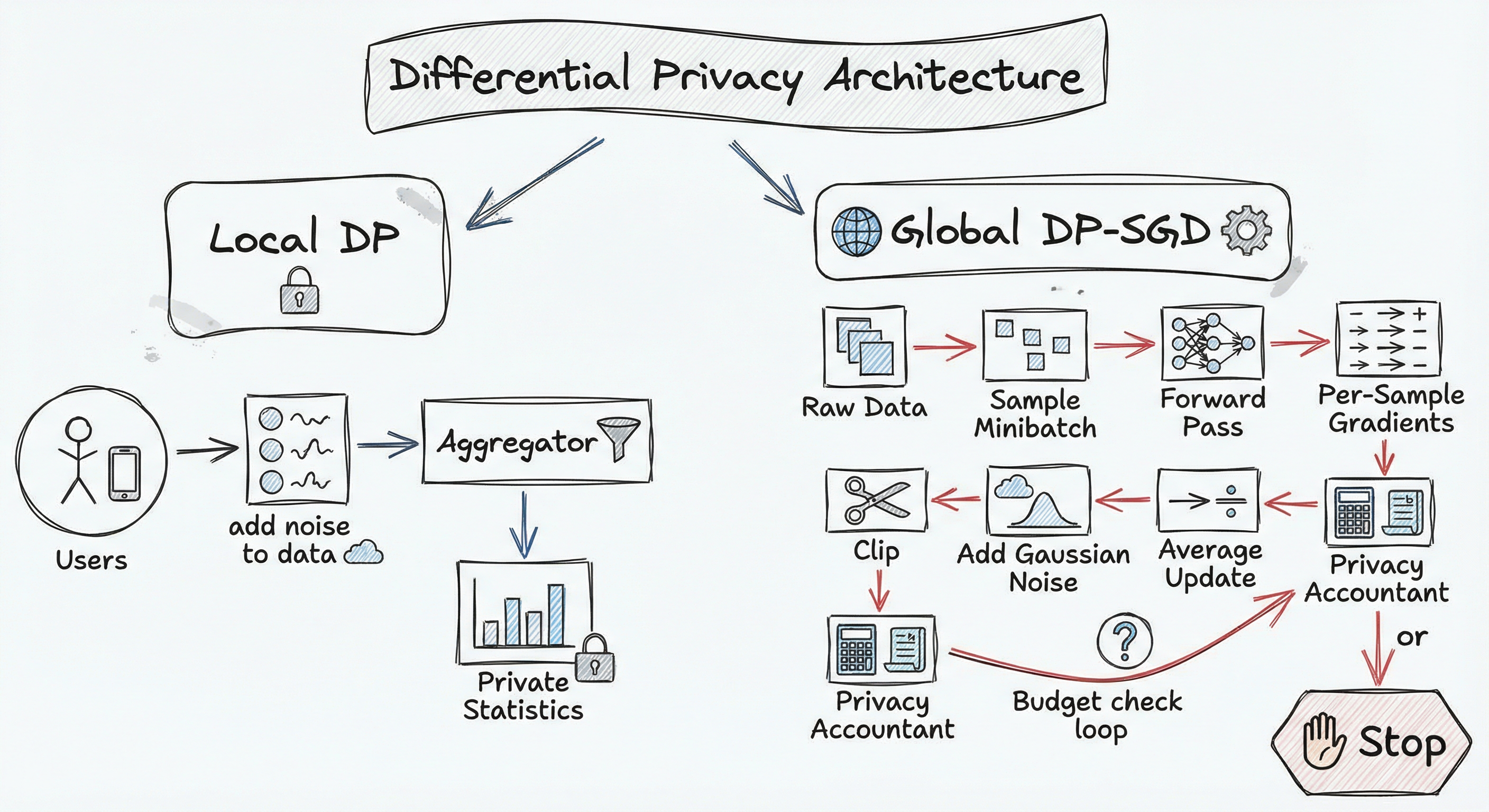
In the DP-SGD architecture (global DP for model training), the privacy accountant is critical -- it tracks cumulative privacy loss across all training iterations using the moments accountant or Renyi DP framework, and halts training when the privacy budget is exhausted.
Key Components
Noise Mechanism
The core component that adds calibrated random noise to computation outputs. The Laplace mechanism adds noise from for pure -DP, providing heavier tails suitable for low-dimensional queries. The Gaussian mechanism adds noise from with for -DP, preferred for high-dimensional outputs like gradients. The exponential mechanism selects outputs from a discrete set without directly adding noise, useful for categorical queries.
Sensitivity Calculator
Computes the global sensitivity of the target function -- the maximum change in output caused by adding or removing one individual. For counting queries, . For mean queries on values in , . For gradient vectors in DP-SGD, sensitivity is bounded by the clipping threshold . Accurate sensitivity computation is critical: overestimating leads to unnecessary noise (utility loss), underestimating leads to privacy violations.
Per-Sample Gradient Clipper
In DP-SGD, clips each individual training example's gradient to bound its norm at a threshold : . This ensures no single training example can have an outsized influence on the model update, which is essential for bounding sensitivity. The clipping threshold is a hyperparameter that trades off bias (too aggressive clipping distorts gradients) against privacy (higher requires more noise).
Privacy Accountant
Tracks the cumulative privacy loss ( spent) across all training iterations or queries. The moments accountant (Abadi et al., 2016) and the Renyi Differential Privacy (RDP) accountant (Mironov, 2017) provide tighter composition bounds than naive -addition. Given a noise multiplier , sampling rate (batch size / dataset size), and number of steps , the accountant computes the total guarantee. Implemented in Opacus (PrivacyEngine) and TensorFlow Privacy (compute_dp_sgd_privacy).
Subsampling Amplification
Exploits the fact that training on a random subsample of the dataset provides stronger privacy than training on the full dataset. If a mechanism is -DP and we apply it to a random subsample of rate , the effective privacy is approximately -DP. This privacy amplification by subsampling is why minibatch SGD naturally helps with privacy -- smaller batch sizes (relative to dataset size) amplify the privacy guarantee of each step.
Post-Processing Immunity
A fundamental property of DP: any computation on the output of a differentially private mechanism is also differentially private with the same parameters. This means once you have a DP model or DP query result, you can perform arbitrary post-processing (fine-tuning predictions, computing derived statistics, visualization) without additional privacy cost. This property makes DP composable with downstream ML pipeline stages.
Data Flow
DP-SGD Training Flow (the most common DP architecture for ML):
-
Initialize: Set privacy budget , clipping threshold , noise multiplier , batch size , and dataset size . Initialize model parameters .
-
Compute sampling rate: . Lower provides stronger privacy amplification per step.
-
For each training step :
- Sample a random minibatch of size via Poisson sampling (each record included independently with probability ).
- Compute per-sample gradients for each .
- Clip each gradient: .
- Aggregate and add noise: .
- Update model: .
- Privacy accounting: Update the moments accountant with for this step.
-
Check budget: Query the accountant for the current . If , stop training.
-
Release model: The final model weights satisfy -DP with respect to the training data.
Key Insight: The noise is added to the sum of clipped gradients, not to individual gradients. This is global DP -- the server (training process) sees raw gradients but the output (model weights) is private. In federated learning with local DP, each client clips and noises their own gradient update before sending it to the server.
The diagram shows two architectural patterns. The top section illustrates Local Differential Privacy where three users each independently add noise (yellow) to their data before sending to a central aggregator that produces private statistics. The bottom section shows Global DP via DP-SGD: raw training data flows through minibatch sampling, forward pass, per-sample gradient computation, gradient clipping (red), Gaussian noise addition (blue), and averaged model update. A privacy accountant (purple) tracks cumulative epsilon after each step and checks whether the budget is exhausted, either looping back for another training step or stopping.
How to Implement
Implementation Approaches for Differential Privacy in ML
There are four main paths to implementing differential privacy, each suited to different use cases:
Approach 1: Opacus (PyTorch DP-SGD) -- Meta's Opacus library wraps existing PyTorch models with minimal code changes. You attach a PrivacyEngine to your optimizer, specify the target epsilon, and Opacus handles per-sample gradient computation, clipping, noise addition, and privacy accounting automatically. Best for PyTorch users who want to add DP to existing training pipelines.
Approach 2: TensorFlow Privacy (TF DP-SGD) -- Google's TensorFlow Privacy provides drop-in replacement optimizers (DPKerasSGDOptimizer, DPKerasAdamOptimizer) that implement DP-SGD within the TF/Keras ecosystem. Privacy guarantees are computed using a separate analysis module. Best for TensorFlow/Keras users.
Approach 3: SmartNoise / OpenDP (Statistical Queries) -- SmartNoise, developed by Microsoft and Harvard as part of the OpenDP initiative, provides differentially private SQL queries and synthetic data generation. Rather than training ML models with DP, it adds noise to database queries or generates private synthetic datasets. Best for data analysts who need DP statistics without building ML models.
Approach 4: Custom Implementation -- For specialized mechanisms (local DP, exponential mechanism, private selection), implement the noise mechanism directly. This requires careful sensitivity analysis and privacy accounting but provides maximum flexibility. Best for research or novel DP applications.
Cost and Performance Considerations
DP-SGD training is 2-10x slower than standard SGD due to per-sample gradient computation (which prevents efficient batched matrix operations). Memory usage increases by 2-3x because individual gradients must be stored before clipping. For a BERT-base model (110M parameters), DP-SGD training on 8x A100 GPUs costs approximately 50-100 (~INR 4,200-8,400) for standard training.
Recent optimizations like ghost clipping (computing clipped gradient norms without materializing individual gradients) and LoRA + DP (applying DP only to low-rank adapter weights) reduce overhead to 1.3-2x, making DP training increasingly practical.
import torch
import torch.nn as nn
import torch.optim as optim
from torch.utils.data import DataLoader, TensorDataset
from opacus import PrivacyEngine
from opacus.validators import ModuleValidator

# Step 1: Define a simple model
model = nn.Sequential(
    nn.Linear(784, 256),
    nn.ReLU(),
    nn.Linear(256, 10)
)

# Step 2: Validate model compatibility with Opacus
# (replaces BatchNorm with GroupNorm, etc.)
model = ModuleValidator.fix(model)
errors = ModuleValidator.validate(model, strict=False)
assert len(errors) == 0, f"Model incompatible with Opacus: {errors}"

# Step 3: Standard PyTorch setup
optimizer = optim.Adam(model.parameters(), lr=1e-3)
criterion = nn.CrossEntropyLoss()

# Dummy data (replace with real dataset)
X = torch.randn(10000, 784)
y = torch.randint(0, 10, (10000,))
dataset = TensorDataset(X, y)
dataloader = DataLoader(dataset, batch_size=256, shuffle=True)

# Step 4: Attach PrivacyEngine
# This wraps the model, optimizer, and dataloader for DP-SGD
privacy_engine = PrivacyEngine()

model, optimizer, dataloader = privacy_engine.make_private_with_epsilon(
    module=model,
    optimizer=optimizer,
    data_loader=dataloader,
    target_epsilon=3.0,        # Total privacy budget
    target_delta=1e-5,         # Failure probability
    epochs=10,                 # Number of training epochs
    max_grad_norm=1.0,         # Gradient clipping threshold C
)

# Step 5: Train with DP-SGD (same loop as standard PyTorch!)
for epoch in range(10):
    total_loss = 0
    for batch_X, batch_y in dataloader:
        optimizer.zero_grad()
        output = model(batch_X)
        loss = criterion(output, batch_y)
        loss.backward()
        optimizer.step()  # Opacus handles clipping + noise
        total_loss += loss.item()

    # Check current epsilon spent
    epsilon = privacy_engine.get_epsilon(delta=1e-5)
    print(f"Epoch {epoch+1}: Loss={total_loss/len(dataloader):.4f}, "
          f"Epsilon={epsilon:.2f}")

# Step 6: Final privacy guarantee
final_epsilon = privacy_engine.get_epsilon(delta=1e-5)
print(f"\nTraining complete. Final (epsilon, delta) = ({final_epsilon:.2f}, 1e-5)")
This example demonstrates the minimal code changes needed to add differential privacy to a PyTorch training loop using Opacus:
ModuleValidator.fix(): Automatically replaces DP-incompatible layers (e.g.,BatchNormwithGroupNorm) since batch normalization leaks information across samples.PrivacyEngine.make_private_with_epsilon(): Wraps the model, optimizer, and dataloader. Opacus automatically computes the required noise multiplier to achieve the target within the given number of epochs.max_grad_norm=1.0: Sets the clipping threshold . Per-sample gradients with norm exceeding 1.0 are scaled down.optimizer.step(): Under the hood, Opacus computes per-sample gradients, clips them, adds Gaussian noise to the sum, and updates model weights.get_epsilon(): Queries the RDP accountant for the cumulative epsilon spent so far.
The training loop is identical to standard PyTorch -- Opacus handles all DP mechanics transparently.
import numpy as np
from typing import Tuple

def laplace_mechanism(
    true_value: float,
    sensitivity: float,
    epsilon: float
) -> float:
    """Add Laplace noise for epsilon-differential privacy.

    Args:
        true_value: The true answer to the query.
        sensitivity: Global sensitivity (max change from one record).
        epsilon: Privacy budget (smaller = more private).

    Returns:
        Noisy answer satisfying epsilon-DP.
    """
    scale = sensitivity / epsilon  # Laplace scale parameter b
    noise = np.random.laplace(loc=0, scale=scale)
    return true_value + noise

def private_mean(
    data: np.ndarray,
    lower_bound: float,
    upper_bound: float,
    epsilon: float
) -> Tuple[float, float]:
    """Compute differentially private mean.

    Splits epsilon budget: half for count, half for sum.
    """
    n = len(data)
    clipped = np.clip(data, lower_bound, upper_bound)

    # Split privacy budget
    eps_count = epsilon / 2
    eps_sum = epsilon / 2

    # Private count (sensitivity = 1)
    private_n = laplace_mechanism(n, sensitivity=1.0, epsilon=eps_count)
    private_n = max(private_n, 1)  # Avoid division by zero

    # Private sum (sensitivity = upper - lower)
    true_sum = np.sum(clipped)
    sensitivity_sum = upper_bound - lower_bound
    private_sum = laplace_mechanism(true_sum, sensitivity_sum, eps_sum)

    return private_sum / private_n, epsilon

# Example: Private salary statistics
np.random.seed(42)
salaries_inr = np.random.normal(800000, 200000, size=5000)  # INR
salaries_inr = np.clip(salaries_inr, 200000, 2000000)

true_mean = np.mean(salaries_inr)
print(f"True mean salary: INR {true_mean:,.0f}")

# Compute private mean with different epsilon values
for eps in [0.1, 0.5, 1.0, 5.0, 10.0]:
    results = [private_mean(salaries_inr, 200000, 2000000, eps)[0]
               for _ in range(100)]
    avg_estimate = np.mean(results)
    std_estimate = np.std(results)
    error_pct = abs(avg_estimate - true_mean) / true_mean * 100
    print(f"  eps={eps:>5.1f}: INR {avg_estimate:>12,.0f} "
          f"(+/- {std_estimate:>10,.0f}, error: {error_pct:.2f}%)")
This example implements the Laplace mechanism from scratch, demonstrating the core DP building block:
laplace_mechanism(): Adds noise from to the true value. The noise scale decreases with larger (less privacy, more accuracy).private_mean(): Shows how to compose two private queries (count + sum) using budget splitting -- each sub-query gets half the total . By basic composition, the total privacy cost is .- Sensitivity analysis: The count query has sensitivity 1 (adding/removing one person changes count by 1). The sum query has sensitivity
upper - lower(one person's contribution is bounded by the data range after clipping). - Privacy-utility tradeoff: Running with different values shows that (strong privacy) has high variance (~10-20% error), while (weak privacy) is nearly exact (<0.5% error). The sweet spot for most applications is .
import tensorflow as tf
from tensorflow_privacy.privacy.optimizers.dp_optimizers_keras import (
    DPKerasAdamOptimizer
)
from tensorflow_privacy.privacy.analysis import compute_dp_sgd_privacy_lib

# Hyperparameters
EPOCHS = 10
BATCH_SIZE = 256
DATASET_SIZE = 60000
L2_NORM_CLIP = 1.0      # Gradient clipping threshold
NOISE_MULTIPLIER = 1.1  # sigma (noise scale)
LEARNING_RATE = 0.001

# Build model (avoid BatchNormalization -- use LayerNormalization)
model = tf.keras.Sequential([
    tf.keras.layers.Flatten(input_shape=(28, 28)),
    tf.keras.layers.Dense(256, activation='relu'),
    tf.keras.layers.LayerNormalization(),
    tf.keras.layers.Dense(128, activation='relu'),
    tf.keras.layers.Dense(10)
])

# Use DP optimizer (drop-in replacement for Adam)
optimizer = DPKerasAdamOptimizer(
    l2_norm_clip=L2_NORM_CLIP,
    noise_multiplier=NOISE_MULTIPLIER,
    num_microbatches=BATCH_SIZE,  # One microbatch per sample
    learning_rate=LEARNING_RATE
)

# IMPORTANT: Use reduction=NONE so per-sample losses are preserved
loss = tf.keras.losses.SparseCategoricalCrossentropy(
    from_logits=True,
    reduction=tf.losses.Reduction.NONE  # Critical for DP!
)

model.compile(optimizer=optimizer, loss=loss, metrics=['accuracy'])

# Load and preprocess MNIST
(x_train, y_train), (x_test, y_test) = tf.keras.datasets.mnist.load_data()
x_train = x_train.astype('float32') / 255.0
x_test = x_test.astype('float32') / 255.0

# Train with DP-SGD
model.fit(
    x_train, y_train,
    epochs=EPOCHS,
    batch_size=BATCH_SIZE,
    validation_data=(x_test, y_test),
    verbose=1
)

# Compute final privacy guarantee
epsilon, best_alpha = compute_dp_sgd_privacy_lib.compute_dp_sgd_privacy(
    n=DATASET_SIZE,
    batch_size=BATCH_SIZE,
    noise_multiplier=NOISE_MULTIPLIER,
    epochs=EPOCHS,
    delta=1e-5
)

print(f"\nPrivacy guarantee: (epsilon={epsilon:.2f}, delta=1e-5)")
print(f"Optimal RDP order: alpha={best_alpha}")
This example shows DP-SGD training in TensorFlow using the tensorflow-privacy library:
DPKerasAdamOptimizer: Drop-in replacement fortf.keras.optimizers.Adamthat performs per-sample gradient clipping and noise addition. Thel2_norm_clipparameter sets andnoise_multipliersets .num_microbatches=BATCH_SIZE: Setting microbatches equal to batch size ensures per-sample gradient clipping (each sample is its own microbatch). For memory efficiency, you can use fewer microbatches (grouping samples), but this provides weaker per-sample privacy.reduction=NONE: Critical -- the loss function must NOT reduce (sum/mean) across samples, because the DP optimizer needs individual per-sample losses to compute per-sample gradients.compute_dp_sgd_privacy(): Post-hoc analysis function that computes the total -DP guarantee given the training parameters. It uses RDP accounting to find the tightest bound across all Renyi orders .- No BatchNormalization: Batch norm computes statistics across the batch, leaking information about other samples. Use
LayerNormalizationorGroupNormalizationinstead.
import numpy as np
from dataclasses import dataclass, field
from typing import List, Tuple

@dataclass
class PrivacyBudgetTracker:
    """Track cumulative privacy loss using basic and advanced composition."""
    total_budget_epsilon: float
    total_budget_delta: float
    queries: List[Tuple[float, float]] = field(default_factory=list)

    def add_query(self, epsilon: float, delta: float = 0.0) -> bool:
        """Record a query and check if budget is exceeded.

        Returns True if query is within budget, False otherwise.
        """
        # Check if adding this query exceeds budget
        test_queries = self.queries + [(epsilon, delta)]
        eps_basic, delta_basic = self._basic_composition(test_queries)
        eps_adv, delta_adv = self._advanced_composition(test_queries)

        # Use the tighter bound
        effective_eps = min(eps_basic, eps_adv)
        effective_delta = min(delta_basic, delta_adv)

        if effective_eps <= self.total_budget_epsilon and \
           effective_delta <= self.total_budget_delta:
            self.queries.append((epsilon, delta))
            return True
        else:
            print(f"BUDGET EXCEEDED: Would need eps={effective_eps:.4f} "
                  f"(budget={self.total_budget_epsilon})")
            return False

    def _basic_composition(self, queries) -> Tuple[float, float]:
        """Basic composition: sum of epsilons and deltas."""
        total_eps = sum(eps for eps, _ in queries)
        total_delta = sum(delta for _, delta in queries)
        return total_eps, total_delta

    def _advanced_composition(
        self, queries, delta_prime: float = 1e-6
    ) -> Tuple[float, float]:
        """Advanced composition theorem (Dwork et al. 2010)."""
        k = len(queries)
        if k == 0:
            return 0.0, 0.0

        # Assuming uniform epsilon for simplicity
        eps_max = max(eps for eps, _ in queries)
        total_delta = sum(delta for _, delta in queries)

        # Advanced composition bound
        eps_composed = (
            np.sqrt(2 * k * np.log(1 / delta_prime)) * eps_max
            + k * eps_max * (np.exp(eps_max) - 1)
        )
        delta_composed = total_delta + delta_prime

        return eps_composed, delta_composed

    @property
    def remaining_budget(self) -> Tuple[float, float]:
        """Return remaining (epsilon, delta) budget."""
        if not self.queries:
            return self.total_budget_epsilon, self.total_budget_delta

        eps_basic, delta_basic = self._basic_composition(self.queries)
        eps_adv, delta_adv = self._advanced_composition(self.queries)

        effective_eps = min(eps_basic, eps_adv)
        effective_delta = min(delta_basic, delta_adv)

        return (
            self.total_budget_epsilon - effective_eps,
            self.total_budget_delta - effective_delta
        )

    def summary(self):
        """Print budget usage summary."""
        remaining_eps, remaining_delta = self.remaining_budget
        print(f"Privacy Budget Summary:")
        print(f"  Total queries: {len(self.queries)}")
        print(f"  Budget: eps={self.total_budget_epsilon}, "
              f"delta={self.total_budget_delta}")
        print(f"  Remaining: eps={remaining_eps:.4f}, "
              f"delta={remaining_delta:.6f}")
        pct = (1 - remaining_eps / self.total_budget_epsilon) * 100
        print(f"  Usage: {pct:.1f}%")

# Example: Data analyst with limited privacy budget
tracker = PrivacyBudgetTracker(
    total_budget_epsilon=5.0,
    total_budget_delta=1e-5
)

# Simulate analyst queries
queries = [
    ("Count of users in Delhi", 0.5),
    ("Average transaction amount", 1.0),
    ("Median age by city", 0.8),
    ("Revenue by product category", 1.5),
    ("Click-through rate by segment", 2.0),  # This might exceed!
]

for description, eps in queries:
    success = tracker.add_query(epsilon=eps)
    status = "APPROVED" if success else "DENIED"
    print(f"  [{status}] {description} (eps={eps})")

tracker.summary()
This example demonstrates privacy budget management -- a critical operational concern in DP deployments:
- Budget tracking: Each query against the private dataset consumes some . The tracker accumulates privacy loss and prevents queries that would exceed the total budget.
- Basic vs. advanced composition: Basic composition sums values linearly (), while advanced composition grows as for queries. The tracker uses whichever gives the tighter bound.
- Practical implication: With a total budget of , an analyst can run ~5-10 queries at each (basic composition) or potentially more using advanced composition. Once the budget is exhausted, no more queries are allowed until new data is collected.
- India use case: For a fintech company analyzing UPI transaction data under DPDP Act compliance, the budget tracker ensures that no combination of analytics reports can leak individual transaction details.
# DP-SGD Training Configuration (YAML)
privacy:
  target_epsilon: 3.0          # Total privacy budget
  target_delta: 1e-5           # Failure probability
  max_grad_norm: 1.0           # Per-sample gradient clipping C
  noise_multiplier: auto       # Auto-computed from epsilon/epochs
  accounting_mode: rdp          # 'rdp' (Renyi) or 'gdp' (Gaussian)
  secure_mode: false            # Cryptographic noise generation

model:
  architecture: resnet18
  replace_batchnorm: true       # Auto-replace BatchNorm with GroupNorm
  num_groups: 32                # GroupNorm groups

training:
  epochs: 20
  batch_size: 256
  learning_rate: 0.001
  optimizer: adam
  dataset_size: 60000
  poisson_sampling: true        # Required for tight DP accounting

budget_management:
  total_budget_epsilon: 10.0    # Organization-wide budget
  allocated_training: 5.0       # Budget for this training run
  allocated_evaluation: 2.0     # Budget for evaluation queries
  allocated_tuning: 3.0         # Budget for hyperparameter search
  alert_threshold: 0.8          # Alert when 80% budget consumed
Common Implementation Mistakes
- ●
Using BatchNormalization with DP-SGD: Batch normalization computes mean and variance across the batch, creating inter-sample dependencies that violate DP's per-sample privacy guarantee. The batch statistics leak information about other samples in the minibatch. Solution: replace
BatchNormwithGroupNorm,LayerNorm, orInstanceNorm. Opacus'sModuleValidator.fix()does this automatically. - ●
Ignoring privacy budget composition: Each training epoch, each query, each model evaluation on private data consumes privacy budget. Teams often track per-step epsilon but forget that the total epsilon across all steps (and across all uses of the private data, including hyperparameter tuning) must be bounded. Solution: use a centralized privacy accountant (moments accountant or RDP) and include ALL data accesses in the accounting.
- ●
Setting clipping threshold C too high or too low: Too low ( typical gradient norm) aggressively clips most gradients, introducing bias and slow convergence. Too high ( typical gradient norm) provides no clipping benefit but requires proportionally more noise (). Solution: set to the median or 75th percentile of per-sample gradient norms observed during a non-private warm-up run.
- ●
Confusing local DP and global DP guarantees: Local DP (noise added on-device) with is MUCH stronger than global DP with because local DP protects against a malicious server. Comparing values across local and global models is misleading. Solution: always specify the trust model (local vs. global) when quoting privacy parameters.
- ●
Treating delta as unimportant: Setting or effectively provides no privacy guarantee (50-100% chance of catastrophic failure). A common rule of thumb is where is the dataset size (e.g., for 100K records). Solution: fix to a cryptographically small value and report for that .
- ●
Using non-private hyperparameter tuning on private data: If you tune learning rate, clipping threshold, or noise multiplier by evaluating on the private dataset, each evaluation consumes privacy budget. Running 50 hyperparameter configurations effectively 50x your privacy loss. Solution: use public data for hyperparameter tuning, or allocate a portion of the privacy budget explicitly for tuning. Alternatively, use established hyperparameter recommendations from the literature.
When Should You Use This?
Use When
You are training ML models on sensitive personal data (medical records, financial transactions, biometric data, location history) and need provable privacy guarantees that go beyond anonymization
Your organization must comply with privacy regulations like India's DPDP Act 2023, GDPR, HIPAA, or CCPA and needs a mathematically verifiable privacy mechanism for audit and compliance
You need to share data or model outputs with external parties (researchers, partners, regulators) without risking individual privacy -- DP provides formal guarantees regardless of adversary capabilities
You are building a federated learning system where multiple parties (hospitals, banks, telecom operators) collaborate on model training without revealing their raw data
You want to release aggregate statistics (Census data, public health reports, usage analytics) where attackers might use auxiliary information to re-identify individuals
You need to generate synthetic data with formal privacy guarantees -- DP mechanisms ensure the synthetic data does not leak information about specific individuals in the source dataset
You are deploying user-facing analytics (ad performance reports, engagement metrics) where individual user actions must be protected from the platform operator or downstream consumers
Avoid When
Your data is already public or non-sensitive (e.g., Wikipedia text, public domain images, weather data) -- DP adds unnecessary noise and reduces model quality for no privacy benefit
You have a very small dataset (<1000 records) -- DP noise scales with regardless of dataset size, so the signal-to-noise ratio becomes unacceptably low for small datasets. The noise overwhelms the signal.
You need individual-level predictions rather than aggregate statistics -- DP protects individuals within aggregates; it does not help when the goal is to produce per-person outputs (e.g., personalized recommendations must use the person's data)
Your privacy threat model is data breaches rather than inference attacks -- DP protects against statistical inference on query outputs, not against an attacker who gains direct access to the raw database. Use encryption and access control for breach protection.
You are in an exploratory research phase with rapidly changing models and objectives -- DP's privacy budget is finite and non-renewable for a given dataset. Burning budget during exploration leaves nothing for the final model.
The privacy-utility tradeoff is unacceptable for your application -- strong DP () can reduce model accuracy by 5-20%, which may be intolerable for safety-critical applications (medical diagnosis, autonomous driving)
Key Tradeoffs
The Fundamental Privacy-Utility Tradeoff
Differential privacy's central tradeoff is between privacy strength (lower ) and data utility (model accuracy, statistical precision). This tradeoff is inherent and cannot be eliminated -- it is a mathematical fact that perfect privacy () requires releasing pure noise, while perfect utility () provides no privacy.
| Privacy Level | Epsilon () | Typical Utility Impact | Use Case |
|---|---|---|---|
| Very strong | 0.01 - 0.1 | 15-30% accuracy drop | Census data, public health |
| Strong | 0.1 - 1.0 | 5-15% accuracy drop | Medical records, financial data |
| Moderate | 1.0 - 5.0 | 2-8% accuracy drop | User analytics, ad targeting |
| Weak | 5.0 - 10.0 | <3% accuracy drop | Internal analytics, low-risk data |
| Nominal | >10.0 | <1% accuracy drop | Compliance checkbox (limited protection) |
Dataset Size Matters
The privacy-utility tradeoff improves with larger datasets. DP noise has fixed magnitude (determined by and sensitivity), while the signal strength grows with or . For a counting query with :
- : Noise ~ Laplace(1), relative error ~ 1% per record = substantial
- : Same noise, relative error ~ 0.01% per record = negligible
- : Same noise, relative error ~ 0.0001% = invisible
This is why DP works well for Apple (billions of devices) and the U.S. Census (330M people) but is challenging for a small hospital with 500 patient records.
Cost of DP Training
| Metric | Standard Training | DP Training () | Overhead |
|---|---|---|---|
| Training time | 1x | 2-5x | Per-sample gradients |
| Memory usage | 1x | 2-3x | Storing individual gradients |
| Final accuracy | Baseline | -3 to -10% | Noise in gradients |
| Cloud cost (INR) | ₹4,200 | ₹8,400-21,000 | GPU hours |
| Hyperparameter tuning | Standard grid search | Limited by privacy budget | Must use public data or allocate budget |
Alternatives & Comparisons
Privacy filters remove or mask personally identifiable information (names, email addresses, Aadhaar numbers) from data. This is simpler to implement but provides no formal guarantee -- an adversary with auxiliary information can still re-identify individuals from masked data (as demonstrated in the Netflix and AOL attacks). Choose privacy filters for quick PII removal in low-risk scenarios. Choose differential privacy when you need mathematical guarantees against sophisticated adversaries.
Federated synthesis generates synthetic data from distributed sources without centralizing raw data. It addresses the data centralization problem but does not inherently provide differential privacy guarantees -- the synthetic data may still leak information about individual training records unless DP is explicitly added. Choose federated synthesis when data cannot leave its source (regulatory or contractual constraints). Combine with differential privacy (DP-FedAvg) for formal privacy guarantees.
Standard GANs can generate realistic synthetic data but provide no privacy guarantees -- they can memorize and reproduce training examples. DP-GAN variants (DP-CTGAN, PATE-GAN) combine GANs with differential privacy for provably private synthetic data. Choose standard GANs when privacy is not a concern and maximum sample quality is needed. Choose DP-GAN when you need both realistic synthetic data and formal privacy guarantees, accepting a quality reduction.
K-anonymity ensures each record is indistinguishable from at least other records by generalizing quasi-identifiers. It is simpler to implement but has well-known weaknesses: vulnerable to composition attacks, homogeneity attacks, and background knowledge attacks. K-anonymity provides a syntactic guarantee (data looks similar) while DP provides a semantic guarantee (outputs are indistinguishable). Choose k-anonymity for legacy compliance requirements. Choose DP for robust privacy against adaptive adversaries.
Pros, Cons & Tradeoffs
Advantages
Mathematically rigorous guarantee: Unlike heuristic anonymization, DP provides a formal, quantifiable bound on privacy loss parameterized by . This guarantee holds against adversaries with unlimited computational power and arbitrary auxiliary information -- the strongest possible threat model.
Composable privacy accounting: DP's composition theorems allow precise tracking of cumulative privacy loss across multiple queries, training epochs, and data uses. Advanced composition ( growth) and Renyi DP accounting enable tight budgets for iterative algorithms like SGD.
Post-processing immunity: Any computation on the output of a DP mechanism is automatically DP with the same parameters. Once you have a DP model, you can deploy, fine-tune (on public data), distill, and query it without additional privacy cost.
Regulatory compliance enabler: DP provides auditable, mathematically verifiable privacy -- exactly what regulators under DPDP Act, GDPR, and HIPAA seek. Organizations can demonstrate compliance by reporting values rather than relying on subjective assessments of anonymization quality.
Works across data modalities: DP mechanisms apply to tabular data (Laplace mechanism), images (DP-SGD for CNNs), text (DP fine-tuning for LLMs), and aggregate statistics (Census, analytics). The same theoretical framework covers all use cases.
Production-ready tooling: Libraries like Opacus (PyTorch), TensorFlow Privacy, and SmartNoise provide drop-in implementations that require minimal code changes. Ghost clipping and LoRA integration reduce computational overhead to practical levels.
Enables data sharing and collaboration: DP allows organizations to share aggregate statistics, trained models, or synthetic data with formal guarantees that no individual's information is leaked -- enabling research collaborations (hospital networks, financial consortia) that would otherwise be impossible under privacy regulations.
Disadvantages
Utility degradation: Adding noise inherently reduces model accuracy and statistical precision. For strong privacy (), accuracy drops of 5-20% are common. This can be unacceptable for safety-critical applications (medical diagnosis, fraud detection) where every percentage point matters.
Finite, non-renewable privacy budget: Once the privacy budget is spent, no more queries or training runs are possible on the same dataset without reducing privacy guarantees. This creates operational constraints -- every exploration, hyperparameter search, and model evaluation consumes budget permanently.
Computational overhead for DP-SGD: Per-sample gradient computation prevents efficient batched operations, increasing training time by 2-5x and memory by 2-3x. For large models (billions of parameters), this overhead can be prohibitive without techniques like ghost clipping or LoRA.
Challenging to calibrate: Choosing the right , clipping threshold , noise multiplier , and training duration requires expertise. There is no universal "good" epsilon -- the appropriate value depends on the sensitivity of the data, the dataset size, the threat model, and regulatory requirements.
Poor performance on small datasets: DP noise has fixed magnitude regardless of dataset size, so the signal-to-noise ratio degrades rapidly for small datasets (< 5,000 records). This is particularly problematic for rare disease studies, niche markets, or startup datasets in India where data is scarce.
Does not protect against all threats: DP protects against inference from computational outputs, not against database breaches, insider threats, or side-channel attacks. It is one layer of a defense-in-depth strategy, not a complete privacy solution.
Epsilon interpretation challenge: While is mathematically precise, interpreting its practical meaning for stakeholders ("what does mean for my users?") is difficult. There is no consensus on what constitutes an acceptable -- Apple uses per day (local DP), the Census uses (global DP), and academic papers often target .
Failure Modes & Debugging
Privacy Budget Exhaustion
Cause
The total privacy budget () is consumed by repeated queries, training epochs, hyperparameter searches, or model evaluations on the same dataset. Teams often underestimate how quickly the budget is spent -- each epoch of DP-SGD consumes budget, each analyst query consumes budget, and even debugging evaluations consume budget. Without centralized accounting, different teams may independently consume budget against the same data.
Symptoms
The privacy accountant reports exceeding the target, requiring either accepting weaker privacy guarantees or discarding the trained model. Analysts are blocked from running additional queries. Hyperparameter searches are cut short, resulting in suboptimal model configurations. The organization discovers retroactively that more budget was consumed than intended.
Mitigation
Implement a centralized privacy ledger that tracks all epsilon expenditures across teams and projects for each dataset. Allocate budget upfront: e.g., 60% for training, 20% for evaluation, 20% for analyst queries. Use public data or synthetic data for hyperparameter tuning and debugging to avoid consuming private budget. Consider the sparse vector technique for answering many queries with limited budget by only revealing queries whose answers exceed a threshold.
Excessive Gradient Clipping Bias
Cause
The gradient clipping threshold in DP-SGD is set too low, causing most per-sample gradients to be aggressively clipped. This introduces systematic bias in the gradient estimates -- the clipped average no longer points in the true gradient direction. The model converges to a suboptimal solution or fails to converge entirely, especially for layers with naturally large gradient magnitudes (embedding layers, early convolutional layers).
Symptoms
Training loss plateaus at a high value despite sufficient epochs. Model accuracy is significantly worse than expected (beyond the noise-induced degradation). Gradient norms after clipping are consistently equal to for most samples (indicating all gradients are being clipped). Learning curves show no improvement after initial epochs.
Mitigation
Adaptively set : Run a few non-private training steps to observe the distribution of per-sample gradient norms. Set to the median or 75th percentile of observed norms. Use per-layer clipping (clip each layer's gradients independently) to handle layers with different gradient scales. Consider automatic clipping techniques that adapt during training based on gradient statistics. Opacus supports max_grad_norm as a tunable hyperparameter -- include it in (budget-limited) hyperparameter search.
Noise Multiplier Miscalibration
Cause
The noise multiplier is set incorrectly for the desired privacy guarantee. A common error is computing based on incorrect assumptions about the sampling rate (), the number of training steps, or the composition theorem used. For example, using basic composition instead of RDP accounting gives a conservative (wastefully noisy) estimate. Conversely, computing with the wrong dataset size can result in insufficient noise and a violated privacy guarantee.
Symptoms
When is too high: model fails to learn, gradients are dominated by noise, accuracy is near random chance. When is too low: post-hoc privacy analysis reveals is much higher than intended, violating the privacy contract. Discrepancy between the computed during planning and the reported after training.
Mitigation
Use library-provided utilities for computation: Opacus's make_private_with_epsilon() auto-computes from target , , epochs, and batch size. For manual computation, use the RDP accountant (not basic composition) for tight bounds. Always verify the final post-training using privacy_engine.get_epsilon() or compute_dp_sgd_privacy(). Validate by comparing the library's computed against analytical formulas.
Side-Channel Privacy Leakage
Cause
DP guarantees apply to the output of the mechanism, but side channels -- timing, memory access patterns, floating-point rounding, exception handling -- can leak information. For example, if the training loop takes longer for certain data points (due to variable-length sequences), an observer can infer properties of the training data from wall-clock time. Floating-point arithmetic is deterministic, so the Gaussian noise mechanism may not provide perfect statistical privacy in IEEE 754 representation.
Symptoms
Privacy auditing (membership inference attacks) succeeds at rates higher than the DP guarantee predicts. Timing analysis reveals correlations between training duration and data properties. Adversaries can distinguish between models trained with and without specific records despite DP guarantees.
Mitigation
Use secure mode in Opacus (secure_mode=True), which uses cryptographic random number generation and constant-time operations. Pad variable-length inputs to fixed sizes to eliminate timing side channels. Use discrete Gaussian mechanisms instead of continuous Gaussian for provable security under finite precision. Run empirical privacy audits (membership inference attacks) to validate that the implemented mechanism matches the theoretical guarantee.
Incompatible Model Architecture
Cause
Certain neural network components are incompatible with DP-SGD because they create dependencies between samples in a minibatch. Batch normalization computes statistics (mean, variance) across the batch, allowing one sample's data to influence another sample's gradient through shared normalization statistics. Multi-head attention with KV caching across samples, and data-dependent control flow (different computation paths for different samples) similarly break per-sample gradient isolation.
Symptoms
Opacus raises IncompatibleModuleError when wrapping the model. TensorFlow Privacy produces incorrect gradient estimates. Privacy guarantees are technically violated because per-sample gradients are not independent. Model produces unexpected artifacts or NaN losses during DP training.
Mitigation
Replace BatchNorm with GroupNorm, LayerNorm, or InstanceNorm (Opacus's ModuleValidator.fix() does this automatically). For transformers, ensure attention is computed independently per sample (no cross-sample KV sharing). Use DP-compatible architectures from the start: simple MLPs, ResNets with GroupNorm, and standard transformers all work well with DP-SGD. Test model compatibility with ModuleValidator.validate() before training.
Placement in an ML System
Where Differential Privacy Fits in the ML Pipeline
Differential privacy is not a single-point component but a cross-cutting concern that can be applied at multiple stages of the ML pipeline:
-
Data Collection (Local DP): Each data contributor (user device, hospital, bank branch) adds noise to their data before sending it to the central server. This is the Apple/Google model. The server aggregates noisy data to compute statistics or train models. No raw data is ever centralized.
-
Data Preprocessing (Global DP for Queries): A trusted data curator holds raw data and answers analyst queries with DP noise (Laplace or Gaussian mechanism). Used for exploratory data analysis, reporting, and dashboards. Each query consumes privacy budget.
-
Model Training (DP-SGD): The model training loop is modified to clip per-sample gradients and add noise. The resulting model weights are differentially private -- safe to release, deploy, or share. This is the most common application in production ML systems.
-
Synthetic Data Generation (DP-GAN): Train a generative model (GAN, VAE) with DP-SGD, then use it to generate unlimited synthetic data. The synthetic data inherits the DP guarantee of the generator via post-processing immunity. Useful for creating shareable datasets without privacy risk.
-
Model Serving (DP Predictions): Add noise to individual predictions at serving time. Less common because it degrades every prediction, but useful for specific scenarios like privacy-preserving recommendation explanations.
Typical Placement for Indian ML Systems: For a Razorpay-style fintech processing UPI transactions, DP would be applied at the training stage (DP-SGD for fraud detection models) and the analytics stage (DP queries for business intelligence dashboards showing transaction patterns). The raw transaction data stays encrypted at rest, and all external outputs (models, reports, APIs) carry DP guarantees to comply with RBI data localization and DPDP Act requirements.
Pipeline Stage
Data Generation / Privacy / Model Training
Upstream
- data-ingestion
- feature-store
- data-validation
Downstream
- model-registry
- model-serving
- federated-synth
- gan-generator
Scaling Bottlenecks
The primary bottleneck in DP-SGD is computing per-sample gradients. Standard backpropagation computes the gradient of the loss averaged over the minibatch -- a single efficient matrix multiplication. DP-SGD requires individual gradients for each sample to clip them independently, preventing batched computation. This increases memory by (storing separate gradient tensors) and time by .
Mitigation: Opacus supports ghost clipping (computing clipped gradient norms without materializing full per-sample gradients) and fast gradient clipping (introduced in Opacus August 2024) that significantly reduce memory requirements. LoRA + DP applies DP only to low-rank adapter parameters (a fraction of total parameters), reducing both memory and computation.
Unlike compute or storage, privacy budget is a non-renewable resource for a fixed dataset. As the organization scales its analytics and ML operations, more teams and models compete for the same finite . This creates organizational bottlenecks: who gets to use the budget? How is it allocated across training, evaluation, and ad-hoc queries?
Mitigation: Continuously collect new data (each new dataset has a fresh budget). Use public or synthetic data for non-critical operations. Implement organizational policies for budget allocation with governance boards.
DP-SGD for large language models (1B+ parameters) is particularly challenging because (1) per-sample gradient memory scales with model size, (2) noise magnitude scales with gradient dimensionality, and (3) privacy amplification via subsampling is less effective for small sampling rates. Training GPT-2 (1.5B params) with DP requires 8x A100 GPUs and costs ~500 (~INR 42K) non-private.
Mitigation: Use DP fine-tuning (not DP pre-training): pre-train on public data without DP, then fine-tune on private data with DP. This dramatically reduces the number of DP training steps and the associated privacy cost. LoRA + DP further reduces overhead by restricting DP to a small number of adapter parameters.
Production Case Studies
Apple deployed local differential privacy at scale starting with iOS 10 and macOS Sierra (2016). The system collects aggregate usage statistics -- popular emoji, frequently visited websites, health data type preferences -- from hundreds of millions of devices without tracking individual users. Each device locally randomizes its data before sending it to Apple's servers using a combination of hashing, subsampling, and the randomized response mechanism.
Apple processes billions of privatized records daily across multiple use cases. The system achieves per-datum privacy loss of with a daily cap of per user. Despite strong local DP guarantees, the massive user base (hundreds of millions) provides sufficient statistical power for accurate aggregate estimates of emoji popularity, website resource consumption, and health data usage patterns.
Google pioneered large-scale local DP with RAPPOR (Randomized Aggregatable Privacy-Preserving Ordinal Response), deployed in Chrome starting 2014. RAPPOR uses a two-stage randomized response: permanent randomization (applied once per client, creating a consistent but noisy representation) and instantaneous randomization (applied each time data is reported). This design enables longitudinal analysis of browsing patterns while maintaining privacy. Google also maintains the open-source differential privacy library providing DP building blocks in C++, Go, Java, and Python.
RAPPOR successfully identified popular Chrome homepage settings, malicious software processes on Windows machines, and TLS/SSL certificate usage patterns across millions of Chrome installations. Google subsequently expanded DP to its advertising platform (DP for conversion measurement), Google Maps (aggregate mobility reports during COVID-19), and federated learning for Gboard keyboard predictions.
The U.S. Census Bureau adopted differential privacy for the 2020 Census, replacing the previous "data swapping" approach after demonstrating that swapping was vulnerable to reconstruction attacks. The TopDown algorithm applies DP noise to population counts at multiple geographic levels (nation, state, county, census tract, block) with a hierarchical consistency constraint ensuring counts sum correctly across levels. This was the largest deployment of differential privacy ever undertaken.
The 2020 Census protected the privacy of 330 million respondents with a global epsilon of approximately 19.61 for the redistricting data. A Columbia Engineering study confirmed that DP was the correct choice, showing that the previous swapping method was both less private and less accurate. However, the deployment generated controversy among demographers who noted reduced accuracy for small population subgroups (rural areas, small racial groups), illustrating the inherent privacy-utility tradeoff at small scales.
LinkedIn developed PriPeARL (Privacy-Preserving Analytics and Reporting at LinkedIn), a framework that applies differential privacy to ad analytics reports. When advertisers view campaign performance metrics (impressions, clicks, conversions), the reported counts are perturbed with Laplace noise calibrated to satisfy event-level DP. This ensures that no single user's click or conversion can be identified from the aggregate reports, even by sophisticated advertisers with auxiliary data.
LinkedIn's DP analytics system serves millions of ad performance reports daily with event-level differential privacy. The system handles practical challenges like negative noisy counts (floored to zero), small-count suppression (counts below a threshold are hidden), and consistency across time-series reports. Advertisers experience minimal utility loss because campaign metrics involve large counts (thousands of impressions) where DP noise is negligible relative to the signal.
Researchers at the All India Institute of Medical Sciences (AIIMS) Delhi have explored differential privacy for sharing medical imaging datasets and patient records for collaborative research. Using DP-CTGAN (differentially private conditional tabular GAN), they generate synthetic electronic health records that preserve the statistical relationships between patient demographics, diagnoses, lab values, and outcomes. The synthetic data enables external researchers to develop and validate clinical prediction models without accessing real patient data -- critical for compliance with Indian health data regulations and the DPDP Act 2023.
Initial results demonstrate that DP-CTGAN with produces synthetic patient records with downstream model performance within 8-12% of models trained on real data. This enables multi-institutional research collaborations across Indian hospitals that were previously impossible due to data sharing restrictions. The privacy guarantees provide legal defensibility under the DPDP Act, where "reasonable security safeguards" are required for health data processing.
Tooling & Ecosystem
Meta's production-grade library for training PyTorch models with differential privacy. Provides a PrivacyEngine that wraps existing models and optimizers with minimal code changes. Supports per-sample gradient computation, automatic gradient clipping, Gaussian noise addition, and RDP-based privacy accounting. Recent additions include ghost clipping for memory efficiency and LoRA integration for large model fine-tuning.
Google's library for training TensorFlow/Keras models with DP-SGD. Provides drop-in replacement optimizers (DPKerasSGDOptimizer, DPKerasAdamOptimizer) and privacy analysis tools (compute_dp_sgd_privacy). Includes tutorials for MNIST classification, federated learning with DP, and membership inference testing. Split into two packages: tensorflow-privacy (training) and tensorflow-empirical-privacy (privacy testing).
Google's core differential privacy library providing building blocks (Laplace mechanism, Gaussian mechanism, bounded mean/sum/count) in C++, Go, Java, and Python. Includes a privacy-on-beam library for Apache Beam pipelines, a stochastic tester for verifying DP implementations, and a privacy accounting library. The most comprehensive multi-language DP toolkit available.
A joint initiative between Microsoft and Harvard providing differentially private tools for statistical analysis and synthetic data generation. SmartNoise includes a SQL processing layer (add DP noise to SQL queries) and a synthetic data layer (generate private tabular datasets). The OpenDP library provides a modular, composable framework for building custom DP mechanisms with provable guarantees. Written in Rust for memory safety with Python bindings.
Commercial platform for enterprise differential privacy, built by former Census Bureau DP researchers. Provides a high-level API for differentially private analytics on Apache Spark, handling budget tracking, noise calibration, and post-processing automatically. Used by the U.S. Census Bureau, IRS, and other government agencies for privacy-preserving data releases. Offers both open-source core and enterprise features.
An open-source framework by OpenMined for running differentially private computations on large-scale data processing frameworks (Apache Spark, Apache Beam). Provides DP aggregations (count, sum, mean, quantiles) that integrate into existing ETL pipelines. Designed for production data engineering teams who need to add DP to batch processing without rewriting their pipeline architecture.
Research & References
Dwork, McSherry, Nissim & Smith (2006)TCC 2006
The foundational paper that introduced the formal definition of differential privacy (-DP) and the Laplace mechanism for achieving it. Showed that privacy can be preserved by calibrating noise to the sensitivity of the query function. Won the 2017 Godel Prize for its transformative impact on privacy research.
Dwork & Roth (2014)Foundations and Trends in TCS
The definitive monograph on differential privacy, covering the Laplace mechanism, Gaussian mechanism, exponential mechanism, composition theorems, and applications to machine learning. Essential reading for anyone implementing or researching DP -- serves as both textbook and reference.
Abadi, Chu, Goodfellow, McMahan, Mironov, Talwar & Zhang (2016)ACM CCS 2016
Introduced DP-SGD (Differentially Private Stochastic Gradient Descent) with per-sample gradient clipping and Gaussian noise addition. Also introduced the moments accountant for tight privacy composition tracking. Demonstrated that deep neural networks can be trained with modest privacy budgets () at manageable accuracy cost on MNIST and CIFAR-10.
Mironov (2017)CSF 2017
Proposed Renyi Differential Privacy (RDP) based on Renyi divergence, which provides tighter composition bounds than -DP. RDP composes linearly in (for a fixed Renyi order ) and converts to -DP. This is the privacy accounting framework used in Opacus and TensorFlow Privacy.
McMahan, Ramage, Talwar & Zhang (2017)ICLR 2018
Demonstrated user-level differential privacy for federated learning of language models, adding DP to the Federated Averaging algorithm. Showed that with a sufficiently large number of users, DP comes at the cost of increased computation rather than decreased utility -- a critical result for DP in federated learning deployed on mobile devices (Gboard).
Erlingsson, Pihur & Korolova (2014)ACM CCS 2014
Introduced RAPPOR, a practical system for local differential privacy deployed in Google Chrome. Uses a novel two-stage randomized response (permanent + instantaneous) to collect frequency statistics while maintaining strong local DP guarantees. The first major industry deployment of differential privacy at scale.
Yousefpour, Shilov, Sablayrolles, Testuggine, Prasad, Maez, Synnaeve, Kurakin & Tramer (2021)arXiv preprint
Describes the design and architecture of Meta's Opacus library for DP training in PyTorch. Covers per-sample gradient computation, module validation, privacy accounting, and benchmarks showing Opacus achieves comparable accuracy to custom DP-SGD implementations with significantly less engineering effort.
Interview & Evaluation Perspective
Common Interview Questions
- ●
What is differential privacy and why is it better than k-anonymity or data masking?
- ●
Explain the difference between epsilon and delta in (epsilon, delta)-DP. What happens if delta is too large?
- ●
How does DP-SGD work? Walk through the per-sample gradient clipping and noise addition steps.
- ●
What is the privacy budget and how does composition work? Why does advanced composition give O(sqrt(k)) instead of O(k)?
- ●
Compare local differential privacy vs. global differential privacy. When would you choose each?
- ●
How would you design a differentially private ML training pipeline for a healthcare company handling patient records?
- ●
What is the privacy-utility tradeoff and how does dataset size affect it?
- ●
How would you set the clipping threshold C and noise multiplier sigma in DP-SGD?
Key Points to Mention
- ●
Differential privacy provides a mathematical guarantee that the output of a computation is essentially unchanged whether or not any individual's data is included. This is parameterized by (privacy loss) and (failure probability). Unlike k-anonymity, DP is robust against arbitrary auxiliary information and composition of multiple queries.
- ●
DP-SGD modifies standard SGD in two ways: (1) clip each per-sample gradient to bound its norm at , and (2) add Gaussian noise to the sum of clipped gradients. The moments accountant tracks cumulative across all training steps using Renyi DP.
- ●
Composition theorems quantify how privacy degrades with multiple uses: basic composition is linear ( values add), advanced composition is sublinear (), and RDP provides the tightest bounds for Gaussian mechanisms. This is critical for iterative algorithms like SGD where thousands of gradient steps are needed.
- ●
The privacy-utility tradeoff improves with dataset size because DP noise is fixed while signal grows. Apple and Google can use strong DP ( per datum) because they have hundreds of millions of users. A hospital with 1,000 patients needs much weaker DP () for useful models.
- ●
Post-processing immunity means any computation on DP output is also DP with the same parameters. This is powerful: once you train a DP model, all downstream uses (inference, distillation, fine-tuning on public data) are free.
- ●
For compliance with India's DPDP Act, DP provides verifiable "reasonable security safeguards" -- you can report exact values to regulators, unlike subjective anonymization assessments.
Pitfalls to Avoid
- ●
Claiming that removing PII (names, Aadhaar numbers) is sufficient for privacy -- the Netflix/AOL attacks proved this wrong. Always distinguish between syntactic anonymization and semantic privacy (DP).
- ●
Quoting epsilon values without specifying the trust model (local vs. global DP) -- an in local DP is much stronger than in global DP. Always clarify the threat model.
- ●
Forgetting that hyperparameter tuning on private data consumes privacy budget. Mention that you would use public data for tuning or allocate budget explicitly.
- ●
Treating DP as a silver bullet for all privacy concerns -- DP protects against inference attacks on outputs, not database breaches, insider threats, or side channels. Mention defense-in-depth.
- ●
Not mentioning the computational overhead of DP-SGD (2-5x slower, 2-3x more memory) -- interviewers want to see that you understand the practical engineering tradeoffs, not just the theory.
Senior-Level Expectation
A senior/staff engineer should discuss differential privacy at three levels:
(1) Mathematical: Define -DP formally. Explain the Laplace and Gaussian mechanisms with sensitivity analysis. Derive why composition is sublinear using moments/RDP. Discuss the Renyi divergence connection and why it gives tighter bounds than basic composition.
(2) Engineering: Design a complete DP training pipeline: data ingestion with sensitivity bounds, DP-SGD with Opacus or TF Privacy, privacy budget management across training/evaluation/analytics, model validation using membership inference attacks, and deployment with post-processing immunity. Discuss practical choices: clipping threshold calibration, noise multiplier tuning, replacing BatchNorm with GroupNorm, ghost clipping for memory efficiency, LoRA + DP for large models.
(3) System Design & Governance: Architect an organization-wide privacy budget management system: centralized epsilon ledger, per-team allocations, audit trails, automated budget alerts. Design for compliance with DPDP Act / GDPR: what epsilon to report, how to document privacy guarantees, how to handle budget exhaustion. Estimate costs: DP training overhead ($200-400 / INR 16,800-33,600 for BERT-base), infrastructure for centralized privacy accounting, and organizational overhead for privacy governance. Discuss when DP is NOT the right solution and recommend alternatives (encryption, access control, synthetic data without DP).
Summary
What We Covered
Differential privacy (DP) is the gold standard mathematical framework for protecting individual privacy in data analysis and machine learning. Introduced by Dwork et al. in 2006, it provides a formal guarantee parameterized by (privacy budget) that the output of any computation is essentially unchanged whether or not any single individual's data is included. The smaller the , the stronger the privacy -- but also the more noise must be added, creating the fundamental privacy-utility tradeoff that governs all DP deployments.
The two core mechanisms are the Laplace mechanism (adds Laplace noise calibrated to sensitivity for pure -DP) and the Gaussian mechanism (adds Gaussian noise calibrated to sensitivity for -DP). For ML model training, DP-SGD (Abadi et al., 2016) modifies stochastic gradient descent by clipping per-sample gradients and adding Gaussian noise, with cumulative privacy loss tracked by the moments accountant or Renyi DP framework. Production implementations are available through Meta's Opacus (PyTorch), Google's TensorFlow Privacy, and Microsoft/Harvard's SmartNoise/OpenDP.
Major deployments include Apple (local DP for emoji/website usage from hundreds of millions of devices), Google (RAPPOR for Chrome browsing statistics), the U.S. Census Bureau (2020 Census with ), and LinkedIn (DP for ad analytics reports). For Indian practitioners, DP is becoming critical as the DPDP Act 2023 mandates "reasonable security safeguards" for personal data processing -- DP provides mathematically verifiable compliance that traditional anonymization cannot. Key applications include privacy-preserving fraud detection for UPI transactions, synthetic patient data for multi-hospital research, and privacy-safe user analytics for e-commerce platforms.
The main challenges are the privacy-utility tradeoff (strong DP can reduce model accuracy by 5-20%), computational overhead of DP-SGD (2-5x slower training), finite privacy budget (non-renewable for a fixed dataset), and epsilon calibration (no universal consensus on acceptable values). These are mitigated by pre-training on public data, using LoRA + DP for large models, implementing centralized privacy budget management, and following established guidelines from industry deployments. Differential privacy is not a complete privacy solution -- it protects against inference attacks on outputs but must be combined with encryption, access controls, and security practices for comprehensive data protection.