Faker Generator in Machine Learning
The Faker Generator is a rule-based synthetic data engine that produces realistic-looking but entirely fictitious records -- names, addresses, phone numbers, credit card numbers, dates, paragraphs of text, and hundreds of other data types -- without any machine learning model training. Built on deterministic templates and locale-specific rules, Faker is the workhorse of test data generation in software engineering and increasingly in ML pipelines where you need structurally valid placeholder data before real datasets are available.
Unlike statistical or deep-learning-based generators (GANs, VAEs, copulas), Faker does not learn from real data distributions. Instead, it relies on curated dictionaries and formatting rules for each data type. When you call fake.name(), Faker picks a first name and last name from a locale-specific dictionary and concatenates them according to cultural conventions. When you call fake.address(), it composes street number, street name, city, state, and postal code using region-appropriate templates. This means Faker output is always structurally correct (valid phone number format, plausible address structure) but statistically independent -- column correlations, joint distributions, and temporal patterns are not captured.
This distinction matters. Faker excels at populating database schemas for integration testing, generating realistic PII for data pipeline stress tests, building demo datasets for product showcases, and bootstrapping ML projects before real data is collected. It is not a replacement for distribution-preserving synthetic data generators like CTGAN or copula models when downstream model accuracy depends on realistic statistical relationships.
The Python Faker library supports over 80 locales including en_IN (Indian English), hi_IN (Hindi), ta_IN (Tamil), and te_IN (Telugu), making it the go-to tool for Indian engineering teams building applications with locale-specific test data -- Aadhaar-style IDs, Indian phone numbers, INR currency values, and addresses with correct PIN code formats. Combined with custom providers, Faker becomes a flexible scaffolding layer that can be extended to generate domain-specific records like UPI transaction IDs, GST numbers, or IRCTC PNR records.
Concept Snapshot
- What It Is
- A rule-based library that generates realistic but fictitious structured data (names, addresses, phone numbers, emails, dates, financial records, and 200+ other types) using locale-specific dictionaries and formatting templates, without learning from real data distributions.
- Category
- Data Generation
- Complexity
- Beginner
- Inputs / Outputs
- Inputs: data schema definition (column names, data types, constraints, locale) and record count. Outputs: a dataset of structurally valid synthetic records conforming to the schema.
- System Placement
- Sits at the earliest stage of ML and software pipelines -- before any real data is available. Used for test data generation, schema validation, pipeline smoke testing, and bootstrapping ML experiments with placeholder data.
- Also Known As
- Faker Library, Rule-Based Data Generator, Template-Based Synthetic Data, Fake Data Generator, Mock Data Generator
- Typical Users
- Software Engineers, QA Engineers, Data Engineers, ML Engineers, Data Scientists, Backend Developers
- Prerequisites
- Basic Python programming, Understanding of data types and schemas, Familiarity with relational database concepts, Basic knowledge of locales and internationalization
- Key Terms
- providerlocalecustom providerseeddeterministic generationPIIschema-aware generationdata maskingreferential integrity
Why This Concept Exists
The Test Data Problem
Every software system needs data to test against. In the early days of development, engineers would hand-write a few rows of test data: John Doe, 123 Main St, [email protected]. But hand-crafted test data has severe limitations. It doesn't scale -- you can't hand-write 100,000 rows for load testing. It lacks diversity -- your tests run against the same five names and three addresses. And it's culturally narrow -- software built for Indian users needs Indian names, addresses, and phone numbers, not American defaults.
Using real production data for testing is the obvious alternative, but it creates serious problems. Production data contains Personally Identifiable Information (PII) -- real names, Aadhaar numbers, bank account details, medical records. Copying this data to development or staging environments violates privacy regulations (India's Digital Personal Data Protection Act 2023, GDPR, HIPAA), creates security risks (data breaches in test environments), and exposes organizations to legal liability. Even anonymized production data can be re-identified through linkage attacks.
Enter Rule-Based Generation
The Faker library (originally created by Andreas Jost as fzaninotto/Faker for PHP in 2011, ported to Python by Daniele Faraglia as joke2k/faker in 2012) solved this by providing a simple API for generating realistic-looking fake data. Instead of copying real records, you generate structurally valid but entirely fictitious ones.
The key insight is that for many use cases, you don't need data that preserves the statistical distribution of real data -- you need data that looks right. A valid Indian phone number starts with +91 followed by 10 digits beginning with 6-9. A valid email has a local part, an @, and a domain. A valid PAN number follows the pattern [A-Z]{5}[0-9]{4}[A-Z]. Faker encodes these structural rules and generates compliant records at arbitrary scale.
Evolution: From Testing to ML
Faker's role has expanded beyond software testing into ML pipelines:
- Schema validation: Before ingesting real data, generate Faker data matching the expected schema to verify that your feature pipeline, data loaders, and model inputs handle all column types correctly.
- Cold-start bootstrapping: New ML projects often start without labeled data. Faker provides placeholder data so engineers can build end-to-end pipelines while data collection runs in parallel.
- Privacy-safe demos: Product demos and investor pitches need realistic-looking data without exposing real users. Faker generates convincing datasets that tell a story without privacy risk.
- Data masking: Replace real PII in production databases with Faker-generated equivalents that preserve format and data type. A real name becomes a fake name, a real phone number becomes a fake phone number, maintaining referential integrity.
Indian Context: Indian fintech companies like Razorpay and PhonePe use Faker extensively to generate test transaction data with valid UPI IDs, IFSC codes, and INR amounts. E-commerce platforms like Flipkart and Meesho use it to populate staging environments with realistic product catalogs, user profiles, and order histories -- all without touching real customer data.
Core Intuition & Mental Model
The Phone Book Analogy
Imagine you need to create a fake phone book for a movie set in Mumbai. You don't need the actual residents of Mumbai -- you need plausible residents. So you take a list of common Indian first names (Priya, Rahul, Ananya, Arjun), a list of common surnames (Sharma, Patel, Iyer, Reddy), a list of Mumbai localities (Andheri, Bandra, Powai, Dadar), and templates for Indian phone numbers (+91 9XXXXXXXXX). Then you randomly combine these elements: "Priya Sharma, Flat 402 Sunshine Apartments, Andheri West, Mumbai 400058, +91 98765 43210."
That's exactly what Faker does, but at scale and for hundreds of data types across 80+ locales.
Providers: The Building Blocks
Faker organizes its generation capabilities into providers -- modular classes that each handle a specific data domain. The faker.providers.person provider generates names. The faker.providers.address provider generates addresses. The faker.providers.company provider generates company names. Each provider is locale-aware: faker.providers.person for en_IN draws from Indian name dictionaries, while the same provider for ja_JP draws from Japanese name dictionaries.
Think of providers as specialized factories. Need a person? The person factory assembles one from first name + last name + prefix components. Need an address? The address factory assembles one from building + street + city + state + PIN components. Each factory follows locale-specific rules about how these components combine.
Seeds: Reproducibility
A critical feature of Faker is seeded generation. By setting Faker.seed(42), every subsequent call produces the same sequence of outputs. This means your test suite generates the same fake data every run, making tests deterministic and reproducible. Change the seed, and you get an entirely different but equally valid dataset. This is invaluable for debugging: if a test fails with seed 42, you can reproduce the exact same data to investigate.
What Faker Does NOT Do
Faker generates each column independently. If you generate 1000 rows with fake.name() and fake.date_of_birth(), the names and dates are uncorrelated -- you might get a 5-year-old named "Dr. Rajesh Kumar" (a name more typical of adults). Real data has correlations: age correlates with name popularity, income correlates with location, purchase amount correlates with product category. Faker doesn't model these relationships.
This is by design, not a bug. Faker optimizes for structural validity and speed, not statistical fidelity. When you need correlations, you either add post-processing rules on top of Faker output, or you switch to a statistical generator (CTGAN, copula) that learns from real data.
Technical Foundations
Formal Model
A Faker generator can be formalized as a template-based sampling system. Let be a schema with columns, where each column has an associated provider function mapping from a random state to a value domain .
A single record is generated as:
where is the random seed and PRNG is a pseudorandom number generator (Python's Mersenne Twister by default).
Provider Functions
Each provider function is a compositional template. For example, the name() provider for locale en_IN is:
where denotes string concatenation with separators, and each sub-function samples uniformly from a locale-specific dictionary:
Independence Property
Critically, for a record , each column value is marginally independent:
This means the joint distribution of Faker-generated data is the product of marginals. There are no learned correlations between columns. This is the fundamental difference from statistical generators (copulas, GANs) where:
Uniqueness and Collision Probability
For a dictionary of size , the probability of collision (generating a duplicate value) after samples follows the birthday problem:
For example, with first names and samples, . Faker provides a unique property to guarantee uniqueness: fake.unique.name() tracks previously generated values and resamples on collision, but this degrades to expected time per generation as .
Throughput
Faker's generation speed is bounded by Python's interpreter overhead. For simple providers (integers, booleans), throughput is approximately records/second. For complex providers (addresses, profiles), throughput drops to -- records/second due to string formatting and dictionary lookups. This is typically 10--100x slower than compiled generators (e.g., mimesis for simple types) but sufficient for most testing and prototyping workloads.
Internal Architecture
Faker's architecture follows a modular provider pattern where a central Faker factory delegates data generation to specialized provider classes. Each provider encapsulates the logic for one data domain (person, address, company, internet, etc.) and can be locale-customized by subclassing.
The system has three layers: the facade layer (the Faker class that users interact with), the provider layer (pluggable generator classes), and the locale layer (dictionaries and templates for 80+ locales). When you call fake.name(), the facade routes to the person provider, which selects the locale-appropriate subclass, samples from its dictionaries, and formats the result.
Custom providers (shown in amber) allow users to extend Faker with domain-specific generators -- UPI IDs, Aadhaar numbers, GST numbers -- that follow the same provider interface.
Key Components
Faker Facade
The main entry point that users interact with. Instantiated with one or more locales (Faker('en_IN') or Faker(['en_IN', 'hi_IN'])). Routes method calls to the appropriate provider. Manages the PRNG state for reproducibility via Faker.seed(). Supports the unique property for collision-free generation. Acts as a proxy that dynamically resolves provider methods at call time.
Standard Providers
Over 20 built-in provider classes covering common data domains: person (names, titles, suffixes), address (street, city, state, postal code), company (company name, BS, catch phrase), internet (email, URL, IP, user agent), phone_number (locale-formatted numbers), date_time (dates, times, timestamps, timedeltas), lorem (paragraphs, sentences), credit_card (valid Luhn numbers), ssn (locale-specific ID numbers), currency (codes, names), file (paths, extensions, MIME types), and more. Each provider defines multiple methods for fine-grained control.
Locale Modules
Locale-specific subclasses of standard providers that override dictionaries and formatting rules. For en_IN, the person locale provides Indian first names (Aarav, Diya, Vivaan) and surnames (Agarwal, Gupta, Nair). The address locale provides Indian cities, states, and 6-digit PIN codes. The phone_number locale provides +91 prefixed numbers. Faker supports 80+ locales including en_IN, hi_IN, ta_IN, te_IN, bn_IN, kn_IN, ml_IN, mr_IN, gu_IN, and pa_IN for comprehensive Indian language coverage.
Custom Providers
User-defined provider classes that extend Faker with domain-specific generation logic. Custom providers inherit from faker.providers.BaseProvider and register with the Faker instance via fake.add_provider(MyProvider). They can access the PRNG through self.random_element(), self.random_int(), and other base methods. Common custom providers in Indian ML systems: Aadhaar number generator, PAN number generator, UPI ID generator, GSTIN generator, IFSC code generator, and IRCTC PNR generator.
PRNG Engine
Python's random.Random instance (Mersenne Twister) that provides the source of randomness for all providers. The PRNG is seeded globally via Faker.seed(n) or per-instance via fake.seed_instance(n). Seeding ensures deterministic, reproducible output across runs -- critical for test suites. The PRNG state is shared across all providers within a Faker instance, so the sequence of calls determines the output.
Unique Enforcer
An optional wrapper accessed via fake.unique.method() that tracks previously returned values and retries generation on collision. Maintains an internal set per method and raises UniquenessException after 1000 failed attempts (configurable). Essential when generating primary keys, email addresses, or other columns that require uniqueness. Performance degrades as the unique set fills up -- for a dictionary of size , the last few unique values require retries each.
Data Flow
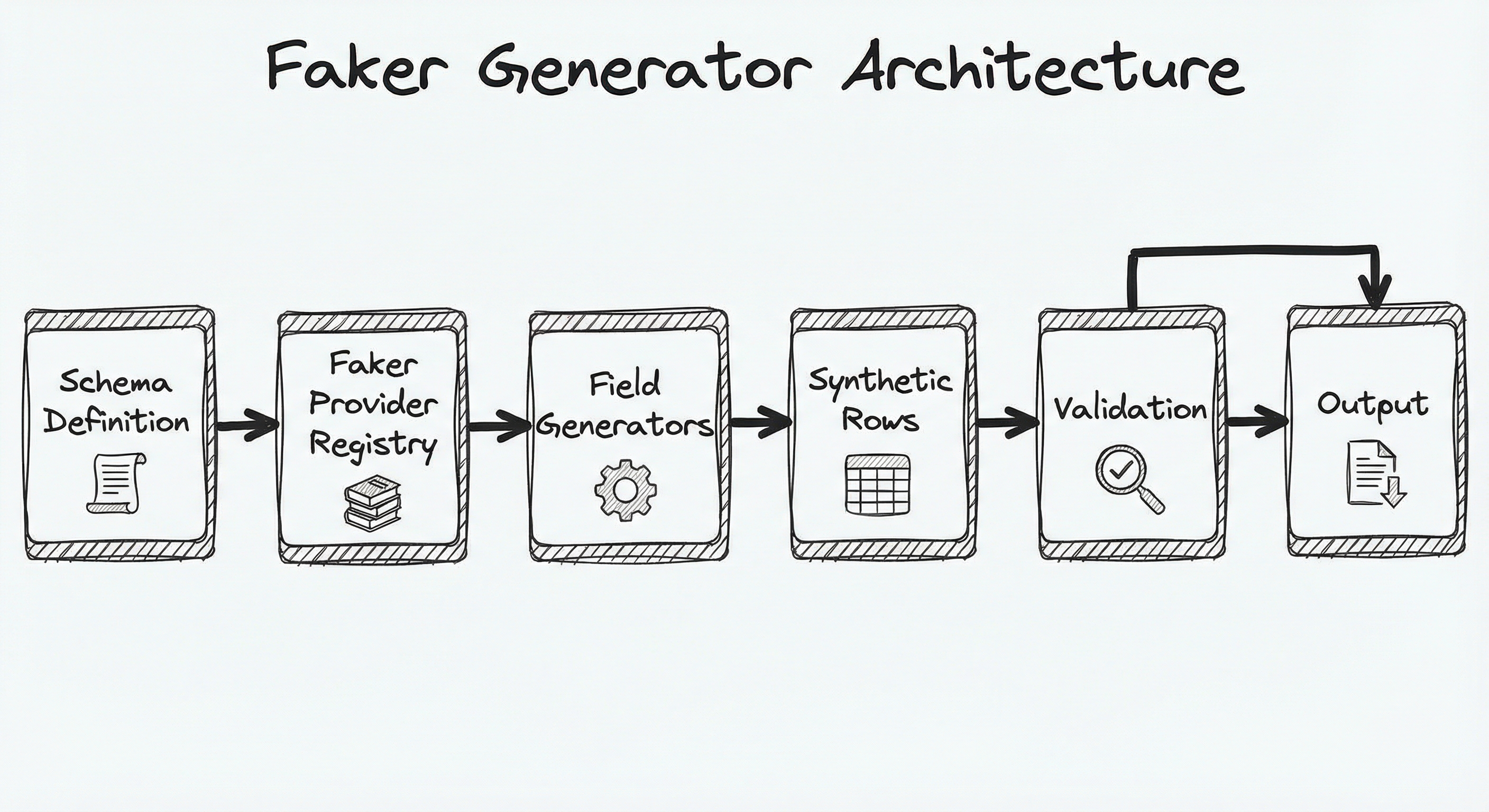
Generation Flow for a Single Record:
-
Schema definition: The user defines desired columns and their Faker methods, e.g.,
{"name": fake.name, "email": fake.email, "phone": fake.phone_number, "address": fake.address}. -
PRNG initialization: The Faker instance seeds its Mersenne Twister PRNG. If no seed is set, system entropy is used (non-reproducible).
-
Provider dispatch: For each column, the Faker facade dispatches to the appropriate provider.
fake.name()routes toPersonProvider.name(),fake.email()routes toInternetProvider.email(). -
Locale resolution: The provider checks if a locale-specific subclass exists. For
Faker('en_IN'),PersonProviderresolves tofaker.providers.person.en_IN.Provider, which contains Indian name dictionaries. -
Template composition: The provider composes the output from sub-elements.
name()might callfirst_name()+last_name(), where each samples from the locale dictionary using the PRNG. -
Value return: The composed string (or other data type) is returned to the caller.
-
Record assembly: The user collects all column values into a row. Repeating steps 3-6 for rows produces the full synthetic dataset.
Batch Generation Flow:
For generating DataFrames, users typically use list comprehensions or fake.profile() for pre-composed records. The faker library itself does not provide batch APIs; users build them with pandas:
import pandas as pd
df = pd.DataFrame([{"name": fake.name(), "email": fake.email()} for _ in range(10000)])
This creates all records in a single Python loop, bounded by interpreter speed (~5,000-15,000 records/second for multi-column schemas).
A three-layer architecture diagram. The top layer shows the Faker Facade (purple) as the user entry point. The middle layer shows five provider boxes (green for standard, amber for custom): PersonProvider, AddressProvider, CompanyProvider, InternetProvider, and CustomProvider. The bottom layer shows three locale dictionary boxes (blue): en_IN, hi_IN, and en_US. Arrows flow from the facade to providers, and from providers to locale dictionaries. Output flows from providers to Record and then to DataFrame/CSV/JSON output formats.
How to Implement
Getting Started
Faker is installed via pip (pip install Faker) and requires no configuration, GPU, or external services. It works entirely in-memory and offline, making it one of the simplest tools in the synthetic data ecosystem.
Approach 1: Direct API Calls -- The simplest path. Instantiate Faker, set a locale, and call provider methods directly. Best for quick prototyping, Jupyter notebooks, and generating small datasets (<100K rows).
Approach 2: Schema-Driven Generation -- Define a schema mapping column names to Faker methods and generate DataFrames programmatically. Best for automated test data pipelines where schemas change frequently.
Approach 3: Custom Providers -- Extend Faker with domain-specific generators for your application's unique data types (UPI IDs, policy numbers, medical codes). Best for teams with specialized data requirements not covered by built-in providers.
Approach 4: Faker + Statistical Post-Processing -- Use Faker for structural generation, then apply correlation injection, conditional filtering, or CTGAN refinement to add statistical realism. Best for ML applications where downstream model training benefits from realistic joint distributions.
Performance Considerations
Faker is single-threaded and Python-bound. For large datasets (>1M rows), consider:
- Parallel generation: Use
multiprocessingwith different seeds per worker. - Batch seeding: Generate data in chunks of 100K rows, each with a different seed, and concatenate.
- Alternative libraries:
mimesisis 5-10x faster for simple types;polarscan parallelize DataFrame construction. - Pre-generation: Generate large pools of fake values once, cache them, and sample from the cache.
Cost Note: Faker is entirely free and open source (MIT license). The only cost is compute time -- generating 1M rows takes ~2-5 minutes on a standard laptop (no GPU needed). Compare this to CTGAN training (~30 minutes on GPU, ~INR 85 / 10 per 1M records via GPT-4).
from faker import Faker
import pandas as pd

# Initialize with Indian English locale
fake = Faker('en_IN')
Faker.seed(42)  # Reproducible output

# Generate individual fields
print(fake.name())           # e.g., "Saanvi Agarwal"
print(fake.address())        # e.g., "Flat 301, Sunshine Towers\nAndheri West\nMumbai 400058"
print(fake.phone_number())   # e.g., "+91 98765 43210"
print(fake.email())          # e.g., "[email protected]"
print(fake.date_of_birth())  # e.g., datetime.date(1987, 3, 15)

# Generate a DataFrame of 10,000 fake user records
records = []
for _ in range(10_000):
    records.append({
        'name': fake.name(),
        'email': fake.unique.email(),
        'phone': fake.phone_number(),
        'address': fake.address(),
        'city': fake.city(),
        'state': fake.state(),
        'pincode': fake.postcode(),
        'date_of_birth': fake.date_of_birth(minimum_age=18, maximum_age=80),
        'company': fake.company(),
        'job_title': fake.job(),
        'salary_inr': fake.random_int(min=300000, max=5000000, step=10000),
    })

df = pd.DataFrame(records)
print(f"Generated {len(df)} records")
print(df.head())
print(f"\nUnique emails: {df['email'].nunique()}")
print(f"Unique names: {df['name'].nunique()}")

# Save to CSV
df.to_csv('fake_users_india.csv', index=False)
This example demonstrates the core Faker workflow with the en_IN locale. Key points:
- Locale selection:
Faker('en_IN')ensures Indian names, addresses, phone numbers, and postal codes. - Seeding:
Faker.seed(42)makes output deterministic -- running this script twice produces identical data. - Unique constraint:
fake.unique.email()guarantees no duplicate emails across 10,000 records. - Parameterized generation:
date_of_birth(minimum_age=18, maximum_age=80)constrains the output range. - Custom ranges:
random_int(min=300000, max=5000000, step=10000)generates salary values in INR with realistic granularity.
Note that columns are statistically independent -- a 22-year-old might have a salary of INR 50,00,000, which is unrealistic but structurally valid.
from faker import Faker
from faker.providers import BaseProvider
import random
import string

class IndianFinanceProvider(BaseProvider):
    """Custom Faker provider for Indian financial identifiers."""

    def pan_number(self) -> str:
        """Generate a valid-format PAN number (AAAAA9999A)."""
        # First 3: random uppercase letters
        first_three = ''.join(self.random_letters(3)).upper()
        # 4th char: entity type (P=Person, C=Company, H=HUF, etc.)
        entity_types = 'PCHATBJLFE'
        fourth = self.random_element(entity_types)
        # 5th char: first letter of surname (random for fake data)
        fifth = self.random_uppercase_letter()
        # 4 digits
        digits = ''.join([str(self.random_digit()) for _ in range(4)])
        # Last: check letter (random for fake data)
        last = self.random_uppercase_letter()
        return f"{first_three}{fourth}{fifth}{digits}{last}"

    def aadhaar_number(self) -> str:
        """Generate a valid-format Aadhaar number (12 digits, not starting with 0 or 1)."""
        first_digit = str(self.random_int(min=2, max=9))
        remaining = ''.join([str(self.random_digit()) for _ in range(11)])
        raw = first_digit + remaining
        return f"{raw[:4]} {raw[4:8]} {raw[8:]}"

    def upi_id(self) -> str:
        """Generate a fake UPI ID."""
        handle = self.generator.user_name()
        banks = ['okaxis', 'okicici', 'okhdfcbank', 'oksbi',
                 'ybl', 'paytm', 'apl', 'ibl']
        bank = self.random_element(banks)
        return f"{handle}@{bank}"

    def gstin(self) -> str:
        """Generate a valid-format GSTIN (15 characters)."""
        state_codes = ['01', '02', '03', '04', '05', '06', '07', '08',
                       '09', '10', '11', '12', '13', '14', '15', '16',
                       '17', '18', '19', '20', '21', '22', '23', '24',
                       '27', '29', '32', '33', '34', '36', '37']
        state = self.random_element(state_codes)
        pan = self.pan_number()
        entity_num = str(self.random_int(min=1, max=9))
        z_default = 'Z'
        check = self.random_uppercase_letter()
        return f"{state}{pan}{entity_num}{z_default}{check}"

    def ifsc_code(self) -> str:
        """Generate a fake IFSC code."""
        bank_prefixes = ['SBIN', 'HDFC', 'ICIC', 'UTIB', 'KKBK',
                         'PUNB', 'BARB', 'CNRB', 'IOBA', 'BKID']
        prefix = self.random_element(bank_prefixes)
        branch_code = ''.join([str(self.random_digit()) for _ in range(6)])
        return f"{prefix}0{branch_code}"

    def indian_bank_account(self) -> str:
        """Generate a fake Indian bank account number (11-16 digits)."""
        length = self.random_int(min=11, max=16)
        return ''.join([str(self.random_digit()) for _ in range(length)])

    def inr_amount(self, min_val: int = 100, max_val: int = 1000000) -> str:
        """Generate an INR amount with proper formatting."""
        amount = self.random_int(min=min_val, max=max_val)
        # Indian number formatting (lakhs, crores)
        s = str(amount)
        if len(s) <= 3:
            return f"INR {s}"
        result = s[-3:]
        s = s[:-3]
        while s:
            result = s[-2:] + ',' + result
            s = s[:-2]
        return f"INR {result}"


# Usage
fake = Faker('en_IN')
fake.add_provider(IndianFinanceProvider)
Faker.seed(42)

print(fake.pan_number())       # e.g., "BXMPK7834L"
print(fake.aadhaar_number())   # e.g., "4823 9017 5634"
print(fake.upi_id())           # e.g., "rahul.sharma@okicici"
print(fake.gstin())            # e.g., "27BXMPK7834L1ZA"
print(fake.ifsc_code())        # e.g., "HDFC0004521"
print(fake.inr_amount())       # e.g., "INR 4,52,300"

# Generate financial test data
transactions = []
for _ in range(5000):
    transactions.append({
        'sender_name': fake.name(),
        'sender_upi': fake.upi_id(),
        'receiver_name': fake.name(),
        'receiver_upi': fake.upi_id(),
        'amount': fake.random_int(min=1, max=100000),
        'timestamp': fake.date_time_this_year(),
        'status': fake.random_element(['SUCCESS', 'FAILED', 'PENDING']),
    })

import pandas as pd
df = pd.DataFrame(transactions)
print(f"\nGenerated {len(df)} fake UPI transactions")
print(df.head())
This example shows how to build a custom provider for Indian financial data types not covered by Faker's built-in providers. Key design decisions:
- Inherits from
BaseProvider: Gains access toself.random_element(),self.random_int(),self.random_digit(), and other utility methods that use the shared PRNG. - Format-correct but not checksum-valid: PAN, Aadhaar, and GSTIN follow the correct format patterns but do not implement actual checksum algorithms. This is intentional -- the data should look right but not accidentally match real identifiers.
- Composable: The
gstin()method callsself.pan_number()internally, demonstrating provider method composition. - Registered via
add_provider(): After registration, custom methods are callable directly on the Faker instance (fake.pan_number()).
This pattern is widely used by Indian engineering teams at Razorpay, Juspay, and PhonePe for generating test payment data.
from faker import Faker
import pandas as pd
import numpy as np
from typing import Callable, Dict, List, Any, Optional
from dataclasses import dataclass

@dataclass
class ColumnSpec:
    """Schema specification for a single column."""
    name: str
    generator: Callable
    unique: bool = False
    nullable: float = 0.0  # Probability of null value
    post_process: Optional[Callable] = None

class SchemaFaker:
    """Schema-driven Faker data generation with constraints."""

    def __init__(self, locale: str = 'en_IN', seed: int = 42):
        self.fake = Faker(locale)
        Faker.seed(seed)
        self.fake.seed_instance(seed)

    def generate(
        self,
        schema: List[ColumnSpec],
        num_rows: int,
        constraints: Optional[List[Callable]] = None
    ) -> pd.DataFrame:
        """Generate a DataFrame from schema with optional row-level constraints."""
        data: Dict[str, List[Any]] = {col.name: [] for col in schema}

        for _ in range(num_rows):
            row = {}
            for col in schema:
                # Generate value
                if col.unique:
                    value = self.fake.unique.__getattr__(
                        col.generator.__name__
                    )()
                else:
                    value = col.generator()

                # Apply nullable probability
                if col.nullable > 0 and np.random.random() < col.nullable:
                    value = None

                # Apply post-processing
                if col.post_process and value is not None:
                    value = col.post_process(value)

                row[col.name] = value

            # Apply row-level constraints
            if constraints:
                for constraint in constraints:
                    row = constraint(row)

            for col_name, val in row.items():
                data[col_name].append(val)

        return pd.DataFrame(data)


# Define schema for an Indian e-commerce dataset
fake = Faker('en_IN')
Faker.seed(42)

def age_salary_constraint(row: dict) -> dict:
    """Inject correlation: older people tend to earn more."""
    if row.get('age') and row.get('annual_income'):
        age = row['age']
        # Base salary + age-based component + noise
        base = 200000
        age_factor = (age - 18) * 15000
        noise = np.random.normal(0, 50000)
        row['annual_income'] = max(200000, int(base + age_factor + noise))
    return row

def city_pincode_constraint(row: dict) -> dict:
    """Ensure pincode matches city (simplified)."""
    city_pins = {
        'Mumbai': ['400001', '400050', '400070', '400093'],
        'Delhi': ['110001', '110020', '110044', '110085'],
        'Bangalore': ['560001', '560034', '560066', '560100'],
        'Chennai': ['600001', '600028', '600040', '600096'],
        'Hyderabad': ['500001', '500034', '500072', '500081'],
    }
    city = row.get('city')
    if city in city_pins:
        row['pincode'] = np.random.choice(city_pins[city])
    return row

schema = [
    ColumnSpec('customer_id', fake.uuid4, unique=True),
    ColumnSpec('name', fake.name),
    ColumnSpec('email', fake.email, unique=True),
    ColumnSpec('phone', fake.phone_number),
    ColumnSpec('age', lambda: fake.random_int(min=18, max=75)),
    ColumnSpec('city', lambda: fake.random_element(
        ['Mumbai', 'Delhi', 'Bangalore', 'Chennai', 'Hyderabad',
         'Pune', 'Kolkata', 'Ahmedabad', 'Jaipur', 'Lucknow']
    )),
    ColumnSpec('pincode', fake.postcode),
    ColumnSpec('annual_income', lambda: fake.random_int(min=200000, max=5000000, step=10000)),
    ColumnSpec('signup_date', lambda: fake.date_between(start_date='-3y', end_date='today')),
    ColumnSpec('is_premium', lambda: fake.boolean(chance_of_getting_true=20)),
    ColumnSpec('referral_code', fake.bothify, nullable=0.6,
               post_process=lambda x: x.upper()),
]

generator = SchemaFaker(locale='en_IN', seed=42)
df = generator.generate(
    schema=schema,
    num_rows=10000,
    constraints=[age_salary_constraint, city_pincode_constraint]
)

print(f"Generated {len(df)} records")
print(f"Columns: {list(df.columns)}")
print(f"\nAge-Income correlation: {df['age'].corr(df['annual_income']):.3f}")
print(df.head(10))
This example demonstrates schema-aware generation -- a production pattern where the data schema is defined declaratively and generation is handled by a reusable engine. Key features:
- ColumnSpec dataclass: Declarative column definitions with generator functions, uniqueness constraints, nullable probabilities, and post-processing hooks.
- Row-level constraints: The
age_salary_constraintinjects a realistic age-income correlation that Faker cannot produce natively. This hybrid approach (Faker for structure + rules for correlations) is the most practical way to add statistical realism. - City-pincode consistency: Ensures that PIN codes match cities -- a common referential integrity requirement that pure Faker misses.
- Nullable columns:
referral_codeis null 60% of the time, simulating realistic missing data patterns.
This pattern scales well for enterprise test data generation where schemas are complex and constraints are numerous.
from faker import Faker
import pandas as pd
import numpy as np
from sdv.single_table import CTGANSynthesizer
from sdv.metadata import SingleTableMetadata

# ---- Step 1: Generate structural skeleton with Faker ----
fake = Faker('en_IN')
Faker.seed(42)

def generate_faker_skeleton(n_rows: int = 5000) -> pd.DataFrame:
    """Generate structurally valid data with Faker."""
    records = []
    for _ in range(n_rows):
        records.append({
            'customer_id': fake.uuid4(),
            'name': fake.name(),
            'email': fake.email(),
            'phone': fake.phone_number(),
            'age': fake.random_int(min=18, max=75),
            'city': fake.random_element(
                ['Mumbai', 'Delhi', 'Bangalore', 'Chennai', 'Hyderabad']
            ),
            'account_type': fake.random_element(
                ['savings', 'current', 'salary']
            ),
            'monthly_income': fake.random_int(min=15000, max=500000, step=1000),
            'credit_score': fake.random_int(min=300, max=900),
            'loan_amount': fake.random_int(min=50000, max=5000000, step=10000),
            'loan_approved': fake.boolean(chance_of_getting_true=40),
        })
    return pd.DataFrame(records)

faker_data = generate_faker_skeleton(5000)
print("Faker skeleton stats:")
print(f"  Income-CreditScore correlation: "
      f"{faker_data['monthly_income'].corr(faker_data['credit_score']):.3f}")
print(f"  Approval rate: {faker_data['loan_approved'].mean():.2%}")

# ---- Step 2: Train CTGAN on real data for correlations ----
# In production, this uses your actual historical data
real_data = pd.read_csv('real_loan_applications.csv')

metadata = SingleTableMetadata()
metadata.detect_from_dataframe(real_data)

# Train CTGAN to learn joint distributions
ctgan = CTGANSynthesizer(
    metadata,
    epochs=200,
    batch_size=500,
    verbose=True
)
ctgan.fit(real_data)

# Generate statistically realistic numerical columns
ctgan_data = ctgan.sample(num_rows=5000)

# ---- Step 3: Hybrid merge ----
# Use Faker for PII columns (names, emails, phones)
# Use CTGAN for statistical columns (income, credit_score, loan_amount, approved)
hybrid_data = faker_data[['customer_id', 'name', 'email', 'phone']].copy()
hybrid_data['age'] = ctgan_data['age'].values
hybrid_data['city'] = ctgan_data['city'].values
hybrid_data['account_type'] = ctgan_data['account_type'].values
hybrid_data['monthly_income'] = ctgan_data['monthly_income'].values
hybrid_data['credit_score'] = ctgan_data['credit_score'].values
hybrid_data['loan_amount'] = ctgan_data['loan_amount'].values
hybrid_data['loan_approved'] = ctgan_data['loan_approved'].values

print("\nHybrid data stats:")
print(f"  Income-CreditScore correlation: "
      f"{hybrid_data['monthly_income'].corr(hybrid_data['credit_score']):.3f}")
print(f"  Approval rate: {hybrid_data['loan_approved'].mean():.2%}")
print(f"  All emails unique: {hybrid_data['email'].nunique() == len(hybrid_data)}")

hybrid_data.to_csv('hybrid_synthetic_loans.csv', index=False)
print(f"\nSaved {len(hybrid_data)} hybrid synthetic records")
This hybrid Faker + CTGAN approach combines the best of both worlds:
- Faker handles PII columns (names, emails, phones, IDs) -- these need to be structurally valid and unique but don't need statistical correlations. Faker is perfect here.
- CTGAN handles numerical/categorical columns (income, credit score, loan amount, approval status) -- these need realistic joint distributions learned from real data. CTGAN preserves correlations (e.g., higher income correlates with higher credit score and loan approval).
The hybrid approach is common in Indian fintech (Razorpay, Lendingkart) where you need synthetic datasets that are both privacy-safe (Faker PII) and statistically useful (CTGAN correlations) for model development. It avoids CTGAN's weakness with text/PII columns (CTGAN often generates nonsensical names) while avoiding Faker's weakness with statistical relationships.
from faker import Faker
import pandas as pd
import hashlib
from typing import Dict, Callable

class FakerDataMasker:
    """
    Replace real PII with Faker-generated equivalents while
    preserving referential integrity (same real value -> same fake value).
    """

    def __init__(self, locale: str = 'en_IN', seed: int = 42):
        self.fake = Faker(locale)
        Faker.seed(seed)
        # Cache: maps real values to their fake replacements
        self._cache: Dict[str, Dict[str, str]] = {}

    def _get_or_create(
        self, column: str, real_value: str, generator: Callable
    ) -> str:
        """Get cached fake value or generate a new one."""
        if column not in self._cache:
            self._cache[column] = {}

        if real_value not in self._cache[column]:
            self._cache[column][real_value] = generator()

        return self._cache[column][real_value]

    def mask_dataframe(
        self,
        df: pd.DataFrame,
        column_generators: Dict[str, Callable]
    ) -> pd.DataFrame:
        """Mask specified columns, preserving referential integrity."""
        masked_df = df.copy()

        for column, generator in column_generators.items():
            if column in masked_df.columns:
                masked_df[column] = masked_df[column].apply(
                    lambda val: self._get_or_create(
                        column, str(val), generator
                    ) if pd.notna(val) else val
                )

        return masked_df


# Example: Mask a real customer dataset
real_data = pd.DataFrame({
    'customer_id': ['CUST001', 'CUST002', 'CUST003', 'CUST001', 'CUST002'],
    'name': ['Priya Sharma', 'Rahul Patel', 'Ananya Iyer',
             'Priya Sharma', 'Rahul Patel'],
    'email': ['[email protected]', '[email protected]', '[email protected]',
              '[email protected]', '[email protected]'],
    'phone': ['+91 98765 43210', '+91 87654 32109', '+91 76543 21098',
              '+91 98765 43210', '+91 87654 32109'],
    'purchase_amount': [2500, 15000, 8900, 3200, 22000],
    'product_category': ['Electronics', 'Fashion', 'Groceries',
                         'Books', 'Electronics'],
})

print("Original data:")
print(real_data)

# Initialize masker
masker = FakerDataMasker(locale='en_IN', seed=42)

# Define which columns to mask and how
column_generators = {
    'customer_id': lambda: f"CUST{masker.fake.random_int(min=100, max=999)}",
    'name': masker.fake.name,
    'email': masker.fake.email,
    'phone': masker.fake.phone_number,
}

masked_data = masker.mask_dataframe(real_data, column_generators)
print("\nMasked data:")
print(masked_data)

# Verify referential integrity
print("\nReferential integrity check:")
print(f"  CUST001 rows have same masked name: "
      f"{masked_data.loc[masked_data['name'] == masked_data.iloc[0]['name']].shape[0] == 2}")
print(f"  Purchase amounts preserved: "
      f"{(masked_data['purchase_amount'] == real_data['purchase_amount']).all()}")
print(f"  Product categories preserved: "
      f"{(masked_data['product_category'] == real_data['product_category']).all()}")
This data masking pattern replaces real PII with Faker-generated equivalents while preserving two critical properties:
- Referential integrity: The same real value always maps to the same fake value. If "Priya Sharma" appears in rows 1 and 4, both are replaced with the same fake name. This preserves JOIN relationships and aggregation correctness.
- Non-PII preservation: Columns that are not PII (purchase amounts, product categories) are left untouched, so analytical queries on the masked data produce valid results.
This pattern is used extensively in Indian banking (RBI compliance) and healthcare (DPDP Act) to create development and staging datasets from production data without exposing real customer information.
# Schema configuration (YAML) for schema-aware Faker generation
generation:
  locale: en_IN
  seed: 42
  num_rows: 50000
  output_format: csv  # csv, json, parquet
  output_path: ./data/synthetic/

schema:
  - name: customer_id
    generator: uuid4
    unique: true

  - name: full_name
    generator: name
    unique: false

  - name: email
    generator: email
    unique: true

  - name: phone
    generator: phone_number
    unique: false

  - name: date_of_birth
    generator: date_of_birth
    params:
      minimum_age: 18
      maximum_age: 80

  - name: city
    generator: random_element
    params:
      elements:
        - Mumbai
        - Delhi
        - Bangalore
        - Chennai
        - Hyderabad
        - Pune
        - Kolkata

  - name: annual_income_inr
    generator: random_int
    params:
      min: 200000
      max: 5000000
      step: 10000

  - name: credit_score
    generator: random_int
    params:
      min: 300
      max: 900

  - name: is_active
    generator: boolean
    params:
      chance_of_getting_true: 85

  - name: signup_date
    generator: date_between
    params:
      start_date: "-3y"
      end_date: today

  - name: referral_code
    generator: bothify
    params:
      text: "??###"
    nullable: 0.4
    post_process: upper

constraints:
  - type: correlation
    columns: [age, annual_income_inr]
    method: linear
    strength: 0.6

  - type: conditional
    if_column: is_active
    if_value: false
    then_column: signup_date
    then_range: ["-3y", "-1y"]

quality_checks:
  - unique_columns: [customer_id, email]
  - non_null_columns: [customer_id, full_name, email, phone]
  - value_ranges:
      credit_score: [300, 900]
      annual_income_inr: [200000, 5000000]
Common Implementation Mistakes
- ●
Assuming Faker data has realistic distributions: Faker generates each column independently with uniform (or near-uniform) sampling from dictionaries. Real-world data has skewed distributions (most users are 25-45, not uniformly 18-80), correlations (income correlates with education), and temporal patterns (more signups on weekdays). Never train ML models on pure Faker data expecting realistic performance. Use Faker for structural testing only, or add post-processing constraints.
- ●
Forgetting to set seeds for reproducibility: Without
Faker.seed(n), every run produces different data, making test failures non-reproducible. Always seed Faker in test suites. Use different seeds for different test scenarios to ensure diversity while maintaining determinism per scenario. - ●
Using
uniqueproperty for large datasets:fake.unique.name()maintains an internal set of all previously generated values. For a dictionary of ~500 first names and ~500 last names, you get ~250,000 unique combinations. Requesting more than ~200,000 unique names will causeUniquenessExceptionor extreme slowdowns as Faker retries repeatedly. For large datasets, usefake.uuid4()for true uniqueness or accept some duplicates in non-key columns. - ●
Ignoring locale fallback behavior: If you request
Faker('hi_IN')but call a method without a Hindi locale provider (e.g.,fake.credit_card_number()), Faker silently falls back toen_US. This can produce culturally inconsistent data -- Hindi names with American credit card formats. Always verify which providers have locale support for your chosen locale. - ●
Using Faker-generated data for security testing: Faker-generated credit card numbers pass Luhn checksum validation by design. Faker-generated emails look real. If you accidentally log, transmit, or store Faker data in systems that process real PII, it may trigger security alerts or compliance violations. Label Faker-generated datasets clearly and never mix them with real data in production storage.
- ●
Not batching for performance: Generating records one at a time in a Python loop is slow (~5,000 rows/sec). For large datasets, pre-generate pools of values (
names = [fake.name() for _ in range(1000)]) and sample from pools, or usemultiprocessingwith per-worker seeds. Themimesislibrary is 5-10x faster for simple types if Faker is too slow.
When Should You Use This?
Use When
You need structurally valid test data for integration testing, load testing, or CI/CD pipelines and don't need realistic statistical distributions
You need PII-like data (names, emails, phones, addresses) for development environments without exposing real customer data
You're building a data pipeline from scratch and need placeholder data to test ingestion, transformation, and serving before real data is available
You need locale-specific data -- Indian names, addresses, phone numbers with +91 prefix, 6-digit PIN codes -- for applications serving Indian users
You're doing data masking to replace real PII in production database copies with realistic fake equivalents for staging/dev environments
You need to generate demo datasets for product showcases, investor presentations, or documentation without privacy concerns
You're bootstrapping an ML project and need initial data to build end-to-end pipelines while real data collection is in progress
Your data requirements are simple and schema-driven -- each column can be generated independently without complex inter-column relationships
Avoid When
You need statistically realistic data where column correlations, joint distributions, and temporal patterns must match real data -- use CTGAN, copula models, or Gaussian generators instead
You're generating training data for ML models where model accuracy depends on realistic data distributions -- Faker's independent columns will produce models that don't generalize
You need data that preserves complex relationships like referential integrity across multiple tables without manual constraint coding
You need high-volume generation (>10M rows) with low latency -- Faker's Python overhead makes it 10-100x slower than compiled alternatives like mimesis or C-based generators
You're generating unstructured data (images, audio, video, free-form text) -- Faker only handles structured and semi-structured data types
You need privacy-guaranteed synthetic data with formal differential privacy bounds -- Faker provides no mathematical privacy guarantees since it doesn't learn from real data
You need to reproduce the statistical properties of a specific real dataset for regulatory auditing or model validation -- Faker cannot replicate a given distribution
Key Tradeoffs
Core Tradeoff: Speed and Simplicity vs. Statistical Fidelity
Faker occupies a unique position in the synthetic data landscape: it is the simplest, fastest, and cheapest option, but it produces the least statistically realistic output. This is an intentional design choice -- Faker solves the "I need realistic-looking test data right now" problem, not the "I need data that matches my production distribution" problem.
| Aspect | Faker | CTGAN | Copula | Gaussian | LLM Generator |
|---|---|---|---|---|---|
| Setup time | 1 minute | 30 min - 2 hours | 15-30 min | 5-10 min | 5 min |
| Training required | No | Yes (GPU) | Yes (CPU) | Yes (CPU) | No |
| Statistical fidelity | None | High | High | Medium | Medium |
| PII realism | Excellent | Poor | N/A | N/A | Good |
| Column correlations | None | Learned | Learned | Parametric | Prompted |
| Speed (10K rows) | 2 seconds | 30 seconds | 5 seconds | 1 second | 5 minutes |
| Cost per 1M rows | Free | ~INR 85 ($1) | Free | Free | ~INR 8,500 ($100) |
| Locale support | 80+ | None | None | None | Prompted |
| Reproducibility | Seed-based | Seed-based | Seed-based | Seed-based | Non-deterministic |
When to Combine Faker with Other Tools
The most productive approach for ML teams is a layered strategy:
- Phase 1 (Day 1-7): Use Faker to generate structural skeleton data. Build and test your entire pipeline end-to-end.
- Phase 2 (Week 2-4): As real data arrives, train CTGAN on numerical/categorical columns. Replace Faker's statistical columns with CTGAN output (hybrid approach).
- Phase 3 (Month 2+): Use CTGAN or copula models for the full dataset. Keep Faker only for PII masking and test data generation.
Cost Analysis for a Typical Indian Startup
| Scenario | Faker Only | Faker + CTGAN | CTGAN Only | LLM Generator |
|---|---|---|---|---|
| 100K test records | Free, 20 sec | INR 85, 5 min | INR 85, 5 min | INR 850, 50 min |
| 1M training records | Free, 3 min | INR 170, 35 min | INR 170, 30 min | INR 8,500, 8 hrs |
| 10M production records | Free, 30 min | INR 500, 3 hrs | INR 500, 3 hrs | INR 85,000, 80 hrs |
Recommendation for Indian ML teams: Start every project with Faker for pipeline development (zero cost, zero setup). Graduate to Faker + CTGAN hybrid when you need statistical fidelity for model training. Use pure CTGAN/copula only when Faker's PII generation isn't needed.
Alternatives & Comparisons
Gaussian generators produce numerical data from specified distributions (mean, variance, covariance matrices) and can model inter-column correlations through multivariate normal distributions. Choose Gaussian generators when your data is primarily numerical and you need parametric control over distributions. Choose Faker when you need structured data types (names, addresses, emails) that cannot be modeled as Gaussian distributions.
LLM-based generators (GPT-4, Claude) produce contextually coherent records by prompting a language model with schema descriptions and examples. LLMs can generate realistic-looking PII with correlations (e.g., an address that matches a city) but are 100-1000x more expensive than Faker and non-deterministic. Choose LLM generators when you need semantic coherence across columns and can tolerate higher cost. Choose Faker when you need high-volume, deterministic, locale-specific data at zero cost.
CTGAN learns joint distributions from real training data and generates synthetic records that preserve correlations, skewness, and multimodal patterns. However, CTGAN requires real training data, GPU compute, and produces poor PII (nonsensical names and emails). Choose CTGAN when statistical fidelity matters for model training. Choose Faker when you need realistic PII, have no real data yet, or need zero-cost zero-setup generation.
Copula models separate marginal distributions from dependency structure, enabling fine-grained control over both. They handle non-Gaussian marginals and complex dependency patterns better than multivariate Gaussian. Choose copulas when you need mathematical control over both marginals and correlations. Choose Faker when your use case is test data generation where statistical properties don't matter.
Pros, Cons & Tradeoffs
Advantages
Zero setup cost and instant start:
pip install Fakerand one line of code generates data. No model training, no GPU, no cloud services, no configuration files. The fastest path from "I need test data" to having test data.Excellent locale support: 80+ locales including 9 Indian locales (
en_IN,hi_IN,ta_IN,te_IN,bn_IN,kn_IN,ml_IN,mr_IN,gu_IN). Indian names, addresses, phone numbers, and postal codes are generated with culturally appropriate formats.Deterministic and reproducible: Seed-based generation ensures identical output across runs. Test suites produce the same data every time, making failures reproducible. Different seeds generate different but equally valid datasets.
Extensible via custom providers: Any data type not covered by built-in providers can be added through custom provider classes. Indian-specific formats (PAN, Aadhaar, UPI, GSTIN, IFSC) are straightforward to implement.
Structurally valid output: Generated data follows real-world formatting rules -- valid phone number patterns, plausible addresses, Luhn-valid credit card numbers, correctly formatted dates. Ideal for testing data validation pipelines.
Free and open source (MIT): No licensing costs, no API keys, no usage limits. The entire library runs locally without internet access. Zero marginal cost regardless of data volume.
Battle-tested and widely adopted: Over 17,000 GitHub stars, 1.7 billion PyPI downloads, and active development since 2012. Extensive documentation, community providers, and StackOverflow answers for every edge case.
Disadvantages
No statistical fidelity: Columns are generated independently with no learned correlations. Age doesn't correlate with income, city doesn't correlate with state, purchase amount doesn't correlate with product category. Data is structurally valid but statistically meaningless.
Slow for large-scale generation: Python's interpreter overhead limits Faker to ~5,000-15,000 records/second for multi-column schemas. Generating 10M rows takes 15-30 minutes. Compiled alternatives like
mimesisare 5-10x faster for simple types.Limited data type coverage: Faker handles structured data well (names, addresses, numbers, dates) but cannot generate images, audio, video, embeddings, or complex nested JSON structures. For unstructured data, you need GAN or diffusion-based generators.
Unique generation degrades with scale: The
fake.unique.method()approach tracks all previously generated values in memory. For dictionaries with limited cardinality (e.g., ~500 first names), uniqueness requests beyond 80% of dictionary size cause severe slowdowns orUniquenessException.No privacy guarantees: While Faker doesn't learn from real data, it provides no formal privacy guarantees (no differential privacy, no k-anonymity). If you need mathematically provable privacy, use DP-CTGAN or similar tools with formal privacy budgets.
Locale quality varies: The
en_USlocale is comprehensive, but less common locales (including some Indian ones) may have limited dictionaries or missing provider implementations.hi_INhas fewer address templates thanen_IN, for example.No temporal patterns: Faker generates timestamps independently. It cannot simulate realistic patterns like weekday/weekend traffic, seasonal trends, business hours clustering, or event-driven spikes. Time-series data requires dedicated generators.
Failure Modes & Debugging
UniquenessException on Constrained Columns
Cause
When fake.unique.method() is used on a provider with a small dictionary (e.g., fake.unique.first_name() with ~500 names in the locale dictionary), requesting more unique values than the dictionary contains triggers a UniquenessException after 1000 retry attempts. This commonly occurs when generating large datasets with unique constraints on low-cardinality fields.
Symptoms
Python raises faker.exceptions.UniquenessException: Got duplicated values after 1000 iterations. Generation halts mid-dataset. For near-capacity dictionaries, generation becomes extremely slow before failing -- each new unique value requires hundreds of retries. Memory usage spikes as the internal uniqueness set grows.
Mitigation
Use fake.unique.clear() between batches if absolute uniqueness across the full dataset isn't required. For true uniqueness on high-cardinality needs, use fake.uuid4() or composite keys (first_name + random_suffix). Pre-calculate the maximum unique values available: check len(fake.providers) or test empirically. For email uniqueness, use a domain with a counter: f"{fake.user_name()}_{i}@testdomain.com". Consider switching to fake.bothify('????####') for pattern-based unique IDs.
Locale Fallback Producing Inconsistent Data
Cause
When a specific provider method lacks a locale-specific implementation, Faker silently falls back to en_US. For example, Faker('hi_IN').credit_card_number() returns a US-formatted credit card because the hi_IN locale doesn't override the credit card provider. This creates datasets with Hindi names but American credit card numbers, phone formats, or company names.
Symptoms
Generated data contains unexpected English/American values interspersed with locale-appropriate values. Column distributions don't match expected locale patterns. QA tests pass but manual inspection reveals culturally inconsistent records. The issue is silent -- no warnings or errors are raised.
Mitigation
Explicitly verify which providers are overridden in your target locale by checking the Faker source: faker/providers/{provider_name}/{locale}/. Write integration tests that validate locale-specific patterns (e.g., assert phone numbers start with +91 for en_IN). Use custom providers to override fallback behavior for critical columns. Consider using multiple Faker instances with different locales for different columns.
Memory Exhaustion with Large Unique Sets
Cause
The fake.unique property maintains an in-memory Python set of all previously generated values. For large datasets (>1M rows) with multiple unique columns, this set consumes significant memory. A unique email column with 5M entries (average 30 bytes each) consumes ~150MB. Multiple unique columns multiply this cost.
Symptoms
Python process memory grows linearly with dataset size. For very large datasets (>10M rows), the process may hit system memory limits and be killed by the OOM killer. Generation slows progressively as set membership checks on large sets become expensive. Pandas DataFrame construction after generation fails due to insufficient remaining memory.
Mitigation
Generate data in batches (e.g., 100K rows per batch) and write each batch to disk before generating the next. Use fake.unique.clear() between batches and add batch-specific prefixes to maintain global uniqueness. For truly large-scale generation, use database-backed deduplication (SQLite or Redis) instead of in-memory sets. Pre-generate large pools of unique values with mimesis (faster) and sample from the pool.
Statistical Artifacts in ML Training
Cause
Training ML models on Faker-generated data produces models that learn Faker's uniform distributions rather than real-world patterns. Since Faker samples names uniformly from dictionaries, a model trained on Faker data learns that all names are equally likely. Since Faker generates columns independently, the model learns no inter-column relationships. When deployed on real data with skewed distributions and strong correlations, the model fails.
Symptoms
Model trained on Faker data shows high accuracy on Faker test data but poor accuracy on real data. Feature importance analysis shows that features known to be predictive in real data have zero importance on Faker data. Model predictions are uncorrelated with actual outcomes. Calibration plots show severe miscalibration.
Mitigation
Never use pure Faker data for ML model training. Use Faker only for pipeline testing (verifying data flows, API contracts, schema compatibility). For model training, use the Faker + CTGAN hybrid approach: Faker for PII columns, CTGAN for statistical columns. Alternatively, add explicit correlation injection via post-processing constraints. Always validate synthetic training data against a held-out real data sample before training.
Seed Collision Across Test Suites
Cause
Multiple test files or CI jobs using the same Faker seed produce identical data, creating hidden dependencies between tests. If Test A and Test B both use Faker.seed(42), they generate the same names, emails, and values. A bug that only manifests with specific data (e.g., names containing apostrophes) might be missed because seed 42 never generates such names.
Symptoms
Tests pass individually but fail when run together (shared PRNG state). Tests appear to cover diverse scenarios but actually test the same data repeatedly. Edge cases (special characters in names, very long addresses, boundary values) are never exercised. CI passes consistently but production fails on data patterns not covered by the seed.
Mitigation
Use different seeds per test file or test class. Use fake.seed_instance(n) for per-instance seeding rather than global Faker.seed(n). Add property-based testing with random seeds (e.g., Hypothesis library) to explore diverse data patterns. Explicitly test edge cases: names with apostrophes (O'Connor), hyphenated names, very long values, empty strings, Unicode characters, and boundary numbers.
Placement in an ML System
Where Faker Fits in ML Systems
Faker occupies the earliest stage of the ML data pipeline -- before any real data exists. In a typical ML project lifecycle:
-
Project kickoff (Week 1): Data schema is defined. Real data collection begins but won't be ready for weeks. Engineers generate Faker data matching the schema to build end-to-end pipelines: data ingestion, feature engineering, model training, serving, and monitoring. Every component is tested against structurally valid fake data.
-
Development phase (Weeks 2-8): Real data trickles in. Faker data is gradually replaced with real data for model training, but continues to power CI/CD test suites, staging environments, and demo instances.
-
Production phase (Month 2+): Real data powers model training and serving. Faker's role shifts to: (a) generating test data for CI/CD pipelines, (b) masking production data copies for staging environments, (c) generating demo/presentation data, (d) stress testing with high-volume fake data.
Integration Points
Faker integrates with ML systems at several touchpoints:
- Feature stores: Generate fake feature values to test feature store read/write paths before real features are computed.
- Model registries: Create fake model metadata (names, versions, metrics) to test registry UI and API.
- Monitoring dashboards: Generate fake prediction logs to test monitoring and alerting pipelines.
- A/B testing frameworks: Generate fake user events to test experiment assignment and metric computation.
Indian Startup Pattern: Most Indian ML startups (especially in fintech, healthtech, and edtech) start with Faker-generated data on Day 1, transition to Faker + CTGAN hybrid by Month 2, and use pure real data by Month 6. Faker remains permanently in the CI/CD pipeline for integration testing.
Pipeline Stage
Data Generation / Test Data
Upstream
- Schema definition (database schema, API contract, Protobuf/Avro spec)
- Data requirements document (column types, constraints, volumes)
- Locale and internationalization requirements
Downstream
- Data pipeline testing (ingestion, transformation, validation)
- Schema validation and contract testing
- Feature engineering pipeline (using Faker data as placeholder)
- Model training (only with hybrid Faker + CTGAN approach)
- Load testing and performance benchmarking
- Demo and presentation datasets
Scaling Bottlenecks
Faker's primary bottleneck is Python's single-threaded interpreter. Each fake.method() call involves dictionary lookup, random sampling, string formatting, and method dispatch -- all in interpreted Python. For simple types (integers, booleans), throughput is ~100,000/sec. For complex types (addresses, profiles), throughput drops to ~3,000-5,000/sec.
Multiprocessing: Spawn worker processes, each with a different seed (seed + worker_id), generating total_rows / N rows in parallel. Use multiprocessing.Pool or joblib.Parallel. Linear speedup up to CPU core count.
Pre-generation pools: Generate large pools of values once (e.g., 10K names, 10K addresses) and sample from pools using numpy's fast random sampling. Eliminates Faker overhead for repeated generation patterns.
Compiled alternatives: For maximum throughput, use mimesis (5-10x faster than Faker for simple types) or write custom generators in Cython/Rust. The polyfactory library provides Pydantic-model-based generation with better performance.
Faker itself uses minimal memory (~10MB for loaded providers). The bottleneck is the output DataFrame -- 1M rows with 10 string columns (~100 bytes each) consumes ~1GB. For large datasets, stream records to disk (CSV, Parquet) instead of accumulating in memory. Use pyarrow for efficient columnar serialization.
Production Case Studies
Razorpay's engineering team uses Faker with custom providers to generate test payment data for their payment gateway. Custom providers produce valid-format UPI IDs, VPA handles, IFSC codes, and INR transaction amounts. The test data populates staging environments and powers CI/CD pipelines that run 10,000+ integration tests against the payment processing stack.
Faker-based test data generation reduced staging environment setup time from 4 hours (database restore from production snapshot) to 15 minutes (Faker generation script). Eliminated the need to handle real PII in development environments, simplifying DPDP Act compliance. The team generates 500K fake transactions per CI run across 200+ test scenarios.
Flipkart uses Faker to generate synthetic product catalogs, user profiles, and order histories for their ML recommendation pipeline testing. With custom providers for Indian product names, descriptions in multiple languages (Hindi, Tamil, Telugu), and INR pricing, they create realistic-looking catalogs with 100K+ products for load testing their search and recommendation engines.
Synthetic catalog generation enabled parallel development of the recommendation engine (ML team) and data pipeline (data engineering team) without waiting for production data access approvals. Load testing with Faker-generated 10M user events identified a memory bottleneck in the recommendation serving layer before production launch, preventing a potential Diwali sale outage.
Thoughtworks India documented their approach to synthetic test data generation using Faker for multiple client projects across banking, insurance, and healthcare. They built a reusable Faker-based framework with Indian financial data providers (PAN, Aadhaar, GSTIN) and integrated it with their CI/CD pipelines. The framework supports schema-driven configuration where test data specs are defined in YAML alongside test cases.
The reusable framework reduced test data setup effort by 70% across client projects. It eliminated the practice of copying production databases for testing, which had previously caused two data breach incidents in client staging environments. The framework is now part of Thoughtworks' standard delivery toolkit for Indian financial services clients.
CRED uses Faker to generate synthetic credit card transaction histories, reward point calculations, and user credit profiles for their ML-powered credit score analysis and personalized offer recommendation systems. Custom providers generate realistic credit score distributions, EMI schedules, and spending patterns across Indian merchant categories (fuel, groceries, dining, travel).
Faker-generated test data enabled the ML team to develop and iterate on their credit scoring model 3x faster by eliminating the 2-week data access request process. The synthetic data pipeline generates 1M transaction records in under 5 minutes, enabling daily model retraining experiments during development phase.
Tooling & Ecosystem
The primary Python Faker library with 80+ locales, 20+ built-in providers, and extensible custom provider architecture. Supports seeded generation, unique constraints, and per-instance locale configuration. The most widely used fake data library in the Python ecosystem with 17,000+ GitHub stars.
A high-performance alternative to Faker that is 5-10x faster for simple data types. Provides a similar API with typed data generation and 30+ locale support. Supports schema-based generation via mimesis.schema. Best choice when Faker's Python overhead is a bottleneck for large dataset generation.
A Pydantic/dataclass-aware factory library that auto-generates fake instances from your data models. Integrates with Faker under the hood but provides type-safe, model-driven generation. Ideal for teams already using Pydantic for data validation -- your data models become your test data generators.
The JavaScript/TypeScript equivalent of Python Faker with 60+ locales and comprehensive data type support. Essential for full-stack teams that need consistent fake data generation in both backend (Python) and frontend (JavaScript) test suites. Supports tree-shaking for bundle size optimization.
While primarily a statistical synthetic data library (CTGAN, TVAE, copulas), SDV integrates well with Faker for the hybrid approach. Use Faker for PII columns, SDV for statistical columns. Provides quality metrics (Column Shapes, Column Pair Trends) to evaluate synthetic data fidelity against real data.
A data quality validation framework that pairs excellently with Faker. Define expectations on your real data schema, then validate Faker-generated data against the same expectations to ensure synthetic data meets structural requirements. Catches issues like wrong data types, invalid ranges, or format violations in generated data.
Research & References
Xu, Skoularidou, Cuesta-Infante & Veeramachaneni (2019)NeurIPS 2019
Introduces CTGAN for tabular synthetic data generation, which addresses limitations of rule-based generators like Faker by learning joint distributions from real data. The paper demonstrates that CTGAN-generated data preserves column correlations and multimodal distributions that Faker cannot capture, establishing the theoretical gap between rule-based and learned synthetic data.
Patki, Wedge & Veeramachaneni (2016)IEEE DSAA 2016
Presents the Synthetic Data Vault framework for generating multi-table relational synthetic data. Highlights the limitations of independent column generation (the Faker approach) and proposes copula-based methods that capture inter-column dependencies. Provides the theoretical foundation for understanding when rule-based generation is sufficient vs. when statistical methods are required.
Park, Mohammadi, Gorde, Jajodia, Park & Kim (2018)VLDB 2018
Proposes table-GAN for generating synthetic relational data and compares against rule-based methods. Demonstrates that GAN-based synthesis preserves statistical properties (mean, variance, pairwise correlations) significantly better than independent sampling approaches like Faker, with 30-60% better downstream model accuracy on privacy-preserving synthetic datasets.
Tucker, Wang, Rotalinti & Myles (2020)npj Digital Medicine
Evaluates multiple synthetic data generation approaches for healthcare data, including rule-based (Faker-style), Bayesian networks, and GANs. Finds that rule-based generators produce structurally valid but clinically implausible records (e.g., pregnant males, pediatric hip replacements), while learned models preserve clinical validity. Establishes best practices for combining rule-based and statistical approaches.
Interview & Evaluation Perspective
Common Interview Questions
- ●
How would you generate realistic test data for a new ML pipeline when no production data is available yet?
- ●
What are the limitations of rule-based synthetic data generators like Faker compared to statistical methods?
- ●
How would you ensure that synthetic test data covers edge cases that Faker's uniform sampling might miss?
- ●
Describe a data masking strategy for production database copies that preserves referential integrity.
- ●
When would you choose Faker over CTGAN for synthetic data generation, and vice versa?
- ●
How would you design a synthetic data pipeline that serves both testing and ML training needs?
Key Points to Mention
- ●
Faker generates columns independently -- no learned correlations. This is fine for structural testing but insufficient for ML training.
- ●
The hybrid Faker + CTGAN approach: Faker for PII (structurally valid, realistic-looking), CTGAN for numerical/categorical (statistically faithful).
- ●
Seed-based reproducibility is critical for deterministic test suites. Always seed Faker in CI/CD contexts.
- ●
Custom providers extend Faker for domain-specific data types (Indian financial IDs, healthcare codes, industry-specific formats).
- ●
Data masking with Faker preserves referential integrity through value caching -- same real value always maps to same fake value.
- ●
Faker's locale support (80+ locales, 9 Indian locales) makes it the best choice for internationalized test data.
Pitfalls to Avoid
- ●
Don't claim Faker data is suitable for ML model training without qualification -- always mention the independence limitation.
- ●
Don't forget that Faker provides no formal privacy guarantees -- it's not a differential privacy tool.
- ●
Don't overlook the performance implications -- Faker is Python-bound and slow for large-scale generation. Mention multiprocessing and alternatives.
- ●
Don't assume all Faker locales have equal quality -- some locales have limited provider coverage and fall back to en_US silently.
Senior-Level Expectation
Senior and staff-level candidates should discuss the lifecycle of synthetic data in ML systems: starting with Faker for pipeline scaffolding, transitioning to hybrid Faker + CTGAN as real data arrives, and eventually using Faker only for CI/CD testing and data masking. They should articulate the tradeoff between structural validity (Faker excels) and statistical fidelity (CTGAN excels), and recommend appropriate tools for each project phase. They should also discuss data masking with referential integrity preservation, privacy implications of synthetic data in regulated industries (DPDP Act, GDPR), and the performance engineering required for large-scale synthetic data generation (multiprocessing, streaming to disk, compiled alternatives). A strong answer includes cost analysis in Indian context and awareness of tools like mimesis, polyfactory, and SDV.
Summary
The Faker Generator is a rule-based synthetic data library that produces structurally valid but statistically independent fake records -- names, addresses, phone numbers, financial identifiers, and 200+ other data types -- across 80+ locales. It is the simplest, fastest, and cheapest synthetic data tool available, requiring no model training, no GPU, and no real data to operate. With Indian locale support (en_IN plus 8 regional language locales) and extensible custom providers for PAN, Aadhaar, UPI, GSTIN, and IFSC formats, Faker is the go-to tool for Indian engineering teams needing locale-specific test data.
Faker's primary strength is structural validity at zero cost -- every generated record looks right (valid phone format, plausible address structure, correct ID patterns) and can be reproduced deterministically via seeds. Its primary limitation is statistical independence -- columns have no learned correlations, making pure Faker data unsuitable for ML model training. The recommended production pattern is a hybrid approach: Faker for PII columns (names, emails, phones) combined with CTGAN for numerical/categorical columns (income, scores, labels) that require realistic joint distributions.
In the ML system lifecycle, Faker serves as the Day 1 scaffolding tool -- generating placeholder data to build and test end-to-end pipelines before real data is available -- and the permanent testing backbone -- powering CI/CD test suites, staging environment data masking, and demo dataset generation throughout the project lifecycle. Indian startups and enterprises from Razorpay to Flipkart rely on Faker to eliminate production PII from development workflows while maintaining realistic-looking test environments.