VAE Generator in Machine Learning
Variational Autoencoders (VAEs) are one of the foundational generative modeling frameworks in modern machine learning, introduced by Kingma & Welling in 2013. Unlike GANs that learn through adversarial competition, VAEs take a principled probabilistic approach: they learn a latent variable model by maximizing a lower bound on the data log-likelihood. The encoder maps data to a distribution in latent space, and the decoder samples from that distribution to reconstruct -- or generate -- new data.
The elegance of VAEs lies in their mathematical foundation. By combining deep neural networks with variational inference, VAEs provide a tractable way to learn complex, high-dimensional data distributions. The Evidence Lower Bound (ELBO) decomposes neatly into two interpretable terms: a reconstruction loss (how well can the decoder reproduce the input?) and a KL divergence regularizer (how close is the learned posterior to the prior?). This dual objective encourages both faithful reconstruction and a well-structured, smooth latent space.
Since their introduction, VAEs have spawned a rich family of variants addressing different challenges. β-VAE controls the tradeoff between reconstruction and disentanglement. Conditional VAE (CVAE) enables label-conditioned generation. VQ-VAE replaces the continuous latent space with discrete codebooks, enabling high-fidelity generation for images and audio. Hierarchical VAEs stack multiple latent layers for richer representations, culminating in models like NVAE that rival GAN image quality.
Today, VAEs power applications ranging from drug molecule design at Indian pharmaceutical companies to privacy-preserving synthetic data generation for fintech compliance. They underpin anomaly detection systems at Razorpay, power recommendation diversity at Flipkart, and enable synthetic medical record generation at AIIMS collaborations -- all benefiting from VAEs' unique combination of stable training, density estimation, and structured latent spaces.
Concept Snapshot
- What It Is
- A probabilistic generative model that learns to encode data into a structured latent space distribution and decode samples from that space to generate new data, trained by maximizing the Evidence Lower Bound (ELBO) on the data log-likelihood.
- Category
- Data Generation
- Complexity
- Advanced
- Inputs / Outputs
- Inputs: training dataset for fitting the model + optional conditioning labels. Outputs: synthetic samples drawn from the learned latent distribution, latent representations for downstream tasks, and likelihood estimates for anomaly detection.
- System Placement
- Sits in the data generation and augmentation stage of ML pipelines, upstream of feature engineering and model training. Also used as a standalone module for anomaly detection, representation learning, and privacy-preserving data synthesis.
- Also Known As
- Variational Autoencoder, VAE, Variational Inference Network, Probabilistic Autoencoder, Latent Variable Generator
- Typical Users
- ML Engineers, Data Scientists, Research Scientists, Privacy Engineers, Drug Discovery Scientists, Computational Biologists
- Prerequisites
- Deep neural networks (feedforward, convolutional), Probability distributions (Gaussian, Bernoulli, categorical), Bayesian inference and variational inference basics, KL divergence and information theory fundamentals, Backpropagation and gradient-based optimization, PyTorch or TensorFlow fundamentals
- Key Terms
- encoderdecoderlatent spaceELBOKL divergencereparameterization trickposterior collapsedisentangled representationsreconstruction lossvariational inference
Why This Concept Exists
The Challenge of Tractable Generative Modeling
Before VAEs, generative modeling faced a fundamental dilemma. Methods that defined explicit probability models -- like Gaussian Mixture Models or Boltzmann Machines -- required computing intractable partition functions or marginal likelihoods. Training involved expensive MCMC sampling or approximate methods like contrastive divergence. These approaches couldn't scale to the complex, high-dimensional distributions found in real-world data like images, audio, or molecular structures.
Autoencoders offered a different path: learn an encoder-decoder pair that compresses data to a low-dimensional bottleneck (latent code) and reconstructs it. But standard autoencoders produce unstructured latent spaces -- there's no guarantee that sampling random points in the latent space will produce valid outputs. The latent space has "holes" and discontinuities, making it useless for generation. You could reconstruct training data, but you couldn't generate new, plausible samples.
The Variational Inference Breakthrough
In December 2013, Diederik Kingma and Max Welling published Auto-Encoding Variational Bayes, a paper that elegantly resolved this tension. Their key insight was to frame the autoencoder as a latent variable model and train it using amortized variational inference.
Instead of learning a deterministic encoding , the VAE encoder outputs the parameters of a distribution . The decoder then reconstructs from a sample . The training objective -- the Evidence Lower Bound (ELBO) -- simultaneously encourages accurate reconstruction and pushes the learned posterior toward a smooth prior .
The reparameterization trick made this work in practice: instead of sampling directly (which blocks gradient flow), express where . This reroutes the stochasticity to an input noise variable, allowing standard backpropagation through the encoder.
Concurrently, Rezende, Mohamed & Wissner-Gross published Stochastic Backpropagation and Approximate Inference in Deep Generative Models (ICML 2014), arriving at essentially the same framework through a different derivation, validating the approach.
Evolution: From Blurry Samples to State-of-the-Art
Early VAEs produced notoriously blurry images because the Gaussian reconstruction loss (MSE) penalizes pixel-level deviations rather than perceptual quality. The research community responded with innovations:
- β-VAE (Higgins et al., 2017): Introduced a hyperparameter controlling the weight of KL divergence, enabling disentangled representations where individual latent dimensions correspond to interpretable factors (e.g., rotation, color, size).
- VQ-VAE (van den Oord et al., 2017): Replaced the continuous Gaussian latent space with a discrete codebook of learned embeddings. Combined with an autoregressive prior (PixelCNN), VQ-VAE achieved GAN-competitive image quality.
- NVAE (Vahdat & Kautz, 2020): A hierarchical VAE achieving FID scores competitive with GANs (51.7 on CelebA 256×256) through deep residual networks and carefully designed hierarchical latent structure.
- VQ-VAE-2 (Razavi et al., 2019): Multi-scale hierarchical VQ-VAE generating high-fidelity 1024×1024 images, demonstrating that VAEs can match GAN quality with the right architecture.
Indian Context: VAE research thrives at Indian institutions. IIT Bombay's work on disentangled representations for medical imaging, IISc Bangalore's contributions to molecular generation with VAEs, and IIIT Hyderabad's research on VAE-based speech synthesis represent growing Indian participation in this space. Companies like Qure.ai use VAE-based anomaly detection for medical image screening, and fintech firms like Razorpay explore VAE-generated synthetic transaction data for fraud model development under RBI data localization requirements.
Core Intuition & Mental Model
The Postal Service Analogy
Imagine a postal service that compresses packages for transport. The encoder is the packing facility: it takes your item (data ) and compresses it into a standardized box (latent code ). But here's the twist -- the packer doesn't create one exact box. Instead, it specifies a region in the warehouse: "put this somewhere near shelf 5, row 3, with a little wiggle room." Mathematically, the encoder outputs a mean and variance defining a Gaussian distribution over possible box locations.
The decoder is the unpacking facility at the destination. It receives a box from that region of the warehouse and reconstructs the original item as faithfully as possible. During training, we ask: can the unpacker recover the item from the box? (reconstruction loss) And is the warehouse organized sensibly -- not too spread out, not too compressed? (KL divergence regularizer).
The KL divergence term is what makes VAEs magical for generation. It ensures the latent space is smooth and well-organized: nearby points in latent space should decode to similar outputs, and every region should contain something meaningful. Without this regularizer (as in standard autoencoders), the warehouse is chaotic -- some shelves are packed, others empty, and there's no logic to the layout.
Why Randomness Enables Generation
The critical question is: why introduce randomness? Why not just learn a deterministic encoding like a standard autoencoder?
The answer lies in continuity. A deterministic autoencoder can memorize a lookup table: latent code maps to face A, maps to face B. But between and ? Garbage. There's no reason for intermediate codes to produce anything meaningful.
By forcing the encoder to output distributions (not points) and pushing those distributions toward a standard Gaussian prior, the VAE ensures that the entire latent space is "filled in." The overlapping distributions create a smooth interpolation: (halfway between and ) will produce a face that looks like a blend of A and B. This is why VAE latent spaces support smooth interpolation, arithmetic ("smiling man" - "neutral man" + "neutral woman" = "smiling woman"), and controlled generation.
The Reconstruction-Regularization Dance
VAE training is a delicate balance:
-
Reconstruction alone (no KL term): The encoder produces tight, non-overlapping distributions (essentially delta functions). Reconstruction is perfect but the latent space is fragmented and useless for generation. This is just a standard autoencoder.
-
Regularization alone (no reconstruction): All distributions collapse to the prior . The encoder ignores the input entirely, and the decoder generates random samples from the prior. This is useless too.
-
Balanced ELBO: The encoder produces distributions that are distinct enough to encode useful information (good reconstruction) but overlapping enough to fill the latent space smoothly (good generation). This tension is the heart of VAE design.
Mental Model: Think of the latent space as a map. Each training sample is a city. The KL divergence says: "cities should be spread across the map, not clustered in one corner." The reconstruction loss says: "each city should have enough detail to be recognizable." The map (latent space) that satisfies both constraints is one where cities are spread out, labeled, and smoothly connected -- exactly what you need for generation.
Technical Foundations
The Generative Model
A VAE defines a latent variable model with observed data and latent variables :
- Prior: (standard Gaussian in )
- Likelihood (decoder): parameterized by neural network with weights
- Marginal likelihood: (intractable for neural decoders)
The Intractability Problem
We want to maximize over the training data, but the integral is intractable. The true posterior is also intractable because it requires .
Variational Inference and ELBO
Introduce an approximate posterior (encoder): parameterized by neural network with weights .
The Evidence Lower Bound (ELBO) provides a tractable lower bound on :
The gap between and the ELBO is exactly the KL divergence between the approximate and true posteriors:
Since , maximizing the ELBO simultaneously:
- Maximizes (better generative model)
- Minimizes (better approximate posterior)
ELBO Decomposition
The ELBO has two interpretable terms:
- Reconstruction term: Measures how well the decoder reconstructs from samples . For continuous data with Gaussian likelihood, this is negative MSE. For binary data, it's negative binary cross-entropy.
- KL term: Pushes the approximate posterior toward the prior , ensuring the latent space is smooth and well-structured.
Closed-Form KL for Gaussians
When both and are Gaussian, the KL divergence has a closed-form solution:
where is the latent dimension, and , are the encoder outputs for each latent dimension.
The Reparameterization Trick
Sampling is a stochastic operation that blocks gradient backpropagation through the encoder. The reparameterization trick resolves this:
This reparameterizes the random variable as a deterministic function of and an independent noise source . Gradients with respect to now flow through and via standard backpropagation.
β-VAE Objective
The β-VAE modifies the ELBO with a hyperparameter controlling the KL weight:
- : Standard VAE.
- : Stronger regularization, promoting disentangled representations at the cost of reconstruction quality.
- : Weaker regularization, better reconstruction but less structured latent space.
VQ-VAE: Discrete Latent Variables
Vector Quantized VAE replaces the continuous Gaussian latent space with a discrete codebook of embedding vectors. The encoder output is quantized to the nearest codebook entry:
The VQ-VAE loss combines three terms:
where is the stop-gradient operator. The quantization operation uses straight-through estimation for gradient backpropagation: gradients pass through as if quantization were the identity function.
Convergence Note: Unlike GANs, VAE training converges reliably because it optimizes a single well-defined loss function (negative ELBO). The loss decreases monotonically over training, and hyperparameter sensitivity is much lower than GANs. However, the ELBO is a lower bound, so a lower loss doesn't guarantee the best generative model -- the bound gap can vary.
Internal Architecture
The VAE architecture consists of three core components: an encoder that maps data to latent distribution parameters, a sampling layer that implements the reparameterization trick, and a decoder that maps latent samples back to data space. Unlike GANs with their adversarial two-network setup, VAEs train a single unified model end-to-end with a single loss function.
For image data, the encoder uses convolutional layers to progressively downsample spatial dimensions while increasing channel count, terminating in two parallel linear heads that output and . The decoder mirrors this with transposed convolutions (or upsampling + convolution) to reconstruct the image. For tabular data, both encoder and decoder are fully connected networks.
The following diagram shows the encoder-decoder architecture with the latent space sampling:
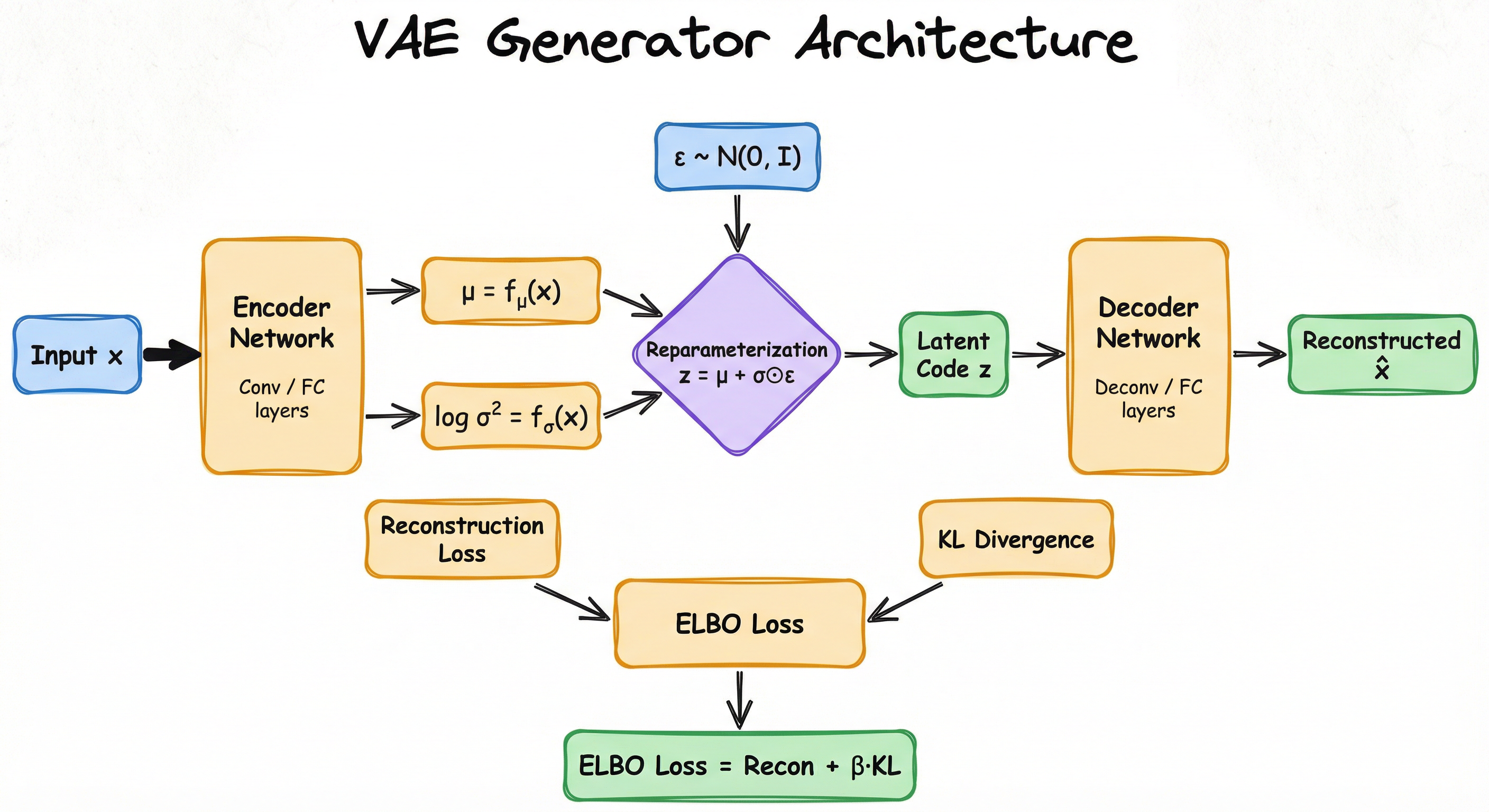
At inference time for generation, only the decoder is needed: sample from the prior and pass through the decoder to produce a new sample. For reconstruction or encoding, both encoder and decoder are used.
Key Components
Encoder Network (Inference Network)
A neural network that maps input data to the parameters of the approximate posterior distribution in latent space. For images, uses convolutional layers with stride-2 downsampling, batch normalization, and ReLU/LeakyReLU activations. The final convolutional feature map is flattened and passed through two parallel linear layers: one outputting the mean and one outputting the log-variance (log-variance is used instead of variance for numerical stability). The encoder is also called the recognition network or inference network because it performs approximate Bayesian inference.
Reparameterization Layer
The differentiable sampling mechanism that enables gradient flow through the stochastic latent variable. Instead of sampling directly (which would block gradients), it computes where is sampled independently. This separates the learnable parameters (, ) from the stochasticity (), enabling standard backpropagation. During inference, you can either sample (for generation diversity) or use (for deterministic encoding).
Latent Space
The low-dimensional space (typically ) where the VAE learns a compressed, structured representation. Regularized by the KL divergence term to approximate , the latent space supports smooth interpolation (linear paths between codes produce gradual output changes), arithmetic (vector operations on codes correspond to semantic operations on outputs), and sampling (random draws from produce valid outputs). The structure of the latent space is what makes VAEs powerful for generation, unlike standard autoencoders.
Decoder Network (Generative Network)
A neural network that maps latent codes to reconstructed data . For images, uses transposed convolutions (or nearest-neighbor upsampling + convolution) with batch normalization and ReLU activations, terminating with sigmoid (for [0,1] pixel values) or tanh (for [-1,1] normalization). The decoder defines the likelihood model: Gaussian likelihood (MSE loss) for continuous data, Bernoulli likelihood (BCE loss) for binary data, or categorical likelihood (cross-entropy) for discrete data. During generation, the decoder operates alone: where .
Loss Function (Negative ELBO)
The training objective combines reconstruction loss and KL regularization. Reconstruction loss: -- MSE for continuous outputs, BCE for binary. KL divergence: -- has a closed form for Gaussian-to-Gaussian. The total loss is minimized jointly over encoder () and decoder (). The coefficient (standard VAE: ; -VAE: ) controls the reconstruction-regularization tradeoff.
Prior Distribution
The assumed distribution over latent variables, typically a standard Gaussian . The prior serves as the baseline distribution from which we sample during generation. More expressive priors include Gaussian Mixture Models (VampPrior), learned autoregressive priors (VQ-VAE + PixelCNN), and normalizing flow priors (IAF-VAE) that better match the aggregate posterior and reduce the ELBO gap.
Data Flow
Training Flow:
-
Encode: Pass input through the encoder network to obtain latent distribution parameters: , .
-
Sample (reparameterize): Draw and compute . This is the reparameterization trick -- gradients flow through and while is treated as a constant input.
-
Decode: Pass the latent sample through the decoder to produce reconstruction .
-
Compute loss: Calculate reconstruction loss (or BCE) and KL divergence . Total loss = Reconstruction + KL.
-
Backpropagate: Compute gradients of total loss with respect to encoder () and decoder () parameters. Update both networks simultaneously with a single optimizer step.
-
Repeat: Continue for all minibatches across multiple epochs until convergence.
Generation Flow (Inference): Only the decoder is needed.
- Sample from the prior.
- Pass through the decoder: .
- Output as the generated sample.
Interpolation Flow: Given two data points and :
- Encode both: , (use means for deterministic interpolation).
- Compute interpolated latents: for .
- Decode each: .
- The resulting sequence shows smooth transitions between and .
A left-to-right flowchart showing the VAE architecture. Input data x enters the encoder network (blue), which produces two outputs: mean mu and log-variance. These feed into the reparameterization layer (purple) along with random noise epsilon sampled from a standard Gaussian. The reparameterization layer produces the latent code z (amber), which enters the decoder network (green) to produce the reconstruction x-hat. Two loss branches are shown: reconstruction loss (comparing x and x-hat) and KL divergence loss (from mu and log-variance), which combine into the total ELBO loss (red). The diagram illustrates the differentiable sampling process that enables end-to-end backpropagation.
How to Implement
Implementation Approaches
There are three main paths to implementing VAEs in production:
Approach 1: PyTorch/TensorFlow from Scratch -- For custom architectures, implement the encoder and decoder as nn.Module subclasses, write the reparameterization trick, and define the ELBO loss manually. This provides maximum control and is straightforward because VAE training is a single-objective optimization (unlike GANs). Recommended for research or domain-specific architectures.
Approach 2: High-Level Libraries -- For tabular data, use SDV (Synthetic Data Vault) with TVAE. For images, use Pythae (a library of VAE variants including β-VAE, IWAE, VAMP, RHVAE) or PyTorch Lightning with built-in VAE templates. These abstract away boilerplate while remaining customizable.
Approach 3: Domain-Specific Frameworks -- For molecular generation, use RDKit + MolVAE. For text, use VAE-based language models. For music, use Magenta. These frameworks encode domain knowledge (chemical validity constraints, grammar rules) into the VAE architecture.
Training Stability (VAE's Key Advantage)
Unlike GANs, VAE training is remarkably stable:
- Single loss function: No adversarial balancing -- just minimize negative ELBO.
- Monotonic convergence: Loss decreases predictably over training. No oscillations.
- Hyperparameter robustness: Learning rates of 1e-3 to 1e-4 with Adam work in most cases.
- Reproducible: Same hyperparameters produce consistent results across runs.
The main training challenge is posterior collapse (see Failure Modes), addressed by KL annealing, free bits, or cyclical annealing schedules.
Cost Note: Training a convolutional VAE on 64×64 images with 50K samples takes ~30 minutes on a single RTX 4090 (~INR 40 / 100-300 (~INR 8,400-25,200) for training on 4x V100s over 1-2 days. This is significantly cheaper than comparable GAN training.
import torch
import torch.nn as nn
import torch.nn.functional as F
import torch.optim as optim
from torch.utils.data import DataLoader
from torchvision import datasets, transforms

# Hyperparameters
latent_dim = 128
image_size = 64
channels = 3
batch_size = 128
lr = 1e-3
beta = 1.0  # KL weight (1.0 = standard VAE, >1 = β-VAE)

class Encoder(nn.Module):
    def __init__(self):
        super().__init__()
        # Conv layers: 3x64x64 -> 32x32x32 -> 64x16x16 -> 128x8x8 -> 256x4x4
        self.conv1 = nn.Conv2d(channels, 32, 4, 2, 1)
        self.conv2 = nn.Conv2d(32, 64, 4, 2, 1)
        self.conv3 = nn.Conv2d(64, 128, 4, 2, 1)
        self.conv4 = nn.Conv2d(128, 256, 4, 2, 1)
        self.bn1 = nn.BatchNorm2d(32)
        self.bn2 = nn.BatchNorm2d(64)
        self.bn3 = nn.BatchNorm2d(128)
        self.bn4 = nn.BatchNorm2d(256)

        # Flatten 256*4*4 = 4096 -> latent params
        self.fc_mu = nn.Linear(256 * 4 * 4, latent_dim)
        self.fc_logvar = nn.Linear(256 * 4 * 4, latent_dim)

    def forward(self, x):
        x = F.relu(self.bn1(self.conv1(x)))
        x = F.relu(self.bn2(self.conv2(x)))
        x = F.relu(self.bn3(self.conv3(x)))
        x = F.relu(self.bn4(self.conv4(x)))
        x = x.view(x.size(0), -1)  # Flatten
        mu = self.fc_mu(x)
        logvar = self.fc_logvar(x)
        return mu, logvar

class Decoder(nn.Module):
    def __init__(self):
        super().__init__()
        self.fc = nn.Linear(latent_dim, 256 * 4 * 4)
        self.deconv1 = nn.ConvTranspose2d(256, 128, 4, 2, 1)
        self.deconv2 = nn.ConvTranspose2d(128, 64, 4, 2, 1)
        self.deconv3 = nn.ConvTranspose2d(64, 32, 4, 2, 1)
        self.deconv4 = nn.ConvTranspose2d(32, channels, 4, 2, 1)
        self.bn1 = nn.BatchNorm2d(128)
        self.bn2 = nn.BatchNorm2d(64)
        self.bn3 = nn.BatchNorm2d(32)

    def forward(self, z):
        x = F.relu(self.fc(z))
        x = x.view(-1, 256, 4, 4)
        x = F.relu(self.bn1(self.deconv1(x)))
        x = F.relu(self.bn2(self.deconv2(x)))
        x = F.relu(self.bn3(self.deconv3(x)))
        x = torch.sigmoid(self.deconv4(x))  # Output [0, 1]
        return x

class VAE(nn.Module):
    def __init__(self):
        super().__init__()
        self.encoder = Encoder()
        self.decoder = Decoder()

    def reparameterize(self, mu, logvar):
        """Reparameterization trick: z = mu + sigma * epsilon"""
        std = torch.exp(0.5 * logvar)  # sigma = exp(0.5 * log(sigma^2))
        eps = torch.randn_like(std)     # epsilon ~ N(0, I)
        return mu + std * eps

    def forward(self, x):
        mu, logvar = self.encoder(x)
        z = self.reparameterize(mu, logvar)
        x_recon = self.decoder(z)
        return x_recon, mu, logvar

    def generate(self, num_samples, device):
        """Generate new samples from the prior."""
        z = torch.randn(num_samples, latent_dim).to(device)
        return self.decoder(z)

def vae_loss(x_recon, x, mu, logvar, beta=1.0):
    """ELBO loss = Reconstruction + beta * KL divergence."""
    # Reconstruction: Binary Cross-Entropy (pixel-wise)
    recon_loss = F.binary_cross_entropy(x_recon, x, reduction='sum')

    # KL divergence: closed-form for Gaussian
    # KL = -0.5 * sum(1 + log(sigma^2) - mu^2 - sigma^2)
    kl_loss = -0.5 * torch.sum(1 + logvar - mu.pow(2) - logvar.exp())

    return recon_loss + beta * kl_loss

# Initialize
device = torch.device('cuda' if torch.cuda.is_available() else 'cpu')
model = VAE().to(device)
optimizer = optim.Adam(model.parameters(), lr=lr)

# Training loop
for epoch in range(num_epochs):
    model.train()
    total_loss = 0
    for batch_idx, (data, _) in enumerate(dataloader):
        data = data.to(device)
        optimizer.zero_grad()

        x_recon, mu, logvar = model(data)
        loss = vae_loss(x_recon, data, mu, logvar, beta=beta)

        loss.backward()
        optimizer.step()
        total_loss += loss.item()

    avg_loss = total_loss / len(dataloader.dataset)
    print(f'Epoch {epoch}: Avg Loss = {avg_loss:.4f}')

# Generate new samples
model.eval()
with torch.no_grad():
    samples = model.generate(64, device)
    # samples shape: (64, 3, 64, 64)
This is a complete convolutional VAE implementation. Key design decisions:
- Encoder outputs two heads:
fc_muandfc_logvarproduce the mean and log-variance of the approximate posterior. Log-variance (not variance or std) is used for numerical stability -- it can be any real number, while variance must be positive. - Reparameterization trick:
z = mu + exp(0.5 * logvar) * epsseparates the learnable parameters from the random noise, enabling backpropagation through the sampling operation. - BCE reconstruction loss: Appropriate when pixel values are in [0, 1] (sigmoid output). For [-1, 1] outputs (tanh), use MSE loss instead.
- KL closed form: The analytic KL divergence for diagonal Gaussians avoids Monte Carlo estimation noise.
- Beta parameter: Set to 1.0 for standard VAE. Increase to 4-10 for disentangled β-VAE (at the cost of reconstruction quality).
- Single optimizer: Unlike GANs, both encoder and decoder are updated simultaneously with the same optimizer. No alternating updates needed.
import torch
import torch.nn as nn
import torch.nn.functional as F
import math

class BetaVAE(nn.Module):
    """β-VAE with cyclical KL annealing to prevent posterior collapse."""

    def __init__(self, input_dim, hidden_dim=512, latent_dim=64, beta=4.0):
        super().__init__()
        self.beta = beta
        self.latent_dim = latent_dim

        # Encoder
        self.encoder = nn.Sequential(
            nn.Linear(input_dim, hidden_dim),
            nn.BatchNorm1d(hidden_dim),
            nn.ReLU(),
            nn.Linear(hidden_dim, hidden_dim),
            nn.BatchNorm1d(hidden_dim),
            nn.ReLU(),
        )
        self.fc_mu = nn.Linear(hidden_dim, latent_dim)
        self.fc_logvar = nn.Linear(hidden_dim, latent_dim)

        # Decoder
        self.decoder = nn.Sequential(
            nn.Linear(latent_dim, hidden_dim),
            nn.BatchNorm1d(hidden_dim),
            nn.ReLU(),
            nn.Linear(hidden_dim, hidden_dim),
            nn.BatchNorm1d(hidden_dim),
            nn.ReLU(),
            nn.Linear(hidden_dim, input_dim),
        )

    def encode(self, x):
        h = self.encoder(x)
        return self.fc_mu(h), self.fc_logvar(h)

    def reparameterize(self, mu, logvar):
        std = torch.exp(0.5 * logvar)
        eps = torch.randn_like(std)
        return mu + std * eps

    def decode(self, z):
        return self.decoder(z)

    def forward(self, x):
        mu, logvar = self.encode(x)
        z = self.reparameterize(mu, logvar)
        x_recon = self.decode(z)
        return x_recon, mu, logvar, z

def cyclical_annealing(step, total_steps, n_cycles=4, ratio=0.5):
    """Cyclical KL annealing schedule (Fu et al., 2019).

    Ramps beta from 0 to 1 over `ratio` fraction of each cycle,
    then holds at 1 for the remainder. This prevents posterior
    collapse by letting the decoder learn useful representations
    before KL regularization kicks in.
    """
    cycle_length = total_steps // n_cycles
    position_in_cycle = step % cycle_length
    ramp_length = int(cycle_length * ratio)

    if position_in_cycle < ramp_length:
        return position_in_cycle / ramp_length
    else:
        return 1.0

def free_bits_kl(mu, logvar, free_bits=0.25):
    """Free bits: clamp KL per dimension to a minimum value.

    Prevents posterior collapse by ensuring each latent dimension
    encodes at least `free_bits` nats of information.
    From Kingma et al., 'Improved Variational Inference with
    Inverse Autoregressive Flow', NeurIPS 2016.
    """
    kl_per_dim = -0.5 * (1 + logvar - mu.pow(2) - logvar.exp())
    # Clamp each dimension to at least free_bits
    kl_clamped = torch.clamp(kl_per_dim, min=free_bits)
    return kl_clamped.sum(dim=-1).mean()

# Training with cyclical annealing
model = BetaVAE(input_dim=784, latent_dim=64, beta=4.0)
optimizer = torch.optim.Adam(model.parameters(), lr=1e-3)

total_steps = num_epochs * len(dataloader)
step = 0

for epoch in range(num_epochs):
    for batch_idx, (data, _) in enumerate(dataloader):
        data = data.view(-1, 784).to(device)

        x_recon, mu, logvar, z = model(data)

        # Reconstruction loss
        recon_loss = F.mse_loss(x_recon, data, reduction='sum') / data.size(0)

        # KL with free bits (optional)
        kl_loss = free_bits_kl(mu, logvar, free_bits=0.25)

        # Cyclical annealing weight
        anneal_weight = cyclical_annealing(step, total_steps)

        # Total loss: recon + beta * anneal_weight * KL
        loss = recon_loss + model.beta * anneal_weight * kl_loss

        optimizer.zero_grad()
        loss.backward()
        optimizer.step()
        step += 1
This implementation addresses the two most common VAE training challenges:
-
β-VAE (Higgins et al., 2017): Setting β > 1 (typically 2-10) strengthens the KL regularization, encouraging disentangled representations where individual latent dimensions capture independent factors of variation. The tradeoff: higher β means blurrier reconstructions but more interpretable, disentangled latent spaces.
-
Cyclical KL Annealing (Fu et al., 2019): Gradually increases the KL weight from 0 to 1 over multiple cycles. This prevents posterior collapse -- a failure mode where the KL term dominates early in training, causing the encoder to output the prior regardless of input. By initially setting KL weight to 0, the decoder first learns useful representations, then KL regularization gradually organizes the latent space.
-
Free Bits (Kingma et al., 2016): Ensures each latent dimension encodes at least a minimum amount of information by clamping the per-dimension KL to a floor value. This prevents the common scenario where only a few latent dimensions are active and the rest collapse to the prior.
import torch
import torch.nn as nn
import torch.nn.functional as F

class VectorQuantizer(nn.Module):
    """Vector Quantization layer for VQ-VAE.

    Maintains a codebook of K embedding vectors. Maps continuous
    encoder outputs to the nearest codebook entry.
    """
    def __init__(self, num_embeddings=512, embedding_dim=64, commitment_cost=0.25):
        super().__init__()
        self.num_embeddings = num_embeddings
        self.embedding_dim = embedding_dim
        self.commitment_cost = commitment_cost

        # Codebook: K x D embedding vectors
        self.embedding = nn.Embedding(num_embeddings, embedding_dim)
        self.embedding.weight.data.uniform_(-1/num_embeddings, 1/num_embeddings)

    def forward(self, z_e):
        # z_e shape: (B, D, H, W) for images
        # Reshape to (B*H*W, D) for distance computation
        z_e_flat = z_e.permute(0, 2, 3, 1).contiguous().view(-1, self.embedding_dim)

        # Compute distances to codebook entries: ||z_e - e_k||^2
        distances = (
            torch.sum(z_e_flat ** 2, dim=1, keepdim=True)
            + torch.sum(self.embedding.weight ** 2, dim=1)
            - 2 * z_e_flat @ self.embedding.weight.t()
        )

        # Find nearest codebook entry
        encoding_indices = torch.argmin(distances, dim=1)
        z_q = self.embedding(encoding_indices).view(z_e.permute(0, 2, 3, 1).shape)
        z_q = z_q.permute(0, 3, 1, 2)  # Back to (B, D, H, W)

        # Losses
        codebook_loss = F.mse_loss(z_q.detach(), z_e)  # Move codebook to encoder
        commitment_loss = F.mse_loss(z_q, z_e.detach())  # Keep encoder near codebook
        vq_loss = codebook_loss + self.commitment_cost * commitment_loss

        # Straight-through estimator: copy gradients from z_q to z_e
        z_q_st = z_e + (z_q - z_e).detach()

        return z_q_st, vq_loss, encoding_indices

class VQVAE(nn.Module):
    def __init__(self, num_embeddings=512, embedding_dim=64):
        super().__init__()

        # Encoder: 3x64x64 -> 64x16x16
        self.encoder = nn.Sequential(
            nn.Conv2d(3, 32, 4, 2, 1), nn.ReLU(),
            nn.Conv2d(32, 64, 4, 2, 1), nn.ReLU(),
            nn.Conv2d(64, embedding_dim, 3, 1, 1),  # Output dim matches codebook
        )

        # Vector Quantizer
        self.vq = VectorQuantizer(num_embeddings, embedding_dim)

        # Decoder: 64x16x16 -> 3x64x64
        self.decoder = nn.Sequential(
            nn.ConvTranspose2d(embedding_dim, 64, 4, 2, 1), nn.ReLU(),
            nn.ConvTranspose2d(64, 32, 4, 2, 1), nn.ReLU(),
            nn.ConvTranspose2d(32, 3, 3, 1, 1), nn.Sigmoid(),
        )

    def forward(self, x):
        z_e = self.encoder(x)
        z_q, vq_loss, indices = self.vq(z_e)
        x_recon = self.decoder(z_q)

        recon_loss = F.mse_loss(x_recon, x)
        total_loss = recon_loss + vq_loss

        return x_recon, total_loss, indices

    def encode_to_indices(self, x):
        """Encode image to discrete codebook indices."""
        z_e = self.encoder(x)
        _, _, indices = self.vq(z_e)
        return indices

# Training
model = VQVAE(num_embeddings=512, embedding_dim=64).to(device)
optimizer = torch.optim.Adam(model.parameters(), lr=3e-4)

for epoch in range(num_epochs):
    for data, _ in dataloader:
        data = data.to(device)
        x_recon, loss, indices = model(data)

        optimizer.zero_grad()
        loss.backward()
        optimizer.step()

# After training, use with autoregressive prior (e.g., PixelCNN)
# for high-quality generation
VQ-VAE replaces the continuous Gaussian latent space with a discrete codebook of learned embedding vectors. Key design elements:
- Vector Quantizer: Maintains a codebook of K embeddings. Each spatial location in the encoder output is mapped to the nearest codebook entry by L2 distance. This creates a discrete bottleneck.
- Straight-through estimator: Gradients from the decoder cannot flow through the argmin operation, so we copy gradients directly from the quantized output to the encoder output:
z_q_st = z_e + (z_q - z_e).detach(). - Two auxiliary losses: Codebook loss moves embeddings toward encoder outputs. Commitment loss keeps encoder outputs near their assigned embeddings.
- No KL term: VQ-VAE does not use KL divergence because the latent space is discrete. Instead, a separate autoregressive prior (PixelCNN, Transformer) is trained on the discrete indices to model for generation.
VQ-VAE produces much sharper images than standard VAE because the discrete codebook prevents the averaging effect of Gaussian latent variables. Combined with PixelCNN or Transformer priors, VQ-VAE-2 achieves image quality competitive with GANs.
# VAE Configuration (YAML)
model:
  architecture: conv-vae
  latent_dim: 128
  image_size: 64
  channels: 3
  variant: beta-vae  # standard | beta-vae | vq-vae

encoder:
  base_channels: 32
  num_layers: 4
  activation: relu
  normalization: batch_norm
  output_heads:
    - mu
    - logvar

decoder:
  base_channels: 32
  num_layers: 4
  activation: relu
  output_activation: sigmoid
  normalization: batch_norm

loss:
  reconstruction: bce  # bce | mse
  beta: 4.0
  kl_annealing:
    type: cyclical  # linear | cyclical | none
    warmup_epochs: 10
    n_cycles: 4
    ratio: 0.5
  free_bits: 0.25  # minimum KL per dimension (0 to disable)

training:
  batch_size: 128
  epochs: 100
  learning_rate: 1e-3
  optimizer: adam
  weight_decay: 1e-5
  scheduler:
    type: cosine
    min_lr: 1e-5

vq_vae:  # only used if variant is vq-vae
  num_embeddings: 512
  commitment_cost: 0.25
  ema_decay: 0.99  # EMA codebook update

data:
  dataset: celeba
  augmentation:
    - random_horizontal_flip
    - random_crop
    - normalize:
        mean: [0.5, 0.5, 0.5]
        std: [0.5, 0.5, 0.5]

checkpointing:
  save_every: 10
  log_reconstructions: true
  log_samples: true
  log_interpolations: true
Common Implementation Mistakes
- ●
Using MSE loss with sigmoid output: If the decoder outputs values in [0, 1] via sigmoid, use Binary Cross-Entropy (BCE) loss, not MSE. BCE is the correct negative log-likelihood for a Bernoulli output distribution. Using MSE with sigmoid causes gradients to vanish near 0 and 1. Conversely, if using tanh output (range [-1, 1]), MSE (Gaussian likelihood) is appropriate.
- ●
Not summing losses correctly: The ELBO should sum (not average) over data dimensions for the reconstruction term and sum over latent dimensions for KL. Then divide by batch size for the final loss. Averaging over data dimensions underweights reconstruction relative to KL, causing blurry outputs. Common error: using
reduction='mean'inF.binary_cross_entropywhen you should usereduction='sum'divided by batch size. - ●
Ignoring posterior collapse: When the decoder is too powerful (e.g., autoregressive like PixelCNN), it can reconstruct perfectly without using the latent code, causing the encoder to collapse to the prior ( for all ). The latent space becomes useless. Solutions: KL annealing, free bits, or weakening the decoder (e.g., reducing receptive field).
- ●
Setting latent dimension too high or too low: Too few latent dimensions (e.g., 2 for complex images) create an information bottleneck that limits reconstruction quality. Too many dimensions (e.g., 1024 for MNIST) lead to unused dimensions that collapse to the prior. Start with latent_dim = 32-128 for images and 16-64 for tabular data, then tune based on the active units metric.
- ●
Forgetting to use log-variance instead of variance: The encoder should output , not or . Log-variance can be any real number (unconstrained), while variance must be positive and standard deviation must be non-negative. Using variance directly requires an activation function (e.g., softplus) that can cause numerical issues. The reparameterization computes .
- ●
Training with β too high from the start: Starting with a large β (e.g., β=10) immediately forces the latent space to match the prior before the decoder has learned useful representations. This triggers posterior collapse. Always use KL annealing: start with β=0 (or small) and increase to the target β over training. Cyclical annealing (Fu et al., 2019) repeats this ramp-up multiple times for best results.
When Should You Use This?
Use When
You need stable, reproducible training without the hyperparameter sensitivity and mode collapse issues of GANs -- VAEs converge reliably with standard Adam optimizer settings
You require density estimation or anomaly detection -- VAEs provide (via ELBO) that directly measures how likely a sample is, enabling outlier scoring
You want a structured, interpretable latent space for downstream tasks like representation learning, interpolation, style transfer, or conditional generation
You're working with small to medium datasets (<50K samples) where GANs would overfit or mode-collapse -- VAEs generalize better from limited data
You need disentangled representations where individual latent dimensions correspond to interpretable factors of variation (using β-VAE or FactorVAE)
Your application requires both encoding and generation -- VAEs provide bidirectional mapping (encode real data to latent space AND decode latent codes to data)
You're building molecular design or drug discovery pipelines where continuous latent space navigation enables optimization of molecular properties
Avoid When
Photorealistic image quality is paramount -- standard VAEs produce blurry images due to Gaussian reconstruction loss. Use GANs, VQ-VAE + autoregressive prior, or diffusion models instead
You're generating high-resolution images (512×512+) where per-pixel losses fail to capture perceptual quality -- diffusion models or StyleGAN are better suited
Your data is purely discrete (text tokens, categorical sequences) without natural continuous representations -- autoregressive models (GPT-family) are more effective
You need maximum generation diversity without any blurriness -- GANs' adversarial loss produces sharper, more diverse samples at the cost of training stability
Speed of generation is critical and you also need high quality -- while VAEs generate fast (single forward pass), their quality lags GANs and diffusion models for complex data
You only need unconditional generation of simple data -- simpler methods like GMMs, copulas, or statistical resampling may suffice without deep learning overhead
Your team lacks expertise in probabilistic inference and latent variable models -- while VAEs train stably, debugging issues like posterior collapse requires understanding variational inference
Key Tradeoffs
Core Tradeoff: Reconstruction Quality vs. Latent Space Regularity
The ELBO's two terms pull in opposite directions. Strong reconstruction (low reconstruction loss) requires the encoder to output tight, informative distributions, while strong regularization (low KL) requires distributions to spread out and match the prior. This fundamental tension is why standard VAEs produce blurry outputs -- the Gaussian blur is a consequence of averaging over the posterior.
| Aspect | VAE | GAN | Diffusion Model |
|---|---|---|---|
| Sample Quality | Good (blurry for images) | Excellent (photorealistic) | Excellent (matches GANs) |
| Training Stability | Excellent (single loss) | Poor (mode collapse, divergence) | Good |
| Training Time | Fast (30min-12h) | Moderate (2h-5 days) | Slow (1-7 days) |
| Inference Speed | Fast (single forward pass) | Fast (single forward pass) | Slow (20-1000 steps) |
| Density Estimation | Yes (ELBO lower bound) | No (implicit model) | Yes (via diffusion SDE) |
| Latent Space | Structured, smooth, interpretable | Unstructured | N/A (no explicit latent space) |
| Disentanglement | Excellent (β-VAE) | Poor | Moderate |
| Small Data (<10K) | Good | Poor (overfits) | Moderate |
β-VAE: Reconstruction vs. Disentanglement
Increasing β forces stronger disentanglement (each latent dimension captures one factor) but degrades reconstruction quality:
| β Value | Reconstruction | Disentanglement | Use Case |
|---|---|---|---|
| 0.5 | Better than standard | Minimal | Sharp reconstructions needed |
| 1.0 | Standard VAE | Moderate | General purpose |
| 4.0 | Blurrier | Good | Interpretable representations |
| 10.0 | Very blurry | Excellent | Factor discovery, causal analysis |
Compute Cost Comparison
| Task | VAE Cost | GAN Cost | Diffusion Cost |
|---|---|---|---|
| MNIST 28×28 | $0.25 (₹21) / 15min | $1 (₹85) / 1h | $5 (₹420) / 3h |
| CelebA 64×64 | $2 (₹170) / 2h | $12 (₹1,000) / 12h | $50 (₹4,200) / 1d |
| High-res 256×256 | $50 (₹4,200) / 12h | $240 (₹20,100) / 2d | $300 (₹25,200) / 3d |
| Tabular 100K rows | $0.50 (₹42) / 20min | $2 (₹170) / 1h | N/A |
Practitioner's Note: For most production use cases involving latent space analysis, anomaly detection, or moderate-quality generation, VAEs offer the best effort-to-value ratio. For applications demanding photorealistic quality, consider VQ-VAE-2 (which matches GAN quality with VAE stability) or diffusion models.
Alternatives & Comparisons
GANs produce sharper, more photorealistic samples than standard VAEs by using an adversarial loss instead of pixel-wise reconstruction. However, GANs suffer from training instability, mode collapse, and provide no density estimation. Choose GANs when image quality is critical and you can tolerate complex training. Choose VAEs when you need stable training, latent space structure, anomaly detection, or disentangled representations.
Diffusion models achieve GAN-level quality with better training stability by learning a gradual denoising process. They outperform standard VAEs in image quality but are 100-1000x slower at inference. Choose diffusion models for high-quality image generation where inference latency is acceptable. Choose VAEs for fast inference, explicit density estimation, or when you need an interpretable latent space.
TVAE (Tabular VAE) is a VAE variant specialized for tabular data with mixed column types. It uses mode-specific normalization from CTGAN applied to the VAE framework. TVAE trains faster and more stably than CTGAN but may produce slightly less accurate multivariate statistics. Choose TVAE over generic VAEs for structured/tabular data with categorical and continuous columns.
CTGAN uses a GAN framework for tabular synthetic data, while TVAE uses a VAE framework. CTGAN can produce higher-fidelity multivariate correlations for complex tabular datasets, but is harder to train. For tabular data, CTGAN vs. TVAE is a direct comparison: CTGAN for maximum quality, TVAE for training stability and speed.
Copula-based generators model multivariate dependencies using statistical copula functions (Gaussian, Clayton, Frank). They require no neural network training and are fast to fit. However, copulas assume parametric dependency structures and struggle with complex, nonlinear relationships. Choose copulas for simple tabular data with well-understood correlations. Choose VAEs for complex, nonlinear distributions.
Pros, Cons & Tradeoffs
Advantages
Stable, reproducible training: VAEs optimize a single well-defined loss (negative ELBO) that decreases monotonically. No mode collapse, no adversarial balancing, no hyperparameter knife-edge. Training converges reliably with standard Adam settings across runs.
Explicit density estimation: VAEs provide (via ELBO lower bound), enabling anomaly detection, outlier scoring, and likelihood-based evaluation. You can answer "how likely is this sample?" -- something GANs fundamentally cannot do.
Structured, smooth latent space: The KL regularization ensures the latent space is continuous and organized. Nearby latent codes produce similar outputs, enabling smooth interpolation, latent arithmetic, and meaningful traversals. This makes VAEs ideal for representation learning and downstream tasks.
Disentangled representations (β-VAE): By increasing β, individual latent dimensions can be encouraged to capture independent, interpretable factors of variation (rotation, color, size). This enables factor discovery, controlled generation, and causal analysis -- capabilities unique to the VAE family.
Bidirectional mapping: VAEs provide both encoding () and decoding (). You can encode real data into latent representations for clustering, classification, or visualization, AND generate new data from the latent space. GANs only provide the decoding direction.
Works with small datasets: VAEs generalize better than GANs from limited data (<10K samples) because the KL regularization acts as a strong prior. For Indian startups and research labs with limited labeled data, VAEs are more practical than data-hungry GANs.
Rich variant ecosystem: The VAE framework has spawned dozens of well-studied variants: β-VAE (disentanglement), CVAE (conditional generation), VQ-VAE (discrete latents, sharp images), hierarchical VAE (multi-scale), NVAE (GAN-competitive quality). Each addresses specific limitations while maintaining the core stability.
Disadvantages
Blurry sample quality: Standard VAEs with Gaussian decoders produce blurry images because MSE/BCE loss averages over reconstruction uncertainty. The Gaussian likelihood penalizes pixel-level deviations rather than perceptual quality. VQ-VAE and perceptual loss VAEs address this but add complexity.
Posterior collapse: When the decoder is powerful enough to model without the latent code, the encoder collapses to the prior (), making the latent space useless. This is especially common with autoregressive decoders or very deep architectures. Requires KL annealing, free bits, or architectural constraints.
ELBO is a lower bound, not exact: The training objective is a lower bound on , not the true likelihood. The gap depends on how well approximates . This means a lower ELBO doesn't always mean a better generative model. Tighter bounds (IWAE) or more flexible posteriors (normalizing flows) partially address this.
Limited expressiveness with standard Gaussian posterior: Assuming restricts the posterior to unimodal, axis-aligned Gaussians. Complex true posteriors with multiple modes or correlations are poorly approximated. Normalizing flow posteriors (IAF-VAE) or mixture posteriors improve this.
Reconstruction-regularization tradeoff: The ELBO's two terms inherently conflict. You cannot simultaneously achieve perfect reconstruction AND perfect KL match to the prior. This fundamental tension limits overall quality. There is no free lunch -- sharper images require sacrificing latent space regularity, and vice versa.
Evaluation challenges: While ELBO provides a training signal, it's not a reliable metric for comparing different VAE architectures or for measuring generation quality. FID scores for VAEs are typically 2-5x worse than comparable GANs. Separate evaluation (FID, visual inspection, downstream task performance) is needed.
Latent space underutilization: In high-dimensional latent spaces, many dimensions collapse to the prior and encode no information. The model effectively uses a lower-dimensional subspace. Tracking active units (AU) and using techniques like free bits are needed to maximize latent space utilization.
Failure Modes & Debugging
Posterior Collapse
Cause
The decoder learns to model independently of the latent code , causing the encoder to output the prior for all inputs. This occurs when: (1) the decoder has autoregressive structure or is very deep, making it powerful enough to ignore ; (2) the KL term dominates too early in training before the decoder learns to use ; (3) the latent dimension is too large, providing more capacity than needed. The latent space becomes useless for representation learning or controlled generation.
Symptoms
KL divergence drops to zero (or near-zero) early in training and stays there. All inputs map to nearly identical latent distributions. Generated samples from random look identical to reconstructions. Latent space interpolation produces no meaningful variation. The number of active units (latent dimensions with ) is zero or very small compared to total latent dimensions.
Mitigation
KL Annealing: Start with β=0 and linearly increase to β=1 over the first 10-30% of training. This lets the decoder first learn to use the latent code for reconstruction, then gradually applies regularization. Cyclical Annealing (Fu et al., 2019): Repeat the β ramp-up multiple times for even better results. Free Bits (Kingma et al., 2016): Set a minimum KL per dimension (e.g., 0.25 nats), forcing each dimension to encode at least some information. Weaker Decoder: Reduce the decoder's receptive field (for autoregressive decoders) or capacity to force reliance on the latent code. Skip Connections: Add connections from encoder to decoder to provide an information highway that reduces posterior collapse risk.
Blurry Reconstruction / Generation
Cause
The Gaussian likelihood (MSE loss) in the decoder penalizes pixel-level deviations equally across all frequencies. For uncertain regions (e.g., exact hair position), the model learns to output the expected value -- an average of all possible configurations -- which appears blurry. This is a fundamental consequence of the Gaussian assumption: the optimal reconstruction under MSE is the conditional mean , which averages over uncertainty rather than committing to a specific sharp output.
Symptoms
Reconstructions are recognizable but lack fine detail -- edges are soft, textures are smoothed, small features (eyes, text) are indistinct. Generated samples are even blurrier than reconstructions because they sample from the prior rather than the posterior. FID scores are 2-5x worse than comparable GANs. High-frequency image details (textures, sharp edges) are missing.
Mitigation
Perceptual loss: Replace MSE with a loss computed on intermediate features of a pretrained network (VGG, ResNet). This captures perceptual similarity rather than pixel-level similarity. Adversarial loss: Add a discriminator (creating a VAE-GAN hybrid) that provides perceptual feedback. VQ-VAE: Use discrete latent codes that avoid the averaging effect of Gaussian latents. VQ-VAE with an autoregressive prior achieves GAN-competitive sharpness. Hierarchical VAE: Use multi-scale latent variables (NVAE, VDVAE) that capture both coarse and fine details at appropriate resolutions.
KL Vanishing / Over-Regularization
Cause
When using β-VAE with β >> 1 or when the KL annealing schedule ramps up too aggressively, the KL term overwhelms the reconstruction loss. The encoder is forced to match the prior too closely, losing the ability to encode input-specific information. This is the opposite of posterior collapse in symptoms but shares the same root cause: an imbalance between the ELBO's two terms.
Symptoms
Reconstruction quality degrades significantly -- outputs are washed out, low-detail, or generic. The KL divergence is very low (nearly zero), but unlike posterior collapse, this is because the strong regularization forces it. Generated samples look similar to each other (low diversity) because the encoder compresses all inputs to a narrow region of latent space. Latent traversals produce very subtle changes.
Mitigation
Reduce β to a more moderate value (start with β=1 and increase gradually). Use controlled capacity increase (Burgess et al., 2018): where is a target KL value that increases from 0 to the desired capacity over training. This allows precise control over the information throughput of the latent bottleneck. Monitor the rate-distortion curve to find the optimal β for your quality-disentanglement tradeoff.
Codebook Collapse (VQ-VAE)
Cause
In VQ-VAE, some codebook entries are never selected by the encoder, becoming "dead" embeddings that waste capacity. This occurs when: (1) the codebook is too large relative to the data complexity; (2) initial codebook embeddings are poorly positioned; (3) the commitment loss is too strong, keeping the encoder near a subset of embeddings. Dead codebook entries reduce the model's effective capacity and diversity.
Symptoms
Codebook utilization is low -- only 10-30% of embeddings are actively used. Perplexity of codebook usage (exponential of entropy of embedding selection distribution) is much lower than the codebook size. Generated samples lack diversity because the model only uses a fraction of available codes. Reconstruction quality plateaus early.
Mitigation
EMA codebook update: Replace the gradient-based codebook update with exponential moving average (EMA), which more reliably moves embeddings toward encoder outputs. Codebook reset: Periodically reinitialize unused embeddings to the encoder outputs of random training samples. Reduce codebook size: If utilization is persistently low, reduce the number of embeddings. Jitter: Add small noise to encoder outputs before quantization to encourage exploration of the codebook.
Latent Space Holes
Cause
Despite KL regularization, the aggregate posterior may not perfectly match the prior , leaving regions of latent space where no training data maps. Sampling from these "holes" during generation produces unrealistic or out-of-distribution outputs. This is especially problematic in high-dimensional latent spaces where volume grows exponentially.
Symptoms
Some generated samples (from prior sampling) are clearly unrealistic or contain artifacts, even when reconstructions look good. Interpolation between distant latent codes passes through unrealistic intermediate states. The distribution of latent codes (encoder outputs) visually doesn't match the prior when projected to 2D (e.g., via t-SNE or PCA).
Mitigation
Increase KL weight (higher β) to force better prior matching at the cost of reconstruction quality. Use more expressive priors: Replace with a VampPrior (mixture of approximate posteriors), a learned GMM prior, or a normalizing flow prior that better matches the aggregate posterior shape. Two-stage training: First train the VAE, then fit a more flexible prior (e.g., a normalizing flow) to the aggregate posterior. Rejection sampling: At generation time, reject samples that fall in low-density regions of the aggregate posterior.
Placement in an ML System
Where VAEs Fit in Production ML Systems
VAEs serve multiple roles in production ML pipelines, often simultaneously:
1. Synthetic Data Generation: Train a VAE on real data, then sample from the prior to generate unlimited synthetic samples. Unlike GANs, VAE training is stable and reproducible, making it suitable for automated pipelines. Use cases: data augmentation for rare classes, privacy-preserving data sharing (with differential privacy), generating test data for QA environments.
2. Anomaly Detection: The ELBO provides a natural anomaly score -- data points with low ELBO (high reconstruction error or high KL divergence) are likely outliers. This is used in fraud detection (Razorpay-style fintech systems), manufacturing defect detection, and medical image screening (Qure.ai-style applications).
3. Representation Learning: The encoder maps data to a structured latent space useful for downstream tasks. Latent representations can be used for clustering, similarity search, or as features for classifiers. β-VAE latent codes are particularly useful because disentangled dimensions are independently interpretable.
4. Conditional Generation (CVAE): By conditioning on labels or attributes, CVAEs generate data matching specific criteria. In ML systems, this enables targeted data augmentation ("generate more samples of rare class X"), controlled synthetic data ("generate patient records with diabetes and age > 60"), and what-if analysis.
Example Pipeline: A fintech company in India trains a VAE on anonymized transaction data. The system serves three purposes: (1) anomaly detection -- flag transactions with low ELBO as potential fraud; (2) synthetic data -- generate fake transaction records for developer testing environments under RBI data localization rules; (3) representation learning -- use latent codes as features for a downstream credit scoring model.
Pipeline Stage
Data Generation / Representation Learning
Upstream
- Real training data collection and preprocessing
- Data cleaning and normalization
- Feature engineering (for tabular VAEs)
- Image preprocessing (resize, normalize to [0,1] or [-1,1])
Downstream
- Synthetic data quality evaluation (FID, statistical tests)
- Anomaly detection systems (using ELBO as anomaly score)
- Downstream model training (using synthetic or augmented data)
- Representation learning and clustering (using latent space)
- Privacy-preserving data sharing (synthetic records)
Scaling Bottlenecks
VAE training is compute-bound during the encoder-decoder forward/backward pass. Unlike GANs, there is no alternating optimization -- the entire model is updated in a single step, making distributed training straightforward with standard data parallelism.
Memory: The main bottleneck is storing intermediate activations for both encoder and decoder during backpropagation. For high-resolution images (256×256+), gradient checkpointing reduces memory at the cost of ~30% slower training. A hierarchical VAE (NVAE) with 30+ latent layers requires 24-40 GB GPU memory.
Latent dimensionality: Higher latent dimensions increase the KL computation and the decoder's input size, but this is typically a small fraction of total compute. The bottleneck is almost always the convolutional/attention layers.
VAE inference is fast -- a single forward pass through the decoder. For batch generation, throughput scales linearly with batch size up to GPU memory limits. A convolutional VAE generates ~5,000 64×64 images per second on a single V100.
Latent space navigation for large-scale generation requires sampling strategies. Uniform sampling from works but may undersample rare modes. For production, use importance-weighted sampling or fit a more complex prior to the aggregate posterior.
For serving, only the decoder is needed (encoder is discarded unless encoding/anomaly detection is required). The decoder is typically 5-15M parameters -- easily served on CPU for moderate throughput or GPU for high throughput. Quantizing to FP16 halves memory with negligible quality loss.
Production Case Studies
DeepMind's work on protein structure prediction (AlphaFold) and related generative modeling research has leveraged VAE-based approaches for learning compact representations of protein structures. VAE-based models learn latent spaces over molecular conformations, enabling exploration of protein design space. The latent space structure allows interpolation between known protein folds to hypothesize novel structures.
VAE-based generative models for molecular design have enabled 10-100x faster exploration of chemical space compared to brute-force screening. In drug discovery pipelines, this translates to reducing candidate molecule screening from months to days. Indian pharmaceutical companies (Dr. Reddy's, Biocon) are exploring similar VAE-based approaches for generic drug molecule optimization.
Spotify Research's official publication on FS-VAE (Fast-Slow Variational Autoencoder) presented at WSDM 2022, which uses sequential and non-sequential encoders to model user listening patterns by capturing both long-term preferences and short-term taste changes.
FS-VAE significantly improved prediction accuracy for next track selection compared to baseline models; combines variational autoencoder architecture with fast-moving (session-based) and slow-moving (historical) feature encoders for personalized music recommendations.
NVIDIA's NVAE (Nouveau VAE) demonstrated that hierarchical VAEs can achieve image quality competitive with GANs. NVAE uses a deep hierarchical latent structure with residual cells, spectral regularization, and depth-wise separable convolutions. The model achieves state-of-the-art density estimation on CIFAR-10 and CelebA while generating high-quality 256×256 images.
NVAE achieved FID of 51.7 on CelebA 256×256 (compared to 62.2 for previous best VAE), narrowing the gap with GANs significantly. The model demonstrated that careful architectural design -- not just the loss function -- determines VAE image quality. NVAE's techniques (spectral regularization, residual latent cells) have been adopted by subsequent hierarchical VAE research.
Razorpay's ML team explores VAE-based approaches for two key applications: (1) fraud detection using the ELBO as an anomaly score to flag suspicious payment transactions, and (2) synthetic data generation for creating realistic test transaction datasets that comply with RBI data localization requirements. The VAE latent space clusters transactions by risk profile, enabling targeted monitoring.
VAE-based anomaly detection processes 100M+ transactions monthly with sub-10ms latency per transaction (decoder-only inference). The synthetic data pipeline generates privacy-preserving test datasets that enable Razorpay's engineering teams to develop and test payment features without accessing real customer transaction data, supporting RBI compliance and PCI-DSS requirements.
Tooling & Ecosystem
A comprehensive Python library implementing 20+ VAE variants including standard VAE, β-VAE, IWAE, VQ-VAE, VAMP, RHVAE, SVAE, and more. Provides unified training pipelines, evaluation metrics, and model comparison tools. The best resource for benchmarking and experimenting with different VAE architectures.
Production-grade library for generating synthetic tabular data. Includes TVAE (Tabular VAE) alongside CTGAN and copula-based synthesizers. Provides metadata-driven configuration, quality metrics (Column Shapes, Column Pair Trends), and constraint handling. The standard tool for tabular synthetic data.
PyTorch Lightning provides structured training loops that simplify VAE implementation. The community maintains VAE templates with built-in logging, distributed training, and checkpointing. Reduces boilerplate while maintaining full flexibility for custom architectures.
Google Research library for training and evaluating disentangled representations, primarily through β-VAE and its variants. Includes standardized disentanglement metrics (DCI, SAP, Factor VAE metric), benchmark datasets (dSprites, 3D Shapes), and reproducible training pipelines.
Includes implementations of FID (Frechet Inception Distance), IS (Inception Score), and other generative model evaluation metrics. GPU-accelerated and compatible with PyTorch Lightning. Essential for quantitatively evaluating VAE generation quality against baselines.
While primarily for diffusion models, Hugging Face Diffusers includes pretrained VAE encoder-decoders used in Stable Diffusion (the KL-autoencoder). These VAEs map images to compact latent spaces and back, providing production-ready encoder-decoder pairs that can be used standalone for representation learning or image compression.
Research & References
Kingma & Welling (2013)ICLR 2014
The foundational VAE paper that introduced the framework of amortized variational inference with neural networks. Derived the ELBO, proposed the reparameterization trick for differentiable sampling through Gaussian latent variables, and demonstrated generation on MNIST and Frey Face datasets. One of the most cited papers in deep generative modeling.
Rezende, Mohamed & Wissner-Gross (2014)ICML 2014
Independently derived the same variational autoencoder framework as Kingma & Welling, arriving at the reparameterization trick through a different mathematical path (stochastic backpropagation). Also introduced the idea of using normalizing flows to create more flexible approximate posteriors, which later became a major research direction.
Higgins, Matthey, Pal, Burgess, Glorot, Botvinick, Mohamed & Lerchner (2017)ICLR 2017
Introduced the β-VAE by adding a hyperparameter β > 1 to the KL term, discovering that stronger regularization encourages disentangled representations where individual latent dimensions correspond to interpretable factors of variation. Proposed the disentanglement metric and demonstrated on dSprites and CelebA that β-VAE discovers rotation, scale, position, and shape factors without supervision.
van den Oord, Vinyals & Kavukcuoglu (2017)NeurIPS 2017
Introduced Vector Quantized VAE (VQ-VAE) replacing the continuous Gaussian latent space with a discrete codebook of learned embeddings. Uses straight-through estimation for gradient flow through the quantization step. Combined with a PixelCNN prior over discrete codes, VQ-VAE achieves sharper image generation than continuous VAEs and enables high-quality speech synthesis.
Razavi, van den Oord & Vinyals (2019)NeurIPS 2019
Extended VQ-VAE to a multi-scale hierarchical architecture (VQ-VAE-2) that generates diverse, high-fidelity 1024×1024 images. Uses a top-level codebook for global structure and a bottom-level codebook for local details, each with its own autoregressive prior. Achieved FID competitive with BigGAN while maintaining the stable training of VAEs.
Vahdat & Kautz (2020)NeurIPS 2020
Demonstrated that carefully designed hierarchical VAEs can achieve GAN-competitive image quality. NVAE uses deep residual cells, spectral regularization, and depth-wise separable convolutions across 30+ hierarchical latent layers. Achieved state-of-the-art density estimation on CIFAR-10 (2.91 bits/dim) and competitive FID on CelebA 256×256 (51.7).
Fu, Li, Gan, Chen, Henao & Carin (2019)NAACL 2019
Proposed cyclical KL annealing as a solution to posterior collapse in VAE training. Instead of linearly increasing the KL weight once, the schedule cycles between 0 and 1 multiple times during training. Each cycle allows the model to first learn useful representations (low KL weight) then organize the latent space (high KL weight). Demonstrated significant improvements in text generation and dialogue modeling.
Interview & Evaluation Perspective
Common Interview Questions
- ●
Explain how VAEs work. What is the ELBO and why do we optimize it?
- ●
What is the reparameterization trick and why is it necessary?
- ●
Compare VAEs to GANs. When would you choose one over the other?
- ●
What is posterior collapse and how do you prevent it?
- ●
Explain the difference between β-VAE and standard VAE. What does disentanglement mean?
- ●
How does VQ-VAE differ from standard VAE? Why does it produce sharper images?
- ●
How would you use a VAE for anomaly detection in a production system?
- ●
Design a privacy-preserving synthetic data system using VAEs for a fintech company.
Key Points to Mention
- ●
VAEs learn a latent variable model by maximizing the ELBO: . The ELBO lower-bounds the intractable log-likelihood . The gap is the KL between approximate and true posteriors.
- ●
The reparameterization trick (, ) enables backpropagation through the stochastic sampling step by separating learnable parameters from randomness.
- ●
VAEs provide three things GANs cannot: (1) density estimation for anomaly detection, (2) structured latent space for representation learning, (3) stable, reproducible training. GANs provide one thing VAEs struggle with: photorealistic sample quality.
- ●
Posterior collapse occurs when the decoder ignores the latent code. The encoder outputs the prior for all inputs, making the latent space useless. Solutions: KL annealing (linear or cyclical), free bits (minimum KL per dimension), weaker decoder.
- ●
β-VAE with β > 1 encourages disentangled representations where each latent dimension captures one independent factor of variation. At β = 4-10, you can discover factors like rotation, lighting, and color without supervision, at the cost of blurrier reconstructions.
- ●
VQ-VAE replaces the Gaussian latent space with a discrete codebook, avoiding the averaging effect that causes blur. Combined with an autoregressive prior (PixelCNN/Transformer), VQ-VAE achieves GAN-competitive image quality while maintaining stable VAE training.
- ●
For anomaly detection: encode input , compute ELBO (or just reconstruction error). Low ELBO = data point is unlikely under the learned distribution = potential anomaly. This provides a principled, calibrated anomaly score.
Pitfalls to Avoid
- ●
Claiming VAEs generate as well as GANs for images -- standard VAEs produce blurrier outputs. Acknowledge the reconstruction-regularization tradeoff. Mention VQ-VAE and hierarchical VAEs if pressed on quality.
- ●
Confusing the ELBO with the true likelihood. The ELBO is a lower bound; a lower ELBO value doesn't always mean a better generative model because the bound gap can vary. Show awareness of tighter bounds (IWAE) and their tradeoffs.
- ●
Saying the KL divergence 'measures how different two distributions are' without specifying it's asymmetric: . The VAE minimizes , which tends to be mode-covering (spreading to cover all of ).
- ●
Not mentioning posterior collapse as the primary failure mode. This is the single most important practical challenge in VAE training, and interviewers expect you to know solutions (KL annealing, free bits).
- ●
Describing VAEs as 'just autoencoders with noise' -- this misses the probabilistic foundation. VAEs are principled latent variable models trained with variational inference. The mathematical framework (ELBO, variational posterior, prior matching) is what makes them useful beyond compression.
Senior-Level Expectation
A senior/staff engineer should discuss VAEs at three levels: (1) Mathematical: Derive the ELBO from Jensen's inequality or the KL decomposition. Explain why the reparameterization trick works and when it fails (non-Gaussian posteriors -- use normalizing flows or score function estimator). Discuss the information-theoretic interpretation: rate (KL) vs. distortion (reconstruction) tradeoff. (2) Architecture: Compare VAE variants -- β-VAE for disentanglement, VQ-VAE for discrete representation and sharp generation, hierarchical VAE (NVAE, VDVAE) for multi-scale modeling. Discuss when each variant is appropriate and their computational tradeoffs. (3) System Design: For a production synthetic data system, design the full pipeline: VAE training on sensitive data (with optional differential privacy), quality evaluation (FID, statistical tests, downstream task performance), privacy auditing (membership inference attacks), and deployment (encoder for anomaly detection at inference time, decoder for batch synthetic data generation). Estimate costs in INR/USD, latency budgets, and scaling requirements. Address the reconstruction-regularization tradeoff with practical solutions (perceptual loss, VQ-VAE) and explain when a VAE is the right choice versus GANs or diffusion models.
Summary
What We Covered
Variational Autoencoders (VAEs), introduced by Kingma & Welling in 2013, are probabilistic generative models that learn latent variable representations through variational inference. The encoder maps data to the parameters of a distribution in latent space, and the decoder generates data from sampled latent codes. Training maximizes the Evidence Lower Bound (ELBO), which balances reconstruction quality against latent space regularization through KL divergence.
The reparameterization trick (, ) enables gradient-based optimization through the stochastic sampling step. The VAE framework has spawned powerful variants: β-VAE (β > 1 encourages disentangled representations where each latent dimension captures one independent factor), VQ-VAE (discrete codebook latents that produce sharper images by avoiding Gaussian averaging), CVAE (conditional generation given labels or attributes), and hierarchical VAEs (NVAE, VDVAE) that stack multiple latent layers for multi-scale representation and GAN-competitive image quality.
VAEs' key strengths are stable training (single loss, monotonic convergence, no mode collapse), density estimation (ELBO as anomaly score), structured latent space (smooth interpolation, arithmetic, disentanglement), and bidirectional mapping (encode and decode). Their main weakness is blurry sample quality for images due to the reconstruction-regularization tradeoff, though VQ-VAE and hierarchical architectures largely address this. Posterior collapse -- where the encoder ignores the input and outputs the prior -- is the primary failure mode, mitigated by KL annealing, free bits, and cyclical schedules.
For production deployments, VAEs serve as synthetic data generators (privacy-preserving tabular data for fintech/healthcare compliance), anomaly detectors (ELBO-based scoring for fraud detection and medical screening), and representation learners (structured latent spaces for clustering, search, and downstream models). Training costs are 2-10x lower than comparable GANs: a convolutional VAE on 64×64 images trains in ~2 hours for 50-300 / ₹4,200-25,200 for 1-2 days on multi-GPU setups. VAEs are the right choice when you need stable training, density estimation, or interpretable latent spaces; defer to GANs or diffusion models when photorealistic image quality is the primary requirement.