Prefix Tuning in Machine Learning
Prefix tuning is a parameter-efficient fine-tuning (PEFT) method that prepends a sequence of learnable continuous vectors -- called prefix tokens or virtual tokens -- to the key and value matrices of every transformer layer, while keeping all original model parameters frozen. Introduced by Li & Liang in 2021, it was one of the earliest methods to demonstrate that you could adapt a billion-parameter language model by training fewer than 0.1% of its parameters.
Why does this matter? Because full fine-tuning of large language models is brutally expensive. Fine-tuning GPT-3 175B requires hundreds of gigabytes of GPU memory and costs thousands of dollars per run. Prefix tuning sidesteps this by learning a small set of task-specific vectors that steer the model's attention without modifying any of the frozen weights. You get task-specific behavior without task-specific copies of the entire model.
In production ML systems, prefix tuning enables multi-tenant model serving: a single frozen base model can serve dozens or hundreds of tasks, each with its own lightweight prefix. Swap the prefix, change the behavior. This is transformative for companies like Flipkart or Swiggy that need to serve multiple domain-specific models -- product categorization, review sentiment, delivery ETA prediction -- without deploying separate model instances for each.
This guide covers the full lifecycle: the math behind prefix tuning, the MLP reparameterization trick, prefix length selection, multi-task prefix sharing, production deployment patterns, and how prefix tuning compares to LoRA, prompt tuning, P-tuning, and adapter methods.
Concept Snapshot
- What It Is
- A PEFT method that prepends learnable continuous vectors (virtual tokens) to the key-value pairs at every transformer layer, steering model behavior without modifying frozen base weights.
- Category
- Model Training
- Complexity
- Advanced
- Inputs / Outputs
- Inputs: frozen pretrained model + task-specific training data. Outputs: a small prefix parameter matrix (typically 0.1-1% of model size) that adapts the model to the target task.
- System Placement
- Sits in the fine-tuning stage of the ML pipeline, between pretrained model selection and model deployment/serving.
- Also Known As
- prefix-tuning, prefix PEFT, continuous prefix, virtual token tuning, soft prefix
- Typical Users
- ML Engineers, NLP Researchers, Applied Scientists, MLOps Engineers
- Prerequisites
- Transformer architecture (attention mechanism), Key-value attention computation, Fine-tuning fundamentals, Basic understanding of PEFT motivation
- Key Terms
- prefix lengthvirtual tokensreparameterizationMLP trickkey-value prependingsoft promptmulti-task prefixprefix projection
Why This Concept Exists
The Full Fine-Tuning Tax
Before PEFT methods, adapting a pretrained transformer to a new task meant updating every single parameter. For a 7B-parameter model, that's roughly 28 GB of optimizer states (with AdamW), 14 GB for gradients, and 14 GB for the model weights themselves -- totaling ~56 GB just for training. On an NVIDIA A100 80GB GPU in an Indian cloud provider like E2E Networks, that's approximately INR 150/hour (145/hour).
Worse still, if you have 50 tasks, you need 50 separate copies of the model. Each copy consumes storage, requires its own serving infrastructure, and multiplies your operational burden.
The Insight: Attention Is All You Need to Steer
Li & Liang (2021) observed something elegant: the transformer's behavior is largely governed by what the attention mechanism attends to. If you can control the key-value context that each attention head sees, you can steer the model's output without touching its weights.
The key insight was that prepending trainable vectors to the key and value matrices at every layer -- not just the input embedding layer -- provides a richer, more expressive control surface than input-only methods. Each layer's prefix can independently influence the attention pattern at that depth, giving prefix tuning a form of layer-wise task specialization that input-only methods lack.
From Discrete Prompts to Continuous Prefixes
Before prefix tuning, practitioners tried discrete prompt engineering -- manually crafting text prompts to elicit desired behavior. But discrete prompts are limited to the model's existing vocabulary, brittle to phrasing, and impossible to optimize with gradient descent.
Prefix tuning's breakthrough was moving from discrete token space to continuous embedding space. Instead of searching over word sequences, you optimize real-valued vectors directly. This opened the door to gradient-based optimization of the "prompt" -- something that discrete tokens fundamentally cannot support.
Historical Context: Prefix tuning (Li & Liang, 2021) appeared alongside several related ideas: prompt tuning (Lester et al., 2021), P-tuning (Liu et al., 2021), and adapter layers (Houlsby et al., 2019). Together, these formed the first wave of PEFT methods that preceded the now-dominant LoRA family. Understanding prefix tuning is essential for understanding the design space of parameter-efficient adaptation.
Core Intuition & Mental Model
The Mental Model: A Whisper in Every Ear
Imagine a large language model as a company with many departments (layers), each staffed by employees (attention heads) who make decisions based on the documents (key-value pairs) on their desks. Full fine-tuning retrains every employee. Prefix tuning, by contrast, places a small briefing memo on every desk in every department. The employees don't change -- they just see additional context that steers their decisions toward the desired task.
The prefix vectors are like a persistent background whisper that every attention head hears at every layer. They don't replace the model's knowledge; they redirect it. A prefix for sentiment analysis might encode something like "focus on emotional valence" in a way the model's attention mechanism naturally integrates.
Why Every Layer Matters
This is where prefix tuning differs critically from prompt tuning (which only prepends to the input layer). In a deep transformer, information from the input gets progressively transformed through dozens of layers. A signal injected only at the input can get diluted or overwritten by layer 20. Prefix tuning injects fresh steering signals at every layer, maintaining influence throughout the forward pass.
Think of it like this: prompt tuning gives you one chance to whisper at the front door. Prefix tuning gives you an advocate in every room of the building.
The Reparameterization Trick: Why We Don't Optimize Directly
Here's a subtlety that trips people up. You might think we'd just create a matrix of prefix vectors and optimize them directly with gradient descent. But in practice, directly optimizing high-dimensional prefix vectors leads to unstable training -- the loss landscape is rugged, and the prefixes tend to oscillate without converging.
Li & Liang's solution was the MLP reparameterization trick: instead of optimizing the prefix matrix directly, you optimize a smaller matrix and pass it through a two-layer MLP to produce . The MLP acts as a smooth mapping that regularizes the optimization. Once training is complete, you discard the MLP and keep only the resulting prefix matrix for inference. Elegant and practical.
Technical Foundations
Notation and Setup
Let denote the frozen parameters of a pretrained transformer with layers. At each layer , the standard multi-head attention computes:
where , , are the query, key, and value matrices for input tokens.
Prefix Injection
Prefix tuning introduces learnable prefix vectors and for each layer , where is the prefix length (number of virtual tokens). These are concatenated to the key and value matrices:
The attention computation becomes:
The query matrix now attends over both the prefix tokens and the original input tokens. The prefix tokens receive attention weights, effectively injecting learned information into the attention output.
Total Trainable Parameters
The total number of trainable parameters for prefix tuning is:
wait -- let me be more precise. For a model with layers, hidden dimension , and attention heads (with ), the prefix parameters per layer are (one set for keys, one for values). Total:
For GPT-2 Large (, ) with prefix length :
MLP Reparameterization
During training, we do NOT optimize and directly. Instead, we learn a smaller matrix (where ) and transform it through a two-layer MLP:
where , , and are the MLP parameters also optimized during training.
After training, the MLP is discarded. Only the resulting prefix matrices are stored for inference.
Expressiveness Analysis
The prefix mechanism can be understood as adding a bias term to the attention output. Given prefix attention weights (over prefix positions) and original attention weights (over input positions):
The first term is a learned, input-dependent bias. As prefix length increases, the prefix can capture more complex task-specific patterns -- but at the cost of consuming attention capacity that would otherwise go to the actual input tokens.
Internal Architecture
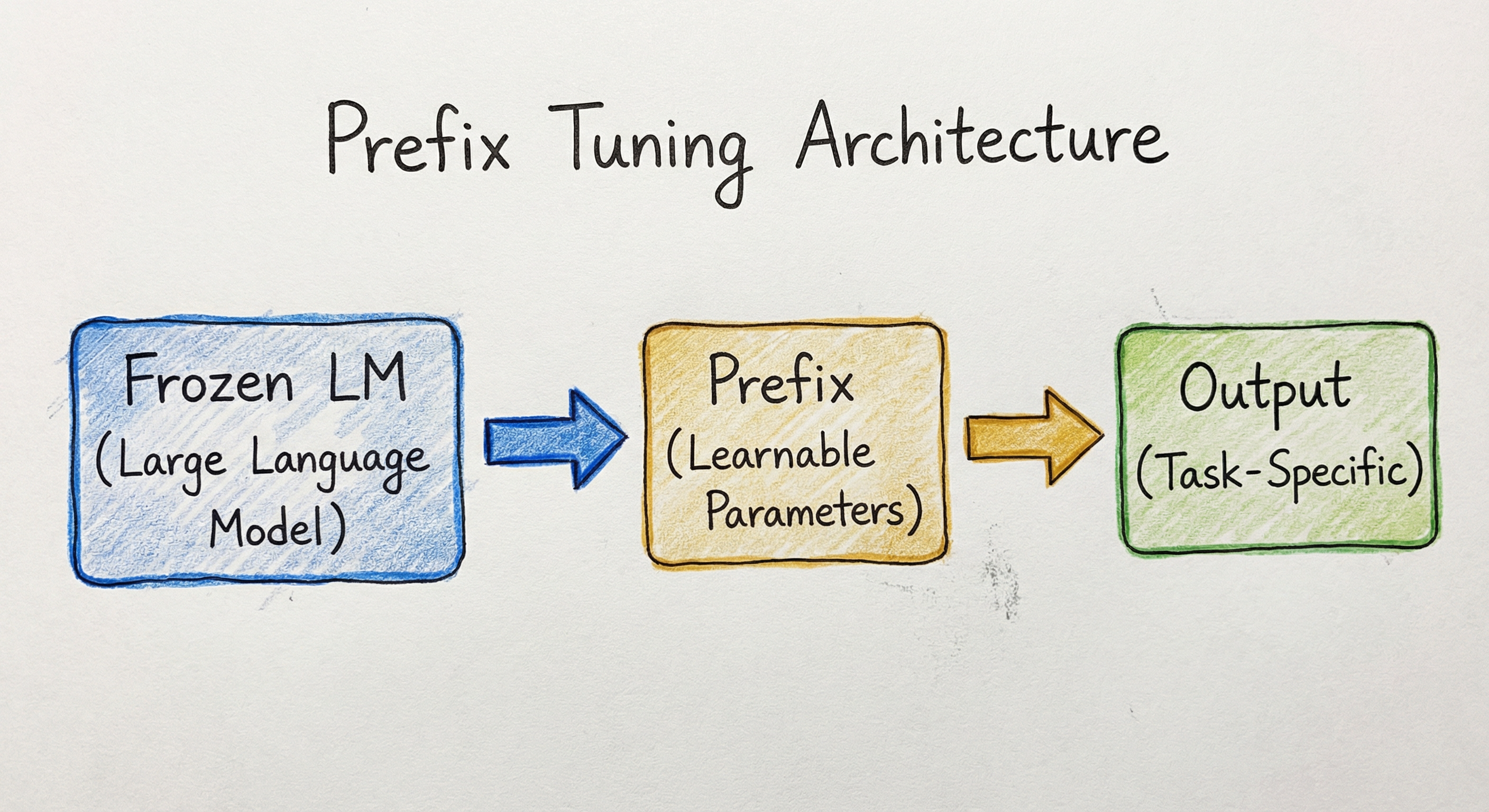
The architecture of prefix tuning has two distinct phases: a training-time architecture that includes the MLP reparameterization network, and an inference-time architecture that uses only the distilled prefix matrices.
During training, a small embedding matrix is fed through a two-layer MLP to produce the full prefix vectors for each layer. These are concatenated with the key-value pairs at every attention head in every layer. The frozen model performs its standard forward pass, but with the extended key-value context. Gradients flow only through the prefix parameters and MLP weights -- the base model remains untouched.
During inference, the MLP is discarded entirely. The precomputed prefix matrices are simply prepended to the key-value caches at each layer. This makes inference with prefix tuning nearly as fast as the base model -- the only overhead is attending to additional positions per layer.
Key Components
Prefix Embedding Matrix
A small learnable matrix that serves as the seed representation for all prefix vectors. During training, this is the primary parameter being optimized (along with the MLP). The dimension is typically set to the model's hidden dimension or smaller.
MLP Reparameterizer
A two-layer feedforward network (with tanh activation) that maps the compact prefix embedding to full-dimensional prefix vectors for each layer. This stabilizes training by smoothing the optimization landscape. Discarded after training -- only its output (the final prefix matrices) is retained.
Key Prefix Vectors ($P_K^{(l)}$)
Learnable vectors prepended to the key matrix at layer . These control what the attention heads attend to by adding new matchable positions in key space. Shape: per head per layer.
Value Prefix Vectors ($P_V^{(l)}$)
Learnable vectors prepended to the value matrix at layer . These control what information is retrieved when attention is placed on prefix positions. Shape: per head per layer.
Frozen Transformer Backbone
The original pretrained model with all parameters frozen (no gradient computation). Performs standard forward passes but with extended key-value context from the prefix. All original capabilities are preserved.
Prefix Cache (Inference)
At inference time, the precomputed prefix key-value pairs are stored as a static cache and prepended to the KV cache at each layer. This avoids recomputation and makes prefix tuning compatible with standard KV-cache-based autoregressive generation.
Data Flow
Training Path: Task-specific training data is tokenized and embedded. The prefix embedding matrix is passed through the MLP reparameterizer to produce full prefix vectors for all layers. At each transformer layer, prefix key-value vectors are concatenated with the input key-value matrices. The extended attention is computed, the loss is calculated on the task objective (e.g., cross-entropy for generation), and gradients flow back through the prefix parameters and MLP only.
Inference Path: The trained prefix matrices (post-MLP, stored as static tensors) are loaded alongside the frozen model. At each layer, prefix KV pairs are prepended to the KV cache. The model generates tokens as usual, with the prefix providing persistent task-specific context. Switching tasks requires only swapping the prefix tensors -- no model reloading needed.
Multi-Task Path: Multiple prefix matrices can be stored in a prefix bank. A routing mechanism (or simple task ID lookup) selects the appropriate prefix at request time. The frozen model processes all tasks, with task specialization driven entirely by the active prefix.
A flowchart showing two phases. Training phase: small embedding matrix flows through MLP reparameterizer to produce full prefix vectors. These are injected into each layer of a frozen transformer, where they are prepended to key-value matrices before multi-head attention. Output logits compute loss, with gradients flowing back only to prefix parameters. Inference phase: precomputed prefix matrices are directly prepended to KV caches at each layer.
How to Implement
Implementation Approaches
Prefix tuning can be implemented from scratch or via established PEFT libraries. The two dominant approaches in 2026 are:
Approach 1: Hugging Face PEFT library -- the standard choice for most practitioners. It provides a PrefixTuningConfig that handles prefix injection, MLP reparameterization, and checkpoint management. Three lines of configuration, and you're training.
Approach 2: Manual implementation -- useful for understanding the mechanics or when you need custom behavior (e.g., prefix sharing across layers, dynamic prefix length, or integration with non-Hugging Face models).
For production deployment, most teams use the PEFT library for training and then export the prefix weights for optimized serving via vLLM, TensorRT-LLM, or a custom inference server.
Cost Context: Prefix tuning a 7B model on a single A100 GPU costs approximately INR 500-1,500 (96-300) for the same setup. On Indian cloud providers like E2E Networks or Jarvislabs.ai, you can get A100 instances for INR 120-180/hour ($1.50-2.20/hour).
from transformers import AutoModelForCausalLM, AutoTokenizer, TrainingArguments, Trainer
from peft import PrefixTuningConfig, get_peft_model, TaskType
from datasets import load_dataset

# Load base model (frozen)
model_name = "meta-llama/Llama-2-7b-hf"
tokenizer = AutoTokenizer.from_pretrained(model_name)
model = AutoModelForCausalLM.from_pretrained(model_name, device_map="auto")

# Configure prefix tuning
peft_config = PrefixTuningConfig(
    task_type=TaskType.CAUSAL_LM,
    num_virtual_tokens=20,         # prefix length m
    prefix_projection=True,         # use MLP reparameterization
    encoder_hidden_size=1024,       # MLP hidden dimension d'
    token_dim=4096,                 # model hidden dimension
    num_transformer_submodules=1,   # 1 for decoder-only, 2 for encoder-decoder
)

# Wrap model with PEFT
model = get_peft_model(model, peft_config)
model.print_trainable_parameters()
# Output: trainable params: 9,437,184 || all params: 6,747,844,608 || trainable%: 0.1398

# Prepare dataset
dataset = load_dataset("samsum", split="train")

def tokenize(example):
    inputs = tokenizer(
        f"Summarize: {example['dialogue']}",
        truncation=True, max_length=512, padding="max_length"
    )
    labels = tokenizer(
        example["summary"], truncation=True, max_length=128, padding="max_length"
    )
    inputs["labels"] = labels["input_ids"]
    return inputs

tokenized = dataset.map(tokenize, remove_columns=dataset.column_names)

# Train
training_args = TrainingArguments(
    output_dir="./prefix-tuned-llama",
    num_train_epochs=5,
    per_device_train_batch_size=4,
    gradient_accumulation_steps=4,
    learning_rate=3e-2,           # higher LR typical for prefix tuning
    warmup_steps=100,
    logging_steps=50,
    save_strategy="epoch",
    fp16=True,
)

trainer = Trainer(
    model=model,
    args=training_args,
    train_dataset=tokenized,
)
trainer.train()

# Save only prefix weights (~37 MB for this config)
model.save_pretrained("./prefix-tuned-llama")
This is the standard production workflow. Key points: (1) num_virtual_tokens=20 sets the prefix length -- the most important hyperparameter. (2) prefix_projection=True enables the MLP reparameterization trick for training stability. (3) The learning rate is higher than typical fine-tuning (3e-2 vs 2e-5) because we're optimizing far fewer parameters. (4) The saved checkpoint is tiny -- only the prefix weights, not the full model.
import torch
import torch.nn as nn
from transformers import AutoModelForCausalLM

class PrefixTuningWrapper(nn.Module):
    """Minimal prefix tuning implementation for understanding the mechanics."""

    def __init__(self, model_name: str, prefix_length: int = 20, prefix_dim: int = 512):
        super().__init__()
        self.model = AutoModelForCausalLM.from_pretrained(model_name)
        self.config = self.model.config

        # Freeze all base model parameters
        for param in self.model.parameters():
            param.requires_grad = False

        self.prefix_length = prefix_length
        self.n_layers = self.config.num_hidden_layers
        self.n_heads = self.config.num_attention_heads
        self.d_model = self.config.hidden_size
        self.d_head = self.d_model // self.n_heads

        # Prefix embedding (the small seed matrix P')
        self.prefix_embedding = nn.Embedding(prefix_length, prefix_dim)

        # MLP reparameterizer: P' -> full prefix vectors
        self.prefix_mlp = nn.Sequential(
            nn.Linear(prefix_dim, self.d_model),
            nn.Tanh(),
            nn.Linear(self.d_model, self.n_layers * 2 * self.d_model),
            # Output: for each layer, key prefix + value prefix
        )

        # Prefix token IDs (just indices 0..prefix_length-1)
        self.prefix_tokens = torch.arange(prefix_length)

    def get_prefix(self, batch_size: int) -> tuple[torch.Tensor, torch.Tensor]:
        """Generate prefix key-value pairs for all layers."""
        prefix_tokens = self.prefix_tokens.unsqueeze(0).expand(batch_size, -1)
        prefix_tokens = prefix_tokens.to(self.prefix_embedding.weight.device)

        # P' -> MLP -> full prefix
        prefix_embeds = self.prefix_embedding(prefix_tokens)    # (B, m, d')
        past_key_values = self.prefix_mlp(prefix_embeds)        # (B, m, L*2*d)

        # Reshape to (L, 2, B, n_heads, m, d_head)
        past_key_values = past_key_values.view(
            batch_size, self.prefix_length, self.n_layers, 2, self.n_heads, self.d_head
        )
        past_key_values = past_key_values.permute(2, 3, 0, 4, 1, 5)

        # Split into per-layer (key, value) tuples
        past_kv_list = []
        for l in range(self.n_layers):
            key = past_key_values[l][0]   # (B, n_heads, m, d_head)
            value = past_key_values[l][1] # (B, n_heads, m, d_head)
            past_kv_list.append((key, value))

        return tuple(past_kv_list)

    def forward(self, input_ids, attention_mask=None, labels=None):
        batch_size = input_ids.shape[0]
        past_key_values = self.get_prefix(batch_size)

        # Extend attention mask to cover prefix tokens
        if attention_mask is not None:
            prefix_mask = torch.ones(batch_size, self.prefix_length,
                                     device=attention_mask.device)
            attention_mask = torch.cat([prefix_mask, attention_mask], dim=1)

        outputs = self.model(
            input_ids=input_ids,
            attention_mask=attention_mask,
            past_key_values=past_key_values,
            labels=labels,
        )
        return outputs

    def trainable_parameters(self):
        """Count trainable vs total parameters."""
        trainable = sum(p.numel() for p in self.parameters() if p.requires_grad)
        total = sum(p.numel() for p in self.parameters())
        return trainable, total, 100 * trainable / total
This manual implementation reveals the core mechanics: (1) A small prefix_embedding matrix serves as the seed. (2) The prefix_mlp reparameterizes it into full-dimensional prefix vectors for all layers. (3) The output is reshaped into per-layer key-value tuples that the model consumes via past_key_values. (4) The attention mask is extended to include prefix positions. This is pedagogically useful but use the PEFT library for production.
import torch
import os
from typing import Dict

class PrefixBank:
    """Manage multiple task-specific prefixes for a single frozen model."""

    def __init__(self, prefix_dir: str, device: str = "cuda"):
        self.prefixes: Dict[str, torch.Tensor] = {}
        self.device = device
        self._load_all_prefixes(prefix_dir)

    def _load_all_prefixes(self, prefix_dir: str):
        """Load all prefix checkpoints from directory."""
        for task_name in os.listdir(prefix_dir):
            task_path = os.path.join(prefix_dir, task_name, "prefix_weights.pt")
            if os.path.exists(task_path):
                weights = torch.load(task_path, map_location=self.device)
                self.prefixes[task_name] = weights
                print(f"Loaded prefix for task '{task_name}': "
                      f"{weights['past_key_values'].shape}")

    def get_prefix(self, task_name: str) -> torch.Tensor:
        """Retrieve prefix for a specific task."""
        if task_name not in self.prefixes:
            raise KeyError(
                f"Unknown task '{task_name}'. "
                f"Available: {list(self.prefixes.keys())}"
            )
        return self.prefixes[task_name]["past_key_values"]

    @property
    def memory_usage_mb(self) -> float:
        total_bytes = sum(
            w["past_key_values"].nelement() * w["past_key_values"].element_size()
            for w in self.prefixes.values()
        )
        return total_bytes / (1024 * 1024)


# Example usage: serve multiple tasks from one model
prefix_bank = PrefixBank("./trained_prefixes/")
print(f"Loaded {len(prefix_bank.prefixes)} tasks, "
      f"total prefix memory: {prefix_bank.memory_usage_mb:.1f} MB")

# Route incoming request to appropriate prefix
task = "sentiment_analysis"  # from request metadata
prefix_kv = prefix_bank.get_prefix(task)

# Pass prefix_kv as past_key_values to model.generate()
# Each task's prefix is ~1-40 MB vs ~14 GB for the full model
This pattern is the key production advantage of prefix tuning: a single model instance serves multiple tasks by swapping lightweight prefix tensors. The PrefixBank loads all task prefixes into GPU memory (typically 1-40 MB each). At request time, the task-appropriate prefix is selected and injected into the forward pass. For 100 tasks, total prefix memory is ~1-4 GB vs ~1.4 TB for 100 full model copies. This is especially cost-effective on Indian cloud infrastructure where GPU memory is the primary cost driver.
# PEFT PrefixTuningConfig (YAML equivalent)
task_type: CAUSAL_LM
num_virtual_tokens: 20          # prefix length m
prefix_projection: true          # MLP reparameterization
encoder_hidden_size: 1024        # MLP hidden dim d'
token_dim: 4096                  # model hidden dim
num_transformer_submodules: 1    # 1=decoder-only, 2=enc-dec

# Training hyperparameters (recommended ranges)
learning_rate: 3e-2              # 10-100x higher than full FT
weight_decay: 0.01
warmup_ratio: 0.06
num_train_epochs: 5-10
batch_size: 4-8                  # with gradient accumulation
fp16: true
max_seq_length: 512
Common Implementation Mistakes
- ●
Learning rate too low: Prefix tuning requires significantly higher learning rates (1e-2 to 5e-2) compared to full fine-tuning (2e-5 to 5e-5). Using a full-fine-tuning learning rate with prefix tuning leads to near-zero gradient updates and the prefix never converges. This is the number one mistake beginners make.
- ●
Skipping reparameterization: Training prefix vectors directly without the MLP reparameterization trick causes unstable training, especially for longer prefixes. The loss oscillates and often fails to converge. Always use
prefix_projection=Trueduring training. - ●
Prefix length too large: Setting prefix length beyond 100-200 consumes attention capacity from actual input tokens. The model starts attending primarily to prefix positions, crowding out the input. This manifests as degraded performance despite more trainable parameters -- counterintuitive but well-documented.
- ●
Forgetting to extend the attention mask: When implementing manually, failing to extend the attention mask to cover prefix positions causes the model to mask out prefix tokens. The prefix has zero effect and training appears to stall. Always concatenate a ones-mask for prefix positions.
- ●
Mixing prefix lengths at inference: Loading a prefix trained with
m=20into a serving setup configured form=10(or vice versa) causes dimension mismatches or silent corruption. Always store and validate prefix metadata alongside weights. - ●
Not accounting for prefix in context window: Prefix tokens consume positions in the model's context window. With a 4096-token context limit and
m=50, your effective input capacity is 4046 tokens. For long-context tasks, this matters.
When Should You Use This?
Use When
You need to adapt a large frozen model to multiple tasks and want to store only one copy of the base model with lightweight per-task adapters (the core multi-tenant use case)
GPU memory is severely constrained and full fine-tuning is infeasible -- prefix tuning requires only forward-pass memory for the base model plus tiny prefix gradients
You want to preserve the base model's general capabilities while adding task-specific behavior without risking catastrophic forgetting
Your deployment architecture requires hot-swapping between tasks at inference time without reloading model weights -- prefix swapping takes microseconds
You are working with encoder-decoder models (T5, BART, mBART) where prefix tuning has been shown to match full fine-tuning with as few as 0.1% trainable parameters
Regulatory or compliance requirements mandate that the base model weights remain unmodified (common in healthcare and finance verticals in India, where model provenance is audited)
Avoid When
Your task requires significant deviation from the pretrained model's capabilities -- prefix tuning cannot teach fundamentally new knowledge, only steer existing knowledge
You have abundant compute and memory and need maximum task performance -- full fine-tuning or LoRA typically achieves 1-3% higher accuracy on challenging benchmarks
Your model is small (<1B parameters) -- the overhead of prefix tuning is less justified when full fine-tuning is cheap anyway. On a 350M-parameter model, just fine-tune it.
You are working with very long input sequences where the prefix's consumption of context window positions creates a meaningful capacity bottleneck
You need to adapt vision-only models or architectures without standard key-value attention (e.g., state-space models like Mamba) -- prefix tuning is inherently tied to the attention mechanism
You require interpretability of the adaptation -- prefix vectors are opaque continuous embeddings that resist human interpretation, unlike discrete prompts
Key Tradeoffs
Parameter Efficiency vs. Task Performance
Prefix tuning achieves its best results on generation and NLU tasks with encoder-decoder models, where Li & Liang (2021) showed it matching full fine-tuning at 0.1% trainable parameters on table-to-text (E2E, WebNLG, DART) and summarization (XSUM) benchmarks. For decoder-only models and harder tasks, performance typically lags full fine-tuning by 1-5% but remains competitive with other PEFT methods.
| Method | Trainable % | E2E (BLEU) | WebNLG (BLEU) | Memory Savings |
|---|---|---|---|---|
| Full Fine-tuning | 100% | 68.2 | 46.2 | 1x (baseline) |
| Prefix Tuning | 0.1% | 69.7 | 44.1 | ~5-8x |
| LoRA (r=16) | 0.5% | 68.9 | 45.8 | ~3-4x |
| Prompt Tuning | 0.01% | 65.3 | 41.2 | ~10x |
Prefix Length: The Critical Hyperparameter
Prefix length is the most important knob. Too short (m < 5): insufficient steering capacity. Too long (m > 200): attention dilution and context window consumption. The sweet spot for most tasks is . Li & Liang found diminishing returns beyond and degradation beyond .
Inference Overhead
Prefix tuning adds additional positions to each attention computation. For and input length , this is a ~4% increase in attention FLOPs -- negligible. But for very long contexts () with short prefixes, the overhead rounds to zero. The real cost is not compute but context window consumption.
Alternatives & Comparisons
LoRA adds small trainable low-rank matrices to attention weight projections, while prefix tuning adds virtual tokens to key-value pairs. LoRA typically achieves 1-3% higher task accuracy and doesn't consume context window positions. Choose LoRA for maximum performance; choose prefix tuning for multi-task serving where prefix swapping is simpler than LoRA adapter swapping. In practice, LoRA has become the dominant PEFT method by 2026, but prefix tuning remains relevant for multi-tenant and encoder-decoder scenarios.
Prompt tuning (Lester et al., 2021) prepends learnable tokens only at the input embedding layer, while prefix tuning prepends at every transformer layer. Prompt tuning is simpler (fewer parameters) but less expressive -- it cannot influence deeper layers directly. Prefix tuning outperforms prompt tuning on smaller models; the gap narrows as model size increases beyond 10B parameters. Choose prompt tuning for simplicity with very large models; choose prefix tuning when you need stronger task adaptation.
Adapter layers (Houlsby et al., 2019) insert small bottleneck modules between existing transformer layers, adding serial computation. Prefix tuning operates in parallel (within existing attention) and adds no new sequential layers, making it slightly faster at inference. Adapters typically achieve comparable or slightly better accuracy. Choose adapters when you want modular, composable task-specific components; choose prefix tuning when inference latency is critical.
QLoRA combines 4-bit quantization with LoRA, enabling fine-tuning of very large models on consumer GPUs. Prefix tuning can also be combined with quantization but lacks the same ecosystem support. Choose QLoRA when memory is the binding constraint (e.g., training a 70B model on a single 24GB GPU); choose prefix tuning when you need the cleanest multi-task separation with zero weight modification.
Full fine-tuning updates all model parameters and achieves the highest task-specific performance, but requires storing separate model copies per task and risks catastrophic forgetting. Prefix tuning sacrifices 1-5% accuracy for 100x fewer trainable parameters and the ability to serve multiple tasks from one model. Choose full fine-tuning when you have one high-stakes task and abundant compute; choose prefix tuning when operating under resource constraints or multi-task requirements.
IA3 learns rescaling vectors for key, value, and feedforward activations -- even fewer parameters than prefix tuning (often 10x fewer). However, IA3 is less expressive for complex tasks. Choose IA3 for extremely parameter-constrained scenarios; choose prefix tuning when you need more capacity for nuanced task adaptation.
Pros, Cons & Tradeoffs
Advantages
Extreme parameter efficiency: typically 0.1-1% trainable parameters, enabling fine-tuning of 7B+ models on a single consumer GPU. A Llama-2-7B prefix is ~9 MB vs ~14 GB for the full model.
Multi-task serving from one model: swap lightweight prefix tensors at inference time to switch tasks in microseconds. One frozen model, unlimited task-specific behaviors. This is the killer feature for production ML platforms.
No modification to base weights: the pretrained model remains untouched, preserving all general capabilities and avoiding catastrophic forgetting. Important for compliance requirements where model provenance must be auditable.
Minimal inference overhead: prefix tokens add only positions to attention computation, typically <5% additional FLOPs. Unlike adapters, no new sequential layers are introduced.
Composable with quantization: prefix tuning works with 8-bit and 4-bit quantized base models, further reducing memory requirements. Train a prefix on a quantized Llama-2-7B using just 6 GB of GPU memory.
Strong results on generation tasks: on table-to-text and summarization benchmarks with encoder-decoder models, prefix tuning matches or exceeds full fine-tuning quality, making it a no-compromise choice for these domains.
Disadvantages
Consumes context window positions: prefix tokens occupy positions in the model's context window, reducing the effective input capacity. For a 4096-token context with , you lose ~1.2% of input capacity -- modest but not zero.
Underperforms LoRA on decoder-only models: on benchmarks like GLUE, SuperGLUE, and instruction following with decoder-only architectures, LoRA typically achieves 1-3% higher accuracy. For performance-critical applications, this gap matters.
Sensitive to prefix length and learning rate: the hyperparameter search space, while small, is consequential. Wrong prefix length or learning rate can lead to complete training failure (loss plateau or divergence).
Opaque adaptation mechanism: unlike discrete prompts, continuous prefix vectors are not human-interpretable. Debugging why a prefix produces certain behaviors requires probing tools and attention visualization.
Limited ecosystem support for inference: while training support via PEFT is excellent, optimized inference runtimes (vLLM, TGI, TensorRT-LLM) have better-tested LoRA support than prefix tuning support as of 2026.
Reparameterization adds training complexity: the MLP trick introduces additional hyperparameters (hidden dimension, activation function) and the two-phase workflow (train with MLP, deploy without) adds a distillation step.
Failure Modes & Debugging
Training divergence without reparameterization
Cause
Directly optimizing high-dimensional prefix vectors without the MLP reparameterization trick. The loss landscape for raw prefix optimization is highly non-convex with sharp valleys, causing gradient updates to oscillate.
Symptoms
Training loss spikes repeatedly, fails to decrease below the base model's zero-shot performance, or oscillates wildly between epochs. Gradient norms for prefix parameters show extreme variance.
Mitigation
Always enable prefix_projection=True in PEFT config. If training still diverges, reduce the learning rate from 3e-2 to 1e-2, increase warmup steps to 10% of total training, and try gradient clipping at max_norm=1.0.
Attention dilution with long prefixes
Cause
Setting prefix length too large (>200-500). The softmax attention distribution spreads too much weight across prefix positions, leaving insufficient attention for actual input tokens.
Symptoms
Task performance decreases as prefix length increases beyond a threshold. The model generates generic or repetitive outputs. Attention visualization shows >50% of attention mass on prefix positions even for informative input tokens.
Mitigation
Start with and increase in increments of 10-20, measuring validation performance at each step. Plot the prefix-length-vs-accuracy curve to find the saturation point. For most tasks, is optimal.
Task interference in multi-prefix serving
Cause
When serving multiple tasks with different prefixes from one model, prefixes trained independently can cause unexpected interactions if the base model's internal representations have shifted due to weight modifications in other components (e.g., if someone accidentally fine-tuned the embedding layer).
Symptoms
Task A's performance degrades after deploying Task B's prefix. Cross-task contamination in outputs. Latent space probing shows prefix vectors from different tasks clustering together instead of remaining separated.
Mitigation
Ensure the base model is strictly frozen across all prefix training runs. Version-lock the base model checkpoint. Add a validation step that tests all deployed prefixes against their evaluation sets after any system change.
Context window exhaustion
Cause
Prefix tokens consume positions from the model's finite context window. For tasks with long inputs and non-trivial prefix lengths, the effective input capacity drops below what the task requires.
Symptoms
Input truncation at inference time. The model misses critical information that appears later in the input. Performance degrades specifically on longer inputs while short-input performance remains normal.
Mitigation
Calculate effective context: . For long-context tasks, use the shortest prefix length that achieves acceptable quality. Consider RoPE-extended models with 128K+ context windows where is negligible.
Prefix-model version mismatch
Cause
Loading a prefix trained on one version of the base model (e.g., Llama-2-7B) with a different version (e.g., Llama-2-7B-chat). The prefix vectors encode geometric relationships specific to the exact model checkpoint they were trained with.
Symptoms
Severe performance degradation. Outputs are nonsensical or off-topic. The model may generate repeated tokens or degenerate sequences. No error is raised -- the shapes match, but the semantics don't.
Mitigation
Always store the exact base model checkpoint hash alongside prefix weights. Implement a validation check that compares model hashes at load time. Treat prefix + base model as a versioned pair, never mix-and-match.
Gradient starvation on small datasets
Cause
Prefix tuning on very small datasets (<1K examples) with standard training hyperparameters. The prefix parameters receive insufficient gradient signal to converge meaningfully.
Symptoms
Training loss barely decreases. The prefix-tuned model behaves almost identically to the base model. Validation metrics show negligible improvement over zero-shot baseline.
Mitigation
For small datasets: (1) increase training epochs to 20-50, (2) reduce prefix length to , (3) use aggressive data augmentation, (4) consider few-shot in-context learning as an alternative -- it may actually outperform prefix tuning below ~500 examples.
Placement in an ML System
Position in the ML Pipeline
Prefix tuning sits squarely in the fine-tuning stage, after a pretrained base model has been selected and before the adapted model is deployed for serving. It replaces or complements full fine-tuning as the adaptation mechanism.
In a typical production workflow: the base model is downloaded from a model hub (upstream), training data is prepared and split (upstream), prefix tuning produces a lightweight adapter checkpoint (this block), the prefix is registered alongside its base model in a model registry (downstream), and the prefix + frozen model pair is deployed to a serving endpoint (downstream).
What makes prefix tuning unique in the pipeline is its serving-time implications. Unlike full fine-tuning (which produces an independent model copy), prefix tuning produces a tiny artifact that depends on a specific frozen model. This changes how the model registry, deployment pipeline, and serving infrastructure must operate -- they need to understand the concept of a "base model + adapter" rather than a monolithic model.
Indian Startup Context: For teams building on limited GPU budgets (common in Indian ML startups where A100s cost INR 150-250/hour), prefix tuning enables a powerful pattern: rent one GPU instance, load one base model, and serve 10-50 customer-specific adaptations simultaneously. This turns what would be a INR 50 lakh/month (6K/month) single-model setup.
Pipeline Stage
Training / Fine-tuning
Upstream
- full-fine-tuning
- model-training
- train-test-split
Downstream
- model-registry
- model-serving
- ab-testing
Scaling Bottlenecks
The primary bottleneck is training throughput, not inference. During training, the full base model must perform forward passes (even though it's frozen), and the prefix gradient computation requires backpropagation through the entire attention mechanism. For a 70B model, this still needs multiple A100 GPUs even though only 0.1% of parameters are trainable.
At inference, prefix tuning scales well. The prefix KV cache is tiny (typically <50 MB per task) and precomputed. The bottleneck shifts to standard autoregressive generation -- prefix overhead is negligible. Serving 100 tasks with 100 prefixes from one model adds only ~2-5 GB of prefix cache memory.
For multi-task deployments, the scaling bottleneck is prefix management: tracking which prefix corresponds to which task, ensuring version compatibility with the base model, and routing requests to the correct prefix. At scale (>1000 tasks), you need a proper prefix registry and routing layer.
Production Case Studies
The original prefix tuning paper demonstrated the method on GPT-2 (345M, 774M) and BART-Large for table-to-text generation (E2E, WebNLG, DART) and summarization (XSUM). With only 0.1% trainable parameters, prefix tuning matched or outperformed full fine-tuning on generation benchmarks, establishing its viability as a production PEFT method.
Matched full fine-tuning BLEU scores on E2E (69.7 vs 68.2) and WebNLG (44.1 vs 46.2) while training 1000x fewer parameters. Demonstrated that the method extrapolates to unseen table configurations better than full fine-tuning, suggesting superior generalization.
Google's work on prompt tuning (Lester, Al-Rfou & Chia, 2021) built directly on prefix tuning, simplifying it by prepending only at the input layer. While technically a different method, the paper extensively benchmarks against prefix tuning and demonstrates that at T5-XXL scale (11B params), the simpler approach matches prefix tuning -- validating the core insight that soft prompts can replace fine-tuning at scale.
Demonstrated that prompt tuning (a simplified variant of prefix tuning) closes the gap with full fine-tuning as model scale increases, achieving within 1% accuracy on SuperGLUE at 11B parameters. This influenced the design of Google's production multi-task serving infrastructure.
Microsoft's unified PEFT benchmark (He et al., 2022) systematically compared prefix tuning, LoRA, adapters, and other PEFT methods across 100+ NLU and NLG tasks. The study found that prefix tuning excels at generation tasks but underperforms LoRA on classification tasks, leading to practical guidance on method selection that influenced Azure AI's fine-tuning service offerings.
Provided the first large-scale empirical comparison showing that PEFT method choice is task-dependent. Prefix tuning was competitive on 65% of generation tasks but lagged on 70% of classification tasks. This evidence shaped the default PEFT recommendations in Azure OpenAI fine-tuning documentation.
Hugging Face integrated prefix tuning as a first-class PEFT method in their widely-used peft library, making it accessible to millions of ML practitioners. The implementation supports both encoder-decoder and decoder-only models, handles the MLP reparameterization transparently, and enables prefix sharing and composition for multi-task deployments.
Made prefix tuning a 3-line configuration change for any Hugging Face model. The PEFT library has been downloaded 50M+ times, and prefix tuning is used across thousands of community models on the Hugging Face Hub. This democratized access to PEFT techniques for Indian ML teams and startups who previously couldn't afford full fine-tuning infrastructure.
Tooling & Ecosystem
The de facto standard library for parameter-efficient fine-tuning. Provides PrefixTuningConfig with full support for MLP reparameterization, multi-task training, and checkpoint management. Works with any transformers model.
A flexible delta-tuning library from Tsinghua University. Supports prefix tuning alongside adapters, LoRA, BitFit, and other PEFT methods. Provides a unified API for comparing PEFT approaches and includes visualization tools for prefix analysis.
A framework for integrating multiple PEFT methods (including prefix tuning) into LLaMA-family models. Provides benchmarking scripts for comparing prefix tuning vs LoRA vs adapters on common tasks.
The base library that PEFT builds on. Provides the model architectures, tokenizers, and training infrastructure. Models support past_key_values injection, which is the underlying mechanism prefix tuning uses.
Microsoft's deep learning optimization library. Enables prefix tuning of very large models (70B+) via ZeRO-Offload and mixed-precision training. Essential for teams training prefixes on models that don't fit in single-GPU memory.
Experiment tracking platform commonly used to log prefix tuning hyperparameter sweeps (prefix length, learning rate, MLP dimension). Provides visualization of training curves across different prefix configurations.
Research & References
Li & Liang (2021)ACL 2021
The foundational paper introducing prefix tuning. Demonstrates that prepending learnable continuous vectors to transformer key-value pairs at every layer achieves comparable performance to full fine-tuning at 0.1% of trainable parameters on table-to-text and summarization tasks.
Lester, Al-Rfou & Chia (2021)EMNLP 2021
Proposes prompt tuning, a simplified variant of prefix tuning that prepends only at the input layer. Shows that at sufficient model scale (>10B params), this simpler approach matches prefix tuning and full fine-tuning. Foundational for understanding the expressiveness-scale tradeoff.
Liu, Zheng, Du, Ding, Qian, Yang & Tang (2021)arXiv preprint
Introduces P-tuning, which uses a trainable LSTM or MLP to generate continuous prompt embeddings inserted at the input layer. Demonstrated improvements on GPT-2 and GPT-3 for knowledge probing and NLU tasks. Shares the reparameterization insight with prefix tuning.
He, Zhou, Ma, Berg-Kirkpatrick & Neubig (2022)ICLR 2022
Provides a unified mathematical framework showing that prefix tuning, adapters, and LoRA can all be expressed as modifications to the attention mechanism. Demonstrates that combinations of PEFT methods often outperform individual methods.
Liu, Ji, Fu, Du, Yang & Tang (2022)ACL 2022
Extends P-tuning to apply continuous prompts at every layer (effectively prefix tuning with different training strategies). Demonstrates that this approach matches fine-tuning across model scales from 330M to 10B parameters on both NLU and NLG tasks.
Hu, Shen, Wallis, Allen-Zhu, Li, Wang, Wang & Chen (2022)ICLR 2022
Introduces LoRA, the dominant PEFT method as of 2026. The paper benchmarks against prefix tuning and shows LoRA achieves comparable or superior performance with better training stability and no context window consumption. Essential reading for understanding where prefix tuning fits in the PEFT landscape.
Lialin, Deshpande & Rumshisky (2023)arXiv preprint
Comprehensive survey of 40+ PEFT methods including prefix tuning, categorizing them by modification type (additive, selective, reparameterization) and providing empirical guidelines for method selection based on task type and model scale.
Interview & Evaluation Perspective
Common Interview Questions
- ●
What is prefix tuning and how does it differ from prompt tuning?
- ●
Explain the MLP reparameterization trick in prefix tuning. Why is it necessary?
- ●
How would you choose between prefix tuning and LoRA for a production system?
- ●
What happens inside the attention mechanism when prefix tokens are prepended?
- ●
How would you serve 100 different tasks from a single frozen model using prefix tuning?
- ●
What is the relationship between prefix length and model performance? How would you select it?
- ●
How does prefix tuning handle the context window limitation?
- ●
Can prefix tuning teach a model fundamentally new knowledge? Why or why not?
Key Points to Mention
- ●
Prefix tuning prepends learnable vectors at every layer (key and value), not just the input -- this is the key difference from prompt tuning and what makes it more expressive for smaller models.
- ●
The MLP reparameterization trick maps a smaller embedding through a two-layer MLP to produce prefix vectors. This stabilizes training and is discarded at inference time -- a clean separation of training and serving concerns.
- ●
Total trainable parameters: , typically 0.1-1% of total model parameters. Be ready to calculate this for any given model architecture.
- ●
The killer production advantage is multi-task serving: one frozen model, many prefixes, microsecond task switching. Quantify the cost savings vs. deploying separate model copies.
- ●
Prefix length sweet spot is typically . Going beyond 200 causes attention dilution. Always discuss the prefix-length-vs-accuracy curve.
- ●
Prefix tuning works best with encoder-decoder models (T5, BART) and generation tasks. For decoder-only models and classification, LoRA typically wins by 1-3%.
Pitfalls to Avoid
- ●
Confusing prefix tuning with prompt tuning -- they are different methods. Prefix tuning modifies every layer; prompt tuning modifies only the input layer. This is the most common interview mistake.
- ●
Claiming prefix tuning is always better than or equivalent to LoRA. It's not. LoRA dominates for decoder-only models and classification. Be honest about the limitations.
- ●
Forgetting that prefix tokens consume context window positions. An interviewer will probe this if you propose prefix tuning for long-context applications.
- ●
Not mentioning the reparameterization trick. It's a fundamental part of the method, and skipping it suggests shallow understanding.
- ●
Describing prefix tuning without connecting it to the attention mechanism math. You should be able to write out the modified attention equation on a whiteboard.
Senior-Level Expectation
A senior/staff-level candidate should discuss prefix tuning within the broader PEFT taxonomy: how it relates to LoRA (additive in weight space vs. additive in activation space), adapters (serial vs. parallel), and the unified view from He et al. (2022). They should reason about when prefix tuning is the right choice vs. alternatives, with quantitative justification (parameter counts, benchmark numbers, cost estimates). Production system design should include: prefix versioning and registry, base-model compatibility validation, A/B testing of prefix variants, monitoring for prefix degradation over time, and the multi-tenant serving architecture. The ability to discuss prefix length as a bias-variance tradeoff -- short prefixes underfit, long prefixes waste attention -- demonstrates deep understanding. Finally, cost analysis matters: calculating the INR/USD savings of multi-prefix serving vs. multi-model serving for a realistic Indian ML platform scenario.
Summary
Prefix tuning is a parameter-efficient fine-tuning method that adapts large language models by prepending learnable continuous vectors to the key-value pairs at every transformer layer. Introduced by Li & Liang (2021), it achieves competitive task performance while training only 0.1-1% of model parameters. The core mechanism is elegant: instead of modifying frozen weights, prefix tuning injects task-specific steering signals into the attention computation at every depth of the network.
The method has three distinctive strengths. First, extreme parameter efficiency -- a prefix for a 7B-parameter model is typically 1-40 MB, versus 14 GB for a full model copy. Second, multi-task serving from a single model -- swap a tiny prefix tensor and the model switches tasks in microseconds, enabling cost-effective multi-tenant deployments. Third, zero modification to base weights -- the pretrained model is strictly frozen, preserving its general capabilities and satisfying regulatory requirements for model provenance.
In practice, prefix tuning occupies a specific niche in the 2026 PEFT landscape. LoRA has become the dominant general-purpose PEFT method due to better performance on decoder-only models and stronger ecosystem support. But prefix tuning remains the method of choice for three scenarios: encoder-decoder generation tasks (where it matches full fine-tuning), multi-task serving architectures with high task counts (where prefix swapping is architecturally cleaner), and compliance-sensitive deployments (where zero weight modification is mandatory). Understanding prefix tuning is essential for any ML engineer working with PEFT -- not just for its direct applications, but because its core insight (steering attention via learned virtual tokens) laid the intellectual groundwork for the entire soft-prompt family of methods.