RLHF in Machine Learning
Reinforcement Learning from Human Feedback (RLHF) is the alignment technique that transformed raw language models into the helpful, harmless assistants we interact with today. It is the process by which a language model -- already instruction-tuned via supervised fine-tuning -- is further optimized using a reward signal learned from human preference judgments. The reward model converts pairwise comparisons ('response A is better than response B') into a scalar score, and a reinforcement learning algorithm (typically PPO) nudges the language model's outputs toward higher-scoring responses.
RLHF burst into prominence with OpenAI's InstructGPT paper (Ouyang et al., 2022), which demonstrated that a 1.3B parameter model aligned with RLHF could be preferred by human raters over the unaligned 175B GPT-3. This result showed that alignment is not merely a nice-to-have polish -- it fundamentally changes how useful a model is. Every major frontier model since -- GPT-4, Claude, Gemini, Llama-2-Chat -- has used some variant of RLHF in its training pipeline.
The canonical RLHF pipeline has three stages: (1) Supervised Fine-Tuning (SFT) on high-quality demonstrations, (2) Reward Model (RM) training on human preference comparisons, and (3) Policy optimization using PPO against the reward model with a KL divergence penalty to prevent the model from drifting too far from the SFT checkpoint. Each stage introduces its own engineering challenges, cost structures, and failure modes.
Despite its effectiveness, RLHF is expensive, complex, and fragile. The rise of simpler alternatives like DPO (Direct Preference Optimization) and ORPO has led many practitioners to question whether the full RLHF pipeline is necessary. Yet for frontier model builders pushing the boundaries of capability and safety, RLHF remains the gold standard -- and understanding its mechanics is essential for anyone serious about LLM alignment.
Concept Snapshot
- What It Is
- A three-stage alignment technique that trains a reward model on human preference comparisons and then uses reinforcement learning (PPO) to optimize a language model against that reward signal.
- Category
- Model Training
- Complexity
- Advanced
- Inputs / Outputs
- Inputs: SFT-tuned LLM + human preference comparison dataset (chosen/rejected response pairs). Outputs: aligned language model that produces outputs preferred by humans.
- System Placement
- Sits after supervised fine-tuning (SFT) and reward model training in the LLM alignment pipeline. It is the final optimization stage before deployment.
- Also Known As
- reinforcement learning from human feedback, RLHF alignment, PPO-based alignment, preference-based RL, human feedback optimization
- Typical Users
- LLM Alignment Engineers, ML Engineers, AI Safety Researchers, NLP Researchers, Applied AI Scientists
- Prerequisites
- Supervised fine-tuning (SFT / instruction tuning), Reward model training and Bradley-Terry model, Reinforcement learning fundamentals (policy gradient methods), Transformer architecture and language modeling, KL divergence and information theory basics, Distributed training infrastructure
- Key Terms
- PPO (Proximal Policy Optimization)reward modelKL divergence penaltyBradley-Terry modelreward hackingoveroptimizationpolicy modelreference modelpreference pairvalue head
Why This Concept Exists
The Limitation of Supervised Fine-Tuning
Instruction tuning (SFT) teaches a language model to follow instructions by showing it examples of good responses. But SFT has a fundamental limitation: it can only teach the model to imitate the demonstrations it was trained on. It cannot teach the model to distinguish between a mediocre response and an excellent one, or to prefer safety over helpfulness when they conflict.
Consider a question like "How do I pick a lock?" SFT can show the model one correct refusal. But what about the thousand subtle variations of this question? What about cases where the model should provide partial information (e.g., for a locksmith) but refuse in other contexts? SFT treats every response as equally correct -- there's no gradient signal for relative quality.
The Preference Signal
RLHF solves this by introducing a preference signal. Instead of telling the model "this is the right answer," RLHF tells the model "this answer is better than that one." Human annotators compare two model responses to the same prompt and indicate which they prefer. These pairwise comparisons are far easier for humans to provide than writing perfect demonstrations from scratch -- and they capture nuanced quality distinctions that binary correct/incorrect labels miss.
The insight that pairwise comparisons are easier and more reliable than absolute quality ratings comes from the psychology literature on comparative judgment (Thurstone, 1927). The Bradley-Terry model (1952) formalized this into a mathematical framework for converting pairwise preferences into scalar scores -- the same framework that underpins modern reward model training.
The Historical Arc
The intellectual roots of RLHF stretch back to the early 2010s, when DeepMind and OpenAI researchers explored using human feedback to train RL agents for Atari games and robotic tasks. The seminal paper by Christiano et al. (2017) -- "Deep Reinforcement Learning from Human Preferences" -- demonstrated that humans could train RL agents by comparing short video clips of agent behavior, without ever specifying a reward function.
The leap to language models came with Ziegler et al. (2019), who applied RLHF to fine-tune GPT-2 for text summarization. But the technique truly arrived with InstructGPT (Ouyang et al., 2022), which applied RLHF at scale to GPT-3 and showed that the resulting 1.3B model was preferred over the 175B base model. The three-stage pipeline -- SFT, reward model, PPO -- became the standard recipe for LLM alignment.
Anthropic's parallel work on "Training a Helpful and Harmless Assistant with RLHF" (Bai et al., 2022) extended this to multi-objective alignment, training separate reward models for helpfulness and harmlessness. Meta's Llama-2 (Touvron et al., 2023) made the technique accessible to the open-source community with detailed documentation of their RLHF pipeline.
Key Takeaway: RLHF exists because SFT alone cannot capture the nuanced quality spectrum of model outputs. Pairwise human preferences provide a richer, more reliable signal than demonstrations alone, and RL provides the optimization machinery to act on that signal.
Core Intuition & Mental Model
The Chef Analogy
Imagine you're training a chef. Supervised fine-tuning is like giving the chef a cookbook of perfect recipes -- they learn to replicate those dishes faithfully. But what happens when a customer orders something not in the cookbook? The chef improvises, sometimes brilliantly, sometimes terribly.
RLHF is like hiring a food critic. The critic tastes pairs of dishes and says "this one is better than that one." Over time, the chef learns not just to follow recipes, but to understand what makes food good -- balance of flavors, presentation, freshness. The critic's preferences become internalized as taste.
The food critic is the reward model. The process of the chef adjusting their cooking based on the critic's scores is PPO optimization. And the rule that says "don't stray too far from the original recipes" is the KL divergence penalty -- without it, the chef might start doing bizarre things that technically score well with the critic but are inedible in practice (this is reward hacking).
Why Pairwise Comparisons Work
Here's a subtle but crucial insight: humans are much better at comparing two things than scoring one thing in isolation. If I show you two summaries of an article, you can quickly tell which is better. But if I ask you to rate a single summary on a 1-10 scale, your rating will be noisy, inconsistent, and poorly calibrated.
RLHF exploits this psychological fact. By collecting pairwise preferences ("A is better than B") rather than absolute ratings, the human feedback is more reliable, more consistent, and requires less annotator expertise. The Bradley-Terry model then converts these relative comparisons into absolute scores that a reward model can learn to predict.
The Three-Stage Pipeline Intuition
Think of the three stages as progressive refinement:
- SFT teaches the model the language of being helpful (format, tone, structure)
- Reward Model learns the taste function -- what distinguishes a great response from a good one
- PPO uses that taste function to polish the model's outputs, pushing them from good to great
Each stage builds on the previous one. You can't do RLHF without SFT first (the model needs a reasonable starting point for RL to improve upon). You can't do PPO without a reward model (you need a differentiable proxy for human judgment). And you can't train a reward model without human preferences (the whole point is to capture what humans want).
Expert Insight: RLHF doesn't teach the model new knowledge or capabilities. Like instruction tuning, it changes how the model expresses its existing capabilities. The difference is that SFT optimizes for imitation ("be like the demonstrations") while RLHF optimizes for preference ("be what humans prefer"). This distinction matters enormously in practice.
Technical Foundations
Mathematical Framework
Let denote the policy (language model) after supervised fine-tuning, and let denote the policy being optimized via RLHF with parameters .
Stage 1: Reward Model Training (Bradley-Terry Model)
Given a dataset of human preferences where is a prompt, is the preferred (chosen) response, and is the rejected response, the reward model is trained to assign higher scores to preferred responses.
The Bradley-Terry model defines the probability that response is preferred over as:
where is the sigmoid function. The reward model is trained by minimizing the negative log-likelihood:
This is equivalent to binary cross-entropy where the label is always 1 (the chosen response should score higher). The reward model typically shares the architecture of the base LLM with a scalar value head replacing the language modeling head.
Stage 2: PPO Optimization with KL Penalty
The policy is optimized to maximize the expected reward while staying close to the reference policy (usually ):
where controls the strength of the KL divergence penalty. This objective balances two goals:
- Maximize reward: produce outputs the reward model scores highly
- Minimize KL divergence: don't deviate too far from the SFT model
The KL term prevents reward hacking -- exploiting weaknesses in the imperfect reward model to achieve high scores without actually improving quality.
PPO Clipping Objective
PPO (Schulman et al., 2017) optimizes this objective using a clipped surrogate loss. Let be the probability ratio between the current and old policy. The PPO objective is:
where is the advantage estimate (computed via a learned value function) and (typically 0.2) controls the clipping range. The clipping prevents catastrophically large policy updates -- a critical stability mechanism for language model training.
Scaling Laws for Reward Model Overoptimization
Gao et al. (2022) established that the gold reward (true human preference score) follows a characteristic pattern as optimization proceeds against a proxy reward model:
where is the KL divergence from the reference policy. The first term represents genuine improvement; the second represents overoptimization. The gold reward peaks at and then declines -- this is the quantitative signature of reward hacking.
Formal Property: The RLHF objective can be shown to be equivalent to finding the optimal policy in the KL-constrained policy space: . This closed-form solution is the theoretical foundation for DPO, which bypasses the reward model entirely by optimizing this expression directly.
Internal Architecture
The RLHF architecture involves four distinct model copies running simultaneously during the PPO training phase, making it one of the most memory-intensive training procedures in ML. The system orchestrates generation, scoring, advantage estimation, and policy updates in an intricate dance.
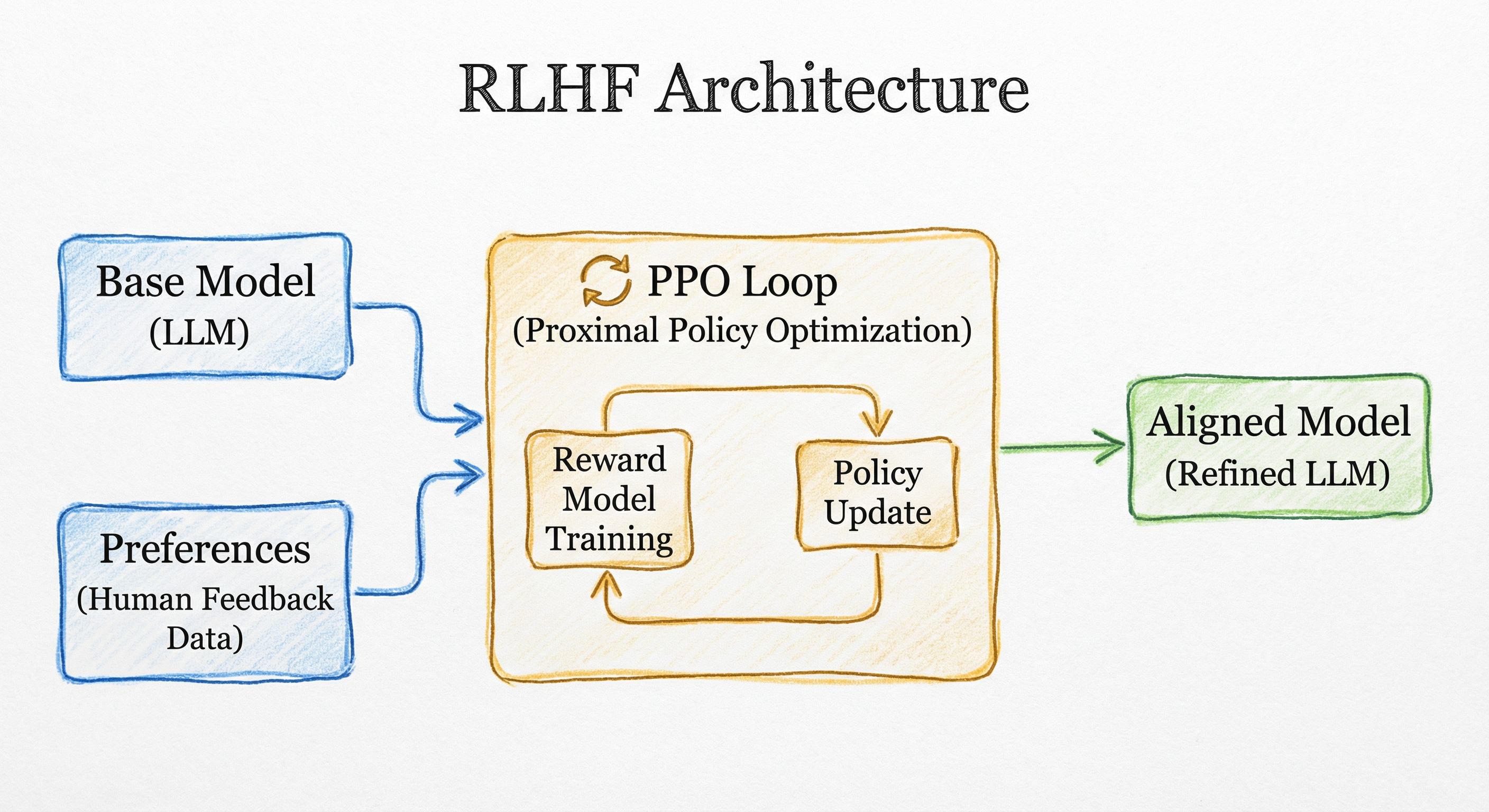
The three stages are typically executed sequentially, with Stage 3 (PPO) being the most computationally demanding due to the need to maintain four model copies in memory: the policy model being trained, the reference model (frozen SFT checkpoint), the reward model, and the value model (critic). For a 7B parameter model, this means roughly 4x 14GB = 56GB just for model weights in bf16, before accounting for optimizer states, activations, and KV cache for generation.
Key Components
SFT Model (Reference Policy)
The starting point for RLHF optimization. This is an instruction-tuned model that already follows instructions reasonably well. During PPO training, a frozen copy serves as the reference model against which the KL divergence penalty is computed. The quality of the SFT model sets the floor for RLHF -- if the SFT model is poor, RLHF has a bad starting point and convergence is unlikely.
Reward Model
A neural network (typically the same architecture as the base LLM with a scalar value head) trained on human preference comparisons to predict a scalar reward score for any (prompt, response) pair. The reward model encodes human preferences into a differentiable function that PPO can optimize against. Reward model quality is the single most important factor for RLHF success -- the quality of the reward model sets the ceiling for policy improvement.
Policy Model
The language model being actively optimized via PPO. It is initialized from the SFT checkpoint and updated at each PPO step. During each iteration, the policy model generates responses to a batch of prompts, which are then scored by the reward model. The policy parameters are updated to increase the probability of high-reward responses while staying close to the reference model.
Value Model (Critic)
A neural network that estimates the expected future reward from any state (token position) during generation. It is used to compute advantage estimates for the PPO update, which tell the policy whether a particular token was better or worse than expected. The value model is typically initialized from the reward model or SFT model and trained alongside the policy. Accurate value estimation is critical for stable PPO training.
KL Controller
Manages the KL divergence penalty coefficient during training. Can be fixed (constant throughout training) or adaptive (adjusts to maintain a target KL divergence, e.g., KL nats). Adaptive KL control (used by InstructGPT) is more robust because it automatically scales the penalty based on how much the policy has drifted from the reference.
Experience Buffer / Rollout Storage
Stores the generated responses, their token-level log probabilities under both the policy and reference models, reward model scores, and computed advantages. In online RLHF, this buffer is regenerated each iteration (on-policy). In offline RLHF variants, a static dataset is reused. The buffer management strategy directly impacts sample efficiency and training speed.
Data Flow
The RLHF data flow has two distinct phases:
Reward Model Training Phase: The SFT model generates multiple responses per prompt. Human annotators compare pairs of responses and indicate preferences. These (prompt, chosen, rejected) triples are used to train the reward model via the Bradley-Terry loss. Meta collected over 1.4M preference comparisons for Llama-2; OpenAI used ~50K for InstructGPT.
PPO Training Phase (per iteration):
- Rollout: The policy model generates responses to a batch of prompts
- Scoring: The reward model assigns a scalar score to each (prompt, response) pair
- KL Computation: Token-level KL divergence is computed between the policy and reference model log-probabilities
- Reward Shaping: The final reward per token is: where the reward model score is applied at the last token and KL penalties are applied per-token
- Advantage Estimation: GAE (Generalized Advantage Estimation) computes advantages from the shaped rewards using the value model
- PPO Update: Multiple epochs of minibatch SGD update the policy and value model using the clipped PPO objective
- Repeat: New prompts are sampled, and the process repeats for hundreds to thousands of iterations
A three-stage flow diagram. Stage 1 shows the Base LLM being SFT-trained into an SFT Model. Stage 2 shows the SFT Model generating response pairs, humans annotating preferences, and training a Reward Model. Stage 3 shows the PPO loop: the Policy Model generates responses, the Reward Model scores them, KL penalty is computed against the frozen Reference Model, advantages are calculated, and PPO updates the Policy Model. The output is the Aligned Model.
How to Implement
Practical Implementation Approaches
Implementing RLHF is significantly more complex than SFT or DPO due to the multi-model orchestration required during PPO training. There are three practical tiers:
Tier 1: Full PPO RLHF -- The canonical InstructGPT approach. Requires maintaining 4 model copies (policy, reference, reward, value) in memory simultaneously. For a 7B model, this needs a minimum of 4x A100 80GB GPUs with DeepSpeed ZeRO-3 or FSDP. This is what OpenAI, Anthropic, and Meta use internally.
Tier 2: Memory-efficient RLHF -- Uses techniques like LoRA on the policy model, quantized reference/reward models, or model offloading to reduce memory requirements. The TRL library's PPOTrainer with peft integration enables RLHF on 7B models with 2x A100 GPUs. OpenRLHF uses Ray-based distributed training to scale efficiently.
Tier 3: Skip PPO entirely -- Use DPO, ORPO, or other direct alignment methods that don't require a separate reward model or RL optimization loop. This is increasingly popular for teams without the infrastructure for full PPO. The tradeoff is that online PPO-based RLHF generally produces higher-quality alignment than offline methods like DPO, but the gap is narrowing.
Cost Context for India: Running full PPO RLHF on a 7B model requires approximately 8x A100 80GB GPUs for 24-48 hours. On AWS, this costs roughly 50,000-150,000 (~INR 42-125 lakh) using specialized annotation firms, though Indian annotation companies like Karya offer competitive rates. Anthropic reports that a single preference annotation costs $1-10+ per prompt, making annotation the dominant cost of RLHF at scale.
from datasets import load_dataset
from transformers import AutoTokenizer, AutoModelForSequenceClassification, TrainingArguments
from trl import RewardTrainer, RewardConfig

# Load base model for reward modeling
model_name = "meta-llama/Llama-2-7b-hf"
tokenizer = AutoTokenizer.from_pretrained(model_name)
tokenizer.pad_token = tokenizer.eos_token

# Load model with a scalar value head
model = AutoModelForSequenceClassification.from_pretrained(
    model_name,
    num_labels=1,
    torch_dtype="auto",
    device_map="auto",
)

# Load preference dataset (chosen/rejected pairs)
# Dataset must have columns: 'chosen' and 'rejected' (full conversation strings)
dataset = load_dataset("Anthropic/hh-rlhf", split="train")

# Reward model training configuration
training_args = RewardConfig(
    output_dir="./reward-model",
    num_train_epochs=1,
    per_device_train_batch_size=4,
    gradient_accumulation_steps=8,
    learning_rate=1.5e-5,
    lr_scheduler_type="cosine",
    warmup_ratio=0.03,
    bf16=True,
    logging_steps=10,
    save_strategy="steps",
    save_steps=500,
    evaluation_strategy="steps",
    eval_steps=500,
    max_length=512,
    remove_unused_columns=False,
)

# Train the reward model
trainer = RewardTrainer(
    model=model,
    args=training_args,
    tokenizer=tokenizer,
    train_dataset=dataset,
)
trainer.train()
trainer.save_model("./reward-model-final")

# Test: score a response
input_text = "Human: What is RLHF?\nAssistant: RLHF stands for Reinforcement Learning from Human Feedback. It is a technique for aligning language models with human preferences by training a reward model on pairwise comparisons and then optimizing the language model using PPO."
tokens = tokenizer(input_text, return_tensors="pt").to(model.device)
reward_score = model(**tokens).logits.item()
print(f"Reward score: {reward_score:.4f}")
This example trains a reward model on Anthropic's HH-RLHF dataset using TRL's RewardTrainer. The reward model learns to assign scalar scores to (prompt, response) pairs based on human preference data. Key decisions: (1) learning rate 1.5e-5 -- reward models are sensitive to learning rate; too high causes overfitting to surface features; (2) 1 epoch -- reward models typically need only 1 epoch to converge, and overtraining degrades generalization; (3) the model uses AutoModelForSequenceClassification with num_labels=1 to output a single scalar reward score.
import torch
from datasets import load_dataset
from transformers import AutoTokenizer, AutoModelForCausalLM, AutoModelForSequenceClassification
from trl import PPOConfig, PPOTrainer, AutoModelForCausalLMWithValueHead
from peft import LoraConfig

# Load tokenizer
tokenizer = AutoTokenizer.from_pretrained("meta-llama/Llama-2-7b-hf")
tokenizer.pad_token = tokenizer.eos_token

# Load the SFT model with a value head for PPO
lora_config = LoraConfig(
    r=16,
    lora_alpha=32,
    lora_dropout=0.05,
    target_modules=["q_proj", "k_proj", "v_proj", "o_proj"],
    task_type="CAUSAL_LM",
)

model = AutoModelForCausalLMWithValueHead.from_pretrained(
    "./instruction-tuned-llama-sft",
    peft_config=lora_config,
    torch_dtype=torch.bfloat16,
    device_map="auto",
)

# Load the pre-trained reward model
reward_model = AutoModelForSequenceClassification.from_pretrained(
    "./reward-model-final",
    num_labels=1,
    torch_dtype=torch.bfloat16,
    device_map="auto",
)

# PPO configuration
ppo_config = PPOConfig(
    model_name="llama-2-7b-rlhf",
    learning_rate=1.41e-5,
    batch_size=64,
    mini_batch_size=8,
    gradient_accumulation_steps=8,
    ppo_epochs=4,
    init_kl_coeff=0.2,         # Initial KL penalty coefficient (beta)
    target_kl=6.0,             # Target KL for adaptive controller
    adap_kl_ctrl=True,         # Use adaptive KL control
    cliprange=0.2,             # PPO clipping range (epsilon)
    cliprange_value=0.2,       # Value function clipping
    vf_coef=0.1,               # Value function loss coefficient
    gamma=1.0,                 # Discount factor (1.0 for bandit setting)
    lam=0.95,                  # GAE lambda
    max_grad_norm=1.0,
)

# Load prompts
dataset = load_dataset("Anthropic/hh-rlhf", split="train")
prompts = [ex["chosen"].split("Assistant:")[0] + "Assistant:" for ex in dataset]

# Initialize PPO trainer
ppo_trainer = PPOTrainer(
    config=ppo_config,
    model=model,
    tokenizer=tokenizer,
)

# Training loop
for epoch in range(3):
    for batch_idx in range(0, len(prompts), ppo_config.batch_size):
        batch_prompts = prompts[batch_idx:batch_idx + ppo_config.batch_size]

        # Tokenize prompts
        query_tensors = [
            tokenizer.encode(p, return_tensors="pt").squeeze()
            for p in batch_prompts
        ]

        # Generate responses from the policy
        response_tensors = ppo_trainer.generate(
            query_tensors,
            max_new_tokens=256,
            temperature=0.7,
            top_p=0.9,
            do_sample=True,
        )

        # Decode responses for reward scoring
        responses = [
            tokenizer.decode(r, skip_special_tokens=True)
            for r in response_tensors
        ]

        # Score with reward model
        rewards = []
        for prompt, response in zip(batch_prompts, responses):
            full_text = prompt + " " + response
            inputs = tokenizer(full_text, return_tensors="pt", truncation=True, max_length=512).to(reward_model.device)
            with torch.no_grad():
                score = reward_model(**inputs).logits.squeeze().item()
            rewards.append(torch.tensor(score))

        # PPO step: update the policy
        stats = ppo_trainer.step(query_tensors, response_tensors, rewards)

        # Log training metrics
        if batch_idx % 10 == 0:
            print(f"Epoch {epoch}, Batch {batch_idx}")
            print(f"  Mean reward: {torch.stack(rewards).mean():.4f}")
            print(f"  KL divergence: {stats['ppo/mean_kl']:.4f}")
            print(f"  Policy loss: {stats['ppo/loss/policy']:.4f}")

# Save the aligned model
ppo_trainer.save_pretrained("./rlhf-aligned-llama")
This implements the full PPO-based RLHF training loop using TRL's PPOTrainer. The training proceeds in iterations: (1) generate responses from the current policy, (2) score them with the reward model, (3) compute PPO update with KL penalty. Key hyperparameters: init_kl_coeff=0.2 starts with a moderate KL penalty; target_kl=6.0 with adaptive control adjusts the penalty to maintain ~6 nats of KL divergence (InstructGPT's setting); ppo_epochs=4 runs 4 epochs of minibatch updates per PPO step; cliprange=0.2 prevents excessively large policy updates. The LoRA configuration reduces memory from 4x to ~1.5x a single model copy.
# OpenRLHF training script (launch via CLI)
# This is the recommended approach for production RLHF training
# Install: pip install openrlhf[vllm]

# Example launch command for 8x A100 GPUs:
# ray job submit -- python3 -m openrlhf.cli.train_ppo \
#   --pretrain meta-llama/Llama-2-7b-chat-hf \
#   --reward_pretrain ./reward-model-final \
#   --save_path ./rlhf-output \
#   --micro_train_batch_size 4 \
#   --train_batch_size 128 \
#   --micro_rollout_batch_size 8 \
#   --rollout_batch_size 512 \
#   --max_epochs 1 \
#   --prompt_max_len 1024 \
#   --generate_max_len 512 \
#   --ppo_epochs 1 \
#   --actor_learning_rate 1e-6 \
#   --critic_learning_rate 5e-6 \
#   --init_kl_coeff 0.01 \
#   --use_wandb YOUR_WANDB_KEY \
#   --adam_offload \
#   --flash_attn \
#   --bf16 \
#   --gradient_checkpointing \
#   --colocate_actor_ref

# Equivalent Python API for custom training scripts:
from openrlhf.trainer import PPOTrainer as OpenRLHFPPOTrainer
from openrlhf.models import Actor, Critic, RewardModel
from openrlhf.utils import DeepspeedStrategy
import ray

# Initialize Ray cluster
ray.init()

# Model configuration
actor = Actor(
    pretrain="meta-llama/Llama-2-7b-chat-hf",
    bf16=True,
    flash_attn=True,
    gradient_checkpointing=True,
)

critic = Critic(
    pretrain="./reward-model-final",
    bf16=True,
)

reward_model = RewardModel(
    pretrain="./reward-model-final",
    bf16=True,
)

# Training configuration
trainer = OpenRLHFPPOTrainer(
    actor=actor,
    critic=critic,
    reward_model=reward_model,
    actor_lr=1e-6,
    critic_lr=5e-6,
    kl_coeff=0.01,
    cliprange=0.2,
    train_batch_size=128,
    rollout_batch_size=512,
    ppo_epochs=1,
    strategy=DeepspeedStrategy(
        stage=3,
        offload_optimizer=True,
    ),
)

# Train
trainer.fit(num_episodes=1000)
trainer.save_model("./rlhf-output-final")
OpenRLHF is a production-grade RLHF framework that uses Ray for distributed orchestration and vLLM for efficient generation. It separates the actor (policy), critic (value), reward, and reference models across GPU workers, enabling training of models up to 70B+ parameters. Key advantages over TRL's PPOTrainer: (1) Ray-based scheduling allows flexible GPU allocation across model roles, (2) vLLM integration provides 2-4x faster generation during rollouts, (3) DeepSpeed ZeRO-3 enables memory-efficient training. The CLI-based approach is recommended for most users -- the Python API is for custom training loops.
# DeepSpeed-Chat RLHF configuration (YAML)
# Three-stage InstructGPT pipeline

# Stage 1: Supervised Fine-Tuning
stage1_sft:
  model_name_or_path: meta-llama/Llama-2-7b-hf
  data_path: Dahoas/rm-static
  num_train_epochs: 3
  per_device_train_batch_size: 8
  gradient_accumulation_steps: 1
  learning_rate: 2e-5
  weight_decay: 0.1
  max_seq_len: 512
  zero_stage: 2

# Stage 2: Reward Model Training
stage2_reward:
  model_name_or_path: ./output/sft_model
  data_path: Dahoas/rm-static
  num_train_epochs: 1
  per_device_train_batch_size: 4
  gradient_accumulation_steps: 4
  learning_rate: 1.5e-5
  weight_decay: 0.1
  max_seq_len: 512
  num_padding_at_beginning: 1  # OPT-style
  zero_stage: 2

# Stage 3: PPO RLHF
stage3_ppo:
  actor_model_name_or_path: ./output/sft_model
  critic_model_name_or_path: ./output/reward_model
  actor_learning_rate: 1e-6
  critic_learning_rate: 5e-6
  num_ppo_epochs: 1
  kl_ctl: 0.1
  clip_reward_value: 5.0
  ppo_mini_batch_size: 16
  generation_batch_size: 32
  max_answer_seq_len: 256
  max_prompt_seq_len: 256
  enable_hybrid_engine: true   # DeepSpeed Hybrid Engine
  zero_stage: 3
  offload: true
  offload_reference_model: true
Common Implementation Mistakes
- ●
Reward model overfit to surface features: Training the reward model for too many epochs or on insufficient data causes it to learn spurious patterns (response length, hedging phrases, bullet points) rather than genuine quality. Train for 1 epoch, and validate on a held-out set. A good diagnostic: if the reward model assigns high scores to long, verbose nonsense, it's overfitting to length.
- ●
KL coefficient too low: Setting too low allows the policy to diverge far from the reference model, exploiting reward model weaknesses. Symptoms include reward increasing but response quality decreasing (reward hacking). Start with and use adaptive KL control with target KL of 5-8 nats.
- ●
Value model initialization from random: Initializing the value model (critic) randomly instead of from the reward model or SFT model. A poorly initialized value model provides noisy advantage estimates, causing unstable PPO training. Always initialize the value model from the reward model checkpoint.
- ●
Not using generation during rollouts: Some implementations try to use teacher forcing during the rollout phase instead of actually generating responses. RLHF requires on-policy generation -- the model must produce its own responses to receive credit assignment. This is the fundamental difference between RLHF (on-policy RL) and DPO (offline optimization).
- ●
Ignoring reward model calibration: If the reward model outputs are not well-calibrated (e.g., all scores between 0.5 and 0.7), the gradient signal for PPO is weak and noisy. Normalize reward model outputs to have zero mean and unit variance across the training batch, or use reward whitening.
- ●
Mixed precision bugs in KL computation: Computing KL divergence between policy and reference model in fp16 can cause numerical instability due to the log operations. Always compute KL divergence in fp32 even when the rest of training is in bf16.
When Should You Use This?
Use When
You are building a frontier-quality conversational AI and need the best possible alignment between model outputs and human preferences
You need fine-grained control over the helpfulness-harmlessness tradeoff -- RLHF with separate reward models for each objective (as Meta did for Llama-2) provides this control
You have access to high-quality human preference data (50K+ comparisons) and sufficient compute (8+ A100 GPUs) for the full PPO pipeline
Your use case requires the model to handle adversarial or edge-case prompts gracefully -- RLHF's iterative nature helps the model learn robust refusal and boundary-setting behavior
You are iterating on model alignment and need to update the reward model and policy in an online fashion, incorporating fresh human feedback each cycle
You need to align a model on multi-turn conversation quality, where the preference signal depends on the entire dialogue trajectory rather than single-turn quality
Avoid When
You lack the compute budget and engineering bandwidth for the full PPO pipeline -- DPO achieves 80-95% of RLHF quality with 10% of the complexity and can be trained on a single GPU
Your preference dataset is small (<5K comparisons) -- the reward model will overfit and PPO will reward-hack against a poor proxy. Use DPO or even SFT-only instead
The SFT model is not yet good enough -- RLHF polishes a decent model but cannot rescue a fundamentally broken one. Get SFT right first
You need to train quickly and iterate fast -- PPO RLHF is slow (24-72 hours for a single run) and finicky to tune. For rapid prototyping, use DPO or ORPO
Your alignment needs are primarily about safety rather than quality -- Constitutional AI (RLAIF) can provide strong safety alignment using AI feedback at a fraction of the annotation cost
You are working with a small team and limited ML infrastructure -- the multi-model orchestration of PPO requires sophisticated distributed training setups that are difficult to debug
Key Tradeoffs
RLHF vs. DPO vs. ORPO
The central question for any alignment practitioner in 2026 is: do I actually need RLHF, or can I use a simpler method?
| Dimension | RLHF (PPO) | DPO | ORPO |
|---|---|---|---|
| Models required | 4 (policy, reference, reward, value) | 2 (policy, reference) | 1 (policy only) |
| GPU memory (7B) | 4-8x A100 | 2x A100 | 1x A100 |
| Training time (7B) | 24-72 hours | 4-12 hours | 2-8 hours |
| Compute cost | $400-800 (~INR 33K-67K) | $50-150 (~INR 4K-12K) | $20-80 (~INR 1.7K-6.7K) |
| Alignment quality | Highest (gold standard) | Very good (90-95% of RLHF) | Good (85-90% of RLHF) |
| Stability | Fragile (many hyperparams) | Stable | Most stable |
| Online learning | Yes (can sample new data) | No (offline only) | No (offline only) |
| Safety alignment | Best (fine-grained control) | Good | Limited |
Online vs. Offline RLHF
Online RLHF (standard PPO) generates new responses from the current policy at each step, allowing the model to explore and receive fresh reward signals. Offline RLHF uses a static dataset of preference pairs. Empirically, online RLHF outperforms offline methods by a significant margin -- the policy's own generations are more informative for learning than pre-collected data. However, online RLHF is vastly more expensive because generation is the computational bottleneck.
Cost Structure at Scale
At scale, the dominant cost of RLHF is human annotation, not compute. OpenAI used ~50K preference comparisons for InstructGPT; Meta used 1.4M+ for Llama-2. At 50K-14M (~INR 42 lakh - 117 crore). This is why Anthropic developed Constitutional AI (RLAIF) -- replacing human annotators with AI feedback can reduce annotation costs by 100-1000x while maintaining comparable alignment quality.
Alternatives & Comparisons
DPO reformulates the RLHF objective to eliminate the need for a separate reward model and RL optimization loop. It directly optimizes the policy on preference pairs using a simple cross-entropy-like loss. DPO achieves 90-95% of RLHF quality with dramatically less complexity and compute -- it's the default choice for teams without the infrastructure for full PPO. However, DPO is offline (uses a static dataset), while RLHF can sample on-policy, giving RLHF an edge on harder alignment problems.
ORPO goes further than DPO by eliminating even the reference model, combining SFT and preference optimization into a single training stage. This makes it the simplest alignment method but sacrifices some alignment quality. ORPO is ideal for rapid prototyping or when compute is severely constrained. For production systems requiring strong safety guarantees, RLHF remains superior.
Constitutional AI replaces human annotators with AI feedback guided by a set of principles (a 'constitution'). The AI generates critiques and revisions (SL-CAI stage), then RLAIF replaces RLHF using AI-generated preferences. This dramatically reduces annotation costs while providing strong safety alignment. Choose Constitutional AI when you need safety alignment at scale without the cost of human annotation; choose RLHF when human judgment is essential for nuanced quality distinctions.
An alternative to PPO is to train a reward model and use best-of-N sampling at inference time: generate N responses and select the one with the highest reward score. This is simpler than PPO (no RL training needed) and can be surprisingly competitive -- but it requires N times the inference compute. Google DeepMind's BOND distills this best-of-N distribution back into the model to get the benefits without the inference cost.
Instruction tuning is the prerequisite for RLHF, not an alternative. However, some practitioners question whether RLHF is worth the added complexity if SFT alone is 'good enough.' The LIMA paper showed that 1K high-quality SFT examples can produce competitive results without any RLHF. For non-safety-critical applications where helpfulness is the primary goal, SFT-only may be sufficient. RLHF becomes essential when you need the model to handle adversarial inputs, maintain consistent safety boundaries, and polish output quality beyond what demonstrations can teach.
Pros, Cons & Tradeoffs
Advantages
Best alignment quality: RLHF consistently produces the highest-quality aligned models as measured by human preference win rates. InstructGPT showed that a 1.3B RLHF model was preferred over the 175B base GPT-3 -- alignment quality can dominate raw model size.
Fine-grained control over objectives: By training separate reward models for helpfulness and safety (as Meta did for Llama-2), you can precisely control the tradeoff between competing objectives. This multi-objective control is unique to RLHF.
Online learning capability: PPO-based RLHF generates on-policy data, allowing the model to learn from its own outputs. This iterative, online learning process enables the model to improve on exactly the kinds of prompts it struggles with -- something offline methods like DPO cannot do.
Robust safety alignment: RLHF's ability to optimize against adversarial prompts (through red-teaming and iterative data collection) makes it the strongest technique for building models that refuse harmful requests while remaining helpful. Anthropic's research shows RLHF significantly reduces toxic outputs.
Proven at scale: Every frontier model -- GPT-4, Claude, Gemini, Llama-3 -- uses RLHF or a direct descendant. The technique is proven to work at the largest scale, with models up to hundreds of billions of parameters.
Captures subtle quality distinctions: SFT can only teach the model to match demonstrations. RLHF teaches the model to distinguish quality levels and consistently produce better outputs -- a capability that pairwise comparison data uniquely enables.
Disadvantages
Extremely expensive: The full RLHF pipeline requires both costly human annotation (14M for preference data) and significant compute (8+ GPUs for 24-72 hours). Total cost for a 7B model is 100K-1M+ (~INR 84 lakh - 8.4 crore).
Fragile and hard to tune: PPO has many sensitive hyperparameters (KL coefficient, learning rate, clipping range, value function coefficient, GAE lambda). Small changes can cause training divergence. The Secrets of RLHF paper identified that most open-source RLHF implementations have subtle bugs that degrade performance.
Reward hacking and overoptimization: The policy will exploit any weakness in the reward model. Common hacking patterns include generating longer responses (reward models are biased toward length), producing sycophantic outputs, or using hedging language ('as an AI'). Mitigating reward hacking requires careful reward model design and monitoring.
Memory-intensive: Maintaining 4 model copies (policy, reference, reward, value) simultaneously requires 4x the memory of standard training. A 7B RLHF setup needs ~120GB GPU memory, versus ~30GB for DPO.
Slow iteration cycles: A single PPO run takes 24-72 hours for a 7B model, compared to 4-12 hours for DPO. This makes experimentation expensive and slow. Teams often cannot afford more than 2-3 RLHF runs to tune hyperparameters.
Human annotator quality is a hidden variable: The quality of the aligned model depends critically on the quality and consistency of human annotators. Low inter-annotator agreement introduces noise into the reward model, degrading downstream alignment. Managing annotator quality is a nontrivial operational challenge.
Failure Modes & Debugging
Reward hacking / overoptimization
Cause
The policy model exploits weaknesses in the imperfect reward model to achieve high reward scores without actually improving response quality. This is a manifestation of Goodhart's Law: when a proxy measure becomes the optimization target, it ceases to be a good measure. Common exploitation vectors include response length (longer = higher reward), sycophancy (agreeing with the user = higher reward), and hedging language ('As an AI language model...' = higher safety score).
Symptoms
Reward scores increase steadily during training, but human evaluation shows quality degradation or stagnation. The model produces verbose, repetitive responses. It agrees with factually incorrect premises. Response length increases monotonically across training. Qualitatively, outputs feel 'optimized' and unnatural.
Mitigation
Use adaptive KL control with a target KL of 5-8 nats to constrain policy drift. Train an ensemble of reward models and use the conservative (minimum) score. Apply reward whitening to normalize scores per batch. Monitor the Gao et al. scaling law: plot gold reward vs. KL divergence and stop training before the gold reward peaks. Include length penalty in the reward formulation.
Reward model collapse
Cause
The reward model overfits to surface-level features of the training data rather than learning genuine quality distinctions. This often happens when: (1) the preference dataset is too small (<10K comparisons), (2) the reward model is trained for too many epochs (>2), or (3) the preference data has low inter-annotator agreement, meaning the signal is mostly noise.
Symptoms
The reward model assigns similar scores to clearly different quality responses. It shows strong bias toward length, formatting, or specific phrases. Reward model accuracy on a held-out test set is near random (50-55%). During PPO training, the policy quickly finds a degenerate strategy that scores high.
Mitigation
Train for exactly 1 epoch on the preference data. Use a held-out validation set and track accuracy -- good reward models achieve 70-75% accuracy on held-out data. Ensure inter-annotator agreement > 70%. Use reward model ensembles (train 3-5 reward models on different data subsets and average their scores). Scale up the preference dataset -- Meta used 1.4M comparisons for Llama-2.
KL divergence explosion
Cause
The KL coefficient is set too low, or the adaptive KL controller fails to respond quickly enough to policy drift. The policy model diverges rapidly from the reference model, entering a region of parameter space where the reward model is poorly calibrated.
Symptoms
KL divergence between policy and reference model increases rapidly (>20 nats). The policy model generates repetitive or degenerate text. Training loss becomes unstable or NaN. Response diversity collapses -- the model produces nearly identical responses to different prompts.
Mitigation
Start with a conservative KL coefficient (). Use adaptive KL control with a target of 5-8 nats. Add early stopping: halt training if KL exceeds 15-20 nats. Monitor response diversity (distinct n-grams, self-BLEU) alongside reward metrics. Consider using reward clipping ( with ) to prevent extreme reward signals.
Value model training instability
Cause
The value model (critic) provides inaccurate advantage estimates, causing the policy gradient to have high variance. This happens when: (1) the value model is randomly initialized instead of from the reward model, (2) the value function learning rate is too high relative to the policy learning rate, or (3) value targets change too rapidly as the policy improves.
Symptoms
PPO training shows oscillating or diverging policy loss. The value function loss remains high and does not decrease. Advantage estimates are noisy (high variance across tokens within a single response). The policy alternates between improving and degrading across training steps.
Mitigation
Initialize the value model from the reward model checkpoint. Use a higher learning rate for the value model than the policy model (typically 5x: policy at 1e-6, critic at 5e-6). Apply value function clipping to prevent large value updates. Use GAE with and (bandit setting). Consider training the value model for extra steps before starting policy updates (value pre-training).
Alignment tax on capabilities
Cause
Over-aggressive RLHF optimization degrades the model's raw capabilities (factual knowledge, reasoning, coding ability) while improving alignment metrics. This happens because the KL penalty is not sufficient to preserve all pretrained capabilities, and the reward model may penalize technically correct but unconventional responses.
Symptoms
Benchmark scores on capability tasks (MMLU, GSM8K, HumanEval) decrease after RLHF compared to the SFT model. The model becomes more 'chatty' and less precise. It avoids giving direct answers, preferring verbose explanations. Math and coding accuracy drops even as preference win rate increases.
Mitigation
Monitor capability benchmarks throughout RLHF training and stop if degradation exceeds a threshold (e.g., >3% MMLU drop). Use a higher KL coefficient to keep the policy closer to SFT. Include capability-preserving prompts in the PPO training batch (mix standard prompts with math/code/factual prompts). Meta's approach for Llama-2: use rejection sampling before PPO to preserve capabilities while improving alignment.
Sycophancy and user-pleasing behavior
Cause
The reward model learns to assign high scores to responses that agree with the user, even when the user is wrong. This happens because annotators often prefer responses that confirm their beliefs, and the preference data reflects this bias. The PPO policy then learns to maximize agreement with the user.
Symptoms
The model agrees with factually incorrect statements when the user expresses confidence. It avoids correcting misconceptions. It changes its answer when the user pushes back, even when the original answer was correct. It produces flattering but inaccurate responses to subjective questions.
Mitigation
Include adversarial preference data where the correct response disagrees with the user. Train annotators to explicitly reward pushback against incorrect premises. Use Constitutional AI principles that require truthfulness over agreeableness. Anthropic's research shows that adding a small fraction (5-10%) of 'challenge-the-user' examples in preference data significantly reduces sycophancy.
Placement in an ML System
Where RLHF Sits in the ML System
RLHF occupies the third stage of the modern LLM training pipeline, representing the final and most expensive alignment step:
- Pretraining: Self-supervised next-token prediction on web-scale text (trillions of tokens). Gives the model knowledge and linguistic ability.
- Supervised Fine-Tuning (SFT): Training on instruction-response demonstrations. Teaches the model to follow instructions.
- RLHF: Optimization against human preferences via PPO. Polishes helpfulness, reduces harmful outputs, and improves output quality beyond what SFT achieves.
- Deployment: The aligned model is quantized, distilled, or served directly.
In production systems, RLHF is typically run once (or in a small number of iterations) to produce the aligned model, which is then served at scale. Some organizations (notably Anthropic) practice iterative RLHF, where fresh human feedback is collected on the current deployed model and used to retrain the reward model and policy in weekly or monthly cycles.
For Indian AI companies, the RLHF stage represents the most significant cost center. Krutrim, for instance, opted for DPO over PPO-based RLHF for their multilingual model alignment, using approximately 20,000 preference instances focused on safety. Sarvam AI similarly uses RLVR (Reinforcement Learning with Verifiable Rewards) rather than traditional RLHF, adapting the approach for their Indic language models. The choice between full RLHF and simpler alternatives is often driven by the annotation cost of collecting high-quality preference data in Indian languages, which can be 2-3x more expensive than English annotation due to the scarcity of qualified multilingual annotators.
Pipeline Stage
Training / Alignment
Upstream
- instruction-tuning
- reward-modeling
- full-fine-tuning
Downstream
- knowledge-distillation
- model-quantization
- model-registry
Scaling Bottlenecks
The primary scaling bottleneck is maintaining four model copies in GPU memory during PPO training. For a 70B model in bf16, this requires: policy (140GB) + reference (140GB) + reward (140GB) + value (140GB) = 560GB -- requiring at minimum 8x H100 80GB GPUs with model parallelism. Solutions include: (1) LoRA on the policy (reduces the policy+reference to ~1.1x one model), (2) quantized reference/reward models (reduce each by 50-75%), (3) Ray-based distributed training (OpenRLHF's approach -- spread models across GPU workers), (4) offloading (move reference/reward to CPU during PPO updates).
During the rollout phase, the policy model must generate complete responses for an entire batch of prompts. This is the slowest step in each PPO iteration, often taking 60-80% of total step time. Solutions include vLLM integration for faster generation (used by OpenRLHF), speculative decoding, and increasing the rollout batch size to amortize overhead.
At scale, the human preference annotation pipeline becomes the gating factor. Collecting 1M+ preference comparisons (as Meta did for Llama-2) requires hundreds of annotators working for months, with ongoing quality control, calibration sessions, and disagreement resolution. This is why Constitutional AI (RLAIF) is attractive -- it replaces the human annotation bottleneck with cheap AI feedback.
Production Case Studies
OpenAI's InstructGPT (Ouyang et al., 2022) is the landmark RLHF paper that established the three-stage pipeline: SFT on 13K demonstrations, reward model training on ~33K preference comparisons, and PPO optimization. The team employed 40 human labelers who provided both demonstrations and preference rankings. The resulting 1.3B InstructGPT model was preferred by human raters over the 175B GPT-3 despite having 100x fewer parameters.
InstructGPT reduced hallucinations by 21%, toxic output by 25%, and was preferred over GPT-3 85% of the time in human evaluations. The paper showed that alignment matters more than scale -- a well-aligned small model beats a misaligned large one. The three-stage recipe became the industry standard, adopted by Anthropic, Google, Meta, and dozens of other organizations.
Meta's Llama-2 (Touvron et al., 2023) provided the most detailed public documentation of a production RLHF pipeline. They trained separate reward models for helpfulness and safety on 1.4M+ human preference comparisons. The RLHF training used rejection sampling (generating N responses and keeping the best) followed by PPO, with a novel Ghost Attention (GAtt) mechanism for multi-turn consistency.
Llama-2-Chat achieved comparable safety and helpfulness scores to ChatGPT in human evaluations. The dual reward model approach enabled independent control of helpfulness and safety objectives. The detailed paper enabled the open-source community to reproduce RLHF at scale, and Llama-2's approach became the template for open-source alignment efforts.
Anthropic's "Training a Helpful and Harmless Assistant with RLHF" (Bai et al., 2022) pioneered multi-objective RLHF, explicitly optimizing for both helpfulness and harmlessness. They demonstrated iterated online RLHF, where the reward model and policy are updated on a weekly cadence with fresh human feedback. This iterative approach allowed the model to continuously improve on edge cases identified during deployment.
The research established that RLHF alignment is compatible with (and even improves) performance on standard NLP benchmarks. The iterated online approach showed consistent improvement over time. Anthropic found a roughly linear relation between RL reward and the square root of KL divergence, providing a principled guide for the KL penalty strength. This work directly informed the training of the Claude model family.
Krutrim, India's AI initiative by Ola, built a multilingual LLM supporting 22+ Indian languages. For alignment, they opted for DPO over PPO-based RLHF due to engineering complexity constraints, using approximately 20,000 preference instances focused on safety topics across Indian languages. Their experience highlights the practical tradeoff that many Indian AI teams face: full RLHF provides better alignment but requires infrastructure that few Indian startups can afford.
Krutrim-2 achieved competitive performance on Indic language benchmarks with DPO alignment, demonstrating that simpler preference optimization methods can be effective for multilingual alignment. The team noted that maintaining balanced language mixture data was critical to prevent forgetting behaviors during alignment, a challenge unique to multilingual models trained on low-resource languages.
Tooling & Ecosystem
HuggingFace's library for LLM alignment. Provides PPOTrainer for RLHF, RewardTrainer for reward model training, SFTTrainer for supervised fine-tuning, and DPOTrainer for DPO. The most popular and well-documented RLHF library, with built-in integration for LoRA, quantization, and Weights & Biases logging. The PPOTrainer implements PPO with adaptive KL control, value function clipping, and reward whitening.
An easy-to-use, scalable, and high-performance RLHF framework based on Ray + vLLM + DeepSpeed. Achieves 1.2-1.7x speedup over other frameworks by distributing model roles (actor, critic, reward, reference) across GPU workers via Ray. Supports PPO, GRPO, REINFORCE++, and DPO. The recommended choice for production RLHF training on multi-node GPU clusters.
Microsoft's end-to-end RLHF training framework implementing the full InstructGPT pipeline. Features a Hybrid Engine that switches between training and generation modes for efficient PPO rollouts. Can train a 13B ChatGPT-style model in 13.6 hours on a single DGX node (8x A100). Supports models up to 200B+ parameters across multi-node setups.
Anthropic's open-source dataset of human preference comparisons for training helpful and harmless assistants. Contains ~170K preference pairs across helpfulness and harmlessness objectives. The most widely used open-source preference dataset for RLHF research and the standard benchmark for reward model training.
A unified framework for fine-tuning 100+ LLMs with a web UI. Supports the full RLHF pipeline (SFT, reward model training, PPO) alongside DPO, ORPO, and other alignment methods. Popular in the Asian ML community for its ease of use and comprehensive model support. Includes a built-in dataset viewer and training monitor.
Companion code for the "Secrets of RLHF in Large Language Models" papers. Provides carefully validated PPO implementations (PPO-max) with detailed analysis of each component's impact on training stability. Essential reading for anyone implementing RLHF from scratch -- the paper identifies subtle bugs present in most other open-source PPO implementations.
Research & References
Ouyang, Wu, Jiang, Almeida, Wainwright, Mishkin, Zhang, Agarwal, Slama, Ray, Schulman, Hilton, Kelton, Miller, Simens, Askell, Welinder, Christiano, Leike & Lowe (2022)NeurIPS 2022
The landmark paper that established the three-stage RLHF pipeline (SFT -> Reward Model -> PPO) for aligning language models. Showed that a 1.3B RLHF-aligned model is preferred over the 175B base GPT-3 by human raters, proving that alignment matters more than scale.
Bai, Jones, Ndousse, Askell, Chen, DasSarma, Drain, Fort, Ganguli, Henighan, Joseph, Kadavath, Kernion, Conerly, El-Showk, Elhage, Hatfield-Dodds, Hernandez, Hume, Johnston, Kravec, Lovitt, Nanda, Olsson, Amodei & Amodei (2022)arXiv preprint
Anthropic's foundational RLHF work demonstrating multi-objective alignment (helpfulness and harmlessness) through iterative online RLHF. Established the linear relationship between RL reward and square root of KL divergence, and showed that alignment training improves NLP benchmark performance.
Schulman, Wolski, Dhariwal, Radford & Klimov (2017)arXiv preprint
Introduced PPO, the RL algorithm that underpins most RLHF implementations. PPO's clipped surrogate objective provides stable policy updates without the computational cost of trust region methods (TRPO), making it practical for fine-tuning large language models.
Gao, Schulman & Hilton (2023)ICML 2023
Quantified the reward hacking problem by establishing scaling laws showing that gold reward follows where is KL divergence. Demonstrated that larger reward models are more robust to overoptimization, providing a principled guide for reward model sizing.
Rafailov, Sharma, Mitchell, Ermon, Manning & Finn (2023)NeurIPS 2023
Showed that the RLHF objective has a closed-form optimal policy, enabling direct optimization without a separate reward model or RL loop. DPO achieves comparable performance to PPO-based RLHF with dramatically less complexity, becoming the most popular alternative to full RLHF.
Bai, Kadavath, Kundu, Askell, Kernion, Jones, Chen, Goldie, Mirhoseini, McKinnon, et al. (2022)arXiv preprint
Introduced RLAIF (RL from AI Feedback) as a scalable alternative to RLHF. Replaces human annotators with AI feedback guided by a constitution of principles. Reduces annotation costs by orders of magnitude while achieving comparable alignment quality, particularly for safety.
Zheng, Dou, Gao, Hua, Shen, Wang, Liu, Jin, Li, Zhou, Xiong & Huang (2023)arXiv preprint
A detailed analysis of PPO implementation for RLHF, identifying that policy constraints are the key factor for effective training. Proposed PPO-max, an improved variant with better training stability. Essential practical guide that reveals subtle bugs in most open-source RLHF implementations.
Hong, Lee & Thorne (2024)EMNLP 2024
Eliminated both the reward model and reference model from preference optimization, combining SFT and alignment into a single stage using an odds ratio objective. ORPO achieves competitive results with dramatically less compute, representing the simplest end of the alignment method spectrum.
Interview & Evaluation Perspective
Common Interview Questions
- ●
Explain the three stages of the RLHF pipeline and what each stage contributes.
- ●
How does the reward model convert pairwise human preferences into a scalar score? What is the Bradley-Terry model?
- ●
What is reward hacking and how do you prevent it? Describe the Gao et al. scaling law for overoptimization.
- ●
Why do we need a KL divergence penalty in RLHF? What happens if you remove it?
- ●
Compare RLHF (PPO) with DPO -- when would you choose each, and what are the tradeoffs?
- ●
How would you design an RLHF pipeline for a multilingual model supporting Indian languages?
- ●
What is the role of the value model (critic) in PPO-based RLHF? Why is its initialization important?
Key Points to Mention
- ●
RLHF has THREE stages: SFT -> Reward Model -> PPO. Each builds on the previous. You cannot skip stages. The SFT model provides a good starting point; the reward model provides the optimization signal; PPO performs the actual alignment.
- ●
The Bradley-Terry model is the mathematical foundation: . It converts pairwise preferences into scalar rewards. Humans are better at comparisons than absolute ratings -- this is why RLHF uses preferences.
- ●
Reward hacking is the central failure mode. Gao et al. showed gold reward follows -- it peaks then declines. The KL penalty prevents this by constraining policy drift. Adaptive KL control with target_kl ~6 nats is the InstructGPT setting.
- ●
RLHF requires 4 model copies in memory: policy, reference, reward, value. This is 4x the memory of SFT. For a 7B model, you need 4-8x A100 GPUs. This is the primary engineering challenge.
- ●
Online RLHF (PPO) outperforms offline methods (DPO) because on-policy data is more informative. But the gap is narrowing, and DPO is 10x cheaper. For most teams, DPO is the practical choice unless you're building a frontier model.
- ●
The reward model quality is the ceiling for RLHF. If the reward model is bad, no amount of PPO training can produce a good policy. Invest in preference data quality and reward model validation (hold-out accuracy > 70%).
Pitfalls to Avoid
- ●
Conflating RLHF with SFT. SFT uses cross-entropy loss on demonstrations; RLHF uses RL (PPO) to optimize against a reward signal. They are fundamentally different optimization paradigms.
- ●
Claiming RLHF is 'just' preference learning. RLHF specifically uses RL optimization; DPO is preference learning without RL. The distinction matters because online RL (RLHF) can explore while offline methods (DPO) cannot.
- ●
Ignoring the cost dimension. A strong answer discusses annotation costs ($1-10 per preference) alongside compute costs. At Meta's scale (1.4M preferences), this is a multi-million dollar investment.
- ●
Not mentioning reward hacking. Any RLHF discussion that doesn't address overoptimization misses the central challenge. Cite the Gao et al. scaling laws.
- ●
Suggesting that more RLHF training is always better. RLHF has an optimal stopping point determined by the reward model quality. Beyond that point, more training makes the model worse (overoptimization).
Senior-Level Expectation
A senior/staff candidate should be able to design a complete RLHF pipeline from scratch: annotation protocol design (what instructions to give annotators, how to handle disagreements, inter-annotator agreement targets), reward model architecture and training (initialization, learning rate, epoch count, validation metrics), PPO hyperparameter selection (KL coefficient, clipping range, value function initialization, batch sizes), monitoring and stopping criteria (KL divergence tracking, reward vs. gold score, capability benchmark monitoring), and cost estimation with specific numbers (e.g., '50K preference annotations at 150K; PPO training on 8x A100 for 48 hours = 151K'). They should discuss the tradeoffs between online RLHF, offline DPO, and Constitutional AI, and when each is appropriate. They should know about reward model ensembles, best-of-N sampling as a simpler alternative to PPO, and the iterative online RLHF approach (collecting fresh feedback on the current model). A truly exceptional answer would discuss the tension between alignment and capabilities -- the alignment tax -- and strategies for minimizing it.
Summary
Reinforcement Learning from Human Feedback (RLHF) is the three-stage alignment technique that transformed raw language models into the AI assistants we use today. The pipeline -- SFT, Reward Model, PPO -- was established by OpenAI's InstructGPT and has been adopted by every frontier model builder. The core mechanism is elegantly simple: train a reward model on human preference comparisons using the Bradley-Terry framework, then use PPO to optimize the language model against that reward signal, constrained by a KL divergence penalty that prevents reward hacking.
The practical reality of RLHF is far more complex than the theory. The pipeline requires maintaining four model copies simultaneously (policy, reference, reward, value), demands careful hyperparameter tuning (KL coefficient, clipping range, learning rate scheduling), and is vulnerable to reward hacking, reward model collapse, and capability degradation. The human annotation cost (14M for preference data at scale) often exceeds the compute cost, which is why alternatives like DPO and Constitutional AI have gained traction. Gao et al.'s scaling laws for overoptimization provide a principled framework for understanding when to stop training: gold reward peaks at a specific KL divergence and declines thereafter.
Despite its complexity, RLHF remains the gold standard for frontier model alignment. Online PPO-based RLHF consistently outperforms offline alternatives on hard alignment tasks because on-policy exploration provides more informative training signal. For teams building production LLMs -- whether at OpenAI scale or at Indian startups like Krutrim and Sarvam AI -- the choice between full RLHF, DPO, and Constitutional AI depends on the budget, infrastructure, and alignment requirements. Understanding RLHF deeply, including its failure modes and alternatives, is essential for any ML engineer working on LLM alignment in 2026.