Domain Adaptation in Machine Learning
Domain adaptation is the art and science of taking a model trained in one domain (the source) and making it work well in a different but related domain (the target). This is one of the most practically important problems in production ML: you almost never deploy a model into the exact same distribution it was trained on.
Consider a sentiment classifier trained on Amazon product reviews. Deploy it on Flipkart reviews written in Hinglish (Hindi-English code-mixed text), and accuracy drops from 92% to 68%. The words are different, the cultural references are different, and the writing style is different -- but the underlying task (detecting positive vs. negative sentiment) is the same. Domain adaptation bridges this gap without requiring you to collect and label thousands of Flipkart-specific examples from scratch.
The field has evolved dramatically since the early statistical methods of the 2000s. Classical approaches focused on re-weighting source samples or finding domain-invariant feature representations. The deep learning era brought adversarial methods like DANN (Domain-Adversarial Neural Networks) that learn features indistinguishable between domains. And the LLM revolution introduced a simpler but powerful paradigm: continued pretraining on domain-specific corpora, followed by task-specific fine-tuning.
Today, domain adaptation powers everything from BloombergGPT in finance to Med-PaLM in healthcare, from Sarvam AI's Indic language models to legal NLP systems parsing Indian court judgments. Whether you're adapting BERT to parse medical records or fine-tuning Llama for a legal chatbot, understanding domain adaptation is essential for building ML systems that work in the real world.
Concept Snapshot
- What It Is
- A set of techniques for transferring knowledge from a source domain (where labeled data is abundant) to a target domain (where labeled data is scarce or the distribution differs), enabling models to generalize across domain boundaries.
- Category
- Model Training
- Complexity
- Advanced
- Inputs / Outputs
- Inputs: pretrained model + source domain data (labeled) + target domain data (labeled, unlabeled, or both) + adaptation strategy. Outputs: a model that performs well on the target domain while retaining useful source knowledge.
- System Placement
- Sits between initial pretraining/training and task-specific fine-tuning in the ML pipeline. Often the first adaptation step when deploying a general model into a specialized vertical (medical, legal, financial, etc.).
- Also Known As
- Transfer Adaptation, Domain Transfer, Domain-Specific Adaptation, Distribution Adaptation, Cross-Domain Transfer Learning
- Typical Users
- ML Engineers, NLP Engineers, Applied Scientists, Data Scientists, MLOps Engineers, Domain Experts (Medical, Legal, Financial)
- Prerequisites
- Transfer learning fundamentals, Distribution theory (source vs. target distributions), Transformer architecture and pretraining objectives, Fine-tuning techniques (full, LoRA, adapter layers), Evaluation methodology for NLP/ML models, Basic understanding of adversarial training (for DANN)
- Key Terms
- source domaintarget domaincovariate shiftconcept driftlabel shiftdomain gapfeature alignmentcontinued pretrainingDAPTTAPTdomain-adversarial trainingcatastrophic forgetting
Why This Concept Exists
The Distribution Mismatch Problem
Every production ML deployment faces the same fundamental challenge: the data the model sees in the real world is never quite the same as the data it was trained on. This gap between training distribution and deployment distribution is called domain shift, and it silently degrades model performance in ways that are often hard to detect until it's too late.
Consider concrete examples from the Indian tech ecosystem:
- Flipkart product search: A text embedding model trained on English product descriptions fails on Indian product listings that mix English, Hindi, and regional language terms ("pure basmati chawal 5kg", "silk saree Kanchipuram").
- IRCTC customer support: A chatbot trained on general English FAQ data struggles with the specific vocabulary of Indian railway booking -- "tatkal quota", "RAC status", "waitlisted berth".
- Razorpay fraud detection: A transaction fraud model trained on US payment patterns misses India-specific fraud vectors involving UPI, NEFT timing patterns, and festival-season spending spikes.
In each case, the model has the right capabilities (text understanding, classification, anomaly detection) but the wrong domain knowledge. Domain adaptation is about efficiently injecting domain knowledge without destroying the general capabilities.
The Theoretical Foundation
Ben-David et al. (2010) formalized the key theoretical result: the error of a classifier on a target domain is bounded by its error on the source domain plus the divergence between source and target distributions, plus a term representing the best achievable error across both domains. This tells us two important things:
-
Domain divergence matters: The more different the source and target distributions are, the harder adaptation becomes. Adapting a medical model to legal text is harder than adapting it to biomedical research text.
-
There's a fundamental limit: If no hypothesis can perform well on both domains simultaneously (the third term is large), no amount of adaptation will help. You need to collect target-domain data.
This theoretical framework explains why some adaptation scenarios work beautifully (English product reviews to Hindi product reviews -- same task, related language) while others fail miserably (image classification model adapted to text classification -- completely different modalities).
The LLM Era Changed Everything
Before large language models, domain adaptation required sophisticated techniques: adversarial training, kernel-based distribution matching, carefully designed domain-invariant features. These methods worked but were fragile, hard to tune, and often task-specific.
The LLM paradigm simplified the dominant approach to a two-step recipe:
- Continued pretraining on a large domain-specific corpus (the DAPT step from Gururangan et al. 2020)
- Task-specific fine-tuning on labeled examples from the target domain
This approach works because LLMs already encode broad linguistic knowledge. Continued pretraining efficiently injects domain vocabulary, stylistic patterns, and factual knowledge. BloombergGPT demonstrated this at scale with 363 billion tokens of financial data. Med-PaLM showed that domain-specific instruction tuning could achieve physician-level performance on medical question answering.
Key Takeaway: Domain adaptation exists because real-world deployment distributions always differ from training distributions. The methods have evolved from statistical re-weighting to adversarial feature alignment to the simpler (but computationally expensive) continued pretraining paradigm of the LLM era.
Core Intuition & Mental Model
The Analogy: Moving to a New Country
Imagine you're an experienced software engineer who moves from Bangalore to Tokyo. You already know how to code -- algorithms, data structures, system design are universal. But the work context is completely different: different language, different business norms, different documentation standards, different team communication patterns.
You have three options:
-
Learn from scratch (train from scratch on target domain): Enroll in a Japanese university and start over. Effective but absurdly wasteful -- you'd spend years re-learning things you already know.
-
Immerse yourself (continued pretraining): Read Japanese technical blogs, documentation, and code reviews for a few months. You absorb the domain vocabulary and cultural norms while your core engineering skills remain intact. This is DAPT.
-
Get a cultural translator (feature alignment): Work with a bilingual colleague who translates your mental models into the local context. You learn to map your existing knowledge to the new domain without explicitly learning Japanese from scratch. This is what adversarial domain adaptation does -- it finds a shared representation space where source and target domains look the same.
In each case, the key insight is the same: you're not starting from zero. The source domain knowledge is valuable, and adaptation is about efficiently bridging the gap rather than rebuilding from the ground up.
Three Types of Domain Shift
Not all domain shifts are created equal, and understanding the type of shift determines which adaptation strategy will work:
Covariate shift (, but is unchanged): The input distribution changes but the labeling function stays the same. Example: training a skin disease classifier on photos taken with professional medical cameras, then deploying it on smartphone photos. The images look different (lighting, resolution, angle), but a melanoma is still a melanoma. Solution: re-weight source samples or align input distributions.
Label shift (, but is unchanged): The class distribution changes. Example: a fraud detector trained on data where 1% of transactions are fraudulent, deployed during a festive season where fraud rates spike to 5%. The fraud patterns are the same, but they're more frequent. Solution: adjust class priors or re-calibrate model outputs.
Concept drift (): The very relationship between inputs and outputs changes. Example: a product recommendation model trained in 2023 deployed in 2025, where user preferences have shifted. The same user profile now indicates different preferences. This is the hardest to handle -- the model's learned mapping is fundamentally wrong for the new domain.
Why Feature Alignment Works
The most elegant idea in domain adaptation is feature alignment: instead of adapting the model's outputs, you adapt its internal representations so that source and target domains become indistinguishable in the feature space.
Think of it like color-blind glasses. If two images (source and target) look different in full color but identical when you remove the color channel, then a classifier trained on the color-blind version will work for both. Domain adaptation finds the right "filter" (feature transformation) that removes domain-specific information while preserving task-relevant information.
Mental Model: Domain adaptation is not about teaching a model new facts -- it's about recalibrating a model's perspective so it can apply its existing knowledge to a new context. The facts (patterns, relationships) are usually transferable; it's the surface-level domain artifacts (vocabulary, distribution, style) that cause the mismatch.
Technical Foundations
Problem Setup
Let denote labeled source domain data drawn from distribution , and denote target domain data drawn from . The goal of domain adaptation is to learn a function that minimizes the target risk:
where is a loss function, using primarily source domain data and limited (or no) target domain labels.
Ben-David's Bound
The foundational theoretical result (Ben-David et al., 2010) bounds the target error:
where:
- is the source error
- is the -divergence between domains, measuring how well any classifier in hypothesis class can distinguish source from target samples
- is the combined error of the ideal joint hypothesis
This bound motivates domain adaptation: to minimize target error, either reduce the domain divergence (feature alignment methods) or find a hypothesis class where both errors are small (domain-invariant representations).
Domain-Adversarial Neural Networks (DANN)
Ganin et al. (2016) operationalized Ben-David's bound with a neural network architecture. The objective is:
where:
- is the feature extractor (parameters ) that maps inputs to a shared representation
- is the task classifier (parameters ) that predicts labels from features
- is the domain discriminator (parameters ) that tries to distinguish source from target features
- controls the trade-off between task performance and domain invariance
The gradient reversal layer (GRL) implements this minimax optimization elegantly: during forward pass, it acts as identity; during backpropagation, it multiplies gradients by . This forces to learn features that are informative for the task but uninformative about domain identity.
Feature Alignment Distances
Maximum Mean Discrepancy (MMD):
where maps samples to a reproducing kernel Hilbert space (RKHS). MMD measures the distance between the mean embeddings of two distributions. It's non-parametric and can be estimated from finite samples.
CORAL (Correlation Alignment):
where and are the covariance matrices of source and target features, is the feature dimension, and is the Frobenius norm. CORAL aligns second-order statistics of feature distributions.
Continued Pretraining (DAPT/TAPT)
For language models, Gururangan et al. (2020) formalized two adaptation strategies:
Domain-Adaptive Pretraining (DAPT): Continue the masked language modeling (MLM) objective on a large domain-specific corpus :
where is the set of masked positions.
Task-Adaptive Pretraining (TAPT): Apply the same MLM objective but on the (unlabeled) task training data :
The key finding: DAPT + TAPT applied sequentially yields the best results, with TAPT providing an additional boost even after DAPT.
Practical Rule: For LLM adaptation, start with continued pretraining (DAPT) on 1-10B tokens of domain text, then fine-tune on task-specific labeled data. If you have fewer than 10K labeled examples, consider TAPT on the unlabeled portion of your task data as an intermediate step.
Internal Architecture
Domain adaptation architectures vary significantly depending on the adaptation paradigm -- adversarial, feature alignment, or continued pretraining. The most common modern architecture for NLP domain adaptation combines continued pretraining with task-specific fine-tuning, while vision and multi-modal systems often use adversarial or feature alignment approaches.
The following diagram shows the three major architectural paradigms for domain adaptation:
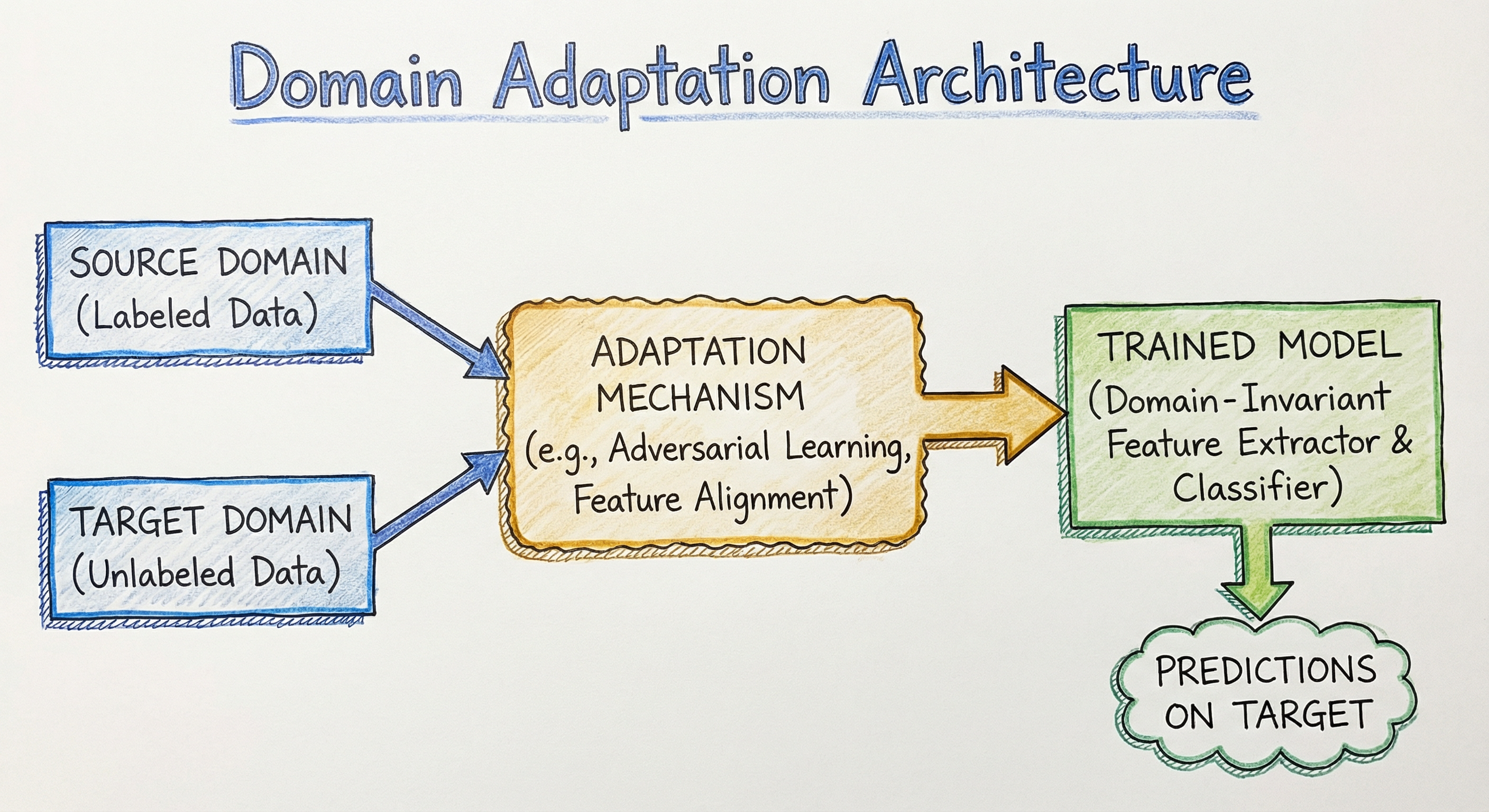
In production systems, the continued pretraining paradigm dominates for LLMs because it's simpler to implement, scales to massive corpora, and integrates naturally with existing training pipelines. Adversarial and feature alignment methods remain important for computer vision, time-series, and scenarios where labeled target data is truly unavailable.
Key Components
Feature Extractor (Shared Encoder)
The backbone network that maps raw inputs from both source and target domains into a shared feature representation. In NLP, this is typically a pretrained transformer (BERT, Llama, etc.). In vision, it's a pretrained CNN or ViT. The feature extractor is the primary component being adapted -- its representations must capture task-relevant patterns while suppressing domain-specific artifacts.
Task Classifier / Prediction Head
A lightweight network (often a single linear layer or small MLP) trained on labeled source data to predict task outputs from the shared features. In classification tasks, this produces class logits. In generation tasks (LLMs), this is the language model head. The task classifier is trained only on source labels but must generalize to target domain features.
Domain Discriminator (Adversarial Methods)
A binary classifier that attempts to distinguish source features from target features. Used in DANN and related adversarial methods. Through the gradient reversal layer, the domain discriminator's loss signal forces the feature extractor to produce domain-invariant representations. The discriminator is discarded after training.
Gradient Reversal Layer (GRL)
A special layer in DANN that acts as identity during the forward pass but reverses (negates and scales by ) gradients during backpropagation. This simple mechanism converts the standard supervised training objective into a minimax game where the feature extractor simultaneously minimizes task loss and maximizes domain confusion.
Alignment Loss Module (MMD/CORAL)
Computes a distributional distance metric between source and target feature representations. MMD measures the distance in a reproducing kernel Hilbert space. CORAL aligns second-order statistics (covariance matrices). Wasserstein distance provides a smoother alternative. The alignment loss is added to the task loss as a regularizer.
Domain Corpus Preprocessor
For continued pretraining approaches, this component curates and preprocesses domain-specific text corpora. This includes deduplication, quality filtering, tokenizer vocabulary extension (if the domain has specialized terminology), and optionally converting raw text into reading comprehension format (as in AdaptLLM) to preserve prompting ability during adaptation.
Forgetting Mitigation Module
Implements strategies to prevent catastrophic forgetting of general knowledge during domain adaptation. Methods include replay buffers (mixing general data with domain data during continued pretraining), elastic weight consolidation (EWC), knowledge distillation from the original model, or model merging (TIES-Merging, DARE) to combine the adapted and original models post-training.
Data Flow
Adversarial Path (DANN): Source and target inputs pass through the shared feature extractor. Source features go to both the task classifier (which computes task loss using source labels) and the domain discriminator (labeled as 'source'). Target features go only to the domain discriminator (labeled as 'target'). The GRL reverses gradients from the discriminator, creating a minimax game: the feature extractor learns representations that fool the discriminator while maintaining task performance.
Feature Alignment Path (MMD/CORAL): Source and target features are extracted separately but through the same encoder. An alignment loss (MMD or CORAL distance between the two feature distributions) is computed and added to the supervised task loss on source data. The combined loss gradient updates the encoder to produce aligned representations.
Continued Pretraining Path (DAPT + TAPT): A pretrained LLM first undergoes DAPT, where it continues its pretraining objective (masked language modeling for encoder models, causal language modeling for decoder models) on a large domain-specific corpus. This injects domain vocabulary and knowledge. Then TAPT further adapts on the unlabeled task data. Finally, supervised fine-tuning on labeled task data completes the adaptation. Gradients flow through the entire model during each stage.
Three parallel architectural paradigms are shown: (1) Adversarial Adaptation (DANN) with a shared feature extractor feeding both a task classifier and a domain discriminator connected through a gradient reversal layer; (2) Feature Alignment where a feature extractor feeds both an alignment loss module and a task classifier; (3) Continued Pretraining showing a sequential pipeline from a pretrained LLM through DAPT on domain corpus, TAPT on task data, and supervised fine-tuning.
How to Implement
Three Implementation Pathways
Domain adaptation implementations fall into three categories, each suited to different scenarios:
Pathway 1: Continued Pretraining (LLM Adaptation) -- The most common approach for NLP in 2025-2026. Use HuggingFace Transformers to continue training a pretrained LLM on domain-specific text, then fine-tune on task data. This is what Bloomberg did for finance, Google did for medicine, and what Indian companies like Sarvam AI do for Indic languages.
Pathway 2: Adversarial Domain Adaptation (DANN) -- Best for scenarios with abundant unlabeled target data and no target labels. Popular in computer vision (adapting ImageNet models to domain-specific image datasets) and industrial applications (adapting quality inspection models to new production lines).
Pathway 3: Feature Alignment (MMD/CORAL) -- A simpler alternative to adversarial methods that adds a distribution alignment loss to the training objective. Easier to train than DANN (no minimax instability) but may be less effective on hard adaptation problems.
Cost Estimate: Continued pretraining of a 7B LLM on 10B domain tokens takes approximately 200-400 A100 GPU-hours, costing 2.7M (~INR 22.7 crore). For Indian startups, starting with LoRA-based domain adaptation on 1-5B tokens is a practical entry point at $50-200 (~INR 4,200-16,800).
from transformers import (
    AutoModelForCausalLM,
    AutoTokenizer,
    TrainingArguments,
    Trainer,
    DataCollatorForLanguageModeling,
)
from datasets import load_dataset

# Load base model and tokenizer
model_name = "meta-llama/Llama-3.1-8B"
tokenizer = AutoTokenizer.from_pretrained(model_name)
tokenizer.pad_token = tokenizer.eos_token

model = AutoModelForCausalLM.from_pretrained(
    model_name,
    torch_dtype="auto",
    device_map="auto",
)

# Load domain-specific corpus (e.g., medical, legal, financial)
# Replace with your domain corpus
domain_dataset = load_dataset(
    "text",
    data_files={"train": "domain_corpus/*.txt"},
    split="train",
)

# Tokenize the domain corpus
def tokenize_function(examples):
    return tokenizer(
        examples["text"],
        truncation=True,
        max_length=2048,
        return_overflowing_tokens=True,
    )

tokenized_dataset = domain_dataset.map(
    tokenize_function,
    batched=True,
    remove_columns=["text"],
)

# Data collator for causal language modeling
data_collator = DataCollatorForLanguageModeling(
    tokenizer=tokenizer,
    mlm=False,  # Causal LM (not masked)
)

# Training arguments for continued pretraining
training_args = TrainingArguments(
    output_dir="./domain-adapted-llama3",
    num_train_epochs=1,  # Usually 1-2 epochs for DAPT
    per_device_train_batch_size=4,
    gradient_accumulation_steps=8,
    learning_rate=2e-5,  # Lower LR than fine-tuning to avoid forgetting
    warmup_ratio=0.05,
    lr_scheduler_type="cosine",
    logging_steps=50,
    save_strategy="steps",
    save_steps=1000,
    bf16=True,
    gradient_checkpointing=True,
    dataloader_num_workers=4,
)

# Train (continued pretraining on domain corpus)
trainer = Trainer(
    model=model,
    args=training_args,
    train_dataset=tokenized_dataset,
    data_collator=data_collator,
)
trainer.train()

# Save domain-adapted model
model.save_pretrained("./domain-adapted-llama3")
tokenizer.save_pretrained("./domain-adapted-llama3")
This is the standard recipe for Domain-Adaptive Pretraining (DAPT). Key decisions:
- Learning rate = 2e-5: Much lower than standard fine-tuning (2e-4) to prevent catastrophic forgetting. The model should gently absorb domain knowledge, not overwrite its general capabilities.
- 1-2 epochs on domain corpus: More epochs risk overfitting to domain text and losing general language understanding. For large corpora (>10B tokens), a single pass is usually sufficient.
- Causal LM objective (mlm=False): For decoder-only models like Llama, we use the standard next-token prediction objective. For encoder models like BERT, switch to
mlm=True. - gradient_checkpointing=True: Essential for fitting continued pretraining on a single GPU. DAPT processes much longer sequences than fine-tuning.
After DAPT, proceed to task-specific fine-tuning (e.g., with SFTTrainer for instruction following, or standard classification fine-tuning).
import torch
import torch.nn as nn
from torch.autograd import Function


class GradientReversalFunction(Function):
    """Gradient Reversal Layer (Ganin et al., 2016)."""

    @staticmethod
    def forward(ctx, x, lambda_val):
        ctx.lambda_val = lambda_val
        return x.clone()

    @staticmethod
    def backward(ctx, grad_output):
        return -ctx.lambda_val * grad_output, None


class GradientReversalLayer(nn.Module):
    def __init__(self, lambda_val=1.0):
        super().__init__()
        self.lambda_val = lambda_val

    def forward(self, x):
        return GradientReversalFunction.apply(x, self.lambda_val)


class DANN(nn.Module):
    """Domain-Adversarial Neural Network for unsupervised domain adaptation."""

    def __init__(self, feature_dim=768, num_classes=2, hidden_dim=256):
        super().__init__()

        # Shared feature extractor (e.g., pretrained BERT backbone)
        self.feature_extractor = nn.Sequential(
            nn.Linear(feature_dim, hidden_dim),
            nn.ReLU(),
            nn.Dropout(0.3),
            nn.Linear(hidden_dim, hidden_dim),
            nn.ReLU(),
        )

        # Task classifier (trained on source labels)
        self.task_classifier = nn.Sequential(
            nn.Linear(hidden_dim, hidden_dim // 2),
            nn.ReLU(),
            nn.Dropout(0.3),
            nn.Linear(hidden_dim // 2, num_classes),
        )

        # Domain discriminator (source vs target)
        self.gradient_reversal = GradientReversalLayer()
        self.domain_discriminator = nn.Sequential(
            nn.Linear(hidden_dim, hidden_dim // 2),
            nn.ReLU(),
            nn.Dropout(0.3),
            nn.Linear(hidden_dim // 2, 2),  # source=0, target=1
        )

    def forward(self, x, lambda_val=1.0):
        self.gradient_reversal.lambda_val = lambda_val

        features = self.feature_extractor(x)
        task_output = self.task_classifier(features)

        reversed_features = self.gradient_reversal(features)
        domain_output = self.domain_discriminator(reversed_features)

        return task_output, domain_output


def train_dann(
    model, source_loader, target_loader,
    optimizer, num_epochs=50, device="cuda"
):
    """Train DANN with progressive lambda scheduling."""
    task_criterion = nn.CrossEntropyLoss()
    domain_criterion = nn.CrossEntropyLoss()

    for epoch in range(num_epochs):
        # Progressive lambda: increases from 0 to 1 over training
        p = epoch / num_epochs
        lambda_val = 2.0 / (1.0 + torch.exp(torch.tensor(-10.0 * p))) - 1.0

        model.train()
        for (src_x, src_y), (tgt_x, _) in zip(source_loader, target_loader):
            src_x, src_y = src_x.to(device), src_y.to(device)
            tgt_x = tgt_x.to(device)

            # Source forward pass
            src_task_out, src_domain_out = model(src_x, lambda_val)
            src_domain_labels = torch.zeros(src_x.size(0), dtype=torch.long, device=device)

            # Target forward pass (no task labels)
            _, tgt_domain_out = model(tgt_x, lambda_val)
            tgt_domain_labels = torch.ones(tgt_x.size(0), dtype=torch.long, device=device)

            # Combined loss
            task_loss = task_criterion(src_task_out, src_y)
            domain_loss = domain_criterion(src_domain_out, src_domain_labels) + \
                          domain_criterion(tgt_domain_out, tgt_domain_labels)
            total_loss = task_loss + domain_loss

            optimizer.zero_grad()
            total_loss.backward()
            optimizer.step()

        if (epoch + 1) % 10 == 0:
            print(f"Epoch [{epoch+1}/{num_epochs}] "
                  f"Task Loss: {task_loss.item():.4f} "
                  f"Domain Loss: {domain_loss.item():.4f} "
                  f"Lambda: {lambda_val.item():.4f}")
This implements the core DANN architecture from Ganin et al. (2016). Key implementation details:
- Gradient Reversal Layer: Uses PyTorch's
Function.applyto reverse gradients during backpropagation. The forward pass is identity; the backward pass multiplies by . - Progressive lambda scheduling: Lambda increases from 0 to 1 over training using a sigmoid schedule. Starting with small lambda lets the feature extractor first learn good task features before the domain adversary kicks in.
- Combined loss: Task loss uses only source labels (supervised). Domain loss uses both source and target (unsupervised -- we only need to know which domain, not the task label).
- Feature extractor backbone: In practice, replace the simple MLP with a pretrained encoder (BERT, ResNet, etc.) and fine-tune the last few layers.
For production use, consider libraries like adapt or Transfer-Learning-Library which provide optimized implementations.
from transformers import AutoModelForCausalLM, AutoTokenizer, TrainingArguments
from peft import LoraConfig, get_peft_model, TaskType
from trl import SFTTrainer
from datasets import load_dataset, concatenate_datasets

# Load base model
model_name = "meta-llama/Llama-3.1-8B"
tokenizer = AutoTokenizer.from_pretrained(model_name)
tokenizer.pad_token = tokenizer.eos_token

model = AutoModelForCausalLM.from_pretrained(
    model_name,
    torch_dtype="auto",
    device_map="auto",
)

# LoRA config for domain adaptation
# Higher rank (32-64) for domain adaptation vs instruction tuning (16)
lora_config = LoraConfig(
    task_type=TaskType.CAUSAL_LM,
    r=64,                         # Higher rank for domain shift
    lora_alpha=128,               # alpha = 2*r
    lora_dropout=0.05,
    target_modules=[
        "q_proj", "k_proj", "v_proj", "o_proj",
        "gate_proj", "up_proj", "down_proj",
    ],
    bias="none",
)

model = get_peft_model(model, lora_config)
model.print_trainable_parameters()

# Load domain-specific dataset (e.g., Indian legal corpus)
domain_data = load_dataset(
    "json",
    data_files="indian_legal_corpus.jsonl",
    split="train",
)

# Mix with general data to prevent catastrophic forgetting (80% domain, 20% general)
general_data = load_dataset("HuggingFaceFW/fineweb", split="train", streaming=True)
general_sample = general_data.take(len(domain_data) // 4)

# Training with replay buffer for forgetting mitigation
training_args = TrainingArguments(
    output_dir="./legal-adapted-llama3",
    num_train_epochs=2,
    per_device_train_batch_size=4,
    gradient_accumulation_steps=4,
    learning_rate=1e-4,            # Moderate LR for LoRA domain adaptation
    warmup_ratio=0.05,
    lr_scheduler_type="cosine",
    logging_steps=25,
    save_strategy="steps",
    save_steps=500,
    bf16=True,
    gradient_checkpointing=True,
)

trainer = SFTTrainer(
    model=model,
    args=training_args,
    train_dataset=domain_data,
    tokenizer=tokenizer,
    max_seq_length=4096,
)
trainer.train()

# Save domain-adapted LoRA adapter (~200 MB)
model.save_pretrained("./legal-adapted-llama3-lora")
print("Domain adapter saved. Ready for task-specific fine-tuning.")
This combines LoRA with domain adaptation -- the most cost-effective approach for Indian startups and research teams. Key decisions:
- rank=64: Higher than the typical r=16 for instruction tuning. Domain adaptation requires more expressiveness because the model needs to learn new vocabulary, concepts, and patterns -- not just follow instructions differently.
- Replay buffer: Mixing 20% general data with domain data is a simple but effective strategy to prevent catastrophic forgetting. The model sees enough general text to maintain broad capabilities.
- learning_rate=1e-4: Slightly lower than standard LoRA fine-tuning to balance adaptation speed vs. forgetting risk.
This approach costs approximately 800-1,600 for full continued pretraining. The quality tradeoff is typically 1-5% on domain benchmarks -- well worth the 20-40x cost savings for most applications.
# Domain adaptation configuration (YAML)
base_model:
  name: meta-llama/Llama-3.1-8B
  dtype: bfloat16

adaptation:
  strategy: continued_pretraining  # or adversarial, feature_alignment

  # DAPT settings
  dapt:
    domain_corpus: ./data/medical_corpus/  # 5-10B tokens
    epochs: 1
    learning_rate: 2e-5
    warmup_ratio: 0.05
    replay_ratio: 0.15  # 15% general data mixed in
    replay_source: HuggingFaceFW/fineweb
    max_seq_length: 4096

  # TAPT settings (optional, applied after DAPT)
  tapt:
    task_corpus: ./data/task_training_unlabeled/
    epochs: 3
    learning_rate: 5e-5

  # Forgetting mitigation
  forgetting:
    strategy: replay_buffer  # replay_buffer, ewc, model_merging
    eval_general_benchmarks:
      - mmlu
      - hellaswag
      - arc_challenge
    forgetting_threshold: 0.05  # Max acceptable degradation on general benchmarks

# Optional: LoRA-based adaptation (lower cost)
lora:
  enabled: true
  rank: 64
  alpha: 128
  dropout: 0.05
  target_modules:
    - q_proj
    - k_proj
    - v_proj
    - o_proj
    - gate_proj
    - up_proj
    - down_proj

evaluation:
  domain_benchmarks:
    - medical_qa
    - pubmedqa
  general_benchmarks:
    - mmlu
    - hellaswag
  report_forgetting_metrics: true
Common Implementation Mistakes
- ●
Using the same learning rate as fine-tuning for continued pretraining: DAPT should use a much lower learning rate (2e-5 vs. 2e-4) because you're trying to gently inject domain knowledge, not rapidly overfit to a specific task. Too high a learning rate causes catastrophic forgetting of general capabilities.
- ●
Not mixing domain data with general data (replay buffer): Pure domain continued pretraining degrades the model's general language understanding and prompting ability. The AdaptLLM paper showed that even converting domain text to reading comprehension format helps preserve prompting ability. Always mix 10-20% general data.
- ●
Setting DANN lambda too high or too early: The adversarial loss can destabilize training if lambda is too large from the start. Use progressive lambda scheduling (sigmoid increase from 0 to 1 over training). A common failure mode is the feature extractor collapsing to a trivial solution that produces constant features.
- ●
Ignoring tokenizer domain mismatch: Pretrained tokenizers may inefficiently encode domain-specific terms. Medical terms like 'thrombocytopenia' or Hindi legal terms like 'nyayalaya' may be split into many subword tokens. Consider extending the tokenizer vocabulary with frequent domain terms and training the new embeddings.
- ●
Assuming more domain data is always better: Diminishing returns set in quickly for continued pretraining. After 5-10B tokens, additional domain text provides marginal improvement. The quality and diversity of domain data matters more than quantity. Deduplicate aggressively.
- ●
Evaluating only on in-domain metrics: A domain-adapted model that excels on domain benchmarks but fails on general tasks has experienced catastrophic forgetting. Always evaluate on both domain-specific AND general benchmarks (MMLU, HellaSwag, etc.) to verify the model didn't trade general capability for domain expertise.
When Should You Use This?
Use When
Your pretrained model performs well on general tasks but degrades significantly on your target domain -- e.g., a general LLM struggling with medical terminology, legal jargon, or Indic language text
You have abundant unlabeled domain data (millions of documents) but limited labeled data (hundreds to thousands of examples) -- the classic semi-supervised adaptation scenario
You're deploying a model into a domain with specialized vocabulary, terminology, or conventions that the pretrained model rarely encountered (financial filings, court judgments, clinical notes)
You need to adapt a model to a new language or language variant -- e.g., adapting an English LLM to Hindi-English code-mixed text, or adapting a general Hindi model to Bhojpuri
Your domain has regulatory or compliance requirements that demand provable domain competence -- e.g., medical AI requiring demonstrated performance on clinical benchmarks before deployment
You're building a domain-specific product where the model must understand domain context deeply -- e.g., a legal research assistant that understands Indian case law structure, or a financial advisor that knows Indian tax regulations
The distribution shift between source and target is moderate -- the domains share core capabilities but differ in surface-level patterns, vocabulary, and conventions
Avoid When
The source and target domains are too dissimilar -- adapting a code generation model to protein folding will not work because the underlying representations are too different
You have sufficient labeled data in the target domain to train a model from scratch -- if you have 1M+ labeled examples, direct training may outperform adaptation from a mismatched source
The pretrained model already performs well on your target domain -- many modern LLMs have seen domain-specific text during pretraining (e.g., GPT-4 performs reasonably well on legal and medical tasks without adaptation)
Your task requires real-time adaptation to continuously shifting distributions -- domain adaptation produces a static adapted model; for continuous drift, consider online learning or retrieval-augmented approaches
You need to adapt to multiple very different domains simultaneously -- multi-target domain adaptation is an open research problem and generally underperforms compared to separate per-domain adaptations
Your compute budget is extremely limited and the source model is large -- continued pretraining of a 70B model still costs thousands of dollars even with efficient methods
Key Tradeoffs
The Spectrum of Adaptation Approaches
Domain adaptation methods span a wide spectrum from zero-cost (prompt engineering) to very expensive (train from scratch). Here's the practical tradeoff matrix:
| Approach | Cost (7B model) | Domain Performance | General Capability | Complexity |
|---|---|---|---|---|
| Prompt Engineering | Free | +5-15% | Preserved | Low |
| RAG with Domain Docs | $50-200 (indexing) | +15-30% | Preserved | Medium |
| LoRA Domain Adaptation | $10-50 / INR 840-4,200 | +20-40% | Slight degradation | Medium |
| DAPT (Continued Pretraining) | $800-1,600 / INR 67K-1.34L | +30-50% | Some degradation | High |
| DAPT + TAPT | $1,000-2,000 / INR 84K-1.68L | +35-55% | Moderate degradation | High |
| Train from Scratch | $100K+ / INR 84L+ | Maximum | N/A (domain only) | Very High |
Quality vs. Forgetting
The central tradeoff in domain adaptation is the adaptation-forgetting curve. More aggressive adaptation (higher learning rate, more epochs, larger domain corpus) improves domain performance but degrades general capabilities. This is not just a theoretical concern -- a medical LLM that can diagnose diseases but can't have a basic conversation is not useful in practice.
Mitigation strategies include:
- Replay buffers: Mix 10-20% general data during continued pretraining
- Model merging: Train the domain-adapted model and merge it with the original using TIES-Merging or DARE
- Elastic Weight Consolidation (EWC): Add a penalty term that discourages large changes to parameters important for general tasks
- Reading comprehension conversion: Transform domain text into QA format (AdaptLLM) to maintain prompting ability
Build vs. Buy
For Indian enterprises, there's also a build-vs-buy decision:
- Build domain-adapted model: Higher upfront cost but full control over data, architecture, and deployment. Best for regulated industries (healthcare, finance, legal) where data sovereignty matters.
- Use domain-specific API: Services like Bloomberg Terminal (finance) or Google's Med-PaLM API (healthcare) offer ready-made domain expertise. Lower cost but vendor lock-in and data privacy concerns.
Practitioner's Rule: Start with RAG (retrieval-augmented generation) for domain adaptation. If RAG performance is insufficient, add LoRA domain adaptation. Only proceed to full continued pretraining if LoRA + RAG still falls short. This incremental approach lets you find the minimum viable adaptation level.
Alternatives & Comparisons
Continued pretraining is actually a method of domain adaptation -- the simplest and most scalable one. If your goal is pure domain knowledge injection without specific task optimization, continued pretraining alone may suffice. Choose domain adaptation (as a broader strategy) when you need the theoretical framework to handle specific shift types (covariate, label, concept); choose continued pretraining when you simply need to inject domain vocabulary and knowledge.
Feature extraction uses a pretrained model as a frozen feature extractor and trains only a lightweight head on target domain data. It's much cheaper than full domain adaptation but less powerful -- the features aren't adapted to the target domain, only the classifier is. Choose feature extraction when compute is extremely limited and the domain shift is mild; choose domain adaptation when the shift is significant enough that frozen features underperform.
Full fine-tuning on target domain data can achieve domain adaptation implicitly, but without explicit adaptation mechanisms, it's prone to overfitting on small target datasets and catastrophic forgetting of source knowledge. Domain adaptation techniques (DANN, MMD, replay buffers) provide principled ways to handle distribution shift. Choose full fine-tuning when you have abundant target labels; choose domain adaptation when target labels are scarce.
LoRA provides parameter-efficient adaptation that can serve as a domain adaptation method (domain-specific LoRA adapter). It's 10-50x cheaper than full continued pretraining but may not capture deep domain knowledge as effectively as DAPT. Choose LoRA when budget is constrained or you need multi-domain serving; choose full DAPT when maximum domain performance is required.
Knowledge distillation transfers knowledge from a large teacher to a smaller student, which can implicitly perform domain adaptation if the teacher is domain-adapted. It's complementary to domain adaptation: first adapt the teacher, then distill to a smaller model for efficient deployment. Choose distillation for model compression; choose domain adaptation for domain knowledge injection.
Multi-task learning trains on multiple related tasks simultaneously, which can improve domain generalization. It's complementary to domain adaptation: multi-task learning broadens capability across tasks within a domain, while domain adaptation bridges the gap between domains. Choose multi-task learning for within-domain capability expansion; choose domain adaptation for cross-domain transfer.
Pros, Cons & Tradeoffs
Advantages
Leverages existing pretrained knowledge: Instead of training from scratch, domain adaptation efficiently builds on the massive investment of pretraining -- saving 90-99% of compute costs compared to training a domain-specific model from scratch
Works with limited target domain labels: Unsupervised and semi-supervised adaptation methods (DANN, DAPT, MMD) can improve target domain performance using only unlabeled target data, which is far cheaper to collect than labeled data
Principled theoretical framework: Ben-David's bounds and subsequent theory provide mathematical guarantees and practical diagnostics for understanding when and why adaptation will work, unlike ad-hoc transfer learning approaches
Enables domain-specific LLMs at accessible cost: Companies like Sarvam AI and FinGPT have shown that domain-adapted models can match or exceed general-purpose models costing orders of magnitude more on domain-specific benchmarks
Multiple paradigms for different scenarios: The toolbox includes adversarial methods (DANN), statistical alignment (MMD, CORAL), continued pretraining (DAPT/TAPT), and parameter-efficient methods (LoRA), giving practitioners options for every budget and constraint
Composable with other ML techniques: Domain adaptation can be combined with LoRA, quantization, knowledge distillation, and RAG for a multi-layered adaptation strategy
Critical for Indian language and market applications: Adapting English-centric models to Hindi, Tamil, Telugu, and other Indic languages is fundamentally a domain adaptation problem, and the techniques directly enable India's AI sovereignty goals
Disadvantages
Catastrophic forgetting is hard to completely prevent: Even with replay buffers and regularization, domain-adapted models typically lose 2-10% performance on general benchmarks, and the degradation can be unpredictable across different capability dimensions
Continued pretraining is computationally expensive: DAPT on billions of domain tokens still requires significant GPU resources -- $800-1,600 for a 7B model, scaling to millions of dollars for 100B+ models like BloombergGPT
No guarantee of positive transfer: If source and target domains are too dissimilar (the term in Ben-David's bound is large), adaptation can actually hurt performance -- a phenomenon called negative transfer
Adversarial methods are unstable to train: DANN and related methods suffer from the same training instability as GANs -- mode collapse, oscillating losses, and sensitivity to hyperparameters. The progressive lambda schedule mitigates but doesn't eliminate this
Domain data quality is critical and hard to ensure: Domain corpora often contain noise, outdated information, or biased content. A medical adaptation trained on patient forums alongside medical journals will learn both expert knowledge and medical misinformation
Evaluation is complex and domain-specific: Validating domain adaptation requires domain expertise to design appropriate benchmarks. Generic metrics like perplexity may not capture whether the model truly understands domain-specific reasoning
Tokenizer mismatch introduces hidden inefficiencies: Pretrained tokenizers may poorly handle domain vocabulary, leading to longer token sequences, increased inference cost, and degraded representation quality for domain-specific terms
Failure Modes & Debugging
Catastrophic Forgetting
Cause
Aggressive continued pretraining on domain-specific data causes the model to overwrite general knowledge stored in its weights. This is especially severe when the domain corpus is much smaller than the original pretraining data, causing the model to overfit to domain patterns and lose broad linguistic competence.
Symptoms
The model excels on domain-specific benchmarks but produces degraded outputs on general tasks. Common signs: inability to follow basic instructions, loss of common sense reasoning, degraded performance on MMLU/HellaSwag, and generating domain jargon in inappropriate contexts (e.g., a medical-adapted model using clinical terminology in casual conversation).
Mitigation
Use a replay buffer mixing 10-20% general data during continued pretraining. Apply Elastic Weight Consolidation (EWC) to protect important general parameters. Use model merging (TIES-Merging, DARE) to combine the adapted and original models. Convert domain text to reading comprehension format (AdaptLLM approach). Monitor both domain and general benchmarks throughout training and implement early stopping on general performance degradation.
Negative Transfer
Cause
The source and target domains are too dissimilar for knowledge to transfer positively. The features learned from source data are not just uninformative for the target -- they're actively misleading. For example, adapting a sentiment classifier from product reviews to financial sentiment, where words like 'bullish' and 'volatile' have opposite connotations than in everyday language.
Symptoms
The domain-adapted model performs worse than training directly on the (limited) target data alone. Training loss converges but validation performance degrades. Feature analysis reveals the model is capturing source-specific patterns that conflict with target domain semantics.
Mitigation
Measure domain divergence before attempting adaptation using proxy-A distance or domain classification accuracy. If a simple classifier can distinguish source from target with >95% accuracy on features, the domains may be too far apart. Consider starting from a more domain-proximate pretrained model, or using target-only training with aggressive data augmentation instead of cross-domain transfer.
Adversarial Training Collapse (DANN)
Cause
The minimax optimization in DANN becomes unstable, causing either the domain discriminator to overwhelm the feature extractor (features collapse to a trivial constant) or the feature extractor to produce degenerate representations that fool the discriminator without being useful for the task.
Symptoms
Domain discriminator accuracy drops to ~50% (random) very early in training while task performance also degrades. Feature visualization shows collapsed representations where all samples map to a small region of feature space. The loss oscillates wildly between the task and domain components.
Mitigation
Use progressive lambda scheduling (sigmoid increase from 0 to 1) to gradually increase adversarial strength. Pre-train the feature extractor and task classifier on source data before enabling the domain discriminator. Apply spectral normalization to the discriminator to stabilize training. Consider simpler alternatives like MMD or CORAL which don't require minimax optimization.
Domain Data Quality Poisoning
Cause
The domain corpus contains low-quality, outdated, or factually incorrect content that the model absorbs during continued pretraining. This is especially problematic for medical and legal domains where mixing expert literature with patient forums or layperson blogs introduces misinformation.
Symptoms
The model confidently generates domain-specific content that is factually wrong or reflects outdated practices. For example, a medical model recommending discontinued treatments found in old forum posts, or a legal model citing overturned case law from web-scraped data.
Mitigation
Implement rigorous data curation with domain expert review. Filter by source quality (prioritize peer-reviewed papers, official documents, and authoritative sources). Apply temporal filtering to exclude outdated content. Use perplexity-based filtering to remove low-quality text. For medical and legal domains, partner with domain experts to build curated training corpora rather than relying on web scraping.
Tokenizer-Domain Vocabulary Mismatch
Cause
The pretrained tokenizer was designed for general English text and fragmentarily encodes domain-specific terms, Indic language words, or specialized notation. Medical terms like 'electroencephalography', Hindi legal terms like 'nyayalaya', or chemical formulas get split into many subword tokens, degrading both representation quality and inference efficiency.
Symptoms
Unusually long token sequences for domain text (2-3x longer than expected). The model struggles with domain-specific named entities, compound terms, and technical vocabulary. Inference is slower than expected because more tokens are generated per semantic unit.
Mitigation
Extend the tokenizer vocabulary with high-frequency domain terms (add 5,000-20,000 new tokens). Initialize new token embeddings by averaging the embeddings of their subword decompositions. Train the new embeddings during a brief continued pretraining phase while keeping most model weights frozen. Sarvam AI's custom tokenizer for Indic languages achieves 4x encoding efficiency over general English tokenizers by taking this approach.
Placement in an ML System
Where Domain Adaptation Fits in the ML System
Domain adaptation sits at a critical junction in the ML pipeline -- between general pretraining and domain-specific deployment. It's the bridge that transforms a general-purpose model into a domain expert:
- Data Engineering: Domain corpus is collected, cleaned, deduplicated, and optionally converted to structured formats (reading comprehension, instruction-response pairs).
- Adaptation: The pretrained model undergoes domain adaptation through continued pretraining, adversarial training, or feature alignment.
- Task Fine-tuning: The domain-adapted model is further fine-tuned on task-specific labeled data (e.g., medical QA, legal document classification, financial sentiment analysis).
- Evaluation: Both domain-specific and general benchmarks are run to verify adaptation quality and measure forgetting.
- Deployment: The adapted model is deployed through standard serving infrastructure, often alongside RAG for additional domain context.
In Indian enterprise ML systems, domain adaptation is increasingly a platform capability rather than a one-off project. Companies like Jio and Reliance are building internal ML platforms where domain adaptation is a configurable step in the model training pipeline, allowing different business units (healthcare, retail, telecom) to create domain-specific models from shared base models.
Architecture Pattern: The most robust production setup uses domain adaptation as a two-stage process: (1) DAPT creates a domain-adapted base model that serves as a foundation for the entire domain, and (2) task-specific LoRA adapters are trained on top for individual use cases. This separates the expensive domain adaptation (done once) from the cheap task specialization (done many times).
Pipeline Stage
Training / Adaptation
Upstream
- Pretrained base model (from model hub or pretraining pipeline)
- Domain corpus collection and curation pipeline
- Data preprocessing and tokenization
- Feature extraction (for generating features from raw data)
Downstream
- Task-specific fine-tuning (instruction tuning, classification, etc.)
- Model evaluation and benchmarking (domain + general)
- Model registry and versioning
- Model serving and deployment
Scaling Bottlenecks
The primary bottleneck for continued pretraining is GPU hours per token. Processing 10B domain tokens through a 7B model takes ~200 A100-hours. For a 70B model, that's ~2,000 A100-hours. The scaling is roughly linear in both model size and corpus size, with limited opportunity for efficiency gains beyond standard mixed-precision training and gradient checkpointing.
As domain corpora grow larger, maintaining data quality becomes the binding constraint. Deduplication, filtering, and quality assessment must scale with the corpus. For domains like Indian legal text, where documents span multiple languages and inconsistent formats, preprocessing can take longer than the actual training.
When deploying domain-adapted models for multiple domains (medical, legal, financial), each domain requires its own adapted model or adapter. Serving N domain-adapted 7B models requires N * 14 GB of GPU memory (in fp16). Multi-LoRA serving mitigates this by sharing a single base model, but the adapter switching overhead grows with the number of concurrent domains.
Evaluating domain adaptation requires both domain-specific and general benchmarks. As the number of domains grows, the evaluation matrix (N domains * M benchmarks) becomes expensive to maintain. Automated evaluation frameworks are essential for organizations adapting to more than 3-4 domains.
Production Case Studies
Bloomberg built BloombergGPT, a 50-billion parameter LLM trained on a mixed corpus of 363 billion tokens of financial data (from Bloomberg's proprietary data sources) and 345 billion tokens of general text. This is domain adaptation at its most ambitious scale -- training a model from scratch on a domain-enriched corpus rather than adapting an existing model. The financial data included news articles, filings, transcripts, and Bloomberg Terminal data spanning decades of financial history.
BloombergGPT significantly outperformed GPT-NeoX and BLOOM on financial NLP benchmarks (sentiment analysis, named entity recognition, question answering on financial text) while maintaining competitive performance on general NLP tasks. The training cost was estimated at ~$2.7M (~INR 22.7 crore) using 512 Amazon SageMaker p4d.24xlarge instances for approximately 53 days.
Google adapted PaLM 2 to the medical domain through a combination of domain-specific instruction tuning and a novel ensemble refinement prompting strategy. Med-PaLM 2 was fine-tuned on medical question-answer pairs from multiple sources including MedQA, MedMCQA, and HealthSearchQA. The adaptation strategy combined domain-specific data curation with prompting innovations -- demonstrating that domain adaptation for LLMs involves both training-time and inference-time techniques.
Med-PaLM 2 achieved 86.5% on MedQA (US Medical License Exam questions), a 19% improvement over the original Med-PaLM and approaching expert physician performance. On physician-evaluated axes, Med-PaLM 2 answers were preferred over physician answers on 8 of 9 clinical evaluation criteria.
Sarvam AI built Sarvam-1, a 2-billion parameter language model specifically adapted for 10 major Indian languages (Hindi, Bengali, Tamil, Telugu, Kannada, Malayalam, Marathi, Gujarati, Oriya, Punjabi). Their approach combined training a custom tokenizer optimized for Indic scripts (4x more efficient than English-trained tokenizers on Indic text) with domain-adaptive pretraining on 2 trillion tokens of Indic language data generated through advanced synthetic data techniques. This represents domain adaptation at the language level -- adapting core language modeling capability to an underrepresented linguistic domain.
Sarvam-1 outperformed Gemma-2-2B and Llama-3.2-3B on standard benchmarks including MMLU, ARC-Challenge, and IndicGenBench despite being a smaller 2B model. In 2025, Sarvam AI was selected by the Government of India under the IndiaAI Mission to build India's sovereign Large Language Model, validating their domain adaptation approach at national scale.
FinGPT demonstrated that lightweight domain adaptation via LoRA and QLoRA fine-tuning can create competitive financial LLMs at a fraction of BloombergGPT's cost. Rather than training from scratch, FinGPT adapts open-source LLMs (LLaMA, Falcon) to finance using curated financial data from news, social media, filings, and market data. The framework emphasizes data-centric domain adaptation -- continuously updating the model with fresh financial data rather than static training.
FinGPT achieved competitive performance with BloombergGPT (50B) on financial sentiment analysis and NER tasks while using 7B-parameter base models and costing less than $300 (~INR 25,200) per training run -- approximately 9,000x cheaper than BloombergGPT's training cost. The open-source framework enabled rapid adoption by fintech startups and research labs.
Tooling & Ecosystem
The dominant framework for LLM domain adaptation via continued pretraining. Trainer class supports causal and masked language modeling objectives for DAPT. Combined with PEFT for parameter-efficient domain adaptation via LoRA. The HuggingFace Hub hosts hundreds of domain-adapted models (AdaptLLM series for medical, legal, and financial domains) that serve as starting points.
A comprehensive library implementing 30+ domain adaptation methods including DANN, CORAL, MMD-based approaches, importance weighting, and subspace alignment. Provides both scikit-learn compatible estimators and TensorFlow-based deep models. Ideal for classical domain adaptation research and non-LLM applications (tabular data, time series, vision).
A PyTorch-based library from Tsinghua University providing optimized implementations of DANN, CDAN, MDD, MCC, and other deep domain adaptation algorithms. Includes benchmarks on standard domain adaptation datasets (Office-31, VisDA, DomainNet). Well-documented with reproducible baselines for computer vision domain adaptation.
Production-grade fine-tuning framework that supports continued pretraining workflows for domain adaptation. YAML-configurable pipelines for DAPT, TAPT, and task-specific fine-tuning. Supports multi-GPU training, DeepSpeed, and FSDP. The go-to tool for teams building domain-adapted LLMs in production.
Unified training framework with web UI supporting continued pretraining, supervised fine-tuning, and RLHF. Provides pre-built recipes for domain adaptation workflows. Supports 100+ model architectures and integrates with PEFT for parameter-efficient adaptation. The web interface makes domain adaptation accessible to teams without deep MLOps expertise.
A comprehensive catalog of NLP resources for Indian languages, including IndicBERT (multilingual BERT for 12 Indian languages), IndicCorp v2 (20.9B tokens across 24 languages), and evaluation benchmarks. Essential for domain adaptation to Indian language contexts. Provides pretrained models, tokenizers, and datasets specifically designed for Indic language NLP.
Research & References
Ganin, Ustinova, Ajakan, Germain, Larochelle, Laviolette, Marchand & Lempitsky (2016)JMLR 2016
Introduced the gradient reversal layer for domain adaptation, enabling end-to-end adversarial training where the feature extractor learns domain-invariant representations. The DANN architecture became the foundation for adversarial domain adaptation methods. Key insight: domain adaptation can be achieved by making features that are simultaneously discriminative for the task and indiscriminate with respect to domain shift.
Gururangan, Marasovic, Swayamdipta, Lo, Beltagy, Downey & Smith (2020)ACL 2020
Established DAPT (Domain-Adaptive Pretraining) and TAPT (Task-Adaptive Pretraining) as standard domain adaptation strategies for language models. Showed that continued pretraining on domain-specific corpora consistently improves downstream performance across biomedical, CS, news, and review domains. DAPT + TAPT yields the best results, with TAPT providing gains even after DAPT.
Ben-David, Blitzer, Crammer, Kulesza, Pereira & Vaughan (2010)Machine Learning Journal
The foundational theoretical paper for domain adaptation. Proved that target domain error is bounded by source error plus domain divergence (measured by -divergence) plus the joint optimal error. This bound motivates all subsequent domain adaptation methods by providing a principled objective: minimize domain divergence while maintaining task performance.
Wu, Irsoy, Lu, Daber, Dredze, Gehrmann, Kambadur, Rosenberg & Mann (2023)arXiv 2023
Demonstrated domain adaptation at scale by training a 50B-parameter LLM on 363B tokens of financial data mixed with 345B tokens of general text. Showed that a mixed-domain pretraining approach (rather than pure domain or general) produces the best results on both financial and general benchmarks. Established the cost-quality frontier for domain-specific LLM training.
Chalkidis, Fergadiotis, Malakasiotis, Aletras & Androutsopoulos (2020)EMNLP 2020 (Findings)
Systematically compared strategies for adapting BERT to the legal domain: using original BERT, additional pretraining on legal text (DAPT), and training from scratch on legal text. Found that DAPT on 12GB of legal English text produced LEGAL-BERT, which outperformed both vanilla BERT and multilingual models on legal NLP tasks including contract clause classification and court case judgment prediction.
Cheng, Huang, Chen, Tai, Chang & Peng (2024)ICLR 2024
Proposed AdaptLLM, which transforms domain-specific raw text into reading comprehension format (with generated questions, summaries, and exercises) before continued pretraining. This approach injects domain knowledge while preserving the model's prompting ability -- addressing the key weakness of standard DAPT. A 7B model adapted with this method competed with BloombergGPT-50B on financial tasks.
Sun & Saenko (2016)ECCV 2016 Workshops
Extended the CORAL (Correlation Alignment) method to deep networks by adding a differentiable CORAL loss that aligns the second-order statistics (covariance matrices) of source and target feature distributions. The CORAL loss is simple to implement, adds minimal computational overhead, and provides a stable alternative to adversarial domain adaptation methods.
Interview & Evaluation Perspective
Common Interview Questions
- ●
What is domain adaptation and why is it needed in production ML systems?
- ●
Explain the difference between covariate shift, label shift, and concept drift. How do you handle each?
- ●
How does DANN (Domain-Adversarial Neural Network) work? Explain the gradient reversal layer.
- ●
What is continued pretraining (DAPT/TAPT)? When would you use DAPT vs. TAPT vs. both?
- ●
How do you prevent catastrophic forgetting during domain adaptation?
- ●
Design a system to adapt a general LLM for the medical domain. What are the key decisions?
- ●
Compare domain adaptation strategies: adversarial (DANN), feature alignment (MMD/CORAL), and continued pretraining. When would you choose each?
- ●
How would you evaluate whether domain adaptation was successful? What metrics would you track?
Key Points to Mention
- ●
Ben-David's bound provides the theoretical foundation: target error <= source error + domain divergence + joint optimal error. This motivates reducing domain divergence through feature alignment or domain-invariant representations.
- ●
Three types of domain shift exist -- covariate shift (input distribution changes), label shift (class distribution changes), and concept drift (the P(Y|X) relationship changes). Each requires different adaptation strategies.
- ●
DANN uses a gradient reversal layer to create a minimax game: the feature extractor learns representations that are simultaneously task-discriminative and domain-invariant. Progressive lambda scheduling is critical for stable training.
- ●
DAPT + TAPT from Gururangan et al. (2020) is the standard LLM adaptation recipe: continued pretraining on domain corpus, then on task data. Both stages use the same pretraining objective (MLM or CLM).
- ●
Catastrophic forgetting is the primary risk. Mitigate with replay buffers (mix 10-20% general data), EWC, model merging (TIES/DARE), or reading comprehension conversion (AdaptLLM).
- ●
For Indian language adaptation: custom tokenizers (like Sarvam AI's 4x more efficient Indic tokenizer) are essential because general tokenizers fragment Indic text into too many subword tokens.
- ●
Cost comparison: BloombergGPT from scratch ~300 / INR 25,200 -- a 9,000x cost difference with competitive domain performance.
Pitfalls to Avoid
- ●
Confusing domain adaptation with transfer learning. Transfer learning is the broader concept; domain adaptation specifically addresses distribution shift between source and target domains where the task may remain the same.
- ●
Treating domain adaptation as a one-time process. In production, domain distributions drift over time (new legal precedents, updated medical guidelines, evolving financial instruments). Domain-adapted models need periodic re-adaptation.
- ●
Suggesting DANN for every domain adaptation problem. Adversarial methods are unstable and unnecessary when simpler approaches (continued pretraining, feature alignment) work. Start simple, escalate only if needed.
- ●
Ignoring the evaluation complexity. Simply measuring domain-specific accuracy is insufficient. You must also track general capability degradation, calibration, and domain-specific failure modes.
- ●
Not mentioning the data quality bottleneck. The success of domain adaptation depends as much on the quality and curation of the domain corpus as on the adaptation algorithm.
Senior-Level Expectation
A senior/staff engineer should discuss domain adaptation at three levels: (1) Theoretical: articulate Ben-David's bound, explain how different shift types (covariate, label, concept) inform algorithm selection, and describe the adaptation-forgetting tradeoff mathematically. (2) Engineering: detail the end-to-end pipeline from domain corpus curation through continued pretraining, tokenizer extension, forgetting mitigation (replay buffers, EWC, model merging), to multi-benchmark evaluation. Include concrete cost estimates (GPU-hours, INR) for the specific model size and domain corpus. (3) System Design: architect a production domain adaptation platform that handles multiple domains, continuous re-adaptation as domain data evolves, A/B testing of adapted vs. base models, and monitoring for domain drift in production. The ability to reason about when NOT to use domain adaptation (e.g., when RAG is sufficient, or when the domain shift is too large for positive transfer) demonstrates senior judgment.
Summary
What We Covered
Domain adaptation bridges the gap between where a model was trained (the source domain) and where it needs to perform (the target domain). The theoretical foundation, established by Ben-David et al. (2010), shows that target error is bounded by source error plus domain divergence plus joint optimal error -- motivating methods that reduce domain divergence while preserving task performance.
Three major paradigms exist: adversarial adaptation (DANN, using gradient reversal to learn domain-invariant features), feature alignment (MMD, CORAL, matching statistical properties of source and target distributions), and continued pretraining (DAPT/TAPT, the dominant approach for LLMs where the model continues its pretraining objective on domain-specific text). The three types of domain shift -- covariate shift, label shift, and concept drift -- each suggest different adaptation strategies, and identifying the shift type is the critical first diagnostic step.
In practice, the biggest challenges are catastrophic forgetting (the model losing general capabilities as it gains domain expertise) and data quality (domain corpora must be carefully curated to avoid injecting noise or misinformation). Mitigation strategies include replay buffers, model merging, EWC regularization, and the AdaptLLM approach of converting domain text to reading comprehension format. The cost spectrum ranges from free (prompt engineering) to millions of dollars (training BloombergGPT from scratch), with LoRA-based domain adaptation ($10-50 / INR 840-4,200) offering the best cost-effectiveness for most teams.
Domain adaptation is especially critical in the Indian context, where adapting English-centric models to Indic languages represents a fundamental domain adaptation challenge. Companies like Sarvam AI, Krutrim, and AI4Bharat are pioneering approaches that combine custom tokenizers, large-scale Indic pretraining, and cross-lingual transfer to build AI that truly serves India's linguistic diversity. Whether you're adapting a model for medical diagnostics, legal research, financial analysis, or regional language support, domain adaptation is the essential bridge between general AI capability and real-world utility.