Instruction Tuning in Machine Learning
Instruction tuning is the process of fine-tuning a pretrained language model on a curated dataset of (instruction, response) pairs so that it learns to follow natural language instructions reliably. It is the single most impactful step in turning a raw language model -- which merely predicts the next token -- into a useful assistant that can answer questions, summarize documents, write code, and reason through multi-step problems.
Before instruction tuning, GPT-3 could produce fluent text but required carefully engineered few-shot prompts to accomplish specific tasks. After instruction tuning (as demonstrated by FLAN and InstructGPT), the same architecture could follow zero-shot instructions with dramatically higher accuracy and better alignment with user intent.
Instruction tuning occupies a critical position in the modern LLM training pipeline: it comes after pretraining (self-supervised next-token prediction on trillions of tokens) and before preference alignment (RLHF, DPO). Think of pretraining as learning a language, instruction tuning as learning to be helpful, and RLHF as learning to be safe and polished. Without instruction tuning, alignment methods have nothing to build on.
Today, instruction tuning is a thriving research area encompassing dataset curation (Alpaca, ShareGPT, OpenAssistant), data synthesis (self-instruct, Evol-Instruct), multi-task mixing strategies, quality filtering, and scaling laws. Whether you are building a chatbot at a Bengaluru startup or aligning a 70B-parameter model at a large tech company, instruction tuning is the bridge between a raw language model and a genuinely useful AI system.
Concept Snapshot
- What It Is
- A supervised fine-tuning procedure where a pretrained language model is trained on instruction-response pairs to follow natural language instructions across diverse tasks.
- Category
- Model Training
- Complexity
- Advanced
- Inputs / Outputs
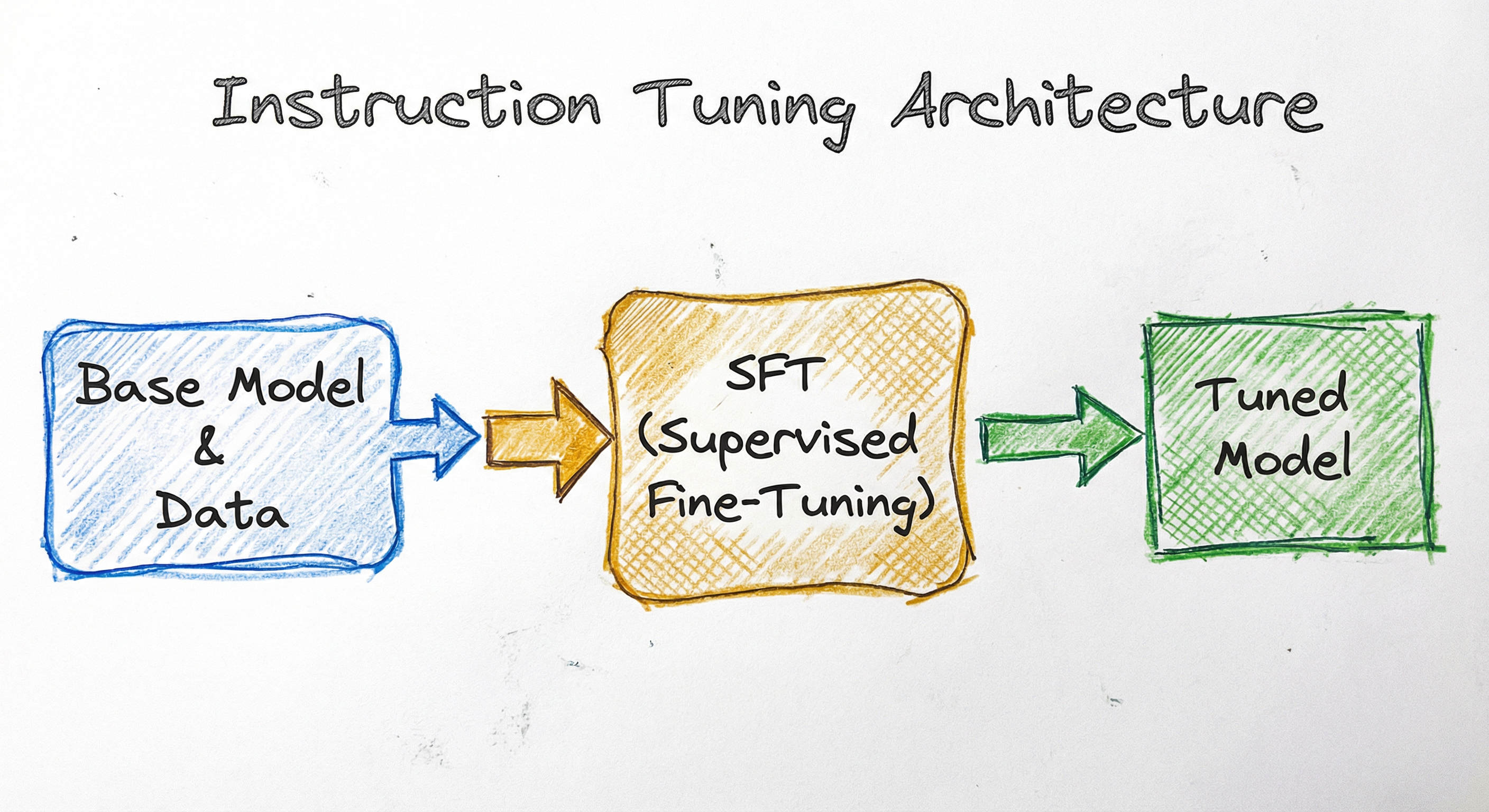
- Inputs: pretrained base LLM + instruction-response dataset. Outputs: instruction-tuned model that follows user instructions zero-shot.
- System Placement
- Sits between pretraining (upstream) and preference alignment such as RLHF or DPO (downstream) in the LLM training pipeline.
- Also Known As
- supervised fine-tuning (SFT), instruction fine-tuning, instruction alignment, task-specific fine-tuning, chat fine-tuning
- Typical Users
- ML Engineers, NLP Researchers, LLM Alignment Engineers, Applied AI Scientists, AI Startup Founders
- Prerequisites
- Language model pretraining, Transformer architecture, Cross-entropy loss and backpropagation, Tokenization and prompt formatting, GPU training infrastructure
- Key Terms
- SFTinstruction-response pairmulti-task mixingself-instructEvol-Instructchat templateloss maskingdata quality filteringscaling laws
Why This Concept Exists
The Gap Between Pretraining and Usefulness
A base language model trained on internet text learns an astonishing amount of knowledge and linguistic ability. But it has no notion of following instructions. Ask GPT-3 base "Summarize the following article:" and it might generate a plausible continuation of that sentence rather than actually producing a summary. The model has learned to predict tokens, not to be helpful.
This gap between capability and usability is exactly what instruction tuning closes. By fine-tuning on thousands of examples where an instruction is paired with a high-quality response, the model learns to condition its generation on the user's intent.
The Historical Arc
The idea crystallized in 2021-2022 through two parallel research threads:
Thread 1: Multi-task instruction tuning. Google's FLAN (Wei et al., 2021) showed that fine-tuning on 62 NLP datasets phrased as instructions improved zero-shot performance on held-out tasks by 25+ points. T0 (Sanh et al., 2021) from BigScience confirmed this on an even broader task collection. The key insight was that task diversity during instruction tuning transfers to unseen tasks -- a form of meta-learning.
Thread 2: Alignment-focused instruction tuning. OpenAI's InstructGPT (Ouyang et al., 2022) demonstrated that fine-tuning GPT-3 on human-written demonstrations of desired behavior, followed by RLHF, produced outputs that human raters strongly preferred. The supervised fine-tuning (SFT) stage of InstructGPT -- which is instruction tuning -- was responsible for a large share of the quality improvement.
Why It Became a Commodity
The release of Stanford Alpaca in March 2023 was a watershed moment. Alpaca showed that self-instruct -- using GPT-3.5 to generate 52K instruction-response pairs and fine-tuning LLaMA-7B on them -- could produce a surprisingly capable assistant for under $600 in API costs (~INR 50,000). Suddenly, instruction tuning wasn't just for labs with millions in compute budget. Indian startups like Sarvam AI and Krutrim began creating Indic-language instruction datasets to build multilingual assistants.
This democratization triggered an explosion: Vicuna (ShareGPT conversations), WizardLM (Evol-Instruct), Orca (complex reasoning traces), and dozens of others. Each explored a different dimension of instruction data quality and diversity.
Key Takeaway: Instruction tuning exists because pretraining gives a model knowledge but not obedience. Without instruction tuning, we'd still be writing elaborate few-shot prompts every time we wanted a language model to do something specific.
Core Intuition & Mental Model
The Mental Model
Think of a base language model as an incredibly well-read person who has consumed the entire internet but has never had a conversation. They know facts, they can write prose, they can even reason -- but if you ask them a direct question, they might just free-associate rather than give you a clear answer. Instruction tuning is like giving this person a few thousand examples of "when someone asks X, here's what a helpful response looks like." After seeing enough examples, they generalize the pattern of being helpful to instructions they've never seen before.
Why It Works So Well With So Little Data
Here's what surprised the field: instruction tuning works with remarkably little data compared to pretraining. A base model trained on trillions of tokens can be instruction-tuned on just 10K-100K examples (a few million tokens). The reason is that instruction tuning doesn't teach the model new knowledge -- the knowledge is already there from pretraining. It teaches the model a new format for expressing that knowledge: the instruction-following format.
This is why researchers say instruction tuning "unlocks" capabilities rather than "adding" them. The LIMA paper (Zhou et al., 2023) pushed this to the extreme, showing that just 1,000 carefully curated examples could produce a competitive instruction-following model. Quality over quantity, decisively.
The Three Things Instruction Tuning Actually Teaches
- Response format: How to structure an answer (paragraph, list, code block, step-by-step)
- Task recognition: How to identify what type of task the instruction describes
- Output calibration: How long and detailed the response should be, when to say "I don't know," and how to handle edge cases
Notice what's not on this list: factual knowledge. If the base model doesn't know something, instruction tuning won't teach it. This is a fundamental limitation that's important to internalize.
Expert Insight: The highest-leverage investment in instruction tuning is not more data -- it's better data. One high-quality example that demonstrates nuanced reasoning is worth more than a hundred sloppy, template-generated ones.
Technical Foundations
Mathematical Formulation
Let denote the parameters of a pretrained language model . Instruction tuning optimizes on a dataset where is an instruction (optionally including input context) and is the desired response.
Cross-Entropy Loss on Instruction-Response Pairs
The standard training objective is the causal language modeling loss computed only on the response tokens:
where is the -th token of response , and denotes all preceding response tokens. Crucially, the loss is masked on the instruction tokens -- the model sees them as context but is not penalized for "predicting" them. This loss masking ensures the model learns to generate responses given instructions rather than memorizing instruction text.
Why Loss Masking Matters
Without loss masking, the gradient signal is diluted by the instruction tokens, which can constitute 30-70% of the total sequence. This slows convergence and can even degrade instruction-following quality. Most modern training frameworks (TRL, Axolotl, LLaMA-Factory) apply loss masking by default.
Scaling Laws for Instruction Tuning
Empirical scaling laws (Chung et al., 2022) show that instruction-tuned performance scales along three axes:
- Number of tasks : Performance on held-out tasks improves log-linearly with the number of training tasks:
- Model size : Larger models benefit more from instruction tuning, with gains roughly proportional to
- Dataset quality : A quality-filtered dataset of size often outperforms an unfiltered dataset of size
The FLAN-T5 paper formalized the relationship:
where are empirically fitted constants and is the accuracy improvement over the base model on held-out tasks.
Chain-of-Thought Scaling
FLAN-T5 (Chung et al., 2022) also showed that including chain-of-thought (CoT) reasoning traces in 9 of the training tasks improved performance on all reasoning benchmarks, including tasks without CoT demonstrations in training. This suggests a cross-task transfer of reasoning ability during instruction tuning.
Formal Property: Instruction tuning is a form of multi-task supervised fine-tuning where the task specification is encoded in natural language rather than as a separate task ID or head. This natural language task specification is what enables zero-shot generalization to unseen instructions.
Internal Architecture
The instruction tuning pipeline has a clear multi-stage architecture. It begins with dataset curation and formatting, passes through tokenization and loss-masked training, and concludes with evaluation and optional preference alignment. Each stage has distinct engineering requirements.
The data curation subpipeline is arguably the most important part. The quality, diversity, and formatting of the instruction dataset determine the ceiling of the resulting model. Modern pipelines combine human-written demonstrations, synthetic data from stronger models, and aggressive quality filtering to build datasets that are both diverse and high-quality.
Key Components
Instruction Dataset
The core training data: a collection of (instruction, optional input, response) tuples. Common formats include Alpaca format ({instruction, input, output}), ShareGPT format (multi-turn conversations with role labels), and OpenAssistant format (conversation trees with quality ratings). Dataset size typically ranges from 1K (LIMA) to 15M+ (FLAN 2022) examples.
Chat Template Formatter
Converts raw instruction-response pairs into the specific chat template expected by the model tokenizer. For example, LLaMA-2-Chat uses [INST]...[/INST], ChatML uses <|im_start|>user\n...<|im_end|>. Incorrect formatting is the #1 cause of silently poor instruction tuning results.
Loss Masking Module
Applies the loss mask to ensure gradients flow only through response tokens, not instruction/system prompt tokens. This is typically handled at the data collator level by setting labels to -100 (the ignore index in PyTorch CrossEntropyLoss) for all non-response positions.
SFT Trainer
The training loop that performs gradient descent on the masked cross-entropy loss. Handles learning rate scheduling (typically cosine with warmup), gradient accumulation for large effective batch sizes, mixed-precision training (bf16/fp16), and optional PEFT methods like LoRA. Common frameworks: HuggingFace TRL SFTTrainer, Axolotl, LLaMA-Factory.
Data Mixing Engine
When training on multiple instruction datasets, this component controls the sampling ratio for each dataset. Strategies include temperature-based sampling (upweight smaller high-quality datasets), proportional sampling, or fixed ratios. FLAN used a carefully tuned mixing strategy across 1,800+ tasks.
Quality Filter Pipeline
Filters instruction-response pairs for quality before training. Methods include: LLM-as-judge scoring (GPT-4 rates each response), perplexity filtering (remove examples the base model finds trivial), deduplication (exact and semantic), length filtering, and toxicity/safety classifiers.
Evaluation Suite
Measures instruction-following quality on held-out benchmarks. Standard evaluations include MT-Bench (multi-turn), AlpacaEval (single-turn with LLM judge), IFEval (instruction following with verifiable constraints), and MMLU/ARC/HellaSwag for capability retention.
Data Flow
Here's the end-to-end data flow:
Dataset Construction: Raw instruction data (human-written, synthetic, or scraped) enters the quality filter pipeline. Filtered examples are deduplicated and formatted into the target chat template. Multiple sources are combined via the data mixing engine with controlled sampling ratios.
Training: Formatted examples are tokenized, with loss masks applied to instruction tokens. The SFT trainer runs gradient descent, typically for 1-3 epochs over the dataset. Checkpoints are saved at regular intervals.
Evaluation: Each checkpoint is evaluated on held-out instruction-following benchmarks. The best checkpoint is selected based on a composite score (e.g., MT-Bench + IFEval). This checkpoint proceeds to optional preference alignment (RLHF/DPO).
A directed flow showing: Base LLM and Instruction Dataset (with sub-sources of Human Written, Synthetic, and Quality Filtering) feed into Chat Template Formatting, then Tokenizer + Loss Masking, then SFT Training Loop, producing an Instruction-Tuned Model. The model is evaluated, then optionally proceeds to RLHF/DPO alignment.
How to Implement
Practical Implementation Approaches
Instruction tuning implementation falls into three tiers based on your resources and requirements:
Tier 1: Full-parameter SFT -- Update all model weights. Best quality but requires significant GPU memory (e.g., 4x A100 80GB for a 7B model with bf16, or 8x A100 for 13B). This is what Google used for FLAN and OpenAI for InstructGPT's SFT stage.
Tier 2: LoRA/QLoRA SFT -- Apply low-rank adapters during instruction tuning. Reduces GPU memory by 60-80% with minimal quality loss. A 7B model can be instruction-tuned on a single A100 or even a consumer RTX 4090 with QLoRA. This is the practical choice for most teams.
Tier 3: API-based distillation -- Use a strong model (GPT-4, Claude) to generate instruction-response pairs, then fine-tune a smaller open model on the synthetic data. This is how Alpaca, Vicuna, and many production models are built.
Cost Context for India: Renting 4x A100 80GB on AWS costs approximately 52-104 (~INR 4,300-8,700). With QLoRA on a single A100, the same run costs 6-24 (~INR 500-2,000). Indian cloud providers like E2E Networks and Jarvislabs.ai offer A100s at roughly 30-40% lower cost than US hyperscalers.
The dataset curation cost is often higher than the compute cost. Having human annotators write 10K high-quality instruction-response pairs costs $5,000-15,000 (~INR 4-12.5 lakh) depending on complexity and annotator expertise. This is where synthetic data methods like self-instruct provide enormous cost savings.
from datasets import load_dataset
from transformers import AutoTokenizer, AutoModelForCausalLM, TrainingArguments
from trl import SFTTrainer, SFTConfig
from peft import LoraConfig

# Load base model and tokenizer
model_name = "meta-llama/Llama-2-7b-hf"
tokenizer = AutoTokenizer.from_pretrained(model_name)
tokenizer.pad_token = tokenizer.eos_token
model = AutoModelForCausalLM.from_pretrained(
    model_name,
    torch_dtype="auto",
    device_map="auto",
)

# Load instruction dataset (Alpaca format)
dataset = load_dataset("tatsu-lab/alpaca", split="train")

# Format into chat template
def format_instruction(example):
    if example["input"]:
        text = f"""### Instruction:\n{example['instruction']}\n\n### Input:\n{example['input']}\n\n### Response:\n{example['output']}"""
    else:
        text = f"""### Instruction:\n{example['instruction']}\n\n### Response:\n{example['output']}"""
    return {"text": text}

dataset = dataset.map(format_instruction)

# LoRA configuration for memory efficiency
lora_config = LoraConfig(
    r=16,
    lora_alpha=32,
    lora_dropout=0.05,
    target_modules=["q_proj", "k_proj", "v_proj", "o_proj"],
    task_type="CAUSAL_LM",
)

# Training configuration
training_args = SFTConfig(
    output_dir="./instruction-tuned-llama",
    num_train_epochs=3,
    per_device_train_batch_size=4,
    gradient_accumulation_steps=4,
    learning_rate=2e-4,
    lr_scheduler_type="cosine",
    warmup_ratio=0.03,
    bf16=True,
    logging_steps=10,
    save_strategy="epoch",
    max_seq_length=2048,
    dataset_text_field="text",
    packing=True,  # Pack short examples for efficiency
)

# Train
trainer = SFTTrainer(
    model=model,
    args=training_args,
    train_dataset=dataset,
    peft_config=lora_config,
    tokenizer=tokenizer,
)
trainer.train()
trainer.save_model("./instruction-tuned-llama-final")
This example demonstrates the standard instruction tuning workflow using HuggingFace's TRL library with LoRA for memory efficiency. Key decisions: (1) LoRA rank 16 provides a good quality-efficiency tradeoff for 7B models; (2) cosine learning rate schedule with warmup prevents early instability; (3) packing=True concatenates short examples to fill the max sequence length, reducing wasted compute by 20-40%; (4) bf16 mixed precision halves memory usage. The Alpaca format (### Instruction / ### Response) is one of the simplest and most widely used templates.
import openai
import json
import random
from typing import List, Dict

client = openai.OpenAI()  # Uses OPENAI_API_KEY env var

# Seed tasks (8-10 human-written examples to bootstrap)
SEED_TASKS = [
    {"instruction": "Write a haiku about machine learning.", "input": "", "output": "Neurons learn and grow\nGradients flowing like streams\nPatterns emerge clear"},
    {"instruction": "Classify the sentiment of the following review.", "input": "The food was absolutely terrible and the service was slow.", "output": "Negative"},
    {"instruction": "Explain the concept of gradient descent in simple terms.", "input": "", "output": "Gradient descent is like finding the lowest point in a valley while blindfolded. You feel the slope under your feet and take a step downhill. You repeat this process, and eventually you reach the bottom."},
]

def generate_instructions(seed_tasks: List[Dict], n_generate: int = 20) -> List[Dict]:
    """Generate new instruction-response pairs using self-instruct."""
    generated = []
    task_pool = seed_tasks.copy()

    for i in range(n_generate):
        # Sample 3 examples from the pool as few-shot demonstrations
        demos = random.sample(task_pool, min(3, len(task_pool)))
        demo_text = "\n\n".join([
            f"Instruction: {d['instruction']}\n"
            f"Input: {d['input']}\n"
            f"Output: {d['output']}"
            for d in demos
        ])

        prompt = f"""Below are example instruction-input-output triples. Generate a NEW, diverse instruction that is different from the examples. The instruction should be clear, specific, and answerable.

{demo_text}

Now generate a new example in JSON format with keys: instruction, input, output.
Make the instruction different in topic and format from the examples above."""

        response = client.chat.completions.create(
            model="gpt-4o",
            messages=[{"role": "user", "content": prompt}],
            temperature=0.9,
            max_tokens=1024,
        )

        try:
            new_task = json.loads(response.choices[0].message.content)
            if all(k in new_task for k in ["instruction", "input", "output"]):
                generated.append(new_task)
                task_pool.append(new_task)  # Add to pool for diversity
                print(f"Generated {i+1}/{n_generate}: {new_task['instruction'][:60]}...")
        except (json.JSONDecodeError, KeyError):
            continue  # Skip malformed outputs

    return generated

# Generate 1000 synthetic instruction pairs
synthetic_data = generate_instructions(SEED_TASKS, n_generate=1000)

# Save for training
with open("synthetic_instructions.json", "w") as f:
    json.dump(synthetic_data, f, indent=2)

print(f"Generated {len(synthetic_data)} instruction pairs")
print(f"Estimated API cost: ~${len(synthetic_data) * 0.005:.2f}")
This implements the self-instruct pipeline (Wang et al., 2022). The key idea: bootstrap from a small set of human-written seed tasks, use a strong LLM to generate new instruction-response pairs, and iteratively grow the task pool. The temperature=0.9 encourages diversity. In practice, you would add deduplication (ROUGE-L filtering), quality scoring (reject examples where the LLM judges the response as low quality), and topic balancing. At 250 (~INR 21,000) -- a fraction of the cost of human annotation.
from transformers import AutoTokenizer
from typing import List, Dict
import torch

tokenizer = AutoTokenizer.from_pretrained("meta-llama/Llama-2-7b-chat-hf")

def format_sharegpt_with_loss_mask(
    conversation: List[Dict[str, str]],
    tokenizer,
    max_length: int = 4096,
) -> Dict[str, torch.Tensor]:
    """
    Format a ShareGPT-style multi-turn conversation with proper loss masking.
    Only compute loss on assistant responses, not user messages or system prompt.
    """
    # Build the full conversation string with role markers
    input_ids = []
    labels = []

    for turn in conversation:
        role = turn["from"]  # "system", "human", or "gpt"
        content = turn["value"]

        if role == "human":
            text = f"[INST] {content} [/INST]"
            tokens = tokenizer.encode(text, add_special_tokens=False)
            input_ids.extend(tokens)
            labels.extend([-100] * len(tokens))  # Mask user tokens

        elif role == "gpt":
            text = f"{content}</s>"
            tokens = tokenizer.encode(text, add_special_tokens=False)
            input_ids.extend(tokens)
            labels.extend(tokens)  # Compute loss on assistant tokens

        elif role == "system":
            text = f"<<SYS>>\n{content}\n<</SYS>>\n\n"
            tokens = tokenizer.encode(text, add_special_tokens=False)
            input_ids.extend(tokens)
            labels.extend([-100] * len(tokens))  # Mask system tokens

    # Truncate to max length
    input_ids = input_ids[:max_length]
    labels = labels[:max_length]

    return {
        "input_ids": torch.tensor(input_ids),
        "labels": torch.tensor(labels),
        "attention_mask": torch.ones(len(input_ids), dtype=torch.long),
    }

# Example ShareGPT conversation
conversation = [
    {"from": "system", "value": "You are a helpful AI assistant."},
    {"from": "human", "value": "What is instruction tuning?"},
    {"from": "gpt", "value": "Instruction tuning is a fine-tuning technique where a pretrained language model is trained on instruction-response pairs to learn to follow natural language instructions."},
    {"from": "human", "value": "How does it differ from RLHF?"},
    {"from": "gpt", "value": "Instruction tuning uses supervised learning on demonstrations, while RLHF uses reinforcement learning with a reward model trained on human preferences. Instruction tuning typically comes first in the training pipeline."},
]

result = format_sharegpt_with_loss_mask(conversation, tokenizer)
print(f"Sequence length: {len(result['input_ids'])}")
print(f"Tokens with loss: {(result['labels'] != -100).sum().item()}")
print(f"Masked tokens: {(result['labels'] == -100).sum().item()}")
This demonstrates the critical detail of loss masking in multi-turn instruction tuning. In the ShareGPT format, conversations alternate between human and gpt turns. Loss is computed only on the gpt (assistant) tokens -- the -100 label tells PyTorch's CrossEntropyLoss to ignore those positions. Getting this wrong is one of the most common instruction tuning bugs: if you train on user tokens too, the model may learn to generate user-like text in its responses, degrading quality.
import openai
import json
from concurrent.futures import ThreadPoolExecutor, as_completed
from typing import List, Dict, Tuple

client = openai.OpenAI()

JUDGE_PROMPT = """Rate the quality of the following instruction-response pair on a scale of 1-5.

Criteria:
- Instruction clarity (is the instruction specific and unambiguous?)
- Response accuracy (is the response correct and complete?)
- Response helpfulness (does it actually address the instruction?)
- Response quality (is it well-written, well-structured?)

Instruction: {instruction}
Response: {response}

Respond with ONLY a JSON object: {{"score": <1-5>, "reason": "<brief explanation>"}}"""

def score_example(example: Dict) -> Tuple[Dict, int, str]:
    """Score a single instruction-response pair using GPT-4o-mini as judge."""
    prompt = JUDGE_PROMPT.format(
        instruction=example["instruction"],
        response=example["output"],
    )
    try:
        response = client.chat.completions.create(
            model="gpt-4o-mini",
            messages=[{"role": "user", "content": prompt}],
            temperature=0.0,
            max_tokens=200,
        )
        result = json.loads(response.choices[0].message.content)
        return example, result["score"], result["reason"]
    except Exception:
        return example, 0, "scoring_failed"

def filter_dataset(
    dataset: List[Dict],
    min_score: int = 4,
    max_workers: int = 10,
) -> List[Dict]:
    """Filter instruction dataset, keeping only high-quality examples."""
    filtered = []

    with ThreadPoolExecutor(max_workers=max_workers) as executor:
        futures = {executor.submit(score_example, ex): ex for ex in dataset}

        for future in as_completed(futures):
            example, score, reason = future.result()
            if score >= min_score:
                example["quality_score"] = score
                filtered.append(example)

    print(f"Kept {len(filtered)}/{len(dataset)} examples (score >= {min_score})")
    print(f"Filter rate: {1 - len(filtered)/len(dataset):.1%}")
    return filtered

# Usage
raw_dataset = json.load(open("synthetic_instructions.json"))
filtered_dataset = filter_dataset(raw_dataset, min_score=4)
json.dump(filtered_dataset, open("filtered_instructions.json", "w"), indent=2)
Quality filtering is the secret weapon of effective instruction tuning. This example uses GPT-4o-mini as an LLM judge to score each instruction-response pair on a 1-5 scale, keeping only examples scoring 4+. In practice, this typically filters out 30-50% of synthetic data and significantly improves the resulting model. The cost is approximately 50 for 50K examples / ~INR 4,200). The AlpaGasus paper showed that filtering Alpaca's 52K examples down to 9K high-quality ones produced a better model.
# Axolotl configuration for instruction tuning (YAML)
base_model: meta-llama/Llama-2-7b-hf
model_type: LlamaForCausalLM
tokenizer_type: LlamaTokenizer

load_in_8bit: false
load_in_4bit: true       # QLoRA

adapter: lora
lora_r: 16
lora_alpha: 32
lora_dropout: 0.05
lora_target_modules:
  - q_proj
  - k_proj
  - v_proj
  - o_proj

datasets:
  - path: tatsu-lab/alpaca
    type: alpaca
  - path: Open-Orca/OpenOrca
    type: sharegpt
    conversation: chatml

dataset_prepared_path: ./prepared_data
val_set_size: 0.02

sequence_len: 4096
sample_packing: true
pad_to_sequence_len: true

wandb_project: instruction-tuning
wandb_run_id: llama2-7b-sft-v1

gradient_accumulation_steps: 4
micro_batch_size: 2
num_epochs: 3
learning_rate: 2e-4
lr_scheduler: cosine
warmup_ratio: 0.03
optimizer: adamw_torch
weight_decay: 0.01

bf16: true
tf32: true
gradient_checkpointing: true

save_strategy: epoch
evaluation_strategy: steps
eval_steps: 100
Common Implementation Mistakes
- ●
Wrong chat template: Using the Alpaca format when the model expects ChatML, or vice versa. This silently degrades instruction-following quality because the model never sees the correct role delimiters during training. Always check the model's
tokenizer_config.jsonfor the expectedchat_template. - ●
Training on instruction tokens: Failing to mask the loss on instruction/system prompt tokens. The model wastes gradient signal learning to predict user messages, which reduces its ability to generate high-quality responses. Always verify that labels are set to -100 for non-response positions.
- ●
Overfitting on small datasets: Training for too many epochs on a small instruction dataset (< 10K examples). Instruction tuning typically needs only 1-3 epochs. Beyond that, the model memorizes specific responses rather than learning the instruction-following pattern. Monitor eval loss and stop when it starts increasing.
- ●
Ignoring data diversity: Training exclusively on one type of instruction (e.g., only QA or only summarization). The whole point of instruction tuning is multi-task generalization. Include diverse tasks: open-ended generation, classification, extraction, reasoning, creative writing, code, and math.
- ●
Not deduplicating: Synthetic datasets from self-instruct often contain near-duplicate instructions with paraphrased wording. Training on duplicates wastes compute and can bias the model toward overrepresented topics. Apply ROUGE-L or embedding-based deduplication.
- ●
Catastrophic forgetting of base capabilities: Overly aggressive fine-tuning (high learning rate, many epochs) can degrade the base model's knowledge and reasoning. Use a conservative learning rate (1e-5 to 2e-4 for LoRA, 1e-5 to 5e-6 for full fine-tuning) and monitor benchmarks like MMLU alongside instruction-following metrics.
When Should You Use This?
Use When
You have a pretrained base LLM and need it to follow instructions (chat, task completion, tool use) rather than just complete text
You are building a domain-specific assistant (legal, medical, finance) and need the model to respond in the expected format for that domain
You want to improve zero-shot task performance without writing few-shot prompts for every use case
You have access to 1K-100K+ high-quality instruction-response examples (human-written or synthetic)
You need to customize model behavior (tone, verbosity, formatting) beyond what prompt engineering alone can achieve
You are preparing a model for subsequent preference alignment (RLHF, DPO) -- instruction tuning is typically the required first step
You want to distill capabilities from a larger model (e.g., GPT-4) into a smaller, self-hosted model for cost or latency reasons
Avoid When
The base model already follows instructions well enough for your use case (e.g., using a model that was already instruction-tuned by the provider)
You need the model to learn new factual knowledge -- instruction tuning is not effective for knowledge injection; consider continued pretraining or RAG instead
Your instruction dataset is very small (<100 examples) and low quality -- the model will memorize rather than generalize. Consider few-shot prompting instead
You lack the compute to fine-tune even with QLoRA -- API-based models with system prompts may be more practical
The task is narrow and well-defined (e.g., sentiment classification) -- a task-specific fine-tune with a classification head is simpler and more efficient than instruction tuning
You need strong safety guarantees -- instruction tuning alone does not provide safety alignment; you need RLHF/DPO/Constitutional AI on top
Key Tradeoffs
Quality vs. Cost
The primary tradeoff in instruction tuning is between data quality and curation cost. Human-written instruction data costs 0.005-0.05 per example (~INR 0.4-4.2). But the LIMA result (1K curated examples beating 52K synthetic ones) shows that quality compounds nonlinearly.
| Approach | Cost per 10K examples | Typical Quality | Best For |
|---|---|---|---|
| Human annotation | $5,000-50,000 (~INR 4-42 lakh) | Highest | Safety-critical, specialized domains |
| Synthetic (self-instruct) | $50-500 (~INR 4,200-42,000) | Medium-High | General instruction following |
| Synthetic + filtering | $100-600 (~INR 8,400-50,000) | High | Best cost-quality ratio |
| Community/open datasets | Free | Variable | Prototyping, research |
Full Fine-Tuning vs. LoRA
Full fine-tuning updates all parameters, providing maximum expressiveness but requiring 4-8x more GPU memory and producing a complete model copy per task. LoRA adds 0.1-1% trainable parameters, enabling instruction tuning of 7B models on a single GPU, but may slightly underperform full fine-tuning on complex reasoning tasks.
Data Volume vs. Epochs
A counterintuitive result: it is generally better to train for 1 epoch on a larger, noisier dataset than for 5 epochs on a small, clean dataset. The exception is when data quality is extremely high (LIMA-quality), where 1-3 epochs on 1K examples can outperform 1 epoch on 50K lower-quality examples. The takeaway: if you can afford quality, invest in quality. If you can't, invest in volume with filtering.
Alternatives & Comparisons
RLHF is the next step after instruction tuning, not a replacement. Instruction tuning teaches the model to follow instructions; RLHF teaches it to produce outputs that humans prefer. Most production LLMs (GPT-4, Claude, Gemini) use instruction tuning followed by RLHF. If you skip instruction tuning and jump straight to RLHF, the RL optimization has no good starting point and tends to produce incoherent outputs.
DPO is a simplified alternative to RLHF that can be applied directly to an instruction-tuned model without training a separate reward model. Some teams combine instruction tuning and DPO into a single-stage process using preference-aware SFT (like ORPO). For pure instruction following without preference data, instruction tuning alone is sufficient; DPO adds value when you have ranked preference pairs.
Continued pretraining adapts the model to a new domain (medical, legal, code) by training on domain-specific text in the standard next-token prediction format. It teaches knowledge, while instruction tuning teaches format. For domain-specific assistants, the optimal pipeline is: pretrain -> continued pretraining on domain corpus -> instruction tuning on domain-specific instructions.
Prompt tuning learns soft prompt embeddings prepended to the input, keeping the entire model frozen. It is far cheaper than instruction tuning but only works for narrow, well-defined tasks. For general instruction following across diverse tasks, instruction tuning significantly outperforms prompt tuning. Prompt tuning is better suited for single-task fine-tuning when compute is extremely limited.
Constitutional AI (CAI) uses AI feedback against a set of principles to self-improve, reducing the need for human annotations. It can partially replace both instruction tuning (via the SL-CAI step) and RLHF (via RL-CAI). CAI is best when you want strong safety alignment with minimal human feedback; instruction tuning is better for raw task performance and helpfulness.
Pros, Cons & Tradeoffs
Advantages
Dramatic improvement in instruction following: A base model that ignores instructions becomes a capable assistant. This is the single highest-ROI step in the LLM training pipeline -- the jump from GPT-3 to InstructGPT was largely due to instruction tuning.
Zero-shot generalization to unseen tasks: Training on diverse instructions transfers to tasks the model has never seen. FLAN showed 25+ point improvements on held-out benchmarks, and this transfer ability improves with model scale.
Data-efficient: Unlike pretraining (which requires trillions of tokens), instruction tuning works with as few as 1,000-50,000 examples. The LIMA paper showed 1K carefully curated examples can produce a competitive model.
Compatible with parameter-efficient methods: LoRA and QLoRA make instruction tuning accessible on consumer hardware. A 7B model can be instruction-tuned on a single RTX 4090 (24GB VRAM) with QLoRA in 2-4 hours.
Enables capability distillation: You can instruction-tune a small open model on outputs from a large proprietary model (GPT-4), capturing much of the capability at a fraction of the inference cost. This is the Alpaca/Vicuna/Orca strategy.
Customizable behavior: Instruction tuning lets you control model personality, response format, verbosity, and domain focus in ways that system prompts alone cannot achieve reliably.
Disadvantages
Does not teach new knowledge: Instruction tuning changes how the model expresses knowledge, not what it knows. If the base model lacks domain expertise, instruction tuning will not add it -- you need continued pretraining or RAG for that.
Risk of catastrophic forgetting: Aggressive instruction tuning can degrade the base model's general capabilities (world knowledge, reasoning, multilingual ability). This is especially problematic with small models or high learning rates.
Data quality is a hidden cost: The cheapest part of instruction tuning is the GPU time. The expensive part is curating, filtering, and validating the instruction dataset. Poor data quality is the #1 reason instruction-tuned models underperform expectations.
Alignment tax on reasoning: Some studies show that instruction tuning can slightly reduce performance on pure reasoning benchmarks (like math or logic puzzles) compared to the base model with few-shot prompting. This is because the model learns to generate "helpful" outputs rather than strictly optimal ones.
Sensitivity to hyperparameters: Learning rate, number of epochs, dataset mixing ratios, and loss masking details all significantly impact quality. There is no universal recipe -- you need to tune per model and dataset.
Licensing and IP concerns with synthetic data: Instruction tuning on outputs from proprietary models (GPT-4, Claude) may violate terms of service and creates legal ambiguity about the resulting model's licensing. This is an active area of debate.
Failure Modes & Debugging
Chat template mismatch
Cause
The training data uses a different chat template (e.g., Alpaca format) than what the model's tokenizer expects (e.g., ChatML). The special tokens and role markers don't align, so the model never learns the correct turn-taking structure.
Symptoms
The model generates coherent text but doesn't properly distinguish between user and assistant roles. It may repeat the user's question, generate in the wrong role, or ignore system prompts. Responses may start with role markers like [INST] that should be hidden.
Mitigation
Always use the model's native chat template from tokenizer.apply_chat_template(). If using a custom template, verify it matches the tokenizer's special tokens. Test by generating a few responses before full training and checking the format looks correct.
Loss masking failure
Cause
The training pipeline computes loss on all tokens (including instruction and system prompt tokens) instead of only the response tokens. This can happen when using a generic causal LM training script that wasn't designed for instruction tuning.
Symptoms
The model appears to follow instructions but produces lower-quality, less coherent responses. It may echo parts of the instruction in its response or generate text that reads more like a continuation of the prompt than a helpful answer. Training loss appears low (because predicting instruction tokens is easy) but eval quality is poor.
Mitigation
Explicitly verify that labels for non-response tokens are set to -100. Add a debug step that prints the number of loss-contributing tokens vs. total tokens -- for a typical instruction dataset, only 30-60% of tokens should contribute to the loss. Use frameworks with built-in loss masking (TRL SFTTrainer, Axolotl).
Distribution collapse from low-diversity data
Cause
The instruction dataset covers too few task types or uses too homogeneous a style (e.g., all examples are simple QA, or all responses follow the same template). The model learns a narrow output distribution.
Symptoms
The model gives good answers for instruction types seen in training but produces generic, templated, or off-topic responses for novel instruction types. MT-Bench scores may be high for certain categories (e.g., extraction) but very low for others (e.g., creative writing, math).
Mitigation
Audit task distribution before training. Ensure representation across at least 8-10 distinct task categories: open QA, closed QA, summarization, classification, extraction, creative writing, code generation, math/reasoning, role-play, and multi-step instructions. Use stratified sampling from diverse source datasets.
Catastrophic forgetting of base capabilities
Cause
Training with too high a learning rate (> 5e-5 for full fine-tuning) or too many epochs (> 5) on a small dataset. The model's pretrained weights drift too far from the base model.
Symptoms
Instruction following improves, but the model's factual knowledge, multilingual ability, and reasoning degrade. MMLU scores drop 5-15 points. The model may start hallucinating more or producing grammatically incorrect text in languages other than English.
Mitigation
Use a conservative learning rate (1e-5 to 5e-6 for full fine-tuning, 1e-4 to 2e-4 for LoRA). Train for 1-3 epochs maximum. Monitor both instruction-following benchmarks (MT-Bench, IFEval) AND capability benchmarks (MMLU, ARC, HellaSwag) during training. Consider LoRA to limit parameter changes.
Sycophantic behavior from biased training data
Cause
The instruction dataset contains responses that are excessively agreeable, always affirmative, and never challenge incorrect premises in user instructions. This is common in synthetic datasets generated from RLHF-trained models like ChatGPT.
Symptoms
The model agrees with factually incorrect statements, provides affirmation even when the user is wrong, and avoids saying 'I don't know' or correcting misconceptions. This is sometimes called the 'sycophancy problem.'
Mitigation
Include instruction-response pairs where the correct response is to disagree, correct the user, or express uncertainty. Add examples with the instruction 'The following statement is false: [true statement]' where the model should push back. The Anthropic Constitutional AI approach explicitly addresses this with critique-and-revision examples.
Overfitting on synthetic data artifacts
Cause
Synthetic datasets generated via self-instruct often contain artifacts from the teacher model: specific phrasings, hedging patterns ('As an AI language model...'), or structural templates. The student model memorizes these artifacts.
Symptoms
The instruction-tuned model uses distinctive phrasings from the teacher model (e.g., 'Certainly!', 'Great question!', 'As of my last training data...'). Outputs feel generic and formulaic. The model may refuse appropriate requests because the teacher model's safety training leaked into the synthetic data.
Mitigation
Apply decontamination and diversity filtering to synthetic data. Use multiple teacher models to reduce single-source artifacts. Post-process synthetic responses to remove common artifacts. Include human-written examples (even a small fraction, 5-10%) to anchor the style distribution.
Placement in an ML System
Where Instruction Tuning Sits in the ML System
Instruction tuning is the second stage of the modern LLM training pipeline, sitting between pretraining and preference alignment:
- Pretraining: Self-supervised next-token prediction on web-scale text (trillions of tokens). This gives the model knowledge and linguistic ability.
- Instruction Tuning (SFT): Supervised fine-tuning on instruction-response pairs (thousands to millions of examples). This teaches the model to follow instructions.
- Preference Alignment (RLHF/DPO): Optimization against human preferences to improve safety, helpfulness, and output quality.
In production ML systems, the instruction-tuned model is often the final model deployed if the use case doesn't require the additional safety and polish that RLHF provides. Many open-source models ship instruction-tuned variants (e.g., Llama-2-Chat, Mistral-Instruct) as the default serving version.
For companies building custom LLM applications in India -- whether it's Krutrim building multilingual assistants, Sarvam AI creating Indic language models, or enterprise teams at TCS/Infosys building domain-specific copilots -- instruction tuning is the customization step that transforms a generic foundation model into a task-specific tool.
Pipeline Stage
Training / Alignment
Upstream
- continued-pretraining
- full-fine-tuning
- lora-fine-tuning
Downstream
- rlhf
- dpo
- reward-modeling
- knowledge-distillation
Scaling Bottlenecks
The primary scaling bottleneck is GPU memory for full-parameter instruction tuning. A 7B model in bf16 requires ~14GB for parameters alone, plus ~28GB for optimizer states (Adam) and ~14GB for gradients, totaling ~56GB -- more than a single A100 40GB. Solutions include ZeRO-3 parallelism, QLoRA (reduces to ~6GB), or gradient checkpointing.
For data scaling, the bottleneck is curation, not volume. Generating 1M synthetic examples takes hours with API calls; filtering them to high quality takes days of LLM-as-judge inference. At scale, data pipeline throughput becomes the gating factor.
Instruction-tuned models have the same inference cost as base models of the same size. The scaling concern is that instruction tuning often pushes teams toward larger models (because larger models benefit more from instruction tuning), increasing serving cost. A well-tuned 7B model can often match a poorly-tuned 70B model on instruction following, so investing in data quality is more cost-effective than scaling model size.
Production Case Studies
Google's FLAN-T5 and FLAN-PaLM (Chung et al., 2022) represent the most comprehensive instruction tuning effort to date. They instruction-tuned T5 and PaLM models on a collection of 1,836 tasks with diverse instruction templates, chain-of-thought reasoning traces, and carefully tuned task mixing ratios. The resulting models set new state-of-the-art on numerous benchmarks.
FLAN-PaLM 540B improved over PaLM by an average of 9.4% across evaluation benchmarks. FLAN-T5-XL (3B parameters) outperformed GPT-3 (175B) on several benchmarks, demonstrating that instruction tuning can compensate for 50x fewer parameters. Chain-of-thought examples in just 9 tasks improved reasoning performance across all tasks.
Stanford's Alpaca project demonstrated that a 7B-parameter LLaMA model fine-tuned on 52K instruction-response pairs generated via self-instruct from GPT-3.5 could produce behavior qualitatively similar to GPT-3.5. The total training cost was under $600 (~INR 50,000), making it one of the most influential demonstrations of accessible instruction tuning.
Alpaca-7B matched text-davinci-003 on the self-instruct evaluation set in blind human evaluations. The project launched a wave of open-source instruction-tuned models and proved that high-quality instruction tuning does not require massive compute budgets -- just good data.
Vicuna-13B was instruction-tuned on ~70K multi-turn conversations shared by users of ChatGPT (collected via ShareGPT.com). By training on real user conversations rather than single-turn synthetic instructions, Vicuna learned more natural conversational patterns including follow-up questions, clarifications, and multi-turn reasoning.
GPT-4-as-judge evaluation rated Vicuna-13B at 92% of ChatGPT's quality and 85% of GPT-4's quality. The project demonstrated that multi-turn conversation data from real users produces more natural and engaging instruction-tuned models than single-turn synthetic datasets.
Microsoft's Orca project instruction-tuned a 13B model on complex reasoning traces from GPT-4, including step-by-step explanations and system messages requesting detailed reasoning. This "explanation tuning" approach transferred reasoning capabilities more effectively than standard instruction-response pairs.
Orca-13B matched or exceeded ChatGPT on complex reasoning benchmarks (BBH, AGIEval) and achieved 95% of GPT-4 quality on professional exams. The key insight: the quality and depth of responses in the training data matters more than volume -- complex reasoning traces transfer better than simple Q&A pairs.
Sarvam AI, an Indian AI startup, created OpenHathi, a Hindi-English bilingual LLM built by continued pretraining and instruction tuning of Llama-2 on Indic language data. The instruction tuning phase included Hindi instruction-response pairs covering translation, summarization, QA, and cultural context specific to India.
OpenHathi demonstrated significantly better Hindi instruction following than the base Llama-2 model, with improved understanding of Indian cultural context, Hindi idioms, and code-mixed (Hinglish) instructions. The project highlighted the importance of instruction datasets that reflect the target population's language use patterns.
Tooling & Ecosystem
HuggingFace's library for LLM alignment. The SFTTrainer class is the most popular tool for instruction tuning, with built-in support for loss masking, packing, LoRA/QLoRA, multi-dataset mixing, and chat template formatting. Actively maintained with excellent documentation.
A comprehensive fine-tuning framework built on top of HuggingFace Transformers. Supports every major model architecture, dataset format (Alpaca, ShareGPT, completion), and training method (full, LoRA, QLoRA). Configuration-driven via YAML files, making it ideal for reproducible experiments.
A unified framework for fine-tuning 100+ LLMs with a web UI. Supports instruction tuning with multiple dataset formats, PEFT methods, and quantization schemes. Includes a built-in dataset viewer and training monitor. Popular in the Chinese and Indian ML communities for its ease of use.
Allen AI's toolkit for training and evaluating instruction-tuned models. Provides training scripts for SFT, DPO, and RLHF, along with comprehensive evaluation on benchmarks like MT-Bench, AlpacaEval, and IFEval. Used to train the Tulu model family.
PyTorch's native library for fine-tuning LLMs. Provides clean, modular recipes for instruction tuning with full fine-tuning, LoRA, and QLoRA. First-party PyTorch support means excellent integration with the broader PyTorch ecosystem. Focuses on simplicity and hackability.
A high-performance fine-tuning library that achieves 2-5x faster training through custom CUDA kernels and memory optimizations. Supports QLoRA instruction tuning of 7B models on a single consumer GPU (16GB VRAM). Particularly popular for cost-conscious fine-tuning on consumer hardware.
Research & References
Wei, Bosma, Zhao, Guu, Yu, Lester, Du, Dai & Le (2021)ICLR 2022
The foundational instruction tuning paper. Showed that fine-tuning a 137B language model on 62 NLP datasets phrased as instructions improved zero-shot performance on held-out tasks by over 25 points, establishing instruction tuning as a core technique for LLM alignment.
Sanh, Webson, Raffel, Bach, Sutawika, Alyafeai, Chaffin, Stiegler, Raja, Dey, Bari, Xu, Thakker, Sharma, Szczechla, Kim, Chhablani, Nayak, Datta, Chang, Jiang, Wang, Manica, Shen, Yong, Pandey, Bber, Oguz, Taber, Yu, Rongali, Nie, Du, Cherry, Verspoor, Malkin, Liu, Kamath, Mille, Moosavi, Mishra, Yao, Doshi, Raunak, Shrivastava, Bawden & Wolf (2021)ICLR 2022
Demonstrated that training an encoder-decoder model (T5) on a massive multi-task mixture with natural language prompts enables strong zero-shot generalization. T0 outperformed GPT-3 on many benchmarks despite being 16x smaller.
Chung, Hou, Longpre, Zoph, Tay, Fedus, Li, Wang, Dehghani, Brahma, Webson, Gu, Dai, Suzgun, Chen, Chowdhery, Castro-Ros, Pellat, Robinson, Valter, Narang, Mishra, Yu, Zhao, Huang, Dai, Yu, Petrov, Chi, Dean, Devlin, Roberts, Zhou, Le & Wei (2022)JMLR 2024
Scaled instruction tuning to 1,836 tasks and showed that performance improves log-linearly with the number of tasks and model size. Demonstrated that including chain-of-thought examples in training improves reasoning across all tasks. FLAN-T5 and FLAN-PaLM became standard baselines.
Ouyang, Wu, Jiang, Almeida, Wainwright, Mishkin, Zhang, Agarwal, Slama, Ray, Schulman, Hilton, Kelton, Miller, Simens, Askell, Welinder, Christiano, Leike & Lowe (2022)NeurIPS 2022
Introduced the three-stage alignment pipeline: SFT on human demonstrations (instruction tuning), reward model training on preferences, and PPO optimization. The SFT stage alone produced a model that human raters strongly preferred over the base GPT-3, validating instruction tuning as the foundation of alignment.
Wang, Kordi, Mishra, Liu, Smith, Khashabi & Hajishirzi (2022)ACL 2023
Proposed using a language model to generate its own instruction-response training data from a small set of seed tasks. Self-instruct-tuned GPT-3 nearly matched InstructGPT, demonstrating that synthetic instruction data can be a viable alternative to expensive human annotation.
Xu, Sun, Zheng, Geng, Zhao, Feng, Tao & Jiang (2023)arXiv preprint
Introduced Evol-Instruct, a method for progressively evolving simple instructions into more complex ones using an LLM. WizardLM-70B trained on Evol-Instruct data outperformed ChatGPT on complex instruction benchmarks, showing that instruction complexity is a key dimension of data quality.
Zhou, Liu, Xu, Iyer, Sun, Du, Gao, Wang, Levy, Lewis, Zettlemoyer & Levy (2023)NeurIPS 2023
Demonstrated that instruction tuning a 65B LLaMA model on just 1,000 carefully curated examples produced a model competitive with GPT-4 in human evaluations. The 'Superficial Alignment Hypothesis' -- that alignment is primarily about learning format, not knowledge -- became a guiding principle for efficient instruction tuning.
Mukherjee, Mitra, Jawahar, Agarwal, Palangi & Awadallah (2023)arXiv preprint
Showed that instruction tuning on detailed reasoning traces (explanation tuning) from GPT-4, rather than simple responses, significantly improves the student model's reasoning capabilities. Orca-13B matched ChatGPT on complex reasoning benchmarks.
Interview & Evaluation Perspective
Common Interview Questions
- ●
What is instruction tuning and how does it differ from pretraining?
- ●
How would you design an instruction tuning pipeline for a domain-specific LLM assistant?
- ●
Explain the trade-offs between human-annotated and synthetic instruction data.
- ●
How does the LIMA result (1K examples) change your approach to instruction tuning?
- ●
What is the role of loss masking in instruction tuning, and what happens if you get it wrong?
- ●
How would you instruction-tune a model for Indian languages with limited Indic instruction data?
- ●
Compare instruction tuning with RLHF -- when do you need each, and why?
Key Points to Mention
- ●
Instruction tuning teaches FORMAT, not knowledge. The Superficial Alignment Hypothesis (LIMA) states that the model's knowledge comes from pretraining; instruction tuning just unlocks the right output format. Lead with this distinction.
- ●
Data quality > data quantity, dramatically. The LIMA result (1K curated examples beating 52K synthetic) and the AlpaGasus result (9K filtered > 52K unfiltered) are your go-to citations.
- ●
Loss masking on instruction tokens is non-negotiable. Computing loss on the full sequence wastes gradient signal and degrades instruction-following quality. Always mask system prompts and user messages.
- ●
Scaling laws are log-linear: performance scales with log(number of tasks) and log(model size). FLAN-T5 showed that doubling the task count yields diminishing but consistent gains.
- ●
Multi-task mixing strategy matters: FLAN's carefully tuned task mixing ratios and the inclusion of chain-of-thought examples in just 9 tasks improved reasoning across ALL benchmarks.
- ●
For Indian language applications, combining translated instruction datasets with natively written Indic instructions produces better results than translation alone, due to cultural context and code-mixing patterns.
Pitfalls to Avoid
- ●
Claiming instruction tuning adds new knowledge to the model -- it does not. If the base model doesn't know organic chemistry, instruction tuning won't teach it organic chemistry.
- ●
Conflating instruction tuning (supervised) with RLHF (reinforcement learning). They are different stages. Instruction tuning comes first and uses standard cross-entropy loss, not RL objectives.
- ●
Suggesting enormous datasets are always better. After the LIMA paper, quantity-focused arguments without quality qualifications sound dated.
- ●
Ignoring the chat template and loss masking details. These are implementation specifics that demonstrate hands-on experience.
- ●
Not mentioning evaluation: a good answer discusses MT-Bench, AlpacaEval, IFEval, or MMLU as concrete evaluation methods.
Senior-Level Expectation
A senior/staff candidate should be able to design an end-to-end instruction tuning pipeline: data sourcing strategy (what mix of human-written, synthetic, and open-source data), quality filtering (LLM-as-judge, perplexity filtering, deduplication), dataset mixing ratios (how to balance task types and data sources), training configuration (full vs. LoRA, learning rate schedule, epochs), evaluation protocol (MT-Bench + capability retention on MMLU), and iteration strategy (how to identify and fix weaknesses in model behavior by curating targeted data). They should discuss cost-quality tradeoffs with specific numbers -- e.g., 'generating 50K examples with GPT-4o costs ~25K and take 3 weeks.' The ability to reason about when NOT to instruction-tune (use prompt engineering or RAG instead) is a strong senior signal.
Summary
Let's recap the key ideas we've covered:
Instruction tuning is the supervised fine-tuning of a pretrained language model on instruction-response pairs. It is the bridge between a raw next-token predictor and a useful assistant that follows natural language instructions. The technique was established by FLAN (Wei et al., 2021) and InstructGPT (Ouyang et al., 2022), and democratized by Alpaca, Vicuna, and the self-instruct methodology.
The core training objective is cross-entropy loss computed only on response tokens (with instruction tokens masked), optimized over a dataset of diverse instruction-response pairs. Scaling laws show that performance improves log-linearly with the number of training tasks and model size. Quality matters more than quantity: the LIMA result (1K curated examples competitive with 52K synthetic) and AlpaGasus (9K filtered > 52K unfiltered) are definitive evidence.
In practice, instruction tuning involves three major decisions: (1) data strategy -- human-written, synthetic (self-instruct, Evol-Instruct), or a mix, with quality filtering via LLM-as-judge; (2) training method -- full fine-tuning for maximum quality or LoRA/QLoRA for cost efficiency; and (3) evaluation -- using MT-Bench, AlpacaEval, and IFEval for instruction following, with MMLU and ARC to verify capability retention.
Instruction tuning sits at the heart of modern LLM development. It is the step that transforms raw language modeling capability into aligned, instruction-following behavior. Whether you are building a multilingual chatbot for Indian users or a domain-specific copilot for enterprise workflows, instruction tuning is almost certainly in your critical path. The field continues to evolve rapidly, with active research into data-efficient methods, synthetic data quality, and multi-modal instruction tuning extending these ideas to images, audio, and video.