Prompt Tuning in Machine Learning
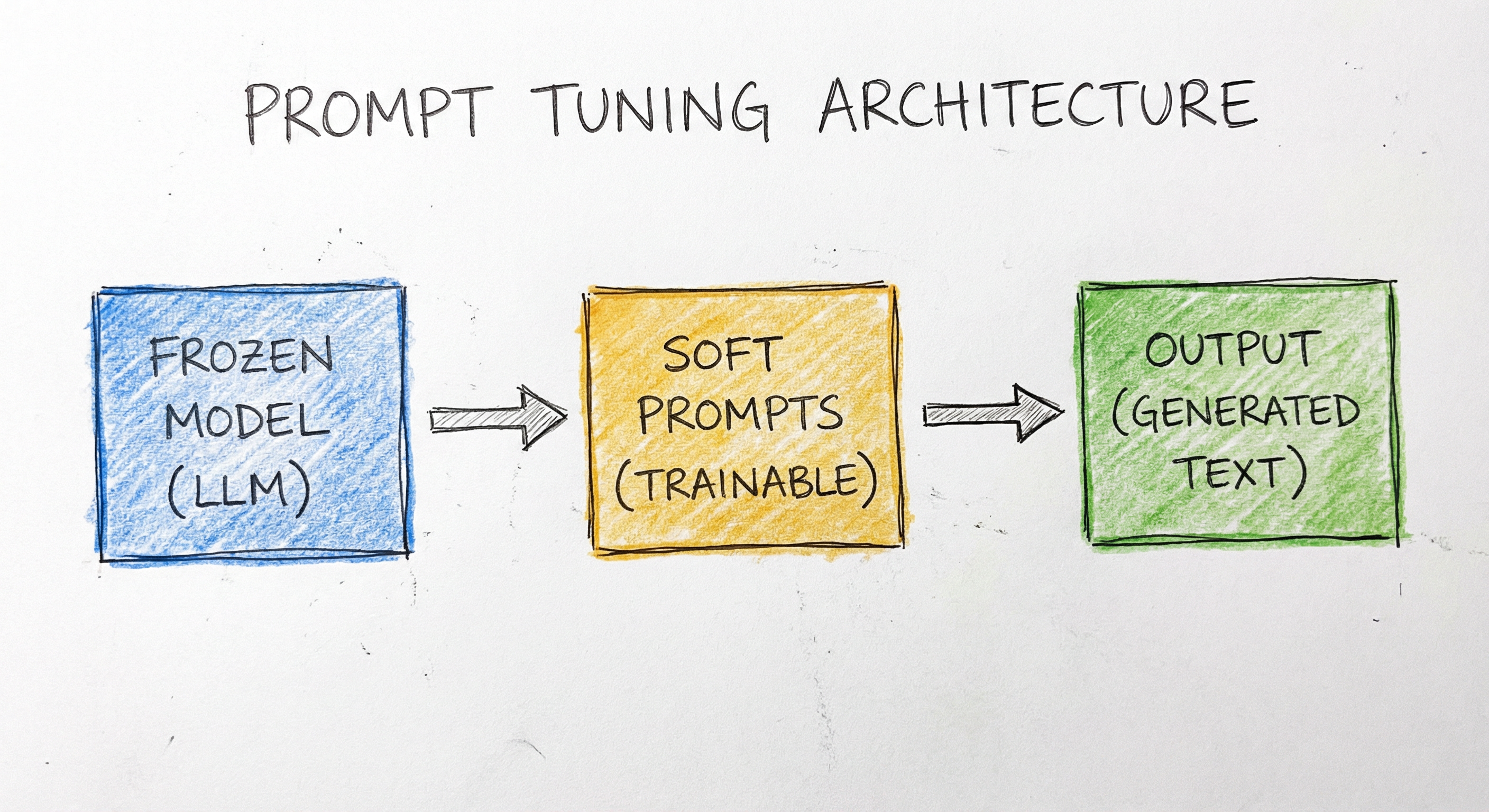
Prompt tuning is one of the most elegant ideas in modern NLP: instead of updating billions of model parameters, you learn a small set of continuous vectors -- called soft prompts -- that are prepended to the input and guide the frozen model toward your task. The model itself never changes.
Introduced by Lester, Al-Rfou, and Constant in their 2021 paper "The Power of Scale for Parameter-Efficient Prompt Tuning," the technique demonstrated a remarkable scaling property: as the base model grows larger, the gap between prompt tuning and full fine-tuning shrinks, until at 10B+ parameters they become essentially equivalent.
This has profound implications for production ML systems. Instead of maintaining separate copies of a multi-billion-parameter model for each task, you maintain one frozen model and swap in tiny soft prompt vectors per task. For a company serving 50 different NLP tasks on a single T5-XXL backbone, this can reduce GPU memory from 50x to approximately 1.01x the base model size.
Prompt tuning sits in the PEFT (Parameter-Efficient Fine-Tuning) family alongside LoRA, prefix tuning, and adapter layers. But it stands out for its simplicity: trainable parameters live only at the input embedding layer, not scattered throughout the model. That architectural constraint makes it uniquely suited for multi-tenant serving and rapid task switching in production.
Concept Snapshot
- What It Is
- A parameter-efficient fine-tuning method that learns continuous soft prompt embeddings prepended to the input, while keeping the entire base model frozen.
- Category
- Model Training
- Complexity
- Intermediate
- Inputs / Outputs
- Inputs: a frozen pretrained language model + task-specific training data. Outputs: a small set of learned soft prompt vectors (typically 1-100 tokens x embedding dimension) that adapt the model to the target task.
- System Placement
- Sits in the model adaptation stage, after pretraining and before deployment. Applied at the input embedding layer of the frozen model.
- Also Known As
- soft prompt tuning, learned prompts, continuous prompt tuning, virtual token tuning
- Typical Users
- ML Engineers, NLP Researchers, Applied Scientists, MLOps Engineers
- Prerequisites
- Transformer architecture, Embedding layers, Transfer learning basics, Gradient-based optimization, Language model pretraining
- Key Terms
- soft prompthard promptprompt lengthinitialization strategyfrozen modelinput embeddingtask-specific adaptationPEFT
Why This Concept Exists
The Problem with Full Fine-Tuning at Scale
Full fine-tuning works beautifully when you have one task and one model. But production ML systems rarely operate that way. Consider a large e-commerce platform like Flipkart that needs sentiment analysis for reviews, intent classification for search queries, product categorization, query rewriting, and a dozen other NLP tasks. Under full fine-tuning, each task requires its own copy of the entire model -- every single parameter, duplicated.
For a 11B-parameter T5-XXL model at FP16, that's approximately 22 GB per task copy. Fifty tasks? That's over a terabyte of GPU memory just for model weights. At cloud GPU prices in India (~INR 100-200/hour for an A100), the cost becomes untenable for all but the largest organizations.
The Insight: Prompts as Soft Interfaces
The idea behind prompt tuning emerged from an observation in the prompt engineering community. Practitioners noticed that discrete (hard) prompts -- carefully crafted text prefixes like "Classify the sentiment of the following review:" -- could dramatically shift model behavior without changing any parameters. But finding the right discrete prompt was brittle, labor-intensive, and often suboptimal.
What if, instead of searching over discrete tokens, we could optimize continuous vectors in the embedding space that serve the same steering function? These learned vectors wouldn't correspond to any real words -- they'd exist in the continuous embedding space where gradient descent can operate freely.
The Scaling Revelation
Lester et al. (2021) showed something remarkable: prompt tuning's effectiveness scales with model size. With a small T5-Small (60M params), prompt tuning significantly underperformed full fine-tuning. But with T5-XXL (11B params), prompt tuning matched full fine-tuning on SuperGLUE -- while training only 0.001% of the parameters.
This isn't just a cost optimization; it's a qualitative shift in how we think about model adaptation. Large models, it turns out, have so much latent capability that a gentle nudge at the input layer is sufficient to unlock task-specific behavior.
Key Takeaway: Prompt tuning exists because full fine-tuning doesn't scale to multi-task production environments, and because large pretrained models contain enough latent capacity that input-layer steering is sufficient for task adaptation.
Core Intuition & Mental Model
The Analogy: Tuning a Radio, Not Rebuilding It
Imagine you have a powerful radio receiver that can pick up every frequency. Full fine-tuning is like rewiring the entire radio for each station. Prompt tuning is like adjusting the dial -- a tiny change at the input that selects the right signal from everything the radio already knows how to receive.
The frozen model is the radio. The soft prompt is the dial position. Each task gets its own dial setting, but the radio hardware stays the same.
Soft Prompts vs. Hard Prompts
A hard prompt is a discrete text string: "Translate English to French:" These are human-readable but constrained to the model's vocabulary. You're searching over a finite, discrete space.
A soft prompt is a sequence of learned continuous vectors, each with the same dimensionality as the model's token embeddings. These vectors don't correspond to any real token -- they're free-form points in embedding space that gradient descent finds to be optimal for your task. Think of hard prompts as choosing from a menu; soft prompts are like having a chef cook exactly what you need.
The critical insight is that the space of useful "instructions" to a model is vastly larger than the space of natural language instructions. By working in continuous embedding space rather than discrete token space, soft prompts can express steering signals that no human-readable prompt could capture.
Why Only the Input Layer?
Unlike prefix tuning, which prepends learned vectors at every transformer layer, prompt tuning only modifies the input. This is both its strength and limitation. The strength: extreme simplicity and minimal interference with the model's internal representations. The limitation: the steering signal must propagate through all layers via the model's own forward pass, which may not be sufficient for smaller models.
Mental Model: Think of prompt tuning as giving the model a very specific pair of glasses before it reads the input. The glasses (soft prompts) change what the model "pays attention to," but the model's brain (parameters) remains unchanged. Larger brains need less prescriptive glasses.
Technical Foundations
Mathematical Formulation
Let denote the frozen parameters of a pretrained language model , and let be the model's token embedding function mapping vocabulary tokens to -dimensional vectors.
Given an input token sequence , the standard embedding produces:
Prompt tuning introduces a learnable soft prompt matrix , where is the prompt length (number of virtual tokens). The concatenated input to the model becomes:
Training Objective
Only is optimized; remains frozen. For a task-specific loss (e.g., cross-entropy for classification), the optimization problem is:
The gradient flows through the entire frozen model but only updates :
where is computed via backpropagation through the frozen model. The frozen parameters participate in the forward and backward pass but receive zero updates.
Parameter Count
The total number of trainable parameters is exactly:
For example, with soft tokens and (T5-Large embedding dimension), the trainable parameter count is 102,400 -- compared to 770M total parameters in T5-Large. That's 0.013% of the model.
Initialization Strategies
The initialization of significantly affects convergence and final performance:
-
Random uniform: where is typically derived from the embedding range. Simplest but often slowest to converge.
-
Sampled vocabulary embeddings: Each is initialized to for some token sampled from the vocabulary. Leverages the model's existing embedding geometry.
-
Class-label initialization: is initialized to the embedding of task-relevant tokens (e.g., "positive," "negative" for sentiment). Lester et al. found this provides the best performance, especially for smaller models.
Practical Note: For models with >10B parameters, the choice of initialization matters less -- the optimization landscape is smooth enough that any reasonable starting point converges to a good solution. For smaller models (< 1B), class-label initialization can make the difference between prompt tuning working and failing entirely.
Internal Architecture
The architecture of a prompt tuning system is deceptively simple -- which is precisely the point. There are three distinct phases: offline training, prompt storage, and online inference. During training, soft prompt vectors are optimized while the base model remains frozen. The trained prompts are stored as lightweight artifacts. At inference time, the appropriate soft prompt is loaded and prepended to the input before passing through the frozen model.
The elegance lies in the separation of concerns: the base model is a shared, immutable resource, and task-specific behavior is entirely captured by the soft prompt vectors. This enables a one-model-many-tasks serving architecture that is fundamentally different from the traditional one-model-per-task approach.
The critical architectural decision is the prompt store -- a lightweight key-value store mapping task IDs to their corresponding soft prompt matrices. At serving time, a task router selects the appropriate prompt, concatenates it with the embedded input, and routes the combined tensor through the shared frozen model. This is what makes prompt tuning ideal for multi-tenant ML platforms.
Key Components
Frozen Base Model
The pretrained language model (e.g., T5, LLaMA, GPT) whose parameters remain completely fixed during prompt tuning. Serves as the shared computational backbone for all tasks. Its embedding layer provides the coordinate system in which soft prompts are defined.
Soft Prompt Matrix
A learnable tensor containing virtual token embeddings, each of dimension . This is the only trainable component. Typical size: 100 tokens x 1024 dims = ~400KB per task at FP32.
Prompt Initializer
Initializes the soft prompt matrix before training. Supports random initialization, vocabulary sampling, or class-label embedding initialization. The choice affects convergence speed and final quality, particularly for smaller base models.
Gradient Router
During backpropagation, ensures gradients flow through the frozen model to update only the soft prompt parameters. In practice, this is handled by setting requires_grad=False on all model parameters and requires_grad=True only on the soft prompt tensor.
Prompt Store
A lightweight storage system (file system, Redis, or object store) that persists trained soft prompt vectors indexed by task ID. Enables rapid prompt swapping at inference time without reloading the base model.
Task Router / Concatenator
At inference time, retrieves the task-specific soft prompt from the store, concatenates it with the embedded user input, and feeds the combined tensor to the frozen model. Handles prompt caching and batching across tasks.
Data Flow
Training Path: Task-specific training data is tokenized and embedded through the frozen model's embedding layer. The soft prompt matrix is prepended to these embeddings. The concatenated tensor passes through the frozen transformer layers. The loss is computed on the output, and gradients propagate back through the entire frozen model but only update . This repeats for each training batch until convergence.
Inference Path: A user request arrives with a task identifier. The task router retrieves the corresponding soft prompt from the prompt store (~400KB load). The user's input is tokenized and embedded. The soft prompt is concatenated with the input embeddings. The combined tensor passes through the frozen model in a standard forward pass. The output is decoded and returned.
Key Property: The frozen model can be loaded once into GPU memory and shared across all tasks. Only the soft prompt changes between tasks, and this swap is nearly instantaneous (microseconds for a 400KB tensor copy).
A flow diagram showing: Task Training Data and Frozen Base Model feed into the Soft Prompt Optimizer, which produces Learned Soft Prompt vectors stored in a Prompt Store. At inference time, User Input is embedded and concatenated with the retrieved soft prompt, then passed through the Frozen Model Forward Pass to produce Task Output.
How to Implement
Implementation Landscape
Prompt tuning is straightforward to implement, which is one of its key advantages. The core idea -- prepend learned vectors to the input embeddings and train only those vectors -- requires minimal custom code when using modern frameworks.
The dominant implementation path in 2025-2026 is through Hugging Face's PEFT library, which provides a unified API for prompt tuning, prefix tuning, LoRA, and other PEFT methods. Under the hood, PEFT modifies the model's forward pass to inject soft prompts and freezes all other parameters.
For teams building custom training loops, the implementation is even simpler: create a nn.Embedding or raw nn.Parameter tensor for the soft prompt, freeze the base model parameters, and ensure only the prompt tensor is passed to the optimizer. The entire custom implementation is often under 50 lines of code.
Cost Context: Training a 100-token soft prompt on T5-Large for a classification task typically takes 2-4 hours on a single A10G GPU (available at ~$1.50/hour on AWS, ~INR 125/hour). This is 10-50x cheaper than full fine-tuning, which requires larger GPUs and longer training times.
from peft import PromptTuningConfig, PromptTuningInit, get_peft_model, TaskType
from transformers import AutoModelForCausalLM, AutoTokenizer, TrainingArguments, Trainer
from datasets import load_dataset

# Load base model (frozen automatically by PEFT)
model_name = "google/flan-t5-large"
model = AutoModelForCausalLM.from_pretrained(model_name)
tokenizer = AutoTokenizer.from_pretrained(model_name)

# Configure prompt tuning
peft_config = PromptTuningConfig(
    task_type=TaskType.CAUSAL_LM,
    prompt_tuning_init=PromptTuningInit.TEXT,        # Initialize from text
    prompt_tuning_init_text="Classify the sentiment of this text:",
    num_virtual_tokens=20,                           # Number of soft prompt tokens
    tokenizer_name_or_path=model_name,
)

# Wrap model with PEFT -- freezes base, adds soft prompt
model = get_peft_model(model, peft_config)
model.print_trainable_parameters()
# Output: trainable params: 20,480 || all params: 783,170,560 || trainable%: 0.0026%

# Standard Hugging Face training
training_args = TrainingArguments(
    output_dir="./prompt-tuning-sentiment",
    learning_rate=3e-2,           # Higher LR works well for prompt tuning
    num_train_epochs=5,
    per_device_train_batch_size=8,
    warmup_steps=100,
    logging_steps=50,
)

dataset = load_dataset("sst2")
trainer = Trainer(
    model=model,
    args=training_args,
    train_dataset=dataset["train"],
)
trainer.train()

# Save only the soft prompt (tiny file!)
model.save_pretrained("./sentiment-prompt")
# Saved file is ~80KB vs ~3GB for the full model
This example uses Hugging Face PEFT to apply prompt tuning to Flan-T5-Large. Key observations: (1) PromptTuningInit.TEXT initializes soft prompts from a human-readable text string, which is converted to embeddings as the starting point. (2) Only 20,480 parameters are trainable (20 tokens x 1024 embedding dim). (3) The learning rate of 3e-2 is much higher than typical fine-tuning rates (~1e-5) because we're optimizing far fewer parameters. (4) The saved prompt file is ~80KB -- you could store thousands of task-specific prompts in the space of one model checkpoint.
import torch
import torch.nn as nn
from transformers import AutoModelForSequenceClassification, AutoTokenizer

class PromptTunedModel(nn.Module):
    def __init__(self, model_name: str, num_soft_tokens: int = 20, num_labels: int = 2):
        super().__init__()
        self.base_model = AutoModelForSequenceClassification.from_pretrained(
            model_name, num_labels=num_labels
        )
        self.tokenizer = AutoTokenizer.from_pretrained(model_name)

        # Freeze all base model parameters
        for param in self.base_model.parameters():
            param.requires_grad = False

        # Get embedding dimension from the model
        embed_dim = self.base_model.config.hidden_size
        self.num_soft_tokens = num_soft_tokens

        # Initialize soft prompt with class-label embeddings
        self.soft_prompt = nn.Parameter(
            torch.randn(num_soft_tokens, embed_dim) * 0.01
        )
        self._init_from_vocab()

    def _init_from_vocab(self):
        """Initialize soft prompts from vocabulary embeddings."""
        embed_weights = self.base_model.get_input_embeddings().weight.data
        # Sample random vocab indices for initialization
        indices = torch.randint(0, embed_weights.shape[0], (self.num_soft_tokens,))
        self.soft_prompt.data = embed_weights[indices].clone()

    def forward(self, input_ids, attention_mask=None, labels=None):
        batch_size = input_ids.shape[0]

        # Get input embeddings from frozen embedding layer
        input_embeds = self.base_model.get_input_embeddings()(input_ids)

        # Expand soft prompt for batch: (p, d) -> (B, p, d)
        soft_prompt_expanded = self.soft_prompt.unsqueeze(0).expand(
            batch_size, -1, -1
        )

        # Concatenate: [soft_prompt | input_embeddings]
        combined_embeds = torch.cat([soft_prompt_expanded, input_embeds], dim=1)

        # Extend attention mask to cover soft prompt tokens
        if attention_mask is not None:
            prompt_mask = torch.ones(
                batch_size, self.num_soft_tokens,
                device=attention_mask.device, dtype=attention_mask.dtype
            )
            attention_mask = torch.cat([prompt_mask, attention_mask], dim=1)

        # Forward pass through frozen model with combined embeddings
        outputs = self.base_model(
            inputs_embeds=combined_embeds,
            attention_mask=attention_mask,
            labels=labels,
        )
        return outputs

# Usage
model = PromptTunedModel("bert-base-uncased", num_soft_tokens=50, num_labels=3)

# Verify only soft prompt is trainable
trainable = sum(p.numel() for p in model.parameters() if p.requires_grad)
total = sum(p.numel() for p in model.parameters())
print(f"Trainable: {trainable:,} / {total:,} ({100*trainable/total:.4f}%)")
# Trainable: 38,400 / 109,521,923 (0.0351%)
This from-scratch implementation shows exactly what prompt tuning does under the hood. The key steps are: (1) freeze all base model parameters, (2) create a learnable nn.Parameter tensor for the soft prompt, (3) initialize it from vocabulary embeddings for better convergence, (4) concatenate the soft prompt with input embeddings at each forward pass, (5) extend the attention mask to cover the prepended soft prompt tokens. This implementation is framework-agnostic and helps you understand what PEFT does internally.
import torch
from pathlib import Path
from typing import Dict
from transformers import AutoModelForCausalLM, AutoTokenizer
from peft import PeftModel, PeftConfig

class MultiTaskPromptServer:
    """Serve multiple tasks from one frozen model with swappable soft prompts."""

    def __init__(self, base_model_name: str, prompt_dir: str, device: str = "cuda"):
        self.device = device
        self.tokenizer = AutoTokenizer.from_pretrained(base_model_name)

        # Load base model ONCE into GPU memory
        self.base_model = AutoModelForCausalLM.from_pretrained(
            base_model_name,
            torch_dtype=torch.float16,
            device_map="auto",
        )

        # Cache soft prompts in memory (they're tiny)
        self.prompt_cache: Dict[str, torch.Tensor] = {}
        self._load_all_prompts(prompt_dir)

        print(f"Loaded {len(self.prompt_cache)} task prompts")
        print(f"Base model memory: {torch.cuda.memory_allocated() / 1e9:.2f} GB")
        total_prompt_bytes = sum(p.nelement() * p.element_size() for p in self.prompt_cache.values())
        print(f"All prompts combined: {total_prompt_bytes / 1e6:.2f} MB")

    def _load_all_prompts(self, prompt_dir: str):
        """Load all task-specific soft prompts from disk."""
        for prompt_path in Path(prompt_dir).glob("*/adapter_model.safetensors"):
            task_name = prompt_path.parent.name
            config = PeftConfig.from_pretrained(str(prompt_path.parent))
            peft_model = PeftModel.from_pretrained(self.base_model, str(prompt_path.parent))

            # Extract just the soft prompt tensor
            for name, param in peft_model.named_parameters():
                if "prompt" in name.lower() and param.requires_grad:
                    self.prompt_cache[task_name] = param.data.clone().to(self.device)
                    break

            # Unload PEFT wrapper to free memory
            del peft_model

    def predict(self, task_name: str, text: str, max_new_tokens: int = 128) -> str:
        """Run inference with task-specific soft prompt."""
        if task_name not in self.prompt_cache:
            raise ValueError(f"Unknown task: {task_name}. Available: {list(self.prompt_cache.keys())}")

        soft_prompt = self.prompt_cache[task_name]  # (p, d) tensor

        inputs = self.tokenizer(text, return_tensors="pt").to(self.device)
        input_embeds = self.base_model.get_input_embeddings()(inputs["input_ids"])

        # Prepend soft prompt
        combined = torch.cat([
            soft_prompt.unsqueeze(0),  # (1, p, d)
            input_embeds,              # (1, n, d)
        ], dim=1)

        # Generate with combined embeddings
        outputs = self.base_model.generate(
            inputs_embeds=combined,
            max_new_tokens=max_new_tokens,
        )
        return self.tokenizer.decode(outputs[0], skip_special_tokens=True)

# Deploy
server = MultiTaskPromptServer(
    base_model_name="google/flan-t5-xl",
    prompt_dir="/models/prompts/",
)

# Same model, different tasks -- just swap the prompt
sentiment = server.predict("sentiment", "This movie was absolutely wonderful!")
summary = server.predict("summarization", "Long article text here...")
ner_result = server.predict("ner", "Sundar Pichai visited IIT Kharagpur last week.")
This production pattern demonstrates the core advantage of prompt tuning: one model, many tasks. The base model is loaded once into GPU memory (~6 GB for T5-XL at FP16). Each task's soft prompt adds ~80KB to memory. Even with 100 tasks loaded simultaneously, the prompt cache totals only ~8MB -- negligible compared to the model. Task switching is a simple tensor swap, not a model reload. This architecture is ideal for multi-tenant SaaS platforms where each customer needs slightly different model behavior.
# PEFT Prompt Tuning Configuration (YAML equivalent)
task_type: CAUSAL_LM
num_virtual_tokens: 20
prompt_tuning_init: TEXT
prompt_tuning_init_text: "Classify the following text:"
tokenizer_name_or_path: google/flan-t5-large

# Training hyperparameters
learning_rate: 0.03
num_train_epochs: 5
per_device_train_batch_size: 8
warmup_ratio: 0.06
weight_decay: 0.01
lr_scheduler_type: linear

# Serving config
serving:
  base_model_device: cuda:0
  prompt_cache_size: 100    # Max concurrent task prompts in memory
  prompt_storage: s3://ml-prompts/production/
  swap_latency_budget_ms: 0.1
Common Implementation Mistakes
- ●
Using standard fine-tuning learning rates: Prompt tuning trains far fewer parameters, so it needs a much higher learning rate (1e-1 to 3e-2) compared to full fine-tuning (1e-5 to 5e-5). Using the lower rate causes the soft prompt to barely move from initialization, resulting in near-random performance.
- ●
Random initialization for small models: For base models under 1B parameters, random initialization often leads to poor convergence. Always use class-label or vocabulary-based initialization for smaller models. This mistake alone can make prompt tuning appear "broken" when it's simply poorly initialized.
- ●
Setting prompt length too short or too long: Too few soft tokens (< 5) provide insufficient steering capacity. Too many (> 150) waste compute without improving quality and can actually hurt performance by drowning out the actual input. The sweet spot for most tasks is 20-100 tokens.
- ●
Forgetting to extend the attention mask: When concatenating soft prompts with input embeddings, the attention mask must also be extended to cover the soft prompt positions. Missing this causes the model to ignore the soft prompt entirely -- a silent bug that produces baseline-level performance.
- ●
Applying prompt tuning to tasks requiring structural model changes: Prompt tuning modifies only the input representation. For tasks that fundamentally change the model architecture (e.g., adding new output heads for token classification), you need adapter layers or LoRA, not prompt tuning.
- ●
Not accounting for reduced effective context length: The soft prompt tokens consume positions in the model's context window. With 100 soft tokens and a 512-token context limit, your effective input length drops to 412 tokens. For long-document tasks, this can silently truncate important content.
When Should You Use This?
Use When
You need to serve many tasks from a single large model (multi-task or multi-tenant serving) and want to minimize GPU memory usage
The base model is large enough (10B+ parameters) that prompt tuning matches full fine-tuning quality -- this is the key prerequisite
You need rapid task switching at inference time without reloading model weights
Training compute budget is limited -- prompt tuning trains 1000x fewer parameters than full fine-tuning, reducing GPU hours proportionally
You want to keep the base model frozen and versioned to simplify model governance, rollback, and auditing in regulated environments
Your tasks are classification, NLI, or generation tasks where input-level steering is sufficient
You're building a platform or SaaS product where each customer needs slightly customized model behavior
Avoid When
The base model is small (< 1B parameters) -- prompt tuning significantly underperforms full fine-tuning at this scale
The task requires structural changes to the model (new output heads, different architectures, token-level predictions with custom CRF layers)
You need the highest possible task performance and have the compute budget for full fine-tuning -- prompt tuning is near but rarely exceeds full fine-tuning quality
Your task involves very long inputs where the soft prompt tokens unacceptably reduce the effective context window
The task is extremely dissimilar from the base model's pretraining distribution (e.g., adapting an English-only model to a low-resource language with a different script)
You need to adapt intermediate model representations rather than just the input layer -- prefix tuning or LoRA may be better suited
Key Tradeoffs
Efficiency vs. Expressiveness
Prompt tuning is the most parameter-efficient PEFT method (fewer trainable parameters than LoRA, prefix tuning, or adapters), but this comes at the cost of expressiveness. Because modifications are limited to the input embedding layer, the steering signal must propagate through the entire model, which limits the complexity of adaptations the technique can express.
| Method | Trainable Params (T5-Large) | Where | Expressiveness |
|---|---|---|---|
| Prompt Tuning | ~20K (0.003%) | Input only | Low-Medium |
| Prefix Tuning | ~200K (0.03%) | Every layer | Medium |
| LoRA (r=8) | ~800K (0.1%) | Attention matrices | High |
| Adapter Layers | ~3.6M (0.5%) | Between layers | High |
| Full Fine-tuning | ~770M (100%) | Everywhere | Maximum |
Scale Dependency
The most important tradeoff is the scale dependency: prompt tuning's effectiveness is tightly coupled to base model size. At 10B+ parameters, it's a clear winner on the efficiency-quality Pareto frontier. At 100M parameters, it's barely viable. This means your choice must factor in which base model you're using.
Serving Simplicity vs. Training Flexibility
Prompt tuning offers the simplest serving architecture of any PEFT method -- literally just a tensor concatenation. But it provides the least training flexibility. If your task requires more nuanced model adaptation, you may need to trade serving simplicity for training expressiveness by moving to LoRA or prefix tuning.
Decision Rule: If you have a 10B+ model and need multi-task serving, start with prompt tuning. If quality is insufficient, upgrade to prefix tuning, then LoRA. Don't jump to full fine-tuning until you've exhausted the PEFT options.
Alternatives & Comparisons
Prefix tuning (Li & Liang, 2021) prepends learned continuous vectors at every transformer layer, not just the input. This provides more expressive control over the model's internal representations, typically yielding better results on smaller models. However, it introduces ~10x more trainable parameters than prompt tuning and makes serving slightly more complex (you need to inject prefixes at each layer). Choose prefix tuning when prompt tuning underperforms on your base model size.
LoRA adds low-rank trainable matrices to the attention layers, modifying the model's internal computations rather than just the input. It's more expressive than prompt tuning (50-100x more trainable parameters) and works well across all model sizes. Choose LoRA when you need higher task quality than prompt tuning provides, or when your base model is under 10B parameters. The tradeoff: LoRA adapters are larger (~10-50MB vs ~80KB for soft prompts) and slightly more complex to serve.
Adapter layers (Houlsby et al., 2019) insert small trainable modules between transformer layers. They offer high expressiveness (~0.5-5% of model parameters) and can be modularly composed. Choose adapters when you need task performance close to full fine-tuning and your serving infrastructure can handle the per-layer insertion. They're heavier than prompt tuning but lighter than full fine-tuning.
Full fine-tuning updates all model parameters, providing maximum task adaptation. Choose it when you need the absolute best performance and can afford the compute and storage costs. For a single task, full fine-tuning is hard to beat. For multi-task serving, it's economically infeasible -- you'd need a separate model copy per task.
IA3 (Infused Adapter by Inhibiting and Amplifying Inner Activations) learns rescaling vectors for key, value, and feedforward activations. It has even fewer trainable parameters than prompt tuning in some configurations and can outperform it on certain tasks. Choose IA3 when you want extreme parameter efficiency with per-layer control. It's less studied than prompt tuning and has fewer production deployments.
Pros, Cons & Tradeoffs
Advantages
Extreme parameter efficiency: Trainable parameters are typically 0.001-0.01% of the base model. A 100-token soft prompt for T5-XXL is ~400KB -- you could store 25,000 task prompts in 10GB, the size of one model checkpoint.
Simplest serving architecture: Task switching is a tensor concatenation, not a model reload. Latency overhead for prompt swapping is measured in microseconds. This enables true multi-tenant serving from a single GPU.
Frozen model integrity: The base model is never modified, simplifying model governance, versioning, and rollback. Regulatory compliance teams love this -- you can prove exactly what model is running and that it hasn't been altered.
Compositional potential: Soft prompts from different tasks can potentially be combined or interpolated, enabling interesting multi-task and transfer learning research directions.
Scales with model size: As base models get larger, prompt tuning gets relatively better. This means the technique becomes more valuable over time as the field moves toward larger foundation models.
Minimal infrastructure requirements: Training requires the same hardware as inference (no need for larger GPUs for gradient accumulation of full-model gradients). A single A10G (~$1.50/hr, ~INR 125/hr) is often sufficient.
Disadvantages
Poor performance on small models: Below 1B parameters, prompt tuning consistently underperforms full fine-tuning and even LoRA. If your base model is BERT-base (110M) or GPT-2 Small (117M), prompt tuning is likely not viable.
Limited expressiveness: Modifications are confined to the input layer. Tasks requiring changes to intermediate representations (e.g., complex structural predictions, multi-hop reasoning) may not be well-served by input-level steering alone.
Reduced effective context length: Soft prompt tokens consume positions in the model's context window. For context-limited models or long-document tasks, this is a real constraint that can degrade performance.
Initialization sensitivity for smaller models: On sub-10B models, the choice of initialization strategy significantly affects final performance. Poor initialization can make the difference between the method working and failing entirely.
Less studied than LoRA in production: While prompt tuning has strong theoretical foundations, LoRA has seen broader production adoption and has more community resources, tutorials, and debugging guides.
Interpretability challenges: Soft prompt vectors don't correspond to human-readable tokens, making it difficult to understand what the model has learned. Debugging a poorly performing soft prompt is harder than debugging a LoRA adapter.
Failure Modes & Debugging
Convergence failure on small base models
Cause
The base model is too small (< 1B parameters) for input-level steering to be sufficient. The optimization landscape is too rugged, and the soft prompt cannot compensate for the model's limited latent capacity.
Symptoms
Training loss plateaus well above the full fine-tuning baseline. Validation metrics stagnate or oscillate. The gap between prompt tuning and full fine-tuning performance remains large (> 5 points) even after extensive hyperparameter search.
Mitigation
Switch to a larger base model (10B+ is ideal), or use a more expressive PEFT method like LoRA or prefix tuning. If stuck with a small model, try class-label initialization and longer prompt lengths (50-100 tokens), which partially compensate for reduced model capacity.
Silent attention mask mismatch
Cause
The attention mask is not extended to cover the prepended soft prompt tokens. The model's self-attention mechanism treats soft prompt positions as padding and ignores them entirely.
Symptoms
Model produces outputs identical to the un-prompted baseline. Training loss does not decrease. The soft prompt has no effect despite being correctly concatenated with input embeddings.
Mitigation
Always extend the attention mask by prepending ones (attention = 1) for each soft prompt position. In custom implementations, add explicit shape assertions: assert attention_mask.shape[1] == input_embeds.shape[1] after concatenation.
Learning rate miscalibration
Cause
Using a learning rate appropriate for full fine-tuning (1e-5 to 5e-5) instead of the higher rates needed for prompt tuning (1e-1 to 3e-2). The few trainable parameters receive updates that are too small to meaningfully change from initialization.
Symptoms
Training loss decreases extremely slowly. After many epochs, the soft prompt vectors have barely moved from their initial values (verifiable by computing L2 distance from initialization). Final performance is barely above the zero-shot baseline.
Mitigation
Use learning rates in the range 1e-1 to 3e-2 for prompt tuning. Start with 3e-2 and tune from there. Use a linear or cosine learning rate schedule with warmup. Monitor the L2 norm of soft prompt updates to ensure meaningful optimization is occurring.
Context window exhaustion
Cause
The soft prompt tokens consume a significant fraction of the model's context window, leaving insufficient room for the actual input. This is particularly problematic for models with short context windows (512 or 1024 tokens).
Symptoms
Input truncation causes the model to miss critical information in long inputs. Performance on long-document tasks degrades compared to the zero-shot baseline without soft prompts. Shorter inputs work fine, but quality drops as input length increases.
Mitigation
Keep prompt length minimal (10-20 tokens) for context-limited models. Use models with larger context windows (2048+). For long-document tasks, consider LoRA or adapter layers instead, which don't consume context positions.
Prompt-task distribution mismatch
Cause
The soft prompt was trained on data from one distribution but is applied at inference time to a substantially different distribution. Unlike full fine-tuning, which deeply adapts the model's representations, prompt tuning provides only surface-level steering that is less robust to distribution shift.
Symptoms
High training/validation performance but poor production performance. Quality degrades on edge cases or out-of-distribution inputs that were not represented in the training data. The model reverts to generic (zero-shot) behavior on unfamiliar inputs.
Mitigation
Ensure training data is representative of the production distribution. Implement monitoring to detect distribution shift. Consider prompt ensembling (averaging soft prompts trained on different data subsets) for more robust steering. Retrain prompts more frequently than you would retrain full models.
Embedding space drift after base model update
Cause
The base model is updated (e.g., new checkpoint, continued pretraining) but existing soft prompts are not retrained. Soft prompts are defined in the embedding space of the original model, which may shift with model updates.
Symptoms
Tasks that previously worked well suddenly degrade after a base model update. The soft prompt vectors are now pointing to semantically different regions of the new embedding space.
Mitigation
Treat soft prompts as coupled to a specific base model version. Version-tag all soft prompts with the base model checkpoint they were trained on. When updating the base model, retrain all soft prompts -- this is fast since each prompt trains in minutes to hours.
Placement in an ML System
Where Prompt Tuning Fits
Prompt tuning occupies a specific niche in the ML system lifecycle: it sits after pretraining (or continued pretraining) and before deployment, in the model adaptation stage. Its unique property is that the adaptation artifact (the soft prompt) is separate from and much smaller than the model itself.
In a typical production architecture, the flow is: (1) a base model is pretrained or obtained from a model hub, (2) prompt tuning creates task-specific soft prompts for each downstream task, (3) the base model and soft prompts are deployed separately -- the model goes to GPU memory, the prompts go to a lightweight key-value store, and (4) at inference time, a task router selects the appropriate prompt and routes requests.
This separation is architecturally significant because it decouples model infrastructure from task management. The ML infrastructure team owns the base model deployment (GPU provisioning, scaling, health monitoring), while application teams own their task-specific prompts (training, evaluation, versioning). This organizational boundary aligns well with how large engineering teams operate -- especially in companies like Google, where the Prompt Tuning paper originated.
Production Insight: For Indian startups and scale-ups running on tight GPU budgets, prompt tuning enables serving multiple customer-specific NLP models from a single GPU instance (e.g., one A100 at ~INR 200/hr), dramatically reducing per-customer cost.
Pipeline Stage
Model Adaptation / Training
Upstream
- Base Model (pretrained)
- Training Data Pipeline
- Continued Pretraining
Downstream
- Model Serving Endpoint
- Model Registry
- A/B Testing Framework
Scaling Bottlenecks
Prompt tuning is one of the least bottleneck-prone methods in the PEFT family, but constraints exist:
Training: The primary bottleneck is the forward and backward pass through the frozen model, which scales with model size just like full fine-tuning. However, since only the soft prompt receives gradient updates, optimizer state memory is negligible (no Adam states for billions of parameters). Training typically requires 1 GPU even for 10B+ models.
Serving: The bottleneck is the base model's inference throughput, not the prompt swapping. For a T5-XXL serving 50 tasks, the model forward pass takes ~50ms per request; the prompt swap takes <0.1ms. The limiting factor is GPU compute for the shared model, not task-switching overhead.
Storage: Extremely scalable. At ~400KB per task prompt, storing 10,000 tasks requires only 4GB. Even S3 or Azure Blob Storage costs are negligible ($0.02/month for 4GB, ~INR 1.7/month).
Concurrent Tasks: The main scaling concern is batching requests across different tasks. Requests for the same task can be batched normally, but cross-task batching requires either padding to the longest prompt or separate forward passes per task in a batch.
Production Case Studies
Google Research introduced prompt tuning and validated it at scale on their T5 model family. They demonstrated that with T5-XXL (11B parameters), prompt tuning matches full fine-tuning performance on the SuperGLUE benchmark while training only 0.001% of the parameters. This became the foundation for multi-task model serving within Google's NLP infrastructure.
Prompt tuning matched full fine-tuning on SuperGLUE (90.4 vs 90.4) with T5-XXL, while reducing per-task storage from 42GB to ~20KB. This enabled Google to serve hundreds of NLP tasks from shared model infrastructure.
The BigScience collaborative applied prompt tuning and related PEFT methods to the BLOOM 176B model as part of the BLOOM+1 initiative. They demonstrated that prompt tuning enables community members to adapt the massive open-source model to new tasks and languages without the prohibitive cost of full fine-tuning. This made task-specific adaptation accessible to researchers in resource-constrained settings, including many institutions in India and the Global South.
Enabled task adaptation of a 176B-parameter model on consumer-grade hardware (single A100). Demonstrated cross-lingual prompt transfer -- soft prompts trained on English data transferred to Hindi and other Indic languages with minimal performance loss.
Microsoft integrated prompt tuning as one of the PEFT options in their Azure OpenAI Service for enterprise customers. This allows enterprises to create task-specific adaptations of GPT models without full fine-tuning, reducing both cost and compliance complexity. Each customer's soft prompt is isolated and can be independently versioned and rolled back.
Enterprise customers reported 10-50x reduction in adaptation costs compared to full fine-tuning, with comparable task performance on classification and extraction tasks. Prompt isolation simplified compliance with data governance requirements.
Samsung Research applied prompt tuning for on-device NLP tasks on mobile processors. By keeping the base model frozen and loading task-specific soft prompts on demand, they achieved multi-task NLP on resource-constrained mobile hardware. The tiny size of soft prompts (< 100KB) made over-the-air updates for new tasks practical without downloading new model weights.
Enabled 12 distinct NLP tasks on a single on-device model with <500KB total prompt storage. Task switching latency was <1ms, compared to ~30 seconds for full model swaps. Battery consumption reduced by ~40% compared to running multiple task-specific models.
Tooling & Ecosystem
The de facto standard library for parameter-efficient fine-tuning. Provides PromptTuningConfig with support for random, text-based, and vocabulary-based initialization. Integrates seamlessly with Hugging Face Transformers and the Trainer API. Supports saving/loading just the soft prompt parameters.
A comprehensive prompt-learning framework from Tsinghua University. Supports both hard and soft prompt tuning, verbalizer design, and prompt ensembling. Particularly useful for research and experimentation with different prompt tuning variants.
A unified framework for adapter-based and prompt-based tuning of large language models. Provides benchmarks comparing prompt tuning with LoRA, prefix tuning, and adapter layers across multiple tasks and model sizes.
NVIDIA's toolkit for building conversational AI. Includes production-grade prompt tuning support with multi-GPU training, mixed precision, and integration with NVIDIA's Triton Inference Server for serving prompt-tuned models at scale.
Google Cloud's managed prompt tuning service for PaLM and Gemini models. Provides a no-code interface for training soft prompts and deploying them as API endpoints. Pricing starts at ~$0.50 per training hour (~INR 42/hr).
Research & References
Lester, Al-Rfou, Constant (2021)EMNLP 2021
The foundational prompt tuning paper. Demonstrated that learned soft prompts match full fine-tuning at 10B+ model scale while training only 0.01% of parameters. Established prompt length, initialization strategy, and model scale as key variables.
Li, Liang (2021)ACL 2021
Introduced prefix tuning, which prepends learned vectors at every transformer layer (not just the input). Showed superior performance to prompt tuning on smaller models for generation tasks. Key comparison point for understanding prompt tuning's limitations.
Liu, Ji, Fu, Du, Yang, Tang (2022)ACL 2022
Extended prefix tuning with deep prompt tuning across all layers, demonstrating that properly configured prompt-based methods can match fine-tuning across model scales (330M-10B) and diverse NLU tasks. Challenged the assumption that prompt tuning requires very large models.
Liu, Zheng, Du, Ding, Qian, Yang, Tang (2023)Nature Machine Intelligence
Introduced P-Tuning (v1), which uses a trainable LSTM to generate continuous prompt embeddings rather than directly optimizing embedding vectors. Showed that learned prompts can outperform manual discrete prompts on knowledge probing and classification tasks.
Vu, Lester, Constant, Al-Rfou, Cer (2022)ACL 2022
Demonstrated that soft prompts trained on one task can be transferred to initialize soft prompts for related tasks, improving convergence and final performance. Established that soft prompts capture transferable task knowledge, analogous to transfer learning with full models.
Chung, Hou, Longpre, Zoph, Tay, Fedus, Li, Wang, Dehghani, Brahma, et al. (2022)JMLR 2024
Introduced Flan-T5 and Flan-PaLM, showing that instruction-tuned base models significantly improve the effectiveness of downstream prompt tuning. Established that the choice of base model matters as much as the prompt tuning technique itself.
Hu, Shen, Wallis, Allen-Zhu, Li, Wang, Wang, Chen (2022)ICLR 2022
Introduced LoRA as an alternative PEFT method. Key comparison: LoRA modifies attention weight matrices (more expressive) while prompt tuning modifies input embeddings (more parameter-efficient). Essential reading for understanding the PEFT landscape.
Interview & Evaluation Perspective
Common Interview Questions
- ●
What is prompt tuning, and how does it differ from prompt engineering?
- ●
Why does prompt tuning work better with larger models? Explain the scaling behavior.
- ●
Compare prompt tuning with prefix tuning and LoRA. When would you choose each?
- ●
How would you design a multi-task serving system using prompt tuning?
- ●
What are the initialization strategies for soft prompts, and why do they matter?
- ●
How does prompt tuning handle the tradeoff between parameter efficiency and task performance?
Key Points to Mention
- ●
Prompt tuning trains only the input embeddings (~0.001% of parameters) while keeping the model frozen. This is fundamentally different from prompt engineering (manual text) and from fine-tuning (updating model weights).
- ●
The scaling law is critical: prompt tuning approaches full fine-tuning performance as model size increases beyond 10B parameters (Lester et al., 2021). This is because larger models have richer internal representations that can be steered with minimal input-level guidance.
- ●
Multi-task serving is the killer use case: one frozen model + N tiny soft prompts (each ~80KB) replaces N full model copies. Task switching is a microsecond-level tensor swap, not a multi-second model reload.
- ●
Initialization matters for smaller models: class-label initialization outperforms random initialization by 5-15 points on sub-1B models. For 10B+ models, initialization barely matters.
- ●
Soft prompts don't correspond to interpretable tokens -- they're continuous vectors in embedding space that gradient descent finds useful for the task. This makes debugging harder but optimization easier than discrete prompt search.
Pitfalls to Avoid
- ●
Conflating prompt tuning (learned continuous vectors) with prompt engineering (manually crafted text). They're fundamentally different optimization paradigms.
- ●
Claiming prompt tuning always matches full fine-tuning -- it only does so at sufficient model scale (10B+). At smaller scales, there's a clear performance gap.
- ●
Forgetting that soft prompts reduce effective context length. With a 100-token prompt and 512-token context, you've lost 20% of your input capacity.
- ●
Overlooking the serving advantages: interviewers often test whether you can think beyond training efficiency to deployment architecture. The one-model-many-tasks serving pattern is the strongest argument for prompt tuning.
Senior-Level Expectation
A senior/staff candidate should discuss prompt tuning within the broader PEFT taxonomy, articulating precise tradeoffs between prompt tuning, prefix tuning, LoRA, and adapter layers along the axes of parameter count, expressiveness, and serving complexity. They should be able to sketch the multi-task serving architecture (frozen model + prompt store + task router) and discuss operational concerns: prompt versioning, A/B testing between prompts, rollback procedures, and monitoring for prompt degradation. They should reference the scaling law from Lester et al. and connect it to the information-theoretic argument that larger models have more latent capacity. Advanced candidates might discuss prompt transferability (SPoT), prompt ensembling, and the relationship between prompt tuning and in-context learning (both steer model behavior through input manipulation, but prompt tuning does so in continuous space with learned representations). Cost analysis in context of Indian/emerging-market deployments would demonstrate practical depth.
Summary
Prompt tuning is a parameter-efficient fine-tuning method that learns a small set of continuous vectors -- soft prompts -- prepended to the input of a frozen language model. Introduced by Lester et al. (2021), it demonstrated a remarkable property: as model size increases beyond 10B parameters, prompt tuning's performance converges to that of full fine-tuning, while training only ~0.001% of the parameters. The soft prompt matrix is the sole trainable artifact, typically comprising 20-100 virtual tokens that steer the frozen model's behavior toward a target task.
The technique's primary production value lies in its one-model-many-tasks serving architecture. Instead of maintaining separate model copies for each downstream task (each consuming 10-40 GB of GPU memory), prompt tuning enables a single frozen model to serve hundreds of tasks by swapping tiny soft prompt vectors (~80KB each) at inference time. Task switching is a microsecond-level tensor concatenation, not a multi-second model reload. This makes prompt tuning uniquely suited for multi-tenant ML platforms, SaaS applications, and resource-constrained deployments -- particularly relevant for organizations in India and emerging markets where GPU costs are a primary constraint.
Compared to other PEFT methods, prompt tuning occupies the extreme efficiency end of the spectrum: fewer trainable parameters than LoRA, prefix tuning, or adapter layers, but with correspondingly limited expressiveness. Its effectiveness is tightly coupled to base model scale -- it excels with 10B+ parameter models but struggles with sub-1B models. The key takeaway for system design is that prompt tuning is not just a training optimization; it's an architectural pattern that fundamentally changes how you think about model serving, task management, and infrastructure cost. When your design calls for multi-task adaptation of a large frozen model, prompt tuning is the method that most cleanly separates the concerns of model infrastructure and task-specific behavior.