Feature Extraction in Machine Learning
Feature extraction is the process of transforming raw data -- text, images, audio, tabular records -- into numerical representations that machine learning models can actually consume. It is, without exaggeration, the single most impactful step in most ML pipelines. The quality of your features puts a hard ceiling on the quality of your model.
Why does this matter so much? Because raw data is messy, high-dimensional, and full of noise. A 1080p image has over 2 million pixel values. A document might contain thousands of unique words. An audio clip is a stream of amplitude samples at 16,000+ per second. No model can work with this raw signal efficiently -- you need to distill it into a compact, informative representation.
Feature extraction sits at the intersection of domain knowledge and mathematical transformation. Classical methods like TF-IDF, PCA, and MFCC encode decades of domain expertise into explicit formulas. Modern methods like CNN feature extractors, BERT embeddings, and autoencoders learn representations directly from data. The best production systems often combine both.
From Flipkart's visual product search extracting CNN features from catalog images, to Razorpay's fraud detection pipeline engineering hundreds of transaction features in real-time, to IRCTC processing millions of booking queries with text features -- feature extraction is the workhorse behind every ML system you interact with daily in India and globally.
Concept Snapshot
- What It Is
- The process of transforming raw input data (text, images, audio, tabular records) into numerical feature vectors that capture the essential information needed for downstream ML tasks.
- Category
- Feature Engineering
- Complexity
- Intermediate
- Inputs / Outputs
- Inputs: raw data (text strings, pixel arrays, audio waveforms, tabular rows). Outputs: fixed-dimensional numerical feature vectors (dense or sparse).
- System Placement
- Sits after data preprocessing/cleaning and before model training or feature selection in the ML pipeline.
- Also Known As
- feature engineering, representation learning, feature computation, signal processing, feature generation, feature transformation
- Typical Users
- ML Engineers, Data Scientists, NLP Engineers, Computer Vision Engineers, Audio/Speech Engineers, Applied Researchers
- Prerequisites
- Linear algebra (vectors, matrices, eigenvalues), Basic statistics (mean, variance, distributions), Data preprocessing fundamentals, Domain knowledge for the data modality (text, image, audio, tabular)
- Key Terms
- TF-IDFbag of wordsPCAautoencoderembeddingsMFCCtransfer learningCNN featuresfeature vectordimensionality reductionsparse vs dense features
Why This Concept Exists
Raw Data Is Not Model-Ready
Here is the fundamental problem: ML models operate on numbers -- specifically, fixed-length vectors of floating-point values. But the world does not hand you fixed-length vectors. It hands you variable-length text documents, images of different resolutions, audio clips of different durations, and tabular records with mixed types (categorical, numerical, datetime, free-text). The gap between raw data and model-ready input is precisely what feature extraction bridges.
Let us put a number on this. A single 224x224 RGB image has 150,528 raw pixel values. Feeding these directly into a logistic regression classifier is theoretically possible but practically terrible -- you would need enormous amounts of training data to learn anything useful from raw pixels, and the model would be painfully slow. Extract 2,048 features from a pre-trained ResNet instead, and suddenly you have a compact, semantically meaningful representation that a simple classifier can work with beautifully.
The Evolution: From Handcrafted to Learned Features
Feature extraction has undergone a dramatic evolution over the past three decades:
Era 1 (1990s-2000s): Handcrafted features. Domain experts designed features based on deep knowledge of the data modality. Computer vision researchers invented SIFT, HOG, and SURF for images. NLP researchers developed TF-IDF, n-grams, and part-of-speech tags. Audio researchers created MFCCs, spectral centroids, and chroma features. These methods are interpretable, fast, and still widely used today.
Era 2 (2006-2014): Shallow learned features. Techniques like PCA, autoencoders, and word embeddings (Word2Vec, GloVe) offered a middle ground -- learning low-dimensional representations from data without requiring task-specific labels. These methods automated part of the feature design process while remaining relatively lightweight.
Era 3 (2014-present): Deep learned features. Transfer learning from deep neural networks -- using the intermediate activations of a pre-trained CNN, BERT, or wav2vec as features -- has become the dominant paradigm. A ResNet trained on ImageNet, fine-tuned or used as a frozen feature extractor, routinely outperforms years of hand-engineered features.
Why Handcrafted Features Still Matter
Despite the rise of deep learning, handcrafted features are far from obsolete. In many production settings -- especially in Indian startups operating under tight compute budgets -- classical features remain the pragmatic choice. TF-IDF with a gradient-boosted tree can outperform a fine-tuned BERT model when you have limited labeled data and no GPU budget. MFCCs are still the backbone of many speech recognition preprocessing pipelines. And for tabular data, thoughtful feature engineering (ratios, rolling aggregates, time-since-event) consistently outperforms throwing raw columns at a neural network.
Key Takeaway: Feature extraction exists because raw data and ML models speak different languages. Feature extraction is the translator. Whether you handcraft features or learn them, the goal is the same: compress raw signal into a compact, informative representation that makes downstream learning easier and faster.
Core Intuition & Mental Model
The Core Promise
Think of feature extraction as compression with a purpose. You are not just making data smaller -- you are making it more useful for a specific task. A good feature extractor discards noise (irrelevant variation) while preserving signal (information that helps predict the target).
Here is an analogy. Imagine you are describing a house to a friend who wants to buy one. You would not read out the RGB values of every pixel in a photo of the house. Instead, you would extract the features that matter: number of bedrooms, square footage, neighborhood, proximity to a metro station, age of the building. That is feature extraction -- selecting and computing the attributes that are predictive of the outcome (house price, in this case).
Two Fundamental Flavors
All feature extraction methods fall into two camps:
Handcrafted (explicit) features: You define the transformation function based on domain knowledge. TF-IDF says "count word frequencies, weight by rarity." MFCC says "apply a mel-scale filterbank to the power spectrum." PCA says "project onto the directions of maximum variance." These are interpretable, fast, and require no training data.
Learned (implicit) features: You let a model discover the transformation from data. An autoencoder learns a compressed representation by reconstructing its input. A CNN learns edge detectors, texture recognizers, and part detectors through backpropagation. BERT learns contextual word representations from massive text corpora. These are powerful but require compute, data, and careful tuning.
The Information Bottleneck View
The deepest way to understand feature extraction is through the information bottleneck lens. You want a representation of your input that:
- Preserves information about the target (high mutual information )
- Discards information about irrelevant variation (low mutual information given )
This tradeoff is the essence of every feature extraction method, whether explicit or learned. TF-IDF preserves word importance while discarding word order. PCA preserves variance while discarding low-variance directions. A CNN preserves spatial hierarchies while discarding pixel-level noise.
Expert Note: When someone says "my model is not learning," the first question to ask is not about the model architecture or the optimizer -- it is about the features. Bad features make good models fail. Good features make simple models succeed. This is the oldest lesson in ML, and it is still the most important one.
Technical Foundations
Mathematical Framework
Let us formalize feature extraction. Given a raw input space (e.g., variable-length text, images of different sizes, audio waveforms), a feature extractor is a function:
that maps each input to a fixed-dimensional vector , where is the feature dimensionality.
Key Classical Methods
TF-IDF (Term Frequency-Inverse Document Frequency):
For a term in document within a corpus :
where is the frequency of term in document , and the logarithmic factor is the inverse document frequency that downweights common terms. The output is a sparse vector of dimensionality (vocabulary size).
PCA (Principal Component Analysis):
Given a centered data matrix , PCA finds the projection matrix () by solving:
where is the covariance matrix. The columns of are the top eigenvectors of , and the extracted features are .
The proportion of variance retained is:
where are the eigenvalues in descending order.
MFCC (Mel-Frequency Cepstral Coefficients):
The extraction pipeline is:
- Apply short-time Fourier transform (STFT):
- Map to mel scale:
- Apply mel filterbank and take log:
- Apply DCT:
Typically 13-40 MFCCs are extracted per frame, yielding a feature matrix of shape .
Autoencoder Feature Extraction:
An autoencoder learns an encoder and decoder by minimizing reconstruction loss:
The bottleneck activations serve as the extracted features. When and the encoder/decoder are linear, this recovers PCA. Nonlinear autoencoders can capture more complex structure.
Complexity Considerations
| Method | Time Complexity | Space Complexity | Output |
|---|---|---|---|
| Bag of Words | $O(n \cdot | V | |
| TF-IDF | $O(n \cdot | V | |
| PCA | Dense | ||
| MFCC | Dense | ||
| Autoencoder | Dense | ||
| CNN (frozen) | Dense |
where = samples, = average document length, = vocabulary size, = input dimensionality, = output dimensionality, = time frames, = FFT size, = training epochs, = CNN forward pass FLOPs.
Internal Architecture
A production feature extraction system is more than just calling sklearn.feature_extraction. It is a pipeline with multiple stages: data ingestion, modality-specific preprocessing, feature computation (potentially using multiple extractors in parallel), feature validation, and output to a feature store or training pipeline. Here is the typical architecture.
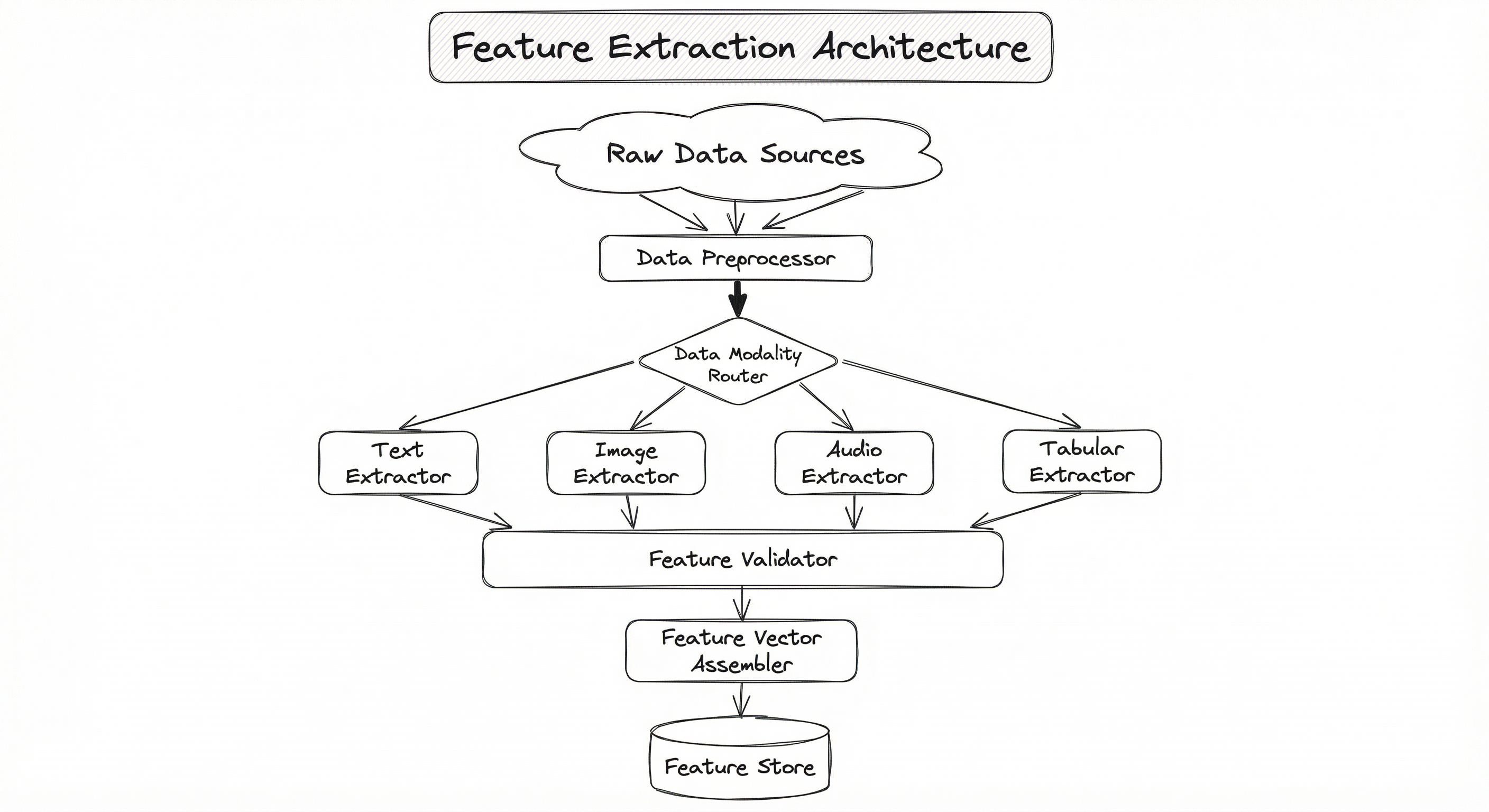
The modality router is a critical design decision. In multimodal systems -- think a food delivery app like Swiggy that processes restaurant images, menu text, and user review audio -- you need parallel extraction pipelines that produce compatible output dimensions for downstream fusion. The feature vector assembler concatenates, stacks, or projects these modality-specific features into a unified representation.
Key Components
Data Preprocessor
Handles modality-specific preprocessing before feature extraction: tokenization and lowercasing for text, resizing and normalization for images, resampling and windowing for audio, type casting and null handling for tabular data. This stage ensures all inputs conform to the expected format for their respective extractors.
Modality Router
Routes each data sample to the appropriate feature extractor based on its type. In multimodal systems, a single sample may be routed to multiple extractors simultaneously (e.g., a product listing has both image and text).
Text Feature Extractor
Converts text into numerical features. Classical options include Bag of Words, TF-IDF, and n-gram representations. Modern options include Word2Vec, GloVe, FastText (static embeddings), and BERT, Sentence-BERT (contextual embeddings). The choice depends on compute budget, corpus size, and task requirements.
Image Feature Extractor
Converts images into feature vectors. Classical options include SIFT, HOG, and color histograms. Modern options use transfer learning from pre-trained CNNs (ResNet, EfficientNet) or Vision Transformers (ViT, DINOv2). The penultimate layer activations of a frozen pre-trained model are the most common approach.
Audio Feature Extractor
Converts audio waveforms into features. Classical options include MFCCs, spectral features (centroid, bandwidth, rolloff), and chroma features. Modern options include learned representations from wav2vec 2.0, HuBERT, or Whisper encoder outputs.
Tabular Feature Extractor
Generates features from structured data. Includes creating interaction features (ratios, products), temporal features (time-since-event, rolling aggregates), encoding categorical variables (one-hot, target encoding), and applying dimensionality reduction (PCA, autoencoders) to high-dimensional numeric columns.
Feature Validator
Checks extracted features for quality issues: NaN/Inf values, unexpected dimensionality, distribution drift from training statistics, and feature value range violations. Critical for catching silent bugs in extraction pipelines.
Feature Vector Assembler
Combines features from multiple extractors into a single feature vector. May concatenate, apply learned fusion (attention-based merging), or project into a shared embedding space for multimodal systems.
Data Flow
Offline (Training) Path: Raw data is pulled from data lakes or warehouses -> preprocessed in batch -> routed to modality-specific extractors -> validated -> assembled into feature vectors -> stored in a feature store (e.g., Feast, Tecton) or directly consumed by model training jobs. Batch extraction typically runs on Spark, Dask, or Ray for parallelism.
Online (Serving) Path: Incoming request data is preprocessed -> features extracted in real-time (or looked up from a precomputed feature store) -> assembled -> sent to the model serving endpoint. Online extraction must meet strict latency SLAs (typically <50ms for feature computation). Pre-trained model inference (e.g., BERT embedding) is the most expensive step and often requires GPU or model distillation.
Key Design Principle: Feature extraction logic must be identical between training and serving to avoid training-serving skew -- one of the most common and insidious bugs in production ML. Use shared extraction code, or better yet, a feature store that guarantees consistency.
A flowchart showing raw data sources flowing into a data preprocessor, then branching via a modality router into four parallel paths (text, image, audio, tabular feature extractors), each converging into a feature validator, then a feature vector assembler, and finally outputting to a feature store or training pipeline.
How to Implement
Implementation Approaches by Modality
Feature extraction implementation varies dramatically by data modality. Let us walk through the most common patterns:
Text: For classical features, scikit-learn's TfidfVectorizer and CountVectorizer are the gold standard -- battle-tested, fast, and production-ready. For learned embeddings, Hugging Face's transformers library provides access to hundreds of pre-trained models. The key decision is sparse vs. dense: TF-IDF produces sparse vectors (fast, interpretable, memory-efficient) while BERT produces dense vectors (richer semantics, higher compute cost).
Images: torchvision pre-trained models (ResNet, EfficientNet, ViT) are the standard for CNN-based feature extraction. Use torch.no_grad() for inference, and extract features from the penultimate layer (before the classification head). For classical features, OpenCV provides SIFT, ORB, and histogram functions.
Audio: librosa is the de facto library for MFCC and spectral feature extraction. For learned audio features, torchaudio provides access to wav2vec 2.0 and HuBERT models.
Tabular: featuretools automates feature generation from relational datasets using Deep Feature Synthesis. tsfresh extracts hundreds of time-series features automatically. For manual feature engineering, pandas and numpy remain the workhorses.
Cost Note: Running BERT feature extraction over 1 million documents on a single NVIDIA T4 GPU (available on AWS at ~3 (~INR 250). The same task with TF-IDF on a 4-core CPU takes under 5 minutes and costs almost nothing. Choose wisely based on your quality requirements and budget.
from sklearn.feature_extraction.text import TfidfVectorizer
import numpy as np

# Corpus of documents
documents = [
    "Flipkart offers great deals on electronics",
    "Swiggy delivers food from restaurants near you",
    "Razorpay processes online payments securely",
    "Zomato provides restaurant reviews and ratings",
    "PhonePe enables UPI-based digital payments"
]

# Configure TF-IDF extractor
tfidf = TfidfVectorizer(
    max_features=5000,       # Limit vocabulary size
    min_df=1,                # Minimum document frequency
    max_df=0.95,             # Remove terms in >95% of docs
    ngram_range=(1, 2),      # Unigrams and bigrams
    sublinear_tf=True,       # Apply log normalization to TF
    strip_accents='unicode'
)

# Fit and transform
tfidf_matrix = tfidf.fit_transform(documents)

print(f"Feature matrix shape: {tfidf_matrix.shape}")  # (5, N)
print(f"Vocabulary size: {len(tfidf.vocabulary_)}")
print(f"Sparsity: {1 - tfidf_matrix.nnz / np.prod(tfidf_matrix.shape):.2%}")

# Get feature names for interpretability
feature_names = tfidf.get_feature_names_out()
for i, doc in enumerate(documents):
    top_indices = tfidf_matrix[i].toarray().argsort()[0][-5:]
    top_features = [(feature_names[j], tfidf_matrix[i, j]) for j in top_indices]
    print(f"\nDoc {i}: {top_features}")
This example demonstrates TF-IDF feature extraction, the most widely used classical text featurization method. The sublinear_tf=True flag applies logarithmic scaling to term frequencies, preventing long documents from dominating. The ngram_range=(1, 2) captures both individual words and two-word phrases, which is important for capturing phrases like 'online payments' or 'food delivery'. TF-IDF produces sparse vectors, which are memory-efficient and work well with linear models like logistic regression and SVM.
import torch
import torchvision.models as models
import torchvision.transforms as transforms
from PIL import Image
import numpy as np

# Load pre-trained ResNet-50 and remove classification head
resnet = models.resnet50(weights=models.ResNet50_Weights.IMAGENET1K_V2)
feature_extractor = torch.nn.Sequential(*list(resnet.children())[:-1])  # Remove final FC layer
feature_extractor.eval()

# Define preprocessing (must match ImageNet training)
preprocess = transforms.Compose([
    transforms.Resize(256),
    transforms.CenterCrop(224),
    transforms.ToTensor(),
    transforms.Normalize(mean=[0.485, 0.456, 0.406],
                         std=[0.229, 0.224, 0.225]),
])

def extract_image_features(image_path: str) -> np.ndarray:
    """Extract 2048-dim features from an image using ResNet-50."""
    img = Image.open(image_path).convert('RGB')
    img_tensor = preprocess(img).unsqueeze(0)  # Add batch dimension

    with torch.no_grad():
        features = feature_extractor(img_tensor)

    return features.squeeze().numpy()  # Shape: (2048,)

# Example usage
features = extract_image_features('product_image.jpg')
print(f"Feature vector shape: {features.shape}")   # (2048,)
print(f"Feature vector norm: {np.linalg.norm(features):.4f}")

# For batch extraction (more efficient)
def extract_batch_features(image_paths: list, batch_size: int = 32) -> np.ndarray:
    """Extract features for a batch of images."""
    all_features = []
    for i in range(0, len(image_paths), batch_size):
        batch_paths = image_paths[i:i + batch_size]
        batch_tensors = torch.stack([
            preprocess(Image.open(p).convert('RGB')) for p in batch_paths
        ])
        with torch.no_grad():
            batch_features = feature_extractor(batch_tensors)
        all_features.append(batch_features.squeeze(-1).squeeze(-1).numpy())
    return np.vstack(all_features)
This example shows the most common production pattern for image feature extraction: using a pre-trained CNN (ResNet-50) as a frozen feature extractor. By removing the final classification layer, we get 2048-dimensional feature vectors that encode rich visual information -- edges, textures, shapes, and high-level object concepts learned from ImageNet. This approach is used at Flipkart for visual product search and at countless other companies for image similarity, duplicate detection, and visual recommendation. The batch extraction function is critical for processing large catalogs efficiently.
import librosa
import numpy as np

def extract_audio_features(audio_path: str, sr: int = 22050, n_mfcc: int = 13) -> dict:
    """Extract comprehensive audio features from a WAV file."""
    # Load audio
    y, sr = librosa.load(audio_path, sr=sr)

    # 1. MFCCs (most important for speech/music)
    mfccs = librosa.feature.mfcc(y=y, sr=sr, n_mfcc=n_mfcc)
    mfcc_mean = np.mean(mfccs, axis=1)     # Mean across time
    mfcc_std = np.std(mfccs, axis=1)        # Std across time
    mfcc_delta = librosa.feature.delta(mfccs)
    mfcc_delta_mean = np.mean(mfcc_delta, axis=1)

    # 2. Spectral features
    spectral_centroid = np.mean(librosa.feature.spectral_centroid(y=y, sr=sr))
    spectral_bandwidth = np.mean(librosa.feature.spectral_bandwidth(y=y, sr=sr))
    spectral_rolloff = np.mean(librosa.feature.spectral_rolloff(y=y, sr=sr))
    zero_crossing_rate = np.mean(librosa.feature.zero_crossing_rate(y))

    # 3. Chroma features (pitch classes)
    chroma = librosa.feature.chroma_stft(y=y, sr=sr)
    chroma_mean = np.mean(chroma, axis=1)   # 12 pitch classes

    # 4. RMS energy
    rms = np.mean(librosa.feature.rms(y=y))

    # Combine into a single feature vector
    feature_vector = np.concatenate([
        mfcc_mean,           # 13 features
        mfcc_std,            # 13 features
        mfcc_delta_mean,     # 13 features
        chroma_mean,         # 12 features
        [spectral_centroid, spectral_bandwidth, spectral_rolloff,
         zero_crossing_rate, rms]  # 5 features
    ])

    return {
        'feature_vector': feature_vector,  # Shape: (56,)
        'mfccs_full': mfccs,               # Shape: (13, T)
        'sample_rate': sr,
        'duration_sec': len(y) / sr
    }

# Example usage
result = extract_audio_features('speech_sample.wav')
print(f"Feature vector shape: {result['feature_vector'].shape}")  # (56,)
print(f"Audio duration: {result['duration_sec']:.2f}s")
This example extracts a comprehensive set of audio features using librosa. MFCCs are the most important features for speech and music analysis -- they approximate the human auditory system's response by mapping frequencies to the mel scale. We extract not just the raw MFCCs but also their statistics (mean, std) and first-order deltas (capturing temporal dynamics). Spectral features provide additional information about the frequency distribution. Chroma features capture pitch class information, useful for music analysis. The final 56-dimensional feature vector is compact enough for traditional classifiers yet rich enough for many audio classification tasks.
from sklearn.decomposition import PCA
from sklearn.preprocessing import StandardScaler
import numpy as np
import matplotlib.pyplot as plt

# Simulate high-dimensional tabular data (e.g., 500 features from sensors)
np.random.seed(42)
X = np.random.randn(10000, 500)
# Add some correlated features (realistic scenario)
X[:, 100:200] = X[:, :100] + np.random.randn(10000, 100) * 0.1
X[:, 200:300] = X[:, :100] * 0.5 + np.random.randn(10000, 100) * 0.3

# Step 1: Always standardize before PCA
scaler = StandardScaler()
X_scaled = scaler.fit_transform(X)

# Step 2: Fit PCA and find optimal number of components
pca_full = PCA()
pca_full.fit(X_scaled)

# Find number of components for 95% variance
cumulative_variance = np.cumsum(pca_full.explained_variance_ratio_)
n_components_95 = np.argmax(cumulative_variance >= 0.95) + 1
print(f"Components for 95% variance: {n_components_95} (out of {X.shape[1]})")

# Step 3: Extract features with optimal components
pca = PCA(n_components=n_components_95)
X_features = pca.fit_transform(X_scaled)

print(f"Original dimensions: {X.shape[1]}")
print(f"Extracted features: {X_features.shape[1]}")
print(f"Compression ratio: {X.shape[1] / X_features.shape[1]:.1f}x")
print(f"Variance retained: {pca.explained_variance_ratio_.sum():.4f}")
PCA is the most widely used linear feature extraction method. It projects data onto the directions of maximum variance, effectively compressing the information into fewer dimensions. The key steps are: (1) standardize the data (PCA is sensitive to scale), (2) determine the optimal number of components using the cumulative explained variance ratio, and (3) transform the data. In this example, correlated features allow PCA to achieve significant compression. In production, PCA is commonly applied to reduce the dimensionality of sensor data, financial indicators, or as a preprocessing step before clustering.
from transformers import AutoTokenizer, AutoModel
import torch
import numpy as np

# Load pre-trained BERT model and tokenizer
model_name = 'sentence-transformers/all-MiniLM-L6-v2'  # 384-dim, fast
tokenizer = AutoTokenizer.from_pretrained(model_name)
model = AutoModel.from_pretrained(model_name)
model.eval()

def mean_pooling(model_output, attention_mask):
    """Apply mean pooling to token embeddings, respecting padding."""
    token_embeddings = model_output[0]  # First element: token embeddings
    input_mask_expanded = attention_mask.unsqueeze(-1).expand(token_embeddings.size()).float()
    return torch.sum(token_embeddings * input_mask_expanded, 1) / torch.clamp(
        input_mask_expanded.sum(1), min=1e-9
    )

def extract_text_embeddings(texts: list, batch_size: int = 32) -> np.ndarray:
    """Extract sentence embeddings from a list of texts."""
    all_embeddings = []

    for i in range(0, len(texts), batch_size):
        batch = texts[i:i + batch_size]
        encoded = tokenizer(batch, padding=True, truncation=True,
                           max_length=512, return_tensors='pt')

        with torch.no_grad():
            outputs = model(**encoded)

        embeddings = mean_pooling(outputs, encoded['attention_mask'])
        # L2 normalize
        embeddings = torch.nn.functional.normalize(embeddings, p=2, dim=1)
        all_embeddings.append(embeddings.numpy())

    return np.vstack(all_embeddings)

# Example: Extract features for product descriptions
texts = [
    "Premium basmati rice 5kg pack for Indian cooking",
    "Wireless Bluetooth earbuds with noise cancellation",
    "Organic cold-pressed coconut oil for hair and skin"
]

embeddings = extract_text_embeddings(texts)
print(f"Embedding shape: {embeddings.shape}")  # (3, 384)

# Compute pairwise cosine similarity
from sklearn.metrics.pairwise import cosine_similarity
sim_matrix = cosine_similarity(embeddings)
print(f"\nSimilarity matrix:\n{sim_matrix}")
This example uses a pre-trained Sentence Transformer model (all-MiniLM-L6-v2) to extract dense 384-dimensional embeddings from text. Unlike TF-IDF, these embeddings capture semantic meaning -- texts about similar topics will have similar embeddings even if they share no words. The mean_pooling function averages token-level embeddings (respecting padding masks) to produce sentence-level representations. L2 normalization ensures cosine similarity can be computed as a simple dot product. This approach is used extensively in production for semantic search, product matching, and recommendation systems.
import torch
import torch.nn as nn
import numpy as np
from sklearn.preprocessing import StandardScaler
from torch.utils.data import DataLoader, TensorDataset

class TabularAutoencoder(nn.Module):
    """Autoencoder for extracting compressed features from tabular data."""
    def __init__(self, input_dim: int, latent_dim: int = 32):
        super().__init__()
        self.encoder = nn.Sequential(
            nn.Linear(input_dim, 256),
            nn.BatchNorm1d(256),
            nn.ReLU(),
            nn.Dropout(0.2),
            nn.Linear(256, 128),
            nn.BatchNorm1d(128),
            nn.ReLU(),
            nn.Dropout(0.2),
            nn.Linear(128, latent_dim),
        )
        self.decoder = nn.Sequential(
            nn.Linear(latent_dim, 128),
            nn.BatchNorm1d(128),
            nn.ReLU(),
            nn.Linear(128, 256),
            nn.BatchNorm1d(256),
            nn.ReLU(),
            nn.Linear(256, input_dim),
        )

    def forward(self, x):
        z = self.encoder(x)
        x_hat = self.decoder(z)
        return x_hat, z

    def extract_features(self, x):
        """Extract latent features without decoding."""
        self.eval()
        with torch.no_grad():
            return self.encoder(x).numpy()

# Training function
def train_autoencoder(X_train: np.ndarray, latent_dim: int = 32,
                      epochs: int = 100, batch_size: int = 256, lr: float = 1e-3):
    scaler = StandardScaler()
    X_scaled = scaler.fit_transform(X_train)

    dataset = TensorDataset(torch.FloatTensor(X_scaled))
    loader = DataLoader(dataset, batch_size=batch_size, shuffle=True)

    model = TabularAutoencoder(X_train.shape[1], latent_dim)
    optimizer = torch.optim.Adam(model.parameters(), lr=lr)
    criterion = nn.MSELoss()

    for epoch in range(epochs):
        total_loss = 0
        model.train()
        for (batch,) in loader:
            x_hat, z = model(batch)
            loss = criterion(x_hat, batch)
            optimizer.zero_grad()
            loss.backward()
            optimizer.step()
            total_loss += loss.item()

        if (epoch + 1) % 20 == 0:
            avg_loss = total_loss / len(loader)
            print(f"Epoch {epoch+1}/{epochs}, Loss: {avg_loss:.6f}")

    return model, scaler

# Example usage
X = np.random.randn(10000, 200)  # 200 raw features
model, scaler = train_autoencoder(X, latent_dim=32, epochs=100)

# Extract 32-dim features from new data
X_new = np.random.randn(100, 200)
X_new_scaled = torch.FloatTensor(scaler.transform(X_new))
features = model.extract_features(X_new_scaled)
print(f"Extracted features shape: {features.shape}")  # (100, 32)
This autoencoder compresses 200 raw tabular features into 32 latent dimensions. The encoder learns a nonlinear compression that preserves the most reconstructable information -- think of it as a nonlinear generalization of PCA. Batch normalization stabilizes training, and dropout prevents the encoder from simply memorizing the identity function. In production, this approach is valuable when you have high-dimensional tabular data (sensor readings, user behavior logs, financial indicators) and want to reduce dimensionality while capturing nonlinear relationships that PCA would miss. Razorpay and similar fintech companies use autoencoder-based features for anomaly detection in transaction data.
import pandas as pd
import numpy as np
from tsfresh import extract_features
from tsfresh.feature_extraction import MinimalFCParameters
from tsfresh.utilities.dataframe_functions import impute

# Create sample time series data (e.g., sensor readings per device)
np.random.seed(42)
data = []
for device_id in range(100):
    n_points = np.random.randint(50, 200)
    timestamps = np.arange(n_points)
    values = np.sin(timestamps * 0.1 + device_id) + np.random.randn(n_points) * 0.3
    for t, v in zip(timestamps, values):
        data.append({'id': device_id, 'time': t, 'value': v})

df = pd.DataFrame(data)

# Extract features automatically
# MinimalFCParameters for speed; use ComprehensiveFCParameters for full extraction
extracted = extract_features(
    df,
    column_id='id',
    column_sort='time',
    default_fc_parameters=MinimalFCParameters(),
    n_jobs=4  # Parallelize across CPU cores
)

# Handle NaN/Inf values
impute(extracted)

print(f"Input: {len(df)} rows across {df['id'].nunique()} time series")
print(f"Extracted: {extracted.shape[1]} features per time series")
print(f"Output shape: {extracted.shape}")
print(f"\nSample feature names: {list(extracted.columns[:10])}")
tsfresh automates the extraction of hundreds of statistical features from time series data: mean, variance, autocorrelation, spectral entropy, number of peaks, and many more. The MinimalFCParameters preset extracts a focused set of ~10 features for speed; ComprehensiveFCParameters extracts 700+ features but takes longer. This is particularly valuable for IoT and manufacturing use cases common in India's growing Industry 4.0 sector, where thousands of sensor time series need to be converted into tabular features for anomaly detection, predictive maintenance, or classification.
# Feature extraction pipeline config (YAML)
pipeline:
  name: product-feature-extraction
  version: "2.1.0"

  text_features:
    method: tfidf
    params:
      max_features: 10000
      ngram_range: [1, 2]
      sublinear_tf: true
      max_df: 0.95
      min_df: 3
    # Alternative: pre-trained embeddings
    # method: sentence-transformer
    # model: all-MiniLM-L6-v2
    # batch_size: 64

  image_features:
    method: resnet50
    params:
      weights: IMAGENET1K_V2
      layer: avgpool  # 2048-dim output
      batch_size: 32
      device: cuda:0
    preprocessing:
      resize: 256
      center_crop: 224
      normalize:
        mean: [0.485, 0.456, 0.406]
        std: [0.229, 0.224, 0.225]

  audio_features:
    method: mfcc
    params:
      n_mfcc: 13
      sample_rate: 22050
      include_delta: true
      include_spectral: true

  tabular_features:
    pca:
      n_components: 0.95  # Retain 95% variance
      standardize: true
    aggregations:
      - mean
      - std
      - min
      - max
      - skew

  output:
    format: parquet
    destination: s3://ml-features/product-features/
    feature_store: feast
    ttl_hours: 24
Common Implementation Mistakes
- ●
Not standardizing before PCA: PCA finds directions of maximum variance. If features are on different scales (e.g., age in years vs. income in lakhs), the high-magnitude features dominate. Always apply
StandardScalerbefore PCA. This is the single most common PCA mistake. - ●
Using TF-IDF without tuning
max_dfandmin_df: Default settings include extremely common words (noise) and extremely rare words (overfitting risk). Setmax_df=0.95to remove words appearing in >95% of documents andmin_df=2-5to remove words appearing in fewer than a few documents. - ●
Extracting CNN features without matching the preprocessing pipeline: Pre-trained ImageNet models expect specific normalization (mean=[0.485, 0.456, 0.406], std=[0.229, 0.224, 0.225]). Using different normalization produces garbage features with no error message. Always check the model card.
- ●
Training-serving skew in feature extraction: Using one extraction pipeline during training (e.g., a fitted TF-IDF vectorizer with its vocabulary) and a different one during serving. The vocabulary, scaling parameters, and PCA projection matrix must be exactly the same. Serialize the entire pipeline, not just the model.
- ●
Ignoring the curse of dimensionality with Bag of Words: A naive BoW on a large corpus can produce 100K+ dimensional sparse vectors. Without dimensionality reduction (hashing trick, SVD, or
max_features), downstream models become slow and prone to overfitting. - ●
Applying autoencoders when PCA suffices: Autoencoders are powerful but harder to train, tune, and deploy. If the relationships in your data are approximately linear, PCA will achieve comparable compression with zero training and perfect reproducibility. Start with PCA, move to autoencoders only when you have evidence of nonlinear structure.
- ●
Forgetting to handle variable-length inputs: Audio clips have different durations, documents have different lengths, time series have different numbers of observations. Feature extraction must produce fixed-length output. Use pooling (mean, max), padding/truncation, or summary statistics to handle this.
When Should You Use This?
Use When
Your raw data is high-dimensional and needs compression before model training (e.g., 10,000 pixel features reduced to 2,048 CNN features)
You are working with unstructured data (text, images, audio) that cannot be directly consumed by ML models
Your downstream model is a classical algorithm (logistic regression, XGBoost, SVM) that benefits from well-engineered input features rather than raw data
You need interpretable features for debugging, compliance, or stakeholder communication (TF-IDF, handcrafted tabular features)
Transfer learning is viable: a pre-trained model on a large dataset (ImageNet, BookCorpus) can provide useful features for your smaller, domain-specific task
You need to reduce compute cost at inference time by precomputing features offline and serving from a feature store
Your dataset is small and you cannot afford to train deep models end-to-end -- extracted features from pre-trained models provide a strong starting point
You are building a multimodal system and need to project different data types into compatible feature spaces
Avoid When
You have enough labeled data and compute to train an end-to-end deep learning model that learns features internally (e.g., a fine-tuned BERT for text classification with 100K+ labeled examples)
The task is well-suited to end-to-end architectures where learned features outperform handcrafted ones (e.g., image generation, machine translation)
Feature extraction would introduce an information bottleneck that hurts performance -- some tasks need raw pixel/token-level information
Your data is already in a suitable numerical format with low dimensionality (e.g., 10 well-defined tabular columns -- just use them directly)
The extraction process is too slow for your real-time latency requirements and you cannot precompute features (though distillation or caching often solves this)
You are working with very small datasets where even simple feature extraction might overfit (e.g., PCA on 50 samples with 500 features will produce meaningless components)
Key Tradeoffs
The Fundamental Tradeoff: Expressiveness vs. Cost
Every feature extraction method lives on a spectrum between cheap but limited and expensive but powerful:
| Method | Compute Cost | Feature Quality | Interpretability | Training Needed |
|---|---|---|---|---|
| Bag of Words | Very Low | Low-Medium | High | No |
| TF-IDF | Low | Medium | High | No (just fitting) |
| PCA | Low-Medium | Medium | Medium | Yes (fit) |
| MFCC | Low | Medium-High | Medium | No |
| Word2Vec/GloVe | Medium | Medium-High | Low | Pre-trained |
| Autoencoder | Medium-High | High | Low | Yes |
| CNN (frozen) | High | Very High | Low | Pre-trained |
| BERT embedding | Very High | Very High | Low | Pre-trained |
The Second Axis: Sparse vs. Dense
TF-IDF and Bag of Words produce sparse feature vectors (mostly zeros). CNN and BERT features produce dense vectors (all non-zero). This has profound implications:
- Sparse features are memory-efficient for storage but can be very high-dimensional (10K-100K). They work well with linear models and are fast to compute. They do not capture semantic similarity.
- Dense features are lower-dimensional (256-4096) but every dimension is used. They capture semantic relationships and work with any model type. They require more compute to produce.
The India Startup Cost Calculus
For a typical Indian startup operating on a tight budget, here is a practical cost comparison for extracting features from 1 million text documents:
- TF-IDF on CPU: ~5 minutes, ~INR 5 ($0.06) on an EC2
m5.xlarge - Sentence-BERT on GPU: ~4 hours, ~INR 200 ($2.40) on an EC2
g4dn.xlarge(T4 GPU) - Full BERT-large on GPU: ~16 hours, ~INR 1,600 ($19) on an EC2
p3.2xlarge(V100 GPU)
The 300x cost difference between TF-IDF and full BERT makes the choice obvious for many use cases. Start with TF-IDF, measure performance, and upgrade to learned embeddings only if the accuracy gap justifies the cost.
Rule of Thumb: Use the simplest feature extraction method that meets your accuracy requirements. Complexity has a cost -- not just in compute, but in debugging, maintenance, and operational risk.
Alternatives & Comparisons
Feature extraction creates new features by transforming raw data (e.g., PCA projects into a new space). Feature selection chooses a subset of existing features without transformation. Use feature selection when your original features are already meaningful and you just need to remove redundant or irrelevant ones. Use feature extraction when raw data needs to be transformed into a usable format.
An embedding model trained end-to-end (e.g., fine-tuned BERT, CLIP) learns features optimized for a specific task. Standalone feature extraction uses frozen, task-agnostic representations. End-to-end embeddings are more powerful when you have sufficient labeled data and compute. Feature extraction with pre-trained models is better when data is scarce or compute is limited.
Data transformation (normalization, scaling, encoding) prepares existing features for model consumption without creating fundamentally new representations. Feature extraction creates new representations from raw data. They are complementary: you often transform data first (clean, scale), then extract features, then transform again (normalize the extracted features).
Categorical encoding (one-hot, label, target encoding) converts categorical variables into numbers. Feature extraction is broader -- it includes encoding but also encompasses transformation of unstructured data (text, images, audio) and dimensionality reduction. Encoding is a subset of the feature extraction toolkit.
Pros, Cons & Tradeoffs
Advantages
Enables ML on unstructured data: Without feature extraction, you simply cannot apply classical ML algorithms to text, images, or audio. It is the bridge between raw signal and model-ready input.
Dramatic dimensionality reduction: PCA can compress 10,000 features to 100 while retaining 95% of variance. CNN features compress 150K pixel values to 2,048. This reduction speeds up training by orders of magnitude.
Transfer learning leverage: Pre-trained feature extractors (ResNet, BERT) encode billions of parameters worth of learned knowledge. You get the benefit of training on ImageNet or BookCorpus without the compute cost (~$50K+ to train BERT from scratch).
Improved model generalization: Well-extracted features reduce noise and irrelevant variation, making it easier for downstream models to learn robust patterns rather than memorizing artifacts.
Interpretability of classical features: TF-IDF weights, PCA loadings, and handcrafted tabular features are inspectable and explainable -- critical for regulated industries like banking (RBI compliance in India) and healthcare.
Decouples feature computation from model training: Features can be precomputed, cached, and reused across multiple models and experiments. This is the foundation of the feature store pattern used at companies like Uber, Airbnb, and Flipkart.
Works with small datasets: Pre-trained feature extractors provide strong representations even when you have only hundreds of labeled examples -- a common scenario in Indian enterprise ML where labeled data is expensive.
Disadvantages
Information loss is inevitable: Every feature extraction method discards some information. PCA drops low-variance directions. TF-IDF drops word order. CNN pooling drops spatial precision. If the discarded information matters for your task, performance will suffer.
Training-serving skew risk: The feature extraction pipeline must be identical between training and serving. Drift in preprocessing, vocabulary, or scaling parameters silently degrades model quality with no error messages.
Computational cost for deep features: Extracting BERT or CNN features at scale requires GPUs. For 100M documents, BERT extraction on V100 GPUs costs approximately INR 1.5-2 lakh (2,400) -- a significant expense for startups.
Maintenance burden: Feature extraction code becomes the most fragile part of the pipeline. Changes to tokenization, image resizing, or audio sampling break downstream models. Every extractor is a contract you must maintain.
Feature staleness: Precomputed features become stale when the underlying data changes or when the extraction method is updated. Re-extraction for large corpora is expensive and time-consuming.
Curse of dimensionality with naive methods: Bag of Words on large vocabularies produces extremely sparse, high-dimensional vectors that cause memory issues and degrade model performance. Without careful tuning, you trade one problem for another.
Hyperparameter sensitivity: PCA requires choosing the number of components. TF-IDF requires tuning
max_features,min_df,max_df, andngram_range. Autoencoders require architecture design, learning rate, and regularization choices. Getting these wrong can be worse than using raw features.
Failure Modes & Debugging
Training-Serving Skew
Cause
The feature extraction pipeline differs between training and production serving. Common culprits: different tokenizer versions, different image preprocessing (resize interpolation method), vocabulary built on training data missing terms seen at inference, or scaling parameters computed on a different data distribution.
Symptoms
Model accuracy in production is significantly lower than during evaluation. Features have unexpected distributions (different means, ranges, or sparsity patterns). The model makes confident but wrong predictions. Metrics look fine on test data but poor on live traffic.
Mitigation
Serialize the entire feature extraction pipeline alongside the model (e.g., using sklearn.pipeline.Pipeline or a custom wrapper). Use a feature store (Feast, Tecton) that guarantees identical feature computation for training and serving. Add distribution comparison tests (KL divergence, KS test) between training and serving feature distributions.
Dimensionality Explosion
Cause
Naive application of Bag of Words or one-hot encoding on high-cardinality features without dimensionality limits. A corpus with 500K unique words produces 500K-dimensional sparse vectors. One-hot encoding of Indian pin codes creates 30,000+ columns.
Symptoms
Memory errors during feature matrix construction. Extremely slow model training. Model overfits dramatically -- high training accuracy, poor test accuracy. Feature matrices that do not fit in RAM.
Mitigation
Always set max_features in TF-IDF/BoW vectorizers. Use the hashing trick (HashingVectorizer) for very large vocabularies. Apply dimensionality reduction (Truncated SVD, PCA) after initial extraction. For high-cardinality categoricals, use target encoding or embedding layers instead of one-hot encoding.
Feature Leakage
Cause
Features extracted using information that would not be available at prediction time. Examples: computing TF-IDF on the full dataset (including test set), using future values in time-series feature aggregations, or including the target variable (directly or indirectly) in feature computation.
Symptoms
Unrealistically high evaluation metrics that do not translate to production performance. Model appears to work perfectly during development but fails on live data. Cross-validation scores are much higher than holdout test scores.
Mitigation
Always fit feature extractors (TF-IDF vocabulary, PCA components, scaler parameters) on the training set only. Use fit_transform on training data and transform on test/production data. For time-series, respect temporal ordering -- never use future data to compute past features. Code review specifically for leakage is worth the investment.
Preprocessing Mismatch for Pre-trained Models
Cause
Using incorrect preprocessing for pre-trained feature extractors. Most common: wrong image normalization constants for ImageNet-trained CNNs, wrong tokenizer for BERT variants, wrong audio sample rate for speech models.
Symptoms
Features have unusual distributions (near-zero values, extreme outliers). Model performance is significantly worse than published baselines. The feature extractor produces output but the output is garbage -- no error, no warning.
Mitigation
Always read the model card. Use the model's bundled preprocessing (e.g., torchvision.models.ResNet50_Weights.IMAGENET1K_V2.transforms() in PyTorch, or AutoTokenizer.from_pretrained() in Hugging Face). Add validation checks that compare feature statistics against expected ranges.
Stale Features After Data Distribution Shift
Cause
Features computed using statistics (PCA, TF-IDF vocabulary, scaler parameters) from historical data that no longer reflects the current data distribution. For example, a TF-IDF vocabulary built on 2023 product descriptions missing trending 2025 terms.
Symptoms
Gradual degradation in model performance over time. New vocabulary terms mapped to zero in TF-IDF (the oov_token problem). PCA components no longer capture the dominant variation in current data.
Mitigation
Schedule periodic re-computation of feature extraction parameters (monthly or quarterly). Monitor feature distribution drift using statistical tests. Implement a warm-up pattern: re-fit extractors on recent data, validate feature quality, then swap in production. Version control all extraction parameters.
GPU Memory Exhaustion During Batch Extraction
Cause
Processing too many samples simultaneously through a deep model (BERT, ResNet). Common when batch size is set too high or images are not resized properly before extraction.
Symptoms
CUDA out-of-memory errors. Python process killed by OOM killer. Extraction pipeline hangs or crashes midway through processing.
Mitigation
Start with small batch sizes (16-32) and increase gradually. Use torch.no_grad() to disable gradient computation (halves memory usage). Process in streaming fashion rather than loading all data into memory. Use mixed precision (torch.float16) for 2x memory savings with minimal quality loss. For very large corpora, use distributed extraction across multiple GPUs or nodes.
Placement in an ML System
Where Feature Extraction Fits
Feature extraction sits in the Feature Engineering stage of the ML pipeline, between data preprocessing (cleaning, normalization) and model training. It is the step that transforms human-readable data into model-readable numerical representations.
In a training pipeline: Raw data -> Clean/Preprocess -> Feature Extraction -> Feature Selection (optional) -> Feature Store (optional) -> Model Training. The feature extractor is typically fit/configured on training data and its parameters are frozen for inference.
In a serving pipeline: Incoming request -> Feature Extraction (real-time or lookup from feature store) -> Model Inference -> Response. Feature extraction latency directly impacts end-to-end inference latency. For Swiggy's restaurant ranking model, feature extraction (computing user preference features, restaurant features, and contextual features) must complete in under 50ms to meet their SLA.
In batch pipelines: Feature extraction runs as a scheduled job (hourly, daily) that precomputes features for a large corpus and stores them in a feature store. This is the dominant pattern for recommendation systems at scale -- Flipkart precomputes product features, user features, and interaction features in batch, then joins them at serving time.
Critical Insight: Feature extraction quality directly determines the ceiling of model performance. If important information is lost during extraction, no amount of model tuning can recover it. This is why senior ML engineers spend more time on feature extraction than on model architecture.
Pipeline Stage
Feature Engineering
Upstream
- data-transformation
- data-preprocessing
- data-cleaning
Downstream
- feature-selection
- feature-store
- model-training
- scaling
Scaling Bottlenecks
The primary bottleneck depends on the extraction method:
CPU-bound methods (TF-IDF, PCA, MFCC): Scale linearly with data volume. A TF-IDF extraction over 100M documents takes ~8 hours on a 32-core machine. Mitigation: parallelize with Spark or Dask. PCA becomes memory-bound for very wide matrices () because the covariance matrix is .
GPU-bound methods (CNN, BERT): Scale linearly with data volume and are constrained by GPU memory and throughput. A single V100 GPU processes ~500 images/second through ResNet-50 or ~100 sentences/second through BERT-base. Mitigation: multi-GPU parallelism, model distillation (DistilBERT is 60% faster than BERT-base with 97% of the quality), or batch processing on spot instances.
Storage bottleneck: Dense feature vectors consume significant storage. 100M documents x 768 dimensions x 4 bytes = ~300 GB. With multiple feature versions (for A/B testing or model comparison), storage costs multiply. Mitigation: quantize features to float16 (halves storage), use columnar formats (Parquet), or implement a feature store with garbage collection.
Some concrete numbers for Indian cloud pricing: extracting CNN features for 10M product images on AWS g4dn.xlarge (T4 GPU, ~INR 50/hour) takes approximately 6 hours, costing ~INR 300 (57). GPUs are almost always cheaper for deep feature extraction at scale.
Production Case Studies
Flipkart built VisNet, a deep CNN trained using a triplet-based deep ranking paradigm for visual product search. The system extracts image features using a VGG-16-based architecture coupled with parallel shallow convolution layers to capture both high-level semantic and low-level visual details from product catalog images. These features power visual similarity search across 50 million+ product listings, enabling users to find visually similar products by uploading a photo.
Achieved state-of-the-art results on the Street2Shop benchmark. The system processes 100K+ catalog additions/deletions per hour and serves visual recommendations to over 100 million users. Feature extraction reduced the visual search problem from comparing raw images (~150K pixels) to comparing compact feature vectors (~2048 dimensions), making real-time retrieval feasible.
Razorpay's Thirdwatch fraud detection system extracts hundreds of features from transaction data in real-time using Apache Flink. Features include device fingerprinting signals (proxy IP, device ID), behavioral signals (time to order, browsing patterns), and derived features (price-to-device-value ratio, address quality scores). The system uses Flink's in-memory states and complex event processing (CEP) to compute rolling aggregation features with sub-200ms latency.
Real-time feature extraction enables fraud evaluation within milliseconds, reducing fraud rates while preserving transaction success rates. The system processes millions of transactions daily, extracting and serving ML features to models that generate risk scores for every payment.
Netflix's recommendation system extracts features across multiple modalities: user behavior features (watch history, ratings, time-of-day patterns), content features (genre embeddings, visual features from thumbnails, NLP features from synopses), and contextual features (device type, time, region). Their feature engineering pipeline transforms raw behavioral data into model-ready representations in real-time, computing user preference vectors, content similarity matrices, and contextual embeddings that update continuously.
Netflix's recommendation system generates over 80% of watched content through personalized suggestions. The multi-modal feature extraction approach enables them to consolidate dozens of specialized models into a more maintainable unified architecture while maintaining recommendation quality across 200M+ subscribers.
Uber's Michelangelo ML platform includes a comprehensive feature extraction and storage system. Features are extracted from diverse sources: real-time trip data, historical ride patterns, geospatial features (distance to landmarks, neighborhood characteristics), and temporal features (time-of-day, day-of-week, holiday indicators). The platform automates feature computation at both batch (Spark) and real-time (Flink) scales, storing results in a unified feature store.
Michelangelo's standardized feature extraction pipeline reduced the time to deploy new ML models from months to weeks. The feature store serves features for hundreds of ML models across ETA prediction, dynamic pricing, fraud detection, and demand forecasting, processing millions of feature lookups per second.
Spotify extracts both audio features (MFCCs, spectral features, tempo, loudness) and text features (NLP embeddings from podcast transcripts, song metadata, playlist descriptions) to power discovery and recommendation. For their natural language podcast search, they extract BERT-based semantic embeddings from episode transcripts and user queries, enabling semantic matching between spoken content and search intent.
Audio and text feature extraction enables Spotify to recommend across modalities -- suggesting podcasts based on music taste and vice versa. Their natural language search reduced the gap between user intent and content discovery for 5M+ podcast episodes.
Picnic, a Dutch online grocery delivery service, built a feature engineering pipeline to predict optimal delivery drop times. They extracted features from historical GPS traces, traffic patterns, building types, and customer-specific unloading times to predict how long each delivery stop would take. Key features included stop sequence position, parcel count, floor level, and time-of-day traffic indices (2020).
The ML-based drop time predictions enabled Picnic to optimize route planning accuracy by 20%, reducing both early and late deliveries. The feature pipeline now processes millions of historical data points to maintain prediction accuracy as delivery patterns evolve.
Tooling & Ecosystem
The de facto standard for classical feature extraction in Python. Provides TfidfVectorizer, CountVectorizer, HashingVectorizer for text; PCA, TruncatedSVD, NMF for dimensionality reduction; and DictVectorizer for tabular data. Battle-tested, well-documented, and integrates seamlessly with sklearn pipelines.
Provides access to thousands of pre-trained models (BERT, RoBERTa, ViT, wav2vec) for extracting deep features from text, images, and audio. The pipeline API makes feature extraction a one-liner. Essential for any modern feature extraction workflow involving learned representations.
PyTorch's ecosystem includes torchvision.models for pre-trained CNN feature extractors (ResNet, EfficientNet, ViT) and torchaudio for audio feature extraction (MFCCs, spectrograms, mel filterbanks). GPU acceleration makes batch extraction fast.
The standard Python library for audio and music analysis. Provides MFCC, spectral features, chroma features, tempo estimation, and beat tracking. Lightweight, well-documented, and does not require GPUs.
Comprehensive computer vision library providing classical feature extractors (SIFT, ORB, HOG), image preprocessing, and histogram computation. Essential for handcrafted image features and real-time video processing.
Automates feature engineering from relational and temporal datasets using Deep Feature Synthesis (DFS). Generates interaction features, aggregation features, and transformation features automatically. Developed by Alteryx. Especially useful for tabular ML on transactional data.
Automatic extraction of relevant features from time series data. Computes 700+ statistical features (mean, variance, autocorrelation, spectral entropy, peaks, etc.) and includes built-in feature selection using hypothesis testing. Integrates with scikit-learn and pandas.
Open-source feature store that manages the lifecycle of extracted features -- from computation to storage to serving. Ensures training-serving consistency for feature extraction pipelines. Critical for operationalizing feature extraction at scale.
Research & References
Mikolov, Chen, Corrado & Dean (2013)ICLR 2013
Introduced Word2Vec (Skip-gram and CBOW architectures) for learning distributed word representations from large text corpora. Demonstrated that learned word vectors capture syntactic and semantic regularities, revolutionizing text feature extraction by replacing sparse BoW features with dense, semantically meaningful embeddings.
Devlin, Chang, Lee & Toutanova (2019)NAACL 2019
Introduced BERT, which produces context-dependent word representations by pre-training a bidirectional Transformer on masked language modeling. BERT's hidden layer activations serve as powerful feature extractors for downstream NLP tasks, achieving state-of-the-art results across 11 benchmarks.
He, Zhang, Ren & Sun (2016)CVPR 2016
Introduced ResNet with skip connections enabling training of very deep CNNs. Pre-trained ResNet models became the standard image feature extractor, with penultimate layer activations providing 2048-dimensional features that transfer effectively across visual domains.
Shlens (2014)arXiv preprint
A widely-cited tutorial building intuition for PCA as a feature extraction and dimensionality reduction technique. Covers the mathematical foundations, geometric interpretation, and practical considerations for applying PCA to real datasets.
Mumuni & Mumuni (2024)arXiv preprint
Comprehensive 2024 survey covering automated feature extraction techniques including AutoML-based approaches, automated data preprocessing, and neural architecture search for feature engineering. Reviews the shift from manual to automated feature extraction pipelines.
Berahmand, Daneshfar, Salehi, Li & Xu (2024)Artificial Intelligence Review
Comprehensive survey of autoencoder architectures (vanilla, variational, denoising, sparse, contractive) and their applications in feature extraction, dimensionality reduction, and representation learning across domains including image, text, and tabular data.
Shankar, Garg, et al. (Flipkart) (2017)arXiv preprint
Describes Flipkart's VisNet system for extracting visual features from product images using deep CNNs. Demonstrates production-scale feature extraction for visual recommendation and search across 50M+ product listings.
Alkinani, Al-Waisy, Al-Fahdawi & Mohammed (2024)arXiv preprint
Proposes an automated framework combining autoencoders with traditional ML classifiers for feature extraction and dimensionality reduction. Demonstrates effectiveness across multiple datasets with significant improvements in noise reduction and anomaly detection.
Interview & Evaluation Perspective
Common Interview Questions
- ●
How would you design a feature extraction pipeline for a multimodal recommendation system (text + images + user behavior)?
- ●
Compare TF-IDF vs. BERT embeddings for text classification. When would you choose each?
- ●
What is PCA and how does it extract features? What happens if you do not standardize before PCA?
- ●
How do you handle training-serving skew in feature extraction pipelines?
- ●
Explain transfer learning for feature extraction. Why does a CNN trained on ImageNet work for medical image classification?
- ●
How would you design a real-time feature extraction system that meets a 50ms latency SLA?
- ●
What is the curse of dimensionality and how does feature extraction help mitigate it?
- ●
How would you extract features from audio data for a speech emotion recognition system?
Key Points to Mention
- ●
Feature extraction transforms raw data into fixed-dimensional numerical representations. The two major categories are handcrafted (TF-IDF, MFCC, PCA) and learned (CNN, BERT, autoencoders). Always start by identifying which is appropriate for your constraints.
- ●
Training-serving skew is the #1 production failure mode for feature extraction. The extraction pipeline must be serialized and version-controlled alongside the model. Use a feature store (Feast, Tecton) for consistency.
- ●
For text: TF-IDF is fast, interpretable, and works well with limited compute. BERT embeddings capture semantic meaning but cost 100x more to compute. The choice depends on accuracy requirements and budget -- quantify the tradeoff.
- ●
For images: Pre-trained CNN features (ResNet penultimate layer) are the standard approach. The preprocessing must exactly match the model's training preprocessing. Always check the model card.
- ●
For tabular data: Handcrafted domain features (ratios, rolling aggregates, time-since-event) often outperform automated approaches. PCA is appropriate when you have many correlated numeric features. Autoencoders help when relationships are nonlinear.
- ●
Cost matters in practice. A senior candidate should be able to estimate extraction costs: BERT over 1M docs on T4 GPU costs ~INR 200, TF-IDF on CPU costs ~INR 5. This shapes real design decisions.
Pitfalls to Avoid
- ●
Claiming deep features are always better than classical features -- TF-IDF + XGBoost beats BERT + logistic regression on many tabular/small-data tasks. Always benchmark.
- ●
Ignoring computational cost: suggesting BERT embeddings for a startup with no GPU budget shows lack of practical awareness.
- ●
Forgetting to mention training-serving skew -- this is the most common production failure and the first thing senior interviewers look for.
- ●
Treating PCA and feature selection as the same thing -- PCA creates new features through projection; feature selection chooses a subset of existing features.
- ●
Not discussing how to handle variable-length inputs (padding, truncation, pooling) when extracting features from sequences.
Senior-Level Expectation
A senior/staff candidate should demonstrate end-to-end system thinking: not just which extraction method to use, but how to operationalize it. This includes: (1) feature extraction pipeline architecture with training-serving consistency, (2) cost estimation and optimization (when to use GPUs vs. CPUs, batch vs. real-time), (3) feature versioning and monitoring for drift, (4) the feature store pattern for decoupling extraction from training, (5) multimodal feature fusion strategies, and (6) the ability to reason about the information bottleneck -- what information is lost by each extraction method and whether that loss matters for the task. Senior candidates should also discuss when NOT to extract features -- when end-to-end learning is superior and why.
Summary
Feature extraction is the foundational step that transforms raw, messy, real-world data into the clean numerical representations that ML models require. We have covered the full spectrum of techniques: classical methods (TF-IDF for text, MFCC for audio, PCA for dimensionality reduction, handcrafted tabular features) that are fast, interpretable, and require no training data; and learned methods (CNN features via transfer learning, BERT embeddings, autoencoders) that capture richer representations but demand more compute. The choice between them is not about which is "better" in the abstract -- it is about which meets your specific accuracy, latency, cost, and interpretability requirements.
In production, the key challenges are not the extraction algorithms themselves but the operational concerns: ensuring training-serving consistency (serialized pipelines, feature stores), managing computational cost (GPU vs. CPU, batch vs. real-time, model distillation), handling feature versioning and staleness (periodic re-computation, drift monitoring), and scaling extraction to millions or billions of data points (distributed processing, caching, quantization). Companies like Flipkart, Razorpay, Netflix, Uber, and Spotify have built sophisticated feature extraction platforms to address these challenges at scale.
The most important insight to carry forward is this: feature extraction determines the ceiling of your model's performance. No amount of model tuning, hyperparameter search, or architectural innovation can compensate for features that lose critical information or introduce noise. Invest your time where it matters most -- and for most ML systems, that is in the feature extraction pipeline. Start simple (TF-IDF, PCA), measure rigorously, and upgrade to learned features only when the accuracy gap justifies the cost and complexity.