IA³ in Machine Learning
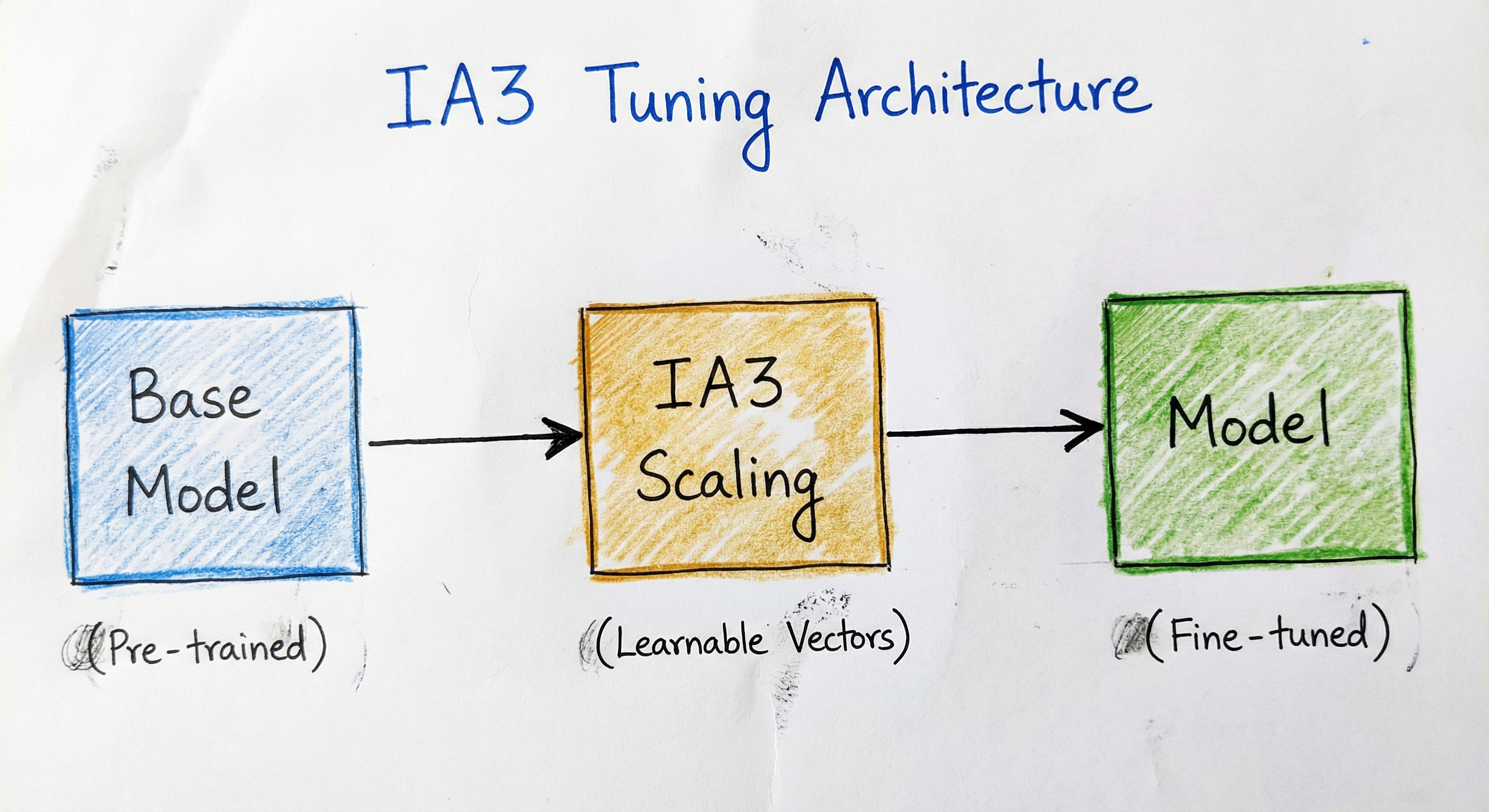
IA3 (Infused Adapter by Inhibiting and Amplifying Inner Activations) is a parameter-efficient fine-tuning method that takes minimalism to its logical extreme. While LoRA adds trainable low-rank matrices to transformer layers, IA3 learns just three tiny vectors that rescale existing activations -- the keys, values, and feedforward intermediate representations. The result is a method that trains roughly 0.01% of the base model's parameters, compared to LoRA's typical 0.2-0.5%.
Introduced by Liu et al. in their 2022 NeurIPS paper "Few-Shot Parameter-Efficient Fine-Tuning is Better and Cheaper than In-Context Learning," IA3 was born from a specific question: can parameter-efficient fine-tuning outperform in-context learning (ICL) with GPT-3, even in few-shot settings? The answer was a resounding yes. Their T-Few recipe -- combining IA3 with task-specific loss modifications on the T0 model -- achieved super-human performance on the RAFT benchmark, beating GPT-3 175B few-shot ICL by 6% absolute accuracy despite being 16x smaller.
The core intuition is elegant: instead of learning new weight matrices (additive, as in LoRA) or new tokens (as in prompt tuning), IA3 learns to amplify or inhibit the activations that already exist in the pretrained model. It is a multiplicative adaptation -- an element-wise rescaling that tells the model "pay more attention to this" or "suppress that." This makes IA3 uniquely suited for few-shot scenarios where data is scarce and you need the lightest possible touch on the pretrained representations.
Today, IA3 is supported in HuggingFace PEFT, NVIDIA NeMo, and AdapterHub. While LoRA remains the default choice for most fine-tuning tasks, IA3 occupies a valuable niche: situations where parameter count must be absolutely minimized, training data is limited, or you need to store thousands of task-specific adapters with negligible storage overhead.
Concept Snapshot
- What It Is
- A parameter-efficient fine-tuning method that learns element-wise rescaling vectors for key, value, and feedforward activations in transformer layers, enabling task adaptation with as few as 0.01% trainable parameters.
- Category
- Model Training
- Complexity
- Intermediate
- Inputs / Outputs
- Inputs: pretrained base model + task-specific training data (often few-shot). Outputs: three learned rescaling vectors per transformer layer (l_k, l_v, l_ff) that can be merged into the base model or applied at inference time.
- System Placement
- Sits in the fine-tuning stage of the ML pipeline, after pretraining and before model serving. Particularly suited for rapid task adaptation in few-shot regimes.
- Also Known As
- IA³, (IA)³, Infused Adapter by Inhibiting and Amplifying Inner Activations, IA3 Adapter, Activation Rescaling Adapter
- Typical Users
- ML Engineers, NLP Researchers, Applied Scientists, MLOps Engineers working with multi-tenant systems, Researchers in low-resource NLP
- Prerequisites
- Transformer architecture (attention mechanism, feedforward layers), Basic understanding of activation functions and element-wise operations, Transfer learning and fine-tuning concepts, Familiarity with PyTorch or similar framework, Understanding of few-shot learning paradigms
- Key Terms
- rescaling vector (l_k, l_v, l_ff)element-wise multiplicationmultiplicative adaptationT-Few recipefew-shot parameter-efficient fine-tuningactivation scalingfrozen weightsPEFT
Why This Concept Exists
The In-Context Learning Tax
By 2022, in-context learning (ICL) with large language models like GPT-3 had become the dominant approach for few-shot tasks. You write a prompt with a few examples, and the model generalizes. No training required.
But ICL has a fundamental problem: it is astronomically expensive at inference time. Every single API call to GPT-3 175B carries the full computational cost of processing the prompt, the examples, and the query through 175 billion parameters. For a classification task with 50 few-shot examples at 100 tokens each, you are burning through 5,000+ tokens per request. At 2022 GPT-3 pricing, processing 10,000 classification queries with few-shot ICL cost roughly $50-100 (~INR 4,000-8,400). Fine-tuning a smaller model once and then running cheap inference would be orders of magnitude cheaper -- but full fine-tuning on few-shot data is notoriously unstable.
The Expressiveness-Efficiency Spectrum
Existing PEFT methods in 2022 offered a spectrum of parameter efficiency:
- Full fine-tuning: Updates all parameters (~100%). Maximum expressiveness, maximum cost.
- Adapter layers (Houlsby et al. 2019): Inserts small feedforward modules. ~2-4% trainable parameters. Adds inference latency.
- LoRA (Hu et al. 2021): Low-rank weight updates. ~0.1-0.5% trainable parameters. No inference latency after merging.
- Prefix tuning (Li & Liang 2021): Learnable prefix tokens. ~0.1% trainable parameters. Consumes context window.
- Prompt tuning (Lester et al. 2021): Soft prompt embeddings. ~0.01% trainable parameters. Weak on smaller models.
Liu et al. asked: can we push even further? Can we get fewer parameters than LoRA while getting better few-shot performance than prompt tuning? And critically, can we beat ICL with GPT-3 -- not just in accuracy, but in total cost?
The Multiplicative Insight
The key insight was a shift from additive to multiplicative adaptation. LoRA learns an additive update to the weight matrix. Prompt tuning adds new tokens to the input. These are all additive modifications.
IA3 instead learns to rescale existing activations. Rather than adding new information to the model, it amplifies useful signals and suppresses irrelevant ones. This is a fundamentally different inductive bias: the pretrained model already contains the right representations; we just need to adjust their relative importance for the new task.
This multiplicative approach requires far fewer parameters because rescaling vectors are rank-1 by nature -- you need just parameters per vector instead of for a LoRA matrix. For a model with hidden dimension 4096 and LoRA rank 16, that is 4,096 vs 131,072 parameters per adapted layer -- a 32x reduction.
Key Takeaway: IA3 exists because multiplicative activation rescaling is a more parameter-efficient inductive bias than additive weight updates for few-shot adaptation. It trades expressiveness for extreme efficiency, making it ideal when data is scarce and adapter storage must be minimal.
Core Intuition & Mental Model
The Analogy: An Audio Mixing Board
Imagine a pretrained language model as a recording studio with hundreds of audio channels already mixed into a master track. Each channel represents a different "feature" the model has learned -- syntax patterns, semantic relationships, factual knowledge, reasoning capabilities. The master mix (the pretrained model) sounds good for general purposes, but you want to adapt it for a specific genre -- say, jazz.
Full fine-tuning is like re-recording every channel from scratch. LoRA is like adding a few new overdub tracks and mixing them in. IA3? IA3 is like walking up to the mixing board and adjusting the volume faders on the existing channels. Turn up the jazz harmony channel, turn down the rock distortion channel. You are not adding any new recordings -- you are just changing which existing signals get amplified and which get suppressed.
This is exactly what IA3 does: it learns three sets of "volume faders" (rescaling vectors) that dial the existing key activations, value activations, and feedforward activations up or down. The output is the same model with the same architecture and the same weights, just with its internal activations rebalanced for the new task.
Why Three Vectors?
IA3 targets three specific activation points in each transformer layer, chosen for maximum impact with minimum parameters:
-
Keys (): Rescaling the key vectors in self-attention changes what the model pays attention to. Amplifying certain key dimensions makes those features more salient in attention scores; suppressing others makes the model ignore them.
-
Values (): Rescaling the value vectors changes what information gets passed through attention. Even if the model attends to the right tokens, IA3 can amplify the useful information extracted from those tokens and suppress noise.
-
Feedforward (): Rescaling the intermediate feedforward activations modifies the model's knowledge retrieval and transformation. The FFN layers are where factual knowledge and reasoning patterns are stored; rescaling here adjusts which knowledge pathways are active.
Together, these three vectors give IA3 leverage over both the attention mechanism (what to look at and what to extract) and the feedforward network (how to process and transform information). It is a surprisingly complete set of controls despite being just three vectors per layer.
Mental Model: IA3 is a learned gain control for transformer activations. Just as a graphic equalizer adjusts frequency bands to shape audio output, IA3 adjusts activation dimensions to shape model behavior -- with the same philosophy that the source material is already good; it just needs the right emphasis.
Technical Foundations
The Core Formulation
Let be an activation vector in a transformer layer. IA3 applies element-wise rescaling:
where is a learned task-specific rescaling vector, denotes the Hadamard (element-wise) product, and is the modified activation.
Application Points
In a standard transformer layer with self-attention and feedforward components, IA3 introduces three learned vectors:
- Key rescaling: where are the key projections and
- Value rescaling: where are the value projections and
- Feedforward rescaling: where is the intermediate activation after the first feedforward layer and
The modified self-attention becomes:
And the modified feedforward network becomes:
where is the activation function (typically GELU or SwiGLU).
Parameter Count Analysis
For a single transformer layer with hidden dimension , key/value dimension , and feedforward intermediate dimension :
- IA3 parameters per layer:
- LoRA parameters per layer (rank , targeting Q, K, V, O): (when )
For a concrete example with a Llama 7B-class model (, , , layers):
- IA3 total: parameters
- LoRA (r=16, Q/K/V/O): parameters
- Ratio: IA3 uses ~27x fewer parameters than LoRA
As a fraction of total model parameters:
- IA3:
- LoRA (r=16):
Initialization
All rescaling vectors are initialized to ones: . This ensures that at the start of training, , so the model begins from the exact pretrained behavior -- analogous to LoRA's zero-initialization of .
Merging into Base Model
After training, the rescaling vectors can be absorbed into the adjacent weight matrices:
- (rescale rows of the key projection)
- (rescale rows of the value projection)
- (rescale columns of the first FFN weight, or equivalently, rescale rows of the second FFN weight)
After merging, the model is structurally identical to the original -- zero inference overhead, same as LoRA.
The T-Few Loss Function
The original paper pairs IA3 with a task-specific loss modification called the T-Few recipe. For multiple-choice tasks, the total loss is:
where:
- is the standard language modeling loss for the correct answer
- is an unlikelihood loss that penalizes the model for assigning high probability to incorrect choices
- is a length-normalized loss that accounts for answer length differences
This loss modification is crucial: IA3 alone with standard cross-entropy underperforms, but combined with the T-Few losses, it achieves state-of-the-art few-shot results.
Practical Rule: IA3 vectors are initialized to ones. If after training most values remain close to 1.0, the adaptation is minimal and the pretrained model was already well-suited. If values deviate significantly (e.g., range 0.1-5.0), the model is making substantial task-specific adjustments.
Internal Architecture
The architecture of IA3 is remarkably minimal. Rather than adding new layers or matrices to the transformer, it inserts learned scalar multipliers at three strategic points within each transformer block. These multipliers -- implemented as vectors applied via element-wise multiplication -- modulate the existing activations without changing the model's structure.
The following diagram illustrates how IA3 intervenes in a single transformer layer. The three rescaling vectors (, , ) are the only trainable parameters; everything else remains frozen.
The green nodes are the only trainable components -- three vectors per layer, totaling roughly 19,000 parameters per layer for a typical 4096-dimension model. Compare this to LoRA's ~524,000 parameters per layer (rank 16, four target modules).
Key Components
Key Rescaling Vector (l_k)
A learned vector that is element-wise multiplied with the key projections in self-attention. By amplifying or suppressing specific dimensions of the key representation, this vector controls what the model attends to -- which features of the input are deemed relevant for the downstream task. Initialized to ones (identity operation).
Value Rescaling Vector (l_v)
A learned vector that rescales the value projections in self-attention. While controls what gets attended to, controls what information is extracted from the attended tokens. This separation gives IA3 independent control over attention routing and information extraction. Initialized to ones.
Feedforward Rescaling Vector (l_ff)
A learned vector that rescales the intermediate activations in the position-wise feedforward network. The FFN layers are where factual knowledge and transformation logic are encoded; rescaling here adjusts which knowledge pathways are active for the task. This is the largest of the three vectors since is typically 2.5-4x larger than . Initialized to ones.
Frozen Base Model Weights
All original pretrained weight matrices (, , , , , , LayerNorm parameters, embeddings) remain completely frozen during IA3 training. No gradients are computed for these weights, which is the primary source of memory savings. The frozen weights capture the general knowledge from pretraining.
Vector Merger (Post-Training)
After training, each rescaling vector is absorbed into the adjacent weight matrix via row or column scaling: . This eliminates the rescaling vectors entirely, making the adapted model structurally identical to the original. The merger operation is a simple matrix-diagonal multiplication with no approximation error.
Data Flow
Training Path: Input tokens are embedded and passed through transformer layers. At each layer, the key and value projections are computed normally (, ), then rescaled element-wise by the learned vectors (, ). The attention mechanism proceeds with the rescaled keys and values. In the feedforward block, the intermediate hidden states are similarly rescaled (). Gradients flow only through the three rescaling vectors per layer; all weight matrices are gradient-free.
Inference Path (Unmerged): Identical to training but without gradient computation. The element-wise multiplication adds negligible compute -- three Hadamard products per layer, each of complexity , compared to the matrix multiplications in the base model.
Inference Path (Merged): After absorbing the vectors into the weight matrices, the model is a standard transformer. Zero additional inference cost. This is the preferred deployment mode.
A flowchart showing a single transformer layer. Input flows through Q, K, V projections (gray, frozen). The K and V outputs are element-wise multiplied by learned rescaling vectors l_k and l_v (green, trainable) before entering the attention computation. After attention and residual connection, the feedforward network's intermediate activation is rescaled by l_ff (green, trainable) before the second linear layer. All other components remain frozen (gray).
How to Implement
Implementation Approaches
There are three primary ways to use IA3 in practice:
Approach 1: HuggingFace PEFT -- The most popular and recommended option. The peft library provides IA3Config that wraps any HuggingFace model with IA3 rescaling vectors. It handles initialization, target module selection, saving/loading, and merging. This is a three-line integration.
Approach 2: NVIDIA NeMo Framework -- For enterprise deployments using Megatron-based models. NeMo supports IA3 natively with peft_scheme='ia3', integrated with their distributed training and serving pipeline.
Approach 3: Custom Implementation -- Straightforward to implement from scratch since IA3 is just element-wise multiplication with learned vectors. Useful for non-standard architectures or research.
The key implementation detail that distinguishes IA3 from LoRA is the feedforward module specification. In PEFT's IA3Config, you must explicitly specify which target modules are feedforward layers (via feedforward_modules) because IA3 applies the rescaling differently: for attention layers, the vector multiplies the output activations (keys and values), while for feedforward layers, it multiplies the input activations. Getting this wrong silently degrades performance.
Cost Note: A full IA3 fine-tuning run on T0-3B with 1,000 training steps takes approximately 15 minutes on a single A100 GPU -- roughly 1.50 (~INR 126). For few-shot classification tasks where IA3 is most effective, the total adaptation cost is negligible.
from transformers import AutoModelForSeq2SeqLM, AutoTokenizer, TrainingArguments, Trainer
from peft import IA3Config, get_peft_model, TaskType
from datasets import load_dataset

# Load base model (T0-3B or any seq2seq/causal model)
model_name = "bigscience/T0_3B"
tokenizer = AutoTokenizer.from_pretrained(model_name)
model = AutoModelForSeq2SeqLM.from_pretrained(
    model_name,
    torch_dtype="auto",
    device_map="auto",
)

# Configure IA3
ia3_config = IA3Config(
    task_type=TaskType.SEQ_2_SEQ_LM,
    target_modules=["k", "v", "wi_1"],       # Keys, Values, FFN intermediate
    feedforward_modules=["wi_1"],              # MUST specify which are FFN layers
    inference_mode=False,
)

# Wrap model with IA3
model = get_peft_model(model, ia3_config)
model.print_trainable_parameters()
# Output: trainable params: 344,064 || all params: 3,000,344,064 || trainable%: 0.0115

# Load few-shot dataset (e.g., 50 examples per class)
dataset = load_dataset("ought/raft", "ade_corpus_v2", split="train")

# Tokenize
def preprocess(examples):
    inputs = [f"Is this text about an adverse drug effect? {text}" for text in examples["Sentence"]]
    targets = ["Yes" if label == 1 else "No" for label in examples["Label"]]
    model_inputs = tokenizer(inputs, max_length=512, truncation=True, padding="max_length")
    labels = tokenizer(targets, max_length=8, truncation=True, padding="max_length")
    model_inputs["labels"] = labels["input_ids"]
    return model_inputs

tokenized_dataset = dataset.map(preprocess, batched=True)

# Training arguments (few-shot: short training)
training_args = TrainingArguments(
    output_dir="./ia3-t0-raft",
    num_train_epochs=20,              # More epochs for few-shot
    per_device_train_batch_size=8,
    learning_rate=3e-3,               # Higher LR than LoRA (IA3 convention)
    warmup_steps=60,
    lr_scheduler_type="linear",
    logging_steps=10,
    save_strategy="epoch",
    bf16=True,
)

# Train
trainer = Trainer(
    model=model,
    args=training_args,
    train_dataset=tokenized_dataset,
)
trainer.train()

# Save adapter (only ~1.3 MB!)
model.save_pretrained("./ia3-t0-raft-adapter")
This demonstrates the standard IA3 fine-tuning workflow using HuggingFace PEFT. Key differences from LoRA:
feedforward_modulesis required: You must tell PEFT which of thetarget_modulesare feedforward layers. IA3 applies rescaling differently to attention outputs vs FFN inputs.- Higher learning rate (3e-3): IA3 vectors converge faster than LoRA matrices because there are far fewer parameters. The original paper uses 3e-3 with Adafactor.
- More epochs for few-shot: With only 50 examples, you need more passes over the data. 20 epochs is typical for few-shot IA3.
- Tiny adapter size: The saved adapter is ~1.3 MB for a 3B model, compared to ~25 MB for LoRA (r=16).
from transformers import AutoModelForCausalLM, AutoTokenizer
from peft import IA3Config, get_peft_model, TaskType

# Load a causal LLM
model_name = "meta-llama/Llama-3.1-8B"
tokenizer = AutoTokenizer.from_pretrained(model_name)
tokenizer.pad_token = tokenizer.eos_token

model = AutoModelForCausalLM.from_pretrained(
    model_name,
    torch_dtype="auto",
    device_map="auto",
)

# IA3 config for Llama architecture
ia3_config = IA3Config(
    task_type=TaskType.CAUSAL_LM,
    target_modules=["k_proj", "v_proj", "down_proj"],  # Keys, Values, FFN
    feedforward_modules=["down_proj"],                   # Specify FFN modules
    inference_mode=False,
)

model = get_peft_model(model, ia3_config)
model.print_trainable_parameters()
# Output: trainable params: 540,672 || all params: 8,030,540,672 || trainable%: 0.0067

# Note: For Llama-style models, the target modules map to:
# k_proj -> key projection in GQA attention
# v_proj -> value projection in GQA attention
# down_proj -> second linear layer in SwiGLU FFN
#
# The adapter size will be ~2 MB for Llama 3.1 8B
# Compare: LoRA (r=16) on all layers would be ~42 MB
When applying IA3 to decoder-only causal LLMs like Llama, the module names differ from encoder-decoder models like T5/T0. Key points:
k_projandv_proj: These are the key and value projection layers in Llama's grouped-query attention.down_proj: This is the second linear layer in Llama's SwiGLU feedforward, where the intermediate activations pass through. The rescaling is applied to the input of this layer (the intermediate representation).- Total trainable parameters: Only ~540K out of 8B -- that is 0.0067%, roughly 78x fewer than LoRA (r=16) targeting the same layers.
- The adapter file is ~2 MB, making it trivial to store thousands of task-specific adapters.
import torch
import torch.nn as nn


class IA3Linear(nn.Module):
    """Drop-in replacement for nn.Linear with IA3 activation rescaling."""

    def __init__(
        self,
        in_features: int,
        out_features: int,
        is_feedforward: bool = False,
    ):
        super().__init__()
        self.in_features = in_features
        self.out_features = out_features
        self.is_feedforward = is_feedforward

        # Frozen pretrained weight (loaded from checkpoint)
        self.weight = nn.Parameter(
            torch.empty(out_features, in_features), requires_grad=False
        )
        self.bias = None  # Optional, typically not used

        # IA3 rescaling vector
        # For attention (K, V): rescale the OUTPUT (out_features dimension)
        # For feedforward: rescale the INPUT (in_features dimension)
        if is_feedforward:
            self.ia3_vector = nn.Parameter(torch.ones(in_features))
        else:
            self.ia3_vector = nn.Parameter(torch.ones(out_features))

    def forward(self, x: torch.Tensor) -> torch.Tensor:
        if self.is_feedforward:
            # Rescale input activations, then apply frozen weight
            x_scaled = x * self.ia3_vector  # Element-wise multiply
            return nn.functional.linear(x_scaled, self.weight, self.bias)
        else:
            # Apply frozen weight, then rescale output
            h = nn.functional.linear(x, self.weight, self.bias)
            return h * self.ia3_vector  # Element-wise multiply

    def merge_weights(self):
        """Absorb IA3 vector into the weight matrix."""
        with torch.no_grad():
            if self.is_feedforward:
                # Rescale columns of weight matrix
                self.weight.mul_(self.ia3_vector.unsqueeze(0))
            else:
                # Rescale rows of weight matrix
                self.weight.mul_(self.ia3_vector.unsqueeze(1))
        del self.ia3_vector


# Usage example: replace key projection in a transformer
# original = model.layers[0].self_attn.k_proj  # nn.Linear(4096, 4096)
# ia3_layer = IA3Linear(4096, 4096, is_feedforward=False)
# ia3_layer.weight.data = original.weight.data.clone()
# model.layers[0].self_attn.k_proj = ia3_layer

# Replace FFN intermediate layer
# original_ffn = model.layers[0].mlp.down_proj  # nn.Linear(11008, 4096)
# ia3_ffn = IA3Linear(11008, 4096, is_feedforward=True)
# ia3_ffn.weight.data = original_ffn.weight.data.clone()
# model.layers[0].mlp.down_proj = ia3_ffn
This from-scratch implementation reveals the critical implementation detail that differentiates IA3 from other methods: the asymmetric application of rescaling vectors.
- Attention layers (K, V): The vector rescales the output of the linear layer. This is equivalent to scaling rows of the weight matrix: .
- Feedforward layers: The vector rescales the input to the linear layer. This is equivalent to scaling columns of the weight matrix: .
This asymmetry follows the original paper and is important for performance. The merge_weights() method shows how to absorb the vectors permanently -- after merging, the layer is a standard nn.Linear.
# IA3 configuration (YAML format for reference)
model:
  name: bigscience/T0_3B
  dtype: bfloat16

ia3:
  target_modules:
    - k         # Key projection in T5 attention
    - v         # Value projection in T5 attention
    - wi_1      # First FFN layer (intermediate)
  feedforward_modules:
    - wi_1      # MUST specify feedforward modules separately
  init_ia3_weights: true   # Initialize vectors to ones
  task_type: SEQ_2_SEQ_LM

training:
  # T-Few recipe settings
  max_steps: 1000
  batch_size: 8
  learning_rate: 3e-3       # Higher than LoRA!
  optimizer: adafactor
  warmup_steps: 60
  lr_scheduler: linear
  bf16: true
  # T-Few loss weights
  unlikelihood_loss_weight: 1.0
  length_norm_loss_weight: 1.0

serving:
  merge_vectors: true       # Absorb into base weights
  deployment: vllm           # Standard deployment after merging
Common Implementation Mistakes
- ●
Forgetting to specify
feedforward_modulesin IA3Config: This is the most common mistake. If you don't tell PEFT which target modules are feedforward layers, IA3 will apply output rescaling to all modules (including FFN layers where input rescaling is correct). Performance silently degrades by 2-5% with no error message. - ●
Using LoRA learning rates (2e-4) instead of IA3 learning rates (3e-3): IA3 has far fewer parameters than LoRA and they converge much faster. The original paper uses 3e-3 with Adafactor. Using a LoRA-typical 2e-4 will make IA3 train extremely slowly and may never converge in few-shot settings.
- ●
Applying IA3 to too many modules: Unlike LoRA where targeting more modules generally helps, IA3's extreme parameter efficiency means adding more target modules can lead to optimization conflicts. Stick to the canonical three: keys, values, and one FFN layer per transformer block.
- ●
Using standard cross-entropy loss for few-shot classification: The T-Few recipe's unlikelihood and length-normalized losses are critical for IA3's few-shot performance. Using only standard cross-entropy with IA3 in few-shot settings underperforms LoRA and may even underperform prompt tuning.
- ●
Expecting LoRA-level performance on complex tasks: IA3 trades expressiveness for parameter efficiency. On tasks requiring significant distribution shift (e.g., complex domain adaptation, multi-step reasoning), IA3 will underperform LoRA. If your validation metrics plateau at 80-85% of LoRA's performance, the task needs more capacity than IA3 can provide.
- ●
Not initializing vectors to ones: Some implementations accidentally initialize to zeros or random values. Zero initialization kills the pretrained model's behavior entirely (all activations become zero). Random initialization adds noise to pretrained representations. Always initialize to ones for identity-like starting behavior.
When Should You Use This?
Use When
You have very limited training data (5-500 examples per class) and need few-shot adaptation -- IA3 was specifically designed for this regime and outperforms other PEFT methods on few-shot benchmarks
You need to store thousands of task-specific adapters with minimal storage overhead -- IA3 adapters are 1-3 MB compared to 10-100 MB for LoRA, enabling massive multi-tenant deployments
Your parameter budget is extremely constrained -- when even LoRA's 0.2% trainable parameters is too many (e.g., on-device adaptation with strict memory limits)
You are working with encoder-decoder models like T5/T0 where the T-Few recipe has been extensively validated and achieves state-of-the-art few-shot results
You want zero inference latency overhead after deployment -- like LoRA, IA3 vectors merge cleanly into base weights with no architectural changes
You need to rapidly iterate on task adaptation experiments -- IA3 training takes 2-5x less time than LoRA due to fewer parameters, enabling faster experiment cycles
Your task is primarily a classification or choice task where the pretrained model already has the right capabilities and just needs to emphasize different activation patterns
Avoid When
You need high-quality domain adaptation with significant distribution shift -- IA3's limited capacity (~0.01% parameters) cannot learn complex new patterns; use LoRA (r=16-64) or full fine-tuning instead
Your task requires multi-step reasoning or complex generation -- research shows IA3 underperforms LoRA by 5-15% on math reasoning and open-ended generation tasks where more expressive updates are needed
You have abundant training data (>10K examples) -- with enough data, LoRA's extra capacity yields measurable quality gains and the training cost difference becomes negligible
You are fine-tuning a decoder-only model for general instruction following -- IA3 was primarily validated on T5/T0 encoder-decoder models with the T-Few recipe; results on decoder-only chat fine-tuning are less consistent
You need to modify attention patterns significantly -- IA3 only rescales keys and values (not queries), which limits its ability to redirect the model's attention to fundamentally new patterns
Your evaluation metric is absolute performance and even a 1-2% quality gap matters -- IA3 generally underperforms LoRA on standard benchmarks; for production systems where quality is paramount, LoRA is the safer bet
Key Tradeoffs
The Core Tradeoff: Extreme Efficiency vs. Capacity
IA3's fundamental tradeoff is simple: it trades adaptation capacity for extreme parameter efficiency. This tradeoff is not a spectrum you can dial -- unlike LoRA where you can increase rank to get more capacity, IA3's rescaling vectors are inherently rank-1. You either accept the constraint or choose a different method.
| Method | Trainable % (7B model) | Adapter Size | Few-shot Quality | Complex Task Quality | Training Speed |
|---|---|---|---|---|---|
| IA3 | ~0.01% | ~2 MB | Excellent | Fair | Very Fast |
| LoRA (r=8) | ~0.12% | ~20 MB | Good | Good | Fast |
| LoRA (r=16) | ~0.24% | ~42 MB | Good | Very Good | Fast |
| LoRA (r=64) | ~0.96% | ~160 MB | Good | Excellent | Moderate |
| Full FT | 100% | ~14 GB | Overkill | Best | Slow |
Cost Comparison
For fine-tuning a 3B parameter model on a few-shot classification task:
| Method | Hardware | Time | Cloud Cost | Cost (INR) |
|---|---|---|---|---|
| IA3 | 1x A10G 24GB | ~15 min | ~$0.25 | ~INR 21 |
| LoRA (r=16) | 1x A10G 24GB | ~45 min | ~$0.75 | ~INR 63 |
| Full Fine-tuning | 1x A100 80GB | ~2 hours | ~$8.00 | ~INR 672 |
For adapting a 7B model on a small dataset (1K examples):
| Method | Hardware | Time | Cloud Cost | Cost (INR) |
|---|---|---|---|---|
| IA3 | 1x A10G 24GB | ~30 min | ~$0.50 | ~INR 42 |
| LoRA (r=16) | 1x A10G 24GB | ~2 hours | ~$2.00 | ~INR 168 |
| QLoRA (r=16) | 1x RTX 4090 24GB | ~3 hours | ~$3.00 | ~INR 252 |
When to Choose IA3 Over LoRA
Choose IA3 when: (1) you have fewer than 500 training examples, (2) adapter storage matters (e.g., serving 10,000+ task variants), or (3) you need the absolute fastest adaptation time. Choose LoRA for everything else.
The decision is straightforward because IA3 and LoRA are not competitors for most use cases -- they occupy different niches on the efficiency-quality Pareto frontier. Think of IA3 as a scalpel and LoRA as a Swiss army knife: the scalpel is better for precise, minimal interventions, but the Swiss army knife handles a wider range of tasks.
Practitioner's Note: If you are unsure whether IA3 or LoRA is appropriate, start with IA3 (it is faster to test). If IA3 underperforms by more than 3% on your validation set, switch to LoRA. The time spent testing IA3 is negligible.
Alternatives & Comparisons
LoRA learns additive low-rank weight updates (), using ~20-80x more parameters than IA3 but with significantly greater adaptation capacity. LoRA outperforms IA3 on complex tasks, domain adaptation, and large-dataset fine-tuning. Choose LoRA as the default PEFT method for most tasks; choose IA3 only for few-shot scenarios, extreme parameter budgets, or when adapter storage is the binding constraint.
QLoRA combines 4-bit base model quantization with LoRA, reducing memory for the frozen weights. IA3 is already lighter on trainable parameters but does not quantize the base model. For few-shot tasks on smaller models (3B-7B), IA3 is more parameter-efficient. For adapting very large models (70B+) where base model memory dominates, QLoRA's quantization advantage is more impactful.
Adapter layers insert small feedforward modules between transformer layers, adding ~2-4% trainable parameters and introducing inference latency from additional sequential computation. IA3 uses 100-200x fewer parameters and has zero inference overhead after merging. Choose adapters only if you need the adapter to remain separate from the base model at inference time; choose IA3 for all efficiency-focused scenarios.
Prefix tuning prepends learnable continuous vectors to keys and values at every layer, consuming part of the context window. IA3 rescales existing activations without using any context tokens. Both are highly parameter-efficient (~0.01-0.1%), but IA3 does not sacrifice context length and generally performs better on few-shot tasks. Choose prefix tuning when you want a method that does not touch any model weights; choose IA3 for better few-shot performance.
Prompt tuning learns soft embeddings prepended only at the input layer. It is extremely parameter-efficient but performs poorly on smaller models (<10B) and struggles with complex tasks. IA3 modifies activations at every layer (deeper intervention) and consistently outperforms prompt tuning in few-shot settings across model sizes. Choose IA3 over prompt tuning in almost all cases.
Full fine-tuning updates all model parameters and achieves the best possible task performance. IA3 trains ~10,000x fewer parameters but with a noticeable quality gap on complex tasks. Choose full fine-tuning when you have abundant data, ample compute budget, and need maximum quality. Choose IA3 for rapid few-shot adaptation where full fine-tuning would catastrophically overfit.
Pros, Cons & Tradeoffs
Advantages
Extreme parameter efficiency: Only ~0.01% of base model parameters are trainable, making IA3 roughly 20-80x more parameter-efficient than LoRA. For a 7B model, that is ~600K parameters vs ~17M for LoRA (r=16).
Negligible adapter storage: IA3 adapters are 1-3 MB per task, enabling storage of tens of thousands of task-specific adapters. A single 1 TB drive can hold ~500,000 IA3 adapters vs ~10,000 LoRA adapters.
Zero inference overhead after merging: Like LoRA, IA3 vectors can be absorbed into the base model weights. The merged model is structurally identical to the original -- no additional latency, no architectural changes.
Superior few-shot performance: The T-Few recipe (IA3 + task-specific losses) outperformed GPT-3 175B in-context learning by 6% on the RAFT benchmark while being 16x smaller. IA3 is the only PEFT method that consistently beats full fine-tuning baselines in few-shot regimes.
Very fast training: Fewer trainable parameters means faster gradient computation, smaller optimizer states, and faster convergence. IA3 fine-tuning is typically 2-5x faster than LoRA for the same task.
No hyperparameter for capacity: Unlike LoRA which requires choosing a rank , IA3 has no capacity knob to tune. The rescaling vectors are fixed at dimension . This simplifies the hyperparameter search -- you only need to tune learning rate and number of steps.
Simple implementation: IA3 is just element-wise multiplication with learned vectors. No matrix decomposition, no routing logic, no additional layers. The entire method can be implemented in ~30 lines of code.
Low-resource language adaptation: IA3's minimal parameter footprint makes it ideal for adapting models to low-resource languages (Hindi, Tamil, Amharic, etc.) where training data is scarce and compute budgets are tight.
Disadvantages
Lower capacity than LoRA on complex tasks: IA3's rank-1 rescaling vectors cannot learn the complex weight updates needed for significant domain adaptation, multi-step reasoning, or open-ended generation. Expect 5-15% lower performance than LoRA on such tasks.
Sensitive to loss function design: The T-Few recipe's unlikelihood and length-normalized losses are critical for IA3's strong few-shot results. Using standard cross-entropy alone significantly reduces IA3's advantage, making it less of a drop-in replacement than LoRA.
Limited validation on decoder-only models: IA3 was primarily developed and validated on T5/T0 encoder-decoder models. Results on decoder-only LLMs (Llama, Mistral, GPT) are less consistent, and the community has less experience tuning IA3 for chat/instruction fine-tuning.
No capacity dial to turn: Unlike LoRA where you can increase rank for harder tasks, IA3 offers no mechanism to increase expressiveness. If the task exceeds IA3's capacity, you must switch to a different method entirely -- there is no middle ground.
Smaller community and ecosystem: LoRA has thousands of tutorials, community adapters, and battle-tested configurations. IA3 has significantly less community support, fewer examples, and less tooling (e.g., no multi-IA3 serving equivalent to vLLM's multi-LoRA).
Math reasoning degradation: Research shows IA3 suffers substantial performance drops (up to 22% accuracy loss compared to LoRA) on mathematical reasoning tasks, suggesting that the multiplicative inductive bias is poorly suited for reasoning-heavy workloads.
Failure Modes & Debugging
Capacity Exhaustion on Complex Tasks
Cause
Applying IA3 to a task that requires more expressive updates than rank-1 rescaling vectors can provide. Common triggers: domain adaptation with significant vocabulary shift, multi-task instruction tuning, mathematical reasoning, or code generation requiring new syntax patterns.
Symptoms
Training loss decreases initially but plateaus at a significantly higher value than a LoRA baseline. The model handles simple aspects of the task (basic classification, pattern matching) but fails on complex subtasks (multi-hop reasoning, nuanced generation). Validation metrics plateau at 80-85% of LoRA performance despite extended training.
Mitigation
IA3 is not designed for complex adaptation. If validation metrics plateau more than 3-5% below a LoRA (r=16) baseline, switch to LoRA. There is no way to increase IA3's capacity -- the rank-1 rescaling is inherent to the method. For borderline cases, try combining IA3 with a small number of unfrozen LayerNorm parameters to add minimal extra capacity.
Feedforward Module Misspecification
Cause
Failing to correctly specify feedforward_modules in the IA3Config, or incorrectly classifying attention modules as feedforward or vice versa. This causes the rescaling vector to be applied on the wrong side of the linear transformation (output vs input).
Symptoms
No error messages -- the model trains and produces outputs, but performance is 2-5% lower than expected on all metrics. The IA3 vectors for misspecified modules may converge to near-uniform values (all close to 1.0), indicating the rescaling is not learning useful patterns. Difficult to diagnose without a correct baseline.
Mitigation
Always verify module classification before training. For T5: k, v are attention, wi_1 is feedforward. For Llama: k_proj, v_proj are attention, down_proj is feedforward. Test with a small training run (100 steps) and check that the IA3 vectors are diverging from their initialization (values significantly above or below 1.0).
Learning Rate Miscalibration
Cause
Using a LoRA-typical learning rate (1e-4 to 5e-4) instead of the higher rate IA3 requires (1e-3 to 3e-3). Because IA3 has far fewer parameters and they are initialized close to the identity, small learning rates produce negligible updates.
Symptoms
IA3 vectors remain very close to their initialization (all values between 0.95-1.05 after full training). Training loss decreases extremely slowly. The model's behavior is almost indistinguishable from the unmodified base model. Increasing training epochs does not help because the per-step update is too small.
Mitigation
Use a learning rate of 1e-3 to 3e-3 for IA3. The original paper uses 3e-3 with Adafactor and linear decay. If using Adam/AdamW, start at 1e-3. Monitor the IA3 vector values during training -- they should show meaningful deviation from 1.0 within the first 100 steps. If all values remain within 0.95-1.05 after 100 steps, increase the learning rate.
Few-Shot Overfitting with Standard Loss
Cause
Training IA3 on very few examples (10-50) with standard cross-entropy loss without the T-Few recipe's unlikelihood and length-normalized losses. The model quickly memorizes the few training examples without learning generalizable patterns.
Symptoms
Training loss drops to near-zero within a few epochs. Validation accuracy on unseen examples is poor or inconsistent. The model may default to a single output class or produce outputs that verbatim match specific training examples. This is paradoxical because IA3 is supposed to excel in few-shot settings, but only when paired with appropriate loss functions.
Mitigation
Implement the full T-Few recipe: add unlikelihood loss () to penalize incorrect choices and length-normalized loss () to prevent length bias. If you cannot implement custom losses, use IA3 with at least 200+ training examples where standard cross-entropy is more reliable. For datasets under 50 examples, the T-Few losses are essentially mandatory.
Initialization Corruption
Cause
Accidentally initializing IA3 vectors to zeros, small random values, or loading corrupted adapter checkpoints. Zero initialization multiplies all activations by zero, completely destroying the pretrained model's representations. Random initialization adds noise proportional to the deviation from ones.
Symptoms
With zero initialization: model outputs are gibberish or empty from the very first training step. Loss starts extremely high and may not decrease. With random initialization: model outputs are slightly degraded from the base model, training is unstable, and final performance is 3-10% lower than proper ones-initialization. These symptoms may be confused with a bad base model or data preprocessing error.
Mitigation
Always verify that init_ia3_weights=True in IA3Config (the default in PEFT). For custom implementations, explicitly set nn.Parameter(torch.ones(dim)). After loading an IA3 adapter, spot-check a few vector values to confirm they are not all zeros or large random values. The HuggingFace PEFT library handles this correctly by default, but custom code or third-party implementations may not.
Placement in an ML System
Where IA3 Fits in the ML System
IA3 occupies the rapid task adaptation niche in the ML pipeline. It sits between base model selection and deployment, specifically optimized for scenarios where adaptation must be fast, lightweight, and applicable to new tasks with minimal data.
The typical workflow for IA3 in a production system:
- Task specification: A new classification task or domain adaptation need is identified (e.g., a Flipkart team needs sentiment classification for a new product category with only 100 labeled examples).
- Few-shot data curation: A small, high-quality dataset of 50-500 examples is prepared.
- IA3 adaptation: The base model is adapted in 15-30 minutes on a single GPU, producing a 1-3 MB adapter.
- Evaluation: The adapted model is tested on held-out examples.
- Deployment: The IA3 vectors are merged into the base model, and the result is deployed as a standard model.
In organizations with many downstream tasks -- like an Indian e-commerce platform serving dozens of classification tasks (spam detection in Kannada, product categorization in Hindi, review sentiment in Tamil) -- IA3 enables a single base model to be quickly adapted to each task with negligible compute cost. The adapter files are tiny enough to version-control alongside code, making reproducibility trivial.
Multi-Task Pattern: For platforms like Razorpay or PhonePe that need rapid adaptation to new fraud patterns across different transaction types, IA3 adapters can be trained in minutes and deployed within the hour. The cost per adaptation (~INR 20-50) makes it economical to retrain adapters weekly or even daily as patterns shift.
Pipeline Stage
Training / Fine-tuning (Few-Shot Adaptation)
Upstream
- Data Preprocessing Pipeline (cleaned, formatted few-shot data)
- Base Model Selection (pretrained checkpoint: T0, T5, Llama, etc.)
- Few-Shot Dataset Curation (curated examples per task/class)
Downstream
- Model Evaluation & Benchmarking
- Adapter Storage / Model Registry
- Model Serving (standard transformer serving after merging)
Scaling Bottlenecks
The primary advantage of IA3 at scale is adapter storage. With adapters of 1-3 MB each, you can realistically store and manage 100,000+ task-specific variants on a single storage node. This makes IA3 attractive for multi-tenant SaaS platforms where each customer has a specialized model.
However, IA3 lacks the multi-adapter serving infrastructure that LoRA enjoys. While vLLM and SGLang have sophisticated multi-LoRA serving with continuous batching, there is no equivalent multi-IA3 serving system. In practice, since IA3 vectors merge cleanly into the base model, the serving path is usually: merge the adapter offline, deploy as a standard model. This means each adapter variant requires its own model instance or a model-swapping mechanism.
For training at scale, IA3's bottleneck is the same as any PEFT method: the forward pass through the full frozen model dominates compute. IA3's tiny parameter count means gradient computation and optimizer updates are negligible, but activation memory for the full model remains. Gradient checkpointing helps, but the base model must still fit in memory.
Production Case Studies
Liu et al. at UNC Chapel Hill introduced IA3 as part of the T-Few recipe, applying it to the T0-3B model across a wide range of few-shot tasks. They evaluated on the RAFT benchmark (Real-world Annotated Few-shot Tasks), which includes 11 diverse classification tasks with only 50 labeled examples each. The T-Few recipe (IA3 + unlikelihood loss + length normalization) achieved super-human performance on RAFT, surpassing both human annotators and GPT-3 175B with in-context learning.
T-Few achieved 75.8% average accuracy on RAFT, beating GPT-3 ICL (few-shot) by 6% absolute and human baseline by 2.2%. The IA3 component trained only ~0.01% of T0-3B's parameters. Total compute cost was approximately 30 A100 GPU-hours across all RAFT tasks -- roughly $120 (~INR 10,000) vs. thousands of dollars for GPT-3 API calls at equivalent query volume.
A 2025 comparative study published in Frontiers in Big Data rigorously benchmarked IA3 against LoRA and ReFT for low-resource text classification on Amazon Reviews and AG News datasets. The study provided the first systematic head-to-head evaluation of these three PEFT methods in controlled low-resource settings, measuring F1 score, GPU memory usage, and parameter efficiency.
IA3 achieved F1 scores of 0.873 (Amazon Reviews) and 0.881 (AG News), trailing LoRA by 3-4% absolute but using only 0.018% trainable parameters vs LoRA's 0.3%. IA3 balanced parameter efficiency and task performance but did not dominate either the efficiency or quality frontier -- ReFT was more efficient and LoRA was more accurate.
The ICLR 2024 paper "Pushing Mixture of Experts to the Limit" introduced Mixture of Vectors (MoV), which extends IA3 by routing inputs to different IA3 expert vectors. This approach combines the extreme parameter efficiency of IA3 with the routing diversity of Mixture-of-Experts, applied to T5 models at 3B and 11B scale for instruction tuning.
MoV (Mixture of IA3 Vectors) achieved up to 14.57% improvement over standard IA3 at 3B scale and 8.39% at 11B scale, while still updating less than 1% of model parameters. The method achieved performance parity with full fine-tuning on unseen tasks, demonstrating that IA3's capacity limitation can be addressed through expert routing.
A practical case study applying IA3 PEFT to fine-tune mT5-small for Amharic text summarization, demonstrating IA3's viability for low-resource African languages. The project leveraged IA3's minimal parameter footprint to adapt the multilingual model with limited Amharic training data, evaluated using ROUGE, BLEU, and BERTScore metrics.
Successfully fine-tuned mT5-small for Amharic summarization with IA3, producing adapter files small enough to open-source alongside the dataset. This demonstrated IA3's potential for low-resource language adaptation where compute budgets are extremely constrained -- a pattern directly applicable to Indian languages like Kannada, Marathi, and Odia.
Tooling & Ecosystem
The primary library for IA3 implementation. Provides IA3Config and get_peft_model() for wrapping any HuggingFace model with IA3 rescaling vectors. Handles target module selection, feedforward module specification, initialization, saving/loading, and merging. Includes task guides and example notebooks for sequence classification and seq2seq tasks.
Enterprise-grade framework supporting IA3 natively via peft_scheme='ia3'. Integrated with Megatron for distributed training of large models. Supports IA3 for GPT-style models (Nemotron, Llama) and T5 models. Particularly suited for organizations already in the NVIDIA ecosystem.
The official code repository for the original T-Few paper that introduced IA3. Contains the complete T-Few recipe including the IA3 implementation, unlikelihood loss, length-normalized loss, and evaluation scripts for the RAFT benchmark. Useful as a reference for implementing the full T-Few recipe beyond just IA3 rescaling vectors.
Unified library for parameter-efficient and modular transfer learning that supports IA3 alongside LoRA, adapters, and prefix tuning. Uses IA3Config with composition_mode='scale' and r=1 internally. Provides a standardized interface for combining multiple PEFT methods and sharing trained adapters.
Community implementation of IA3 for Stable Diffusion image generation models. Produces extremely small adapter files (~222 KB for SD 1.5) that can be swapped in and out during inference. Demonstrates IA3's applicability beyond NLP to vision tasks, where the tiny adapter size enables massive collections of style-specific adaptations.
Research & References
Liu, Tam, Muqeeth, Mohta, Huang, Bansal & Raffel (2022)NeurIPS 2022
The foundational IA3 paper. Introduced (IA)3 as a multiplicative PEFT method that learns rescaling vectors for keys, values, and feedforward activations. Combined with the T-Few recipe (unlikelihood + length-normalized losses), it achieved super-human performance on RAFT and outperformed GPT-3 175B ICL by 6% while being 16x smaller.
Hu, Shen, Wallis, Allen-Zhu, Li, Wang, Wang & Chen (2021)ICLR 2022
The foundational LoRA paper and the primary comparison point for IA3. LoRA's additive low-rank decomposition () is more expressive than IA3's multiplicative rescaling but uses 20-80x more parameters. Understanding LoRA is essential context for evaluating IA3's tradeoffs.
Zadouri, Ustun, Artetxe, Ahia, Hooker & Hooker (2024)ICLR 2024
Extended IA3 by introducing Mixture of Vectors (MoV), which routes inputs to different IA3 expert vectors. MoV achieved up to 14.57% improvement over standard IA3 at 3B scale while still updating <1% of parameters. Demonstrated that IA3's capacity limitation can be addressed through expert routing rather than increasing per-vector dimensionality.
Han, Gao, Ciber, et al. (2024)Transactions on Machine Learning Research (TMLR)
A comprehensive survey categorizing PEFT methods into additive, selective, reparameterized, and hybrid approaches. Places IA3 in the reparameterized category alongside LoRA, and provides systematic comparison of parameter counts, memory efficiency, and downstream task performance across PEFT methods.
Various (2025)Frontiers in Big Data
A rigorous empirical comparison of LoRA, IA3, and ReFT for low-resource text classification. Found that LoRA maximizes F1 performance, ReFT maximizes efficiency, and IA3 balances the two but does not dominate either frontier. IA3 used 0.018% trainable parameters vs LoRA's 0.3%, with a 3-4% F1 gap.
Alex, Lifland, Tunstall, Thakur, Maham, Riedel, Hovy, Neves & Rush (2021)NeurIPS 2021 Datasets and Benchmarks
The benchmark on which IA3's T-Few recipe first achieved super-human performance. RAFT consists of 11 real-world classification tasks with only 50 labeled examples each, making it the gold standard for evaluating few-shot adaptation methods. Understanding RAFT is essential context for IA3's claimed performance advantages.
Interview & Evaluation Perspective
Common Interview Questions
- ●
Explain how IA3 works. How does it differ from LoRA conceptually?
- ●
Why does IA3 use multiplicative rescaling instead of additive weight updates? What is the inductive bias?
- ●
How many parameters does IA3 train compared to LoRA? Walk through the calculation for a 7B model.
- ●
What is the T-Few recipe and why is it important for IA3's performance?
- ●
When would you choose IA3 over LoRA? When would you avoid it?
- ●
How are IA3 vectors merged into the base model at deployment time?
- ●
What are the three activation points IA3 targets and why were they chosen?
- ●
How would you design a system serving 10,000 task-specific IA3 adapters?
Key Points to Mention
- ●
IA3 learns three rescaling vectors per transformer layer (, , ) that element-wise multiply existing activations. This is multiplicative adaptation vs LoRA's additive adaptation.
- ●
IA3 trains ~0.01% of model parameters vs LoRA's ~0.2%, a 20-80x reduction. For a 7B model: ~600K IA3 parameters vs ~17M for LoRA (r=16).
- ●
Vectors are initialized to ones (identity operation) so training starts from exact pretrained behavior -- analogous to LoRA's zero-initialization of B.
- ●
The T-Few recipe is critical: IA3 + unlikelihood loss + length-normalized loss. Without the custom losses, IA3 underperforms LoRA on few-shot tasks.
- ●
IA3 vectors merge into base weights via diagonal matrix multiplication: . Zero inference overhead after merging.
- ●
IA3 excels in few-shot settings (50-500 examples) but has limited capacity for complex tasks. It is not a general replacement for LoRA.
- ●
Cost comparison: IA3 adaptation costs ~INR 20-50 per task vs ~INR 60-170 for LoRA and ~INR 670+ for full fine-tuning on a 3B model.
Pitfalls to Avoid
- ●
Claiming IA3 is universally better than LoRA -- it is not. IA3 is better for few-shot scenarios with extreme parameter constraints; LoRA is better for most production fine-tuning.
- ●
Confusing multiplicative (IA3) with additive (LoRA) adaptation. The inductive biases are fundamentally different: IA3 rescales existing representations; LoRA adds new representations.
- ●
Forgetting the T-Few recipe. Saying 'IA3 outperforms GPT-3' without mentioning the custom loss functions is misleading -- vanilla IA3 with cross-entropy is weaker.
- ●
Not mentioning the feedforward module asymmetry. IA3 applies rescaling on the output for attention (K, V) but on the input for feedforward layers. This is a key implementation detail.
- ●
Ignoring the practical limitation that IA3 has no capacity dial. Unlike LoRA where you can increase rank, IA3's expressiveness is fixed.
Senior-Level Expectation
A senior/staff engineer should discuss IA3 at three levels: (1) Mathematical: articulate the element-wise rescaling formulation, explain why multiplicative adaptation requires fewer parameters than additive (rank-1 vs rank-r updates), and connect it to the intrinsic dimensionality argument. (2) Engineering: cover the full lifecycle including feedforward module specification, learning rate calibration (3e-3 not 2e-4), the T-Few loss recipe, merging strategy, and when to fall back to LoRA. (3) System Design: reason about the adapter storage advantage (1-3 MB per task) for multi-tenant platforms, design a system serving thousands of IA3-adapted tasks (e.g., an Indian e-commerce platform with per-category classifiers), and discuss the cost-performance tradeoff with concrete INR estimates. The ability to articulate when IA3 is the wrong choice (complex reasoning, large datasets, decoder-only instruction tuning) is what separates senior candidates from those who merely know the method exists.
Summary
What We Covered
IA3 (Infused Adapter by Inhibiting and Amplifying Inner Activations) is a parameter-efficient fine-tuning method that learns element-wise rescaling vectors for key, value, and feedforward activations in transformer layers. Introduced by Liu et al. at NeurIPS 2022, IA3 trains only three vectors per transformer layer (, , ), totaling roughly 0.01% of the base model's parameters -- making it 20-80x more parameter-efficient than LoRA. The rescaling vectors are initialized to ones (identity operation) and learned via standard gradient descent, then merged into the base model weights via diagonal matrix multiplication for zero-overhead inference.
IA3's defining contribution is the T-Few recipe: combining IA3 rescaling with unlikelihood loss and length-normalized loss for few-shot adaptation. This recipe achieved super-human performance on the RAFT benchmark and outperformed GPT-3 175B in-context learning by 6% absolute accuracy while being 16x smaller. The key insight is multiplicative rather than additive adaptation -- instead of learning new weight updates (LoRA) or new tokens (prompt tuning), IA3 amplifies useful pretrained activations and suppresses irrelevant ones. This inductive bias is particularly effective in few-shot regimes where data is too scarce for learning complex new representations.
However, IA3 is not a general replacement for LoRA. Its rank-1 rescaling vectors have limited capacity, leading to 5-15% performance gaps on complex tasks like domain adaptation, mathematical reasoning, and open-ended generation. The method was primarily validated on encoder-decoder models (T5/T0) and has less consistent results on decoder-only LLMs. For most production fine-tuning in 2026, LoRA remains the default choice. IA3 excels in the specific niche where it was designed: few-shot adaptation with minimal parameters, enabling ultra-cheap task adaptation (~INR 20-50 per task) and massive multi-tenant adapter storage (~1-3 MB per adapter). For Indian ML teams working on low-resource language tasks or building platforms with hundreds of per-customer classifiers, IA3's cost-efficiency-to-quality ratio makes it a valuable tool in the PEFT arsenal.