Knowledge Distillation in Machine Learning
Knowledge distillation is a model compression technique where a smaller student model is trained to replicate the behavior of a larger, more capable teacher model. The core idea, introduced by Geoffrey Hinton, Oriol Vinyals, and Jeff Dean in 2015, is that the teacher's softened output probabilities (called soft targets) carry richer information than hard labels alone -- they encode inter-class relationships, uncertainty, and the "dark knowledge" that the teacher has learned about the problem structure.
Why does this matter for production ML? Because the models that score highest on benchmarks are almost always too expensive to serve at scale. GPT-4-class models cost 0.30-3 per million tokens -- a 10-100x reduction in inference cost. For Indian companies like Jio serving 450 million users or Flipkart handling millions of product queries daily, this difference is the gap between a viable product and an unsustainable one.
Distillation has powered some of the most impactful deployments in ML history: DistilBERT retained 97% of BERT's accuracy at 60% faster inference, Microsoft's Phi model family distilled GPT-4-level reasoning into 3B-14B parameter models, and Google's distilling-step-by-step approach enabled a 770M T5 model to outperform a 540B PaLM model. In the LLM era, knowledge distillation has become the primary bridge between frontier model capability and production-viable inference cost.
This guide covers the full landscape: from the mathematical foundations (temperature scaling, KL divergence loss) through architectural variants (response-based, feature-based, relation-based) to production deployment patterns for edge devices and cost-constrained serving.
Concept Snapshot
- What It Is
- A training technique that transfers learned knowledge from a large, high-capacity teacher model to a smaller, efficient student model by training the student to match the teacher's soft output distributions rather than just the ground-truth labels.
- Category
- Model Training
- Complexity
- Intermediate
- Inputs / Outputs
- Inputs: pretrained teacher model + training dataset + distillation config (temperature, alpha, loss weights). Outputs: a compact student model that approximates the teacher's behavior with significantly fewer parameters and lower inference cost.
- System Placement
- Sits in the model training/compression stage of the ML pipeline, after the teacher model has been fully trained and before the student model is deployed to production serving infrastructure.
- Also Known As
- Model Distillation, KD, Teacher-Student Training, Knowledge Transfer, Dark Knowledge Distillation, Soft Target Training
- Typical Users
- ML Engineers, MLOps Engineers, Applied Scientists, Edge AI Engineers, NLP Engineers, Computer Vision Engineers
- Prerequisites
- Neural network training basics (loss functions, backpropagation), Softmax function and temperature scaling, KL divergence and cross-entropy loss, Transfer learning fundamentals, Model architecture design (CNNs, Transformers)
- Key Terms
- temperature (T)soft targetshard targetsdark knowledgealpha (loss weighting)KL divergenceteacher modelstudent modellogits
Why This Concept Exists
The Inference Cost Crisis
Training a state-of-the-art model is a one-time expense. Serving it is a recurring, ever-growing cost. Consider the economics of deploying a large language model:
- GPT-4 class model (1.8T parameters estimated): ~150K-300K/month (~INR 1.25-2.5 crore/month).
- Distilled 7B model serving the same task: ~2.5K-15K/month (~INR 2-12.5 lakh/month).
That's a 20-100x cost reduction. For a company like Zerodha processing millions of financial queries, or IRCTC handling peak booking loads, this isn't an optimization -- it's what makes AI features economically feasible.
The Dark Knowledge Insight
Before Hinton's 2015 paper, the standard approach to model compression was simple: train a small model on the same labeled dataset. The problem? Hard labels (one-hot vectors like [0, 0, 1, 0]) discard all the nuance the teacher has learned. When a teacher classifies an image as a "dog" with 80% confidence and "wolf" with 15% and "cat" with 5%, those secondary probabilities contain valuable information -- dogs are more similar to wolves than to cats. Hard labels throw this structural knowledge away.
Hinton called this the dark knowledge of a neural network -- the information encoded in the relative probabilities of incorrect classes. By raising the temperature of the softmax function, these soft probabilities become more informative, exposing the learned similarity structure that the teacher has discovered.
From Ensembles to Single Models
The original motivation was ensemble compression. In 2012-2015, the winning approach for competitions like ImageNet was to train an ensemble of 5-20 models and average their predictions. This gave excellent accuracy but was impractical for deployment -- who wants to run 20 forward passes for a single prediction?
Distillation offered a way to compress ensemble knowledge into a single model. Hinton et al. showed that a single student model trained on the soft targets of an ensemble could match or even exceed the ensemble's performance in some settings. This was transformative: it meant you could invest heavily in training (ensembles, large models, expensive search) and then distill the result into something deployable.
The LLM Era Amplified the Need
With the rise of LLMs (2022-2026), distillation has become even more critical. Foundation models like GPT-4, Claude, and Gemini achieve remarkable capabilities but are prohibitively expensive for many applications. The industry response has been systematic distillation:
- DistilBERT (2019): 40% smaller, 60% faster, 97% of BERT's accuracy
- Phi-1/2/3/4 (2023-2024): Microsoft distilled GPT-4 capabilities into 1.3B-14B parameter models using synthetic data generation
- Llama 3.2 1B/3B (2024): Meta distilled larger Llama models into edge-deployable sizes
- Gemma 2B (2024): Google distilled Gemini capabilities into a 2B parameter model
The pattern is clear: train the biggest model you can afford, then distill it for deployment. This two-stage approach -- expensive training, cheap serving -- has become the dominant paradigm in production ML.
Key Takeaway: Knowledge distillation exists because the best models are too expensive to serve. By transferring the teacher's "dark knowledge" through soft targets, we can build student models that are 10-100x cheaper to run while retaining 90-99% of the teacher's capability.
Core Intuition & Mental Model
The Analogy: Learning from an Expert Tutor
Imagine you're learning to identify bird species. You could study a field guide with hard labels: "This is a robin. This is a sparrow." That works, but it's slow -- you have to figure out the distinguishing features yourself.
Now imagine sitting with an expert ornithologist who says: "This is probably a robin -- see the red breast? But it could also be a varied thrush, which has a similar color pattern. It's definitely not a hawk -- wrong body shape entirely." The expert's graded confidence tells you why things are classified the way they are, not just what they are. You learn faster because the expert's uncertainty is informative.
Knowledge distillation is exactly this. The teacher model is the expert ornithologist. Instead of just saying "class 3" (hard label), it says "70% class 3, 20% class 5, 8% class 7, 2% everything else" (soft targets). The student learns from these soft targets and picks up the inter-class relationships, similarity structures, and edge cases that the teacher discovered during its extensive training.
Temperature as a "Magnifying Glass"
The temperature parameter in knowledge distillation acts like a magnifying glass on the teacher's knowledge. At (standard softmax), the teacher's output might be [0.95, 0.03, 0.02] -- dominated by the top class, with little information in the tail. At , the same logits produce [0.45, 0.30, 0.25] -- the secondary probabilities are amplified, revealing the teacher's learned similarity structure.
Higher temperature "softens" the distribution, making it more uniform and exposing the dark knowledge. Lower temperature "sharpens" it, approaching hard labels. The sweet spot (typically for classification, for language models) balances between preserving the teacher's knowledge structure and not over-smoothing the signal.
Why Does the Student Sometimes Beat the Teacher?
Here's a surprising result that puzzles newcomers: a distilled student can sometimes outperform the teacher it was trained from. How?
The answer lies in regularization and implicit ensemble effects. When you train a student on soft targets from a teacher ensemble, the student effectively learns from multiple models simultaneously. The soft targets smooth out individual model noise and highlight consensus patterns. Additionally, the student's smaller capacity acts as a regularizer -- it can't memorize quirks of the training data the way the teacher can, so it's forced to learn more generalizable features.
Mental Model: Knowledge distillation is like a senior engineer writing documentation for their replacement. The documentation (soft targets) captures not just what decisions were made, but the reasoning and uncertainty behind them. A competent junior engineer (student) reading this documentation can sometimes make better decisions than the original, because the documentation filters out the senior's idiosyncratic habits and preserves only the transferable insights.
Technical Foundations
The Core Formulation (Hinton et al. 2015)
Let the teacher model produce logits and the student model produce logits for an input . The softmax function with temperature is:
At , this is the standard softmax. As , the distribution approaches uniform. The key insight is that higher reveals more of the teacher's learned structure in the probability tails.
Knowledge Distillation Loss
The total KD loss is a weighted combination of two terms:
where:
- is the standard cross-entropy between the student's predictions (at temperature 1) and the ground-truth hard labels
- is the KL divergence between the teacher's soft targets and the student's soft predictions (both at temperature )
- controls the balance between hard-label supervision and soft-target distillation
- is a scaling factor that compensates for the magnitude reduction in gradients when using high temperature
Why the Factor?
When temperature , the softmax outputs are more uniform, which means the gradients of the KL divergence are scaled down by approximately . Multiplying by restores the gradient magnitude to be comparable with the cross-entropy term, ensuring balanced optimization. Without this correction, the distillation signal would be overwhelmed by the hard-label loss at high temperatures.
Gradient Analysis
The gradient of the KL distillation loss with respect to student logit is:
This shows that the student is pushed to match the teacher's soft distribution. When is large, the probabilities are smooth and the gradients focus on matching the overall distribution shape. When , the gradients concentrate on the top class, approaching hard-label training.
Three Types of Distillation Knowledge
Beyond response-based distillation (matching outputs), the literature identifies three categories:
1. Response-based (Logit) Distillation: The student matches the teacher's final output distribution. This is the original Hinton et al. formulation and remains the most widely used.
2. Feature-based Distillation (FitNets, Romero et al. 2015): The student matches the teacher's intermediate representations:
where and are intermediate feature maps and is a learnable regressor that aligns the student's feature space to the teacher's.
3. Relation-based Distillation (RKD, Park et al. 2019): The student preserves the relational structure between data points:
where measures the relationship (e.g., distance, angle) between representation pairs from the teacher () and student ().
Optimal Alpha and Temperature Selection
Empirical guidelines from the literature:
| Task Type | Recommended | Recommended | Notes |
|---|---|---|---|
| Image classification | 3-5 | 0.1-0.3 | Higher for fine-grained classes |
| NLP/BERT distillation | 1-3 | 0.5 | Lower due to vocabulary size |
| LLM distillation | 1-2 | 0.3-0.5 | Sequence-level distillation preferred |
| Object detection | 2-4 | 0.5-0.7 | Region-specific temperature |
Practical Rule: Start with and for classification tasks. If the student closely matches the teacher, reduce to sharpen predictions. If there's a large capacity gap, increase to expose more dark knowledge.
Internal Architecture
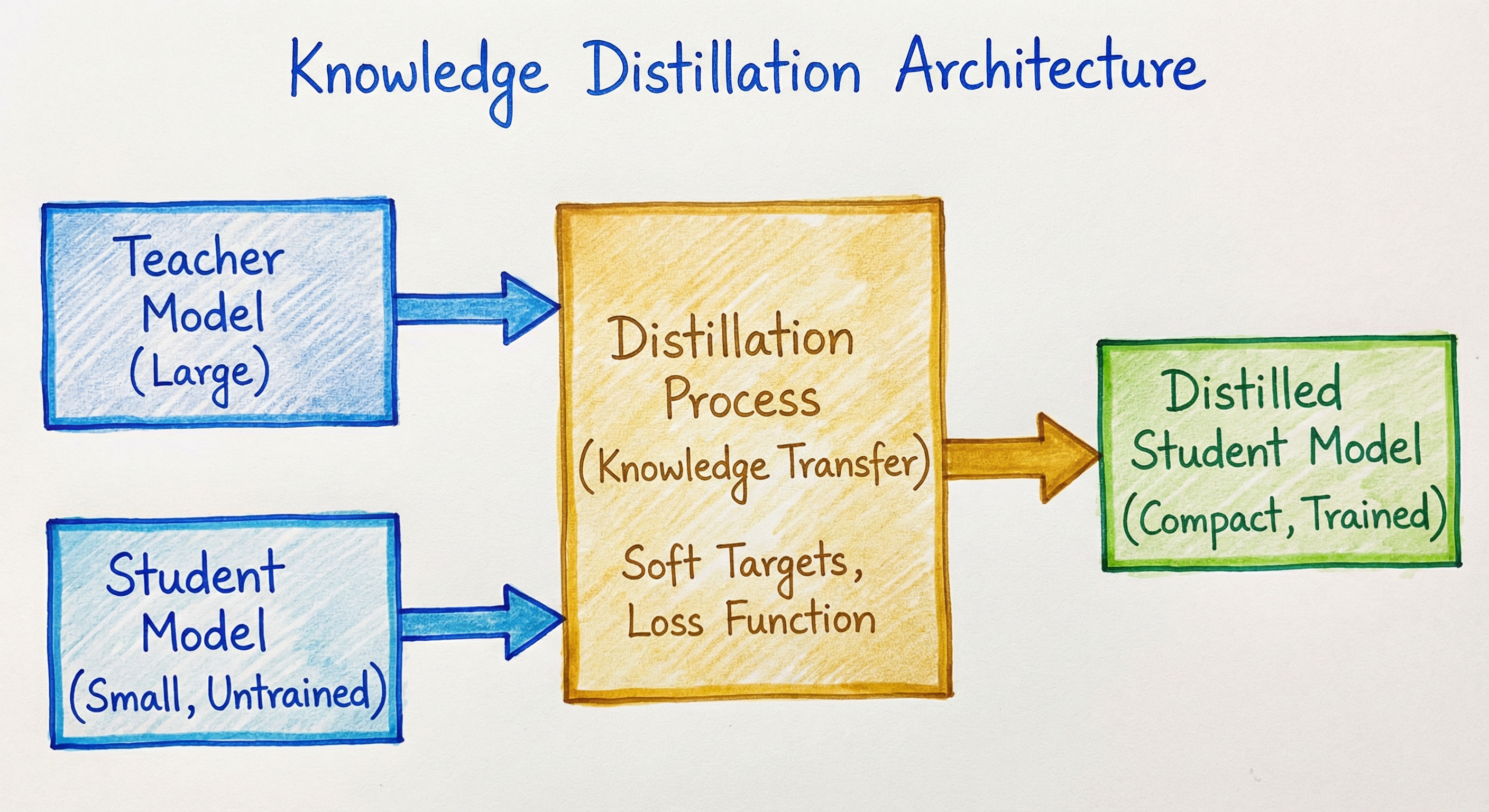
The architecture of a knowledge distillation system involves a trained teacher model, a student model being trained, and a distillation training loop that combines multiple loss signals. The teacher model is frozen (no gradient updates) and acts purely as a knowledge source. The student model is typically a smaller architecture -- fewer layers, narrower hidden dimensions, or a completely different architecture family (e.g., teacher is BERT-large, student is a 2-layer BiLSTM).
The training loop computes two forward passes per batch: one through the teacher (with torch.no_grad()) to generate soft targets, and one through the student to generate predictions. The combined loss optimizes the student to simultaneously match the hard ground-truth labels and the teacher's soft output distribution.
For feature-based distillation, additional alignment layers (projectors) bridge the dimensionality mismatch between teacher and student intermediate representations. These projectors are small learnable networks (typically a single linear layer or a 2-layer MLP) that are discarded after training.
Key Components
Teacher Model (Frozen)
The fully trained, high-capacity model that serves as the knowledge source. The teacher is frozen during distillation -- no gradients are computed for its parameters. It processes each training batch in inference mode to produce logits (and optionally intermediate feature maps) that become the supervisory signal for the student. The teacher can be a single large model, an ensemble of models, or even a model from a different architecture family.
Student Model (Trainable)
The compact model being trained via distillation. The student architecture is chosen for deployment efficiency -- fewer layers, smaller hidden dimensions, or a lightweight architecture family (MobileNet, DistilBERT, TinyLlama). The student receives gradients from both the hard-label cross-entropy loss and the soft-target KL divergence loss, learning both the ground truth and the teacher's generalization patterns.
Temperature-Scaled Softmax
Applies a temperature parameter to the logits before softmax, producing smoothed probability distributions. At temperature , the output distribution is softer (more uniform), revealing the teacher's learned inter-class similarities. Both teacher and student logits are scaled by the same temperature to ensure their distributions are comparable. Typical values: for classification, for language models.
KL Divergence Loss (Distillation Loss)
Measures the divergence between the teacher's soft output distribution and the student's soft output distribution at the same temperature . This loss encourages the student to match the teacher's full probability distribution, not just the argmax prediction. The scaling factor compensates for gradient magnitude reduction at high temperatures.
Cross-Entropy Loss (Hard Label Loss)
The standard supervised loss between the student's predictions (at ) and the ground-truth labels. This anchors the student to the correct answers and prevents the distillation signal from introducing systematic biases if the teacher itself has errors. Weighted by in the combined loss.
Feature Alignment Projector (Optional)
A small learnable network (typically a linear layer or 2-layer MLP) that bridges the dimensionality gap between teacher and student intermediate representations in feature-based distillation. For example, if the teacher has 1024-dimensional hidden states and the student has 256, the projector learns a mapping . Discarded after training.
Data Flow
Standard Distillation Path: Each training batch flows through both the teacher and student. The teacher processes with torch.no_grad() to produce logits . The student processes normally to produce logits . Both and are temperature-scaled to produce soft distributions and . The KL divergence loss is computed between these soft distributions. Simultaneously, the student's standard predictions are compared against ground-truth labels via cross-entropy . The combined loss is backpropagated through the student only.
Feature-Based Distillation Path: In addition to the output-level losses, intermediate representations from specific teacher layers and corresponding student layers are extracted. A projector network aligns the student features to the teacher's feature space. An MSE or cosine similarity loss on these aligned features provides layer-level supervision, guiding the student to develop similar internal representations.
Inference Path: After training, only the student model is deployed. The teacher model, temperature scaling, and all auxiliary loss components are discarded. The student performs standard inference at with no overhead from the distillation process.
A flowchart showing a training batch flowing into two parallel paths: a frozen teacher model (gray) producing soft targets via temperature-scaled softmax, and a trainable student model (green) producing both soft predictions and hard predictions. The soft targets and soft predictions feed into a KL divergence loss (orange). The hard predictions and ground-truth labels feed into a cross-entropy loss (blue). Both losses combine into a weighted total loss that backpropagates through the student only.
How to Implement
Implementation Approaches
There are three primary ways to implement knowledge distillation in practice:
Approach 1: Custom PyTorch Implementation -- For maximum control and understanding. You write the distillation loss, temperature scaling, and training loop explicitly. This is the best starting point for learning and for custom teacher-student architectures.
Approach 2: HuggingFace Transformers/TRL -- For NLP and LLM distillation. HuggingFace provides built-in distillation support through the Trainer API and the TRL library's GKDTrainer. Handles tokenization, distributed training, and evaluation out of the box.
Approach 3: Framework Libraries (torchdistill, KD_Lib, DistiLLM) -- For systematic experimentation across distillation methods. These libraries implement 20+ distillation algorithms and let you switch between them via configuration files.
The key implementation decision is the student architecture. Common patterns:
- Same architecture, fewer layers: DistilBERT (6 layers vs. BERT's 12) -- easiest to implement, allows layer-by-layer initialization from the teacher
- Same architecture, narrower: Reduce hidden dimensions while keeping depth -- better for feature-based distillation
- Different architecture entirely: Distill from Transformer teacher to CNN or RNN student -- maximum compression but requires careful loss design
Cost Note: Distilling a BERT-base teacher into a 6-layer DistilBERT student on the English Wikipedia + BookCorpus dataset takes ~12 hours on 8x V100 GPUs. That's approximately 0.50-2/hour (~INR 42-168/hour) in serving costs depending on traffic. For a service handling 1 million requests/day, the distillation cost is recovered within a week.
import torch
import torch.nn as nn
import torch.nn.functional as F
from torch.utils.data import DataLoader
from torchvision import datasets, transforms, models


class DistillationLoss(nn.Module):
    """Combined KD loss: alpha * CE(student, labels) + (1-alpha) * T^2 * KL(teacher_soft, student_soft)"""

    def __init__(self, temperature: float = 4.0, alpha: float = 0.3):
        super().__init__()
        self.temperature = temperature
        self.alpha = alpha
        self.ce_loss = nn.CrossEntropyLoss()
        self.kl_loss = nn.KLDivLoss(reduction="batchmean")

    def forward(
        self,
        student_logits: torch.Tensor,
        teacher_logits: torch.Tensor,
        labels: torch.Tensor,
    ) -> torch.Tensor:
        # Hard label loss (standard CE at T=1)
        hard_loss = self.ce_loss(student_logits, labels)

        # Soft target loss (KL divergence at temperature T)
        T = self.temperature
        student_soft = F.log_softmax(student_logits / T, dim=-1)
        teacher_soft = F.softmax(teacher_logits / T, dim=-1)
        soft_loss = self.kl_loss(student_soft, teacher_soft) * (T * T)

        # Combined loss
        return self.alpha * hard_loss + (1 - self.alpha) * soft_loss


def train_with_distillation(
    teacher: nn.Module,
    student: nn.Module,
    train_loader: DataLoader,
    optimizer: torch.optim.Optimizer,
    device: torch.device,
    temperature: float = 4.0,
    alpha: float = 0.3,
    epochs: int = 10,
):
    """Full distillation training loop."""
    criterion = DistillationLoss(temperature=temperature, alpha=alpha)
    teacher.eval()  # Teacher is always in eval mode

    for epoch in range(epochs):
        student.train()
        total_loss = 0.0
        correct = 0
        total = 0

        for inputs, labels in train_loader:
            inputs, labels = inputs.to(device), labels.to(device)

            # Teacher forward pass (no gradient)
            with torch.no_grad():
                teacher_logits = teacher(inputs)

            # Student forward pass
            student_logits = student(inputs)

            # Combined distillation loss
            loss = criterion(student_logits, teacher_logits, labels)

            # Backprop (only student receives gradients)
            optimizer.zero_grad()
            loss.backward()
            optimizer.step()

            total_loss += loss.item()
            _, predicted = student_logits.max(1)
            total += labels.size(0)
            correct += predicted.eq(labels).sum().item()

        acc = 100.0 * correct / total
        avg_loss = total_loss / len(train_loader)
        print(f"Epoch {epoch+1}/{epochs} | Loss: {avg_loss:.4f} | Acc: {acc:.2f}%")


# Example usage: Distill ResNet-50 (teacher) into MobileNetV2 (student)
device = torch.device("cuda" if torch.cuda.is_available() else "cpu")

# Teacher: pretrained ResNet-50
teacher = models.resnet50(weights=models.ResNet50_Weights.DEFAULT)
teacher = teacher.to(device)

# Student: MobileNetV2 (10x fewer FLOPs)
student = models.mobilenet_v2(num_classes=1000)
student = student.to(device)

# Dataset
transform = transforms.Compose([
    transforms.RandomResizedCrop(224),
    transforms.RandomHorizontalFlip(),
    transforms.ToTensor(),
    transforms.Normalize(mean=[0.485, 0.456, 0.406], std=[0.229, 0.224, 0.225]),
])
train_dataset = datasets.ImageFolder("path/to/imagenet/train", transform=transform)
train_loader = DataLoader(train_dataset, batch_size=64, shuffle=True, num_workers=4)

# Optimizer
optimizer = torch.optim.AdamW(student.parameters(), lr=1e-3, weight_decay=0.01)

# Train with distillation
train_with_distillation(
    teacher=teacher,
    student=student,
    train_loader=train_loader,
    optimizer=optimizer,
    device=device,
    temperature=4.0,
    alpha=0.3,
    epochs=100,
)
This is the complete implementation of response-based knowledge distillation. Key design decisions:
F.log_softmaxfor student,F.softmaxfor teacher: PyTorch'sKLDivLossexpects log-probabilities for the first argument and probabilities for the second. This is a common source of bugs.T * Tscaling: Compensates for gradient magnitude reduction at high temperatures. Without this, the soft-target loss is overwhelmed by the hard-label loss.reduction='batchmean': Correct normalization for KL divergence. Using'mean'would divide by the number of classes as well, underweighting the distillation signal.- Teacher in
eval()mode: Ensures batch normalization and dropout behave deterministically in the teacher.
import torch
import torch.nn.functional as F
from transformers import (
    AutoModelForSequenceClassification,
    AutoTokenizer,
    TrainingArguments,
    Trainer,
)
from datasets import load_dataset


class DistillationTrainer(Trainer):
    """Custom Trainer with knowledge distillation loss."""

    def __init__(self, teacher_model, temperature=3.0, alpha=0.5, **kwargs):
        super().__init__(**kwargs)
        self.teacher_model = teacher_model
        self.teacher_model.eval()
        self.temperature = temperature
        self.alpha = alpha
        # Move teacher to same device as student
        self.teacher_model.to(self.args.device)

    def compute_loss(self, model, inputs, return_outputs=False, **kwargs):
        labels = inputs.pop("labels")

        # Student forward pass
        student_outputs = model(**inputs)
        student_logits = student_outputs.logits

        # Teacher forward pass (no gradient)
        with torch.no_grad():
            teacher_outputs = self.teacher_model(**inputs)
            teacher_logits = teacher_outputs.logits

        # Hard label loss
        ce_loss = F.cross_entropy(student_logits, labels)

        # Soft target loss
        T = self.temperature
        student_soft = F.log_softmax(student_logits / T, dim=-1)
        teacher_soft = F.softmax(teacher_logits / T, dim=-1)
        kl_loss = F.kl_div(student_soft, teacher_soft, reduction="batchmean") * (T * T)

        # Combined loss
        loss = self.alpha * ce_loss + (1 - self.alpha) * kl_loss

        return (loss, student_outputs) if return_outputs else loss


# Load teacher (BERT-base fine-tuned on SST-2)
teacher_name = "textattack/bert-base-uncased-SST-2"
teacher_model = AutoModelForSequenceClassification.from_pretrained(teacher_name)

# Load student (DistilBERT, 40% smaller)
student_name = "distilbert-base-uncased"
student_model = AutoModelForSequenceClassification.from_pretrained(
    student_name, num_labels=2
)
tokenizer = AutoTokenizer.from_pretrained(student_name)

# Load and tokenize dataset
dataset = load_dataset("glue", "sst2")
tokenized = dataset.map(
    lambda x: tokenizer(x["sentence"], truncation=True, padding="max_length", max_length=128),
    batched=True,
)
tokenized = tokenized.rename_column("label", "labels")
tokenized.set_format("torch", columns=["input_ids", "attention_mask", "labels"])

# Training arguments
training_args = TrainingArguments(
    output_dir="./distilled-bert-sst2",
    num_train_epochs=5,
    per_device_train_batch_size=32,
    per_device_eval_batch_size=64,
    learning_rate=5e-5,
    warmup_ratio=0.1,
    evaluation_strategy="epoch",
    save_strategy="epoch",
    load_best_model_at_end=True,
    bf16=True,
)

# Distillation training
trainer = DistillationTrainer(
    teacher_model=teacher_model,
    temperature=3.0,
    alpha=0.5,
    model=student_model,
    args=training_args,
    train_dataset=tokenized["train"],
    eval_dataset=tokenized["validation"],
    tokenizer=tokenizer,
)
trainer.train()

# Save distilled student
student_model.save_pretrained("./distilled-bert-sst2-final")
This demonstrates LLM distillation using the HuggingFace ecosystem. We subclass Trainer to inject the distillation loss. Key points:
- Teacher is a fine-tuned BERT-base, student is DistilBERT (6 layers vs 12). The student inherits 6 of the teacher's 12 layers as initialization.
- Temperature=3.0: Lower than vision tasks because NLP softmax distributions over large vocabularies are already quite soft.
- Alpha=0.5: Equal weighting of hard and soft losses. For NLP, the hard labels are important because language is less ambiguous than image classification.
- The
DistillationTrainerpattern can be extended to any HuggingFace model pair.
import torch
import torch.nn as nn
import torch.nn.functional as F


class FeatureDistillationLoss(nn.Module):
    """Feature-based KD loss with projector alignment."""

    def __init__(
        self,
        teacher_dims: list[int],
        student_dims: list[int],
        temperature: float = 4.0,
        alpha: float = 0.3,
        beta: float = 0.5,  # Weight for feature loss
    ):
        super().__init__()
        self.temperature = temperature
        self.alpha = alpha
        self.beta = beta

        # Create projectors to align student features to teacher dimensions
        self.projectors = nn.ModuleList([
            nn.Linear(s_dim, t_dim)
            for s_dim, t_dim in zip(student_dims, teacher_dims)
        ])

    def forward(
        self,
        student_logits: torch.Tensor,
        teacher_logits: torch.Tensor,
        student_features: list[torch.Tensor],
        teacher_features: list[torch.Tensor],
        labels: torch.Tensor,
    ) -> torch.Tensor:
        # Response-based loss
        T = self.temperature
        ce_loss = F.cross_entropy(student_logits, labels)
        kl_loss = F.kl_div(
            F.log_softmax(student_logits / T, dim=-1),
            F.softmax(teacher_logits / T, dim=-1),
            reduction="batchmean",
        ) * (T * T)

        response_loss = self.alpha * ce_loss + (1 - self.alpha) * kl_loss

        # Feature-based loss (MSE between projected student and teacher features)
        feature_loss = 0.0
        for proj, s_feat, t_feat in zip(self.projectors, student_features, teacher_features):
            # Flatten spatial dimensions if needed (for CNN features)
            s_feat = s_feat.view(s_feat.size(0), -1) if s_feat.dim() > 2 else s_feat
            t_feat = t_feat.view(t_feat.size(0), -1) if t_feat.dim() > 2 else t_feat

            projected = proj(s_feat)
            feature_loss += F.mse_loss(projected, t_feat.detach())

        feature_loss /= len(self.projectors)

        # Total loss
        return response_loss + self.beta * feature_loss


# Usage example: matching intermediate layers
# teacher_features = [teacher.layer2_output, teacher.layer4_output]  # 512, 2048
# student_features = [student.layer1_output, student.layer2_output]  # 128, 256
# loss_fn = FeatureDistillationLoss(
#     teacher_dims=[512, 2048],
#     student_dims=[128, 256],
#     temperature=4.0,
#     alpha=0.3,
#     beta=0.5,
# )
Feature-based distillation (inspired by FitNets) adds intermediate-layer supervision. The student doesn't just learn to match the teacher's outputs -- it learns to develop similar internal representations.
Key design choices:
- Projectors: Linear layers that map student feature dimensions to teacher feature dimensions. Necessary because teacher and student typically have different hidden sizes.
- MSE loss on features: Encourages the student's intermediate representations to align with the teacher's. Cosine similarity is an alternative that's less sensitive to magnitude differences.
- beta=0.5: Controls the relative importance of feature alignment vs. output matching. Higher beta puts more emphasis on internal representation similarity.
- Detaching teacher features:
t_feat.detach()ensures no gradients flow through the teacher.
# Knowledge Distillation configuration (YAML)
teacher:
  model_name: bert-base-uncased
  checkpoint: ./teacher-finetuned/
  frozen: true

student:
  model_name: distilbert-base-uncased
  num_layers: 6
  hidden_dim: 768
  initialize_from_teacher: true  # Copy every other layer

distillation:
  method: response_based  # or feature_based, relation_based
  temperature: 4.0
  alpha: 0.3  # Weight for hard label loss
  beta: 0.5   # Weight for feature loss (if feature_based)
  hint_layers:  # For feature_based distillation
    teacher: [3, 6, 9, 11]  # Teacher layer indices
    student: [1, 2, 4, 5]   # Corresponding student layers

training:
  epochs: 10
  batch_size: 64
  learning_rate: 5e-5
  warmup_ratio: 0.1
  lr_scheduler: cosine
  gradient_checkpointing: false
  bf16: true

data:
  train_dataset: wikipedia_en  # Large unlabeled corpus for distillation
  eval_dataset: glue/sst2
  max_seq_length: 512
Common Implementation Mistakes
- ●
Forgetting the T-squared scaling factor: Without in the KL loss, the distillation gradient is suppressed by a factor of relative to the CE gradient. At , this means the soft-target signal is 25x weaker than intended. The model effectively ignores the teacher and trains on hard labels only. Always multiply the KL loss by .
- ●
Using F.softmax for both inputs to KL divergence: PyTorch's
F.kl_divexpects the first argument to be log-probabilities (F.log_softmax), not probabilities. UsingF.softmaxfor both produces incorrect gradients that can lead to divergent training. Check the PyTorch docs carefully. - ●
Setting temperature too low (T=1): At , the soft targets are nearly identical to hard labels, and the KL loss provides almost no additional information beyond the CE loss. The whole point of distillation is the soft probability tail -- you need to expose it. A common diagnostic: if the distilled student performs the same as one trained on hard labels alone, your temperature is too low.
- ●
Choosing a student that's too small relative to the teacher: There's a minimum capacity below which the student simply cannot represent the teacher's knowledge. Distilling a 175B GPT-3 into a 100M model will fail no matter how good your distillation loss is. A practical rule: the student should be at least 10-30% of the teacher's capacity (by parameter count or FLOP count) for effective distillation.
- ●
Not pre-training or pre-initializing the student: Starting the student from random initialization is wasteful. For transformer distillation, initialize the student with a subset of the teacher's layers (e.g., every other layer). For CNN distillation, use a pretrained student backbone. Pre-initialization can improve final quality by 2-5%.
- ●
Applying distillation without a transfer/unlabeled dataset: Distillation works best when the training data is large and diverse. If you only distill on the small labeled dataset, the student overfits to the teacher's behavior on those specific examples rather than learning the teacher's general knowledge. Use a large unlabeled dataset for distillation whenever possible.
When Should You Use This?
Use When
You need to reduce inference cost by 10-100x for a production model serving high traffic -- distillation creates smaller models that are cheaper per query while retaining most of the teacher's accuracy
You're deploying ML models to edge devices (mobile phones, IoT sensors, embedded systems) where model size and latency are hard constraints -- e.g., on-device NLP for Jio phones or visual inspection on factory sensors
You have a powerful teacher model (ensemble, large LLM, or expensive API model) and want to capture its knowledge in a self-hosted, cost-effective student model
You need to meet strict latency requirements (e.g., <10ms inference for real-time bidding, <50ms for autocomplete) that large models cannot achieve even with hardware acceleration
You want to compress an ensemble of multiple models into a single model for simpler deployment and reduced serving infrastructure
You have access to large amounts of unlabeled data that can be pseudo-labeled by the teacher, effectively amplifying your training signal through the teacher's generalization
You need to transfer knowledge across architectures -- e.g., from a Transformer teacher to a lightweight CNN or RNN student for specific deployment constraints
Avoid When
The teacher model is not significantly better than what the student can learn from hard labels alone -- distillation only helps when there's meaningful dark knowledge to transfer
You have very limited training data (<1K examples) and no unlabeled data -- the distillation signal needs sufficient examples to be useful; with tiny datasets, standard fine-tuning may work just as well
The capacity gap between teacher and student is too large (>100x parameter ratio) -- the student simply cannot represent the teacher's knowledge, and you'll see diminishing returns beyond a certain compression ratio
You need the absolute best possible accuracy and inference cost is not a concern -- the teacher will almost always be slightly better than the distilled student
The task is too simple for the teacher to learn meaningful soft targets -- on binary classification with clear decision boundaries, soft targets add minimal value over hard labels
You're working with privacy-sensitive data that cannot be processed by the teacher model -- if the teacher is a cloud API and the data must stay on-premise, you can't generate soft targets
Key Tradeoffs
The Core Tradeoff: Model Size vs. Accuracy
Knowledge distillation trades model capacity for inference efficiency. The fundamental question is: how much accuracy can you afford to lose?
| Compression Ratio | Typical Accuracy Retention | Inference Speedup | Example |
|---|---|---|---|
| 2x (50% smaller) | 97-99% | 1.5-2x | BERT -> DistilBERT |
| 5x (80% smaller) | 93-97% | 3-5x | ResNet-152 -> MobileNetV2 |
| 10x (90% smaller) | 88-95% | 5-10x | GPT-4 -> Phi-3-mini |
| 50-100x | 80-90% | 20-50x | 540B PaLM -> 770M T5 |
Cost-Quality Frontier
Here's a realistic cost comparison for serving an NLP classification task at 1 million requests/day:
| Model | Accuracy | Latency (p50) | Monthly Cost (AWS) | Cost (INR) |
|---|---|---|---|---|
| BERT-large (teacher) | 94.5% | 25ms | ~$2,400 | ~INR 2.0 lakh |
| DistilBERT (2x distilled) | 92.7% | 12ms | ~$900 | ~INR 75,000 |
| TinyBERT (4x distilled) | 91.1% | 6ms | ~$450 | ~INR 37,500 |
| ONNX-optimized student | 91.0% | 3ms | ~$250 | ~INR 21,000 |
The 1.8% accuracy drop from BERT-large to DistilBERT saves INR 1.25 lakh/month. For most applications, that tradeoff is overwhelmingly positive.
When Distillation Fails
Distillation struggles when:
- Distribution shift: The student deployment data differs significantly from the teacher's training data. The teacher's soft targets are only useful if they reflect the deployment distribution.
- Reasoning tasks: Complex multi-step reasoning (mathematical proofs, code generation) is harder to distill because the knowledge lives in the reasoning chain, not the output distribution. "Distilling step-by-step" addresses this by also distilling intermediate rationales.
- Rare classes: The teacher's soft targets for rare classes are dominated by noise, not signal. The student may learn to suppress rare classes even more than the teacher does.
Practitioner's Note: Always benchmark the distilled student against a student trained on hard labels alone. If the gap is less than 1%, your distillation setup is likely misconfigured (temperature too low, alpha too high, or the task doesn't benefit from soft targets).
Alternatives & Comparisons
Full fine-tuning adapts a pretrained model by updating all parameters on task-specific data, while distillation trains a separate, smaller student model. Choose full fine-tuning when you want to directly improve the model's task performance without changing its size. Choose distillation when you need a smaller, faster model for deployment. The two techniques are complementary -- you can full-fine-tune a teacher, then distill it into a compact student.
LoRA reduces training cost by learning low-rank weight updates, but the deployed model remains the same size as the base model. Distillation reduces the deployed model size, creating a fundamentally smaller model. Choose LoRA when your goal is cheaper training; choose distillation when your goal is cheaper inference. They can be combined: distill a teacher into a student, then LoRA-fine-tune the student for specific tasks.
Pruning removes redundant weights or neurons from a trained model, directly compressing it without training a separate student. Pruning preserves the original architecture structure, while distillation can change the architecture entirely. Choose pruning for moderate compression (2-5x) with minimal accuracy loss. Choose distillation for aggressive compression (5-100x) or when changing to a different, deployment-friendly architecture.
Continued pretraining adapts a model to a new domain by training on domain-specific text, keeping the model size unchanged. Distillation reduces model size, potentially while also transferring domain knowledge. Choose continued pretraining when the model size is acceptable but domain knowledge is lacking. Choose distillation when inference cost or latency is the bottleneck.
Domain adaptation techniques (adversarial training, domain-specific layers) help models generalize across domains without changing model size. Distillation transfers knowledge into a smaller model, which may also cross domain boundaries. Choose domain adaptation when the source/target domain gap is the primary challenge. Choose distillation when model size/cost is the primary challenge, and use the domain-adapted teacher as the knowledge source.
Pros, Cons & Tradeoffs
Advantages
10-100x inference cost reduction: Distilled students are dramatically cheaper to serve. DistilBERT is 60% faster than BERT with 97% accuracy retention. For a service like PhonePe processing millions of fraud detection queries, this translates to crores in annual infrastructure savings.
Architecture flexibility: Unlike pruning or quantization, distillation allows the student to have a completely different architecture than the teacher. You can distill a Transformer teacher into a CNN, RNN, or even a decision tree -- whatever best fits your deployment constraints.
Works with black-box teachers: You don't need access to the teacher's weights or architecture -- only its output predictions. This enables distilling from proprietary API models (GPT-4, Claude) into open-source students, though API terms of service should be checked.
Implicit regularization: The teacher's soft targets act as a regularizer, smoothing the student's training signal. This often leads to better generalization than training on hard labels alone, especially with limited labeled data.
Ensemble compression: Multiple teacher models can be compressed into a single student, capturing the diversity of the ensemble in a deployable single model. The student often outperforms any individual teacher.
Unlabeled data utilization: The teacher can pseudo-label large amounts of unlabeled data, providing the student with significantly more training signal. This is especially valuable in domains where labeled data is expensive (medical, legal, financial).
Composable with other compression techniques: Distillation combines naturally with quantization, pruning, and architecture search. A distilled + quantized model achieves even greater compression ratios.
Disadvantages
Requires a trained teacher model: You first need to train (or access) a high-quality teacher, which is itself expensive. The total cost is teacher training + distillation training, though the distillation cost is typically much smaller.
Non-trivial quality gap on complex tasks: For tasks requiring deep reasoning, multi-step logic, or rare-event detection, the student may lose 5-15% of the teacher's capability. The gap widens as the compression ratio increases.
Temperature and alpha tuning: The distillation hyperparameters (temperature, loss weighting, learning rate) require experimentation to optimize. Poor choices can result in a student that's worse than one trained on hard labels alone.
Teacher bias propagation: The student inherits the teacher's biases and failure modes. If the teacher has systematic errors (e.g., demographic bias in classification), these are distilled into the student. You cannot distill away problems -- only knowledge.
Capacity floor: There is a minimum student capacity below which distillation cannot compensate for the capacity gap. Attempting to distill a 175B model into a 1M parameter model will fail regardless of technique.
Training data requirements: Effective distillation requires a substantial amount of data (typically 10K+ examples for classification, 100K+ for language generation). With very small datasets, the soft targets don't provide enough signal to outperform hard-label training.
Computational overhead during distillation training: Each training step requires a forward pass through both the teacher and student. For large teachers, this doubles the per-step compute cost compared to standard training.
Failure Modes & Debugging
Capacity Gap Collapse
Cause
The student model is too small relative to the teacher -- the capacity ratio is below the effective distillation threshold (typically >100x parameter ratio). The student literally cannot represent the teacher's learned function, no matter how good the soft targets are.
Symptoms
Training loss decreases normally but evaluation metrics plateau far below the teacher's performance (>10% gap). The student's soft output distributions are much sharper than the teacher's, indicating it can't replicate the nuanced probability structure. Increasing training time doesn't help.
Mitigation
Use an intermediate-sized teacher assistant model: first distill the large teacher into a medium model, then distill the medium model into the small student. This progressive distillation bridges the capacity gap. Alternatively, increase the student's capacity until the gap narrows to <10x.
Temperature Miscalibration
Cause
Temperature set too high or too low for the task. Too high () flattens all distributions to near-uniform, drowning the signal in noise. Too low () makes soft targets identical to hard labels, eliminating the distillation benefit.
Symptoms
At too-high : training is unstable, gradients are noisy, and the student converges to a poor solution that outputs near-uniform distributions. At too-low : distilled student performs identically to one trained on hard labels alone -- no benefit from the teacher.
Mitigation
Start with for classification and for language modeling. Validate by comparing soft-target entropy at different temperatures: ideal temperature produces teacher distributions with entropy between 20-80% of maximum entropy. Run a quick sweep over and select the temperature that maximizes student validation accuracy.
Teacher Bias Amplification
Cause
The teacher has systematic biases (demographic, class-imbalance, domain-specific) that the student amplifies because it lacks the capacity to learn the underlying true distribution and instead memorizes the teacher's biased soft targets.
Symptoms
The student exhibits worse fairness metrics than the teacher -- higher false positive rates for underrepresented groups, stronger class imbalance biases, or amplified spurious correlations. Performance on edge cases and minority classes degrades more in the student than expected from the capacity reduction.
Mitigation
Apply bias-aware distillation: re-weight training examples to upweight underrepresented groups, use debiased soft targets (calibrate teacher outputs before distillation), or add fairness constraints to the student's loss function. Post-distillation, run bias audits comparing teacher and student on disaggregated metrics.
Distribution Mismatch Between Distillation and Deployment
Cause
The data used for distillation (generating soft targets) differs significantly from the data the student will encounter in production. The teacher's soft targets encode its understanding of the training distribution, which may not transfer to a shifted deployment distribution.
Symptoms
Student performs well on distillation validation set but poorly in production. The student's confidence is miscalibrated -- high confidence on inputs that are actually out-of-distribution for the teacher. Performance degrades gradually as the deployment data drifts from the distillation data.
Mitigation
Use production-representative data for distillation, not just the teacher's training set. Collect unlabeled production data, run it through the teacher to generate soft targets, and include these in the distillation dataset. Implement continuous distillation where the teacher periodically generates fresh soft targets on recent production data.
Feature Alignment Failure in Deep Distillation
Cause
In feature-based distillation, the projector networks that align student and teacher intermediate representations converge to a degenerate solution -- mapping all student features to a constant vector that minimizes MSE with teacher features in expectation.
Symptoms
Feature alignment loss decreases to near-zero early in training, but the student's task performance doesn't improve or even degrades. The projector outputs become nearly constant regardless of input. The student's intermediate representations lose discriminative power.
Mitigation
Use cosine similarity instead of MSE for feature alignment (less susceptible to magnitude collapse). Add batch normalization to projector outputs. Initialize projectors with a pretrained mapping (e.g., linear regression from student to teacher features on a small calibration set). Use contrastive feature loss (CRD) instead of direct feature matching.
Placement in an ML System
Where Distillation Fits in the ML System
In a production ML pipeline, knowledge distillation sits in the model compression and optimization stage, between model training and model deployment. The typical workflow:
- Train or acquire teacher model: Fine-tune a large model on the target task, or use a pre-trained model (including API-based models like GPT-4).
- Select student architecture: Choose a compact architecture that meets deployment constraints (latency, memory, power consumption).
- Distillation training: Train the student on soft targets from the teacher, optionally with intermediate feature alignment.
- Post-distillation optimization: Apply quantization (INT8/INT4), pruning, or ONNX compilation for further speedup.
- Evaluation and deployment: Benchmark the student against accuracy thresholds and deploy to production.
For Indian tech companies, the deployment target often dictates the distillation strategy. Jio's on-device AI for 450 million feature phones requires aggressive distillation to models under 50MB. Flipkart's product search needs sub-10ms latency, driving distillation to lightweight architectures. Razorpay's fraud detection needs high accuracy and low latency, requiring careful alpha/temperature tuning to minimize the accuracy-latency tradeoff.
Multi-Stage Distillation Pattern: For very large compression ratios (>50x), organizations like Google and Microsoft use multi-stage distillation chains: GPT-4 -> 70B intermediate -> 7B student -> 1.3B edge model. Each stage compresses by ~5-10x, which is more effective than a single 50x compression step.
Pipeline Stage
Training / Model Compression
Upstream
- Teacher model training (fully trained high-capacity model)
- Training data preparation (labeled + unlabeled data)
- Student architecture selection
Downstream
- Model evaluation and benchmarking
- Model quantization / ONNX export (further optimization)
- Model serving infrastructure (edge devices, cloud endpoints)
Scaling Bottlenecks
The primary bottleneck during distillation training is teacher inference cost. Every training batch requires a forward pass through the teacher, which for large teachers (>10B parameters) can dominate the total training time. For a 70B teacher and a 7B student, the teacher forward pass takes ~5x longer than the student's forward + backward pass.
Mitigation strategies:
- Pre-compute teacher logits: Run the teacher once on the entire training set and cache the soft targets to disk. This trades storage for compute (but requires significant storage for large datasets with large vocabulary).
- Teacher quantization: Run the teacher in INT8 or INT4 during soft target generation. The small precision loss in teacher outputs rarely affects distillation quality.
- Batch teacher inference: Process large batches through the teacher on high-memory GPUs, generating soft targets in bulk.
At serving time, the bottleneck shifts to the student model itself. If further optimization is needed, distillation is typically followed by quantization (INT8/INT4) and ONNX export for runtime-specific optimizations.
Production Case Studies
HuggingFace researchers created DistilBERT by distilling BERT-base into a 6-layer model (from 12 layers), using a triple loss combining language modeling, distillation, and cosine-distance losses. The distillation was performed during pretraining on the English Wikipedia and Toronto BookCorpus, making the resulting model a general-purpose compressed BERT that could be fine-tuned on any downstream task.
DistilBERT retained 97% of BERT's language understanding (as measured on GLUE benchmark) while being 40% smaller (66M vs 110M parameters) and 60% faster at inference. It became the most downloaded model on HuggingFace Hub, deployed by thousands of companies for production NLP. Training cost: ~$1,500 (~INR 1.26 lakh) on 8x V100 GPUs for 90 hours.
Google researchers developed "Distilling Step-by-Step," which extracts not just the teacher's output labels but also its intermediate reasoning rationales as supervision for the student. A 770M parameter T5 model was trained with rationale distillation from a 540B PaLM model. The rationales served as an additional training signal, teaching the student how to reason, not just what to predict.
The 770M T5 student outperformed the 540B PaLM teacher on four NLU benchmarks while being 700x smaller. It also outperformed standard fine-tuning using only 12.5% of the original training data. This technique was made available on Google Cloud Vertex AI for enterprise customers.
Microsoft's Phi model family (Phi-1 through Phi-4) demonstrated that systematically distilling knowledge from GPT-4 through synthetic data generation can produce small models with disproportionate capability. Phi-4 (14B parameters) was trained on 400B tokens of synthetic data generated by GPT-4, carefully curated to cover reasoning, code, math, and general knowledge. While not traditional logit-based distillation, this represents a new paradigm of knowledge transfer through synthetic data.
Phi-4 (14B) surpassed GPT-4 on STEM-focused QA benchmarks despite being ~100x smaller, demonstrating that distillation through synthetic data can exceed teacher performance in specific domains. Phi-3-mini (3.8B) ran on mobile devices with acceptable latency. The Phi family proved that small, well-distilled models can compete with frontier LLMs for specific use cases at a fraction of the cost (~INR 1/query vs ~INR 5/query).
Predibase demonstrated that task-specific distilled and fine-tuned small models consistently outperform GPT-4 on domain-specific tasks. They fine-tuned 25+ LoRA adapters on Mistral 7B using a combination of knowledge distillation from GPT-4 outputs and task-specific labeled data. This showed that the combination of distillation + task-specific fine-tuning creates a powerful compression pipeline.
Task-specific distilled Mistral 7B models outperformed GPT-4 on 25 out of 25 evaluated tasks, with an average improvement of 14 percentage points. Serving costs dropped from 0.60/million tokens** (distilled Mistral 7B). For an Indian e-commerce company processing 10 million product queries daily, this represents savings of ~INR 45 lakh/month.
Tooling & Ecosystem
PyTorch's official knowledge distillation tutorial provides a complete implementation using only torch and torchvision. Covers response-based distillation with temperature scaling and the combined CE + KL loss. The best starting point for understanding the fundamentals before moving to higher-level libraries.
HuggingFace Transformers provides built-in distillation support through the Trainer API. Includes examples for image classification distillation (ViT teacher -> MobileNet student) and NLP distillation. The TRL library extends this with GKDTrainer for generalized knowledge distillation of language models, including on-policy distillation.
A coding-free framework built on PyTorch for reproducible distillation experiments. Implements 26 knowledge distillation methods from papers at CVPR, ICLR, NeurIPS, ECCV, and AAAI. Configuration-driven: switch distillation methods by editing a YAML file without writing code. Part of the official PyTorch Ecosystem since December 2023.
Official implementation of the ICML 2024 paper "DistiLLM: Towards Streamlined Distillation for Large Language Models." Introduces skew KL divergence loss and adaptive off-policy training for LLM distillation. Achieves 4.3x speedup over baseline KD methods while maintaining quality. Supports GPT-2, OPT, and OpenLLaMA model families.
A comprehensive PyTorch library for knowledge distillation, pruning, and quantization benchmarking. Implements vanilla KD, attention transfer, FitNets, relational KD, and several other methods. Developed by the AI research group at BITS Pilani (India), making it particularly relevant for the Indian ML community.
Huawei's Montreal NLP team's collection of knowledge distillation methods specifically for NLP models. Includes adversarial distillation, combined KD (ComKD), and progressive training approaches. Targets BERT-family model compression for edge deployment on Huawei devices.
Research & References
Hinton, Vinyals & Dean (2015)NeurIPS 2014 Workshop (arXiv 2015)
The foundational knowledge distillation paper. Introduced temperature-scaled soft targets as a mechanism to transfer "dark knowledge" from large teacher models (or ensembles) to compact student models. Demonstrated effective ensemble compression and established the KD loss formulation () that remains the standard today.
Romero, Ballas, Kahou, Chassang, Gatta & Bengio (2015)ICLR 2015
Introduced feature-based distillation, extending KD beyond output matching to intermediate representation alignment. Showed that thin, deep student networks can be guided by teacher hidden layer activations ("hints"), achieving better compression than output-only distillation. Foundational work that influenced all subsequent feature-based and attention-transfer distillation methods.
Sanh, Debut, Chaumond & Wolf (2019)NeurIPS 2019 Workshop on Energy Efficient ML
Applied knowledge distillation to BERT pretraining with a triple loss (language modeling + distillation + cosine distance). Produced a 6-layer model retaining 97% of BERT-base's language understanding at 60% faster inference. Became the most impactful practical application of KD in NLP, with millions of downloads on HuggingFace Hub.
Hsieh, Li, Yeh, Nakhost, Fujii, Ratner, Krishna, Lee & Pfister (2023)ACL 2023 (Findings)
Proposed distilling not just teacher outputs but also intermediate reasoning rationales. A 770M T5 student outperformed a 540B PaLM teacher by leveraging extracted rationales as multi-task supervision. Demonstrated that structured knowledge transfer (chain-of-thought) is more effective than logit-only distillation for reasoning tasks.
Gou, Yu, Maybank & Tao (2021)International Journal of Computer Vision (IJCV)
Comprehensive survey categorizing KD methods into response-based, feature-based, and relation-based distillation. Reviews training schemes (offline, online, self-distillation), teacher-student architectures, and applications across vision, NLP, and speech. The definitive reference for understanding the KD landscape and choosing appropriate methods.
Furlanello, Lipton, Tschannen, Itti & Anandkumar (2018)ICML 2018
Demonstrated that self-distillation -- training a student with the same architecture as the teacher -- produces models that outperform the original teacher. This surprising result challenged the assumption that distillation is only useful for model compression and opened the door to self-distillation as a general training improvement technique.
Ko, Kim, Chen & Yun (2024)ICML 2024
Introduced skew KL divergence and adaptive off-policy training for efficient LLM distillation. Achieved 4.3x speedup over baseline KD methods while maintaining quality. Demonstrated effectiveness across GPT-2, OPT, and OpenLLaMA model families, establishing new best practices for auto-regressive model distillation.
Interview & Evaluation Perspective
Common Interview Questions
- ●
Explain the knowledge distillation loss function. What role does temperature play?
- ●
What is 'dark knowledge' in the context of distillation? Why are soft targets more informative than hard labels?
- ●
Compare response-based, feature-based, and relation-based distillation. When would you use each?
- ●
How would you design a distillation pipeline to compress a 70B LLM into a 7B model for production?
- ●
What is self-distillation? How can a student outperform its teacher?
- ●
How do you choose the right temperature and alpha for distillation?
- ●
What are the limitations of knowledge distillation? When does it fail?
- ●
Design a system for a company like Flipkart that needs to serve 10M product classification queries/day with <5ms latency using a distilled model.
Key Points to Mention
- ●
The KD loss has two components: . The factor compensates for gradient scaling at high temperatures -- without it, the distillation signal is times too weak.
- ●
Temperature controls the softness of the output distribution. Higher T reveals inter-class relationships (dark knowledge). T=1 degenerates to hard-label training. Typical: T=3-5 for classification, T=1-2 for LLMs.
- ●
Three types of distillation knowledge: response-based (final outputs), feature-based (intermediate representations, FitNets), and relation-based (inter-sample relationships, RKD). Feature-based is most effective for large capacity gaps.
- ●
Self-distillation (Born-Again Networks) trains a same-sized student from the teacher's soft targets and consistently outperforms the teacher by 1-2%. This works because soft targets regularize training and transfer ensemble-like knowledge.
- ●
Cost comparison: serving DistilBERT vs BERT saves ~60% in inference cost. At Indian startup scale (1M requests/day), that's ~INR 1.25 lakh/month saved. The distillation training cost (~INR 8,000) is recovered in 2-3 days.
- ●
Progressive distillation chains (Teacher -> Medium -> Small) are more effective than single-step large-to-small distillation when the compression ratio exceeds 10x.
- ●
Modern LLM distillation (Phi models, distilling-step-by-step) goes beyond logit matching -- it distills reasoning chains, synthetic data, and structured knowledge.
Pitfalls to Avoid
- ●
Claiming distillation only works for model compression -- self-distillation improves even same-sized models. Distillation is a general training technique, not just a compression method.
- ●
Forgetting the T-squared scaling factor in the loss function -- this is the most common implementation bug and a red flag in interviews.
- ●
Saying the student always performs worse than the teacher -- distilled students can outperform teachers in specific domains (Phi-4 beats GPT-4 on math) or through self-distillation.
- ●
Not discussing the practical aspects: teacher inference cost during training, how to handle the teacher forward pass at scale, pre-computing soft targets, and the storage requirements for cached logits.
- ●
Ignoring the capacity floor: attempting to distill into an arbitrarily small student will fail. There's a minimum viable student size for each teacher-task combination.
Senior-Level Expectation
A senior/staff engineer should discuss knowledge distillation across three dimensions: (1) Theory: articulate the dark knowledge concept, explain why soft targets transfer more information than hard labels (entropy argument), compare the three distillation types with mathematical precision, and discuss the T-squared scaling derivation. (2) Engineering: cover the full distillation pipeline including teacher inference optimization (pre-computing logits, teacher quantization for soft target generation), student architecture selection heuristics, and multi-stage progressive distillation for extreme compression ratios. (3) System Design: design a production distillation system with continuous teacher re-distillation as data distributions shift, model registry integration for versioning teacher-student pairs, A/B testing distilled vs. teacher models, and cost-benefit analysis with concrete numbers (INR per request, latency p99, accuracy retention). A staff-level answer should also address LLM-specific distillation -- chain-of-thought distillation, synthetic data generation as implicit distillation, and the architectural decisions behind DistilBERT/Phi/Gemma model families.
Summary
What We Covered
Knowledge distillation is a model compression technique where a compact student model is trained to replicate the behavior of a larger teacher model using soft targets -- temperature-scaled probability distributions that carry richer information than hard labels. The foundational formulation by Hinton et al. (2015) uses a combined loss: , where the temperature controls how much "dark knowledge" (inter-class relationships, uncertainty patterns) is exposed in the teacher's outputs.
The landscape of distillation extends well beyond output matching. Feature-based distillation (FitNets) aligns intermediate representations between teacher and student, providing layer-level supervision that's especially effective for large capacity gaps. Relation-based distillation preserves inter-sample relationships. Self-distillation (Born-Again Networks) shows that even same-sized students can outperform their teachers through soft-target regularization. In the LLM era, new paradigms have emerged: chain-of-thought distillation (Google's distilling-step-by-step) transfers reasoning rationales alongside predictions, while synthetic data distillation (Microsoft's Phi family) generates training data from teacher models, achieving remarkable results with small student models.
The practical impact of knowledge distillation is measured in inference cost reduction: DistilBERT serves at 60% faster with 97% accuracy retention, Phi-3-mini runs on mobile devices at ~100x lower cost than GPT-4, and task-specific distilled models consistently outperform generic large models on specialized benchmarks. For Indian companies deploying AI at scale -- Jio's 450 million users, Flipkart's product search, Razorpay's fraud detection -- distillation is the bridge between frontier model capability and production-viable inference economics. The key decisions are: student architecture (same family with fewer layers, or different architecture entirely), distillation type (response, feature, or relation-based), temperature ( for classification, for LLMs), and compression ratio (single-step for <10x, progressive distillation for >10x).