ORPO in Machine Learning
ORPO (Odds Ratio Preference Optimization) is a monolithic preference optimization algorithm that combines supervised fine-tuning (SFT) and preference alignment into a single training stage -- without requiring a reference model. Introduced by Hong, Lee, and Thorne (2024) at KAIST AI, ORPO appends an odds ratio-based penalty term to the standard negative log-likelihood (NLL) loss, simultaneously teaching the model to follow instructions and to prefer chosen responses over rejected ones.
Traditional LLM alignment follows a multi-stage pipeline: first SFT on instruction-response pairs, then preference optimization via RLHF (which requires a reward model and RL loop) or DPO (which requires a frozen reference model). ORPO collapses this entire pipeline into a single training pass. The key insight is that standard SFT inadvertently increases the probability of both chosen and rejected responses -- ORPO fixes this by adding a log odds ratio term that penalizes rejected completions while amplifying chosen ones.
The practical implications are significant: ORPO requires only one copy of the model in memory (no reference model), needs no reward model training, and converges faster because it avoids the instability of RL-based methods. Fine-tuning Mistral-7B with ORPO on UltraFeedback achieved 12.20% on AlpacaEval 2.0 and 7.32 on MT-Bench, outperforming comparable DPO and RLHF models. For teams with limited compute budgets -- especially startups in India and smaller research labs -- ORPO offers an accessible path to well-aligned language models at a fraction of the cost and complexity of traditional approaches.
Concept Snapshot
- What It Is
- A single-stage preference optimization algorithm that unifies supervised fine-tuning and preference alignment by appending an odds ratio loss term to the standard NLL objective, eliminating the need for a reference model or reward model.
- Category
- Model Training
- Complexity
- Advanced
- Inputs / Outputs
- Inputs: pretrained base LLM + preference dataset with (prompt, chosen, rejected) triplets. Outputs: an aligned model that follows instructions and prefers high-quality responses.
- System Placement
- Replaces the traditional two-stage pipeline (SFT then DPO/RLHF) with a single training pass. Sits between pretraining (upstream) and deployment/evaluation (downstream).
- Also Known As
- Odds Ratio Preference Optimization, monolithic preference optimization, reference-free preference alignment, single-stage alignment
- Typical Users
- ML Engineers, LLM Alignment Researchers, Applied AI Scientists, AI Startup Teams, NLP Practitioners
- Prerequisites
- Supervised fine-tuning (SFT) fundamentals, Preference datasets (chosen/rejected pairs), Cross-entropy loss and language modeling, Basic understanding of DPO and RLHF objectives, GPU training infrastructure
- Key Terms
- odds ratiopreference alignmentreference modelNLL losslambda parameterchosen responserejected responsemonolithic traininglog odds ratioUltraFeedback
Why This Concept Exists
The Multi-Stage Alignment Problem
The standard recipe for aligning an LLM with human preferences has long been a multi-stage affair. RLHF (Ouyang et al., 2022) introduced a three-stage pipeline: (1) supervised fine-tuning on demonstrations, (2) reward model training on preference pairs, and (3) PPO-based reinforcement learning against the reward model. This works -- InstructGPT and ChatGPT proved it -- but it is expensive, unstable, and complex to implement. The RL loop in particular requires careful tuning of KL penalties, reward scaling, and PPO hyperparameters.
DPO (Rafailov et al., 2023) simplified this to two stages by eliminating the reward model and RL loop entirely. Instead of training a separate reward model, DPO reparameterizes the reward function in terms of the policy itself, resulting in a simple classification loss over preference pairs. But DPO still requires an SFT warmup stage and a frozen reference model during preference optimization, which means two copies of the model in GPU memory.
The Insight Behind ORPO
Hong et al. (2024) made a crucial empirical observation: during standard SFT training, the model increases the log probability of both the chosen and rejected responses. This makes sense -- SFT trains on the chosen responses, and since chosen and rejected responses share similar tokens and patterns, the rejected response probabilities rise as a side effect. This means SFT actually undermines preference alignment by inflating the probability of outputs you want the model to avoid.
This observation motivated ORPO's core design: instead of running SFT first and then fixing the preference problem in a second stage, why not add a preference signal during SFT itself? By appending a log odds ratio term to the NLL loss, ORPO simultaneously teaches the model to generate good responses (via NLL) and to discriminate between good and bad responses (via the odds ratio penalty).
Why This Matters for the Field
ORPO represents a broader trend in LLM alignment toward simpler, more unified training procedures. The progression from RLHF (three stages) to DPO (two stages) to ORPO (one stage) mirrors the field's maturation: as we better understand what alignment training actually needs, we can strip away unnecessary complexity. For resource-constrained teams -- whether at an Indian AI startup with a single A100 or at a university lab -- this simplification is not just convenient, it is enabling. ORPO makes preference-aligned LLMs accessible to organizations that could not justify the infrastructure for RLHF or even the memory overhead of DPO's reference model.
Key Takeaway: ORPO exists because multi-stage alignment pipelines are unnecessarily complex for many use cases. By unifying SFT and preference optimization into a single loss function, ORPO delivers competitive alignment quality with dramatically less compute, memory, and engineering overhead.
Core Intuition & Mental Model
The Restaurant Analogy
Imagine you are training a new chef. The traditional approach (RLHF) works like this: first, you teach the chef to cook by following recipes (SFT). Then you hire a food critic to taste dishes and assign scores (reward model). Finally, you have the chef cook hundreds of dishes, get scored by the critic, and gradually improve (RL loop). It works, but it is expensive and slow.
DPO simplifies this: you skip the food critic. Instead, you show the chef pairs of dishes -- "this one was preferred, this one was not" -- and the chef learns to tell the difference. But you still need a separate recipe-following phase first.
ORPO goes further: you hand the chef preference pairs from day one. "Here's a good version of this dish and a bad version. Learn to cook the good one and understand why the bad one is worse." The chef learns technique and taste simultaneously. No critic needed, no separate phases.
Why the Odds Ratio?
The odds ratio is a natural measure of preference strength. If the model assigns probability to the chosen response and to the rejected response, the odds ratio is:
When , the model already prefers the chosen response. When , the model incorrectly prefers the rejected response. ORPO's loss pushes to be large, which means the model strongly discriminates between good and bad outputs.
The beauty of this formulation is that it is relative: it does not require the absolute probabilities to hit any particular target, just that the chosen response be favored over the rejected one by a sufficient margin. This makes training stable -- the model is not chasing an absolute reward signal but a relative preference.
The Single-Stage Magic
The key intuition for why ORPO works in a single stage: the NLL loss on chosen responses handles the "learn to generate good text" part, while the odds ratio penalty handles the "learn to avoid bad text" part. These two objectives are not in conflict -- they reinforce each other. The NLL loss pulls the chosen response probability up, and the odds ratio penalty simultaneously pushes the rejected response probability down. Together, they produce a model that is both fluent and aligned.
Technical Foundations
ORPO Loss Formulation
Let denote the model parameters. Given a dataset of prompts with chosen responses and rejected responses , the ORPO loss combines two terms:
Component 1: SFT Loss (NLL)
The first component is the standard causal language modeling loss on the chosen response:
This is the same cross-entropy loss used in standard instruction tuning, computed only on the chosen response tokens (with prompt tokens masked).
Component 2: Odds Ratio Loss
Define the average log probability of a response given prompt as:
The odds of generating response are:
The odds ratio between chosen and rejected responses is:
The odds ratio loss is the negative log-sigmoid of the log odds ratio:
where is the sigmoid function. This loss is minimized when , i.e., when the model strongly prefers the chosen response.
The Lambda Parameter
The hyperparameter controls the relative weight of the preference signal versus the language modeling objective:
- Small (e.g., 0.1): Emphasis on fluency/instruction following; weak preference alignment
- Large (e.g., 1.0-10.0): Stronger preference alignment; may slightly sacrifice fluency
- Recommended range: , with the original paper using to depending on the model
Key Mathematical Properties
-
No reference model: Unlike DPO, which computes , ORPO's odds ratio is computed entirely with the current model . This eliminates the need to keep a frozen copy of the model in memory.
-
Gradient dynamics: The SFT gradient increases while the OR gradient simultaneously decreases . This dual action prevents the "probability inflation" problem observed in standard SFT.
-
Relationship to DPO: If we set the reference model in DPO to a uniform distribution, the DPO objective simplifies to something structurally similar to ORPO's odds ratio term, though the exact formulations differ.
Formal Property: ORPO is a monolithic alignment algorithm -- it does not decompose into separable stages. The SFT and preference signals interact during every gradient step, meaning the model never passes through an "aligned but poor at instruction following" or "instruction-following but misaligned" intermediate state.
Internal Architecture
The ORPO training pipeline is notably simpler than RLHF or DPO because it has no separate stages. A single training loop processes preference data (prompt, chosen, rejected triplets), computes the combined SFT + odds ratio loss, and updates the model parameters.
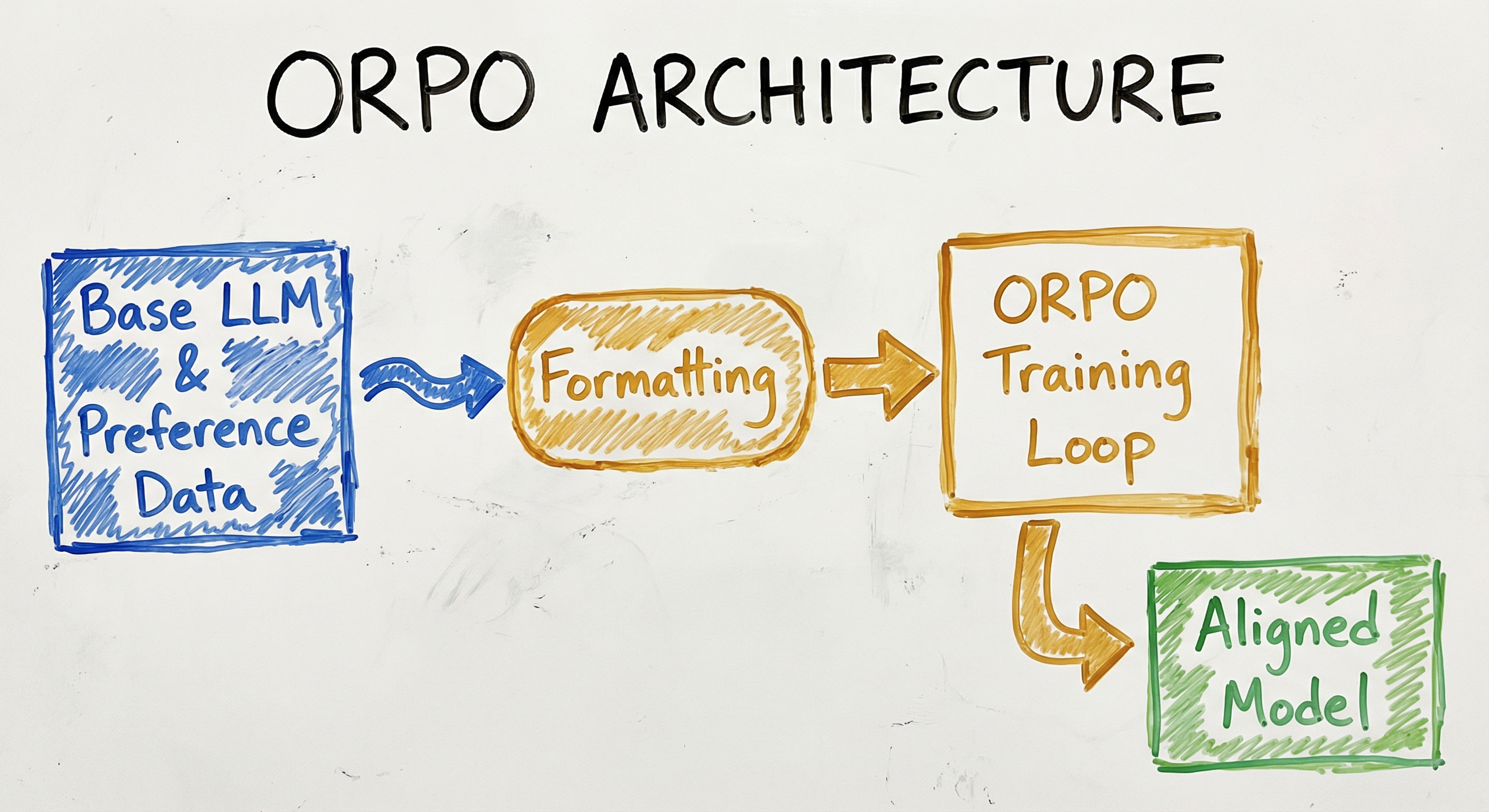
The architecture's simplicity is its primary advantage. Compare this with RLHF (which requires four models: policy, reference, reward, and value function) or DPO (which requires two models: policy and reference). ORPO needs only the single model being trained. This translates directly to GPU memory savings: training a 7B model with ORPO requires roughly half the memory of DPO, because you eliminate the reference model entirely.
Key Components
Preference Dataset Loader
Loads and preprocesses preference data in the format (prompt, chosen_response, rejected_response). Common source datasets include UltraFeedback (Argilla's cleaned binarized version with 61K examples), DPO-mix datasets, and Capybara-DPO. The loader handles tokenization of both chosen and rejected responses from the same prompt, ensuring consistent padding and truncation.
Chat Template Formatter
Applies the model-specific chat template to prompts and responses. For example, LLaMA-3 uses <|start_header_id|>user<|end_header_id|> markers. Both chosen and rejected responses must be formatted identically to avoid spurious signal from template differences. This component uses tokenizer.apply_chat_template() to ensure consistency.
Prompt Masking Module
Masks the prompt tokens in the loss computation. For the SFT (NLL) component, loss is computed only on chosen response tokens. For the odds ratio component, average log probabilities are computed over response tokens only (both chosen and rejected). Labels for prompt positions are set to -100 to exclude them from the cross-entropy calculation.
NLL Loss Computer
Computes the standard causal language modeling (next-token prediction) loss on the chosen response tokens only. This is identical to the SFT loss used in instruction tuning. It teaches the model fluency and instruction following.
Odds Ratio Loss Computer
Computes the average log probabilities for both chosen and rejected responses, converts them to odds, computes the log odds ratio, and applies the log-sigmoid loss. This component handles the preference signal, pushing the model to discriminate between good and bad outputs.
Lambda-Weighted Loss Combiner
Combines the NLL loss and odds ratio loss using the weighting parameter : total_loss = nll_loss + lambda * or_loss. The lambda parameter is the primary hyperparameter unique to ORPO, controlling the strength of the preference signal relative to the language modeling objective.
ORPO Trainer
The main training loop that orchestrates forward passes on both chosen and rejected responses, computes the combined loss, performs backpropagation, and updates model weights. Implementations include HuggingFace TRL's ORPOTrainer, Axolotl's ORPO mode, and LLaMA-Factory's ORPO support.
Data Flow
Here's the end-to-end data flow for a single training step:
1. Data Loading: A batch of (prompt, chosen, rejected) triplets is loaded from the preference dataset. Each triplet is formatted using the model's chat template.
2. Tokenization: Both prompt + chosen and prompt + rejected are tokenized. Prompt tokens are identified for loss masking. This produces two sets of input_ids and labels.
3. Forward Pass (Chosen): The model processes prompt + chosen, producing logits. The NLL loss is computed on chosen response tokens. The average log probability of the chosen response is recorded.
4. Forward Pass (Rejected): The model processes prompt + rejected, producing logits. The average log probability of the rejected response is recorded. No NLL loss is computed on rejected tokens.
5. Odds Ratio Computation: The log odds ratio between chosen and rejected is computed from their average log probabilities. The log-sigmoid of this ratio gives the OR loss.
6. Loss Combination: The final loss is NLL_loss + lambda * OR_loss.
7. Backward Pass: Gradients flow through both the chosen and rejected forward passes, simultaneously increasing chosen response probability and decreasing rejected response probability.
A linear flow diagram showing: Pretrained Base LLM feeds into a Preference Dataset, which is formatted via Chat Template, tokenized with Prompt Masking, and processed through the ORPO Training Loop. Inside the training loop, NLL Loss on Chosen and Odds Ratio Loss are computed and combined with Lambda weighting into the Combined ORPO Loss. The output is an Aligned Model that proceeds to an Evaluation Suite.
How to Implement
Implementation Approaches
ORPO is straightforward to implement because it requires no reference model, no reward model, and no RL loop. The entire algorithm reduces to two forward passes per batch (one for chosen, one for rejected), a simple loss computation, and a standard backward pass.
Option 1: HuggingFace TRL ORPOTrainer -- The most popular and well-maintained implementation. TRL's ORPOTrainer handles all the details: chat template formatting, prompt masking, odds ratio computation, and logging of training metrics (chosen/rejected log probabilities, odds ratio, NLL loss, OR loss). This is the recommended approach for most teams.
Option 2: Axolotl -- Configuration-driven ORPO training via YAML files. Set rl: orpo in your Axolotl config, point to a preference dataset, and Axolotl handles the rest. Best for teams that want reproducible experiments without writing training code.
Option 3: LLaMA-Factory -- Unified web UI-based training that supports ORPO alongside DPO, PPO, and other methods. Especially popular in Asian ML communities for its ease of use.
Option 4: Custom Implementation -- ORPO is simple enough to implement from scratch in ~100 lines of PyTorch. The official repository at xfactlab/orpo provides reference code.
Cost Context for India: ORPO training of a 7B model on 60K preference pairs takes approximately 3-6 hours on a single A100 80GB GPU, costing 5.50-11). Because ORPO eliminates the separate SFT stage, total training cost is roughly 40-50% lower than the SFT + DPO pipeline. For a 13B model, expect 6-12 hours on 2x A100, costing $36-72 (~INR 3,000-6,000).
from datasets import load_dataset
from transformers import AutoTokenizer, AutoModelForCausalLM
from trl import ORPOConfig, ORPOTrainer
from peft import LoraConfig

# Load base model and tokenizer
model_name = "meta-llama/Meta-Llama-3-8B"
tokenizer = AutoTokenizer.from_pretrained(model_name)
tokenizer.pad_token = tokenizer.eos_token

model = AutoModelForCausalLM.from_pretrained(
    model_name,
    torch_dtype="auto",
    device_map="auto",
)

# Load preference dataset (prompt, chosen, rejected)
dataset = load_dataset(
    "argilla/ultrafeedback-binarized-preferences-cleaned",
    split="train"
)

# LoRA configuration for memory efficiency
peft_config = LoraConfig(
    r=16,
    lora_alpha=32,
    lora_dropout=0.05,
    target_modules=["q_proj", "k_proj", "v_proj", "o_proj"],
    task_type="CAUSAL_LM",
)

# ORPO training configuration
orpo_config = ORPOConfig(
    output_dir="./orpo-llama3-8b",
    num_train_epochs=1,
    per_device_train_batch_size=2,
    gradient_accumulation_steps=8,
    learning_rate=8e-6,
    lr_scheduler_type="linear",
    warmup_ratio=0.1,
    beta=0.1,                   # Lambda parameter (called beta in TRL)
    max_length=2048,
    max_prompt_length=512,
    bf16=True,
    logging_steps=10,
    save_strategy="epoch",
    optim="adamw_torch",
    gradient_checkpointing=True,
)

# Initialize trainer and train
trainer = ORPOTrainer(
    model=model,
    args=orpo_config,
    train_dataset=dataset,
    peft_config=peft_config,
    tokenizer=tokenizer,
)

trainer.train()
trainer.save_model("./orpo-llama3-8b-final")
This example demonstrates ORPO training using HuggingFace TRL's ORPOTrainer. Key configuration choices: (1) beta=0.1 is the lambda parameter controlling preference weight -- TRL calls it beta following DPO convention; (2) learning_rate=8e-6 is lower than typical SFT because ORPO performs both SFT and alignment simultaneously; (3) max_prompt_length=512 truncates prompts to leave room for responses within max_length; (4) LoRA with r=16 enables training on a single A100 GPU; (5) gradient_checkpointing=True further reduces memory at the cost of ~20% slower training. The trainer automatically handles the dual forward pass (chosen + rejected), odds ratio computation, and combined loss.
import torch
import torch.nn.functional as F
from transformers import AutoTokenizer, AutoModelForCausalLM

def compute_orpo_loss(
    model,
    chosen_input_ids: torch.Tensor,
    chosen_labels: torch.Tensor,
    rejected_input_ids: torch.Tensor,
    rejected_labels: torch.Tensor,
    lambda_weight: float = 0.1,
) -> dict:
    """Compute the ORPO loss manually for educational purposes."""

    # Forward pass on chosen response
    chosen_logits = model(chosen_input_ids).logits
    # Shift logits and labels for next-token prediction
    shift_chosen_logits = chosen_logits[..., :-1, :].contiguous()
    shift_chosen_labels = chosen_labels[..., 1:].contiguous()

    # NLL loss on chosen (only on response tokens where labels != -100)
    nll_loss = F.cross_entropy(
        shift_chosen_logits.view(-1, shift_chosen_logits.size(-1)),
        shift_chosen_labels.view(-1),
        ignore_index=-100,
    )

    # Average log probability of chosen response
    chosen_mask = (shift_chosen_labels != -100).float()
    chosen_log_probs = F.log_softmax(shift_chosen_logits, dim=-1)
    chosen_token_log_probs = chosen_log_probs.gather(
        -1, shift_chosen_labels.clamp(min=0).unsqueeze(-1)
    ).squeeze(-1)
    chosen_avg_log_prob = (chosen_token_log_probs * chosen_mask).sum() / chosen_mask.sum()

    # Forward pass on rejected response
    rejected_logits = model(rejected_input_ids).logits
    shift_rejected_logits = rejected_logits[..., :-1, :].contiguous()
    shift_rejected_labels = rejected_labels[..., 1:].contiguous()

    # Average log probability of rejected response
    rejected_mask = (shift_rejected_labels != -100).float()
    rejected_log_probs = F.log_softmax(shift_rejected_logits, dim=-1)
    rejected_token_log_probs = rejected_log_probs.gather(
        -1, shift_rejected_labels.clamp(min=0).unsqueeze(-1)
    ).squeeze(-1)
    rejected_avg_log_prob = (rejected_token_log_probs * rejected_mask).sum() / rejected_mask.sum()

    # Compute odds ratio
    chosen_odds = torch.exp(chosen_avg_log_prob) / (1 - torch.exp(chosen_avg_log_prob))
    rejected_odds = torch.exp(rejected_avg_log_prob) / (1 - torch.exp(rejected_avg_log_prob))
    log_odds_ratio = torch.log(chosen_odds / rejected_odds)

    # Odds ratio loss: negative log-sigmoid of log odds ratio
    or_loss = -F.logsigmoid(log_odds_ratio)

    # Combined ORPO loss
    total_loss = nll_loss + lambda_weight * or_loss

    return {
        "total_loss": total_loss,
        "nll_loss": nll_loss.item(),
        "or_loss": or_loss.item(),
        "log_odds_ratio": log_odds_ratio.item(),
        "chosen_avg_log_prob": chosen_avg_log_prob.item(),
        "rejected_avg_log_prob": rejected_avg_log_prob.item(),
    }

# Example usage
model = AutoModelForCausalLM.from_pretrained(
    "meta-llama/Meta-Llama-3-8B",
    torch_dtype=torch.bfloat16,
    device_map="auto",
)

# In practice, chosen_input_ids/labels and rejected_input_ids/labels
# come from your data collator. Labels have -100 for prompt tokens.
print("ORPO loss components:")
print("  total_loss = nll_loss + lambda * or_loss")
print("  where or_loss = -log_sigmoid(log(odds_chosen / odds_rejected))")
This manual implementation shows the inner workings of the ORPO loss for educational purposes. The key steps: (1) NLL loss is standard cross-entropy on chosen response tokens, identical to SFT; (2) Average log probabilities are computed for both chosen and rejected responses over their respective response tokens (prompt tokens masked out); (3) Odds conversion transforms log probabilities to odds via exp(log_p) / (1 - exp(log_p)); (4) Log odds ratio measures how strongly the model prefers the chosen response; (5) Log-sigmoid loss on the log odds ratio pushes the ratio to be large and positive. The lambda_weight parameter (default 0.1) balances the two loss components. In production, use TRL's ORPOTrainer which handles numerical stability, padding, and batching correctly.
# axolotl config for ORPO training
base_model: meta-llama/Meta-Llama-3-8B
model_type: LlamaForCausalLM
tokenizer_type: AutoTokenizer

load_in_4bit: true
adapter: lora
lora_r: 16
lora_alpha: 32
lora_dropout: 0.05
lora_target_modules:
  - q_proj
  - k_proj
  - v_proj
  - o_proj

# ORPO-specific settings
rl: orpo
orpo_alpha: 0.1  # Lambda parameter

datasets:
  - path: argilla/ultrafeedback-binarized-preferences-cleaned
    type: orpo.chat_template
    chat_template: llama3

sequence_len: 2048
max_prompt_len: 512

val_set_size: 0.02
wandb_project: orpo-training

gradient_accumulation_steps: 8
micro_batch_size: 2
num_epochs: 1
learning_rate: 8e-6
lr_scheduler: linear
warmup_ratio: 0.1
optimizer: adamw_torch

bf16: true
tf32: true
gradient_checkpointing: true
save_strategy: epoch
This Axolotl YAML configuration provides a no-code approach to ORPO training. Key settings: rl: orpo activates ORPO mode, orpo_alpha: 0.1 sets the lambda parameter, and type: orpo.chat_template ensures the preference dataset is formatted correctly for ORPO training. The rest follows standard fine-tuning configuration. Axolotl handles data loading, tokenization, loss computation, and training loop management. This is the fastest path to ORPO training for teams that prefer configuration over code.
# HuggingFace TRL ORPOConfig key parameters
# (YAML-style for readability)

output_dir: ./orpo-output
beta: 0.1                    # Lambda/alpha parameter (preference weight)
max_length: 2048              # Max total sequence length
max_prompt_length: 512        # Max prompt length before truncation
learning_rate: 8e-6           # Lower than SFT (8e-6 to 5e-5)
num_train_epochs: 1           # Usually 1 epoch is sufficient
per_device_train_batch_size: 2
gradient_accumulation_steps: 8  # Effective batch size = 16
lr_scheduler_type: linear
warmup_ratio: 0.1
bf16: true
gradient_checkpointing: true
logging_steps: 10
save_strategy: epoch
optim: adamw_torch
Common Implementation Mistakes
- ●
Setting lambda (beta) too high: Using
beta > 1.0in the ORPOTrainer often causes training instability. The odds ratio loss can dominate the NLL loss, leading to fluency degradation. Start withbeta=0.1and increase cautiously. The original paper used values between 0.1 and 1.0 depending on the model. - ●
Using an SFT-tuned model as the starting point: ORPO is designed to replace SFT + preference alignment. Starting from an already SFT-tuned model means the model has already learned instruction following, and the NLL component of ORPO provides redundant signal. Use a base pretrained model, not an instruct variant.
- ●
Wrong chat template for preference data: The chosen and rejected responses must use identical chat template formatting. If there's any formatting difference between chosen and rejected (e.g., different special tokens), the odds ratio will capture template artifacts rather than genuine quality differences.
- ●
Too few training steps: ORPO does more work per step than standard SFT (two forward passes per batch), so it needs fewer total steps than you might expect. But training for too few steps (< 500) often means the odds ratio signal hasn't converged. Monitor the log odds ratio -- it should be positive and increasing during training.
- ●
Ignoring learning rate: ORPO typically requires a lower learning rate than standard SFT (8e-6 vs 2e-4 for LoRA SFT). Using SFT-scale learning rates with ORPO can cause the odds ratio loss to oscillate wildly. The original paper used 5e-5 for full fine-tuning and 8e-6 is common for LoRA.
- ●
Not monitoring the odds ratio during training: The log odds ratio between chosen and rejected responses is the key diagnostic metric. If it stays near zero or goes negative during training, something is wrong (usually the lambda is too small or the learning rate is too high). TRL's ORPOTrainer logs this metric automatically.
When Should You Use This?
Use When
You have a base pretrained model (not already instruction-tuned) and want to simultaneously teach it instruction following and preference alignment in a single training run
You have limited GPU memory and cannot afford to keep a reference model alongside the training model -- ORPO needs only one model copy, halving memory requirements compared to DPO
You want a simpler training pipeline with fewer moving parts -- no reward model training, no RL loop, no reference model management
You have access to preference data (chosen/rejected pairs) and want to use it directly without a separate SFT stage
Your team has limited ML engineering bandwidth -- ORPO requires tuning fewer hyperparameters than RLHF (no KL penalty, no reward scaling, no PPO clipping) and fewer stages than DPO (no separate SFT config)
You are a startup or small team (especially in compute-constrained environments like India) where minimizing training cost and infrastructure complexity is critical
You want fast iteration: ORPO trains in a single pass, so the feedback loop from data change to evaluated model is shorter than multi-stage pipelines
Avoid When
You need fine-grained control over the alignment process -- separating SFT from preference optimization lets you independently tune each stage, which ORPO's monolithic approach does not allow
You already have a high-quality SFT model and only need preference alignment on top -- in this case, DPO or SimPO applied to the existing SFT model is more appropriate than retraining from scratch with ORPO
Your preference data is noisy or low quality -- ORPO's single-stage approach means bad preference data degrades both instruction following and alignment simultaneously. With separate stages, bad preference data only affects the alignment stage, leaving your SFT model intact
You need state-of-the-art safety alignment -- for safety-critical applications, multi-stage pipelines with constitutional AI or RLHF still provide stronger safety guarantees because each stage can be independently validated
You want to use online preference learning (iterative RLHF with live human feedback) -- ORPO is an offline algorithm that assumes a fixed preference dataset. Online methods like PPO with live rewards are better for iterative alignment
You are training on a very small preference dataset (< 1K pairs) -- the odds ratio signal may not converge with too few examples, and standard SFT on the chosen responses alone may work just as well
Key Tradeoffs
Simplicity vs. Control
ORPO's biggest strength -- collapsing SFT and preference alignment into one stage -- is also its biggest limitation. In a two-stage pipeline, you can independently validate your SFT model (check instruction following quality, benchmark on MT-Bench) before adding preference alignment. If the SFT model is bad, you fix the SFT data; if the alignment is bad, you fix the preference data. With ORPO, these are entangled: if the resulting model is poor, it is harder to diagnose whether the problem is the instruction data quality or the preference signal quality.
| Method | Stages | Models in Memory | Reference Model | Reward Model | Typical GPU Memory (7B) |
|---|---|---|---|---|---|
| RLHF | 3 | 4 (policy, ref, reward, value) | Yes | Yes | ~112 GB |
| DPO | 2 | 2 (policy + reference) | Yes | No | ~56 GB |
| ORPO | 1 | 1 (policy only) | No | No | ~28 GB |
Quality vs. Efficiency
Empirical results show ORPO matches or exceeds DPO on standard benchmarks (AlpacaEval, MT-Bench, IFEval) for models up to 7B parameters. However, at larger scales (>13B) and on nuanced safety benchmarks, multi-stage approaches with careful tuning can still outperform ORPO. The question is whether the marginal quality difference justifies 2-3x the training time and cost.
Lambda Sensitivity
The lambda parameter introduces a hyperparameter that balances two objectives. In practice, the optimal lambda varies by model, dataset, and task. Most practitioners find that works well, but this still requires some experimentation. With DPO, the beta parameter serves a similar role but operates on a different scale and is better studied.
Cost Comparison for Indian Teams: Training a 7B model end-to-end with ORPO on E2E Networks (Indian cloud provider) costs approximately INR 450-900 for a single run. The equivalent SFT + DPO pipeline would cost INR 900-1,800 (double, because of two training stages and the reference model memory overhead during DPO). For a startup doing 10 training runs to iterate on data and hyperparameters, the total saving is INR 4,500-9,000 ($55-110) -- meaningful at early-stage budgets.
Alternatives & Comparisons
DPO requires a separate SFT stage before preference optimization and keeps a frozen reference model during training (2x memory). ORPO eliminates both requirements, training in a single stage with a single model copy. Choose DPO when you already have a high-quality SFT model and want to add preference alignment on top, or when you need the diagnostic clarity of separate stages. Choose ORPO when starting from a base model and want maximum simplicity and efficiency.
RLHF is the most powerful but most complex alignment method, requiring SFT, reward model training, and PPO optimization (three stages, four models). It offers the finest control and strongest safety alignment but costs 3-4x more in compute and engineering time. Choose RLHF for safety-critical applications where you need a separate reward model for ongoing evaluation. Choose ORPO when RLHF's complexity is unjustified for your use case.
Reward modeling trains a separate model to score responses, which is then used by RLHF's PPO stage. ORPO bypasses reward modeling entirely by embedding the preference signal directly into the training loss. Choose reward modeling when you need a reusable reward model for tasks beyond alignment (e.g., best-of-N sampling, rejection sampling at inference). Choose ORPO when you only need the preference signal during training.
Constitutional AI uses AI feedback against a set of principles to self-improve, providing strong safety alignment with minimal human feedback. CAI typically uses an RLHF-style pipeline internally. ORPO is simpler and cheaper but does not provide the principle-driven safety guarantees of CAI. Choose CAI for applications requiring robust safety alignment; choose ORPO for general-purpose alignment where compute efficiency matters most.
Standard instruction tuning trains only on chosen responses with no preference signal -- it teaches instruction following but not preference discrimination. ORPO subsumes instruction tuning by including the NLL loss on chosen responses and adding the odds ratio preference term. Choose instruction tuning when you lack preference data (only have instruction-response pairs, not chosen/rejected pairs). Choose ORPO when you have preference data and want alignment in a single pass.
Pros, Cons & Tradeoffs
Advantages
Single-stage training: Eliminates the need for separate SFT and preference alignment stages, reducing pipeline complexity and total training time by 40-60% compared to SFT + DPO.
No reference model required: Unlike DPO, ORPO does not need a frozen copy of the base model during training, halving GPU memory requirements. A 7B model ORPO run fits on a single A100 40GB with LoRA, while DPO would need 80GB or two GPUs.
No reward model needed: Unlike RLHF, ORPO does not require training a separate reward model, eliminating an entire training stage and the associated data curation for reward model training.
Competitive benchmark performance: ORPO matches or exceeds DPO and RLHF on standard alignment benchmarks. Mistral-ORPO-beta achieved 12.20% on AlpacaEval 2.0 and 7.32 on MT-Bench, outperforming comparable DPO models.
Simple implementation: The ORPO loss is straightforward to implement -- it is just NLL loss plus a weighted log-sigmoid odds ratio term. No RL loop, no KL penalty, no reward normalization. This makes debugging and iteration faster.
Addresses SFT probability inflation: ORPO directly solves the problem that standard SFT increases the probability of both chosen and rejected responses, which other methods require a separate stage to fix.
Lower total training cost: By combining two stages into one, ORPO reduces total GPU hours, data preparation overhead, and engineering time. Especially impactful for budget-constrained teams and Indian AI startups.
Disadvantages
Less diagnostic clarity: Because SFT and preference optimization are entangled in a single loss, it is harder to diagnose whether poor results are caused by bad instruction data or bad preference data. Multi-stage pipelines allow independent validation of each stage.
Lambda sensitivity: The lambda (beta) parameter controlling preference weight requires tuning per model and dataset. Setting it too high degrades fluency; too low and alignment is weak. There is no universal default.
Less fine-grained control: You cannot independently adjust the SFT learning rate, schedule, or data mix separately from the preference optimization. In a two-stage pipeline, each stage has its own configuration.
Limited to offline preference data: ORPO requires a fixed preference dataset upfront. It cannot incorporate live human feedback during training, unlike online RLHF approaches.
Less studied at scale: Most ORPO results are on 7B models. The method's performance characteristics at 30B+ scale are less well understood compared to DPO and RLHF, which have been validated at GPT-4 scale.
Requires preference data from the start: Unlike pure SFT (which only needs instruction-response pairs), ORPO requires chosen/rejected pairs. If you only have demonstration data, you need to generate rejected responses synthetically or collect preference annotations.
Failure Modes & Debugging
Lambda too high causing fluency collapse
Cause
Setting the (beta) parameter too high (e.g., > 2.0) causes the odds ratio loss to dominate the NLL loss. The model over-optimizes for preference discrimination at the expense of text generation quality.
Symptoms
The model produces responses that avoid rejected patterns but are incoherent, repetitive, or truncated. Perplexity on general text increases sharply. The log odds ratio metric looks great (large positive values) but actual output quality degrades.
Mitigation
Start with and increase gradually. Monitor both the log odds ratio and perplexity/NLL loss during training. If NLL loss increases while OR loss decreases, lambda is too high. The original paper recommends .
Starting from an instruct model instead of base model
Cause
Using an already instruction-tuned model (e.g., Llama-3-8B-Instruct) as the starting point for ORPO. Since the model already follows instructions, the NLL component of ORPO provides redundant signal, and the odds ratio may destabilize the existing alignment.
Symptoms
Training loss is very low from the start (the model already knows how to generate chosen-style responses). But the final model may actually be worse than the starting instruct model on benchmarks, because the ORPO loss perturbs the existing alignment without clear benefit.
Mitigation
Always start ORPO from a base pretrained model, not an instruct variant. If you already have an SFT model and want to add preference alignment, use DPO or SimPO instead of ORPO.
Preference data quality contamination
Cause
The preference dataset contains noisy labels (chosen responses that are actually worse than rejected ones), or the quality difference between chosen and rejected is too small for the model to learn meaningful preferences.
Symptoms
The log odds ratio oscillates around zero during training and never clearly becomes positive. The resulting model shows no improvement in alignment benchmarks over a plain SFT baseline. In severe cases, the model may develop unpredictable response quality -- sometimes good, sometimes bad.
Mitigation
Audit preference data quality before training. Use established high-quality datasets like UltraFeedback (Argilla cleaned version) or Capybara-DPO. For custom datasets, verify that annotators have > 85% inter-rater agreement on preference rankings. Apply LLM-as-judge filtering to remove ambiguous pairs.
Catastrophic forgetting of base capabilities
Cause
Training for too many epochs or with too high a learning rate causes the model's pretrained knowledge to degrade. ORPO modifies model weights more aggressively than standard SFT because the odds ratio loss actively pushes the model away from rejected response patterns.
Symptoms
Instruction following improves but factual knowledge, reasoning, and multilingual capabilities degrade. MMLU scores drop 5-15 points. The model may start hallucinating or producing grammatically incorrect text, especially in languages with limited representation in the preference dataset.
Mitigation
Train for at most 1-2 epochs with ORPO. Use a conservative learning rate (5e-6 to 8e-6 for LoRA). Monitor capability benchmarks (MMLU, ARC, HellaSwag) alongside alignment benchmarks during training. Consider using LoRA to limit the number of parameters being modified.
Numerical instability in odds computation
Cause
When sequence-level probabilities are very close to 0 or 1, the odds computation can produce extremely large values or NaN. This happens with very long sequences or when the model is highly confident about certain tokens.
Symptoms
Training loss spikes to NaN or infinity. Gradient norms explode. The training run crashes, often inconsistently across different random seeds.
Mitigation
Use log-space computation throughout (TRL's implementation does this correctly). Clamp probabilities to avoid extreme odds values. Ensure numerical precision with bf16 or fp32 accumulation. The TRL ORPOTrainer handles this automatically with appropriate epsilon values.
Placement in an ML System
Where ORPO Sits in the ML System
ORPO occupies a unique position: it replaces the traditional two-stage pipeline of SFT followed by preference optimization. In terms of pipeline placement:
- Pretraining (upstream): The base model is pretrained on web-scale text. Optionally, continued pretraining adapts it to a specific domain.
- ORPO (this stage): A single training run on preference data simultaneously teaches instruction following and preference alignment.
- Evaluation and Deployment (downstream): The aligned model is evaluated on benchmarks (MT-Bench, AlpacaEval, IFEval), registered in a model registry, and deployed to a serving endpoint.
For production ML systems at Indian companies like Flipkart, Razorpay, or Zerodha building internal AI assistants, ORPO simplifies the training infrastructure significantly. Instead of maintaining separate SFT and DPO training pipelines with different data formats, hyperparameters, and evaluation protocols, teams can maintain a single ORPO pipeline. This reduces the ML platform engineering burden and makes the training process more accessible to smaller teams.
Note that ORPO does not replace the need for safety-specific alignment. For user-facing applications that require robust safety guarantees (e.g., healthcare assistants, financial advisors), teams should consider adding a safety-focused alignment stage (constitutional AI, safety-specific DPO) after ORPO, even though ORPO provides some preference alignment out of the box.
Pipeline Stage
Training / Alignment
Upstream
- full-fine-tuning
- lora-fine-tuning
- continued-pretraining
Downstream
- model-registry
- model-serving-endpoint
- knowledge-distillation
Scaling Bottlenecks
ORPO's primary scaling bottleneck is that it requires two forward passes per training step (one for chosen, one for rejected), doubling the activation memory compared to standard SFT. For a 7B model with sequence length 2048, this means approximately 24GB of activation memory per GPU on top of the model parameters and optimizer states. With LoRA, a single A100 40GB handles this comfortably. Full fine-tuning of a 7B model requires ZeRO-3 or model parallelism across 2+ GPUs.
Unlike SFT (where you can train on single instruction-response pairs), ORPO requires triplets of (prompt, chosen, rejected). High-quality preference data is more expensive to collect than instruction-response pairs: each example requires generating at least two responses and having them ranked. At scale, synthetic preference data generation (using a strong LLM as judge) is the practical approach.
ORPO scales linearly with model size and dataset size. For a 70B model, expect 4x A100 80GB with LoRA or 8x H100 with full fine-tuning. Training time is roughly 2x a comparable SFT run (due to dual forward passes) but 0.5x the total time of SFT + DPO (because there's only one stage).
Production Case Studies
The original ORPO paper by Hong, Lee, and Thorne at KAIST AI demonstrated the method by training Mistral-ORPO-alpha and Mistral-ORPO-beta on the UltraFeedback dataset (61K preference pairs). The models were trained on Mistral-7B-v0.1 (a base model, not instruct) in a single stage, without SFT warmup or reference model.
Mistral-ORPO-beta achieved 12.20% on AlpacaEval 2.0, 7.32 on MT-Bench, and 66.19% on IFEval (instruction-level loose), outperforming larger models and multi-stage DPO/RLHF baselines. The model achieved 14.7% length-controlled win rate on the official AlpacaEval leaderboard.
ML researcher Maxime Labonne published a widely-referenced tutorial on fine-tuning Llama-3-8B with ORPO using the TRL library. The tutorial used a 40K-example preference dataset combining multiple DPO datasets (ultrafeedback, capybara, intel-orca, math-preference) and trained with QLoRA for memory efficiency.
The resulting model demonstrated competitive performance with established instruction-tuned Llama-3 variants, proving that ORPO is practical for the open-source community. The tutorial became one of the most popular ORPO implementation guides and was featured on Towards Data Science.
Argilla, a data-centric AI platform, published a comprehensive comparison of ORPO against other alignment methods (RLHF, DPO, IPO, KTO, SimPO) as part of their MantisNLP collaboration. They provided the cleaned UltraFeedback-binarized dataset that became the standard training dataset for ORPO experiments, and benchmarked ORPO's efficiency and quality against alternatives.
Their analysis confirmed that ORPO matches DPO in alignment quality while being significantly more computationally efficient (single stage, no reference model). The UltraFeedback-binarized-preferences-cleaned dataset they curated became the de facto standard for ORPO training, used in the original paper and most subsequent ORPO experiments.
ORPO (Odds Ratio Preference Optimization) is a reference model-free monolithic preference optimization algorithm by Hong et al. (2024). The paper demonstrates both empirically and theoretically that odds ratio is effective for contrasting favored and disfavored styles during SFT across model sizes from 125M to 7B parameters.
Fine-tuning Phi-2 (2.7B), Llama-2 (7B), and Mistral (7B) with ORPO on UltraFeedback alone surpasses state-of-the-art models with 7B+ and 13B+ parameters, achieving up to 12.20% on AlpacaEval 2.0, 66.19% on IFEval (instruction-level loose), and 7.32 in MT-Bench. Published at EMNLP 2024.
Tooling & Ecosystem
HuggingFace TRL's ORPOTrainer is the most popular and well-maintained implementation of ORPO. It provides built-in support for preference data loading, chat template formatting, prompt masking, odds ratio computation, and training metrics logging. The ORPOConfig class exposes the beta parameter (ORPO's lambda) and all standard training arguments.
The official reference implementation from the ORPO paper authors at KAIST AI. Contains the core ORPO loss computation, training scripts, and evaluation code used to produce the paper's results. Useful for understanding the exact implementation details and reproducing paper results.
Axolotl supports ORPO training via its configuration-driven approach. Set rl: orpo in the YAML config and point to a preference dataset. Axolotl handles data formatting, tokenization, loss computation, and training management. Ideal for teams that prefer YAML configs over Python training scripts.
LLaMA-Factory provides ORPO support through its unified web UI and CLI. Supports ORPO alongside DPO, PPO, SimPO, and KTO for 100+ model architectures. Popular in Asian ML communities for its ease of use and visual training interface. Added ORPO support in March 2024.
Unsloth provides 2-5x faster fine-tuning through custom CUDA kernels. While it does not have a native ORPO trainer, it patches TRL's ORPOTrainer via PatchDPOTrainer for accelerated ORPO training. Enables ORPO training of 7B models on consumer GPUs (RTX 4090, 24GB VRAM) with QLoRA.
Argilla is a data-centric AI platform for building and curating preference datasets. It provides tools for collecting human preference annotations, cleaning and filtering preference pairs, and exporting datasets in formats compatible with ORPO training. Their cleaned UltraFeedback dataset is the standard ORPO training dataset.
Research & References
Hong, Lee & Thorne (2024)EMNLP 2024
The foundational ORPO paper. Introduces the odds ratio preference loss that combines SFT and preference alignment into a single stage without a reference model. Demonstrates competitive performance with DPO and RLHF on AlpacaEval, MT-Bench, and IFEval using Phi-2, Llama-2, and Mistral models.
Rafailov, Sharma, Mitchell, Ermon, Manning & Finn (2023)NeurIPS 2023
The DPO paper that ORPO builds upon. DPO eliminated the reward model and RL loop from RLHF but still requires a separate SFT stage and a frozen reference model. ORPO further simplifies DPO by removing the reference model requirement and merging SFT into the preference optimization stage.
Ouyang, Wu, Jiang, Almeida, et al. (2022)NeurIPS 2022
The three-stage RLHF pipeline paper that established the standard alignment approach ORPO aims to simplify. InstructGPT demonstrated SFT + reward modeling + PPO, requiring four models in memory. ORPO achieves comparable alignment quality with a single model and one training stage.
Meng, Xia & Chen (2024)NeurIPS 2024
SimPO, like ORPO, eliminates the reference model using length-normalized average log probabilities as the implicit reward. It differs from ORPO in using a margin-based reward difference rather than an odds ratio. SimPO represents a parallel effort to simplify preference optimization and outperforms DPO on AlpacaEval and Arena-Hard.
Ethayarajh, Xu, Muennighoff, Jurafsky & Kiela (2024)ICML 2024
KTO proposes alignment using only binary feedback (desirable/undesirable) rather than paired preferences, based on Kahneman-Tversky prospect theory. Unlike ORPO which requires chosen/rejected pairs, KTO works with unpaired data. Matches DPO performance at scales from 1B to 30B parameters.
Wang et al. (2024)arXiv preprint
A comprehensive survey categorizing 13+ alignment techniques including ORPO, DPO, KTO, SimPO, IPO, and others. Places ORPO in the broader landscape of preference optimization methods and discusses its advantages and limitations relative to multi-stage approaches.
Interview & Evaluation Perspective
Common Interview Questions
- ●
What is ORPO and how does it differ from DPO and RLHF?
- ●
Explain the odds ratio loss formulation in ORPO. Why odds ratio instead of simple probability difference?
- ●
Why does standard SFT increase the probability of both chosen and rejected responses? How does ORPO address this?
- ●
What role does the lambda parameter play in ORPO? How would you tune it?
- ●
When would you choose ORPO over DPO? When would DPO be preferable?
- ●
How does ORPO achieve memory efficiency compared to DPO and RLHF?
- ●
What are the limitations of a single-stage alignment approach like ORPO?
Key Points to Mention
- ●
ORPO unifies SFT and preference alignment into a single training stage with a single model -- no reference model, no reward model. The loss is simply
NLL + lambda * log_sigmoid(log_odds_ratio). - ●
The key insight: standard SFT inadvertently increases the probability of both chosen and rejected responses. ORPO fixes this by adding the odds ratio penalty that actively pushes rejected response probabilities down.
- ●
ORPO uses roughly half the GPU memory of DPO (one model vs. two) and one quarter the memory of RLHF (one model vs. four). For a 7B model, this means training on a single A100 40GB with LoRA.
- ●
Benchmarks: Mistral-ORPO-beta achieved 12.20% AlpacaEval 2.0 and 7.32 MT-Bench, outperforming comparable DPO and RLHF models trained on the same Mistral-7B base.
- ●
The tradeoff: ORPO sacrifices diagnostic clarity (can't independently validate SFT and alignment stages) for simplicity and efficiency. For production systems needing fine-grained control, multi-stage is better.
- ●
Lambda (beta) tuning is critical: too low (< 0.05) and alignment is weak; too high (> 2.0) and fluency degrades. Start with 0.1, the paper's recommended default.
Pitfalls to Avoid
- ●
Claiming ORPO is strictly better than DPO/RLHF -- it trades control and diagnostic clarity for simplicity. Multi-stage pipelines still have advantages for safety-critical applications and large-scale models.
- ●
Confusing the lambda (beta) parameter with DPO's beta -- they serve similar roles (preference weight) but operate on different loss formulations and have different optimal ranges.
- ●
Forgetting to mention that ORPO requires a base pretrained model, not an instruct model. Starting from an instruct model defeats the purpose of the SFT component.
- ●
Not knowing the actual benchmark numbers. Being able to cite '12.20% AlpacaEval, 7.32 MT-Bench for Mistral-ORPO-beta' demonstrates you've read the paper.
- ●
Ignoring the SFT probability inflation insight. The empirical observation that SFT increases rejected response probabilities is the entire motivation for ORPO -- discuss it.
Senior-Level Expectation
A senior/staff candidate should be able to articulate the full mathematical progression from RLHF to DPO to ORPO, explaining exactly which components each method eliminates and why. They should discuss when ORPO's single-stage approach breaks down -- specifically, in scenarios requiring fine-grained control over alignment (safety-critical applications), very large models (>30B), or online feedback loops. They should compare ORPO with SimPO and KTO as alternative reference-free methods, noting that SimPO uses length-normalized rewards while KTO uses unpaired binary feedback. A strong senior answer would include practical experience: 'We tried ORPO on our 7B domain-specific model and found lambda=0.3 worked best for our use case, but we had to revert to SFT+DPO for our 70B production model because we needed to validate SFT quality independently before alignment.' Cost analysis in context (e.g., 'ORPO saved us $X per training run by eliminating the SFT stage') is a strong senior signal.
Summary
Let's recap the key ideas we've covered:
ORPO (Odds Ratio Preference Optimization) is a monolithic alignment algorithm that combines supervised fine-tuning and preference optimization into a single training stage. Its loss function is elegantly simple: the standard NLL loss on chosen responses (for instruction following) plus a lambda-weighted log-sigmoid odds ratio loss (for preference discrimination). The odds ratio compares the model's confidence in chosen versus rejected responses, and the log-sigmoid ensures a smooth, bounded gradient signal. The key insight motivating ORPO is that standard SFT inadvertently increases the probability of both chosen and rejected responses -- the odds ratio penalty directly addresses this by penalizing rejected response probabilities during training.
In practice, ORPO offers three major advantages: (1) memory efficiency -- no reference model means half the GPU memory of DPO; (2) pipeline simplicity -- one stage instead of two (DPO) or three (RLHF), reducing engineering overhead; and (3) competitive quality -- Mistral-ORPO-beta achieved 12.20% on AlpacaEval 2.0 and 7.32 on MT-Bench, matching or exceeding comparable multi-stage approaches. The tradeoff is reduced diagnostic clarity: you cannot independently validate instruction following and preference alignment when they are trained jointly.
ORPO represents a significant step in the ongoing simplification of LLM alignment. For the growing ecosystem of AI teams in India -- from startups like Sarvam AI and Krutrim to ML teams at Flipkart, Razorpay, and Zerodha -- ORPO lowers the barrier to building well-aligned language models. At a cost of INR 450-900 per training run on Indian cloud infrastructure, preference-aligned LLMs are now within reach of small teams. As the field continues to push toward simpler, more efficient alignment methods (SimPO, KTO, and beyond), ORPO stands as a practical, well-validated option for teams that want alignment quality without multi-stage complexity.