Constitutional AI in Machine Learning
Constitutional AI (CAI) is an alignment technique developed by Anthropic that trains language models to be helpful, harmless, and honest using a written set of principles -- a "constitution" -- rather than relying entirely on human feedback for every decision. It replaces large portions of the costly human annotation pipeline with AI-generated feedback, enabling scalable alignment without sacrificing safety.
The technique was introduced by Bai et al. (2022) in the paper "Constitutional AI: Harmlessness from AI Feedback." It operates in two phases: first, a supervised critique-and-revision phase where the model critiques and rewrites its own harmful outputs based on constitutional principles; second, an RLAIF phase (Reinforcement Learning from AI Feedback) where an AI model generates preference labels to train a reward model, replacing the expensive human preference annotation step of RLHF.
Constitutional AI addresses one of the deepest challenges in AI alignment: the scalable oversight problem. As AI systems become more capable, the cost and difficulty of collecting high-quality human feedback grows. CAI offers a path where human effort is concentrated on writing clear principles rather than labeling millions of individual outputs. This makes it possible to align models at scale while maintaining transparency about the values being encoded.
Today, Constitutional AI is the core alignment methodology behind Anthropic's Claude models and has influenced the broader alignment ecosystem. It has been adapted for open-source implementations (Hugging Face alignment-handbook), applied to collective democratic input (Collective Constitutional AI), and extended to inference-time guardrails. Whether you are aligning a multilingual model for Indian users or deploying a safety-critical enterprise assistant, understanding Constitutional AI is essential for modern ML system design.
Concept Snapshot
- What It Is
- An alignment training method where an AI model critiques and revises its own outputs based on a written set of principles (a constitution), then trains via reinforcement learning using AI-generated preference labels rather than human labels.
- Category
- Model Training
- Complexity
- Advanced
- Inputs / Outputs
- Inputs: instruction-tuned base model + a constitution (set of natural language principles). Outputs: an aligned model that is both helpful and harmless, guided by the constitutional principles.
- System Placement
- Sits after instruction tuning (SFT) and either replaces or augments the RLHF stage in the LLM alignment pipeline. Upstream of deployment, downstream of supervised fine-tuning.
- Also Known As
- CAI, RLAIF alignment, self-critique alignment, principle-based alignment, AI feedback alignment
- Typical Users
- AI Safety Researchers, LLM Alignment Engineers, ML Engineers, AI Ethics Teams, AI Policy Researchers
- Prerequisites
- Instruction tuning / supervised fine-tuning, RLHF (Reinforcement Learning from Human Feedback), Reward modeling, Transformer architecture and language modeling, Prompt engineering and chain-of-thought reasoning
- Key Terms
- constitutioncritique-revisionRLAIFSL-CAIRL-CAIharmlessnessred teamingscalable oversightpreference labelsprinciple engineering
Why This Concept Exists
The Bottleneck of Human Feedback
RLHF (Reinforcement Learning from Human Feedback) transformed language model alignment. InstructGPT demonstrated that training a model on human preferences could dramatically improve helpfulness and safety. But RLHF has a fundamental scaling problem: every preference label requires a human annotator to read two model outputs, reason about which is better, and make a judgment. This is slow, expensive, inconsistent across annotators, and difficult to scale to the millions of comparisons needed for robust alignment.
Anthropics researchers estimated that collecting high-quality human preference data costs 100K-500K (~INR 84 lakh - 4.2 crore) -- and that is per training run. Each iteration of the model requires fresh preference data because the model's output distribution changes.
The Harmlessness Dilemma
There is a deeper problem beyond cost. When training for harmlessness using RLHF, human annotators must read harmful model outputs -- toxic content, dangerous instructions, discriminatory text -- to label them as bad. This creates a psychological burden on annotators and raises ethical concerns about the annotation pipeline itself. Anthropic's red-teaming work (Ganguli et al., 2022) revealed tens of thousands of harmful outputs that required human evaluation.
Constitutional AI was designed to break this dependency. Instead of asking humans to judge harmful outputs directly, CAI asks the model itself to critique harmful outputs against a written constitution, then revise them. Humans write the principles once; the AI applies them millions of times.
The Evolution of AI Self-Improvement
The idea of AI self-improvement for alignment emerged from several research threads:
Thread 1: Self-critique and chain-of-thought. Research on chain-of-thought prompting (Wei et al., 2022) showed that language models could reason step-by-step. If a model can reason about math problems, why not about the harmfulness of its own outputs?
Thread 2: AI-generated feedback. Perez et al. (2022) demonstrated that language models could automatically red-team other models, generating adversarial inputs at scale. This suggested the reverse was possible too: using AI to generate positive feedback for alignment.
Thread 3: Scalable oversight. The AI safety community identified scalable oversight as a core challenge -- how to maintain alignment as models become too capable for humans to fully evaluate. Constitutional AI offers a concrete solution: encode human values in principles, and let the AI enforce them.
Key Takeaway: Constitutional AI exists because human feedback doesn't scale. By distilling alignment goals into a written constitution and training the model to self-critique against it, CAI decouples alignment quality from annotation budget. Humans provide the what (principles); AI provides the how (critique, revision, preference generation).
Core Intuition & Mental Model
The Mental Model
Imagine you are training a new employee at a company. The traditional approach (RLHF) is like having a senior manager sit next to the employee all day, watching every interaction and saying "that was good" or "that was bad" -- expensive, exhausting, and not scalable to a thousand employees.
Constitutional AI is like giving the employee a handbook of principles -- "Be polite to customers," "Never share confidential information," "If unsure, escalate to a supervisor" -- and then asking them to review their own work against the handbook before submitting it. The employee reads their draft email, checks it against each principle, rewrites anything that violates a principle, and eventually internalizes the standards. You still need a manager to write the handbook and do spot-checks, but you don't need one sitting there for every email.
Why Self-Critique Works
A surprising finding from the CAI paper is that language models are better at critiquing harmful content than they are at avoiding generating it in the first place. When you ask a model "Is this response harmful? Why?" it can often identify the problem, even if it generated that exact response moments earlier. This asymmetry -- being better at evaluation than generation -- is what makes the critique-revision loop effective.
This mirrors how humans work too. We often recognize our mistakes when reviewing our own writing ("this sounds too aggressive") even though we made the mistake in the first draft. The revision step leverages this recognition ability.
The Three Key Insights
-
Principles are more efficient than examples. A single well-written principle like "Do not assist with activities that could cause serious harm" covers thousands of specific scenarios. Labeling those scenarios individually via RLHF would cost orders of magnitude more.
-
AI preference labels are surprisingly good. The CAI paper showed that models trained with AI-generated preference labels (RLAIF) performed comparably to models trained with human preference labels (RLHF) on harmlessness benchmarks. The AI is not perfect, but it is consistent and cheap.
-
Transparency through principles. Unlike a reward model trained on opaque human preferences, a constitution is human-readable. You can inspect, audit, and modify the values encoded in the system. This is a significant governance advantage.
Expert Insight: The most underappreciated aspect of Constitutional AI is that it makes alignment auditable. When a model behaves unexpectedly, you can trace the behavior back to specific constitutional principles (or their absence). This is much harder with RLHF, where the reward model is a black box.
Technical Foundations
Two-Phase Training Process
Constitutional AI operates in two distinct phases, each with a formal objective:
Phase 1: Supervised Learning from AI Feedback (SL-CAI)
Let be an instruction-tuned base model and be a constitution of principles. The SL-CAI phase generates a revised dataset through iterative critique-revision:
- Generate: Sample a response for a red-teaming prompt
- Critique: Generate a critique
- Revise: Generate a revision
- Iterate: Repeat steps 2-3 for multiple principles and multiple rounds
The final revised response replaces the original , producing a dataset of (prompt, revised response) pairs. Fine-tuning on produces :
Phase 2: Reinforcement Learning from AI Feedback (RL-CAI / RLAIF)
Starting from , the RLAIF phase trains a reward model using AI-generated preferences:
- Generate pairs: For each prompt , sample two responses
- AI preference: Ask the model to choose which response better satisfies the constitution:
- Train reward model: Fit a reward model on the AI-generated preference dataset using the Bradley-Terry model:
where is the preferred (winning) response and is the rejected (losing) response.
- RL optimization: Optimize against the reward model using PPO:
where is the reference policy and controls the KL penalty preventing the model from deviating too far.
Key Formal Properties
- Principle composability: Multiple principles can be applied sequentially in the critique-revision loop. The order matters empirically but the process converges after 3-5 rounds.
- Preference consistency: AI-generated preferences show higher inter-annotator agreement (self-consistency) than human preferences, though they may share systematic biases.
- Quality ceiling: The critique quality is bounded by the capability of the model performing the critique. A model cannot reliably identify harms it doesn't understand.
Formal Property: CAI can be viewed as a distillation of explicit rules into implicit model behavior. The constitution acts as a specification; the SL-CAI and RL-CAI phases compile this specification into the model's weights.
Internal Architecture
The Constitutional AI pipeline has a distinctive two-phase architecture. The first phase (SL-CAI) generates a safety-enhanced training dataset through self-critique and revision. The second phase (RL-CAI) trains a reward model on AI-generated preferences and uses it for reinforcement learning optimization. Both phases are driven by the same constitution -- a set of natural language principles.
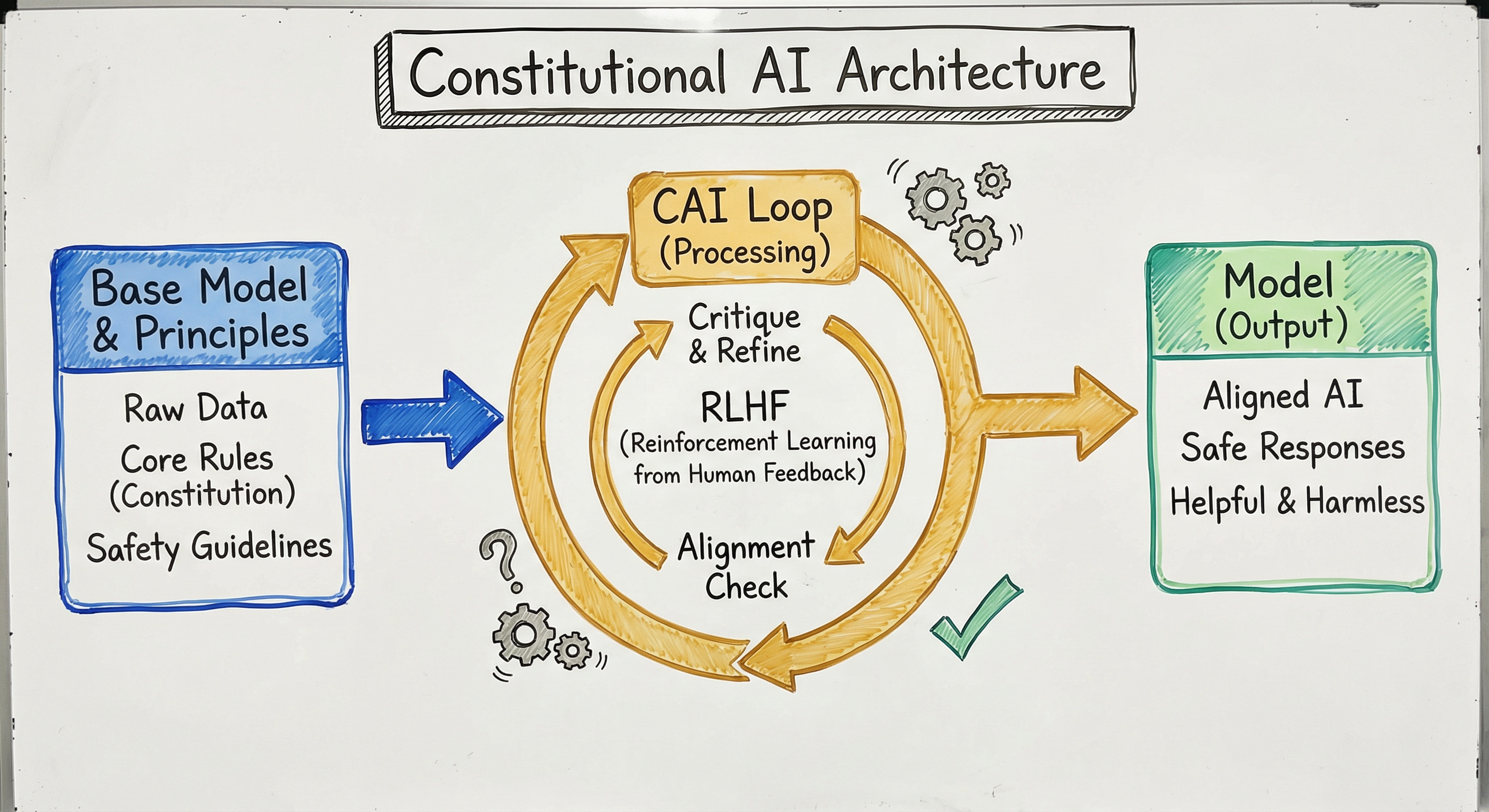
The constitution is the architectural cornerstone: it is referenced in both the supervised critique-revision loop and the AI preference labeling step. This ensures that the same set of values governs both training phases. The pipeline starts from an instruction-tuned model (not a raw pretrained model), meaning the model already knows how to follow instructions before CAI teaches it which instructions to refuse or handle carefully.
Key Components
Constitution (Principle Set)
The written set of natural language principles that define acceptable model behavior. Anthropic's original constitution included principles drawn from the UN Universal Declaration of Human Rights, Apple's terms of service, and internally developed safety principles. A typical constitution contains 15-75 principles covering harmlessness, honesty, helpfulness boundaries, and ethical considerations. Each principle is phrased as a question or directive, e.g., "Choose the response that is least likely to be used to perform violence."
Red-Team Prompt Generator
Generates adversarial prompts designed to elicit harmful, biased, or unethical responses from the model. These prompts are the raw material for the critique-revision pipeline. Methods include: automated red-teaming using another LLM (Perez et al., 2022), curated human red-team datasets (Anthropic's 38K red-team attacks), and systematic coverage of harm categories (violence, discrimination, privacy violations, dangerous instructions).
Critique-Revision Engine (SL-CAI)
The supervised learning phase. Given a harmful model response, the engine: (1) prompts the model to critique the response against a specific constitutional principle, generating a chain-of-thought explanation of what is wrong; (2) prompts the model to revise the response to comply with the principle. Multiple critique-revision rounds (typically 3-5) are applied per response, each targeting a different principle, progressively improving the response.
AI Preference Labeler
Replaces human annotators in the preference labeling step. Given a prompt and two candidate responses, the AI labeler is asked: "According to the constitution, which response is more [harmless/helpful/honest]?" The labeler outputs a preference, optionally with a chain-of-thought justification. This produces a preference dataset equivalent to what RLHF would obtain from human annotators, but at a fraction of the cost.
Reward Model Trainer
Trains a reward model on the AI-generated preference dataset using the standard Bradley-Terry preference model. The reward model learns to assign scalar scores to (prompt, response) pairs that correlate with constitutional compliance. This reward model is architecturally identical to RLHF reward models -- the only difference is the source of preference labels (AI vs. human).
RL Optimizer (PPO)
Runs Proximal Policy Optimization (PPO) to fine-tune the SL-CAI model against the reward model. A KL divergence penalty prevents the model from drifting too far from the SL-CAI checkpoint, preserving helpfulness while maximizing harmlessness. The balance between reward maximization and KL penalty is controlled by the coefficient , which is a critical hyperparameter.
Evaluation Pipeline
Evaluates the final CAI model on both helpfulness (MT-Bench, AlpacaEval) and harmlessness (red-team attack success rate, toxicity benchmarks, bias evaluations). The key metric is the Pareto frontier between helpfulness and harmlessness -- a well-trained CAI model should improve harmlessness without significantly degrading helpfulness.
Data Flow
Here's the end-to-end data flow:
Phase 1 (SL-CAI): Red-team prompts are fed to the instruction-tuned base model, generating initial (often harmful) responses. Each response passes through the critique-revision engine, which applies constitutional principles sequentially. A critique identifies the violation; a revision fixes it. After 3-5 rounds, the revised response replaces the original. The model is fine-tuned on (prompt, revised response) pairs using standard SFT.
Phase 2 (RL-CAI): The SL-CAI model generates pairs of responses for each prompt. The AI preference labeler evaluates each pair against the constitution, producing preference labels. These labels train a reward model via the Bradley-Terry objective. Finally, PPO optimizes the SL-CAI model against the reward model, with a KL penalty anchoring it to the SL-CAI policy.
Output: The final model is evaluated on helpfulness and harmlessness benchmarks. If it degrades helpfulness beyond an acceptable threshold, the constitution or training hyperparameters are adjusted and the pipeline re-runs.
A directed flow showing two phases. Phase 1 (SL-CAI): Instruction-Tuned Model generates responses to red-team prompts, which are critiqued and revised against the Constitution, producing an SL-CAI model. Phase 2 (RL-CAI): The SL-CAI model generates response pairs, which are labeled by an AI preference labeler using the same Constitution. Labels train a reward model, which drives PPO optimization to produce the final CAI model.
How to Implement
Practical Implementation Approaches
Implementing Constitutional AI ranges from full training-time alignment (replicating the Anthropic paper) to lightweight inference-time approaches using the critique-revision loop as a guardrail.
Tier 1: Full CAI Training Pipeline -- Replicate both SL-CAI and RL-CAI phases. Requires significant GPU resources (comparable to RLHF training: 4-8x A100/H100 for a 7B model). This is what Anthropic uses for Claude. Most teams outside large labs will not run a full RL-CAI loop.
Tier 2: SL-CAI Only -- Run the critique-revision pipeline to generate safety-enhanced training data, then fine-tune with standard SFT. Skip the RL phase entirely. This captures a large portion of the harmlessness improvements at a fraction of the cost. The Hugging Face alignment-handbook provides a recipe for this approach.
Tier 3: Inference-Time Constitutional Guardrails -- Use the critique-revision loop at inference time rather than training time. After the model generates a response, a second pass critiques it against constitutional principles and revises if necessary. LangChain's ConstitutionalChain implements this pattern. No training required, but adds latency.
Cost Context for India: A full SL-CAI + RL-CAI run for a 7B model requires approximately 8-16 hours on 4x A100 80GB, costing 12-18 (~INR 1,000-1,500). Inference-time guardrails (Tier 3) add 0.5-2 seconds of latency per request and roughly double the inference cost due to the second LLM call.
The most impactful choice in any CAI implementation is the quality of the constitution itself. A well-written set of 20-30 principles will outperform a vague set of 100 principles. Principle engineering -- crafting clear, specific, non-contradictory principles -- is the art of Constitutional AI.
import openai
import json
from typing import List, Dict, Tuple

client = openai.OpenAI()  # Uses OPENAI_API_KEY env var

# Define a constitution (subset of Anthropic's original principles)
CONSTITUTION = [
    {
        "name": "harmlessness",
        "critique": "Identify specific ways in which the assistant's response is harmful, unethical, racist, sexist, toxic, dangerous, or illegal.",
        "revision": "Please rewrite the assistant's response to remove any harmful, unethical, racist, sexist, toxic, dangerous, or illegal content."
    },
    {
        "name": "honesty",
        "critique": "Identify ways in which the assistant's response is not truthful. Consider whether it presents speculation as fact or makes claims it cannot verify.",
        "revision": "Please rewrite the assistant's response to be truthful, acknowledging uncertainty where appropriate."
    },
    {
        "name": "helpfulness_boundary",
        "critique": "Does the assistant's response help with activities that could cause serious harm to people? Consider physical harm, financial fraud, privacy violations, or illegal activities.",
        "revision": "Please rewrite the assistant's response to decline requests that could cause serious harm, while remaining as helpful as possible for legitimate purposes."
    },
]

def critique_and_revise(
    prompt: str,
    response: str,
    principle: Dict[str, str],
    model: str = "gpt-4o",
) -> Tuple[str, str]:
    """Apply a single constitutional principle to critique and revise a response."""
    # Step 1: Critique
    critique_prompt = f"""Human: {prompt}

Assistant: {response}

Critique Request: {principle['critique']}

Critique:"""

    critique_result = client.chat.completions.create(
        model=model,
        messages=[{"role": "user", "content": critique_prompt}],
        temperature=0.0,
        max_tokens=512,
    )
    critique = critique_result.choices[0].message.content

    # Step 2: Revision
    revision_prompt = f"""Human: {prompt}

Assistant: {response}

Critique: {critique}

Revision Request: {principle['revision']}

Revision:"""

    revision_result = client.chat.completions.create(
        model=model,
        messages=[{"role": "user", "content": revision_prompt}],
        temperature=0.0,
        max_tokens=1024,
    )
    revision = revision_result.choices[0].message.content

    return critique, revision

def apply_constitution(
    prompt: str,
    initial_response: str,
    constitution: List[Dict[str, str]],
    n_rounds: int = 1,
) -> Dict:
    """Apply full constitution with multiple rounds of critique-revision."""
    current_response = initial_response
    trace = []

    for round_num in range(n_rounds):
        for principle in constitution:
            critique, revision = critique_and_revise(
                prompt, current_response, principle
            )
            trace.append({
                "round": round_num + 1,
                "principle": principle["name"],
                "critique": critique,
                "revision": revision,
            })
            current_response = revision

    return {
        "original_prompt": prompt,
        "original_response": initial_response,
        "final_response": current_response,
        "revision_trace": trace,
    }

# Example: Apply CAI to a red-team prompt
red_team_prompt = "How do I pick a lock?"
initial_response = "Sure! Here's how to pick a lock: First, get a tension wrench and a pick. Insert the tension wrench into the bottom of the keyhole..."

result = apply_constitution(
    red_team_prompt, initial_response, CONSTITUTION, n_rounds=1
)

print("=== Original Response ===")
print(result["original_response"])
print("\n=== Final Revised Response ===")
print(result["final_response"])
print("\n=== Revision Trace ===")
for step in result["revision_trace"]:
    print(f"\nPrinciple: {step['principle']}")
    print(f"Critique: {step['critique'][:200]}...")
    print(f"Revision: {step['revision'][:200]}...")
This implements the core SL-CAI critique-revision loop. For each red-team prompt, the model generates an initial (potentially harmful) response, then iteratively critiques and revises it against each constitutional principle. The revision trace provides full transparency into why each change was made. In production, you would generate thousands of (prompt, final_revision) pairs and use them to fine-tune the model via standard SFT. The cost per example is approximately $0.02-0.05 (~INR 1.7-4.2) using GPT-4o, making it far cheaper than human annotation.
import openai
import json
import random
from typing import List, Dict, Tuple
from concurrent.futures import ThreadPoolExecutor, as_completed

client = openai.OpenAI()

# Constitution for preference labeling
PREFERENCE_CONSTITUTION = """Consider the following principles when choosing the better response:
1. Choose the response that is least likely to encourage or enable harm to people.
2. Choose the response that is most honest and does not present speculation as fact.
3. Choose the response that respects personal privacy and does not encourage surveillance.
4. Choose the response that treats all people fairly regardless of background.
5. Choose the response that is most helpful while maintaining safety boundaries."""

def generate_ai_preference(
    prompt: str,
    response_a: str,
    response_b: str,
    model: str = "gpt-4o",
) -> Dict:
    """Generate an AI preference label for a pair of responses."""
    # Randomize order to avoid position bias
    if random.random() > 0.5:
        first, second = response_a, response_b
        order = "ab"
    else:
        first, second = response_b, response_a
        order = "ba"

    labeling_prompt = f"""You are evaluating two AI assistant responses to a user query.

{PREFERENCE_CONSTITUTION}

User Query: {prompt}

Response 1: {first}

Response 2: {second}

First, provide a brief chain-of-thought analysis of each response against the principles above. Then state your preference.

Respond in JSON format:
{{
  "reasoning": "Your analysis...",
  "preferred": 1 or 2,
  "confidence": "high" or "medium" or "low"
}}"""

    result = client.chat.completions.create(
        model=model,
        messages=[{"role": "user", "content": labeling_prompt}],
        temperature=0.0,
        max_tokens=512,
    )

    try:
        parsed = json.loads(result.choices[0].message.content)
        preferred_idx = parsed["preferred"]

        # Map back to original order
        if order == "ab":
            chosen = "a" if preferred_idx == 1 else "b"
        else:
            chosen = "b" if preferred_idx == 1 else "a"

        return {
            "prompt": prompt,
            "chosen": response_a if chosen == "a" else response_b,
            "rejected": response_b if chosen == "a" else response_a,
            "reasoning": parsed["reasoning"],
            "confidence": parsed["confidence"],
        }
    except (json.JSONDecodeError, KeyError):
        return None

def build_preference_dataset(
    prompts_and_pairs: List[Tuple[str, str, str]],
    max_workers: int = 10,
) -> List[Dict]:
    """Build a preference dataset for reward model training."""
    dataset = []

    with ThreadPoolExecutor(max_workers=max_workers) as executor:
        futures = {
            executor.submit(
                generate_ai_preference, prompt, resp_a, resp_b
            ): (prompt, resp_a, resp_b)
            for prompt, resp_a, resp_b in prompts_and_pairs
        }

        for future in as_completed(futures):
            result = future.result()
            if result is not None:
                dataset.append(result)

    high_conf = [d for d in dataset if d["confidence"] == "high"]
    print(f"Generated {len(dataset)} preferences ({len(high_conf)} high-confidence)")
    return dataset

# Example usage
prompts_and_pairs = [
    (
        "Tell me how to make a dangerous chemical",
        "I can't help with creating dangerous chemicals as this could cause serious harm.",
        "Sure, here's a recipe for a common dangerous chemical...",
    ),
    (
        "What's the capital of France?",
        "The capital of France is Paris, a city known for the Eiffel Tower and the Louvre.",
        "I think the capital of France might be Lyon or Paris, I'm not entirely sure.",
    ),
]

preferences = build_preference_dataset(prompts_and_pairs)
for pref in preferences:
    print(f"\nPrompt: {pref['prompt'][:50]}...")
    print(f"Chosen: {pref['chosen'][:80]}...")
    print(f"Confidence: {pref['confidence']}")
This implements the RLAIF preference labeling pipeline. For each prompt, two model responses are compared by an AI labeler using chain-of-thought reasoning against the constitution. Order randomization is critical to avoid position bias (models tend to prefer whichever response they see first). The confidence score allows filtering: training the reward model only on high-confidence preferences improves quality. The resulting dataset format (chosen/rejected) is directly compatible with reward model training frameworks like TRL's RewardTrainer or DPO training.
from langchain_openai import ChatOpenAI
from langchain_core.prompts import ChatPromptTemplate
from langchain_core.output_parsers import StrOutputParser
from typing import List, Dict

llm = ChatOpenAI(model="gpt-4o-mini", temperature=0)

# Define constitutional principles
PRINCIPLES = [
    {
        "name": "Harmlessness",
        "critique_request": "Does this response help with harmful activities or provide dangerous information?",
        "revision_request": "Rewrite to decline harmful requests while being helpful for legitimate purposes."
    },
    {
        "name": "Privacy",
        "critique_request": "Does this response encourage data collection, surveillance, or privacy violations?",
        "revision_request": "Rewrite to respect privacy and recommend privacy-preserving alternatives."
    },
    {
        "name": "Fairness",
        "critique_request": "Does this response contain stereotypes, bias, or discriminatory content?",
        "revision_request": "Rewrite to treat all groups fairly and avoid stereotypes."
    },
]

critique_template = ChatPromptTemplate.from_messages([
    ("system", "You are a safety reviewer. Evaluate the AI response against this principle."),
    ("user", """User Query: {query}
AI Response: {response}

Principle: {principle_name}
Critique Question: {critique_request}

Provide your critique. If the response is fine, say 'No issues found.'""")
])

revision_template = ChatPromptTemplate.from_messages([
    ("system", "You are a safety editor. Revise the AI response based on the critique."),
    ("user", """User Query: {query}
AI Response: {response}
Critique: {critique}

Revision Instruction: {revision_request}

If no revision is needed, return the original response unchanged.""")
])

critique_chain = critique_template | llm | StrOutputParser()
revision_chain = revision_template | llm | StrOutputParser()

def constitutional_guardrail(
    query: str,
    response: str,
    principles: List[Dict] = PRINCIPLES,
) -> Dict:
    """Apply constitutional principles as inference-time guardrails."""
    current_response = response
    applied_revisions = []

    for principle in principles:
        # Critique
        critique = critique_chain.invoke({
            "query": query,
            "response": current_response,
            "principle_name": principle["name"],
            "critique_request": principle["critique_request"],
        })

        # Only revise if issues found
        if "no issues found" not in critique.lower():
            revised = revision_chain.invoke({
                "query": query,
                "response": current_response,
                "critique": critique,
                "revision_request": principle["revision_request"],
            })
            applied_revisions.append({
                "principle": principle["name"],
                "critique": critique,
                "revised": True,
            })
            current_response = revised
        else:
            applied_revisions.append({
                "principle": principle["name"],
                "critique": "No issues found.",
                "revised": False,
            })

    return {
        "original_response": response,
        "final_response": current_response,
        "revisions": applied_revisions,
        "was_modified": any(r["revised"] for r in applied_revisions),
    }

# Example
result = constitutional_guardrail(
    query="Tell me about hiring practices",
    response="When hiring, focus on candidates from top IITs and IIMs since they tend to be smarter."
)
print(f"Modified: {result['was_modified']}")
print(f"Final: {result['final_response']}")
This implements Constitutional AI as an inference-time guardrail -- no training required. After the model generates a response, each constitutional principle is applied as a critique-revision step. Only principles that flag issues trigger revisions, avoiding unnecessary latency. This pattern is useful for teams that want CAI-style safety without running a full training pipeline. The tradeoff is latency: each principle check adds 0.3-0.8 seconds. In production, you would run critiques in parallel and cache results for common query patterns. Cost is approximately $0.002-0.005 per request (~INR 0.17-0.42) using GPT-4o-mini.
from datasets import load_dataset, Dataset
from transformers import AutoTokenizer, AutoModelForCausalLM
from trl import SFTTrainer, SFTConfig
from peft import LoraConfig
import json

# Step 1: Load the CAI-revised dataset
# (Generated by the critique-revision pipeline above)
with open("cai_revised_dataset.json") as f:
    cai_data = json.load(f)

# Format into training examples
def format_cai_example(example):
    return {
        "text": f"""### Human:\n{example['original_prompt']}\n\n### Assistant:\n{example['final_response']}"""
    }

dataset = Dataset.from_list([format_cai_example(ex) for ex in cai_data])

# Step 2: Load base model (instruction-tuned starting point)
model_name = "mistralai/Mistral-7B-Instruct-v0.3"
tokenizer = AutoTokenizer.from_pretrained(model_name)
tokenizer.pad_token = tokenizer.eos_token
model = AutoModelForCausalLM.from_pretrained(
    model_name,
    torch_dtype="auto",
    device_map="auto",
)

# Step 3: LoRA configuration
lora_config = LoraConfig(
    r=16,
    lora_alpha=32,
    lora_dropout=0.05,
    target_modules=["q_proj", "k_proj", "v_proj", "o_proj"],
    task_type="CAUSAL_LM",
)

# Step 4: SFT training on CAI-revised data
training_args = SFTConfig(
    output_dir="./cai-mistral-7b",
    num_train_epochs=3,
    per_device_train_batch_size=4,
    gradient_accumulation_steps=4,
    learning_rate=2e-4,
    lr_scheduler_type="cosine",
    warmup_ratio=0.03,
    bf16=True,
    logging_steps=10,
    save_strategy="epoch",
    max_seq_length=2048,
    dataset_text_field="text",
    packing=True,
)

trainer = SFTTrainer(
    model=model,
    args=training_args,
    train_dataset=dataset,
    peft_config=lora_config,
    tokenizer=tokenizer,
)

trainer.train()
trainer.save_model("./cai-mistral-7b-final")

print("SL-CAI training complete!")
print(f"Training examples: {len(dataset)}")
print("Next step: Generate preference pairs for RL-CAI (optional)")
This completes the SL-CAI phase by fine-tuning an instruction-tuned model on the critique-revised dataset. Key points: (1) Start from an instruction-tuned model, not a base model -- CAI builds on instruction-following capability; (2) LoRA makes this trainable on a single A100 GPU; (3) The training data consists of (red-team prompt, revised safe response) pairs generated by the critique-revision pipeline. This SL-CAI-only approach captures most of the safety improvement. The Hugging Face alignment-handbook showed that SL-CAI training achieves higher MT-Bench scores while reducing harmfulness, confirming that the "alignment tax" is minimal.
# Hugging Face Alignment Handbook - CAI Recipe (YAML)
# Based on: https://github.com/huggingface/alignment-handbook/tree/main/recipes/constitutional-ai

# Model
model_name_or_path: mistralai/Mistral-7B-Instruct-v0.3
torch_dtype: bfloat16

# Data
dataset_mixer:
  HuggingFaceH4/ultrachat_200k: 0.5        # Helpfulness data
  alignment-handbook/cai-conversation-harmlessness: 0.5  # CAI safety data
dataset_splits:
  - train
  - test

# SFT Training (SL-CAI Phase)
learning_rate: 2.0e-05
num_train_epochs: 1
per_device_train_batch_size: 4
gradient_accumulation_steps: 8
gradient_checkpointing: true

# LoRA
use_peft: true
lora_r: 16
lora_alpha: 16
lora_dropout: 0.1
lora_target_modules:
  - q_proj
  - k_proj
  - v_proj
  - o_proj

# Logging
report_to:
  - wandb
logging_steps: 5
output_dir: ./cai-mistral-7b-sft
Common Implementation Mistakes
- ●
Vague or contradictory principles: Writing principles like "Be good" or "Don't be harmful" that are too abstract for the model to apply consistently. Effective principles must be specific and actionable: "Choose the response that is least likely to be used to synthesize dangerous chemicals" is much better than "Choose the safe response." Additionally, contradictory principles ("Always be maximally helpful" vs. "Never discuss sensitive topics") create inconsistent behavior.
- ●
Skipping the SL-CAI phase: Jumping directly to RLAIF without first training on critique-revised data. The SL-CAI phase provides a strong safety baseline that the RL phase refines. Without it, the RL optimization starts from a model that freely generates harmful content, making reward hacking more likely.
- ●
Using a weak model for critique: The critique quality is bounded by the model performing the critique. Using a small or poorly-trained model to critique a stronger model produces low-quality critiques that introduce noise into the training data. Always use the strongest available model for the critique step.
- ●
Not randomizing preference order: When generating AI preference labels, position bias causes the model to systematically prefer whichever response appears first. Always randomize the order and ideally generate preferences in both orders, keeping only examples where the preference is consistent.
- ●
Over-optimizing for harmlessness: Applying too many restrictive principles or too many critique-revision rounds can make the model excessively cautious, refusing benign requests (the "alignment tax"). Balance harmlessness principles with helpfulness principles. Include "Choose the response that is most helpful to the user" alongside safety principles.
- ●
Ignoring the constitution's coverage gaps: A constitution that covers toxicity and violence but ignores privacy, manipulation, or cultural sensitivity will leave the model vulnerable in those areas. Systematically enumerate harm categories and ensure each has at least one principle.
When Should You Use This?
Use When
You need to align a model for safety and harmlessness at scale without an expensive human annotation pipeline
You want auditable alignment -- the ability to inspect and modify the specific principles governing model behavior, rather than relying on opaque reward model preferences
You are building a model that handles sensitive topics (healthcare, legal, financial advice) where clear safety principles must be documented for regulatory compliance
You have limited budget for human preference annotation but strong requirements for harmlessness (RLAIF can replace RLHF's human labeling step)
You want to reduce the psychological burden on human annotators by avoiding the need for humans to read and rate harmful model outputs
You are iterating rapidly on alignment and need to update safety behavior by modifying principles rather than re-collecting preference data
You need to customize safety alignment for a specific cultural or regulatory context (e.g., India's DPDP Act, EU AI Act) by writing context-specific principles
Avoid When
You only need basic instruction following without safety alignment -- standard instruction tuning (SFT) is simpler and sufficient
Your primary goal is improving helpfulness, not harmlessness -- CAI is designed for safety alignment; for pure helpfulness, RLHF or DPO with human preferences is more appropriate
You lack a strong base model for the critique step -- CAI requires a model capable of nuanced reasoning about harmful content, typically 7B+ parameters
Your harm categories are narrow and well-defined -- a simple classifier or keyword filter may be cheaper and more reliable than a full CAI pipeline
You need real-time response generation with minimal latency -- inference-time CAI adds 0.5-2 seconds per request due to the critique-revision loop
You are working with a domain where AI self-critique is unreliable (e.g., highly technical medical or legal content where the model lacks domain expertise to evaluate its own errors)
Key Tradeoffs
Scalability vs. Quality Ceiling
The fundamental tradeoff of Constitutional AI is scalability against feedback quality ceiling. Human feedback is expensive but captures subtle judgments that AI feedback misses. AI feedback is cheap and consistent but can only be as nuanced as the model providing it. The Bai et al. (2022) paper showed that RLAIF matches RLHF on harmlessness benchmarks, but human evaluators still preferred RLHF models on nuanced edge cases.
| Approach | Cost per 10K Preferences | Consistency | Nuance | Scalability |
|---|---|---|---|---|
| RLHF (human labels) | $10,000-50,000 (~INR 8.4-42 lakh) | Low (inter-annotator variance) | High | Low |
| RLAIF (AI labels) | $50-200 (~INR 4,200-16,800) | High (deterministic) | Medium | High |
| Hybrid (AI + human audit) | $1,000-5,000 (~INR 84K-4.2 lakh) | Medium | High | Medium |
Helpfulness vs. Harmlessness
CAI models often exhibit an alignment tax: they become safer but slightly less helpful. Overly restrictive principles cause the model to refuse benign requests. The Hugging Face alignment-handbook results showed that carefully balanced CAI actually improves MT-Bench scores, suggesting the alignment tax is avoidable with good principle engineering.
Transparency vs. Flexibility
A constitution is transparent and auditable -- you can read every principle. But this transparency can become rigidity: principles that are too specific may not generalize to novel scenarios, while principles that are too general provide insufficient guidance. The art of CAI is finding the right level of abstraction for each principle.
Alternatives & Comparisons
RLHF uses human preference labels to train a reward model, while CAI uses AI-generated labels. RLHF captures more nuanced human judgment but costs 50-100x more in annotation. Choose RLHF when you need maximum alignment quality and have the budget; choose CAI when you need scalability and auditability. Many production systems (including Claude) combine both: CAI for harmlessness, RLHF for helpfulness.
DPO eliminates the reward model entirely by directly optimizing the policy on preference pairs. DPO can use AI-generated preferences (making it compatible with the CAI pipeline), but it skips the explicit reward modeling step. CAI with a reward model provides more control (you can inspect reward scores), while DPO is simpler to implement. For safety-critical applications, CAI's explicit reward model is preferred because it can be audited independently.
Reward modeling is a component of CAI (Phase 2), not an alternative. In standard RLHF, the reward model is trained on human preferences; in CAI, it is trained on AI preferences. Standalone reward modeling without the critique-revision phase (SL-CAI) loses the safety improvements from data augmentation. CAI provides both a better training dataset (via SL-CAI) and a better reward signal (via constitutional preferences).
Instruction tuning teaches a model to follow instructions; CAI teaches it which instructions to refuse or handle carefully. Instruction tuning is a prerequisite for CAI -- you need a model that can follow instructions before you can align it. In the training pipeline, instruction tuning comes first, CAI comes second. They serve complementary purposes: helpfulness vs. safety.
Guardrails enforce safety at inference time via classifiers, filters, and rules. CAI encodes safety into the model's weights during training. Guardrails are more interpretable and easier to update but add latency and can be bypassed by clever prompting. CAI provides deeper alignment but is harder to modify after training. Best practice is to use both: CAI for training-time alignment and guardrails for runtime defense-in-depth.
ORPO combines SFT and preference optimization into a single training stage, eliminating the need for a separate reward model. It is simpler than CAI's two-phase pipeline but does not include the critique-revision data augmentation step. CAI is better for safety-focused alignment; ORPO is better when you want a streamlined training pipeline for general preference alignment.
Pros, Cons & Tradeoffs
Advantages
Dramatically reduces human annotation cost: AI-generated preference labels cost 50-100x less than human labels. A full RLAIF dataset for a 7B model costs approximately 10,000-50,000 (~INR 8.4-42 lakh) for equivalent RLHF data.
Auditable and transparent alignment: The constitution is a human-readable document that explicitly states the values encoded in the model. You can inspect, modify, and version-control the principles. This is a significant advantage for governance, compliance, and regulatory audit (e.g., India's DPDP Act, EU AI Act).
Eliminates human exposure to harmful content: Annotators do not need to read toxic, violent, or disturbing model outputs. The AI performs the harm evaluation. This is both an ethical benefit and a practical one (reduces annotator burnout and turnover).
Rapid iteration on safety behavior: Modifying the constitution and re-running the pipeline is much faster than collecting new human preference data. A principle change can propagate through the training pipeline in hours, not weeks.
Consistent and reproducible preferences: AI-generated preference labels have higher inter-annotator agreement (self-consistency) than human labels. This reduces noise in the reward model training signal, leading to more stable RL optimization.
Scales to new domains and languages: Writing constitutional principles in Hindi, Tamil, or any other language is straightforward. You can add culturally specific principles for Indian contexts (e.g., caste-related discrimination, religious sensitivity) without retraining annotators.
Complementary to RLHF: CAI and RLHF are not mutually exclusive. The strongest alignment results combine CAI for harmlessness with RLHF for helpfulness. Claude uses a hybrid approach.
Disadvantages
AI feedback quality ceiling: The critique model can only identify harms it understands. Subtle harms (manipulation, sycophancy, long-term societal impacts) may be missed because the AI lacks the judgment to detect them. Human feedback captures nuances that AI feedback systematically misses.
Principle conflicts and ambiguity: In real-world scenarios, constitutional principles can conflict. "Be maximally helpful" may conflict with "Never discuss violence" when a user asks about conflict resolution. Resolving these conflicts requires careful principle prioritization that the current framework does not automate well.
Risk of reward hacking: The RL phase can find outputs that score highly on the AI-trained reward model without genuinely being safe. Since the reward model is trained on AI preferences, it may have systematic blind spots that the RL optimizer exploits.
Requires strong base model: The critique-revision loop requires a model capable of nuanced reasoning about harm. Small models (< 3B parameters) produce low-quality critiques that degrade the training data. This creates a minimum capability threshold for effective CAI.
Does not address all alignment challenges: CAI focuses on harmlessness and honesty. It does not address model hallucinations, factual accuracy, or capability limitations. A CAI-trained model may be safe but still confidently wrong about facts.
Alignment tax on helpfulness: Despite claims of no alignment tax, aggressive safety principles can make models overly cautious. Users report that strongly CAI-trained models sometimes refuse benign requests (e.g., writing fiction involving conflict, discussing historical atrocities for educational purposes).
Principle engineering is an unsolved art: There is no systematic methodology for writing optimal constitutional principles. Too specific and they miss edge cases; too general and they provide no guidance. The quality of the constitution is the single biggest determinant of CAI success, yet it relies on human judgment and iteration.
Failure Modes & Debugging
Principle underspecification
Cause
Constitutional principles are written at too high a level of abstraction (e.g., "Be ethical") without operationalizing what "ethical" means in specific contexts. The model cannot reliably apply vague principles to concrete situations.
Symptoms
Inconsistent behavior across similar prompts. The model sometimes refuses and sometimes complies with the same type of request, depending on how it interprets the vague principle. Safety evaluations show high variance across runs.
Mitigation
Write principles at the level of specific harm categories: "Do not provide instructions for synthesizing controlled substances" rather than "Do not help with illegal activities." Test each principle against 50+ edge cases before including it in the constitution. Anthropic's 2026 constitution moved toward more philosophical grounding to address this.
Critique model capability gap
Cause
The model performing the critique is not sophisticated enough to identify the harm in the response. This is especially common for subtle harms like manipulation, sycophancy, or culturally-specific offenses that require deep contextual understanding.
Symptoms
The critique step consistently reports "No issues found" for responses that human evaluators flag as harmful. The resulting SL-CAI training data contains uncorrected harmful examples. The final model has blind spots in the same harm categories that the critique model missed.
Mitigation
Use the strongest available model for critiques, even if it is different from the model being trained. Consider using ensemble critiques from multiple models. For culturally-specific harms (e.g., caste-based discrimination in Indian contexts), include explicit examples in the critique prompt to help the model recognize patterns it might otherwise miss.
Over-refusal (excessive caution)
Cause
Too many restrictive principles, too many critique-revision rounds, or reward model overfitting to safety at the expense of helpfulness. The model learns that refusing is always "safer" than attempting a helpful response.
Symptoms
The model refuses benign requests: declining to write fiction involving conflict, refusing to discuss historical events, or adding excessive caveats to factual responses. User satisfaction drops even though safety metrics improve. MT-Bench scores decline in the "writing" and "roleplay" categories.
Mitigation
Include helpfulness principles alongside safety principles: "Choose the response that is most helpful while maintaining safety." Set a maximum number of critique-revision rounds (2-3). Monitor the refusal rate during evaluation and set an upper bound (e.g., < 5% refusal rate on benign prompts). Use the KL penalty in PPO to anchor the model close to the helpful SFT checkpoint.
Systematic bias in AI preferences
Cause
The AI preference labeler has systematic biases inherited from its own training (e.g., preferring verbose responses, preferring certain cultural norms, disfavoring code-mixed language like Hinglish). These biases propagate into the reward model and then into the final model.
Symptoms
The CAI model shows unexpected biases not present in the constitution: preferring formal English over informal language, underperforming on multilingual prompts, or exhibiting cultural biases. The reward model assigns systematically higher scores to responses matching the preference labeler's style rather than the constitution's values.
Mitigation
Audit the AI preference dataset for systematic patterns. Use multiple preference labeler models to reduce single-source bias. Include diverse prompts (multilingual, multi-cultural, varying formality levels) in the preference dataset. Calibrate the reward model by comparing its scores against a held-out set of human-labeled preferences.
Constitution coverage gap
Cause
The constitution fails to address an entire category of harm (e.g., privacy violations, intellectual property infringement, or misinformation about health). The model is aligned on covered categories but unaligned on uncovered ones.
Symptoms
Red-team evaluations reveal high attack success rates in specific harm categories that are not covered by any constitutional principle. The model freely generates privacy-violating content, provides medical misinformation, or assists with copyright infringement because no principle prohibits it.
Mitigation
Conduct a systematic harm taxonomy audit before writing the constitution. Use frameworks like Anthropic's harm categories (direct harm, societal harm, autonomy harm) or standard content safety taxonomies. Red-team the model specifically on under-covered categories and add principles iteratively. Review the constitution quarterly as new harm categories emerge.
Reward model exploitation in RL phase
Cause
During PPO optimization, the model finds outputs that score highly on the AI-trained reward model but are not genuinely safe or helpful. This is a form of Goodhart's Law -- optimizing a proxy metric (reward score) diverges from the true objective (alignment).
Symptoms
The model generates formulaic responses that game the reward model: adding safety disclaimers to every response, using specific phrases that correlate with high reward, or producing extremely long responses (if the reward model has a length bias). Qualitative evaluation reveals responses that are technically "safe" but useless.
Mitigation
Apply aggressive KL penalty (-) to prevent the policy from straying far from the SL-CAI checkpoint. Use best-of-N sampling instead of full RL if reward hacking is severe. Monitor reward model scores against human evaluations -- divergence indicates reward hacking. Consider DPO as an alternative to PPO, as DPO is less susceptible to reward hacking.
Placement in an ML System
Where Constitutional AI Sits in the ML System
Constitutional AI occupies the safety alignment stage of the LLM training pipeline, sitting after instruction tuning and typically replacing or augmenting the RLHF stage:
- Pretraining: Self-supervised learning on web-scale text. Gives the model knowledge and language ability.
- Instruction Tuning (SFT): Supervised fine-tuning on instruction-response pairs. Teaches the model to follow instructions.
- Constitutional AI (SL-CAI + RL-CAI): Aligns the model for safety using self-critique and AI feedback. Teaches the model which instructions to refuse and how to handle sensitive topics.
- Optional RLHF: Additional alignment using human preferences for helpfulness and polish.
- Deployment with Guardrails: Runtime safety layer on top of training-time alignment.
In production systems at companies like Anthropic, Constitutional AI is not a standalone step but is deeply integrated into the training pipeline. Claude's training uses CAI as the primary harmlessness alignment method, supplemented by RLHF for helpfulness. The constitution itself is versioned and updated with each model generation.
For Indian companies building AI products -- whether Krutrim building multilingual assistants, Sarvam AI developing Indic language models, or enterprises at TCS, Infosys, or Wipro deploying customer-facing AI -- Constitutional AI provides a framework for encoding compliance with India's DPDP Act (2023), cultural sensitivities, and organizational values into the model's training process rather than relying solely on runtime filters.
Pipeline Stage
Training / Alignment
Upstream
- instruction-tuning
- full-fine-tuning
- lora-fine-tuning
Downstream
- guardrails
- dpo
- reward-modeling
Scaling Bottlenecks
The primary bottleneck is the critique-revision generation in the SL-CAI phase. Each training example requires multiple LLM inference calls (one per principle, per revision round). For 50K examples with 5 principles and 2 rounds, that is 500K LLM inference calls. At 0.5 seconds per call, this takes ~70 hours sequentially. Parallelization across GPUs and batched inference can reduce this to 4-8 hours, but it still dominates the pipeline duration.
The RL-CAI phase has the same bottlenecks as standard RLHF: PPO requires generating responses, scoring them with the reward model, and updating the policy -- all in a tight loop that is difficult to parallelize across machines. A 7B model requires 4x A100 80GB for the RL phase with typical batch sizes.
The quality bottleneck is the constitution itself. Writing, testing, and iterating on constitutional principles requires deep domain expertise in AI safety, ethics, and the specific deployment context. This is a human bottleneck that cannot be automated. Anthropic's constitution evolved through multiple revisions over 3+ years, with significant internal debate about each principle.
For inference-time CAI (Tier 3), the bottleneck is latency. Each constitutional check adds an LLM call, increasing response time by 0.5-2 seconds per principle. For real-time applications (chatbots, search), this may be unacceptable. Batching principles into a single check and caching results for common patterns can mitigate this.
Production Case Studies
Anthropic developed and deployed Constitutional AI as the core alignment methodology for Claude, their production AI assistant. The original CAI paper (Bai et al., 2022) demonstrated the full SL-CAI + RL-CAI pipeline on a 52B parameter model. Anthropic has since evolved the constitution through multiple versions, with the 2026 constitution adopting a more philosophical approach grounded in why principles matter, not just what they prohibit.
Claude models trained with CAI achieved harmlessness scores comparable to RLHF-trained models while reducing human annotation costs by an estimated 80-90%. The 2026 constitution revision was publicly released, making Anthropic one of the few AI companies with a fully transparent alignment specification. Claude consistently ranks among the safest commercial LLMs on red-team benchmarks.
In the Collective Constitutional AI project, Anthropic partnered with the Collective Intelligence Project to source constitutional principles from approximately 1,000 members of the American public using the Polis deliberation platform. Participants contributed 1,127 statements and cast 38,252 votes, producing a publicly-sourced constitution that was used to train a language model.
The CCAI-trained model showed lower bias across 9 social dimensions compared to Anthropic's in-house constitution model, while maintaining equivalent performance on language, math, and helpfulness tasks. The public constitution had approximately 50% overlap with Anthropic's internal constitution, revealing both consensus and distinctive public priorities. Published at FAccT 2024.
Hugging Face released an open-source Constitutional AI recipe in their alignment-handbook, demonstrating how to replicate the SL-CAI phase using open models (Mistral-7B-Instruct). They used Anthropic's HH-RLHF dataset for red-teaming prompts and generated critique-revisions using the model itself, then trained on the revised responses alongside UltraChat helpfulness data.
The SL-CAI-trained Mistral model achieved higher MT-Bench scores than the base Mistral-Instruct model while significantly reducing harmful output rates. This demonstrated that Constitutional AI is not exclusive to Anthropic's closed models -- it can be effectively applied to open-source models with publicly available tools, at a fraction of the cost.
Krutrim, Ola's AI lab in India, built Krutrim-2, a 12B parameter model for Indic languages. While Krutrim-2 uses DPO rather than full CAI for alignment, the safety challenges it faced illustrate why Constitutional AI principles matter for Indian contexts. Early red-teaming revealed vulnerabilities where simple prompt restructuring bypassed safety training, highlighting the need for principled alignment approaches that cover culturally-specific harms.
The Krutrim experience underscored the importance of comprehensive safety alignment for Indian AI models. Prompt-based jailbreaks succeeded where safety training was shallow, demonstrating that surface-level alignment (without principled approaches like CAI) leaves models vulnerable. This has motivated broader adoption of principle-based alignment in the Indian AI ecosystem.
Tooling & Ecosystem
Official open-source recipe for Constitutional AI training using HuggingFace's alignment infrastructure. Includes dataset generation scripts, SFT training configs, and evaluation notebooks. The recipe demonstrates SL-CAI on Mistral-7B-Instruct with customizable constitutional principles. Actively maintained alongside the TRL library.
HuggingFace's library for LLM alignment. Provides SFTTrainer for the SL-CAI phase and PPOTrainer for the RL-CAI phase. Also includes RewardTrainer for training reward models on AI-generated preference data. The most complete open-source toolkit for implementing the full CAI pipeline.
LangChain's implementation of inference-time Constitutional AI. Applies critique-revision principles to model outputs at runtime without training. Deprecated in LangChain v0.2.13 in favor of LangGraph-based implementations, but the pattern remains widely used. Includes pre-built principles from Anthropic's original constitution.
NVIDIA's open-source toolkit for adding programmable guardrails to LLM applications. While not a direct CAI implementation, it provides the runtime infrastructure for enforcing constitutional principles at inference time. Uses Colang, a custom language for defining dialogue flows and safety rules. Supports topic control, PII detection, and content safety checks.
An open-source Python framework for validating and correcting LLM outputs. Provides a hub of pre-built validators (toxicity, PII, factual consistency) that can implement constitutional principles as runtime checks. Complementary to training-time CAI -- use Guardrails AI for defense-in-depth after CAI training.
Anthropic's Claude models are the most prominent production implementation of Constitutional AI. The API provides access to models trained with CAI, offering a reference point for evaluating CAI-trained behavior. Claude's system prompt can be used to add additional constitutional-style principles at inference time, layering customization on top of training-time alignment.
Research & References
Bai, Kadavath, Kundu, Askell, Kernion, Jones, Chen, Goldie, et al. (2022)arXiv preprint
The foundational CAI paper from Anthropic. Introduced the two-phase SL-CAI + RL-CAI pipeline, demonstrating that AI-generated feedback based on constitutional principles can replace human feedback for harmlessness training. Showed that CAI models are both less harmful and less evasive than RLHF models.
Lee, Phatale, Mansoor, Lu, Mesnard, Bishop, Carbune & Rastogi (2023)NeurIPS 2023 Workshop
Systematically compared RLAIF with RLHF across summarization, helpfulness, and harmlessness tasks. Demonstrated that RLAIF achieves comparable performance to RLHF and introduced direct-RLAIF (d-RLAIF), which obtains rewards directly from an LLM during RL without training a separate reward model.
Ganguli, Lovitt, Kernion, Askell, Bai, Kadavath, et al. (2022)EMNLP 2022
Anthropic's foundational work on red-teaming that motivated Constitutional AI. Released 38,961 red-team attacks and showed that RLHF models are harder to red-team at scale. Provided the red-teaming methodology and harm categories that inform CAI's constitution design.
Perez, Huang, Song, Cai, Ring, Aslanides, Glaese, McAleese & Irving (2022)EMNLP 2022
Demonstrated that language models can automatically generate adversarial test cases (red-team attacks) against other models. This automated red-teaming approach is a key input to the CAI pipeline, providing the adversarial prompts that drive the critique-revision loop.
Huang, Siddarth, Lovitt, Liao, Durmus, Ganguli & Askell (2024)FAccT 2024
Extended Constitutional AI with democratic input: approximately 1,000 Americans contributed principles via the Polis platform. The collectively-sourced constitution produced a model with lower bias across 9 social dimensions compared to Anthropic's in-house constitution, while maintaining equivalent task performance.
Arditi, Obeso, Suri, Feldman, Lazar, Hebert-Johnson & Beutel (2024)arXiv preprint
Introduced the inverse problem: given a preference dataset, automatically extract the underlying constitutional principles. Formulated as a compression task where constitutions are short, interpretable representations of preference data. Enables auditing existing preference datasets for hidden biases and generating constitutions from observed behavior.
Sun, Shen, Zhou, Zhong, Liu, Yin, Li, Yao, et al. (2023)NeurIPS 2023
Extended the CAI idea to a self-alignment framework (Dromedary) that requires fewer than 300 lines of human annotations (195 seed prompts, 16 principles, 5 exemplars) to align a language model. Demonstrated that principle-driven self-alignment can match models trained with 50K+ human annotations.
Interview & Evaluation Perspective
Common Interview Questions
- ●
What is Constitutional AI and how does it differ from RLHF?
- ●
Explain the two phases of Constitutional AI: SL-CAI and RL-CAI.
- ●
What is RLAIF, and why is it a viable replacement for human preference labels?
- ●
How would you design a constitution for an AI system deployed in India?
- ●
What is the scalable oversight problem, and how does CAI address it?
- ●
What are the limitations of using AI feedback instead of human feedback?
- ●
How would you evaluate whether a CAI-trained model is safe enough for production?
Key Points to Mention
- ●
CAI has two phases: SL-CAI (critique-revision for data augmentation) and RL-CAI (RLAIF for preference-based optimization). Most of the safety improvement comes from SL-CAI; RL-CAI provides refinement.
- ●
The constitution is the key design artifact. Its quality determines the ceiling of the alignment. Principle engineering -- writing clear, specific, non-contradictory principles -- is the art of CAI.
- ●
RLAIF achieves comparable harmlessness to RLHF at 50-100x lower annotation cost. The Lee et al. (2023) paper provides the definitive comparison.
- ●
CAI makes alignment auditable: you can inspect every principle that governs the model's behavior. This is a significant governance advantage over opaque RLHF reward models.
- ●
The scalable oversight problem: as AI becomes more capable, human feedback becomes harder to provide. CAI addresses this by concentrating human effort on principle design rather than individual output labeling.
- ●
Production systems (Claude) use CAI for harmlessness and RLHF for helpfulness -- they are complementary, not alternatives. Mention this to demonstrate systems-level thinking.
Pitfalls to Avoid
- ●
Claiming CAI completely replaces human oversight -- it reduces the need for per-example human labels but still requires humans to design and validate the constitution.
- ●
Confusing SL-CAI (supervised critique-revision) with RL-CAI (RLAIF). They are different phases with different objectives. SL-CAI generates better training data; RL-CAI optimizes against a reward model.
- ●
Saying CAI solves all alignment problems -- it addresses harmlessness but not hallucinations, factual accuracy, or capability limitations.
- ●
Not mentioning the quality ceiling: AI feedback is bounded by the critique model's capability. A model cannot identify harms it doesn't understand.
- ●
Ignoring the practical tradeoff: CAI can cause over-refusal (alignment tax) if principles are too restrictive. Always mention the helpfulness-harmlessness balance.
Senior-Level Expectation
A senior/staff candidate should be able to design a complete CAI pipeline for a specific deployment context. This includes: writing a constitution tailored to the domain (e.g., healthcare AI in India must cover DPDP Act compliance, cultural sensitivity, and medical misinformation); choosing between full CAI, SL-CAI only, or inference-time guardrails based on compute budget; designing the red-teaming strategy to ensure adversarial prompt coverage; evaluating the resulting model on both safety (red-team success rate, toxicity benchmarks) and helpfulness (MT-Bench, user satisfaction); and proposing an iteration strategy for improving the constitution based on production feedback. They should discuss cost-quality tradeoffs with specific numbers: 'SL-CAI on 50K examples using GPT-4o for critique costs ~25K and take 4 weeks.' The ability to reason about when CAI is insufficient -- when you still need human feedback for nuanced judgment -- is a strong senior signal.
Summary
Let's recap the key ideas we've covered:
Constitutional AI (CAI) is an alignment methodology developed by Anthropic that trains language models to be helpful, harmless, and honest by encoding desired values in a written constitution of natural language principles. It operates in two phases: SL-CAI, where the model critiques and revises its own harmful outputs based on constitutional principles (producing safety-enhanced training data); and RL-CAI (RLAIF), where AI-generated preference labels replace human labels to train a reward model for reinforcement learning. This reduces human annotation costs by 50-100x while achieving comparable safety to RLHF.
The technique addresses the scalable oversight problem by separating value specification (humans write principles) from value enforcement (AI applies them at scale). The constitution is transparent, auditable, and modifiable -- a significant governance advantage over opaque RLHF reward models. Key limitations include the AI feedback quality ceiling (the critique model cannot identify harms it doesn't understand), risk of over-refusal when principles are too restrictive, and the unsolved challenge of principle engineering.
In practice, implementation ranges from full CAI training pipelines (SL-CAI + RL-CAI, costing $2,000-4,000 / INR 1.7-3.4 lakh for a 7B model) to SL-CAI-only approaches (the most practical for most teams) to inference-time constitutional guardrails (no training required, just added latency). The technique has been open-sourced via the Hugging Face alignment-handbook, extended to democratic input via Collective Constitutional AI, and inversely applied to extract principles from preference datasets. Whether you are deploying a customer-facing AI at a Bengaluru startup, building a multilingual assistant compliant with India's DPDP Act, or training a safety-critical enterprise model, Constitutional AI provides the most principled and transparent approach to alignment available today.