Weaviate in Machine Learning
Weaviate is an open-source, AI-native vector database written in Go that stores both data objects and their vector embeddings in a single system. Unlike vector databases that only handle vectors, Weaviate treats objects as first-class citizens -- you store your data alongside its embeddings, and the database manages the relationship between the two.
What makes Weaviate genuinely distinctive is its module ecosystem. Rather than requiring you to generate embeddings externally and push them in, Weaviate can call embedding models (OpenAI, Cohere, Hugging Face, and others) on your behalf during both ingestion and query time. This means your application code never touches raw vectors -- Weaviate handles vectorization transparently.
But the module system goes further. Weaviate supports generative search (built-in RAG), where a single query retrieves relevant objects via vector search and then passes them to an LLM for answer generation -- all within the database layer. Add native hybrid search (BM25 + dense vectors with fusion algorithms), multi-tenancy with per-tenant shard isolation, a GraphQL API, and schema-enforced collections, and you have a database that covers a remarkably wide surface area.
With over 6 million downloads, backing from Index Ventures and Battery Ventures ($50M Series B), and production deployments at companies like Morningstar, Instabase, and Neople, Weaviate has established itself as a serious contender in the vector database space. Whether you are building a customer support chatbot for a Bengaluru SaaS startup or a financial research assistant for a global investment firm, Weaviate offers a compelling combination of developer ergonomics and production-grade features.
Concept Snapshot
- What It Is
- An open-source vector database written in Go that stores objects with their vector embeddings and provides semantic search, hybrid search, and built-in RAG capabilities through a modular architecture.
- Category
- Vector Databases
- Complexity
- Intermediate
- Inputs / Outputs
- Inputs: data objects (text, images, structured data) with optional pre-computed vectors, or raw data that Weaviate vectorizes via integrated ML modules. Outputs: ranked search results with similarity scores, metadata, and optionally LLM-generated answers (generative search).
- System Placement
- Sits between the embedding model (or replaces it via vectorizer modules) and the downstream consumer -- a re-ranker, context assembler, or LLM generator in a RAG pipeline.
- Also Known As
- Weaviate vector DB, Weaviate Cloud, Weaviate vector search engine
- Typical Users
- ML Engineers, Backend Engineers, Full-Stack Developers, Data Engineers, AI Application Developers
- Prerequisites
- Embeddings and vector representations, Distance metrics (cosine, L2, dot product), Basic understanding of ANN search, RESTful APIs or GraphQL basics
- Key Terms
- HNSWvectorizer moduleshybrid searchBM25reciprocal rank fusionmulti-tenancygenerative searchGraphQLcollectionsschemashardingreplication
Why This Concept Exists
The Gap Between Raw Index Libraries and Production Needs
Before Weaviate, teams building ML-powered search had two options. Option one: use a raw ANN library like FAISS or HNSWlib. These are phenomenal at what they do -- pure vector indexing and search -- but they give you zero persistence, no metadata filtering, no API layer, and certainly no built-in ML model integration. You end up building a mini database around them. Option two: bolt vector search onto an existing database (Elasticsearch with dense vectors, or PostgreSQL with pgvector). This works, but these systems were designed for keyword search and relational queries respectively -- vector search is an afterthought, not a first-class citizen.
Weaviate was built from scratch to close this gap. Founded in 2019 by Bob van Luijt and the team at SeMI Technologies (now Weaviate B.V.), the project started with a radical premise: what if the database itself understood ML models? Instead of treating vectors as opaque blobs of floats, Weaviate integrates directly with embedding providers, knows how to vectorize your data, and can even call generative models to synthesize answers from retrieved results.
The Rise of AI-Native Databases
The timing was prescient. Between 2020 and 2023, three trends converged:
Trend 1: LLMs went mainstream. ChatGPT, GPT-4, and open models like LLaMA proved that large language models could do useful work -- but they needed grounding in external knowledge to avoid hallucination. RAG (Retrieval-Augmented Generation) became the standard pattern, and every RAG pipeline needs a vector store.
Trend 2: Embedding APIs became commoditized. OpenAI's text-embedding-ada-002, Cohere's embed models, and open-source alternatives from Sentence Transformers made it trivial to generate high-quality embeddings. But integrating these APIs with your storage layer still required glue code.
Trend 3: Multi-tenant SaaS demanded isolation. Companies building AI features for thousands of customers (think: a Freshworks or Zoho adding AI search to their products) needed per-tenant data isolation without provisioning separate databases for each customer.
Weaviate addressed all three. Its vectorizer modules eliminate glue code for embedding generation. Its generative modules bring RAG into the database layer. And its native multi-tenancy -- with per-tenant shards that can be offloaded to cold storage -- handles the SaaS isolation problem at scale.
Key Takeaway: Weaviate exists because production ML applications need more than just an ANN index. They need a complete data layer that understands vectors, integrates with ML models, supports hybrid retrieval, and provides the operational features (replication, backups, multi-tenancy) that production workloads demand.
Core Intuition & Mental Model
Think of Weaviate as a "Smart Filing Cabinet"
Here is an analogy that makes Weaviate click. Imagine a filing cabinet where every document is stored in two ways simultaneously: by its label (title, date, category -- like a traditional database index) and by its meaning (what the document is actually about -- like a vector index). When you search, you can search by label, by meaning, or by both at once. That is hybrid search.
Now imagine this filing cabinet has a built-in translator. You hand it a document in plain text, and it automatically understands the document's meaning without you having to explain it. That is the vectorizer module -- it calls an embedding model on your behalf.
Finally, imagine the filing cabinet has a librarian sitting next to it. When you ask a question, the cabinet first finds the most relevant documents (retrieval), and then the librarian reads them and gives you a synthesized answer (generation). That is generative search -- built-in RAG.
The Module Philosophy
The core intuition behind Weaviate's architecture is separation of concerns through modules. The database engine itself handles storage, indexing, querying, and replication. The ML intelligence -- vectorization, re-ranking, generation -- lives in pluggable modules that can be swapped without changing your data model or application code.
This means you can start with text2vec-openai for embedding generation, switch to text2vec-cohere when you find Cohere's multilingual model works better for your Hindi + English corpus, and add generative-openai for RAG -- all without a single schema migration or re-architecture.
What Weaviate Does NOT Do
Weaviate is not a general-purpose database. It does not support SQL, joins, or complex transactions. It is not a replacement for PostgreSQL or MongoDB in your application's primary data store. Think of it as a specialized retrieval layer -- phenomenally good at finding relevant objects by meaning, but not designed to be your system of record for transactional data.
Technical Foundations
Formalizing Weaviate's Search Mechanisms
Let us formalize the three search modes that Weaviate supports, since understanding the math behind them is critical for tuning and debugging.
Vector Search (nearVector / nearText)
Given a collection where each object has an associated vector , and a query vector , Weaviate returns the objects whose vectors minimize the distance function .
Weaviate supports three distance metrics:
- Cosine distance:
- L2-squared distance:
- Dot product distance:
The HNSW index provides approximate -NN in time by maintaining a multi-layer navigable small world graph. The key parameters are:
- : maximum number of connections per node per layer (default 64)
- : beam width during index building (default 128)
- : beam width during search (default -1, meaning dynamic)
The quality of approximation is measured by recall@k:
where is the set returned by HNSW and is the true -NN set.
Keyword Search (BM25)
Weaviate maintains an inverted index alongside the vector index. BM25 scoring for a query containing terms against a document is:
where is term frequency, is document length, is average document length, and , are tuning parameters.
Hybrid Search
Hybrid search fuses the ranked results from vector search and BM25 using a fusion algorithm. Weaviate supports two:
Reciprocal Rank Fusion (RRF):
where is the set of ranking functions, is the rank of document in ranking , and is a constant (typically 60).
Relative Score Fusion: normalizes scores from each search method to [0, 1] and takes a weighted combination controlled by the alpha parameter:
where gives pure vector search and gives pure keyword search.
Practical Note: Relative Score Fusion became the default in Weaviate v1.24+. For most workloads, an alpha between 0.5 and 0.75 works well -- leaning toward vector search for semantic queries and toward keyword search for exact-match requirements like product SKUs or medical codes.
Internal Architecture
Weaviate's internal architecture is organized around a core engine written in Go with a module system that plugs in ML capabilities. The engine handles storage (an LSM-tree based store), vector indexing (HNSW with optional quantization), inverted indexing (for BM25 and filtering), and the API layer (REST, GraphQL, and gRPC). Modules handle vectorization, generative search, and re-ranking by calling external ML model APIs or running local models.
Data is organized into collections (formerly called "classes"), each with a defined schema of properties and a configured vectorizer. Each collection is backed by one or more shards, and in multi-tenant mode, each tenant gets its own shard with full data isolation. Shards contain three key structures: the HNSW vector index (held in memory with WAL-based persistence), the LSM-tree object store (for the actual data objects), and the inverted index (for keyword search and metadata filtering).
Here is how the major components interact:
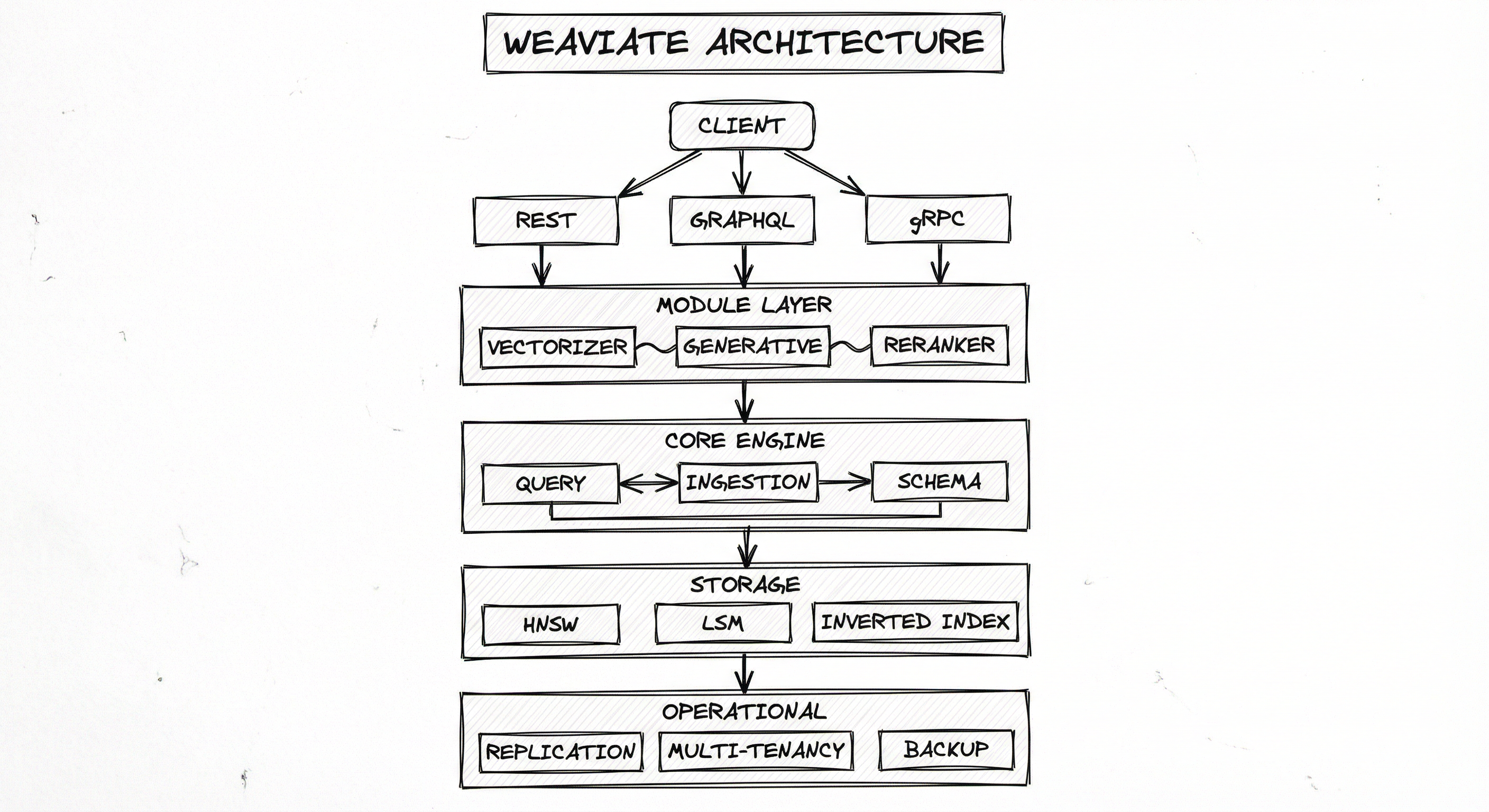
The write path flows like this: a client sends an object via REST/GraphQL/gRPC. If a vectorizer module is configured, the object's properties are sent to the external ML model API for embedding generation. The resulting vector and the original object are then written to the HNSW index (with WAL entry), the LSM-tree object store, and the inverted index. The write is acknowledged once the WAL is durable.
The read path depends on the search type. For vector search, the query is optionally vectorized by the module, then the HNSW index is traversed. For keyword search, the inverted index handles BM25 scoring. For hybrid search, both paths execute in parallel and results are fused. For generative search, the retrieved objects are passed to the generative module which calls an LLM and returns the synthesized answer alongside the source objects.
Key Components
HNSW Vector Index
The primary vector indexing structure. Maintains a multi-layer navigable small world graph in memory for sub-millisecond approximate nearest neighbor queries. Supports configurable parameters (, , ) and optional quantization (Product Quantization, Binary Quantization, Scalar Quantization, Rotational Quantization) for memory reduction. Persisted via Write-Ahead Logs (WAL) that enable full reconstruction after restarts.
Dynamic Index
An adaptive indexing strategy that starts with a flat (brute-force) index for small collections and automatically switches to HNSW once the object count exceeds a configurable threshold (default: 10,000). This avoids the overhead of HNSW graph construction for small datasets while ensuring performance at scale.
Inverted Index
Maintains term-frequency data for BM25 keyword search and indexed metadata fields for filtered queries. Supports tokenization strategies (word, lowercase, whitespace, field, trigram, GSE for CJK languages) and filterable/searchable property configurations.
LSM-Tree Object Store
Stores the actual data objects (properties, metadata, cross-references) using a Log-Structured Merge-tree for write-optimized throughput. Supports memory-mapped access for efficient reads without loading entire datasets into RAM.
Vectorizer Modules
Pluggable modules that call external embedding APIs (OpenAI, Cohere, Hugging Face, Jina AI, Voyage AI, Google, AWS Bedrock) or local models (Ollama, Transformers) to generate vector embeddings during both ingestion and query time. Configured per-collection in the schema.
Generative Modules
Enable built-in RAG by accepting retrieved objects and a prompt template, calling an LLM (OpenAI, Cohere, Google, AWS, Ollama, etc.), and returning the generated response alongside the source objects. Supports both single-object and grouped-object generation.
Multi-Tenancy Manager
Provides per-tenant shard isolation within a single collection. Each tenant's data lives on a dedicated shard with its own HNSW index, object store, and inverted index. Supports hot/warm/cold storage tiers -- inactive tenants can be offloaded to S3 to save memory, then reactivated on demand. Scales to 50,000 active tenants per node.
Replication and Consensus
Handles data replication across nodes for high availability. Uses Raft-based consensus for schema operations and leaderless replication for data operations. Supports tunable consistency levels (ONE, QUORUM, ALL) for both reads and writes.
Data Flow
Write Path: Client sends object via API -> Schema Manager validates against collection schema -> If vectorizer configured, object properties sent to vectorizer module -> Embedding returned -> Object + vector written to WAL -> Inserted into HNSW graph + LSM-tree object store + inverted index -> WAL entry marked complete -> If replication enabled, replicated to follower nodes.
Read Path (Vector Search): Query arrives via API -> If nearText, query text sent to vectorizer module for embedding -> HNSW index traversed with ef beam width -> Top-k candidates retrieved -> Optional metadata post-filtering applied -> Objects fetched from LSM-tree -> Results returned with distance scores.
Read Path (Hybrid Search): Query arrives -> Vector search and BM25 keyword search executed in parallel -> Results fused using selected algorithm (Reciprocal Rank Fusion or Relative Score Fusion) with configurable alpha weighting -> Fused ranked list returned.
Read Path (Generative Search / RAG): Vector or hybrid search retrieves top-k objects -> Objects + user prompt template sent to generative module -> LLM generates response -> Both generated text and source objects returned to client.
A layered architecture diagram showing three tiers: (1) Client Layer with REST, GraphQL, and gRPC APIs at the top; (2) Module Layer with vectorizer, generative, and reranker modules in the middle; (3) Core Engine with query engine, ingestion engine, and schema manager; (4) Storage Layer with HNSW vector index, LSM-tree object store, and inverted index at the bottom; and (5) Operational Layer with replication, multi-tenancy manager, and backup module. Arrows show data flow from client through modules to storage, with the operational layer managing cross-cutting concerns.
How to Implement
Getting Started with Weaviate
Weaviate offers three deployment options, and the right one depends on where you are in your project lifecycle:
Option 1: Weaviate Cloud (WCD) -- Fully managed SaaS. Spin up a cluster in minutes with zero ops overhead. Starts at $45/month (~INR 3,800/month) for the Flex plan. Best for teams that want to focus on application logic, not infrastructure. All vectorizer and generative modules are pre-enabled.
Option 2: Docker / Docker Compose -- Self-hosted on your own infrastructure. Free (open source). Ideal for development, testing, and production deployments where you want full control. Weaviate provides pre-built Docker Compose configurations with modules pre-configured.
Option 3: Kubernetes (Helm Chart) -- For production self-hosted deployments at scale. Weaviate's official Helm chart supports multi-node clusters with replication, horizontal scaling, and integration with cloud storage for backups. Best for teams running on EKS, GKE, or AKS.
Key Implementation Concepts
Before writing code, understand these Weaviate-specific concepts:
- Collections (formerly "classes"): The top-level data container, analogous to a table in SQL. Each collection has a schema defining its properties and vectorizer configuration.
- Properties: Named fields within a collection with explicit data types (
text,int,number,boolean,date,object,geoCoordinates, etc.). - Vectorizer configuration: Set per-collection, determines how objects are embedded. Can be an API-based module (
text2vec-openai), a local model (text2vec-transformers), ornoneif you provide vectors yourself. - Cross-references: Links between objects across collections, enabling graph-like traversals.
- Tenants: In multi-tenant mode, each tenant is an isolated partition within a collection with its own shard.
Cost Note for Indian Teams: A self-hosted Weaviate on a
t3.xlargeEC2 instance in Mumbai (ap-south-1) costs approximately 45/month (~INR 3,800/month) is compelling if your dataset is small enough for shared infrastructure.
import weaviate
import weaviate.classes as wvc
from weaviate.classes.config import Configure, Property, DataType

# Connect to Weaviate Cloud or local instance
client = weaviate.connect_to_weaviate_cloud(
    cluster_url="https://your-cluster.weaviate.network",
    auth_credentials=weaviate.auth.AuthApiKey("your-weaviate-api-key"),
    headers={"X-OpenAI-Api-Key": "your-openai-key"}
)

# Create a collection with OpenAI vectorizer and generative module
collection = client.collections.create(
    name="Article",
    vectorizer_config=Configure.Vectorizer.text2vec_openai(
        model="text-embedding-3-small",
        dimensions=1536
    ),
    generative_config=Configure.Generative.openai(
        model="gpt-4o-mini"
    ),
    properties=[
        Property(name="title", data_type=DataType.TEXT),
        Property(name="content", data_type=DataType.TEXT),
        Property(name="category", data_type=DataType.TEXT,
                 skip_vectorization=True),  # Don't include in embedding
        Property(name="published_date", data_type=DataType.DATE),
    ]
)

print(f"Collection '{collection.name}' created successfully")
client.close()
This creates a Weaviate collection with automatic vectorization via OpenAI's text-embedding-3-small model and generative search via gpt-4o-mini. Notice the skip_vectorization=True on the category property -- this tells Weaviate not to include that field when generating the embedding, which is useful for metadata fields that should be filterable but not semantically searchable. The client automatically handles API key forwarding to the module endpoints.
import weaviate
import weaviate.classes as wvc
from datetime import datetime

client = weaviate.connect_to_weaviate_cloud(
    cluster_url="https://your-cluster.weaviate.network",
    auth_credentials=weaviate.auth.AuthApiKey("your-weaviate-api-key"),
    headers={"X-OpenAI-Api-Key": "your-openai-key"}
)

articles = client.collections.get("Article")

# Batch insert -- Weaviate handles vectorization automatically
with articles.batch.dynamic() as batch:
    batch.add_object(properties={
        "title": "Understanding HNSW Indexing",
        "content": "HNSW (Hierarchical Navigable Small World) is a graph-based "
                   "algorithm for approximate nearest neighbor search...",
        "category": "algorithms",
        "published_date": datetime(2025, 6, 15).isoformat()
    })
    batch.add_object(properties={
        "title": "Multi-Tenancy in Vector Databases",
        "content": "Multi-tenancy enables a single database instance to serve "
                   "isolated data for multiple customers...",
        "category": "architecture",
        "published_date": datetime(2025, 8, 22).isoformat()
    })
    batch.add_object(properties={
        "title": "Building RAG Pipelines with Weaviate",
        "content": "Retrieval-Augmented Generation combines vector search with "
                   "LLM generation to produce grounded answers...",
        "category": "tutorials",
        "published_date": datetime(2025, 11, 3).isoformat()
    })

# Check for errors
if articles.batch.failed_objects:
    print(f"Failed to insert {len(articles.batch.failed_objects)} objects")
else:
    print("All objects inserted and vectorized successfully")

client.close()
Notice that we never compute or pass vectors -- Weaviate's text2vec-openai module automatically calls the OpenAI embedding API for each object during batch insertion. The batch.dynamic() context manager handles optimal batching, rate limiting, and error collection. For large datasets, this is significantly more convenient than managing embedding API calls yourself, though you should be aware of the cost: at OpenAI's pricing, embedding 100K documents of ~500 tokens each with text-embedding-3-small costs roughly $2 (~INR 170).
import weaviate
import weaviate.classes as wvc
from weaviate.classes.query import MetadataQuery, Filter

client = weaviate.connect_to_weaviate_cloud(
    cluster_url="https://your-cluster.weaviate.network",
    auth_credentials=weaviate.auth.AuthApiKey("your-weaviate-api-key"),
    headers={"X-OpenAI-Api-Key": "your-openai-key"}
)

articles = client.collections.get("Article")

# Hybrid search: combines BM25 keyword + vector semantic search
response = articles.query.hybrid(
    query="how does graph-based indexing work for vector search",
    alpha=0.7,  # 0.7 = 70% vector, 30% keyword
    fusion_type=wvc.query.HybridFusion.RELATIVE_SCORE,
    filters=Filter.by_property("category").equal("algorithms"),
    limit=5,
    return_metadata=MetadataQuery(score=True, explain_score=True)
)

for obj in response.objects:
    print(f"Title: {obj.properties['title']}")
    print(f"Score: {obj.metadata.score:.4f}")
    print(f"Explanation: {obj.metadata.explain_score}")
    print("---")

client.close()
This demonstrates Weaviate's hybrid search combining BM25 and vector similarity. The alpha=0.7 parameter weights the result 70% toward vector (semantic) search and 30% toward keyword (BM25) search. The RELATIVE_SCORE fusion normalizes scores from both search methods to [0,1] before combining -- this is the default from v1.24 onwards and generally produces better rankings than the older RANKED fusion. The metadata filter on category is applied as a pre-filter, ensuring only objects matching the filter are candidates for both search methods.
import weaviate
import weaviate.classes as wvc

client = weaviate.connect_to_weaviate_cloud(
    cluster_url="https://your-cluster.weaviate.network",
    auth_credentials=weaviate.auth.AuthApiKey("your-weaviate-api-key"),
    headers={"X-OpenAI-Api-Key": "your-openai-key"}
)

articles = client.collections.get("Article")

# Generative search: retrieve + generate in one query
response = articles.generate.near_text(
    query="vector indexing algorithms",
    limit=3,
    # Single-prompt generation: applied to EACH retrieved object
    single_prompt="Summarize this article in one sentence: {title} - {content}",
    # Grouped-task generation: applied to ALL retrieved objects together
    grouped_task="Based on these articles, explain the key tradeoffs "
                 "in vector indexing for a beginner audience."
)

# Per-object generated summaries
for obj in response.objects:
    print(f"Title: {obj.properties['title']}")
    print(f"Generated summary: {obj.generated}")
    print("---")

# Grouped generation result (RAG answer)
print(f"\nRAG Answer: {response.generated}")

client.close()
This is Weaviate's killer feature: generative search performs retrieval and LLM generation in a single API call. The single_prompt generates a response for each retrieved object individually (useful for summaries or translations). The grouped_task feeds all retrieved objects to the LLM together and generates one combined response -- this is classic RAG. Under the hood, Weaviate first executes the vector search, then passes the results and your prompt to the generative-openai module, which calls GPT-4o-mini. The cost per RAG query is the sum of the embedding API call (~0.001-0.01).
import weaviate
import weaviate.classes as wvc
from weaviate.classes.config import Configure, Property, DataType
from weaviate.classes.tenants import Tenant, TenantActivityStatus

client = weaviate.connect_to_weaviate_cloud(
    cluster_url="https://your-cluster.weaviate.network",
    auth_credentials=weaviate.auth.AuthApiKey("your-weaviate-api-key"),
    headers={"X-OpenAI-Api-Key": "your-openai-key"}
)

# Create a multi-tenant collection
client.collections.create(
    name="CustomerKnowledgeBase",
    multi_tenancy_config=Configure.multi_tenancy(
        enabled=True,
        auto_tenant_creation=True,  # v1.25+
        auto_tenant_activation=True  # v1.25+
    ),
    vectorizer_config=Configure.Vectorizer.text2vec_openai(
        model="text-embedding-3-small"
    ),
    properties=[
        Property(name="document_title", data_type=DataType.TEXT),
        Property(name="document_content", data_type=DataType.TEXT),
    ]
)

kb = client.collections.get("CustomerKnowledgeBase")

# Create tenants (one per customer)
kb.tenants.create([
    Tenant(name="customer_flipkart"),
    Tenant(name="customer_zerodha"),
    Tenant(name="customer_razorpay"),
])

# Insert data scoped to a specific tenant
flipkart_kb = kb.with_tenant("customer_flipkart")
with flipkart_kb.batch.dynamic() as batch:
    batch.add_object(properties={
        "document_title": "Return Policy FAQ",
        "document_content": "Flipkart offers a 7-day return policy on most items..."
    })

# Search within a specific tenant (fully isolated)
results = flipkart_kb.query.near_text(
    query="what is the return policy",
    limit=3
)

# Offload inactive tenant to cold storage
kb.tenants.update([
    Tenant(name="customer_razorpay",
           activity_status=TenantActivityStatus.OFFLOADED)
])

print(f"Active tenants: {len(kb.tenants.get())}")
client.close()
This demonstrates Weaviate's native multi-tenancy. Each tenant (customer_flipkart, customer_zerodha, customer_razorpay) gets its own isolated shard -- data from one tenant is completely invisible to queries scoped to another tenant. The OFFLOADED status moves a tenant's shard to cold storage (S3), freeing memory on the cluster. When that tenant's data is needed again, it can be reactivated. This pattern is essential for SaaS applications: imagine building a customer support chatbot platform where each client (Flipkart, Zerodha, Razorpay) has their own knowledge base. With Weaviate's multi-tenancy, you deploy one cluster and isolate at the shard level rather than provisioning separate databases.
# docker-compose.yml for Weaviate with OpenAI modules
version: '3.4'
services:
  weaviate:
    image: cr.weaviate.io/semitechnologies/weaviate:1.28.4
    restart: on-failure:0
    ports:
      - "8080:8080"  # REST API
      - "50051:50051"  # gRPC
    environment:
      QUERY_DEFAULTS_LIMIT: 25
      AUTHENTICATION_ANONYMOUS_ACCESS_ENABLED: 'true'
      PERSISTENCE_DATA_PATH: '/var/lib/weaviate'
      DEFAULT_VECTORIZER_MODULE: 'text2vec-openai'
      ENABLE_MODULES: 'text2vec-openai,generative-openai,reranker-cohere'
      CLUSTER_HOSTNAME: 'node1'
      # HNSW tuning
      # (set per-collection via API, not env vars)
    volumes:
      - weaviate_data:/var/lib/weaviate

volumes:
  weaviate_data:
Common Implementation Mistakes
- ●
Forgetting to set
skip_vectorizationon metadata properties: By default, Weaviate includes all text properties in the embedding. If you have acategoryorsource_urlfield, it pollutes the vector representation. Always setskip_vectorization=Truefor properties that should be filterable but not semantically searchable. - ●
Using the wrong distance metric for your embedding model: OpenAI's embedding models are trained with cosine similarity. If you configure your Weaviate collection with L2 distance, results will be subtly wrong. Always check the embedding model's documentation and match the distance metric in your collection config.
- ●
Not configuring HNSW parameters for your workload: The defaults (
M=64,efConstruction=128) are reasonable for most cases, but if you have very high recall requirements (>0.99), you may need to increaseefConstructionto 256+ andefto 128+. Conversely, for memory-constrained deployments, reducingMto 16-32 can cut memory usage significantly with moderate recall impact. - ●
Ignoring batch import rate limiting: When using API-based vectorizers (OpenAI, Cohere), batch imports are limited by the vectorizer API's rate limits. If you try to import 1M objects at once, you will hit rate limits. Use Weaviate's
batch.dynamic()with appropriate error handling, and consider using a local vectorizer (text2vec-transformersortext2vec-ollama) for large initial loads. - ●
Not enabling multi-tenancy from the start: You cannot retroactively enable multi-tenancy on an existing collection. If there is any chance your application will need per-customer data isolation, enable multi-tenancy at collection creation time. Adding it later requires creating a new collection and migrating data.
- ●
Over-relying on generative search for high-throughput use cases: Each generative search query triggers an LLM API call, which adds 500ms-3s of latency and costs $0.001-0.05 per query depending on the model. For high-QPS endpoints (>100 QPS), use vector or hybrid search for retrieval and handle generation in your application layer with caching.
When Should You Use This?
Use When
You want built-in vectorization without managing separate embedding infrastructure -- Weaviate's vectorizer modules call OpenAI/Cohere/HuggingFace APIs transparently during ingestion and search
You need hybrid search (BM25 + vector) out of the box -- critical for domains where exact keyword matches matter alongside semantic similarity (legal documents, medical records, Indian government forms with specific codes)
You are building a multi-tenant SaaS application where hundreds or thousands of customers need isolated vector search -- Weaviate's native multi-tenancy scales to 50,000 active tenants per node with per-tenant shard isolation
You want built-in RAG (generative search) to reduce application-layer complexity -- Weaviate handles retrieval + LLM generation in a single query
Your team prefers a schema-first approach with typed properties, rather than schemaless document stores -- Weaviate enforces collection schemas with explicit property types
You need a GraphQL API for flexible, frontend-friendly querying alongside REST and gRPC endpoints
You want modular ML integrations that can be swapped without schema changes -- switch from OpenAI to Cohere embeddings by changing one config field
Your application requires cross-references between objects (e.g., linking articles to authors) with graph-traversal capabilities
Avoid When
You need ultra-low latency (<2ms) for pure vector-only search at extremely high throughput (>50K QPS) -- Weaviate's rich feature set adds overhead compared to stripped-down engines like Qdrant or FAISS
Your use case is pure vector search with no metadata -- the object storage and inverted indexing layers add unnecessary overhead. Use FAISS or HNSWlib directly.
You are running on extremely memory-constrained hardware -- Weaviate's HNSW index is held in memory, and the Go runtime adds baseline memory overhead (~200-500MB). For edge devices, consider lighter alternatives.
You need strong ACID transactions or complex joins -- Weaviate is not a relational database and does not support multi-object transactions
Your corpus is tiny (<10K objects) and you just need a quick prototype -- Chroma or a simple FAISS flat index in memory is simpler and faster to set up
You are on a very tight budget and cannot afford the operational overhead of running Weaviate, even self-hosted -- pgvector on an existing PostgreSQL instance may be more economical
You need GPU-accelerated index building -- unlike FAISS, Weaviate's HNSW implementation is CPU-only
Key Tradeoffs
Feature Richness vs. Raw Performance
Weaviate's greatest strength -- its comprehensive feature set (hybrid search, generative modules, multi-tenancy, GraphQL API) -- is also the source of its primary tradeoff. Each feature adds architectural complexity and runtime overhead. In pure vector search benchmarks, Weaviate typically trails Qdrant (Rust, minimalist) and Milvus (C++, GPU-capable) by 10-30% in QPS. But those benchmarks rarely test the combined workloads where Weaviate shines: hybrid search with metadata filtering in a multi-tenant context.
| Dimension | Weaviate | Qdrant | Milvus | Pinecone |
|---|---|---|---|---|
| Hybrid Search | Native BM25 + vector | Since v1.10 (sparse vectors) | Sparse-dense fusion | Sparse-dense fusion |
| Built-in Vectorization | 15+ modules | None | None | Inference API |
| Built-in RAG | Yes (generative modules) | None | None | None |
| Multi-tenancy | Native shard-per-tenant | Payload-based | Partition key | Namespace-based |
| API | REST + GraphQL + gRPC | REST + gRPC | REST + gRPC + SDK | REST + gRPC |
| Language | Go | Rust | Go + C++ | Proprietary |
| License | BSD-3 | Apache-2.0 | Apache-2.0 | Proprietary |
Memory vs. Recall (Quantization Options)
Weaviate offers four quantization strategies for HNSW to trade memory for recall:
- No quantization: Full float32 vectors in memory. Best recall, highest memory.
- Binary Quantization (BQ): Compresses each dimension to 1 bit. ~32x memory reduction but significant recall loss. Best for high-dimensional models (>1024d) with rescoring.
- Product Quantization (PQ): Divides vectors into segments and quantizes each. ~4-8x memory reduction with moderate recall impact.
- Scalar Quantization (SQ): Compresses float32 to int8. ~4x memory reduction with minimal recall loss (<2%).
- Rotational Quantization (RQ): Applies a learned rotation before quantization. Recommended starting point from v1.33 for best memory-recall balance.
Managed vs. Self-Hosted Costs
For an Indian startup handling 1M vectors with 1536 dimensions:
- Weaviate Cloud (Flex): ~$45-100/month (~INR 3,800-8,400/month). Zero ops.
- Self-hosted on AWS Mumbai (t3.xlarge): ~$120/month (~INR 10,000/month) for compute + storage. Requires DevOps.
- Self-hosted on bare metal (Hetzner/OVH): ~$40-60/month (~INR 3,400-5,000/month). Cheapest but most ops burden.
Rule of Thumb: If your team has fewer than 2 engineers and no dedicated SRE, use Weaviate Cloud. The ops overhead of self-hosting is real and expensive in engineer-hours.
Alternatives & Comparisons
Pinecone is a fully managed, proprietary vector database -- zero self-hosting option. Choose Pinecone if you want absolutely zero operational overhead and are comfortable with vendor lock-in. Choose Weaviate if you need open-source flexibility, built-in vectorization/RAG modules, hybrid BM25+vector search, or want to self-host for compliance or cost reasons. Weaviate's managed cloud offering (WCD) competes directly with Pinecone on the managed-service front.
Qdrant is written in Rust and optimized for raw vector search performance -- it typically outperforms Weaviate by 10-30% in pure vector QPS benchmarks. Choose Qdrant if peak vector search throughput is your priority and you do not need built-in vectorization, generative search, or native multi-tenancy. Choose Weaviate if you want an integrated ML platform with hybrid search, vectorizer modules, and built-in RAG.
Milvus (backed by Zilliz) is a cloud-native vector database with GPU acceleration and multiple index types (IVF, HNSW, DiskANN). Choose Milvus for massive scale (billions of vectors) with GPU-accelerated index building and search. Choose Weaviate for its developer-friendly API (GraphQL), integrated ML modules, and simpler operational profile at moderate scale (millions of vectors).
Chroma is a lightweight, developer-friendly embedding database designed for rapid prototyping. Choose Chroma for weekend hackathons and small projects (<100K vectors). Choose Weaviate when you need production features: replication, multi-tenancy, hybrid search, and managed cloud deployment. Weaviate has a steeper learning curve but dramatically more operational maturity.
pgvector adds vector search to PostgreSQL -- ideal if you are already running Postgres and want to avoid adding another service. Choose pgvector for simple vector search alongside relational data. Choose Weaviate when you need dedicated vector search performance, hybrid BM25+vector search, built-in ML modules, or multi-tenancy at scale. pgvector's HNSW implementation cannot match Weaviate's throughput beyond ~1M vectors.
Pros, Cons & Tradeoffs
Advantages
Built-in vectorization via 15+ modules (OpenAI, Cohere, Hugging Face, Jina, Voyage AI, Ollama, etc.) eliminates the need to manage embedding infrastructure separately -- your application never touches raw vectors unless you want it to
Native hybrid search combining BM25 keyword search with dense vector search in a single query, with configurable fusion algorithms (Reciprocal Rank Fusion, Relative Score Fusion) and alpha weighting -- critical for production retrieval where pure semantic search falls short on exact terms
Generative search (built-in RAG) executes retrieval + LLM generation in a single API call, reducing application complexity and network round-trips for RAG workloads
Production-grade multi-tenancy with per-tenant shard isolation, hot/warm/cold storage tiers, and support for 50,000+ active tenants per node -- purpose-built for SaaS applications
Rich API surface including GraphQL, REST, and gRPC, making it accessible to diverse tech stacks from React frontends to Python ML pipelines
Open source (BSD-3 license) with a managed cloud option -- no vendor lock-in, with the flexibility to self-host or use Weaviate Cloud depending on your operational maturity
Dynamic indexing that starts flat and automatically transitions to HNSW at a configurable threshold, avoiding unnecessary overhead for small collections
Schema-enforced collections with typed properties prevent the data quality issues common in schemaless stores -- the database catches type mismatches at insert time
Disadvantages
Higher baseline memory usage compared to minimalist vector databases (Qdrant, FAISS) due to Go runtime overhead and the object storage layer alongside the vector index -- expect ~200-500MB baseline before any data is loaded
Pure vector search performance lags behind Rust-based alternatives like Qdrant by 10-30% in QPS benchmarks -- the feature richness comes at a runtime cost
API-based vectorizer modules introduce latency and cost during both ingestion and query: each insert requires an embedding API call (~20-100ms), and at scale, embedding API costs can dominate your bill
No GPU-accelerated indexing -- unlike FAISS or Milvus, Weaviate's HNSW implementation is CPU-only, which means index building for very large collections (100M+ vectors) can be slow
Multi-tenancy cannot be retroactively enabled -- you must configure it at collection creation time, which means poor upfront planning forces a migration
GraphQL API has a learning curve for teams unfamiliar with GraphQL -- while powerful, the nested query syntax for filtered generative searches can be verbose
Cold storage offloading is limited -- as of v1.26, tenant offloading only supports AWS S3, not GCS or Azure Blob Storage natively
Failure Modes & Debugging
HNSW index memory exhaustion
Cause
The HNSW graph is held in memory. For large collections without quantization, memory requirements can exceed available RAM. A 10M-vector collection with 1536 dimensions requires approximately:
Teams often underestimate this and provision undersized instances.
Symptoms
Out-of-memory (OOM) kills, container restarts, extreme query latency as the OS pages index data to disk. On Kubernetes, pods enter CrashLoopBackOff. On Docker, the container is killed by the OOM killer.
Mitigation
Enable vector quantization (start with Scalar Quantization for ~4x memory reduction with <2% recall loss, or Rotational Quantization for best quality-memory balance). For very large datasets, consider flat index with quantization or partition data across multiple collections. Always calculate expected memory before deploying: vectors * dimensions * 4 bytes * 1.3.
Vectorizer module API failures during ingestion
Cause
API-based vectorizer modules (text2vec-openai, text2vec-cohere) depend on external services. Rate limits, API outages, or network issues cause embedding generation to fail, which blocks object insertion since Weaviate cannot store an object without its vector (unless vectorizer: none).
Symptoms
Batch import failures with HTTP 429 (rate limit) or 500 (server error) from the vectorizer module. Failed objects accumulate in the batch error list. Import throughput drops dramatically.
Mitigation
Use Weaviate's batch.dynamic() which handles retries automatically. For large initial loads, consider using a local vectorizer (text2vec-transformers with a GPU instance, or text2vec-ollama) to avoid external API dependencies. Alternatively, pre-compute vectors and use vectorizer: none for bulk imports.
Hybrid search alpha misconfiguration
Cause
The alpha parameter in hybrid search controls the BM25 vs. vector weight. An alpha too close to 0.0 (pure keyword) misses semantic matches; too close to 1.0 (pure vector) misses exact term matches. Teams often set it once and never tune it for their specific data distribution.
Symptoms
Retrieval quality is poor despite both BM25 and vector search individually returning good results. Users report that exact keyword queries return irrelevant results (alpha too high) or semantically related queries return nothing (alpha too low).
Mitigation
Start with alpha=0.75 (the community consensus default) and tune using an evaluation set with labeled relevance judgments. Use Weaviate's explain_score metadata to understand how each search method contributed to the final ranking. For domains with many domain-specific terms (legal, medical, Indian government forms with section numbers), lean more toward keyword: alpha=0.5-0.6.
Multi-tenant shard proliferation
Cause
Each tenant creates its own shard with a dedicated HNSW index, object store, and inverted index. With thousands of tenants, the number of open file descriptors, WAL files, and memory-resident indices can overwhelm a single node. The default Linux ulimit for file descriptors (1024) is woefully insufficient.
Symptoms
"Too many open files" errors, degraded write throughput, slow tenant activation from cold storage, and high memory usage even when most tenants are small.
Mitigation
Increase the file descriptor limit (ulimit -n 65536 or higher). Aggressively offload inactive tenants to cold storage (TenantActivityStatus.OFFLOADED). Use auto_tenant_activation (v1.25+) so tenants are only loaded into memory when accessed. Plan for horizontal scaling: Weaviate supports 50,000 active tenants per node, so a 3-node cluster handles 150,000 active tenants.
Schema evolution breaking changes
Cause
Weaviate enforces schemas and does not support all schema migrations. You cannot change a property's data type, rename a property, or enable multi-tenancy on an existing collection. Teams discover this when they need to evolve their data model in production.
Symptoms
Schema update API returns errors. Application code breaks because it assumes a property exists or has a different type. Migration requires creating a new collection and re-importing all data.
Mitigation
Design schemas carefully upfront. Use the object data type for semi-structured data that may evolve. Maintain a schema versioning strategy: create new collections with updated schemas, migrate data in batches, swap the application to the new collection, then delete the old one. This is analogous to blue-green database migrations.
Generative search latency spikes
Cause
Each generative search query triggers an LLM API call (OpenAI, Cohere, etc.) which adds 500ms-5s of latency depending on the model and output length. Under load, LLM API rate limits compound the problem.
Symptoms
P99 latency spikes from ~50ms (pure vector search) to 3-10 seconds. User-facing applications feel sluggish. At high QPS, LLM API rate limits cause query failures.
Mitigation
Use generative search only for user-facing queries where RAG is essential, not for batch or high-throughput workloads. Implement response caching (Redis or application-level) for repeated queries. Consider using smaller, faster models (gpt-4o-mini instead of gpt-4o) for generative modules. For high-QPS use cases, decouple retrieval (Weaviate) from generation (your own LLM serving layer with batching and caching).
Placement in an ML System
Where Weaviate Fits in the ML Pipeline
In a RAG pipeline, Weaviate can serve as a comprehensive retrieval layer that replaces multiple components. Instead of: Embedding Service -> Vector Store -> Re-ranker -> Context Assembler, Weaviate can handle: Vectorization + Vector Storage + Hybrid Search + Generative Synthesis in a single service. This collapses the pipeline but concentrates complexity in one system.
For recommendation systems (imagine building a product recommendation engine for Myntra or a content recommendation system for ShareChat), Weaviate stores item embeddings and supports filtered vector search -- e.g., "find products similar to this one, but only in the user's preferred price range and available for delivery in Bengaluru."
For semantic search applications (enterprise search, customer support, documentation search), Weaviate's hybrid search is the key value proposition. A customer support platform like Freshdesk or Zendesk can use Weaviate to search support tickets by both semantic similarity and exact keyword matching, with multi-tenancy ensuring each business customer's tickets are isolated.
Architectural Decision: The decision to use Weaviate's built-in vectorization vs. external vectorization is a key architectural choice. Built-in vectorization simplifies your pipeline but couples your embedding lifecycle to your database. External vectorization is more flexible (you can version and A/B test embeddings independently) but adds operational complexity. For most teams starting out, built-in vectorization is the right default -- you can decouple later when the need arises.
Pipeline Stage
Retrieval / Serving
Upstream
- embedding-model
- vector-store
- hybrid-search
Downstream
- semantic-search
- hybrid-search
Scaling Bottlenecks
Weaviate's HNSW index resides in memory, making RAM the primary scaling bottleneck. A rough formula:
where is the number of vectors and is the dimensionality. For 10M vectors at 1536 dimensions, that is approximately 80 GB. With Scalar Quantization, this drops to ~20 GB.
Horizontal scaling (sharding across nodes) addresses memory limits but introduces network latency for cross-shard queries (~2-5ms per hop). Weaviate supports automatic sharding, but the shard count must be set at collection creation time.
When using API-based vectorizers, the external embedding API becomes a throughput bottleneck during both ingestion and query. OpenAI's embedding API allows ~3,000 RPM on the free tier and ~10,000 RPM on paid plans. For bulk ingestion of 1M documents, this can take hours unless you parallelize or use a local model.
Bulk ingestion with automatic vectorization is inherently limited by the vectorizer module's throughput. Without vectorization (pre-computed vectors), Weaviate can ingest ~5,000-10,000 objects/second per shard. With vectorization via OpenAI, effective throughput drops to ~50-500 objects/second depending on rate limits.
Production Case Studies
Morningstar built their Intelligence Engine Platform on Weaviate to power Mo, their AI-driven investment research assistant. The platform enables financial professionals and individual investors to conduct investment research through natural language queries over Morningstar's vast corpus of financial data, research reports, and market analysis. Weaviate's hybrid search ensures both semantic understanding and exact financial term matching (ticker symbols, fund names, ISIN codes).
Launched the Weaviate-powered research assistant within weeks, enabling both financial professionals and individual investors to conduct research with natural language queries over Morningstar's extensive data corpus.
Instabase processes over 500,000 highly varied documents per day and needed a vector database that could keep up with their scale and document diversity. After evaluating multiple options, they chose Weaviate for its flexibility as an open-source tool, built-in hybrid search, and the ability to hit their critical performance metrics. Teams across the organization worked together to bring Weaviate into production.
Weaviate outperformed other vector databases on Instabase's critical performance metrics while providing the open-source flexibility they needed for their complex document processing pipeline at 500K+ documents/day.
Neople builds AI-powered digital co-workers for customer service teams. They replaced their PostgreSQL-based search (which took minutes to respond to Slack/Teams messages) with Weaviate for real-time vector search over company-specific knowledge bases. Weaviate's Docker-based deployment made it easy to integrate into their AWS infrastructure using CloudFormation templates, with each Neople tenant running its own isolated Weaviate instance.
Reduced query response time from minutes (PostgreSQL) to real-time, enabling Neople's AI assistants to respond to customer service queries in Slack and Teams with sub-second latency.
Finster's AI-native financial platform manages 42 million vectors in production on Weaviate. The platform ingests financial data streams from FactSet and Morningstar, embeds them, and enables AI-driven financial analysis using a variety of LLMs. Weaviate's ability to handle tens of millions of vectors with consistent query performance was a key selection criterion.
Successfully managing 42M vectors in production with consistent query performance, enabling real-time AI-driven financial analysis across multiple LLM providers.
Kapa converts complex technical documentation into responsive AI support chatbots. Their platform, used by over 100 companies including Docker, OpenAI, Monday.com, Grafana, and Reddit, relies on Weaviate for semantic search over documentation corpora. Each customer's documentation is isolated using Weaviate's multi-tenancy features.
Powers AI chatbots for 100+ leading tech companies, with Weaviate handling the semantic retrieval layer for multi-tenant documentation search across diverse technical domains.
Tooling & Ecosystem
The open-source vector database itself, written in Go. Supports HNSW indexing, hybrid search, multi-tenancy, replication, and a pluggable module system for vectorization and generation. Docker images available for all major platforms.
The official Python client (v4) with a Pythonic, type-safe API for collection management, batch imports, and all search operations. Supports both sync and async operations. The most popular client in the Weaviate ecosystem.
Fully managed Weaviate-as-a-Service. Offers Flex (280/month), and Premium tiers. Includes automated upgrades, built-in RBAC, HA clusters, and all modules pre-enabled. The fastest path from zero to production.
Official TypeScript client for Node.js and browser environments. Ideal for Next.js and React applications that need to query Weaviate directly from server components or API routes.
An open-source RAG application built on Weaviate that provides a full document ingestion, chunking, embedding, and querying pipeline with a web UI. Useful as a reference implementation for building production RAG systems on Weaviate.
Official Kubernetes Helm chart for deploying Weaviate clusters. Supports multi-node deployments, persistent volumes, resource limits, and integration with monitoring stacks (Prometheus/Grafana).
Research & References
Malkov, Y.A. & Yashunin, D.A. (2018)IEEE TPAMI, Vol. 42, No. 4
The foundational paper behind HNSW -- Weaviate's default vector index. Introduced multi-layer proximity graphs with logarithmic search complexity, now the dominant ANN algorithm in production vector databases.
Pan, J.J., Wang, J. & Li, G. (2024)The VLDB Journal, Vol. 33, pp. 1591-1615
Comprehensive survey of 20+ vector database systems including Weaviate, analyzing indexing, storage, and query processing techniques. Provides a rigorous framework for comparing vector databases across multiple dimensions.
Lewis, P., Perez, E., Piktus, A. et al. (2020)NeurIPS 2020
Established the RAG paradigm that Weaviate's generative search modules implement. Showed that combining dense retrieval with seq2seq generation significantly improves factual accuracy on knowledge-intensive tasks.
Jing, Z. et al. (2024)arXiv preprint
Reviews storage and retrieval techniques across vector database systems with detailed design principles. Provides an in-depth comparison of advanced VDB solutions including Weaviate's architecture and module system.
Jegou, H., Douze, M. & Schmid, C. (2011)IEEE TPAMI, Vol. 33, No. 1
Introduced product quantization for compressed vector representations -- the theoretical foundation behind Weaviate's PQ compression option that trades recall for significant memory reduction (4-8x).
Various authors (2025)arXiv preprint
Discusses reliability challenges in vector database systems and proposes a testing roadmap. Relevant to Weaviate's production deployment considerations including data integrity, consistency under concurrent operations, and failure recovery.
Interview & Evaluation Perspective
Common Interview Questions
- ●
How does Weaviate's hybrid search work, and when would you use it over pure vector search?
- ●
Explain Weaviate's multi-tenancy architecture. How does per-tenant shard isolation differ from namespace-based isolation?
- ●
What are the tradeoffs of using Weaviate's built-in vectorizer modules vs. external embedding generation?
- ●
How would you design a multi-tenant RAG system on Weaviate for 10,000 customers, each with ~100K documents?
- ●
Describe Weaviate's HNSW implementation and how you would tune it for a high-recall use case.
- ●
What is generative search in Weaviate, and what are its limitations for high-throughput systems?
- ●
How do you handle embedding model upgrades in a Weaviate deployment with millions of vectors?
Key Points to Mention
- ●
Weaviate's hybrid search combines BM25 (inverted index) and dense vector search (HNSW) with configurable fusion algorithms (RRF, Relative Score Fusion) -- this is distinct from sparse-dense vector fusion used by Qdrant and Milvus.
- ●
Multi-tenancy in Weaviate provides per-tenant shard-level isolation, not just metadata-level filtering. Each tenant has its own HNSW index, LSM-tree store, and inverted index. This means tenant deletion is O(1) (drop the shard) rather than requiring a scan-and-delete.
- ●
The vectorizer module system is a double-edged sword: it simplifies development but creates a runtime dependency on external APIs. For production, you must handle API failures gracefully and understand the cost implications (embedding API costs at scale can exceed the database hosting cost).
- ●
Weaviate's generative search is built-in RAG, not just vector retrieval -- the distinction matters because it means the database orchestrates both the retrieval and generation steps, reducing round-trips but coupling your LLM choice to your database configuration.
- ●
HNSW parameters (
M,efConstruction,ef) directly control the recall-latency-memory tradeoff. Quantify: increasingMfrom 16 to 64 improves recall from ~0.92 to ~0.98 but quadruples memory usage for graph edges.
Pitfalls to Avoid
- ●
Saying Weaviate 'is just another vector database' without mentioning its distinguishing features: built-in vectorization, generative search, hybrid search with BM25, and native multi-tenancy. These are genuine architectural differentiators, not marketing.
- ●
Confusing Weaviate's GraphQL API with a graph database -- Weaviate is fundamentally a vector database with GraphQL as a query interface, not a property graph store like Neo4j.
- ●
Assuming multi-tenancy can be added to an existing collection -- it must be enabled at creation time, and this constraint should inform your initial schema design.
- ●
Overlooking the cost implications of API-based vectorizer modules at scale -- embedding 10M documents via OpenAI costs approximately $40 (~INR 3,360), which may surprise teams accustomed to free local embedding.
- ●
Claiming Weaviate handles billions of vectors easily -- while technically possible with sharding, most production deployments are in the 1M-100M range. Milvus is typically a better fit for billion-scale datasets.
Senior-Level Expectation
A senior candidate should be able to architect a complete multi-tenant RAG system on Weaviate: collection schema design with appropriate skip_vectorization annotations, vectorizer module selection based on language requirements (e.g., text2vec-cohere for multilingual corpora with Hindi and English), HNSW parameter tuning with quantitative recall targets, multi-tenancy strategy with tenant lifecycle management (hot/warm/cold), hybrid search alpha tuning methodology using evaluation sets, generative module selection and caching strategy for cost control, backup and disaster recovery configuration (S3 backups, replication factor of 3), monitoring setup (Prometheus metrics for HNSW recall, query latency P99, and tenant shard counts), and a migration plan for embedding model upgrades using blue-green collection swaps. The candidate should also discuss cost optimization: when to use Weaviate Cloud vs. self-hosted, how to right-size instances based on the memory formula, and when to use quantization to reduce costs -- all grounded in specific numbers, not hand-waving.
Summary
Wrapping Up: Weaviate in Perspective
Weaviate is an open-source, AI-native vector database that distinguishes itself through three core capabilities: a module ecosystem that integrates vectorization, generation, and re-ranking directly into the database layer; native hybrid search combining BM25 keyword matching with dense vector similarity; and production-grade multi-tenancy with per-tenant shard isolation that scales to tens of thousands of active tenants per node.
The architectural philosophy is clear: collapse as much of the retrieval pipeline as possible into the database. Where a traditional stack requires separate services for embedding, storage, search, and generation, Weaviate handles all four through its module system. This dramatically simplifies development -- a complete RAG pipeline can be built with a single Weaviate collection and a few lines of Python -- but it also concentrates complexity in one system. Understanding this tradeoff is key to using Weaviate effectively.
For production deployments, the critical decisions are: (1) vectorizer module selection based on your language and domain requirements, (2) HNSW parameter tuning guided by quantitative recall targets and memory budgets, (3) multi-tenancy strategy with tenant lifecycle management (hot/warm/cold storage tiers), (4) hybrid search alpha tuning using evaluation sets, and (5) cost management across both infrastructure and embedding API expenses. With Weaviate Cloud starting at 120/month (~INR 10,000/month), Weaviate is accessible to both bootstrapped Indian startups and global enterprises. The key is matching your deployment model to your operational maturity and budget constraints.