Human-in-Loop in Machine Learning
Here is the uncomfortable truth about autonomous AI: no production system should run entirely unsupervised when the stakes are real. Human-in-the-Loop (HITL) is the discipline of designing deliberate checkpoints where human judgment intersects with automated AI workflows -- not as a crutch, but as a structural guarantee of safety, quality, and accountability.
In ML systems, HITL spans a surprisingly wide surface area. It shows up during training (annotators labeling data, preference raters scoring RLHF comparisons), during serving (approval gates before an agent executes a financial transaction), and during monitoring (human reviewers auditing flagged predictions). The common thread is intentional human intervention at moments where automation alone carries unacceptable risk.
Why has this become such a critical topic in 2025-2026? Because agentic AI systems -- LLM-powered agents that can browse the web, write code, send emails, and modify databases -- have made the cost of unchecked automation dramatically higher. When your chatbot could merely hallucinate an answer, the failure was annoying. When your agent can execute a wire transfer or deploy code to production, the failure is catastrophic. HITL is what stands between an agent's confidence and irreversible real-world consequences.
From Razorpay's fraud detection reviewers in Bengaluru to LinkedIn's content moderation queues, from OpenAI's RLHF annotators to the EU AI Act's Article 14 mandating human oversight -- this pattern is everywhere. Let's understand it properly.
Concept Snapshot
- What It Is
- A design pattern that embeds deliberate human decision points into automated AI/ML workflows, enabling oversight, correction, and approval at stages where autonomous operation carries unacceptable risk.
- Category
- Agentic Systems
- Complexity
- Intermediate
- Inputs / Outputs
- Inputs: model predictions with confidence scores, agent action proposals, flagged content. Outputs: approved/rejected decisions, corrected labels, human feedback signals, audit records.
- System Placement
- Cross-cutting concern that can be inserted at any stage of the ML pipeline -- training (annotation, RLHF), inference (approval gates, escalation), and post-deployment (monitoring, auditing).
- Also Known As
- HITL, human oversight, human-on-the-loop, human-in-command, manual review gate, human checkpoint
- Typical Users
- ML Engineers, AI Safety Researchers, Compliance Officers, Product Managers, Data Annotators, Domain Experts
- Prerequisites
- Basic ML pipeline concepts, Confidence scores and calibration, Workflow orchestration, Agent architectures
- Key Terms
- approval gateconfidence thresholdescalation policyactive learningRLHFannotation workflowbreakpointaudit traillearning to deferselective prediction
Why This Concept Exists
The Automation Confidence Problem
Every ML model produces outputs with varying degrees of confidence. A fraud detection model might be 99.8% sure that transaction #4521 is legitimate but only 62% confident about transaction #7803. The question is: what do you do with the uncertain ones?
In a fully autonomous system, you either accept the model's best guess (risking false negatives) or reject everything below a threshold (risking false positives). Neither is acceptable when real money, real health outcomes, or real legal consequences are on the line. Human-in-the-loop exists because there is an irreducible gap between what models can decide confidently and what business logic demands be decided correctly.
Three Eras of HITL
Era 1: Annotation (2010s). The first wave of HITL was about training data. Amazon Mechanical Turk, Scale AI, and internal annotation teams labeled millions of images, text spans, and bounding boxes. The human was upstream of the model -- a data factory.
Era 2: RLHF and Alignment (2020-2023). OpenAI's InstructGPT paper (Ouyang et al., 2022) demonstrated that human preference feedback could dramatically improve language model behavior. Suddenly, HITL wasn't just about labeling -- it was about shaping model values. The human moved from annotator to evaluator, and the feedback loop became bidirectional: model generates, human ranks, model improves.
Era 3: Agent Oversight (2024-present). With agentic AI systems executing multi-step plans -- browsing, coding, transacting -- the human's role shifted again. Now the human is a gatekeeper: reviewing proposed actions, approving high-stakes operations, and intervening when the agent's plan looks wrong. Microsoft's Magentic-UI, LangGraph's breakpoints, and CrewAI's human_input parameter all reflect this new paradigm.
The Regulatory Push
This isn't just good engineering -- it's increasingly the law. The EU AI Act (Article 14) mandates that high-risk AI systems "be designed and developed in such a way... that they can be effectively overseen by natural persons during the period in which they are in use." India's Digital Personal Data Protection Act (2023) and the proposed AI governance framework from MeitY similarly emphasize human accountability in automated decision-making.
Key Takeaway: HITL exists because models are probabilistic, stakes are real, and regulators are watching. It bridges the gap between what AI can do and what humans are willing to let AI do unsupervised.
Core Intuition & Mental Model
The Guard Rail, Not the Steering Wheel
Here's the mental model I find most useful: think of HITL as guard rails on a mountain road, not hands on the steering wheel. The AI agent drives. The guard rails exist at the curves where going off the edge would be fatal. You don't put guard rails on straight, flat highways -- that's wasted metal. And you don't remove guard rails from cliff-edge hairpin turns just because the driver is usually good.
The art of HITL design is figuring out where the cliffs are in your specific workflow. For a content recommendation engine, the cliff might be recommending self-harm content to a vulnerable user. For a financial agent, it's executing a transfer above a certain amount. For a healthcare AI, it's any diagnostic suggestion that contradicts established clinical guidelines.
The Confidence-Cost Curve
Every HITL system implicitly navigates a tradeoff I call the confidence-cost curve. On one end, you route everything to humans -- perfect quality, infinite cost, and you've basically built a call center with extra steps. On the other end, you route nothing to humans -- zero marginal cost, but you're one bad prediction away from a headline.
The sweet spot is somewhere in the middle, and it's different for every application. A Swiggy delivery time estimate can tolerate a few minutes of error without human review. An IRCTC ticketing system misallocating a Tatkal ticket? That needs a human escalation path because someone is missing their train.
What HITL Is NOT
Let me be clear about what HITL is not. It is not a replacement for good model quality. If your model is wrong 40% of the time and you route 40% of predictions to humans, you haven't built a HITL system -- you've built a very expensive way to avoid improving your model. HITL should handle the margin cases, not the entire workload. If more than 15-20% of your traffic needs human review, your model needs retraining, not more reviewers.
Expert Note: The goal of a well-designed HITL system is to make itself less necessary over time. Every human correction should feed back into model improvement, gradually shrinking the fraction of cases that need escalation. If your human review rate isn't declining quarter over quarter, something is broken in your feedback loop.
Technical Foundations
Formalizing the Deferral Decision
Let's put some math behind the intuition. The core HITL decision is a selective prediction problem, formalized as follows.
Given a model with a confidence function , we define a deferral policy :
where is the confidence threshold. This is the simplest HITL formulation: trust the model when it's confident, escalate when it isn't.
The Cost-Sensitive Formulation
In practice, we want to minimize total cost. Let be the cost of a human review and be the cost of a model error. The optimal threshold minimizes:
When (high-stakes decisions like medical diagnoses or large financial transactions), shifts higher -- you defer more. When (low-stakes, high-volume tasks like spam classification), shifts lower -- you automate more.
Learning to Defer
More sophisticated approaches learn the deferral function jointly with the predictor. The Learning to Defer framework (Madras et al., 2018) trains a system where represents deferral to a human expert with their own error rate :
This formulation acknowledges a critical reality: humans are not oracles. They have their own error rates, biases, and fatigue-induced degradation. The optimal deferral policy accounts for both model uncertainty and human capability.
The RLHF Connection
In the RLHF paradigm, human feedback enters through reward modeling. Given a prompt and two completions , human annotators express a preference . The reward model is trained via the Bradley-Terry loss:
where and are the preferred and dispreferred completions respectively. This reward model then guides PPO fine-tuning, creating a continuous feedback loop between human preferences and model behavior.
Note on Calibration: The threshold-based approach only works if is well-calibrated -- i.e., when the model says it's 80% confident, it should be correct roughly 80% of the time. Poorly calibrated models will either over-defer (wasting human bandwidth) or under-defer (missing errors). Temperature scaling or Platt scaling should be applied before using confidence scores for deferral decisions.
Internal Architecture
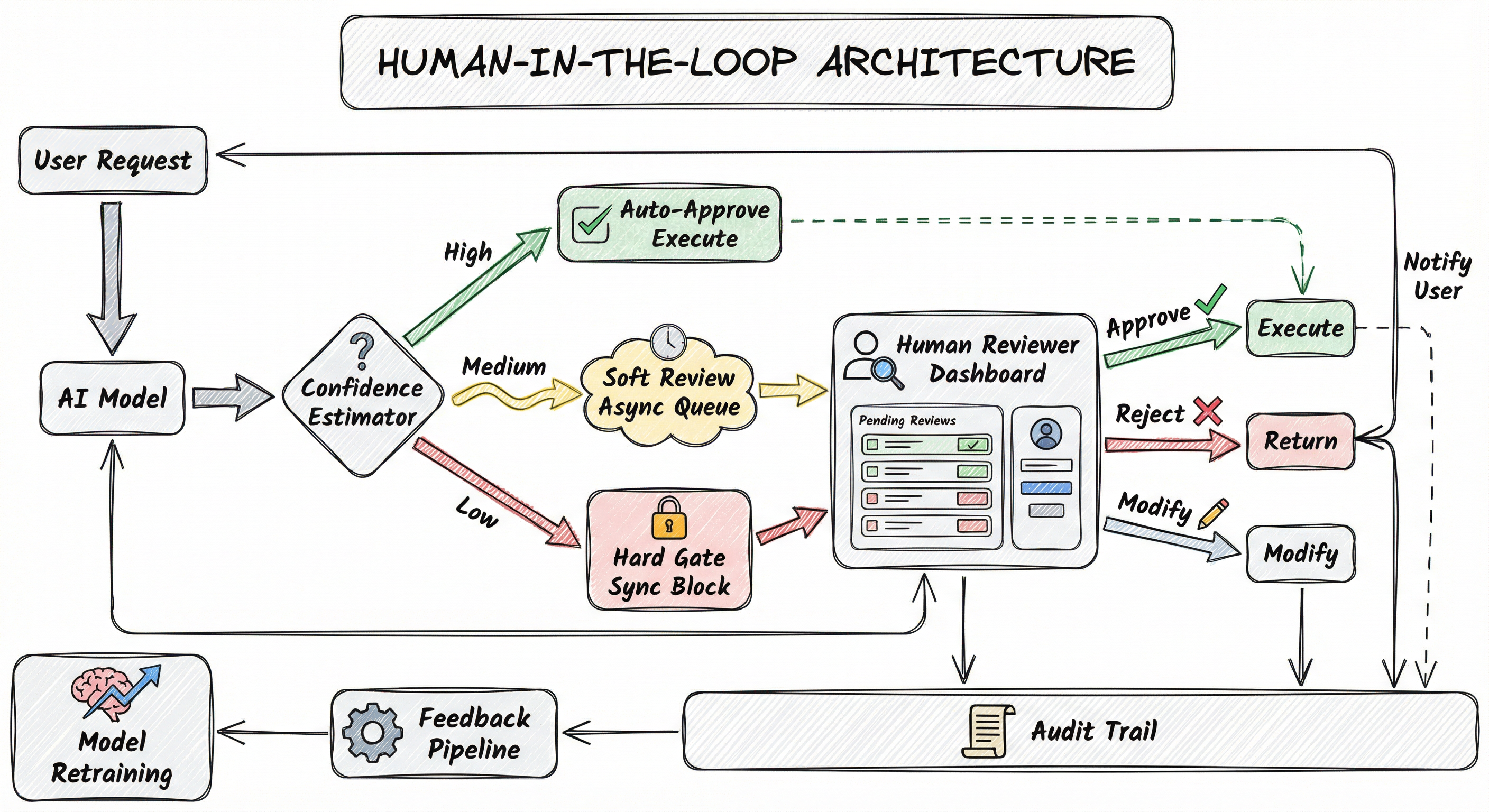
A production HITL system consists of five major subsystems: a confidence estimator that scores predictions, an escalation router that decides what needs human attention, a task queue that manages the review workload, a review interface that presents decisions to humans efficiently, and a feedback pipeline that routes human corrections back into model improvement.
The architecture looks different depending on the context. In a real-time serving scenario (e.g., fraud detection at Razorpay), the escalation router must decide within milliseconds. In an offline annotation workflow (e.g., RLHF at Anthropic), the task queue can batch work over hours. In an agentic workflow (e.g., LangGraph agent executing a multi-step plan), the system pauses at specific breakpoints and waits for approval before proceeding.
Here's the architecture for a real-time HITL system with an agent workflow:
Key Components
Confidence Estimator
Computes a calibrated confidence score for each model prediction or agent action proposal. May use softmax probabilities, Monte Carlo dropout, ensemble disagreement, or an auxiliary calibration model. The quality of this component directly determines the efficiency of the entire HITL system -- poor calibration means you're routing the wrong cases to humans.
Escalation Router
Applies the deferral policy based on confidence scores, business rules, and regulatory requirements. Routes predictions into three tiers: auto-approve (high confidence), soft review (async human check), and hard gate (sync human approval required before execution). Supports configurable thresholds per action type -- e.g., a Razorpay payment agent might auto-approve transfers under INR 10,000 but hard-gate anything above INR 1,00,000.
Task Queue & Priority Manager
Manages the queue of items awaiting human review. Implements priority scheduling based on urgency, business impact, and SLA requirements. For real-time systems, this might use Redis or Kafka with strict latency guarantees. For offline annotation workflows, tools like Label Studio or Argilla manage the queue with features like annotator assignment, inter-rater agreement tracking, and workload balancing.
Review Interface / HMI
The human-machine interface where reviewers see the model's prediction, supporting evidence, confidence scores, and similar historical cases. Good HMIs reduce decision time from minutes to seconds. For agent workflows, this surfaces the agent's proposed action plan, tool calls, and reasoning chain. LangGraph's interrupt() function and CrewAI's HumanTool are programmatic implementations of this component.
Feedback Pipeline
Captures human decisions (approve/reject/modify) and routes them back into the ML pipeline as training signal. In annotation workflows, corrections become new labeled data for supervised fine-tuning. In RLHF setups, preference rankings feed into reward model training. In agent systems, rejected action plans become negative examples for planning module improvement. This is the component that makes HITL a learning system, not just a review system.
Audit Trail & Compliance Logger
Records every decision point -- model prediction, confidence score, routing decision, human reviewer identity, review timestamp, and final outcome. Essential for regulatory compliance (EU AI Act, RBI guidelines for fintech, HIPAA for healthcare). Stored in immutable append-only logs with cryptographic verification for tamper-proofing.
Data Flow
Real-time Serving Path: A prediction or agent action enters the confidence estimator -> scores are computed -> the escalation router applies the deferral policy -> high-confidence items proceed automatically -> uncertain items are enqueued for human review -> the reviewer dashboard presents the decision context -> the human approves, rejects, or modifies -> the decision is executed and logged to the audit trail -> feedback is batched and sent to the retraining pipeline.
Annotation / RLHF Path: The model generates candidate outputs -> an active learning sampler selects the most informative examples (highest uncertainty, highest expected information gain) -> items are queued in the annotation tool -> human annotators provide labels or preference rankings -> data is validated for inter-rater agreement -> approved annotations feed into supervised fine-tuning or reward model training -> the improved model generates better candidates, closing the loop.
Agent Breakpoint Path: The agent receives a task and generates a plan -> at predefined breakpoints (before tool calls, before irreversible actions), execution pauses -> the state is checkpointed -> the human reviews the proposed action and approves or modifies it -> execution resumes from the checkpoint -> the full trace is logged for debugging and compliance.
A flowchart showing a user request flowing into an AI model/agent, which feeds into a confidence estimator. The estimator routes to three paths: high confidence (auto-approve), medium confidence (async review queue), and low confidence (sync blocking gate). Both review paths lead to a human reviewer dashboard with approve/reject/modify options. All outcomes flow into an audit trail and feedback pipeline that feeds back into model retraining.
How to Implement
Implementation Patterns
There are three primary implementation patterns for HITL, and most production systems combine at least two:
Pattern 1: Threshold-Based Escalation. The simplest and most common. Set a confidence threshold, route everything below it to humans. Works for classification tasks, fraud detection, content moderation. The main engineering challenge is calibrating the threshold -- too low and you miss errors, too high and you drown your reviewers.
Pattern 2: Agent Breakpoints. For agentic workflows where the model executes multi-step plans. Execution pauses at predefined checkpoints (before API calls, database writes, or any irreversible action) and waits for human approval. LangGraph implements this with interrupt() functions, CrewAI with human_input=True on tasks. The engineering challenge is state management -- you need to serialize and resume agent state across potentially long human review periods.
Pattern 3: Active Learning Loop. For training-time HITL where the model selects its own training examples. The model identifies the data points it is most uncertain about and routes those to human annotators. This maximizes the information gained per annotation dollar spent. Tools like Prodigy and Label Studio have built-in active learning support.
Cost Context: Human review costs vary dramatically. In India, a trained content moderator costs approximately INR 3-5 lakh/year (~18,000-30,000/year). Offshore annotation services like Scale AI charge 1-5 per task for expert medical or legal review. Design your escalation thresholds with these costs in mind.
from dataclasses import dataclass
from enum import Enum
from typing import Any, Optional
import logging
import time
import uuid


class ReviewTier(Enum):
    AUTO_APPROVE = "auto_approve"
    SOFT_REVIEW = "soft_review"     # async, non-blocking
    HARD_GATE = "hard_gate"         # sync, blocks execution


@dataclass
class EscalationPolicy:
    """Configurable thresholds per action type."""
    action_type: str
    auto_approve_threshold: float   # above this -> auto approve
    soft_review_threshold: float    # above this but below auto -> soft review
    # below soft_review_threshold -> hard gate
    max_auto_approve_amount: Optional[float] = None  # e.g., INR 10000
    require_audit: bool = True


@dataclass
class ReviewDecision:
    decision_id: str
    action_id: str
    tier: ReviewTier
    confidence: float
    reviewer_id: Optional[str] = None
    approved: Optional[bool] = None
    modified_action: Optional[Any] = None
    review_timestamp: Optional[float] = None
    feedback_notes: Optional[str] = None


class HITLEscalationRouter:
    """Routes model predictions to the appropriate review tier."""

    def __init__(self, policies: list[EscalationPolicy], audit_logger=None):
        self.policies = {p.action_type: p for p in policies}
        self.audit_logger = audit_logger or logging.getLogger("hitl_audit")
        self.review_queue = []  # In production, use Redis or Kafka

    def route(self, action_type: str, confidence: float,
              amount: Optional[float] = None, metadata: dict = None) -> ReviewDecision:
        """Determine the review tier for a given action."""
        policy = self.policies.get(action_type)
        if policy is None:
            # Unknown action type -> hard gate by default (fail safe)
            return self._create_decision(action_type, confidence, ReviewTier.HARD_GATE)

        # Amount-based override: large transactions always need review
        if (policy.max_auto_approve_amount is not None
                and amount is not None
                and amount > policy.max_auto_approve_amount):
            tier = ReviewTier.HARD_GATE
        elif confidence >= policy.auto_approve_threshold:
            tier = ReviewTier.AUTO_APPROVE
        elif confidence >= policy.soft_review_threshold:
            tier = ReviewTier.SOFT_REVIEW
        else:
            tier = ReviewTier.HARD_GATE

        decision = self._create_decision(action_type, confidence, tier)

        # Log to audit trail
        if policy.require_audit:
            self._log_audit(decision, amount, metadata)

        # Enqueue if review needed
        if tier != ReviewTier.AUTO_APPROVE:
            self.review_queue.append(decision)

        return decision

    def _create_decision(self, action_type: str, confidence: float,
                         tier: ReviewTier) -> ReviewDecision:
        return ReviewDecision(
            decision_id=str(uuid.uuid4()),
            action_id=action_type,
            tier=tier,
            confidence=confidence,
        )

    def _log_audit(self, decision: ReviewDecision,
                   amount: Optional[float], metadata: dict):
        self.audit_logger.info(
            f"HITL_ROUTING | id={decision.decision_id} | "
            f"action={decision.action_id} | tier={decision.tier.value} | "
            f"confidence={decision.confidence:.4f} | amount={amount} | "
            f"metadata={metadata}"
        )


# --- Usage Example ---
policies = [
    EscalationPolicy(
        action_type="payment_transfer",
        auto_approve_threshold=0.95,
        soft_review_threshold=0.80,
        max_auto_approve_amount=10000.0,  # INR 10,000
    ),
    EscalationPolicy(
        action_type="content_publish",
        auto_approve_threshold=0.90,
        soft_review_threshold=0.70,
    ),
]

router = HITLEscalationRouter(policies)

# High confidence, small amount -> auto approve
d1 = router.route("payment_transfer", confidence=0.97, amount=5000)
print(d1.tier)  # ReviewTier.AUTO_APPROVE

# High confidence but large amount -> hard gate
d2 = router.route("payment_transfer", confidence=0.97, amount=500000)
print(d2.tier)  # ReviewTier.HARD_GATE

# Low confidence -> hard gate
d3 = router.route("payment_transfer", confidence=0.55, amount=2000)
print(d3.tier)  # ReviewTier.HARD_GATE
This implementation demonstrates a production-ready escalation router with three review tiers. The key design decisions are: (1) fail-safe default -- unknown action types always go to hard gate, (2) amount-based override -- large transactions require review regardless of confidence, and (3) audit logging -- every routing decision is recorded. In production, replace the in-memory queue with Redis Streams or Apache Kafka for durability and horizontal scaling.
from langgraph.graph import StateGraph, START, END
from langgraph.types import interrupt, Command
from langgraph.checkpoint.memory import MemorySaver
from typing import TypedDict


class AgentState(TypedDict):
    task: str
    plan: str
    tool_calls: list[dict]
    human_approved: bool
    result: str


def plan_step(state: AgentState) -> AgentState:
    """Agent generates a plan and proposed tool calls."""
    # In production, this calls an LLM to generate the plan
    plan = f"Plan for: {state['task']}"
    tool_calls = [
        {"tool": "database_write", "args": {"table": "orders", "action": "update"}},
        {"tool": "send_email", "args": {"to": "[email protected]"}},
    ]
    return {**state, "plan": plan, "tool_calls": tool_calls}


def human_review_step(state: AgentState) -> AgentState:
    """Pause execution and wait for human approval."""
    # This is where the magic happens -- interrupt() pauses the graph
    # and surfaces the current state to the human reviewer
    review_context = (
        f"Agent proposes the following actions:\n"
        f"Plan: {state['plan']}\n"
        f"Tool calls: {state['tool_calls']}\n"
        f"Please approve (yes/no/modify):"
    )
    human_response = interrupt(review_context)

    if human_response.get("approved"):
        return {**state, "human_approved": True}
    elif human_response.get("modified_calls"):
        return {
            **state,
            "tool_calls": human_response["modified_calls"],
            "human_approved": True,
        }
    else:
        return {**state, "human_approved": False, "result": "Rejected by human reviewer"}


def execute_step(state: AgentState) -> AgentState:
    """Execute the approved actions."""
    if not state.get("human_approved"):
        return state
    # Execute tool calls here
    results = [f"Executed {tc['tool']}" for tc in state["tool_calls"]]
    return {**state, "result": "; ".join(results)}


def should_execute(state: AgentState) -> str:
    """Conditional edge: only execute if human approved."""
    return "execute" if state.get("human_approved") else "end"


# Build the graph with HITL breakpoint
builder = StateGraph(AgentState)
builder.add_node("plan", plan_step)
builder.add_node("human_review", human_review_step)
builder.add_node("execute", execute_step)

builder.add_edge(START, "plan")
builder.add_edge("plan", "human_review")
builder.add_conditional_edges("human_review", should_execute, {
    "execute": "execute",
    "end": END,
})
builder.add_edge("execute", END)

# Compile with checkpointing (required for interrupt)
checkpointer = MemorySaver()
graph = builder.compile(checkpointer=checkpointer)

# Run the agent -- it will pause at human_review_step
config = {"configurable": {"thread_id": "task-001"}}
initial_state = {"task": "Update order status and notify customer",
                 "plan": "", "tool_calls": [],
                 "human_approved": False, "result": ""}

# First invocation: runs until interrupt
result = graph.invoke(initial_state, config)
# Graph is now paused, waiting for human input

# Human reviews and approves
human_input = Command(resume={"approved": True})
final_result = graph.invoke(human_input, config)
print(final_result["result"])
# Output: "Executed database_write; Executed send_email"
This example shows LangGraph's interrupt() function creating a synchronous breakpoint in an agent workflow. The agent generates a plan, execution pauses at the human review node, and the graph's state is checkpointed. A human reviewer can then approve, reject, or modify the proposed actions before execution continues. The MemorySaver checkpointer persists state across the interrupt -- in production, you'd use a persistent backend like Redis or PostgreSQL. This pattern is essential for any agent that performs irreversible actions.
import numpy as np
from sklearn.ensemble import RandomForestClassifier
from sklearn.metrics import accuracy_score
from label_studio_sdk import Client


class ActiveLearningLoop:
    """Implements uncertainty-based active learning with human annotation."""

    def __init__(self, model, ls_url: str, ls_api_key: str, project_id: int):
        self.model = model
        self.ls_client = Client(url=ls_url, api_key=ls_api_key)
        self.project = self.ls_client.get_project(project_id)
        self.labeled_X, self.labeled_y = [], []
        self.iteration = 0

    def compute_uncertainty(self, X_pool: np.ndarray) -> np.ndarray:
        """Compute prediction uncertainty using entropy."""
        proba = self.model.predict_proba(X_pool)
        entropy = -np.sum(proba * np.log(proba + 1e-10), axis=1)
        return entropy

    def select_for_annotation(self, X_pool: np.ndarray,
                               n_samples: int = 50) -> np.ndarray:
        """Select the most uncertain samples for human review."""
        uncertainty = self.compute_uncertainty(X_pool)
        top_indices = np.argsort(uncertainty)[-n_samples:]
        return top_indices

    def send_to_label_studio(self, samples: list[dict]):
        """Push selected samples to Label Studio for annotation."""
        tasks = [{"data": sample} for sample in samples]
        self.project.import_tasks(tasks)
        print(f"Sent {len(tasks)} tasks to Label Studio for annotation")

    def fetch_annotations(self) -> list[dict]:
        """Retrieve completed annotations from Label Studio."""
        tasks = self.project.get_labeled_tasks()
        annotations = []
        for task in tasks:
            if task.get("annotations"):
                latest = task["annotations"][-1]
                annotations.append({
                    "data": task["data"],
                    "label": latest["result"][0]["value"]["choices"][0],
                    "annotator": latest.get("completed_by"),
                })
        return annotations

    def retrain(self, X_new: np.ndarray, y_new: np.ndarray):
        """Retrain model with newly annotated data."""
        self.labeled_X.append(X_new)
        self.labeled_y.append(y_new)
        X_all = np.vstack(self.labeled_X)
        y_all = np.concatenate(self.labeled_y)
        self.model.fit(X_all, y_all)
        self.iteration += 1
        print(f"Retrained model (iteration {self.iteration}) "
              f"on {len(y_all)} total samples")

    def run_iteration(self, X_pool: np.ndarray, n_samples: int = 50):
        """Execute one active learning iteration."""
        # 1. Select most uncertain samples
        indices = self.select_for_annotation(X_pool, n_samples)
        selected = X_pool[indices]

        # 2. Send to humans for annotation
        samples = [{"features": x.tolist()} for x in selected]
        self.send_to_label_studio(samples)

        # 3. Wait for annotations (in production, this is async)
        print(f"Waiting for {n_samples} annotations...")
        # annotations = self.fetch_annotations()  # called after humans complete

        return indices


# --- Usage ---
model = RandomForestClassifier(n_estimators=100)
# model.fit(initial_X, initial_y)  # fit on seed data first

al_loop = ActiveLearningLoop(
    model=model,
    ls_url="http://localhost:8080",
    ls_api_key="your-api-key",
    project_id=1,
)

# Run active learning iteration
# indices = al_loop.run_iteration(X_unlabeled_pool, n_samples=50)
This shows an active learning loop where the model identifies its most uncertain predictions (using entropy over predicted class probabilities) and routes those specific examples to human annotators via Label Studio. Each annotation cycle maximizes information gain per human hour. In practice, this can reduce annotation costs by 40-70% compared to random sampling -- for an Indian annotation team costing INR 4 lakh/year (~1,920-3,360) per annotator per year.
# HITL Escalation Policy Configuration (YAML)
escalation_policies:
  - action_type: payment_transfer
    auto_approve_threshold: 0.95
    soft_review_threshold: 0.80
    max_auto_approve_amount_inr: 10000
    require_two_reviewers_above_inr: 500000
    sla_seconds: 30
    audit: true

  - action_type: content_publish
    auto_approve_threshold: 0.92
    soft_review_threshold: 0.75
    categories_always_review:
      - hate_speech
      - self_harm
      - child_safety
    sla_seconds: 300
    audit: true

  - action_type: agent_tool_call
    auto_approve_threshold: 0.98
    soft_review_threshold: 0.85
    irreversible_actions_always_gate:
      - database_delete
      - send_email
      - api_post
    sla_seconds: 60
    audit: true

review_settings:
  max_queue_depth: 500
  reviewer_session_limit_minutes: 120
  min_reviewers_per_task: 1
  high_stakes_min_reviewers: 2
  inter_rater_agreement_threshold: 0.80

feedback_pipeline:
  batch_size: 256
  retrain_trigger: every_1000_annotations
  min_agreement_for_training: 0.85
  store: redis
  audit_log: immutable_append_only
Common Implementation Mistakes
- ●
Over-escalation (the 'checkbox syndrome'): Setting confidence thresholds too high so that 30-40% of predictions go to human review. This overwhelms reviewers, increases latency, and defeats the purpose of automation. If your human review rate exceeds 15-20%, your model needs improvement, not more reviewers.
- ●
No feedback loop: Building a review system that captures human decisions but never feeds them back into model retraining. Without the feedback loop, your HITL system is a cost center, not a learning system. Every human correction is wasted training signal.
- ●
Ignoring reviewer fatigue: Expecting human reviewers to maintain consistent accuracy through an 8-hour shift of monotonous yes/no decisions. Studies show reviewer accuracy drops by 10-20% after 2-3 hours of continuous review. Implement rotation, breaks, and workload caps.
- ●
Treating human labels as ground truth: Assuming every human decision is correct. In practice, inter-annotator agreement for complex tasks (sentiment analysis, content policy) is often only 70-85%. Use multiple reviewers for high-stakes decisions and measure inter-rater reliability (Cohen's kappa or Fleiss' kappa).
- ●
Synchronous gates on low-stakes actions: Requiring blocking human approval for actions that are easily reversible or low-impact. This adds unnecessary latency. Use asynchronous review for reversible actions and reserve synchronous gates for irreversible, high-stakes operations.
- ●
Missing audit trails: Not logging the full decision chain (model prediction -> confidence score -> routing decision -> reviewer identity -> final outcome). This makes debugging impossible and fails regulatory compliance. Every production HITL system needs immutable, append-only audit logs.
When Should You Use This?
Use When
Your AI system makes decisions with legal, financial, or safety consequences that cannot be easily reversed -- loan approvals, medical triage, criminal risk scoring
Regulatory requirements mandate human oversight (EU AI Act Article 14, RBI guidelines for automated lending, HIPAA for clinical decision support)
Your model operates in a domain where the cost of a false positive or false negative is extremely high relative to the cost of human review
You are deploying an agentic AI system that can execute irreversible actions -- database mutations, financial transactions, sending communications
Your model is new in production and you need to build confidence in its accuracy before granting full autonomy (graduated autonomy pattern)
The domain requires explainability and you need a human to validate the model's reasoning, not just its output
You are collecting training data and want to maximize annotation efficiency through active learning rather than random sampling
Your application serves diverse user populations where model performance varies across segments (e.g., different languages, regions, or demographics)
Avoid When
The task is high-volume, low-stakes, and easily reversible -- spam filtering, recommendation ranking, ad targeting. Adding humans here just adds cost without meaningful quality improvement.
Your model accuracy is already at or above human-level performance for the task. Adding a human review layer would actually decrease accuracy while adding latency and cost.
Latency requirements are in the single-digit millisecond range (real-time bidding, autocomplete) where any human involvement is physically impossible.
The feedback from human reviewers would not meaningfully improve the model -- for example, tasks where inter-annotator agreement is already low and more labels wouldn't help.
You are using HITL as a crutch to avoid improving a fundamentally underperforming model. If your model needs human review on 40% of cases, you need a better model, not more humans.
The human reviewers lack the domain expertise to make better decisions than the model. An untrained reviewer evaluating a protein folding prediction adds no value.
Key Tradeoffs
The Fundamental Tradeoff: Throughput vs. Safety
Every human checkpoint adds latency. A synchronous approval gate might add 30 seconds to 5 minutes per action, depending on reviewer availability. For a Zerodha-like trading platform processing thousands of orders per second, that's a non-starter. For an HDFC loan approval system, a 2-minute human review is perfectly acceptable.
| Dimension | Fully Automated | HITL (Threshold) | Fully Manual |
|---|---|---|---|
| Latency | 10-100ms | 100ms-5min | 5-30min |
| Cost per decision | INR 0.01-0.10 | INR 1-50 | INR 50-500 |
| Accuracy | Model-dependent | Model + Human | Human-limited |
| Scalability | Near-infinite | Human-bottlenecked | Very limited |
| Audit trail | Automatic | Comprehensive | Often inconsistent |
| Regulatory compliance | Risky | Strong | Strong |
The Second Axis: Model Improvement Rate
A well-designed HITL system improves the underlying model over time, which should reduce the fraction of cases needing human review. If you're spending INR 10 lakh/month (~$12,000/month) on reviewers in month 1, that should decline to INR 5-6 lakh/month by month 6 as the feedback loop kicks in. If it doesn't, your feedback pipeline is broken.
The Scalability Ceiling
Human reviewers don't scale horizontally the way compute does. You can spin up 100 GPU instances in minutes; hiring and training 100 qualified content moderators takes months. This creates a scalability ceiling that must be planned for. For Indian startups scaling rapidly -- think Meesho going from 100K to 10M sellers -- the reviewer hiring pipeline must be ahead of the traffic curve, or the review queue will explode.
Rule of Thumb: Budget for 1 human reviewer per 500-2,000 daily escalations, depending on task complexity. A simple approve/reject takes 10-30 seconds; a complex content policy decision takes 2-5 minutes.
Alternatives & Comparisons
Guardrails are automated safety checks (input/output validation, content filters, schema enforcement) that operate without human involvement. Use guardrails for deterministic safety rules (e.g., 'never output PII', 'reject SQL injection'). Use HITL when the decision requires judgment, context, or domain expertise that can't be codified as rules. Most production systems use both: guardrails catch the obvious violations, HITL handles the ambiguous cases.
An agent supervisor is an AI-based oversight layer -- a second model that monitors and evaluates the primary agent's actions. Think of it as AI-in-the-loop rather than human-in-the-loop. Supervisors are faster and cheaper but less reliable for novel edge cases. The best production systems use a hierarchy: agent supervisor for routine oversight, human escalation for cases the supervisor flags as uncertain.
A content moderator is a specialized HITL implementation focused specifically on user-generated content (text, images, video). While HITL is a general pattern applicable across the ML pipeline, content moderation is a specific application domain with its own tooling (Spectrum Labs, Hive Moderation), regulatory frameworks (DSA, IT Act Section 79), and operational challenges (reviewer trauma, cultural context).
A fairness checker audits model outputs for bias across protected attributes (gender, caste, religion, region). It can operate automatically using statistical tests, but complex fairness determinations often require human judgment -- is this differential outcome unfair or does it reflect legitimate differences? HITL provides the human judgment layer that purely algorithmic fairness checks cannot.
Pros, Cons & Tradeoffs
Advantages
Catches edge cases that models miss -- human reviewers bring world knowledge, common sense, and contextual understanding that even the best models lack, especially for culturally nuanced content or novel scenarios
Enables graduated autonomy -- you can start with heavy human oversight and progressively reduce it as the model proves itself, building stakeholder confidence without gambling on day-one full automation
Generates high-quality training signal -- every human correction is a labeled example that feeds back into model improvement, creating a virtuous cycle where the system gets better over time
Meets regulatory requirements -- EU AI Act (Article 14), India's DPDP Act, RBI lending guidelines, and healthcare regulations increasingly mandate human oversight for automated decisions affecting individuals
Provides defensible audit trails -- when something goes wrong (and it will), you have a complete record of what the model predicted, why it was escalated, who reviewed it, and what they decided
Builds user trust -- knowing that a human can intervene increases end-user confidence, particularly in high-stakes domains like healthcare, finance, and legal services
Handles distribution shift gracefully -- when the model encounters out-of-distribution inputs (a new type of fraud, a novel content policy violation), the HITL system naturally routes these to humans rather than making bad automated decisions
Disadvantages
Introduces latency -- synchronous human review adds seconds to minutes of delay, which is unacceptable for real-time applications like programmatic advertising or high-frequency trading
Creates a scalability bottleneck -- human reviewers don't scale horizontally like compute resources. During traffic spikes (Flipkart Big Billion Days, cricket match peaks on Hotstar), review queues can back up catastrophically
Significant ongoing cost -- human reviewers are a recurring expense. A team of 20 moderators in India costs INR 60-100 lakh/year (~$72,000-120,000/year), and that cost doesn't decrease unless the feedback loop is working
Reviewer inconsistency -- different humans make different decisions on the same case. Inter-annotator agreement for nuanced tasks is typically 70-85%, introducing noise into both decisions and training data
Reviewer fatigue and burnout -- content moderators reviewing disturbing content experience real psychological harm. Turnover in moderation teams is high, requiring continuous hiring and training
Can become a crutch -- teams may rely on human reviewers instead of investing in model improvement, creating a permanent dependency that becomes more expensive as scale increases
Privacy concerns -- human reviewers see sensitive data (financial transactions, medical records, private messages), requiring robust access controls, NDAs, and data handling policies
Failure Modes & Debugging
Review Queue Overflow
Cause
Traffic spike exceeds reviewer capacity, or model degradation causes a sudden increase in escalation rate. Common during events like Flipkart Big Billion Days or IPL season content surges.
Symptoms
Review queue depth grows unboundedly. SLA breaches. Items time out and either fall through without review (dangerous) or get blocked indefinitely (poor user experience). Reviewers cut corners under pressure, reducing decision quality.
Mitigation
Implement adaptive thresholds that automatically loosen when queue depth exceeds a limit, accepting slightly lower review quality to maintain throughput. Set up auto-scaling reviewer pools. Use an overflow policy (e.g., auto-approve medium-confidence items when queue > 1000, but never auto-approve low-confidence). Monitor queue depth as a Tier-1 operational metric.
Feedback Loop Poisoning
Cause
Malicious or consistently incorrect human reviewers inject bad labels into the training pipeline. One biased annotator can systematically shift model behavior over thousands of reviews.
Symptoms
Model accuracy degrades gradually after retraining on human feedback. Bias appears in specific categories or demographics. Annotator agreement metrics diverge without explanation.
Mitigation
Implement reviewer quality monitoring: track per-reviewer agreement with consensus, inject known-label test cases (gold standard tasks) into the review queue, and flag reviewers whose accuracy drops below threshold. Use majority voting (3+ reviewers) for high-stakes training data. Apply anomaly detection on reviewer decision patterns.
Automation Bias (Over-Trust)
Cause
Human reviewers become over-reliant on model predictions and rubber-stamp decisions without genuine independent evaluation. This is well-documented in aviation, radiology, and content moderation.
Symptoms
Review approval rate suspiciously close to 100%. Review decision time drops below what genuine evaluation would require (e.g., approving complex cases in under 2 seconds). Error rate on human-reviewed items approaches or exceeds the fully automated error rate.
Mitigation
Don't show the model's prediction to the reviewer for a random subset of cases (blind review). Track correlation between model prediction and reviewer decision -- perfect correlation indicates rubber-stamping. Set minimum review time thresholds. Periodically insert adversarial test cases where the model is deliberately wrong.
Threshold Miscalibration
Cause
Confidence scores are not well-calibrated -- the model says 90% confident but is actually only correct 70% of the time. This causes the escalation router to auto-approve items that should have been reviewed.
Symptoms
Error rate on auto-approved items is higher than expected given the confidence threshold. Post-hoc audits reveal mistakes in items that bypassed human review. The relationship between stated confidence and actual accuracy is non-monotonic.
Mitigation
Apply calibration techniques (temperature scaling, Platt scaling, isotonic regression) to confidence scores before using them for routing. Continuously monitor the calibration curve by comparing stated confidence bins to actual accuracy. Re-calibrate whenever the model is retrained or the data distribution shifts.
Reviewer Privacy Breach
Cause
Human reviewers have access to sensitive data (financial transactions, medical records, private conversations) and either intentionally or accidentally expose it.
Symptoms
Data leaks traced to reviewer access patterns. PII appears in unauthorized locations. Compliance violations flagged during audits.
Mitigation
Implement minimum necessary access: redact unnecessary PII before it reaches reviewers. Use secure review environments with no copy/paste, screenshot prevention, and audit logging of all data access. Enforce background checks, NDAs, and regular security training. For Indian data, comply with DPDP Act requirements for data processor agreements.
Stale Escalation Policies
Cause
The data distribution, model behavior, or business requirements have changed, but the escalation thresholds remain fixed at values optimized for old conditions.
Symptoms
Either too many or too few items are escalated compared to the target rate. Review costs increase without corresponding quality improvement. New categories of errors slip through because they weren't considered when policies were set.
Mitigation
Implement dynamic threshold optimization that periodically re-evaluates the confidence-cost curve using recent production data. Set up automated alerts when escalation rates deviate more than 10% from target. Review and update escalation policies at least quarterly, or automatically using Bayesian optimization.
Placement in an ML System
Where Does HITL Sit in the Pipeline?
HITL is a cross-cutting concern -- it touches multiple stages of the ML system rather than sitting at a single fixed point.
During training: HITL manifests as annotation workflows (Label Studio, Prodigy), preference labeling (RLHF for LLMs), and active learning loops. It sits between the data pipeline and the model training loop, feeding curated human judgments into the learning process.
During serving: HITL acts as an approval gate between the model's prediction and the downstream action. In an agentic system, it sits between the planning module (upstream) and the execution engine (downstream). The agent proposes an action, the HITL gate evaluates it, and only approved actions proceed.
During monitoring: HITL enables human audit of production predictions. Randomly sampled or flagged predictions are routed to expert reviewers who assess quality, detect drift, and identify systematic errors.
The key architectural insight is that HITL doesn't replace any existing pipeline component -- it wraps existing components with human oversight. The planning module still plans, the agent still proposes actions, the model still predicts. HITL adds a conditional checkpoint that gates progression based on human judgment.
Important: HITL must be designed as a first-class system component, not bolted on as an afterthought. The state management, queue infrastructure, and feedback pipelines need to be architected from day one.
Pipeline Stage
Cross-cutting / Serving / Training
Upstream
- agent-orchestrator
- planning-module
Downstream
- guardrails
- agent-supervisor
Scaling Bottlenecks
The primary bottleneck is human reviewer throughput. Unlike compute resources, you can't auto-scale humans. A single reviewer can handle approximately 100-400 decisions per hour for simple binary tasks, dropping to 15-30 per hour for complex multi-step reviews.
At scale, the queue management system becomes critical. If you're processing 100,000 predictions per day with a 5% escalation rate, that's 5,000 items per day requiring human review -- roughly 20-25 full-time reviewers for simple tasks. For a company like Flipkart during sale events, daily predictions might spike to 10M+, and even a 1% escalation rate means 100,000 reviews per day.
The feedback pipeline also creates a bottleneck: human corrections must be batched, validated for quality, and incorporated into the training pipeline. If retraining takes 6 hours and you retrain daily, there's always at least a 6-30 hour lag between a human correction and the model improvement it produces.
Production Case Studies
OpenAI's InstructGPT paper demonstrated the power of RLHF (Reinforcement Learning from Human Feedback) -- arguably the most impactful HITL application in ML history. A team of 40 human labelers provided preference rankings on model outputs, which were used to train a reward model. This reward model then guided PPO fine-tuning of GPT-3. The human feedback loop transformed a raw language model into one that could follow instructions reliably.
The 1.3B parameter InstructGPT model (with RLHF) was preferred by human evaluators over the 175B parameter GPT-3 (without RLHF) -- a 100x smaller model outperforming through human feedback. This proved that HITL-based alignment is more cost-effective than scaling model size alone.
LinkedIn built a dynamic content prioritization system that uses XGBoost models to score content entering the review queue. High-probability non-violative content is deprioritized, while policy-violating content is escalated for faster human review. The system dynamically adjusts reviewer bandwidth allocation based on content risk scores, ensuring the most harmful content gets reviewed first.
Reduced average time-to-action on policy-violating content by routing human reviewers to the highest-risk items first. The ML model handles the triage, but every enforcement decision still passes through a trained human reviewer, maintaining both speed and accuracy.
Razorpay's fraud detection pipeline combines ML models with human risk analysts in a three-tier system. Transactions are scored in real-time (under 200ms) and routed to auto-approve, human review, or auto-block based on the fraud score. Dedicated risk analysts review ambiguous transactions, and their decisions feed back into model retraining through weekly touchpoints. The system handles millions of transactions daily across India's diverse payment landscape.
Achieved a dramatic reduction in fraud-to-sales ratio while maintaining high authorization rates. The human-in-the-loop design ensures that legitimate transactions from new patterns (UPI adoption surge, festive season spikes) aren't incorrectly blocked while genuinely fraudulent transactions are caught.
Flipkart uses human-in-the-loop for catalog quality assurance and seller onboarding. Image recognition AI scans product images uploaded by sellers to flag counterfeits and policy violations, with flagged items routed to human reviewers for final disposition. NLP models moderate product reviews, especially during high-volume sale events, flagging suspicious patterns for human verification. The system balances automation with human expertise to maintain catalog integrity across millions of listings.
Blocked over 50,000 fraudulent listings before they went live in 2023. The combination of AI flagging and human review allows Flipkart to scale catalog moderation to handle the volume of India's largest e-commerce platform while maintaining quality standards.
Microsoft's Magentic-UI is a research prototype for human-in-the-loop agentic systems. It implements five interaction mechanisms: co-planning (human and agent jointly create the task plan), co-tasking (human can take over specific subtasks), action approval (agent pauses before executing potentially dangerous actions), answer verification (human confirms the agent's final output), and memory (system learns from human corrections across sessions).
Magentic-UI demonstrated that structured HITL interactions significantly improve agent reliability for web-based tasks. The co-planning mechanism, where humans can edit the agent's proposed plan before execution begins, reduced task failure rates compared to fully autonomous execution.
Tooling & Ecosystem
Agent orchestration framework with first-class support for HITL via interrupt() functions and breakpoints. Enables pausing agent execution at any node, serializing state to a checkpoint, and resuming after human review. The recommended framework for building production agent workflows with approval gates.
Multi-agent platform with built-in HITL via human_input=True on tasks and a HumanTool that agents can invoke when they need guidance. Supports both automated and human-in-the-loop agent training for repeatable, reliable outcomes.
Open-source data labeling platform with ML backend integration for active learning loops. Supports image, text, audio, and video annotation with configurable workflows, reviewer assignment, and inter-annotator agreement tracking. The go-to tool for building annotation-based HITL pipelines.
Open-source feedback platform purpose-built for LLM fine-tuning and RLHF workflows. Supports collecting demonstration data for SFT, comparison data for reward model training, and prompt selection for RL. Integrates with Hugging Face ecosystem.
Annotation tool by Explosion (creators of spaCy) with built-in active learning. The model participates in the annotation process, selecting the most informative examples for human review. Designed for developer-centric workflows where the annotator and the ML engineer are the same person.
Durable workflow orchestration engine that natively supports human approval steps via signals and manual triggers. Workflows can pause for hours or days waiting for human input, with full state persistence and fault tolerance. Ideal for building enterprise HITL workflows that span multiple microservices.
LLM evaluation platform that supports human-in-the-loop feedback collection, prompt management, and observability. Enables domain experts to give feedback on model outputs and experiment with prompts. Used by companies like Gusto, Vanta, and Duolingo.
Workflow orchestration platform built on Netflix Conductor with native HITL task support. Provides visual workflow builders, human task assignment, SLA management, and integration with messaging platforms for reviewer notifications. Offers both cloud and self-hosted deployments.
Research & References
Ouyang, Wu, Jiang, Almeida, Wainwright, Mishkin, Zhang, et al. (2022)NeurIPS 2022
The InstructGPT paper that established RLHF as the standard alignment technique for LLMs. Demonstrated that a 1.3B model with human feedback outperforms a 175B model without it, proving that human-in-the-loop alignment is more cost-effective than pure scaling.
Bai, Kadavath, Kundu, Askell, Kernion, Jones, Chen, Goldie, et al. (2022)arXiv preprint
Introduced Constitutional AI and RLAIF (RL from AI Feedback), showing that human oversight can be partially automated by having AI systems self-critique against a set of principles. Represents the frontier of reducing HITL cost while maintaining alignment quality.
Kaufmann, Weng, Bengs, Hullermeier (2023)arXiv preprint
Comprehensive survey covering the full RLHF pipeline: human feedback collection, reward modeling, and policy optimization. Provides a taxonomy of feedback types (rankings, ratings, corrections) and their tradeoffs.
Wu, Xiao, Sun, Zhang, Ma, He (2022)Future Generation Computer Systems
Broad survey of HITL patterns across the ML lifecycle, covering active learning, interactive labeling, and human-guided model selection. Categorizes HITL approaches by the stage of ML pipeline they target.
Madras, Pitassi, Zemel (2018)NeurIPS 2018
Foundational paper on learning to defer -- training models to decide when to pass decisions to human experts. Shows that selective deferral can simultaneously improve both accuracy and fairness, as the model learns to defer on cases where it would be biased.
Various (2025)arXiv preprint
Presents a framework for threshold-based escalation in content moderation, framing the trust-or-escalate decision as a cost minimization problem balancing misclassification cost against human review cost.
Casper, Davies, Shi, Gilbert, Scheurer, Rando, Hendrycks, et al. (2023)arXiv preprint
Critical analysis of RLHF limitations including reward hacking, evaluation difficulty for superhuman models, and the challenge that human feedback is noisy, biased, and inconsistent. Essential reading for understanding the boundaries of HITL-based alignment.
Burns, Haotian, Kleiman-Weiner, Bowman, et al. (2023)arXiv preprint (OpenAI Superalignment)
Explores whether weak human supervision can elicit strong model capabilities. Found that naive fine-tuning on weak labels recovers significant strong model performance, but with room for improvement -- suggesting that better HITL techniques are needed for superhuman model alignment.
Interview & Evaluation Perspective
Common Interview Questions
- ●
How would you design a human-in-the-loop system for a financial agent that can execute transactions?
- ●
What is the relationship between RLHF and human-in-the-loop? How does the feedback loop work?
- ●
How do you set the confidence threshold for escalation? What happens when the threshold is wrong?
- ●
How would you handle a sudden spike in escalations that overwhelms your review team?
- ●
What are the failure modes of human-in-the-loop systems, and how do you mitigate automation bias?
- ●
How would you design the feedback pipeline to ensure human corrections actually improve the model?
- ●
How do you measure the ROI of a HITL system? When is it worth the cost?
Key Points to Mention
- ●
HITL is a cost-sensitive optimization problem: the optimal escalation threshold depends on the ratio of error cost to review cost. Always frame it quantitatively, not just qualitatively.
- ●
The three tiers of review: auto-approve, soft review (async), hard gate (sync). Different actions in the same system may use different tiers -- e.g., read operations auto-approve, write operations hard-gate.
- ●
Human reviewers are not oracles -- they have their own error rates, biases, and fatigue. A good HITL system accounts for reviewer quality, uses inter-rater agreement metrics, and includes gold-standard test cases.
- ●
The feedback loop is what makes HITL a learning system. Without it, you're just building an expensive manual review process that never improves.
- ●
Calibration is the prerequisite for threshold-based escalation. If your model's confidence scores aren't calibrated, your routing decisions will be systematically wrong.
- ●
Audit trails are not optional -- they're a regulatory requirement in finance (RBI), healthcare (HIPAA), and increasingly in all AI systems (EU AI Act Article 14).
Pitfalls to Avoid
- ●
Treating HITL as a simple yes/no gate without discussing the feedback loop back to model improvement -- this suggests you see it as a cost center, not a learning system.
- ●
Ignoring the scalability problem -- saying 'just add more reviewers' without discussing queue management, adaptive thresholds, and the hiring/training pipeline.
- ●
Forgetting about reviewer quality and consistency. Interviewers will probe whether you understand that human labels are noisy and how to handle that.
- ●
Proposing synchronous human review for every action in a high-throughput system -- this shows a lack of practical production experience.
- ●
Not discussing the cost dimension. A senior candidate should be able to estimate reviewer costs, compute the break-even point, and justify the HITL investment in business terms.
Senior-Level Expectation
A senior/staff-level candidate should be able to design a complete HITL system end-to-end: confidence estimation with calibration, multi-tier escalation routing with configurable policies, queue management with adaptive overflow handling, reviewer interface design, audit logging for compliance, and a feedback pipeline that feeds corrections into active learning or RLHF retraining. They should discuss cost modeling (INR per review, break-even analysis, ROI projections), operational concerns (reviewer hiring, training, burnout management, shift scheduling for 24/7 coverage), and graceful degradation (what happens when the review queue is overwhelmed). The ability to reason about the confidence-cost tradeoff curve and derive optimal thresholds -- not just hand-wave about 'setting a threshold' -- is what separates senior from mid-level. Bonus points for discussing how HITL interacts with other system components: guardrails (automated safety), agent supervisors (AI-based oversight), and monitoring (drift detection triggering human audit).
Summary
Human-in-the-Loop is the engineering discipline of inserting deliberate human checkpoints into automated AI workflows -- not as a sign of weak automation, but as a structural guarantee of safety, quality, and compliance. From confidence-based escalation routers that defer uncertain predictions to human experts, to RLHF pipelines where annotator preferences shape language model behavior, to agent workflow breakpoints where execution pauses for human approval before irreversible actions -- HITL is a cross-cutting pattern that touches every stage of the ML lifecycle.
The core engineering challenge is optimizing the confidence-cost curve: routing enough traffic to humans to catch dangerous errors, but not so much that you overwhelm reviewers or destroy throughput. This requires well-calibrated confidence scores, configurable escalation policies, robust queue management, and -- critically -- a feedback pipeline that routes every human correction back into model improvement. A HITL system without a feedback loop is just an expensive manual process. With one, it's a learning system that progressively reduces its own need for human intervention.
As agentic AI systems move from generating text to executing real-world actions, the stakes of HITL design have never been higher. Frameworks like LangGraph and CrewAI now provide first-class HITL primitives (breakpoints, interrupts, human tools), and regulations like the EU AI Act mandate human oversight for high-risk applications. For ML engineers building production systems -- whether at a Bengaluru fintech processing lakhs of transactions daily or a global platform moderating billions of content items -- mastering HITL design is no longer optional. It's the difference between an AI system you can deploy confidently and one you're afraid to turn on.