Agent Orchestrator in Machine Learning
Here is the uncomfortable truth about single-agent systems: they hit a ceiling. The moment you need specialized reasoning across multiple domains -- say, a customer support flow that requires inventory lookup, payment processing, and sentiment-aware escalation -- you need multiple agents working together. And the moment you have multiple agents, you need something to coordinate them. That something is the agent orchestrator.
An agent orchestrator is the control plane of a multi-agent system. It decides which agent runs when, what information flows between agents, how errors are handled, and when to involve a human. Think of it as the conductor of an orchestra: the individual musicians (agents) are talented, but without coordination, you get noise instead of music.
Frameworks like LangGraph, CrewAI, AutoGen, and the OpenAI Agents SDK have made multi-agent orchestration accessible to production teams. Google's Agent2Agent (A2A) protocol, launched in April 2025 and now governed by the Linux Foundation with 150+ supporting organizations, is standardizing how agents communicate across vendors. Whether you are building a code-review pipeline at a Bengaluru startup or orchestrating fraud detection agents at Razorpay's scale, understanding agent orchestration is table stakes for production ML systems in 2026.
Concept Snapshot
- What It Is
- A coordination layer that manages the execution order, communication, state, and error handling of multiple AI agents working together to complete complex tasks.
- Category
- Agentic Systems
- Complexity
- Advanced
- Inputs / Outputs
- Inputs: user request, task specification, agent registry, shared state. Outputs: final synthesized response, execution trace, intermediate artifacts from each agent.
- System Placement
- Sits at the top of an agentic pipeline, above individual agents, tools, and memory stores. Receives requests from the application layer and delegates to specialized sub-agents.
- Also Known As
- agent coordinator, multi-agent controller, workflow orchestrator, agent supervisor, agentic workflow engine
- Typical Users
- ML Engineers, AI Platform Engineers, Backend Engineers, Solutions Architects
- Prerequisites
- LLM fundamentals, Prompt engineering, Tool use / function calling, State machines or DAGs, Basic distributed systems concepts
- Key Terms
- supervisor patternhandoffDAG workflowstate graphagent delegationinter-agent communicationconsensus mechanismA2A protocolagentic loop
Why This Concept Exists
The Single-Agent Ceiling
A single LLM agent faces three fundamental limits:
-
Context window saturation: Complex tasks require so much context that a single agent's system prompt becomes unwieldy, and performance degrades as prompt length increases.
-
Specialization vs. generalization tradeoff: An agent fine-tuned for SQL generation will be mediocre at writing marketing copy. Humans solved this millennia ago: we specialize, then coordinate.
-
Reliability through redundancy: A single point of failure is unacceptable in production. Multi-agent systems enable fallback agents, consensus mechanisms, and graceful degradation.
The Coordination Problem
Once you accept that multiple agents are necessary, coordination becomes the problem. Without an orchestrator, agents can deadlock, duplicate work, contradict each other, or spiral into infinite loops. The orchestrator solves this by imposing structure: defining execution order, managing shared state, enforcing termination conditions, and routing information between agents.
Historical Evolution
Multi-agent coordination traces back to distributed AI research in the 1980s and the FIPA standards of the late 1990s. But LLM-powered agents brought three transformations:
- Natural language as the communication protocol: LLM agents communicate in natural language, dramatically lowering integration cost compared to rigid message schemas.
- Tool use and function calling: Modern LLMs can invoke APIs, query databases, and execute code -- making agents genuinely useful.
- Framework explosion: LangGraph (2024), CrewAI (2024), AutoGen v0.4 (2025), OpenAI Agents SDK (2025), and Google's A2A protocol (2025) transformed orchestration from research into production infrastructure.
Key Takeaway: Agent orchestrators exist because multi-agent systems are inherently chaotic without coordination. The orchestrator turns a collection of agents into a reliable system.
Core Intuition & Mental Model
The Orchestra Analogy
A conductor does not play any instrument. Similarly, the orchestrator does not perform reasoning or tool use -- that is the agents' job. The orchestrator handles four things:
- Sequencing: Which agent runs next, given the current state?
- Communication routing: What output from Agent A does Agent B need as input?
- Quality control: Validate agent outputs, request retries, or escalate to a human.
- Termination: Decide when the task is complete, preventing infinite loops.
Mental Model: The State Machine
Think of agent orchestration as a state machine -- a directed graph with conditional edges. Each node is an agent. Each edge is a transition triggered by the previous agent's output. The orchestrator traverses this graph, maintaining state as it goes.
This is exactly how LangGraph works: you define a StateGraph with nodes and edges, compile it, and the framework handles execution. CrewAI abstracts this further with its Crews-and-Flows architecture.
The Key Insight Most People Miss
The orchestrator's value is not in the happy path -- any framework can route messages when everything works. The value is in what happens when things go wrong: malformed output, tool timeouts, conversation cycles, or budget overruns. Robust error handling separates production orchestrators from demo-day prototypes.
Technical Foundations
Formal Framework
An agent orchestrator can be formalized as a tuple where:
- is a finite set of agents, each with capabilities and a callable interface
- is the state space -- the set of all possible configurations of shared memory, intermediate results, and metadata
- is the transition function that selects the next agent (or terminates) based on current state and the previous agent's output
- is the initial state (typically containing the user's request)
- is the set of terminal states (task complete, error, timeout)
Execution Semantics
Execution proceeds as a sequence of steps:
At each step , the orchestrator evaluates to determine the next agent or halts if the state is terminal.
Orchestration Complexity
The complexity of orchestration depends on the graph topology:
- Sequential (chain): where is the number of agents. Simple but no parallelism.
- Parallel fan-out/fan-in: wall-clock time where is the latency of agent . Throughput-optimal but requires merge logic.
- DAG with conditional edges: Variable, bounded by the longest path in the DAG. Most production systems use this pattern.
- Cyclic (loops with exit conditions): Potentially unbounded without explicit termination. The orchestrator MUST enforce a maximum iteration count to guarantee termination:
Cost Model
Total orchestration cost for a single task execution:
where is the token cost per agent invocation, is the cost of external tool calls, and is the overhead of the orchestration layer itself (typically negligible compared to LLM costs, but frameworks like LangGraph Cloud charge $0.001 per node execution).
Warning: Multi-agent systems multiply LLM costs. A 5-agent pipeline where each agent uses 2,000 tokens costs 5x a single-agent call. At GPT-4o prices (2,500/day (~INR 2.1 lakh/day) in LLM inference alone. Budget carefully.
Internal Architecture
A production agent orchestrator consists of five core subsystems: a router/dispatcher that determines which agent handles each sub-task, a state manager that maintains shared context across agents, an agent registry that tracks available agents and their capabilities, a communication bus for inter-agent message passing, and a supervisor/monitor that enforces quality, timeouts, and termination.
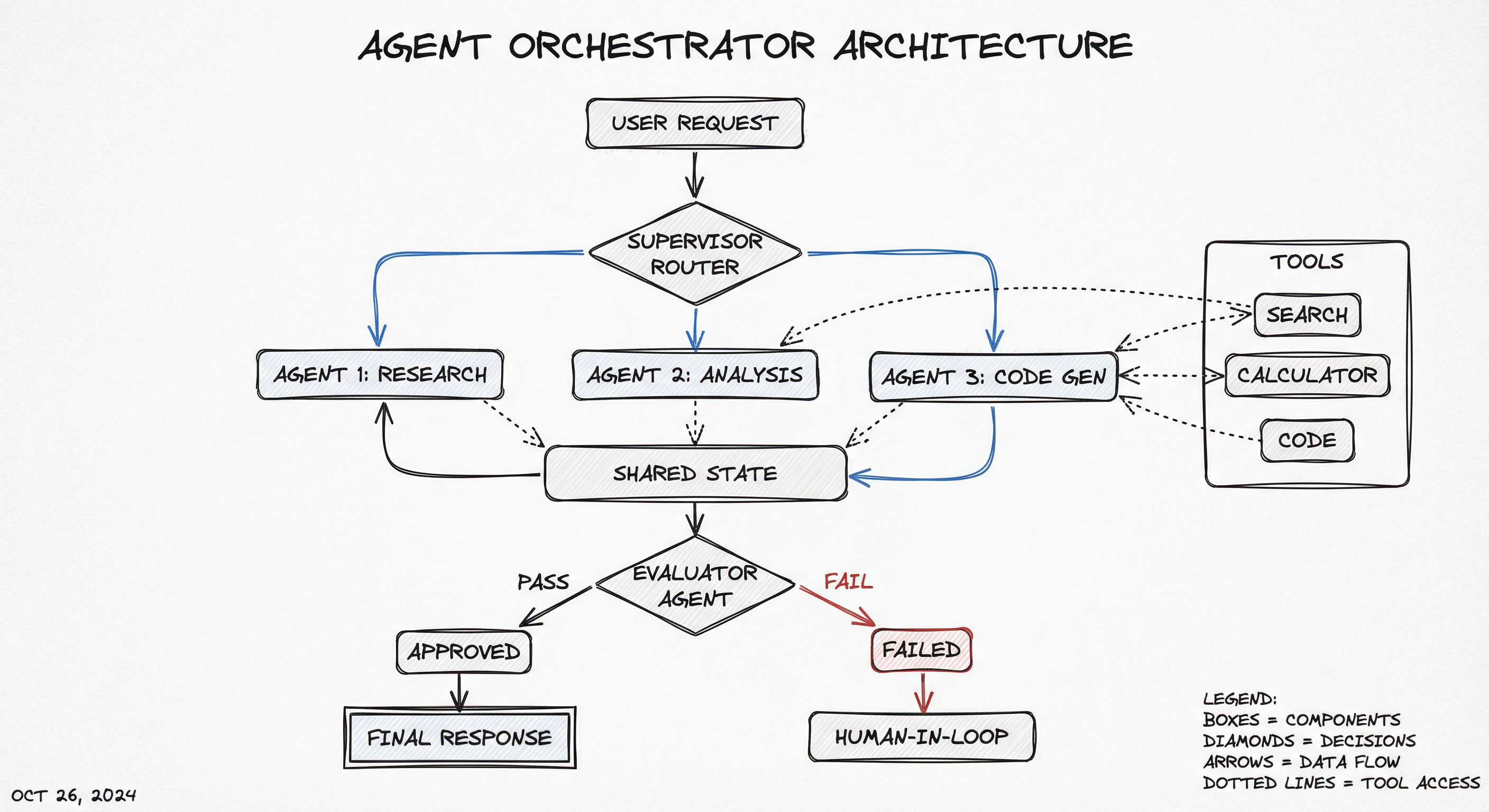
The architecture can be implemented in several topologies, each with different tradeoffs. Here is the most common production pattern -- the supervisor topology -- where a central orchestrator delegates to specialized agents:
Alternative topologies include peer-to-peer (agents communicate directly without a central supervisor -- useful for debate/consensus patterns), hierarchical (multiple layers of supervisors for large agent teams), and swarm (agents self-organize based on capability matching, as in OpenAI's Swarm/Agents SDK handoff pattern).
Key Components
Supervisor / Router
The central decision-making component. Receives the user request, decomposes it into sub-tasks, selects the appropriate agent for each sub-task based on capability matching, and synthesizes the final response. In LangGraph, this is typically implemented as a node with conditional edges. In CrewAI, this is the manager agent in hierarchical process mode.
Agent Registry
Maintains a catalog of available agents, their capabilities (described as natural language or structured metadata), input/output schemas, and health status. This enables dynamic agent discovery and routing. In the A2A protocol, agents publish Agent Cards -- JSON metadata describing their capabilities, authentication requirements, and supported interaction modes.
Shared State Manager
Maintains the global state that persists across agent invocations within a single task execution. Stores intermediate results, conversation history, extracted entities, and metadata. In LangGraph, this is the TypedDict state that flows through the graph. In CrewAI, this is managed by the Crew's shared context and memory system.
Communication Bus
Handles message routing between agents. In simple implementations, this is direct function calls. In distributed systems, this may use message queues (Redis Streams, Kafka) or event-driven architectures. Google's A2A protocol standardizes this with JSON-RPC messages over HTTP/HTTPS, supporting synchronous request-response, streaming (SSE), and push notifications for long-running tasks.
Monitor / Evaluator
Observes agent execution for quality, safety, and cost. Validates agent outputs against expected schemas, checks for hallucinations or policy violations, enforces token budgets, and triggers retries or human escalation when needed. This component is critical for production deployments -- Salesforce's Agentforce processes 11 million agent calls per day with this level of monitoring.
Error Recovery Engine
Handles failures gracefully: agent timeouts, malformed outputs, tool call failures, and infinite loops. Implements retry with exponential backoff, fallback to alternative agents, graceful degradation (returning a partial result), and circuit-breaker patterns to prevent cascading failures.
Data Flow
User request arrives at the Supervisor -> Supervisor analyzes the request and creates a task plan (sequential, parallel, or DAG) -> Task plan is written to Shared State -> Supervisor dispatches sub-tasks to selected agents.
Each agent receives its sub-task + relevant shared state -> Agent performs reasoning, tool calls, and produces output -> Output is validated by the Monitor -> Valid output is written to Shared State -> Supervisor evaluates if more agents need to run (via transition function) or if the task is complete.
Supervisor reads all agent outputs from Shared State -> Synthesizes or selects the final response -> Optionally passes through an Evaluator Agent for quality check -> Returns final response to the user with execution trace.
The separation of state management from agent execution is key -- it allows agents to be stateless and reusable, while the orchestrator maintains the full execution context. This is analogous to how a web server handles requests statelessly while the database maintains state.
A supervisor/router node at the top receives user requests and routes to three specialized agents (Research, Analysis, Code Gen). Each agent connects to domain-specific tools and writes results to a central shared state store. The shared state feeds back to the supervisor, which checks quality via an evaluator agent before producing the final response. A human-in-the-loop path exists for failed quality checks.
How to Implement
Three Levels of Implementation
Implementation approaches fall into three categories, each appropriate for different team sizes and complexity levels:
Level 1: Framework-based orchestration -- Use LangGraph, CrewAI, or OpenAI Agents SDK to define agent graphs declaratively. Best for teams starting with multi-agent systems. Setup time: hours to days.
Level 2: Custom orchestration with building blocks -- Combine LLM APIs, message queues, and state stores to build a bespoke orchestrator. Necessary when frameworks don't support your exact topology or you need fine-grained control over execution. Setup time: weeks.
Level 3: Platform-level orchestration -- Deploy on managed platforms like LangGraph Cloud, Databricks Agent Bricks, or Salesforce Agentforce. Best for enterprises needing scale, monitoring, and governance out of the box. Setup time: days, but with ongoing platform costs.
For most teams in 2026, Level 1 is the right starting point. LangGraph offers the most control (explicit graph definition), CrewAI offers the fastest setup (role-based agent declaration), and OpenAI Agents SDK offers the tightest integration with OpenAI models (native handoff patterns).
Cost Context: LangGraph Cloud charges ~0.005 per deployment run. CrewAI Enterprise pricing starts at custom quotes. For a startup in Hyderabad running 10K orchestrated requests/day with an average of 5 nodes per request, LangGraph Cloud costs roughly $50/day (~INR 4,200/day) in platform fees alone, on top of LLM costs. Self-hosted LangGraph (open-source) eliminates platform fees but requires your own infrastructure.
from typing import TypedDict, Literal, Annotated
from langgraph.graph import StateGraph, START
from langgraph.graph.message import add_messages
from langchain_openai import ChatOpenAI
from langchain_core.messages import HumanMessage, SystemMessage

# 1. Define shared state
class OrchestratorState(TypedDict):
    messages: Annotated[list, add_messages]
    next_agent: str
    results: dict

# 2. Define specialized agents (each is a graph node)
def research_agent(state: OrchestratorState) -> OrchestratorState:
    llm = ChatOpenAI(model="gpt-4o", temperature=0)
    response = llm.invoke([
        SystemMessage(content="You are a research specialist."),
        *state["messages"]
    ])
    return {"messages": [response],
            "results": {**state.get("results", {}), "research": response.content}}

def analysis_agent(state: OrchestratorState) -> OrchestratorState:
    llm = ChatOpenAI(model="gpt-4o", temperature=0)
    research = state.get("results", {}).get("research", "")
    response = llm.invoke([
        SystemMessage(content=f"Analyze this research:\n{research}"),
        *state["messages"]
    ])
    return {"messages": [response],
            "results": {**state.get("results", {}), "analysis": response.content}}

# 3. Supervisor decides next agent based on state
def supervisor(state: OrchestratorState) -> OrchestratorState:
    results = state.get("results", {})
    if not results.get("research"): return {"next_agent": "research"}
    elif not results.get("analysis"): return {"next_agent": "analysis"}
    else: return {"next_agent": "end"}

def route_next(state) -> Literal["research", "analysis", "__end__"]:
    return "__end__" if state.get("next_agent") == "end" else state["next_agent"]

# 4. Build and compile the graph
graph = StateGraph(OrchestratorState)
graph.add_node("supervisor", supervisor)
graph.add_node("research", research_agent)
graph.add_node("analysis", analysis_agent)
graph.add_edge(START, "supervisor")
graph.add_conditional_edges("supervisor", route_next)
graph.add_edge("research", "supervisor")
graph.add_edge("analysis", "supervisor")

orchestrator = graph.compile()
result = orchestrator.invoke({
    "messages": [HumanMessage(content="Analyze UPI's impact on financial inclusion in India")],
    "next_agent": "", "results": {}
})
This LangGraph example implements the supervisor pattern: a central supervisor node decides which specialized agent to invoke next based on the current state. After each agent runs, control returns to the supervisor, which evaluates progress and routes to the next agent or terminates. The StateGraph is compiled into an immutable execution plan, and the add_messages annotation ensures conversation history accumulates correctly. This pattern is the bread and butter of production multi-agent systems.
from crewai import Agent, Task, Crew, Process
from crewai.tools import tool

# 1. Define agents with roles and backstories
researcher = Agent(
    role="Senior Research Analyst",
    goal="Find comprehensive, accurate data about the given topic",
    backstory="You are a seasoned analyst at a top Indian consulting firm. "
              "You specialize in technology and financial inclusion research.",
    tools=[search_web],  # custom @tool-decorated functions
    llm="gpt-4o",
    verbose=True
)

analyst = Agent(
    role="Data Analyst",
    goal="Analyze research findings and extract actionable insights",
    backstory="You are a quantitative analyst who works with RBI and NPCI data.",
    tools=[calculate_metrics],
    llm="gpt-4o",
    verbose=True
)

writer = Agent(
    role="Technical Writer",
    goal="Produce a clear, well-structured report from research and analysis",
    backstory="You write for CTOs at Indian fintech companies.",
    llm="gpt-4o",
    verbose=True
)

# 2. Define tasks assigned to agents
research_task = Task(
    description="Research UPI's impact on financial inclusion in India.",
    expected_output="A detailed research brief with statistics and sources",
    agent=researcher
)
analysis_task = Task(
    description="Analyze the research findings. Identify trends and correlations.",
    expected_output="An analytical summary with key metrics",
    agent=analyst
)
report_task = Task(
    description="Write a report combining the research and analysis.",
    expected_output="A polished 2000-word report",
    agent=writer
)

# 3. Create crew with hierarchical process (manager supervises)
crew = Crew(
    agents=[researcher, analyst, writer],
    tasks=[research_task, analysis_task, report_task],
    process=Process.hierarchical,  # manager agent auto-created
    manager_llm="gpt-4o",
    verbose=True
)

result = crew.kickoff()
print(result)
CrewAI takes a role-playing approach to multi-agent orchestration. Each agent is defined with a role, goal, and backstory that shapes its behavior through prompt engineering. The Process.hierarchical mode creates an implicit manager agent that supervises the crew, delegates tasks, and validates outputs. This is more declarative than LangGraph -- you describe what you want each agent to do, and CrewAI handles the orchestration mechanics. The tradeoff is less fine-grained control over the execution graph.
from agents import Agent, Runner, handoff

# 1. Define specialized agents
billing_agent = Agent(
    name="Billing Specialist",
    instructions="Handle billing inquiries. Process refunds up to INR 5,000.",
    tools=[lookup_order, process_refund],
)
shipping_agent = Agent(
    name="Shipping Specialist",
    instructions="Handle shipping inquiries. Track packages, update addresses.",
    tools=[track_shipment, update_address],
)
escalation_agent = Agent(
    name="Senior Support Lead",
    instructions="Handle escalated cases. Refunds up to INR 25,000.",
    tools=[process_large_refund, create_engineering_ticket],
)

# 2. Triage agent routes to specialists via handoffs
triage_agent = Agent(
    name="Customer Support Orchestrator",
    instructions="Route customers to the right specialist. Never handle tasks yourself.",
    handoffs=[
        handoff(billing_agent, description="Transfer to billing"),
        handoff(shipping_agent, description="Transfer to shipping"),
        handoff(escalation_agent, description="Escalate to senior"),
    ],
)

# 3. Run with loop protection
import asyncio
async def handle_query(msg: str):
    result = await Runner.run(triage_agent, input=msg, max_turns=10)
    return result.final_output

response = asyncio.run(handle_query("I was charged twice for order #IND-2026-4521"))
The OpenAI Agents SDK (successor to the experimental Swarm framework) uses a handoff pattern for orchestration. Instead of a central supervisor managing a graph, agents can directly transfer conversations to other agents. The triage agent acts as the entry point, routing to specialists. This is the simplest orchestration pattern -- ideal for customer support, helpdesk, and routing scenarios where the topology is essentially a flat dispatch. The max_turns parameter is critical for preventing runaway conversations.
import asyncio
from dataclasses import dataclass
from openai import AsyncOpenAI
import time

client = AsyncOpenAI()

@dataclass
class AgentConfig:
    name: str
    system_prompt: str
    model: str = "gpt-4o"
    timeout_seconds: float = 30.0

@dataclass
class AgentResult:
    agent_name: str
    output: str
    latency_ms: float
    success: bool
    error: str | None = None

async def invoke_agent(agent: AgentConfig, prompt: str) -> AgentResult:
    """Invoke a single agent with timeout and error handling."""
    start = time.monotonic()
    try:
        response = await asyncio.wait_for(
            client.chat.completions.create(
                model=agent.model,
                messages=[
                    {"role": "system", "content": agent.system_prompt},
                    {"role": "user", "content": prompt}
                ]
            ),
            timeout=agent.timeout_seconds
        )
        return AgentResult(agent.name, response.choices[0].message.content,
                          (time.monotonic() - start) * 1000, True)
    except Exception as e:
        return AgentResult(agent.name, "",
                          (time.monotonic() - start) * 1000, False, str(e))

async def parallel_fan_out(agents, prompt, max_retries=2):
    """Fan out to multiple agents in parallel, retry failures."""
    tasks = [invoke_agent(a, prompt) for a in agents]
    results = await asyncio.gather(*tasks, return_exceptions=True)
    for i, r in enumerate(results):
        if isinstance(r, Exception) or not r.success:
            for _ in range(max_retries):
                retry = await invoke_agent(agents[i], prompt)
                if retry.success:
                    results[i] = retry
                    break
    return [r for r in results if isinstance(r, AgentResult) and r.success]

async def synthesize(results, prompt, threshold=0.7, total_agents=3):
    """Synthesize results with consensus check."""
    if len(results) / total_agents < threshold:
        raise RuntimeError(f"Below consensus: {len(results)}/{total_agents}")
    outputs = "\n".join([f"[{r.agent_name}]: {r.output}" for r in results])
    resp = await client.chat.completions.create(
        model="gpt-4o",
        messages=[{"role": "system", "content": "Synthesize these agent outputs."},
                  {"role": "user", "content": f"Question: {prompt}\n{outputs}"}]
    )
    return resp.choices[0].message.content

# Usage
agents = [
    AgentConfig("Risk Analyst", "Analyze financial risk. Focus on downside."),
    AgentConfig("Growth Analyst", "Analyze growth potential."),
    AgentConfig("Tech Analyst", "Analyze technical feasibility."),
]
final = asyncio.run(
    (lambda: parallel_fan_out(agents, "Expand fintech to Tier-2 Indian cities?"))()
)
This custom implementation demonstrates the fan-out/fan-in pattern with consensus. Multiple specialist agents analyze the same question in parallel, and a synthesis agent merges their outputs. Key production features include: per-agent timeouts, retry logic, consensus threshold validation (requiring a minimum fraction of agents to succeed), and cost budgeting. This pattern is common in financial analysis, risk assessment, and any domain where multiple perspectives improve decision quality.
# LangGraph orchestrator configuration (YAML)
orchestrator:
  name: support-orchestrator
  recursion_limit: 25

agents:
  - name: triage
    model: gpt-4o-mini
    temperature: 0.0
    max_tokens: 500
    role: router

  - name: billing
    model: gpt-4o
    temperature: 0.0
    max_tokens: 2000
    tools: [lookup_order, process_refund]

  - name: shipping
    model: gpt-4o
    temperature: 0.0
    max_tokens: 2000
    tools: [track_shipment, update_address]

  - name: escalation
    model: gpt-4o
    temperature: 0.0
    max_tokens: 3000
    tools: [create_ticket, process_large_refund]
    requires_human_approval: true

state:
  persistence: redis
  ttl_seconds: 3600

monitoring:
  trace_backend: langsmith
  cost_alert_threshold_usd: 0.50
  latency_p99_alert_ms: 30000

error_handling:
  max_retries: 2
  retry_backoff_ms: [1000, 3000]
  fallback_agent: escalation
  timeout_seconds: 45
Common Implementation Mistakes
- ●
Unbounded agent loops: Failing to set a
max_iterationsormax_turnslimit, allowing agents to cycle indefinitely. This is the #1 production incident in multi-agent systems. Every loop MUST have an explicit exit condition. LangGraph'srecursion_limitparameter exists for exactly this reason. - ●
Over-sharing state: Passing the entire conversation history and all intermediate results to every agent. This wastes tokens, increases latency, and can confuse agents with irrelevant context. Each agent should receive only the state it needs -- this is the principle of least privilege applied to context.
- ●
Ignoring agent cost multiplication: A 5-agent pipeline does not cost 5x a single agent -- it often costs 10-20x because each agent's prompt includes shared context that grows with each step. Monitor token usage per agent and set budget caps at the orchestrator level.
- ●
Hardcoding agent routing: Using if/else chains instead of capability-based routing. This makes the system brittle -- adding a new agent requires modifying the orchestrator. Use agent capability descriptions and let the supervisor LLM perform routing based on semantic matching.
- ●
No observability: Failing to log the full execution trace (which agent ran, what it produced, how long it took, what it cost). Without traces, debugging multi-agent failures is nearly impossible. Use LangSmith, Phoenix, or custom structured logging from day one.
- ●
Treating all failures equally: An agent returning a slightly imperfect response is very different from an agent timing out or returning malformed JSON. Implement graduated error handling: retry for transient failures, fallback for persistent failures, and human escalation for critical failures.
When Should You Use This?
Use When
Your task requires multiple distinct capabilities that cannot be handled well by a single agent (e.g., research + analysis + writing, or triage + billing + shipping)
You need human-in-the-loop approval at specific decision points, such as refunds above a threshold or content moderation escalation
The workflow has conditional branching -- different paths depending on the input type, user intent, or intermediate results
You require parallel execution where multiple agents analyze the same input from different perspectives and results are synthesized (debate/consensus patterns)
Error isolation is critical -- a failure in one agent should not crash the entire pipeline. Each agent's failure can be handled independently
Your system needs auditability -- you must be able to trace exactly which agent made which decision and why, for compliance or debugging purposes
The task involves multi-step workflows with dependencies between steps that must be managed explicitly (like LangGraph's DAG-based execution)
Avoid When
A single agent with tool use can handle the task. Do not introduce multi-agent complexity for problems that a well-prompted single agent can solve. This is the most common over-engineering mistake in 2026.
Your task is purely sequential with no branching, parallelism, or error recovery needs -- a simple chain of LLM calls with no orchestration framework is simpler and cheaper
Latency is critical and you cannot afford the overhead of multiple LLM calls. A single agent call takes 1-3 seconds; a 5-agent orchestrated pipeline takes 5-15 seconds minimum. For real-time autocomplete or sub-second responses, multi-agent orchestration is too slow.
Your budget is tight and you cannot justify the LLM cost multiplication. If a single GPT-4o call costs 0.05-0.10 per request. At 100K requests/day, that is $5,000-10,000/day (~INR 4.2-8.4 lakh/day).
You lack observability infrastructure (tracing, logging, monitoring). Debugging multi-agent systems without traces is like debugging distributed systems without logs -- technically possible but practically a nightmare.
The agents' responsibilities overlap significantly and you cannot clearly define boundaries between them. Ambiguous delegation leads to duplicated work and conflicting outputs.
Key Tradeoffs
The Fundamental Tradeoff: Capability vs. Cost and Latency
Multi-agent orchestration multiplies both capability and cost. A 5-agent system can handle tasks no single agent can, but it also costs 5-20x more in LLM tokens and takes 3-10x longer. The decision to use orchestration should be driven by a clear ROI calculation: does the improved quality/capability justify the cost?
| Factor | Single Agent | Multi-Agent (3-5 agents) | Multi-Agent (10+) |
|---|---|---|---|
| Latency | 1-3s | 5-15s | 15-60s |
| Cost per request | $0.005-0.02 | $0.02-0.10 | $0.10-1.00 |
| Reliability | Single point of failure | Redundancy possible | High redundancy |
| Debugging | Simple | Moderate | Very hard |
| Setup complexity | Hours | Days-weeks | Weeks-months |
The Second Axis: Control vs. Autonomy
Frameworks offer different positions on this spectrum:
- LangGraph: Maximum control. You define every node and edge explicitly. Great for predictable, auditable workflows. But verbose for simple use cases.
- CrewAI: High autonomy. Agents can delegate to each other, and the framework handles much of the routing. Great for creative/exploratory tasks. But harder to debug when agents go off-script.
- OpenAI Agents SDK: Middle ground. Handoff patterns are explicit, but within a conversation the agent has autonomy. Great for customer-facing applications.
The Cost Reality for Indian Startups
For a typical Indian SaaS startup processing 50K customer support queries/day with a 3-agent orchestrated pipeline (triage + specialist + quality check), monthly costs break down roughly as:
- LLM inference (GPT-4o-mini for triage, GPT-4o for specialists): ~$3,000/month (~INR 2.5 lakh/month)
- Platform fees (LangGraph Cloud): ~$1,500/month (~INR 1.25 lakh/month)
- Infrastructure (state store, monitoring): ~$500/month (~INR 42,000/month)
- Total: ~$5,000/month (~INR 4.2 lakh/month)
This is 3-5x the cost of a single-agent system but typically delivers 40-60% better resolution rates and 50% reduction in human escalation -- making the ROI positive if your support team costs more than the system.
Alternatives & Comparisons
A ReAct loop is a single agent that reasons and acts in a loop -- think, tool-call, observe, repeat. Choose ReAct when one agent with access to multiple tools can handle the task. Choose an orchestrator when the task genuinely requires different specialized agents with different system prompts, models, or tool sets. If your orchestrator only has one agent doing real work and the rest are just routing, you probably want a ReAct loop instead.
A LangGraph node is an individual processing step within a LangGraph graph. The agent orchestrator IS the graph that connects these nodes. They are complementary, not alternatives: you use LangGraph nodes to build the orchestrator. If you only have one node, you do not need an orchestrator.
The supervisor is one specific orchestration pattern where a central agent delegates to sub-agents. The orchestrator is the broader concept that includes supervisor, peer-to-peer, swarm, and hierarchical patterns. A supervisor IS an orchestrator, but not all orchestrators use the supervisor pattern. Choose a supervisor when you want centralized control; choose peer-to-peer when agents need to debate or reach consensus.
A CrewAI agent is a single agent within a CrewAI crew. The orchestrator (the Crew + Flow) coordinates multiple such agents. CrewAI provides a higher-level abstraction than LangGraph: you define agent roles and tasks, and CrewAI handles orchestration. Choose CrewAI when you want rapid prototyping and role-based collaboration. Choose LangGraph when you need explicit control over every transition.
Pros, Cons & Tradeoffs
Advantages
Specialization without compromise: Each agent can be optimized for its specific task -- different models, temperatures, system prompts, and tool sets. A triage agent can use GPT-4o-mini for speed while the analysis agent uses GPT-4o for depth.
Error isolation and graceful degradation: When one agent fails, the orchestrator can retry, fall back to an alternative agent, or return a partial result. Single-agent systems offer no such resilience.
Human-in-the-loop integration: Orchestrators naturally accommodate human approval steps at any point in the workflow. This is essential for high-stakes decisions like refunds, medical recommendations, or financial trades.
Scalability of complexity: You can add new capabilities by adding new agents without modifying existing ones. This follows the Open/Closed Principle -- the system is open for extension but closed for modification.
Auditability and compliance: The execution trace shows exactly which agent made which decision, enabling post-hoc analysis, debugging, and regulatory compliance. Salesforce's Agentforce provides this at 11 million calls/day.
Parallel execution for latency optimization: Independent sub-tasks can be fanned out to multiple agents simultaneously, reducing wall-clock time compared to sequential execution.
Disadvantages
Cost multiplication: Each agent invocation costs LLM tokens. A 5-agent pipeline can cost 10-20x a single agent call when you account for shared context passed to each agent. This adds up fast at scale.
Latency overhead: Sequential agent calls are additive. A 3-agent chain with 2-second calls takes at least 6 seconds. Even with parallelism, the slowest agent determines the pipeline latency.
Debugging complexity: When the final output is wrong, you need to trace through multiple agents to find where things went off track. Without good observability tooling, this is extremely painful.
State management headaches: Shared state can grow large and unwieldy. Race conditions in parallel execution, stale state in long-running workflows, and state schema evolution all require careful engineering.
Over-engineering risk: The biggest failure mode is using a multi-agent system for a task that a single agent could handle. This is surprisingly common -- teams reach for orchestration frameworks because they are exciting, not because the problem requires them.
Framework lock-in: LangGraph, CrewAI, and OpenAI Agents SDK have different abstractions and APIs. Migrating between them requires significant rewriting. The A2A protocol aims to reduce this, but adoption is still early.
Failure Modes & Debugging
Infinite agent loops
Cause
Cyclic dependencies in the agent graph without proper termination conditions. Agent A delegates to Agent B, which delegates back to Agent A. Or a supervisor keeps retrying a failing agent without a retry limit.
Symptoms
Rapidly increasing token usage, runaway costs, eventual timeout or OOM. In LangGraph, you will see a RecursionError if recursion_limit is hit. In production without limits, you will see a cost spike and an eventually killed process.
Mitigation
Always set recursion_limit in LangGraph (default is 25, but set it explicitly). Use max_turns in OpenAI Agents SDK. Implement a global cost cap at the orchestrator level. Add cycle detection in your graph validation step. Monitor loop count per execution and alert when it exceeds 2x the expected maximum.
Agent role confusion / scope creep
Cause
Poorly defined agent boundaries. An agent's system prompt is too vague, causing it to attempt tasks outside its specialization and produce low-quality results. Or multiple agents have overlapping responsibilities, leading to duplicated or contradictory outputs.
Symptoms
Inconsistent response quality. Some requests are handled well (when they match an agent's sweet spot) and others poorly. The supervisor/router struggles to decide which agent to invoke. Debugging reveals that agents are doing each other's jobs.
Mitigation
Write precise, non-overlapping agent descriptions. Use structured capability definitions (not just free-text system prompts). Test routing with a diverse set of sample queries and measure routing accuracy. In CrewAI, use the allow_delegation=False flag when agents should NOT delegate to each other.
State corruption in parallel execution
Cause
Multiple agents writing to shared state simultaneously without proper synchronization. When agents run in parallel (fan-out pattern), their state updates can overwrite each other.
Symptoms
Missing intermediate results, inconsistent final output, non-deterministic behavior across runs. The synthesis agent sees partial state and produces incomplete responses.
Mitigation
Use append-only state (like LangGraph's add_messages annotation) instead of overwrite semantics. When agents write to different keys in the state dict, use namespaced keys (e.g., agent_name.output). For truly concurrent writes, use a thread-safe state store (Redis, database) with optimistic locking.
Cascading failures
Cause
An upstream agent's failure causes all downstream agents to fail, and the orchestrator does not implement circuit-breaking or fallback paths.
Symptoms
A single agent timeout or error causes the entire pipeline to fail. Error logs show a chain of failures propagating through the graph. Response rate drops to zero even though most agents are healthy.
Mitigation
Implement circuit breakers at the orchestrator level: if an agent fails 3 times in a row, skip it and use a fallback path. Design the graph with optional nodes that can be bypassed. Return partial results when possible rather than failing completely.
Token budget exhaustion
Cause
Shared context (conversation history, intermediate results) grows with each agent invocation. By the time the 5th agent in a chain runs, the context window is nearly full, leading to truncation or context window overflow errors.
Symptoms
Later agents in the pipeline receive truncated context and produce lower-quality outputs. Token usage per request grows superlinearly with the number of agents. You start seeing 400 errors from the LLM API (context length exceeded).
Mitigation
Implement context windowing: summarize or truncate shared state before passing to each agent. Use a dedicated summarization step between agents. Set per-agent max_tokens limits. Consider using smaller models (GPT-4o-mini) for agents that need less context. LangGraph's trim_messages utility is designed for this.
Supervisor bottleneck
Cause
All routing decisions go through a single supervisor agent, which becomes a throughput bottleneck under high load. The supervisor also adds latency to every step since control must return to it after each agent.
Symptoms
Latency scales linearly with the number of agents (each agent adds supervisor round-trip time). Under load, the supervisor queue grows and response times spike. The supervisor accounts for 30-50% of total token usage despite not doing any real work.
Mitigation
For high-throughput systems, consider hierarchical supervision (sub-supervisors for each domain) or direct handoff patterns (agents route to each other, as in OpenAI Agents SDK). Use a lightweight model (GPT-4o-mini or a fine-tuned small model) for the supervisor. Cache routing decisions for recurring query patterns.
Placement in an ML System
Where Does the Agent Orchestrator Sit?
In an agentic AI system, the orchestrator sits at the top of the agent hierarchy. It receives requests from the application layer (API, chat interface, workflow trigger) and coordinates all downstream components:
-
Upstream: The planning module may decompose a high-level goal into sub-tasks before passing them to the orchestrator. Prompt templates define each agent's system prompt. Guardrails enforce safety and policy constraints on inputs and outputs.
-
Downstream: The orchestrator invokes tool executors (APIs, databases, code sandboxes) through individual agents. Agent context and conversation history flow to the memory store for persistence. Human-in-the-loop components are triggered when the orchestrator determines that human approval or intervention is needed.
The orchestrator is the critical path for every request in a multi-agent system. Its reliability, latency, and cost directly determine the system's overall performance. A slow orchestrator makes the entire system slow; a buggy orchestrator makes the entire system unreliable.
Key Insight: The orchestrator does not add intelligence -- it adds structure. The intelligence lives in the individual agents. The orchestrator's job is to make sure that intelligence is applied in the right order, to the right problems, with the right context.
Pipeline Stage
Orchestration / Serving
Upstream
- planning-module
- prompt-template
- guardrails
Downstream
- tool-executor
- memory-store
- human-in-loop
Scaling Bottlenecks
The primary bottleneck is LLM inference latency, which is additive in sequential orchestration patterns. A 5-agent sequential pipeline with 2-second per-agent latency takes at least 10 seconds, which may be unacceptable for interactive applications.
The second bottleneck is state store throughput. If every agent reads and writes shared state (e.g., a Redis instance), the state store can become a bottleneck under high concurrency. At 1,000 concurrent orchestrations with 5 agents each, that is 5,000 state read/write operations per second.
The third bottleneck is supervisor throughput in centralized patterns. A single supervisor handling 1,000 QPS must make 1,000 routing decisions per second, each requiring an LLM call. This typically requires model-level optimizations (caching, fine-tuned small models for routing) or architectural changes (distributed supervision).
Some concrete numbers: Salesforce's Agentforce handles 11 million agent calls per day (~127 QPS) across their platform. For a typical Indian SaaS company, 10K-50K orchestrated requests/day is a realistic starting point.
Production Case Studies
Salesforce built Agentforce, a modular multi-model orchestration platform that powers AI agents across sales, service, marketing, and commerce. The architecture treats each LLM as a swappable module within an orchestration graph -- different agents can use different models (some optimized for reasoning, others for summarization). The platform includes a trust layer for security, an orchestration engine for multi-agent coordination, and a monitoring system that handles 11 million agent calls per day in production.
Agentforce processes 11 million daily agent calls across production environments. The internal DevOps AI agent (OpsAI) built on Agentforce achieved measurable reduction in median Time to Resolution for production incidents.
Swiggy built an enterprise-scale AI customer support system using Databricks and a multi-agent architecture. They enhanced their system with separate agent instances for each customer support disposition (refund, delivery issue, payment problem, etc.), enabling clear functional separation and modular control. The system integrates with Swiggy's CRM for structured action-trigger workflows, where agent decisions are executed in the CRM backend based on dynamic context and business rules.
The multi-agent system automates and personalizes customer support at massive scale, with real-time monitoring, deep traceability, and rigorous evaluation cycles enabling rapid iteration and strong SLAs. The architecture supports multi-intent conversations where a single customer session may require multiple specialized agents.
Stripe's developer blog post explaining how to integrate the Stripe Agent Toolkit into LLM agentic workflows, enabling AI agents to process payments, handle refunds, and manage transactions programmatically.
Released November 2024 as part of Stripe's Agentic Commerce Suite, enabling businesses to automate payment operations through AI agents with minimal code changes.
AWS published reference architecture for multi-agent orchestration using LangGraph on AWS. The guidance demonstrates how to orchestrate multiple specialized AI agents to solve complex customer support challenges through different coordination mechanisms (supervisor, hierarchical, swarm). The implementation uses Amazon Bedrock for LLM inference, Lambda for agent execution, and DynamoDB for state management.
The reference architecture provides a production-ready template for enterprises deploying multi-agent systems on AWS, with built-in patterns for error recovery, state persistence, and agent monitoring. Used by multiple AWS enterprise customers as a starting point for their own orchestration implementations.
Tooling & Ecosystem
Graph-based agent orchestration framework by LangChain. Defines workflows as state machines with nodes (agents) and edges (transitions). Supports conditional routing, parallel execution, persistence, and human-in-the-loop. The most explicit and controllable framework -- you define every node and edge. Now the recommended approach for agents in the LangChain ecosystem.
Role-playing multi-agent orchestration framework. Agents are defined with roles, goals, and backstories. Supports sequential and hierarchical processes, agent delegation, and memory. The dual Crews + Flows architecture enables both autonomous collaboration (Crews) and structured event-driven workflows (Flows). Built independently from LangChain.
Production-ready successor to OpenAI Swarm. Uses handoff patterns where agents transfer conversations to other agents. Lightweight, ergonomic, and tightly integrated with OpenAI models. Best for routing-style orchestration (triage -> specialist patterns). Includes built-in guardrails and tracing.
Multi-agent conversation framework with an asynchronous, event-driven architecture (v0.4+). Being merged with Semantic Kernel into the unified Microsoft Agent Framework for enterprise deployments. Supports customizable agents, code execution, and human oversight. Strong integration with Azure OpenAI.
Open protocol for agent-to-agent communication across frameworks and vendors. Agents publish Agent Cards describing their capabilities. Communication uses JSON-RPC over HTTP/HTTPS with support for streaming (SSE) and push notifications. Governed by the Linux Foundation with 150+ supporting organizations. The emerging standard for inter-agent interoperability.
Managed multi-agent supervisor architecture on Databricks. Provides pre-built patterns for supervisor-based orchestration with MLflow integration for tracing, evaluation, and monitoring. Used by Swiggy for their enterprise customer support system.
Observability and evaluation platform for LLM applications, including multi-agent systems. Provides execution traces, cost tracking, latency analysis, and evaluation datasets. Essential companion to LangGraph for production deployments. Pricing starts free for developer tier.
Research & References
Wu, Bansal, Zhang, Wu, Li, Zhu, Jiang, Zhang, Wang, et al. (2023)ICOLM 2024
Introduced the AutoGen framework with conversable agents that integrate LLMs, tools, and humans through automated multi-agent chat. Established the pattern of customizable, composable agents that became the foundation for modern orchestration frameworks.
Qian, Cong, Yang, Chen, Su, Xu, Liu, Sun (2023)ACL 2024
Demonstrated a chat-chain orchestration approach where specialized agents (CEO, CTO, programmer, tester) collaborate through structured communication phases to produce complete software. Showed that linguistic communication can replace rigid APIs for inter-agent coordination.
Hong, Zhuge, Chen, Zheng, Cheng, Zhang, Wang, Wang, Yau, Lin, et al. (2023)ICLR 2024
Introduced Standardized Operating Procedures (SOPs) into multi-agent workflows, encoding human domain expertise as structured workflows. Demonstrated that imposing human-like process constraints on agent collaboration significantly improves output quality over unstructured debate.
Guo, Chen, Wang, Yi, Yu, et al. (2024)IJCAI 2024
Comprehensive survey categorizing multi-agent systems into five streams including Agents Orchestration as a pivotal challenge. Analyzes communication patterns, task decomposition strategies, and the tradeoffs between structured and unstructured agent collaboration.
Li, Zhang, Chen, et al. (2024)arXiv preprint
Surveys the rapidly expanding field of LLM-based Multi-Agent Systems (LLM-MAS), presenting a framework encompassing applications in complex task solving, scenario simulation, and generative agent evaluation. Covers orchestration patterns, communication protocols, and emergent behaviors.
Wang, Li, et al. (2025)arXiv preprint
Proposes a puppeteer-style paradigm where a centralized orchestrator is trained via reinforcement learning to dynamically direct agents based on evolving task states. Achieves superior performance with reduced computational costs compared to fixed orchestration topologies.
Du, Li, Torralba, Tenenbaum, Mordatch (2023)ICML 2024
Showed that having multiple LLM instances debate each other improves factuality and reasoning over single-model inference. Established the theoretical foundation for consensus-based multi-agent orchestration patterns.
Interview & Evaluation Perspective
Common Interview Questions
- ●
How would you design a multi-agent customer support system that handles billing, shipping, and technical issues?
- ●
What are the tradeoffs between supervisor-based and peer-to-peer agent orchestration topologies?
- ●
How do you prevent infinite loops in a multi-agent system?
- ●
How would you handle state management in a parallel fan-out/fan-in agent workflow?
- ●
What observability would you set up for a production multi-agent system?
- ●
When would you choose a single ReAct agent over a multi-agent orchestrator?
- ●
How do you manage the cost of multi-agent systems at scale?
Key Points to Mention
- ●
Agent orchestration is fundamentally a state machine problem. The orchestrator maintains state and transitions between agents based on conditions. LangGraph makes this explicit with its StateGraph abstraction.
- ●
The supervisor pattern (centralized routing) vs. handoff pattern (agent-to-agent delegation) vs. consensus pattern (parallel debate) are the three primary topologies, each optimized for different use cases: routing, specialization, and quality respectively.
- ●
Cost multiplication is the #1 practical concern. Always calculate total cost = (number of agents) x (tokens per agent) x (price per token) x (requests per day). A 5-agent pipeline at 100K requests/day with GPT-4o can cost $5,000-10,000/day.
- ●
Termination guarantees are non-negotiable. Every cyclic graph must have a hard recursion limit. Every agent call must have a timeout. Every orchestration must have a cost cap.
- ●
Google's A2A protocol is becoming the standard for inter-agent communication. Understanding Agent Cards, JSON-RPC messaging, and Task lifecycle management shows awareness of the industry direction.
- ●
Error handling separates production systems from demos. Implement graduated response: retry for transient failures, fallback for persistent failures, human escalation for critical decisions.
Pitfalls to Avoid
- ●
Saying you would use multi-agent orchestration for every problem. The interviewer wants to hear you identify when a single agent with tools is sufficient. Over-engineering is a red flag.
- ●
Ignoring cost analysis. Always mention the token multiplication effect and give concrete cost estimates in INR or USD.
- ●
Describing the happy path only. Production orchestrators are judged by how they handle failures, not by how they handle successes.
- ●
Conflating agent orchestration frameworks (LangGraph, CrewAI) with agent communication protocols (A2A). These operate at different layers of the stack.
- ●
Forgetting about observability. If you cannot trace an execution from request to response through every agent, you cannot debug it.
Senior-Level Expectation
A senior/staff-level candidate should be able to design an agent orchestration system end-to-end: choosing the right topology (supervisor, hierarchical, swarm, or peer-to-peer) with justification based on the task structure, defining agent boundaries with non-overlapping capabilities, implementing proper state management with conflict resolution for parallel execution, setting up comprehensive observability (traces, metrics, cost tracking), calculating cost projections at target scale, and planning for graceful degradation under partial failures. They should be able to compare frameworks (LangGraph vs CrewAI vs OpenAI Agents SDK) with specific technical tradeoffs rather than marketing bullet points. They should also discuss the A2A protocol and where the industry is heading with agent interoperability. For Indian companies specifically, they should address cost optimization strategies -- using cheaper models for routing, caching supervisor decisions, and implementing tiered escalation to minimize expensive agent invocations.
Summary
Let us recap what we have covered about agent orchestration:
-
An agent orchestrator is the coordination layer that manages multiple AI agents working together on complex tasks. It handles routing (which agent runs next), state management (shared context across agents), error recovery (retries, fallbacks, human escalation), and termination (preventing infinite loops). Without an orchestrator, multi-agent systems devolve into chaos.
-
The three dominant orchestration topologies are: the supervisor pattern (a central agent delegates to specialists -- implemented by LangGraph and CrewAI's hierarchical mode), the handoff pattern (agents transfer conversations directly -- implemented by OpenAI Agents SDK), and the consensus pattern (multiple agents analyze in parallel and results are synthesized -- used for debate and quality assurance). Most production systems combine elements of all three.
-
Framework choice matters but is not the most important decision. LangGraph offers maximum control through explicit graph definition, CrewAI offers rapid prototyping through role-based agent declaration, and OpenAI Agents SDK offers simplicity for routing scenarios. All three are production-capable in 2026. Google's A2A protocol is standardizing inter-agent communication across frameworks.
-
The critical success factors for production orchestration are: explicit termination guarantees (recursion limits, cost caps, timeouts), comprehensive observability (execution traces through every agent), graduated error handling (retry -> fallback -> human escalation), and rigorous cost management (LLM token costs multiply with each agent). A multi-agent system that works in demos but fails in production almost always lacks one or more of these.
The agent orchestrator is the difference between a collection of AI agents and an AI system. It transforms individual capabilities into coordinated intelligence, much like an operating system transforms hardware components into a usable computer. As multi-agent architectures become the default for complex AI applications, the orchestrator is the component that will determine whether those systems are reliable, cost-effective, and auditable in production.