Feature Store in Machine Learning
A feature store is the centralized data layer purpose-built for machine learning features -- the bridge between raw data and the models that consume it. It manages the full lifecycle of features: definition, computation, storage, versioning, discovery, and serving at both training and inference time.
Why does this matter? Because the hardest engineering problem in production ML is not training the model -- it is reliably getting the right features to the right model at the right time. Without a feature store, every ML project re-invents its own data pipelines, leading to duplicated work, inconsistent feature logic, and the dreaded training-serving skew where features computed during training differ from those computed during inference.
The concept was popularized by Uber's Michelangelo platform in 2017 and has since become a core component of every mature ML platform. Today, companies like Airbnb (Chronon), LinkedIn (Feathr), DoorDash, Gojek (Feast), and Flipkart operate feature stores that manage tens of thousands of features serving millions of predictions per second.
Whether you are a startup in Bengaluru deploying your first fraud detection model or a hyperscaler running thousands of models in production, understanding the feature store is essential for building reliable, scalable ML systems.
Concept Snapshot
- What It Is
- A centralized repository that manages the storage, versioning, discovery, and dual-mode serving (offline for training, online for inference) of ML features with guaranteed consistency between environments.
- Category
- Feature Engineering
- Complexity
- Intermediate
- Inputs / Outputs
- Inputs: raw data from batch and streaming sources, feature transformation logic. Outputs: consistent feature vectors served to training pipelines (offline) and inference endpoints (online) with point-in-time correctness guarantees.
- System Placement
- Sits between data sources / feature pipelines (upstream) and model training / model serving systems (downstream) in the ML platform architecture.
- Also Known As
- feature platform, feature management system, feature registry, feature serving layer, ML feature catalog
- Typical Users
- ML Engineers, Data Scientists, Data Engineers, MLOps Engineers, Platform Engineers
- Prerequisites
- Feature engineering fundamentals, Batch vs. streaming data processing, ML model training and serving basics, Key-value stores and data warehouses
- Key Terms
- online storeoffline storefeature materializationpoint-in-time correctnesstraining-serving skewfeature freshnessfeature versioningentityfeature viewfeature group
Why This Concept Exists
The Feature Engineering Tax
Ask any ML engineer what they spend most of their time on, and the answer is almost never "training models." Studies consistently show that data scientists spend 60-80% of their time on data preparation and feature engineering. At Airbnb, before they built Zipline (later Chronon), ML practitioners spent roughly 60% of their time collecting and writing transformations for ML tasks.
The problem gets worse as organizations scale. Each ML project independently builds pipelines to extract, transform, and serve features. A fraud detection model and a recommendation model at the same company might both need "user's average transaction amount over the last 30 days" -- but each team computes it differently, stores it differently, and serves it differently. This leads to feature silos: duplicated computation, inconsistent logic, and wasted engineering effort.
The Training-Serving Skew Problem
Here is the really insidious problem. During training, a data scientist writes a Spark job to compute features from a data warehouse. During inference, a backend engineer rewrites the same logic in Java for a real-time API. These two implementations inevitably diverge -- different rounding, different null handling, different time windows. The model sees different feature distributions at inference than it saw during training, and performance silently degrades.
This is training-serving skew, and it is one of the most common causes of production ML failures. Google's MLOps best practices documentation explicitly calls it out as a key challenge. Feature stores solve this by providing a single source of truth: you define the feature transformation once, and the system materializes it to both the offline store (for training) and the online store (for serving).
The Evolution
The concept crystallized at Uber in 2017 with Michelangelo Palette, which hosted over 20,000 features serving 10 million real-time predictions per second. Gojek and Google Cloud co-developed Feast as the first open-source feature store in 2019. Since then, the ecosystem has exploded: Tecton (founded by Feast creators), Hopsworks, Databricks Feature Store, Amazon SageMaker Feature Store, Vertex AI Feature Store, LinkedIn's Feathr, and Airbnb's Chronon.
Key Takeaway: Feature stores exist because ML systems need consistent, reusable, and efficiently served features. Without them, every team reinvents the same data plumbing, and training-serving skew silently erodes model quality.
Core Intuition & Mental Model
The Library Analogy
Think of a feature store like a well-organized library for ML data. Without a library, every researcher who needs a book has to go find the raw materials and bind their own copy. Some researchers bind the book differently -- different page order, different fonts, some pages missing. When they cite the book in their papers, the citations don't match. Chaos.
A feature store is the librarian. It takes raw materials (data), binds them into standardized books (features), catalogs them so anyone can find what they need (discovery), and ensures that every reader gets the same edition (consistency). It maintains two reading rooms: a quiet archive for researchers doing historical analysis (the offline store for training) and a fast-access counter for people who need answers right now (the online store for inference).
The Two Fundamental Promises
A feature store makes two promises that no other component in the ML stack provides:
Promise 1: Consistency. The feature values your model sees during training will be identical to the values it sees during inference. Same logic, same computation, same result. This eliminates training-serving skew by construction, not by convention.
Promise 2: Reuse. A feature computed by one team is available to every other team. If the fraud team computes "user's average order value over 7 days," the recommendation team can use the exact same feature without rewriting the pipeline. At Uber, this led to a catalog of 20,000+ reusable features. At Airbnb, 99% of features are now managed through their feature platform.
What a Feature Store is NOT
A feature store is not a data warehouse, not a feature engineering framework, and not a model registry. It does not decide which features to engineer or how to transform them -- that is the job of feature extraction and selection components upstream. The feature store's responsibility starts after the feature transformation logic is defined: it handles the computation, storage, serving, and lifecycle management of those features.
Mental Model: Data sources are the raw ingredients. Feature pipelines are the recipes. The feature store is the kitchen that executes recipes, stores prepared dishes, and serves them consistently to every table (model) in the restaurant.
Technical Foundations
Formal Structure
A feature store can be formalized as a system that manages a collection of feature views , where each feature view is defined as a tuple:
where:
- is the entity (the primary key, e.g.,
user_id,item_id) - is the transformation function mapping raw data to a -dimensional feature vector
- is the data source specification (batch table, streaming topic, or request-time input)
- is the freshness requirement (how often the feature must be recomputed)
Point-in-Time Correctness
The most important formal property of a feature store is point-in-time correctness. When constructing a training dataset for a label observed at time , the feature store must return the feature values that were available at or before time , never after. Formally:
This prevents data leakage -- using future information to predict the past. Without point-in-time correctness, a model trained on leaked features will appear to perform brilliantly in offline evaluation but fail catastrophically in production.
Feature Freshness and Staleness
Feature freshness is defined as the time lag between the latest available data and the currently served feature value:
Different features have different staleness tolerances. A user's lifetime value can be hours stale; a user's current GPS location cannot. The feature store must support heterogeneous freshness requirements across its feature catalog.
Online vs. Offline Serving Latency
The online store provides low-latency lookups, typically:
The offline store supports batch retrieval for training, where throughput matters more than latency:
Key Equation: The training-serving skew for feature can be quantified as the distributional divergence between offline and online feature values: . A well-functioning feature store maintains .
Internal Architecture
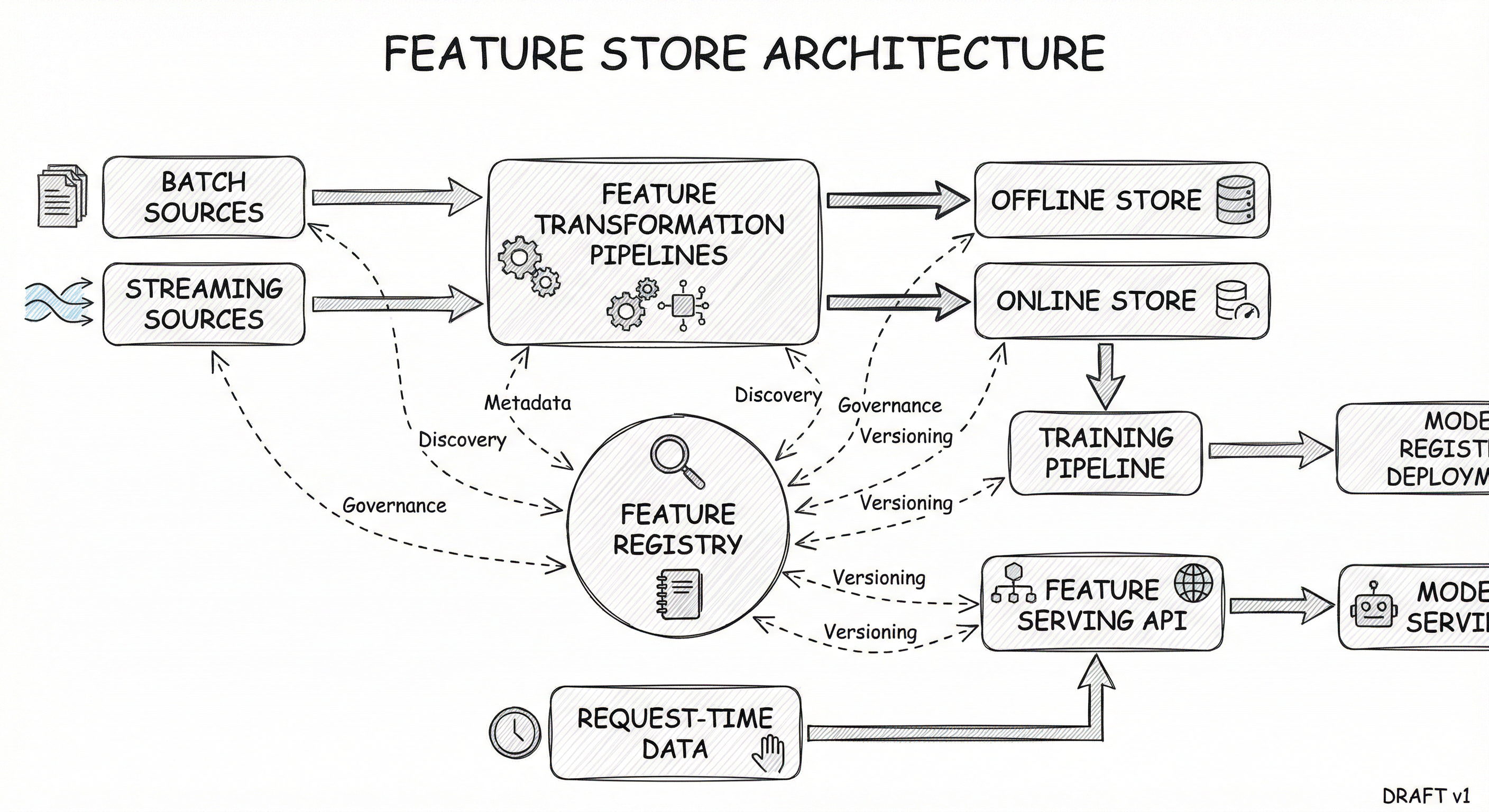
A production feature store consists of six interconnected subsystems: a feature registry for metadata and definitions, feature transformation pipelines for computation, an offline store for historical feature retrieval, an online store for low-latency serving, a materialization engine that keeps stores in sync, and a feature serving API that abstracts store access from consumers.
The architecture follows a dual-store pattern: the offline store (typically a data warehouse like BigQuery, Redshift, or Hive) holds the complete time-series history of every feature for training dataset construction with point-in-time correctness. The online store (typically a key-value store like Redis, DynamoDB, or Bigtable) holds only the latest feature values for each entity, optimized for sub-10ms lookups during inference.
The materialization engine is the glue that binds these two stores. It executes feature transformation logic, writes results to both stores, and ensures consistency. Materialization can be triggered on a schedule (batch), continuously (streaming via Kafka/Kinesis), or on-demand (request-time computation).
Key Components
Feature Registry
The metadata layer that stores feature definitions, schemas, ownership, lineage, versioning, and documentation. It acts as a catalog that enables feature discovery across teams. In Feast, this is the FeatureView definition; in Hopsworks, it is the FeatureGroup. The registry ensures that every consumer understands exactly what a feature represents, how it is computed, and who owns it.
Offline Store
A columnar storage backend (e.g., BigQuery, Redshift, S3/Parquet, Hive) that maintains the full time-series history of feature values. Used for training dataset construction with point-in-time correct joins -- ensuring that features reflect only data available at the time each label was observed. Optimized for high-throughput batch reads, not low-latency lookups.
Online Store
A low-latency key-value store (e.g., Redis, DynamoDB, Bigtable, Cassandra) that holds the latest feature values for each entity. Serves feature vectors to inference endpoints at sub-10ms latency. Only stores the most recent state -- no historical time-series. At DoorDash, the online store handles 20 million reads per second using optimized Redis clusters.
Materialization Engine
The computation layer that executes feature transformations and writes results to both offline and online stores. Supports three materialization modes: batch (scheduled Spark/Flink jobs), streaming (continuous processing from Kafka topics), and on-demand (request-time transformations). Ensures that offline and online stores stay in sync to prevent training-serving skew.
Feature Transformation Layer
Defines the logic for computing features from raw data sources. Transformations can be written in SQL, Python, PySpark, or Flink. The key architectural principle is that the same transformation definition is used for both offline (historical) and online (real-time) computation, eliminating the dual-implementation problem that causes training-serving skew.
Feature Serving API
The unified API layer through which models consume features. For online serving, it accepts entity keys (e.g., user_id=12345) and returns the latest feature vector in milliseconds. For offline serving, it accepts a list of entity-timestamp pairs and returns point-in-time correct feature values. The API abstracts away which store is being queried, so model code remains unchanged between training and inference.
Data Flow
Batch Features: Scheduled jobs (e.g., daily Spark pipelines) read from the data warehouse, apply transformations, and write results to both the offline store (append to historical table) and online store (upsert latest values). At Uber, batch materialization runs nightly for 20,000+ features.
Streaming Features: A Flink or Spark Streaming job continuously consumes events from Kafka, computes aggregations (e.g., rolling 5-minute average), and writes to the online store in near real-time. The offline store receives periodic snapshots for training consistency.
On-Demand Features: Some features cannot be precomputed (e.g., the cosine similarity between a user's query embedding and an item embedding). These are computed at request time within the serving API and are never materialized to a store.
Training: The data scientist submits a training query with entity keys and timestamps. The feature store performs a point-in-time join against the offline store, ensuring no future data leaks into the training set. The result is a training DataFrame.
Inference: The model serving endpoint calls the feature serving API with entity keys. The API performs a key-value lookup against the online store, returning the latest feature vector. Latency budget is typically < 10ms at p99.
The critical invariant is that both paths use features computed by the same transformation logic, ensuring consistency between what the model learned and what it sees in production.
A directed flow showing batch and streaming data sources feeding into feature transformation pipelines. The pipelines write to both an offline store (for training) and an online store (for serving). A feature registry provides metadata to all components. Training pipelines read from the offline store with point-in-time joins, while model serving reads from the online store via a low-latency feature serving API. Request-time data feeds directly into the serving API.
How to Implement
Choosing Your Implementation Path
Feature store implementations fall along a spectrum from lightweight open-source libraries to fully managed enterprise platforms:
Tier 1: Open-Source Self-Managed -- Feast is the dominant choice here. You define feature views in Python, register them in a feature registry, and Feast handles materialization to your chosen offline store (BigQuery, Redshift, S3) and online store (Redis, DynamoDB, SQLite). Great for teams that want control and are comfortable managing infrastructure. Airbnb's Chronon is another strong open-source option, especially for streaming features.
Tier 2: Managed Platform -- Tecton (founded by the creators of Feast) provides a fully managed feature platform with built-in orchestration, monitoring, and a polished developer experience. Hopsworks offers a similar managed experience with strong open-source roots. Databricks Feature Store integrates natively with Unity Catalog for governance.
Tier 3: Cloud-Native -- AWS SageMaker Feature Store, Google Vertex AI Feature Store, and Azure ML Feature Store integrate deeply with their respective cloud ecosystems. Best when you are already committed to a single cloud provider.
For an Indian startup, Feast with Redis (online) and S3/Parquet (offline) on AWS is a cost-effective starting point at roughly INR 8,000-15,000/month (~1,500/month (~INR 1.26 lakh/month) but eliminates operational burden.
Practical Advice: Start with Feast if you have a small ML team (2-5 engineers) and want to move fast. Graduate to Tecton or Hopsworks when you hit 50+ feature views and need streaming features, monitoring, and multi-team governance.
from feast import Entity, FeatureView, Field, FileSource, FeatureStore
from feast.types import Float32, Int64
from datetime import timedelta

# 1. Define the data source
driver_stats_source = FileSource(
    path="data/driver_stats.parquet",
    timestamp_field="event_timestamp",
    created_timestamp_column="created",
)

# 2. Define the entity (primary key)
driver = Entity(
    name="driver_id",
    join_keys=["driver_id"],
    description="Unique identifier for a driver",
)

# 3. Define a feature view
driver_stats_fv = FeatureView(
    name="driver_hourly_stats",
    entities=[driver],
    ttl=timedelta(days=1),
    schema=[
        Field(name="conv_rate", dtype=Float32),
        Field(name="acc_rate", dtype=Float32),
        Field(name="avg_daily_trips", dtype=Int64),
    ],
    online=True,
    source=driver_stats_source,
    tags={"team": "driver_performance"},
)

# 4. Apply definitions to the registry
store = FeatureStore(repo_path=".")
store.apply([driver, driver_stats_fv])

# 5. Materialize features to the online store
from datetime import datetime
store.materialize(
    start_date=datetime(2024, 1, 1),
    end_date=datetime(2024, 12, 31),
)

# 6. Get online features for inference
online_features = store.get_online_features(
    features=["driver_hourly_stats:conv_rate", "driver_hourly_stats:acc_rate"],
    entity_rows=[{"driver_id": 1001}, {"driver_id": 1002}],
).to_dict()
print(online_features)

# 7. Get historical features for training (point-in-time join)
import pandas as pd
entity_df = pd.DataFrame({
    "driver_id": [1001, 1002, 1001],
    "event_timestamp": pd.to_datetime([
        "2024-06-01 12:00:00",
        "2024-06-01 12:00:00",
        "2024-07-01 12:00:00",
    ]),
})
training_df = store.get_historical_features(
    entity_df=entity_df,
    features=["driver_hourly_stats:conv_rate", "driver_hourly_stats:acc_rate"],
).to_df()
print(training_df)
This complete Feast example demonstrates the full feature store lifecycle: defining a data source, declaring an entity (the join key), creating a feature view with schema and TTL, materializing features to the online store, retrieving features for real-time inference, and performing a point-in-time join for historical training data. The get_historical_features call is where point-in-time correctness is enforced -- Feast ensures that for each entity-timestamp pair, only feature values available at or before that timestamp are returned.
from feast import Entity, StreamFeatureView, Field, KafkaSource
from feast.types import Float64, Int64
from datetime import timedelta

# Define a Kafka source for real-time events
order_events_source = KafkaSource(
    name="order_events",
    kafka_bootstrap_servers="kafka:9092",
    topic="order_events",
    timestamp_field="event_timestamp",
    batch_source=FileSource(path="data/order_events.parquet",
                            timestamp_field="event_timestamp"),
    message_format=JsonFormat(schema_json="order_schema.json"),
    watermark_delay_threshold=timedelta(minutes=5),
)

# Define a streaming feature view
user_order_stats = StreamFeatureView(
    name="user_order_stats_stream",
    entities=[Entity(name="user_id", join_keys=["user_id"])],
    ttl=timedelta(hours=2),
    schema=[
        Field(name="order_count_1h", dtype=Int64),
        Field(name="avg_order_value_1h", dtype=Float64),
    ],
    online=True,
    source=order_events_source,
    aggregations=[
        Aggregation(column="order_id", function="count", time_window=timedelta(hours=1)),
        Aggregation(column="order_value", function="avg", time_window=timedelta(hours=1)),
    ],
    tags={"team": "fraud_detection", "freshness": "real-time"},
)
This example shows how to define a streaming feature view backed by a Kafka source. The feature store consumes order events in real-time, computes rolling 1-hour aggregations (order count, average order value), and materializes them to the online store. The batch_source ensures the same features are available in the offline store for training. This pattern is essential for fraud detection systems at companies like Razorpay or PhonePe, where feature freshness measured in minutes (not hours) directly impacts model accuracy.
import pandas as pd
import numpy as np

def point_in_time_join(entity_df, feature_df, entity_key, timestamp_col):
    """
    Demonstrates the core logic of a point-in-time correct feature join.
    For each row in entity_df, retrieves the latest feature values
    available AT OR BEFORE the entity's timestamp.

    In production, this is handled by the feature store (Feast, Tecton, etc.).
    This implementation illustrates the concept.
    """
    # Sort both DataFrames by timestamp
    entity_df = entity_df.sort_values(timestamp_col)
    feature_df = feature_df.sort_values(timestamp_col)

    # Perform an as-of merge (backward-looking temporal join)
    result = pd.merge_asof(
        entity_df,
        feature_df,
        on=timestamp_col,
        by=entity_key,
        direction="backward",  # Only look backward in time
    )
    return result

# Example: Labels (what we want to predict)
labels_df = pd.DataFrame({
    "user_id": ["u1", "u1", "u2"],
    "event_timestamp": pd.to_datetime([
        "2024-06-15 10:00:00",  # Label observed at 10 AM
        "2024-06-16 14:00:00",  # Label observed at 2 PM next day
        "2024-06-15 12:00:00",
    ]),
    "label": [1, 0, 1],
})

# Example: Feature values (computed at different times)
features_df = pd.DataFrame({
    "user_id": ["u1", "u1", "u1", "u2", "u2"],
    "event_timestamp": pd.to_datetime([
        "2024-06-14 08:00:00",  # Feature value from June 14
        "2024-06-15 08:00:00",  # Feature value from June 15 morning
        "2024-06-16 08:00:00",  # Feature value from June 16 morning
        "2024-06-14 08:00:00",
        "2024-06-15 08:00:00",
    ]),
    "avg_order_value": [250.0, 275.0, 300.0, 180.0, 195.0],
})

# Point-in-time correct join
training_data = point_in_time_join(labels_df, features_df, "user_id", "event_timestamp")
print(training_data)
# For u1 at 10:00 on June 15, gets feature from 08:00 June 15 (275.0)
# For u1 at 14:00 on June 16, gets feature from 08:00 June 16 (300.0)
# For u2 at 12:00 on June 15, gets feature from 08:00 June 15 (195.0)
# NEVER uses future feature values -- this is the whole point
This example implements a simplified point-in-time join to illustrate the concept that is central to every feature store. The pd.merge_asof with direction='backward' ensures that for each label timestamp, only feature values computed before that timestamp are used. Without this guarantee, training data can contain data leakage -- features computed from future data that would not have been available at prediction time. This causes models to perform unrealistically well in offline evaluation but fail in production. Every production feature store (Feast, Tecton, Hopsworks, Chronon) implements this pattern at scale.
# Feast feature_store.yaml configuration
project: fraud_detection
registry: gs://my-bucket/feast-registry/registry.pb
provider: gcp
online_store:
  type: redis
  connection_string: redis://10.0.0.1:6379
offline_store:
  type: bigquery
  project_id: my-gcp-project
  dataset: feast_features
entity_key_serialization_version: 2
flags:
  alpha_features: true
  on_demand_transforms: true
Common Implementation Mistakes
- ●
Skipping point-in-time correctness: Joining features to labels using a simple left join instead of a temporal as-of join. This introduces data leakage where future feature values are used to predict past events. The model looks great offline (because it is cheating) and fails in production. Always use the feature store's built-in point-in-time join functionality.
- ●
Dual implementation of feature logic: Writing feature transformations in PySpark for training and rewriting them in Java/Go for serving. Even small differences (rounding, null handling, timezone conversion) cause training-serving skew. Use the feature store's transformation layer to define logic once and materialize to both stores.
- ●
Ignoring feature freshness requirements: Materializing all features on a daily batch schedule when some features (e.g., fraud signals, real-time session data) need sub-minute freshness. This leads to stale features that degrade model quality for latency-sensitive use cases. Map each feature to its required freshness tier: batch (hourly/daily), near-real-time (minutes), or real-time (seconds).
- ●
No feature monitoring or validation: Deploying features without monitoring for data drift, null rates, or schema changes. A silent change in an upstream data source can cause feature distributions to shift, degrading model performance without any alerts. Set up statistical tests (KS test, PSI) on feature distributions.
- ●
Overloading the online store: Storing every feature in the online store when only a subset is needed at inference time. This wastes memory and increases cost. A typical pattern: 80% of features are batch-only (needed for training but not serving). Only materialize to the online store what the inference endpoint actually reads.
- ●
Treating feature store as a data warehouse: Using the feature store for ad-hoc analytics, dashboarding, or non-ML queries. Feature stores are optimized for entity-key-based lookups and point-in-time joins, not arbitrary SQL. Keep analytical queries in your data warehouse.
When Should You Use This?
Use When
Your organization has multiple ML models that share common features (e.g., user features used by both recommendation and fraud models) -- the feature store eliminates duplicated computation and ensures consistency
You need to prevent training-serving skew by guaranteeing that the same feature transformation logic produces both training and serving data
Your ML models require point-in-time correct training datasets to avoid data leakage, especially for time-sensitive domains like fraud detection, credit scoring, or dynamic pricing
You are building streaming features (e.g., real-time aggregations from Kafka) that need to be served at sub-10ms latency alongside batch features
Your ML platform serves multiple teams and you need feature discovery, governance, and access control across organizational boundaries
You need to track feature lineage and versioning for compliance, reproducibility, or debugging purposes (e.g., financial services regulations in India under RBI guidelines)
Your inference pipeline needs to fetch features for multiple entities in a single batch call with guaranteed low latency (e.g., re-ranking hundreds of candidates at Swiggy or Zomato)
Avoid When
You have a single model with a handful of features and no plans to scale -- the overhead of setting up a feature store is not justified. A simple Python script or SQL query will do.
All your features are request-time only (computed from data available in the inference request itself, e.g., text length, image dimensions) -- no precomputation or storage is needed
Your ML system is purely offline / batch with no real-time serving requirement -- a well-organized data warehouse with good SQL queries may be sufficient
You are in the early experimentation phase and feature definitions change daily -- the rigidity of a feature store can slow down rapid iteration. Wait until features stabilize before formalizing them.
Your organization lacks the engineering capacity to operate a feature store -- even managed options require understanding of materialization, TTLs, and monitoring. Budget at least one engineer for ongoing maintenance.
Key Tradeoffs
Complexity vs. Consistency
A feature store adds a significant component to your ML infrastructure. You need to maintain the registry, monitor materialization jobs, manage the online store's capacity, and handle schema evolution. For a two-person ML team, this overhead can be prohibitive. For a 20-person team with 100+ models, the consistency guarantees and feature reuse pay for themselves many times over.
Freshness vs. Cost
Streaming features (sub-minute freshness) are dramatically more expensive than batch features. A streaming pipeline on Flink or Spark Streaming requires always-on compute, which can cost INR 50,000-2,00,000/month (~60-180/month) for the same features. Choose the freshness tier that your model actually needs, not the one that sounds impressive.
| Freshness Tier | Latency | Typical Compute | Monthly Cost (India, moderate scale) |
|---|---|---|---|
| Batch | Hours | Spark job (scheduled) | INR 5,000-15,000 ($60-180) |
| Near-Real-Time | Minutes | Spark Streaming / Flink | INR 30,000-1,00,000 ($360-1,200) |
| Real-Time | Seconds | Flink + Redis | INR 80,000-2,50,000 ($960-3,000) |
| On-Demand | Milliseconds | Request-time compute | Included in serving cost |
Online Store Sizing
The online store is typically the most expensive component. Redis stores data in memory, and costs scale linearly with the number of entities multiplied by the number of features. For 10 million users with 200 features (8 bytes each), you need approximately:
With Redis overhead (2-3x), budget ~40-50 GB. On AWS ElastiCache, that is roughly $500/month (~INR 42,000/month). DoorDash optimized their Redis-based feature store to handle 20 million reads per second through custom serialization and Snappy compression, achieving a 3x capacity increase.
Alternatives & Comparisons
A standalone feature extraction pipeline computes features but does not manage their storage, serving, or versioning. Choose a bare pipeline when you have a single model with simple features. Choose a feature store when you need consistency across training and serving, feature reuse across teams, or point-in-time correctness. The feature store adds lifecycle management on top of what a raw pipeline provides.
Teams often start by querying features directly from a data warehouse (BigQuery, Snowflake). This works for batch training but fails for real-time serving -- data warehouses are not designed for sub-10ms key-value lookups. A feature store adds the online store and materialization layer to bridge this gap. If you only do batch predictions, direct warehouse access may be sufficient.
Stream processing can compute real-time features, but without a feature store, those features are ephemeral -- they lack historical storage, point-in-time correctness, versioning, and reuse. A feature store wraps stream processing with the metadata and serving infrastructure needed for production ML. Use raw stream processing when you need event-driven actions (alerts, triggers), not ML features.
Pros, Cons & Tradeoffs
Advantages
Eliminates training-serving skew by ensuring the same feature transformation logic produces both training and serving data. At Airbnb, this single benefit justified building an entire feature platform.
Enables feature reuse across teams and models, reducing duplicated engineering effort. Uber's Palette hosts 20,000+ shared features; LinkedIn's Feathr reduced feature development time from weeks to days.
Guarantees point-in-time correctness for training datasets, preventing data leakage that would otherwise inflate offline metrics and cause production failures.
Supports heterogeneous freshness by unifying batch, streaming, and on-demand features behind a single API. A model can consume a daily batch feature alongside a real-time streaming feature without knowing the difference.
Provides feature discovery and governance through a centralized registry with documentation, lineage, ownership, and access control -- essential for organizations with multiple ML teams.
Reduces time-to-production for new models by providing a catalog of pre-computed, validated features. Data scientists can focus on model development instead of data pipeline engineering.
Standardizes feature monitoring with built-in data quality checks, drift detection, and freshness alerts, catching data issues before they impact model performance.
Disadvantages
Significant setup and operational overhead -- even Feast requires configuring registries, online/offline stores, materialization jobs, and monitoring. Budget 2-4 weeks for initial setup and ongoing maintenance effort.
Introduces infrastructure complexity with multiple components (registry, online store, offline store, materialization engine) that can fail independently. Each component needs monitoring, alerting, and capacity planning.
Streaming feature support remains challenging -- computing and serving real-time aggregations with exactly-once semantics is hard. Many teams spend months getting streaming materialization right.
Schema evolution is painful -- changing a feature's data type or adding new columns to an existing feature view requires careful migration of both online and offline stores, sometimes requiring full re-materialization.
Over-engineering risk for small teams -- a two-person ML team with three models does not need a feature store. The abstraction adds complexity without proportional benefit at small scale.
Vendor lock-in concerns with managed platforms (Tecton, SageMaker Feature Store, Vertex AI) -- migrating thousands of feature definitions and materialization pipelines between providers is a multi-month effort.
Cost of online store at scale -- Redis or DynamoDB costs grow linearly with entity count and feature count. At 100M entities with 500 features, online store costs alone can reach $5,000-10,000/month (~INR 4.2-8.4 lakh/month).
Failure Modes & Debugging
Training-serving skew from dual implementation
Cause
Feature transformation logic is implemented separately for the offline (training) and online (serving) paths -- typically in different languages or frameworks (PySpark vs. Java). Subtle differences in rounding, null handling, timezone conversion, or aggregation windows cause features to diverge.
Symptoms
Model performs well in offline evaluation but degrades in production. A/B test metrics are systematically lower than offline backtests. Feature distribution comparison (training vs. serving) shows statistically significant divergence on KS tests or PSI scores.
Mitigation
Use the feature store's unified transformation layer so the same code produces both offline and online features. Monitor training-serving skew continuously by logging served feature values and comparing distributions against training data. Set alerts when PSI > 0.1 for any feature.
Data leakage from incorrect point-in-time joins
Cause
Training dataset construction uses a simple left join instead of a temporal as-of join, allowing future feature values to leak into the training set. Common when teams bypass the feature store and query raw tables directly.
Symptoms
Unrealistically high offline metrics (AUC, accuracy) that do not reproduce in production. The model appears to have learned future-looking patterns that are not available at prediction time. Performance drops sharply when deployed.
Mitigation
Always use the feature store's get_historical_features API for training dataset construction -- it enforces point-in-time correctness by design. Validate training datasets by confirming that all feature timestamps precede the corresponding label timestamps. Add automated checks in CI/CD.
Stale features from materialization failures
Cause
Batch or streaming materialization jobs fail silently (Spark OOM, Kafka consumer lag, network partition), and the online store continues serving outdated feature values. Without freshness monitoring, this goes undetected.
Symptoms
Feature values in the online store are hours or days stale. Model predictions become less accurate, especially for time-sensitive features (e.g., real-time fraud signals, inventory levels). Users report that recommendations feel "off."
Mitigation
Monitor feature freshness with alerts: track max(current_time - last_materialized_time) for every feature view. Set SLOs per freshness tier (e.g., batch features < 2 hours stale, streaming features < 5 minutes stale). Implement automatic fallback to default values or graceful degradation when features are stale beyond their TTL.
Online store capacity exhaustion
Cause
Entity count grows beyond provisioned capacity (e.g., new user acquisition spike during a sale event like Flipkart Big Billion Days), or too many features are materialized to the online store unnecessarily.
Symptoms
Redis OOM errors, increased p99 latency, serving timeouts, and degraded model inference. On Kubernetes, Redis pods enter CrashLoopBackOff. DoorDash documented this challenge in their engineering blog before optimizing their Redis deployment.
Mitigation
Right-size the online store: only materialize features that the inference endpoint actually needs (often 20-30% of all defined features). Use compression (Snappy, protobuf) to reduce per-entity memory. Set up auto-scaling or capacity alerts at 70% utilization. Consider tiered storage: hot features in Redis, warm features in DynamoDB.
Feature schema mismatch across versions
Cause
A feature's data type, dimensionality, or computation logic changes without proper versioning. Old and new feature definitions coexist in the registry, and models trained on the old schema receive features computed with the new schema (or vice versa).
Symptoms
Type errors or silent numeric mismatches at inference time. Model predictions shift suddenly after a feature update. Debugging reveals that feature schema version used during training differs from the version served online.
Mitigation
Implement strict feature versioning: every schema change creates a new feature version. Use the feature registry to track which model version depends on which feature version. Enforce compatibility checks in the serving API that reject requests for features with mismatched versions. Treat feature schema changes like API contract changes.
Cross-team feature ownership conflicts
Cause
Multiple teams modify the same shared feature without coordination. One team changes the aggregation window; another team's model breaks because it was trained on the old window. No governance or access control on feature definitions.
Symptoms
Unexpected model performance changes after another team's feature update. Debugging reveals that a shared feature's definition was modified without notification. Teams lose trust in shared features and start duplicating them -- defeating the purpose of the feature store.
Mitigation
Enforce feature ownership in the registry: every feature view has a designated owner team. Require code review and approval for changes to shared features. Implement immutable feature versions -- modifying a feature creates a new version, and consumers must explicitly opt in to upgrades.
Placement in an ML System
The Central Position
The feature store sits at the heart of the ML platform, mediating between data infrastructure and model infrastructure. It is the single point through which all feature data flows, whether destined for training or inference.
Upstream: Feature extraction and selection pipelines define what to compute. Batch data sources (data warehouses, data lakes) and streaming data sources (Kafka, Kinesis) provide the raw inputs. The feature store consumes outputs from these upstream components.
Downstream: Model training pipelines query the offline store for point-in-time correct training datasets. Model serving endpoints query the online store for real-time feature vectors. The feature store is the gatekeeper for both paths.
This central position gives the feature store outsized influence on the entire ML system's reliability. If the feature store has stale data, models make stale predictions. If the feature store has inconsistent data between offline and online stores, models exhibit training-serving skew. If the feature store is slow, inference latency suffers.
Architectural Principle: The feature store decouples feature producers (data engineers who build pipelines) from feature consumers (data scientists who train models and ML engineers who deploy them). This separation of concerns enables teams to work independently while maintaining system-wide consistency.
Pipeline Stage
Feature Engineering / Serving
Upstream
- feature-extraction
- feature-selection
- batch-data-source
- streaming-data-source
Downstream
- model-training
- model-serving
Scaling Bottlenecks
The online store is the primary scaling bottleneck. At DoorDash, the feature store handles 20 million reads per second using Redis. Scaling beyond this requires sharding across multiple Redis clusters, which introduces cross-shard latency and operational complexity. Each shard adds ~2-3ms of network overhead.
Batch materialization for large feature sets (millions of entities, hundreds of features) can take hours on a single Spark cluster. At Uber, nightly batch materialization of 20,000+ features requires significant compute. Streaming materialization adds continuous compute cost and introduces challenges around exactly-once semantics and backpressure handling.
As the number of feature definitions grows (1,000+ feature views), registry operations (listing, searching, applying changes) can slow down. Hopsworks addresses this with a relational metadata store; Feast uses a serialized protobuf file that becomes unwieldy at scale.
Historical feature retrieval with point-in-time joins is computationally expensive. For training datasets with millions of entity-timestamp pairs joined against billions of feature records, the join can take hours. Partitioning the offline store by entity and time range helps, as does push-down of predicates to the data warehouse.
Production Case Studies
Uber built Michelangelo Palette, one of the first feature stores, as part of their ML platform. Palette hosts 20,000+ curated features covering entities like drivers, riders, cities, and restaurants. Features are precomputed and stored for both online (real-time predictions) and offline (model training) use. Approximately 400 active ML projects use Palette, with 5,000+ models in production.
Palette reduced feature development time from weeks to hours and enabled 10 million real-time predictions per second at peak. The centralized feature catalog eliminated duplicated feature engineering across teams.
Airbnb developed Chronon (originally Zipline) to address the challenge that ML practitioners spent 60% of their time on feature engineering. Chronon provides a declarative framework where data scientists define features in configuration, and the platform handles computation, storage, and serving. Now 99% of Airbnb's features are managed through Chronon.
Reduced feature development time from months to days. Over 10,000 features are now managed on the platform. Stripe adopted Chronon as an early open-source co-maintainer, validating the approach for financial services.
DoorDash built a gigascale feature store using Redis to serve millions of entities (consumers, merchants, food items) across dozens of ML use cases including store ranking and cart item recommendations. They benchmarked five key-value stores and selected Redis for its performance profile, then optimized serialization with protocol buffers and Snappy compression.
Tripled feature store capacity while reducing Redis latencies by 38%. The optimized store handles 20 million reads per second, supporting real-time recommendations for millions of daily orders. Later applied client-side caching to further improve performance by 70%.
Gojek co-developed Feast (Feature Store) with Google Cloud as an open-source feature store. Feast manages feature ingestion, storage, and retrieval for ML models powering ride matching, pricing, and fraud detection. The system handles thousands of lookup requests per second while maintaining consistency between training and serving data.
Feast became the most widely adopted open-source feature store, with contributors from Shopify, NVIDIA, Robinhood, IBM, and Walmart. Gojek's adoption demonstrated that feature stores could work at scale in emerging markets with cost-sensitive infrastructure.
LinkedIn built Feathr, a feature store used internally since 2017. Feathr manages feature definitions through a producer-consumer model: feature producers register definitions and transformations, while consumers import feature groups into their ML workflows. LinkedIn's largest ML projects replaced custom feature pipelines with Feathr.
Removed significant volumes of custom feature preparation code, reducing engineering time for adding new features from weeks to days. Feathr performed up to 50% faster than the custom pipelines it replaced. Open-sourced under Apache 2.0 and donated to the Linux Foundation's LF AI & Data.
iFood, Brazil's largest food delivery platform (60M+ users), built a feature store architecture powering their recommendation engine. The system serves real-time features including user taste profiles, restaurant quality scores, delivery time estimates, and contextual signals (time of day, weather, location). Features are computed via streaming pipelines (Kafka + Flink) and served with sub-10ms latency for real-time personalization (2021).
The feature store-powered recommendation system drives 70%+ of orders through personalized suggestions. Real-time feature serving enabled iFood to move from batch-updated recommendations to live personalization that adapts to current context and user mood.
Faire, a B2B wholesale marketplace, built a real-time feature store to power their product ranking system. The feature store serves features across three tiers: batch features (computed daily via Spark — seller quality scores, product popularity), near-real-time features (computed via Flink — recent click-through rates, trending items), and real-time features (computed at request time — query-product relevance). Features are stored in Redis for low-latency serving (2022).
The feature store architecture enabled Faire to serve 100+ ranking features with sub-5ms latency, powering their marketplace ranking for thousands of retailers. The three-tier approach balances freshness and compute cost, with real-time features driving the biggest ranking improvements.
Tooling & Ecosystem
The leading open-source feature store. Supports offline stores (BigQuery, Redshift, Snowflake, S3/Parquet), online stores (Redis, DynamoDB, SQLite, PostgreSQL), and streaming sources (Kafka). Provides point-in-time correct joins, feature versioning, and a Python SDK. Originally co-developed by Gojek and Google Cloud.
Enterprise feature platform founded by the creators of Feast. Offers a fully managed service with built-in orchestration, monitoring, and a declarative DSL for feature definitions. Supports batch, streaming, and real-time feature computation with strong consistency guarantees. Includes Rift, a purpose-built compute engine for feature engineering.
Open-source feature store with a managed cloud offering. First feature store to appear at SIGMOD (2024). Supports batch, streaming, and request-time features, with built-in support for vector embeddings via OpenSearch. Provides a unified API for columnar, row-oriented, and similarity search queries.
Open-source feature platform originally built at Airbnb (previously called Zipline). Provides a declarative framework for defining batch, streaming, and real-time features. Focuses on eliminating training-serving skew and data leakage through point-in-time correctness. Co-maintained by Stripe.
Integrated with Databricks Unity Catalog for governance and lineage. Any Delta table with a primary key can serve as a feature table. Supports time-series features with TIMESERIES keyword, automatic feature retrieval during batch scoring and online inference, and FeatureSpecs for reusable feature sets.
Fully managed AWS service with dual offline (S3) and online (low-latency) stores. Integrates with SageMaker training, processing, and inference pipelines. Supports feature ingestion from S3, Redshift, Lake Formation, Snowflake, and Databricks. Priced per million read/write requests and storage.
GCP-native feature store that uses BigQuery as its offline store. Supports Bigtable-based online serving with 99% of requests under 2ms. Integrates with Vertex AI training and prediction pipelines. Feature groups and features are managed as first-class resources with lineage tracking.
Feature store open-sourced by LinkedIn and donated to the LF AI & Data Foundation. Built on Apache Spark for large-scale feature computation. Supports both online and offline feature serving, feature sharing across teams, and native integration with Azure. Producer-consumer model for feature management.
Research & References
Dowling, J., et al. (2024)ACM SIGMOD 2024
The first feature store paper at a top-tier database conference. Presents Hopsworks as a highly available data platform for managing feature data with API support for columnar, row-oriented, and similarity search query workloads. Addresses collaborative development, feature reuse, and multi-pipeline architectures.
Dowling, J. (2021)Hopsworks Technical Report
Foundational article articulating the case for feature stores as a dedicated data layer in ML systems. Defines the dual-store architecture (online + offline), point-in-time correctness requirements, and the feature registry concept that influenced subsequent implementations.
Hermann, J., Del Balso, M. (2017)Uber Engineering Blog
The seminal blog post that introduced the feature store concept to the wider ML community. Describes Uber's end-to-end ML platform including the feature store (later named Palette), which manages features across training and serving. Widely credited with mainstreaming the feature store pattern.
Simha, N., et al. (2023)Airbnb Engineering Blog
Describes Airbnb's feature platform that evolved from Zipline. Introduces a declarative approach to feature definition where users specify what features to compute (not how), and the platform handles materialization to both offline and online stores with automatic point-in-time correctness.
Google Cloud Architecture Center (2023)Google Cloud Documentation
Google's authoritative guide to MLOps maturity levels. Explicitly identifies the feature store as a key component for Level 2 (CI/CD automation) ML systems, addressing training-serving skew through shared feature definitions and a centralized feature store that serves both experimental and production environments.
Interview & Evaluation Perspective
Common Interview Questions
- ●
What is a feature store and why do we need one? Can you explain the problem it solves?
- ●
How does a feature store prevent training-serving skew?
- ●
Explain point-in-time correctness. What happens if you get it wrong?
- ●
How would you design a feature store for a food delivery app (like Swiggy or DoorDash) that needs both batch and real-time features?
- ●
What is the difference between the online store and offline store? When do you use each?
- ●
How would you handle feature versioning when a feature's computation logic changes?
- ●
Your feature store's online store is running out of memory. What do you do?
- ●
How would you monitor feature data quality in production?
Key Points to Mention
- ●
A feature store solves three core problems: training-serving skew (consistency), feature reuse (efficiency), and point-in-time correctness (preventing data leakage). Lead with these three, not with tooling.
- ●
The dual-store architecture (offline for training, online for serving) is the fundamental design pattern. The offline store is columnar (BigQuery, S3/Parquet) for throughput; the online store is key-value (Redis, DynamoDB) for latency.
- ●
Point-in-time joins are the most critical correctness property. Always explain with a concrete example: 'If the label was observed at 10 AM, we must use feature values from before 10 AM, never after.'
- ●
Feature materialization has three modes: batch (hourly/daily), streaming (sub-minute), and on-demand (request-time). Each has different cost and complexity profiles. Show you understand the tradeoffs.
- ●
At scale, the online store is the primary cost and performance bottleneck. DoorDash's engineering blog on their Redis optimization is a great reference -- mention concrete numbers like 20M reads/second.
- ●
Feature stores decouple feature producers (data engineers) from feature consumers (data scientists and ML engineers), enabling independent development with system-wide consistency.
Pitfalls to Avoid
- ●
Conflating a feature store with a data warehouse or a data lake -- a feature store is a specialized serving layer, not a general-purpose storage system.
- ●
Forgetting to mention point-in-time correctness -- this is the most technically important property and separates candidates who understand the problem from those who have only read the marketing material.
- ●
Claiming that a feature store is always necessary -- for a single model with a few features, it is over-engineering. Show judgment about when NOT to use one.
- ●
Ignoring the cost dimension -- online stores (Redis, DynamoDB) are expensive at scale. Senior candidates should discuss cost-performance tradeoffs and optimization strategies (compression, TTLs, tiered storage).
- ●
Not differentiating between batch, streaming, and on-demand features -- each has different computation, storage, and freshness characteristics. Treating them as the same reveals shallow understanding.
Senior-Level Expectation
A senior or staff-level candidate should be able to design a complete feature store architecture end-to-end: choosing the offline store (BigQuery vs. S3/Parquet based on query patterns and cost), sizing the online store (memory calculation: entities x features x bytes, plus overhead), designing the materialization pipeline (batch vs. streaming based on freshness requirements), implementing point-in-time correctness with temporal joins, setting up feature monitoring (drift detection with PSI/KS tests, freshness SLOs, null rate alerts), and planning for scale (sharding strategy for the online store, partitioning strategy for the offline store). They should discuss governance -- how to manage feature ownership, versioning, deprecation, and access control across multiple teams. They should reference real-world architectures (Uber's Palette, DoorDash's Redis optimization, Airbnb's Chronon) with concrete numbers. For Indian tech context, they should discuss cost-effective implementations using Feast + Redis on AWS or GCP, and how to handle features for high-traffic events like Flipkart Big Billion Days or IPL streaming on JioCinema.
Summary
What We Covered
A feature store is the centralized data layer for ML features -- the bridge between raw data and model consumption. It solves three fundamental problems: training-serving skew (by computing features from a single transformation definition for both training and inference), feature reuse (by providing a shared catalog that eliminates duplicated feature engineering across teams), and point-in-time correctness (by enforcing temporal joins that prevent data leakage in training datasets).
The architecture follows a dual-store pattern: an offline store (BigQuery, S3, Redshift) for historical feature retrieval during training, and an online store (Redis, DynamoDB, Bigtable) for low-latency feature serving during inference. The materialization engine keeps both stores in sync by executing the same feature transformation logic for batch, streaming, and on-demand computation modes. The feature registry provides the metadata layer for discovery, versioning, lineage, and governance.
In practice, the feature store has become an essential component of every mature ML platform. Uber's Palette manages 20,000+ features serving 10M predictions/second. Airbnb's Chronon handles 99% of their features. DoorDash's Redis-based store processes 20M reads/second. For teams just getting started, Feast offers a proven open-source foundation with flexible backend choices. The key decision is not whether to adopt a feature store, but when -- and the answer is typically when your organization crosses the threshold from a single ML project to a platform supporting multiple models and teams.
Bottom Line: The feature store is not glamorous -- it doesn't train models or generate predictions. But it is the infrastructure that makes the difference between ML systems that work in notebooks and ML systems that work in production. Get the data layer right, and the rest of the ML pipeline becomes dramatically simpler.