Encoding in Machine Learning
Every machine learning model, from logistic regression to a 70-billion-parameter LLM, consumes numbers. But the real world hands you categories: city names, product types, cuisine labels, payment methods, languages. Encoding is the bridge between those raw categorical values and the numeric representations your model actually ingests.
This sounds trivial -- just assign each category a number, right? In practice, the choice of encoding scheme has outsized impact on model accuracy, training speed, memory footprint, and even fairness. A naive one-hot encoding on a Flipkart product catalog with 50,000 leaf categories will blow up your feature matrix to unmanageable dimensions. A careless label encoding will inject false ordinal relationships into a gradient-boosted tree. And a target encoding without regularization will leak your labels straight into your features.
Encoding sits squarely in the feature engineering stage of the ML pipeline -- after data cleaning, before model training. It is one of those deceptively simple steps that separates a weekend Kaggle notebook from a production system that serves millions of predictions per second. Getting it right means understanding the tradeoffs between information preservation, dimensionality, leakage risk, and computational cost.
In this guide, we cover every major encoding technique -- from the classic one-hot to learned entity embeddings -- with runnable code, mathematical foundations, real-world case studies, and the failure modes that bite teams in production.
Concept Snapshot
- What It Is
- The process of transforming categorical (non-numeric) features into numerical representations that machine learning algorithms can consume, while preserving as much useful information as possible.
- Category
- Feature Engineering
- Complexity
- Intermediate
- Inputs / Outputs
- Inputs: raw categorical columns (nominal or ordinal strings/labels). Outputs: numeric vectors/columns suitable for model consumption -- dense floats, sparse binary arrays, or learned embeddings.
- System Placement
- Sits after data cleaning and exploratory analysis, and before feature scaling/normalization and model training in the ML pipeline.
- Also Known As
- categorical encoding, feature encoding, variable encoding, category transformation, dummy variable creation
- Typical Users
- Data Scientists, ML Engineers, Feature Engineers, Data Analysts, Applied Researchers
- Prerequisites
- Categorical vs. numerical data types, Nominal vs. ordinal variables, Basic probability and statistics, Supervised learning fundamentals, Pandas / DataFrame operations
- Key Terms
- one-hot encodinglabel encodingordinal encodingtarget encodingbinary encodingfrequency encodingweight of evidenceentity embeddingscardinalitytarget leakagefeature hashing
Why This Concept Exists
The Fundamental Problem: Models Speak Numbers, Data Speaks Categories
Most ML algorithms operate on numerical vectors. Whether it is computing a dot product in logistic regression, calculating Euclidean distance in KNN, or optimizing gradient splits in XGBoost, the underlying math requires numbers. But a staggering fraction of real-world data is categorical. Consider a food delivery platform like Swiggy: the features include restaurant_type ("North Indian", "Chinese", "South Indian"), payment_method ("UPI", "Credit Card", "Cash on Delivery"), city ("Bengaluru", "Hyderabad", "Delhi"), and cuisine_tags (multi-label). None of these are numbers, yet each carries critical predictive signal.
The earliest approach was simple: assign integers -- 0, 1, 2, 3 -- to each category. This is label encoding, and it works fine for tree-based models that only care about split boundaries. But for linear models, neural networks, and distance-based algorithms, this introduces a fatal flaw: it implies an ordering and a magnitude relationship that does not exist. Is "Chinese" > "North Indian"? Is the distance between "UPI" and "Cash on Delivery" meaningful? Of course not.
The Evolution of Encoding Techniques
One-hot encoding solved the ordinal problem by creating a binary indicator column for each category. It became the default in the 1990s and 2000s, and for low-cardinality features (2-20 categories), it remains excellent. But as ML systems scaled to production workloads with features like zip_code (19,000+ in India), product_id (millions on Flipkart), or user_id (hundreds of millions), one-hot encoding became computationally infeasible.
This pressure drove the development of information-theoretic encodings -- target encoding, weight of evidence, James-Stein estimation -- that compress each category into a single scalar derived from the target variable. These are vastly more memory-efficient but introduce the risk of target leakage: the encoded feature contains information about the label, which inflates training metrics but degrades generalization.
The latest evolution is learned encodings via embedding layers. Pioneered by the 2016 "Entity Embeddings of Categorical Variables" paper and popularized by deep learning frameworks, embedding layers let the model learn dense, low-dimensional representations of categories during training. This approach dominates modern recommendation systems, NLP, and any setting where categorical features have high cardinality and latent structure.
Key Takeaway: Encoding exists because ML models require numeric inputs, and the choice of encoding scheme directly impacts model capacity, training efficiency, and generalization. There is no single best method -- the right choice depends on cardinality, model type, and whether you can tolerate target leakage risk.
Core Intuition & Mental Model
The Core Question Every Encoding Answers
At its heart, every encoding method answers one question: how do I represent a category as a number (or a set of numbers) such that the model can exploit the information that category carries?
Think of it like translating between languages. One-hot encoding is a word-by-word dictionary: every category gets its own dedicated column, no ambiguity, no compression. Target encoding is more like a summary translation: each category is replaced by a single number that captures its relationship to the thing you are trying to predict. And entity embeddings are like learning the meaning of words from context -- the model discovers rich, multi-dimensional representations through training.
The Three Axes of Tradeoff
Every encoding technique lives somewhere on three axes:
-
Information preservation vs. dimensionality: One-hot encoding preserves maximum information (no category is confounded with another) but creates columns for categories. Target encoding collapses to one column but loses inter-category distinctions that are orthogonal to the target.
-
Leakage risk vs. predictive power: Methods that use the target variable (target encoding, WoE, CatBoost encoding) extract more predictive signal but risk overfitting to the training labels. Methods that ignore the target (one-hot, binary, frequency) are safe from leakage but may underperform.
-
Simplicity vs. flexibility: Label encoding takes one line of code. Entity embeddings require a neural network architecture, training loop, and hyperparameter tuning. The extra complexity is only justified when the payoff in accuracy or scalability is material.
A Useful Mental Model
Imagine your categorical feature is a set of houses on a street. One-hot encoding gives each house its own GPS coordinate -- precise but verbose. Label encoding numbers them 1 to N along the street, which makes sense only if the order matters (ordinal data). Target encoding replaces each house with its property value -- a single informative number, but one that tells you nothing about the house's color or style. Entity embeddings learn a rich fingerprint for each house: location, size, style, neighborhood quality -- all compressed into a dense vector that captures latent structure the model discovers on its own.
Technical Foundations
Mathematical Framework
Let be a categorical feature taking values in a finite set where is the cardinality. An encoding is a function that maps each category to a -dimensional numeric vector.
One-Hot Encoding
The one-hot encoder maps each category to a standard basis vector:
where is the vector with 1 in position and 0 elsewhere. This yields output dimensions. The resulting feature matrix is sparse with exactly one non-zero entry per row per encoded feature.
Label / Ordinal Encoding
Label encoding assigns an integer:
This yields but implicitly imposes an ordering .
Target Encoding (Mean Encoding)
Target encoding replaces each category with the conditional expectation of the target:
where is the count of observations with category . This yields . To mitigate overfitting on rare categories, a smoothed version blends with the global mean:
where is a smoothing parameter (often 1-100) that controls regularization strength.
Weight of Evidence (WoE)
For binary classification, WoE encodes each category using the log-odds ratio:
where is the count of positive-class observations with category , is the total positive count, and analogously for class 0. WoE creates a monotonic relationship with the log-odds of the target, making it naturally suited for logistic regression.
Binary Encoding
Binary encoding converts the ordinal index to its binary representation:
This yields dimensions, a logarithmic compression compared to one-hot encoding. For categories, one-hot requires 1000 columns while binary requires only columns.
Feature Hashing
Feature hashing applies a hash function to map categories into a fixed-size vector:
where is a hash function and . Collisions (multiple categories mapping to the same bucket) introduce noise, controlled by .
Entity Embedding
An embedding layer learns a dense mapping:
where is a learnable weight matrix and is the embedding dimension (typically ). The mapping is learned end-to-end via backpropagation.
Internal Architecture
The encoding stage sits within the broader feature engineering pipeline and interfaces with both upstream data ingestion and downstream model training. In a production system, encoding is typically implemented as a fitted transformer -- an object that learns encoding parameters from training data (e.g., category-to-target-mean mappings) and applies them consistently to new data at inference time.
The architecture varies by encoding type but follows a common pattern: a fitting phase that computes encoding parameters from training data, a transform phase that applies the encoding to input data, and a persistence layer that stores encoding parameters for reproducible inference.
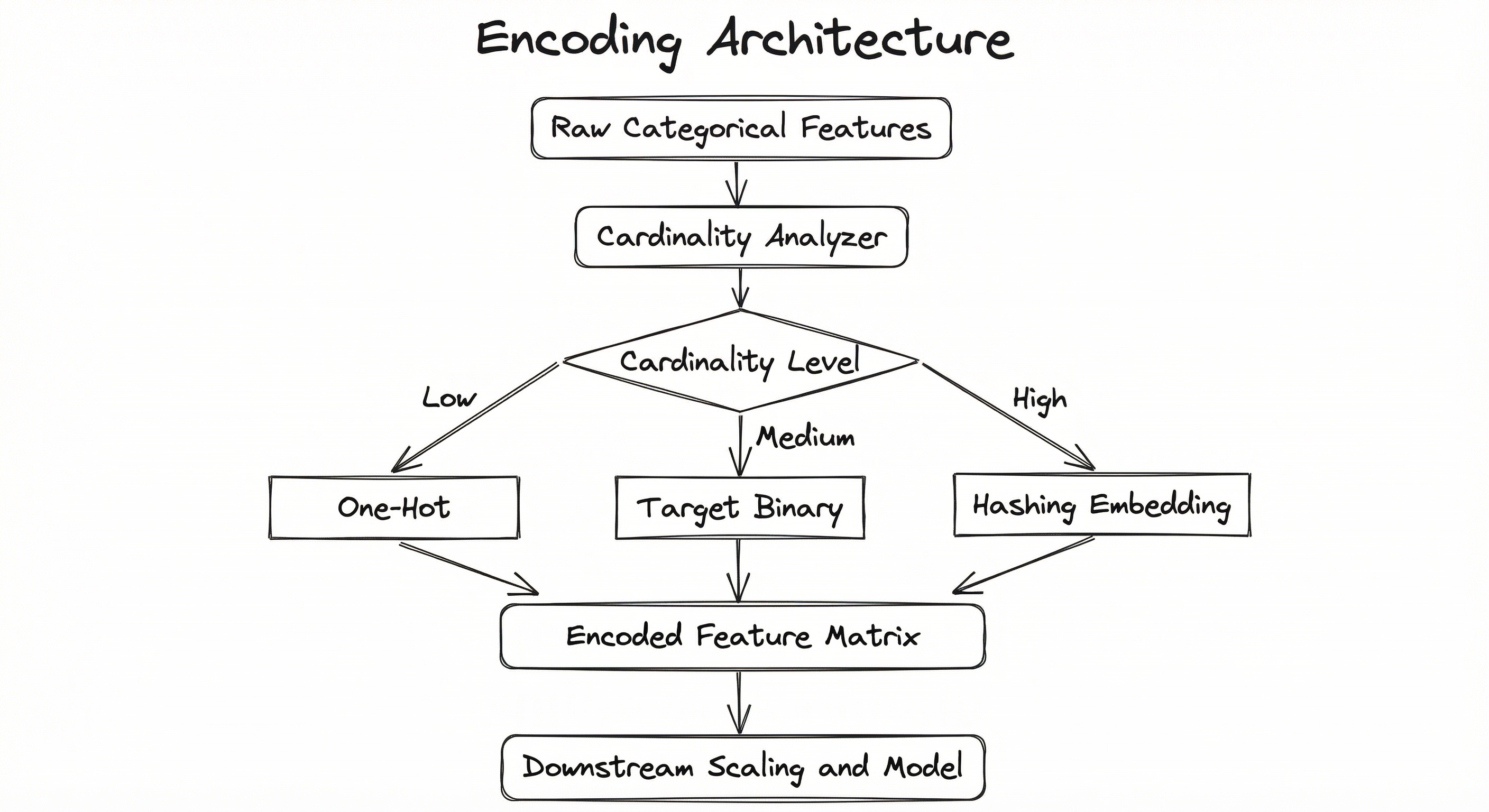
In practice, a single dataset often contains categorical features at multiple cardinality levels. A well-designed pipeline applies different encoding strategies per feature based on cardinality, ordinality, and model type. For instance, Swiggy's delivery time prediction model might one-hot encode payment_method (4 categories), target-encode restaurant_id (200K+ categories), and use learned embeddings for area_id in its deep learning model.
Key Components
Cardinality Analyzer
Inspects each categorical column to determine the number of unique categories (), the distribution of category frequencies, and whether an inherent ordering exists (nominal vs. ordinal). This analysis informs which encoding method to apply.
One-Hot Encoder
Creates binary indicator columns for low-cardinality features. Handles unknown categories at inference via a configurable strategy: ignore, raise error, or map to a dedicated <UNKNOWN> column. Supports both dense and sparse matrix output.
Target Encoder
Computes smoothed target statistics per category from training data. Stores the category-to-value mapping and the global mean for handling unseen categories. Applies cross-validation or leave-one-out regularization to mitigate target leakage during training.
Binary / Base-N Encoder
Converts category indices to their binary (or base-N) representation, producing columns. A middle ground between one-hot (too many columns) and label encoding (false ordinality).
Hashing Encoder
Applies a deterministic hash function (e.g., MurmurHash) to map category strings to a fixed number of buckets. Requires no fitting step and handles unseen categories automatically, at the cost of hash collisions.
Embedding Layer
A learnable lookup table () integrated into a neural network architecture. Learns dense, low-dimensional representations during model training. Requires gradient-based optimization and is not a standalone preprocessing step.
Encoding Persistence Store
Serializes fitted encoding parameters (category-to-value mappings, vocabulary lists, embedding weights) for reproducible inference. Typically stored as pickled transformers, JSON mappings, or model checkpoints.
Data Flow
Fit Path (Training Time): Raw categorical columns arrive from the data pipeline. The cardinality analyzer profiles each column. Based on cardinality and model type, the appropriate encoder is selected and fitted on training data. For target-aware encoders, fitting uses cross-validated folds to prevent leakage. Fitted parameters are persisted to the encoding store.
Transform Path (Training & Inference): Categorical values pass through the fitted encoder, producing numeric outputs. Unknown categories encountered at inference are handled per the encoder's strategy (map to global mean for target encoding, map to zero vector for one-hot, hash naturally for hashing). The encoded feature matrix is passed to downstream scaling and model consumption.
Key constraint: The encoding vocabulary and parameters must be identical between training and inference. A common production bug is fitting the encoder on full data (including validation/test) during development, then encountering vocabulary mismatches in production.
A directed flow showing raw categorical features entering a cardinality analyzer, which routes to one of three encoding paths (one-hot for low cardinality, target/binary for medium, hashing/embedding for high cardinality), all converging into an encoded feature matrix that feeds downstream scaling and model training.
How to Implement
Choosing the Right Implementation
The Python ecosystem offers three main libraries for categorical encoding, each with distinct strengths:
scikit-learn provides OneHotEncoder, OrdinalEncoder, and LabelEncoder in its preprocessing module. These are battle-tested, well-documented, and integrate seamlessly with scikit-learn pipelines. However, they lack advanced encoders like target encoding (added in v1.3+ as TargetEncoder), WoE, or CatBoost encoding.
category_encoders (scikit-learn-contrib) is the most comprehensive library, offering 20+ encoding schemes including TargetEncoder, WOEEncoder, BinaryEncoder, HashingEncoder, CatBoostEncoder, JamesSteinEncoder, and more. All encoders follow the scikit-learn transformer API (fit / transform) and work with pandas DataFrames.
feature-engine provides a curated set of encoders (OrdinalEncoder, CountFrequencyEncoder, MeanEncoder, WoEEncoder, DecisionTreeEncoder) with strong support for feature selection integration and a focus on preventing target leakage via built-in cross-validation.
For deep learning, PyTorch and TensorFlow/Keras provide nn.Embedding and tf.keras.layers.Embedding respectively -- learnable lookup tables that map integer category indices to dense vectors.
Cost Note: All three libraries are open-source and free. The computational cost of encoding is typically negligible compared to model training. For a dataset with 10M rows and 50 categorical features, encoding takes 10-60 seconds on a 4-core machine (~INR 3/hour on AWS t3.xlarge, or $0.04/hour). The real cost concern is the downstream impact on model memory: one-hot encoding 50 features with average cardinality 500 produces 25,000 columns, requiring ~2 GB RAM for 10M rows in float32.
import pandas as pd
from sklearn.preprocessing import OneHotEncoder
from sklearn.compose import ColumnTransformer

# Sample data: Swiggy-style restaurant features
df_train = pd.DataFrame({
    'cuisine': ['North Indian', 'Chinese', 'South Indian', 'Italian', 'North Indian'],
    'payment': ['UPI', 'Credit Card', 'Cash', 'UPI', 'Credit Card'],
    'delivery_time': [30, 45, 25, 50, 35]
})

df_test = pd.DataFrame({
    'cuisine': ['North Indian', 'Thai', 'Chinese'],  # 'Thai' unseen in train
    'payment': ['UPI', 'Cash', 'UPI'],
    'delivery_time': [28, 40, 38]
})

# Configure encoder: handle_unknown='infrequent_if_exist' groups rare/unseen categories
ohe = OneHotEncoder(
    handle_unknown='infrequent_if_exist',
    min_frequency=2,           # Categories with freq < 2 are grouped
    sparse_output=False,       # Dense array for small datasets
    drop='if_binary'           # Drop one column for binary features
)

cat_features = ['cuisine', 'payment']
preprocessor = ColumnTransformer(
    transformers=[('cat', ohe, cat_features)],
    remainder='passthrough'
)

X_train = preprocessor.fit_transform(df_train)
X_test = preprocessor.transform(df_test)  # 'Thai' mapped to infrequent category

print(f"Train shape: {X_train.shape}")  # (5, 5) - compressed from 7 categories
print(f"Test shape: {X_test.shape}")    # (3, 5) - same dimensions, no crash
This example demonstrates production-safe one-hot encoding with two critical features: handle_unknown='infrequent_if_exist' prevents crashes when unseen categories appear at inference time, and min_frequency groups rare categories to control dimensionality. The ColumnTransformer applies encoding selectively to categorical columns while passing numeric columns through unchanged -- a pattern you will use in virtually every real pipeline.
import pandas as pd
import numpy as np
from category_encoders import TargetEncoder
from sklearn.model_selection import KFold

# Simulate a Zomato restaurant rating prediction dataset
np.random.seed(42)
n = 10000
areas = np.random.choice(
    ['Koramangala', 'Indiranagar', 'HSR Layout', 'Whitefield',
     'Electronic City', 'Jayanagar', 'Marathahalli', 'Yelahanka',
     'Hebbal', 'Banashankari', 'JP Nagar', 'BTM Layout',
     'Malleshwaram', 'Rajajinagar', 'Basavanagudi'],
    size=n
)
ratings = np.random.uniform(2.5, 4.8, size=n)

df = pd.DataFrame({'area': areas, 'rating': ratings})

# WRONG: Fit on full data -> target leakage!
# te = TargetEncoder().fit(df[['area']], df['rating'])

# RIGHT: Use cross-validated target encoding to prevent leakage
te = TargetEncoder(
    cols=['area'],
    smoothing=10.0,        # Regularization: blend with global mean
    min_samples_leaf=20,   # Min samples before using category mean
    handle_unknown='value' # Unseen categories get global mean
)

# Cross-validated encoding for training data
kf = KFold(n_splits=5, shuffle=True, random_state=42)
df['area_encoded'] = np.nan

for train_idx, val_idx in kf.split(df):
    te.fit(df.iloc[train_idx][['area']], df.iloc[train_idx]['rating'])
    df.loc[val_idx, 'area_encoded'] = te.transform(
        df.iloc[val_idx][['area']]
    )['area'].values

# Refit on full training data for inference-time use
te.fit(df[['area']], df['rating'])

# At inference time:
new_data = pd.DataFrame({'area': ['Koramangala', 'Unknown Area']})
encoded = te.transform(new_data)
print(encoded)  # 'Unknown Area' gets global mean
Target encoding replaces each category with the mean target value for that category. The critical implementation detail is cross-validated encoding during training to prevent target leakage. Without it, the model sees its own labels during training, inflating metrics by 2-5% on typical datasets. The smoothing parameter controls how much rare categories are pulled toward the global mean -- essential when some restaurant areas in the Zomato dataset have only a handful of orders.
import pandas as pd
import numpy as np
from category_encoders import BinaryEncoder, HashingEncoder

# Simulate high-cardinality feature: Indian PIN codes
np.random.seed(42)
n = 50000
pin_codes = [f"{np.random.randint(100000, 999999)}" for _ in range(n)]
df = pd.DataFrame({'pin_code': pin_codes, 'delivery_success': np.random.binomial(1, 0.85, n)})

print(f"Unique PIN codes: {df['pin_code'].nunique()}")  # ~49,000+

# Approach 1: Binary Encoding
# For 50,000 categories: ceil(log2(50000)) = 16 columns vs 50,000 for one-hot
be = BinaryEncoder(cols=['pin_code'])
df_binary = be.fit_transform(df[['pin_code']])
print(f"Binary encoding columns: {df_binary.shape[1]}")  # 16 columns

# Approach 2: Feature Hashing (no fitting needed, handles unseen categories)
he = HashingEncoder(cols=['pin_code'], n_components=32)  # Fixed 32 buckets
df_hashed = he.fit_transform(df[['pin_code']])
print(f"Hashing encoding columns: {df_hashed.shape[1]}")  # 32 columns

# Feature hashing handles completely new PIN codes without retraining
new_pins = pd.DataFrame({'pin_code': ['999999', '123456', '000001']})
new_hashed = he.transform(new_pins)
print(f"New PIN codes encoded successfully: {new_hashed.shape}")  # (3, 32)

# Collision analysis: how many categories share a bucket?
from collections import Counter
bucket_assignments = he.transform(df[['pin_code']]).values.argmax(axis=1)
collision_rate = 1 - len(set(bucket_assignments)) / len(set(pin_codes))
print(f"Approximate collision rate: {collision_rate:.2%}")
This example contrasts two approaches for high-cardinality features like Indian PIN codes (~19,000 valid codes, but user input may produce even more unique values). Binary encoding reduces 50,000 categories to just 16 columns using binary representation -- a 3,125x compression. Feature hashing maps categories to a fixed number of buckets without any fitting step, making it ideal for streaming or online-learning scenarios where new categories appear continuously. The tradeoff is hash collisions, which introduce noise proportional to the collision rate.
import torch
import torch.nn as nn
import numpy as np

class TabularModel(nn.Module):
    """Neural network with learned embeddings for categorical features.

    Pattern used by Swiggy, DoorDash, and Uber for delivery time prediction.
    """
    def __init__(self, cat_dims, emb_dims, n_continuous, output_dim=1):
        super().__init__()

        # Create embedding layers for each categorical feature
        # Rule of thumb: emb_dim = min(50, ceil(cardinality / 2))
        self.embeddings = nn.ModuleList([
            nn.Embedding(num_categories, emb_dim)
            for num_categories, emb_dim in zip(cat_dims, emb_dims)
        ])

        # Total input dim = sum of embedding dims + continuous features
        total_emb_dim = sum(emb_dims)
        input_dim = total_emb_dim + n_continuous

        self.fc = nn.Sequential(
            nn.Linear(input_dim, 256),
            nn.ReLU(),
            nn.BatchNorm1d(256),
            nn.Dropout(0.3),
            nn.Linear(256, 128),
            nn.ReLU(),
            nn.BatchNorm1d(128),
            nn.Dropout(0.2),
            nn.Linear(128, output_dim)
        )

    def forward(self, x_cat, x_cont):
        # x_cat: (batch, n_cat_features) - integer indices
        # x_cont: (batch, n_continuous) - float values
        embeddings = [
            emb(x_cat[:, i]) for i, emb in enumerate(self.embeddings)
        ]
        x = torch.cat(embeddings + [x_cont], dim=1)
        return self.fc(x)


# Example: Delivery time prediction
cat_dims = [15, 500, 20000, 5]    # city, restaurant_id, area_id, payment_method
emb_dims = [8, 50, 50, 3]         # embedding dimensions per feature
n_continuous = 10                   # distance, hour, day_of_week, etc.

model = TabularModel(cat_dims, emb_dims, n_continuous)

# Dummy forward pass
batch_size = 64
x_cat = torch.randint(0, 5, (batch_size, 4))   # categorical indices
x_cont = torch.randn(batch_size, 10)            # continuous features
prediction = model(x_cat, x_cont)
print(f"Output shape: {prediction.shape}")  # (64, 1)

# Total embedding parameters:
total_params = sum(c * e for c, e in zip(cat_dims, emb_dims))
print(f"Embedding parameters: {total_params:,}")  # 1,030,135
print(f"vs One-Hot dimensions: {sum(cat_dims):,}")  # 20,520
Entity embeddings learn dense, low-dimensional representations for each category during training. This approach is standard in production deep learning systems at companies like Uber (DeepETA), DoorDash (store2vec), and Swiggy. The key advantage over one-hot encoding is dimensionality reduction (1M+ parameters vs. 20K+ sparse columns) and the ability to capture latent relationships -- for example, the model might learn that restaurant_ids serving similar cuisines have nearby embeddings. The rule of thumb for embedding dimension is .
import pandas as pd
import numpy as np
from category_encoders import WOEEncoder

# Simulate credit scoring data (common in Indian NBFC/fintech companies)
np.random.seed(42)
n = 20000

df = pd.DataFrame({
    'employment_type': np.random.choice(
        ['Salaried', 'Self-Employed', 'Business', 'Freelancer', 'Government'],
        size=n, p=[0.4, 0.2, 0.15, 0.1, 0.15]
    ),
    'education': np.random.choice(
        ['Graduate', 'Post-Graduate', 'Under-Graduate', 'Doctorate', 'Diploma'],
        size=n, p=[0.35, 0.25, 0.2, 0.05, 0.15]
    ),
    'loan_default': np.random.binomial(1, 0.12, size=n)  # 12% default rate
})

# WoE encoding: specifically designed for binary classification
woe = WOEEncoder(cols=['employment_type', 'education'], regularization=1.0)

df_encoded = woe.fit_transform(df[['employment_type', 'education']], df['loan_default'])

# Inspect the WoE values
print("WoE mapping for employment_type:")
for cat in df['employment_type'].unique():
    woe_val = df_encoded.loc[df['employment_type'] == cat, 'employment_type'].iloc[0]
    print(f"  {cat}: WoE = {woe_val:.4f}")

# Compute Information Value (IV) to assess predictive power
def compute_iv(df, feature, target):
    """IV < 0.02: useless, 0.02-0.1: weak, 0.1-0.3: medium, > 0.3: strong"""
    groups = df.groupby(feature)[target].agg(['sum', 'count'])
    groups.columns = ['events', 'total']
    groups['non_events'] = groups['total'] - groups['events']
    total_events = groups['events'].sum()
    total_non_events = groups['non_events'].sum()
    groups['pct_events'] = groups['events'] / total_events
    groups['pct_non_events'] = groups['non_events'] / total_non_events
    groups['woe'] = np.log(groups['pct_events'] / groups['pct_non_events'].clip(1e-10))
    groups['iv'] = (groups['pct_events'] - groups['pct_non_events']) * groups['woe']
    return groups['iv'].sum()

iv = compute_iv(df, 'employment_type', 'loan_default')
print(f"\nInformation Value (employment_type): {iv:.4f}")
Weight of Evidence encoding originates from credit scoring and is widely used by Indian NBFCs and fintech companies like Razorpay, Lendingkart, and Capital Float. WoE transforms each category into the log-odds ratio of positive vs. negative outcomes, creating a monotonic relationship with the logistic regression target. The companion metric Information Value (IV) quantifies the predictive power of each feature: IV < 0.02 is useless, 0.02-0.1 is weak, 0.1-0.3 is medium, and > 0.3 is strong. The regularization parameter adds Laplace smoothing to prevent infinite WoE values when a category has zero events.
from catboost import CatBoostClassifier, Pool
import pandas as pd
import numpy as np

# CatBoost handles categorical encoding internally using Ordered Target Statistics
np.random.seed(42)
n = 5000

df = pd.DataFrame({
    'city': np.random.choice(
        ['Mumbai', 'Delhi', 'Bengaluru', 'Chennai', 'Hyderabad',
         'Pune', 'Kolkata', 'Ahmedabad', 'Jaipur', 'Lucknow'],
        size=n
    ),
    'product_category': np.random.choice(
        ['Electronics', 'Fashion', 'Groceries', 'Home', 'Beauty'],
        size=n
    ),
    'order_value': np.random.uniform(100, 5000, size=n),
    'is_returned': np.random.binomial(1, 0.15, size=n)
})

# Specify which columns are categorical -- CatBoost handles the rest
cat_features = ['city', 'product_category']

train_pool = Pool(
    data=df[['city', 'product_category', 'order_value']],
    label=df['is_returned'],
    cat_features=cat_features  # Tell CatBoost these are categorical
)

model = CatBoostClassifier(
    iterations=500,
    learning_rate=0.05,
    depth=6,
    verbose=100,
    one_hot_max_size=5,  # One-hot for features with <= 5 categories
    random_seed=42
)

model.fit(train_pool)

# CatBoost uses Ordered Target Statistics internally:
# For each observation, it computes target stats using only
# PRECEDING observations in a random permutation -- this prevents
# the target leakage that plagues naive target encoding.
print("\nFeature importance:")
for name, importance in zip(
    ['city', 'product_category', 'order_value'],
    model.feature_importances_
):
    print(f"  {name}: {importance:.2f}")
CatBoost's killer feature is its Ordered Target Statistics encoding: for each training example, it computes target statistics using only observations that precede it in a random permutation. This eliminates target leakage without requiring explicit cross-validation loops. The one_hot_max_size parameter automatically switches to one-hot encoding for low-cardinality features. This approach, introduced in the 2017 CatBoost paper by Prokhorenkova et al., consistently outperforms manual target encoding in benchmarks.
# Feature engineering pipeline config (YAML)
encoding:
  features:
    - name: cuisine_type
      cardinality: 15
      method: one_hot
      params:
        handle_unknown: infrequent_if_exist
        min_frequency: 50
        drop: if_binary

    - name: restaurant_id
      cardinality: 250000
      method: target_encoding
      params:
        smoothing: 20.0
        min_samples_leaf: 50
        cv_folds: 5
        handle_unknown: global_mean

    - name: pin_code
      cardinality: 19000
      method: hashing
      params:
        n_components: 64
        hash_function: murmurhash3

    - name: payment_method
      cardinality: 4
      method: one_hot
      params:
        drop: first

    - name: product_category
      cardinality: 50000
      method: embedding
      params:
        embedding_dim: 50
        pretrained: null

  global:
    unknown_strategy: global_mean
    nan_strategy: treat_as_category
    persistence: joblib
    encoding_version: "v2.3"
Common Implementation Mistakes
- ●
Fitting encoders on the full dataset (train + test): This is the most common and most damaging mistake. Target encoders, WoE encoders, and even one-hot encoders must be fit exclusively on training data. Fitting on the full dataset leaks test-set information into the encoding, inflating validation metrics by 2-10% and producing models that fail in production.
- ●
Using label encoding for nominal features with linear models: Label encoding assigns integers (0, 1, 2, ...) that imply an ordering. For a feature like
citywith values {Mumbai=0, Delhi=1, Bengaluru=2}, a linear model will treat Delhi as 'between' Mumbai and Bengaluru -- meaningless. Use one-hot or target encoding instead for nominal features fed to linear/distance-based models. - ●
Ignoring unseen categories at inference time: Production data will contain categories not seen during training. If your encoder crashes on unknown categories (the default behavior of many implementations), your inference pipeline fails silently or loudly. Always configure
handle_unknown='value'or equivalent, and test with novel categories before deploying. - ●
One-hot encoding high-cardinality features without dimensionality control: One-hot encoding a feature with 10,000+ categories creates a 10,000-column sparse matrix per feature. This bloats memory, slows training, and often hurts model performance due to the curse of dimensionality. Use target encoding, feature hashing, or embeddings for high-cardinality features.
- ●
Applying target encoding without regularization on rare categories: A category seen only 3 times in training data with all 3 being positive will get a target encoding of 1.0 -- pure overfitting. Always use smoothing (blend with global mean) or minimum sample thresholds. The
smoothingparameter in category_encoders controls this. - ●
Forgetting to encode the same way at training and inference: If you use k-fold target encoding during training but single-pass target encoding at inference, the distributions will differ. Maintain a single fitted encoder object (serialized via pickle or joblib) for both training validation and production inference.
- ●
Not handling NaN/missing values before encoding: Many encoders treat NaN as a valid category, silently creating a
NaNbucket with its own encoding. Decide explicitly whether missing values should be a separate category or imputed before encoding.
When Should You Use This?
Use When
Your dataset contains categorical features that need to be converted to numeric form for model consumption -- which is virtually every real-world ML problem
You have low-cardinality nominal features (2-20 categories) that should be one-hot encoded to avoid imposing false ordinal relationships
You have high-cardinality features (100+ categories) like user IDs, product IDs, or ZIP codes that need compact representations via target encoding, hashing, or embeddings
You are building a credit scoring or risk model where Weight of Evidence encoding provides interpretable, monotonic transformations aligned with logistic regression
You need online-compatible encoding that handles previously unseen categories without retraining -- use feature hashing
You are training a deep learning model on tabular data and want the model to learn categorical representations end-to-end via embedding layers
You have ordinal features (e.g., education level: High School < Bachelor's < Master's < PhD) where the natural ordering should be preserved via ordinal encoding
Avoid When
Your feature is already numeric -- encoding is for categorical-to-numeric transformation only. Do not encode continuous variables (use binning/discretization instead if you want to categorize them)
The categorical feature has only 2 unique values and your model handles binary inputs natively -- a single 0/1 column suffices without a full encoding pipeline
You are using a model that handles categorical features natively (CatBoost, LightGBM with
categorical_featureparameter) -- let the model handle encoding internally for optimal resultsThe categorical feature is a free-text field (user reviews, descriptions) -- use NLP techniques (TF-IDF, sentence embeddings) rather than categorical encoding
You have a target variable with severe class imbalance and are considering target encoding without regularization -- the encoded values for rare-class categories will be unreliable and leak noise rather than signal
The feature has extremely high cardinality with uniform distribution (e.g., unique transaction IDs) -- no encoding can extract meaningful signal from a feature where every value appears once. Drop the feature or extract derived features (e.g., transaction frequency per user)
Key Tradeoffs
The Fundamental Tradeoff: Dimensionality vs. Information Preservation
One-hot encoding preserves maximum information (each category is fully distinguishable) but at the cost of new columns. For a Flipkart product catalog with 50,000 leaf categories, this means 50,000 sparse columns per feature -- infeasible for most models and expensive in memory.
Target encoding collapses to a single column but conflates categories that happen to have similar target means. Two completely different restaurant types might get similar encodings simply because their average delivery time happens to be close.
| Method | Dimensions | Leakage Risk | Unseen Categories | Best For |
|---|---|---|---|---|
| One-Hot | None | Needs explicit handling | Low cardinality (), linear models | |
| Label/Ordinal | 1 | None | Needs mapping | Ordinal features, tree models |
| Target | 1 | High (needs CV) | Maps to global mean | Medium-high cardinality, tree models |
| Binary | None | Partial handling | Medium cardinality (20-1000) | |
| Hashing | (fixed) | None | Automatic | Very high cardinality, streaming |
| WoE | 1 | High (needs CV) | Needs handling | Binary classification, credit scoring |
| Embedding | (learned) | None | Needs fallback | Deep learning, high cardinality |
The Second Tradeoff: Preprocessing Simplicity vs. Model Integration
Standalone encoders (one-hot, target, binary) are model-agnostic preprocessing steps. You encode once and feed to any model. Embedding layers are tightly coupled to neural network training -- you cannot export an embedding encoding and plug it into XGBoost (though you can extract the learned embeddings post-training as features for other models, a technique called embedding transfer).
Rule of Thumb: Start simple. Use one-hot for features with , target encoding with 5-fold CV for features with , and embeddings or feature hashing for . Then measure the impact on your validation metric and adjust.
Alternatives & Comparisons
Feature extraction derives new numeric features from raw data (e.g., extracting day-of-week from a timestamp, or TF-IDF from text). Encoding converts existing categorical labels to numeric form. If your 'categorical' feature is actually free text or a timestamp, you need feature extraction, not encoding.
Scaling transforms the range or distribution of already-numeric features (min-max, standard, robust scaling). Encoding converts non-numeric features to numeric. In a pipeline, encoding happens first, then scaling is applied to the encoded outputs (especially for target encoding, which produces values on the target's scale).
Data transformation is a broader category that includes encoding, scaling, log transforms, and other numeric manipulations. Encoding is specifically the categorical-to-numeric conversion step within the larger transformation pipeline.
Pros, Cons & Tradeoffs
Advantages
Unlocks categorical signal for models: Without encoding, categorical features are invisible to most ML algorithms. Proper encoding surfaces the predictive signal hidden in category labels -- often the most important features in a model (e.g.,
merchant_categoryin fraud detection).Multiple methods for different scenarios: The encoding toolbox is rich. Low-cardinality features get one-hot encoding (simple, no information loss). High-cardinality features get target encoding or embeddings (compact, high signal). This flexibility means you can optimize per-feature rather than applying a one-size-fits-all approach.
Mature ecosystem with production-ready libraries: scikit-learn, category_encoders, feature-engine, and deep learning frameworks all provide battle-tested encoding implementations. You rarely need to implement encoding from scratch.
Embeddings capture latent relationships: Entity embedding layers learn that 'Mumbai' and 'Pune' are more similar than 'Mumbai' and 'Chennai', or that 'Electronics' and 'Appliances' are related product categories. This latent structure improves model generalization beyond what one-hot encoding can achieve.
Enables model interpretability: WoE encoding produces values directly interpretable as log-odds contributions, making it a favorite in regulated industries (banking, insurance) where model explainability is a compliance requirement.
Memory efficiency at scale: Feature hashing and binary encoding reduce high-cardinality features from thousands of columns to tens, enabling training on datasets that would otherwise exceed available memory. A 50,000-category feature encoded in 16 binary columns saves ~300x memory vs. one-hot.
Disadvantages
Target leakage is a constant threat: Any encoding method that uses the target variable (target encoding, WoE, CatBoost encoding) risks leaking label information into features. Without careful cross-validation, this inflates training metrics and produces models that underperform in production by 2-10%.
Unseen categories break pipelines: Categories not present in training data cause failures at inference time unless explicitly handled. This is especially problematic in dynamic domains (new restaurants on Swiggy, new products on Flipkart) where novel categories appear daily.
One-hot encoding creates dimensionality explosion: For features with categories, one-hot encoding produces prohibitively large sparse matrices. This increases training time, memory usage, and can degrade model performance due to the curse of dimensionality.
Encoding choices interact with model type: The same encoding can be optimal for one model and harmful for another. Target encoding works well for tree models but can cause multicollinearity issues in linear regression. One-hot encoding is ideal for linear models but wasteful for trees. This model-encoding interaction adds complexity to pipeline design.
Ordinal assumptions are easy to introduce accidentally: Label encoding and ordinal encoding impose a numeric ordering on categories. If the feature is nominal (no natural order), this creates a false signal that misleads linear models, KNN, and SVMs.
Maintenance burden in production: Encoding vocabularies, target statistics, and embedding weights must be versioned, persisted, and kept in sync between training and serving. Category drift (new categories appearing, old ones disappearing) requires periodic re-fitting and redeployment.
Failure Modes & Debugging
Target leakage via naive target encoding
Cause
Target encoding is fitted on the same data used for training without cross-validation. Each category's encoding contains direct information about the target labels for those exact training examples.
Symptoms
Training accuracy is suspiciously high (often 2-10% above expected). Validation and test performance are significantly lower than training performance. The gap between train and validation metrics widens as encoding smoothing decreases.
Mitigation
Always use k-fold cross-validated target encoding during training: for each fold, fit the encoder on the out-of-fold data and transform the in-fold data. Use CatBoost's Ordered Target Statistics for automatic leakage prevention. Set smoothing >= 10 and min_samples_leaf >= 20 to regularize rare categories.
Unseen category crash at inference
Cause
A category appears in production data that was not present in the training set. The encoder has no mapping for this category and raises a ValueError or produces NaN.
Symptoms
Inference pipeline throws exceptions for specific inputs. Prediction requests fail intermittently as new categories (new restaurants, new products, new cities) appear in production. Monitoring shows increasing error rates over time as data drifts.
Mitigation
Configure all encoders with explicit unknown-category handling: handle_unknown='value' for category_encoders (maps to global mean/median), handle_unknown='infrequent_if_exist' for scikit-learn's OneHotEncoder. For embedding layers, reserve index 0 as an <UNKNOWN> token. Test your pipeline with synthetic unknown categories before deployment.
Dimensionality explosion from one-hot encoding
Cause
One-hot encoding is applied to a high-cardinality feature (e.g., pin_code with 19,000 categories or product_id with 500,000 categories) without cardinality awareness.
Symptoms
Out-of-memory errors during training. Feature matrix size exceeds available RAM (e.g., 10M rows x 500K one-hot columns x 4 bytes = 20 TB in dense representation). Training time increases by orders of magnitude even with sparse matrices.
Mitigation
Set a cardinality threshold (e.g., ) for one-hot encoding. Use target encoding, binary encoding, feature hashing, or embeddings for higher-cardinality features. In scikit-learn, use OneHotEncoder(max_categories=20) to automatically group rare categories.
Train-serve encoding skew
Cause
The encoding logic or parameters differ between training and inference. Common causes: re-fitting the encoder on production data, using different library versions, or applying transformations in a different order.
Symptoms
Model predictions in production are systematically different from validation metrics. Feature distributions at inference time do not match training distributions despite identical raw inputs. Debugging shows correct raw features but incorrect encoded features.
Mitigation
Serialize the fitted encoder object (via joblib.dump or pickle) during training and load the exact same object at inference time. Version your encoding pipeline alongside your model. Use integration tests that feed identical inputs through both training and serving encoders and assert identical outputs.
Silent ordinal injection in nominal features
Cause
Label encoding (0, 1, 2, ...) is applied to a nominal feature (no natural order) and fed to a model that treats numeric inputs as continuous (linear regression, SVM, KNN).
Symptoms
Model quality is subtly degraded. The model learns spurious relationships based on arbitrary integer assignments (e.g., treating city=2 as 'closer' to city=3 than to city=0). This is hard to detect because the model still trains and produces predictions -- they are just worse than they should be.
Mitigation
Audit every label-encoded feature: is it truly ordinal? If not, switch to one-hot or target encoding. For tree-based models (Random Forest, XGBoost, LightGBM), label encoding is safe because trees only use split thresholds, not magnitudes. For all other model types, avoid label encoding for nominal features.
Hash collision noise in feature hashing
Cause
The number of hash buckets () is set too low relative to the cardinality (), causing many distinct categories to collide into the same bucket.
Symptoms
Model accuracy plateaus below expected performance. Increasing the number of buckets improves accuracy, confirming that collisions were degrading signal. Feature importance analysis shows hashed features contributing less than expected.
Mitigation
Use at least buckets to keep expected collision rate below 50%. Monitor collision rate empirically. Consider signed hashing (the alternate_sign parameter in scikit-learn's FeatureHasher) to reduce collision bias by making collisions cancel out in expectation rather than accumulate.
Placement in an ML System
Where Does Encoding Sit in the ML Pipeline?
Encoding occupies the feature engineering stage, immediately after data cleaning and before feature scaling/normalization and model training. In a production pipeline, encoding is typically implemented as part of a feature transformation pipeline that runs both during training and at inference time.
In a batch training pipeline (e.g., Flipkart's daily product ranking model), encoding runs as a Spark or Pandas transformation step in the ETL process, with fitted encoders stored in a feature store or model registry.
In a real-time serving pipeline (e.g., Swiggy's delivery time prediction), the fitted encoder is loaded into the serving container and applied to each incoming request. The encoding step typically adds 0.1-1ms to inference latency -- negligible compared to model inference itself.
For streaming/online learning systems (e.g., ad click prediction at Hotstar), feature hashing is preferred because it requires no pre-fitted vocabulary and handles new categories without retraining.
Key Insight: Encoding is a stateful transformation -- the encoder parameters learned during training must be applied identically at inference. This statefulness makes encoding one of the most common sources of train-serve skew in production ML systems.
Pipeline Stage
Feature Engineering / Preprocessing
Upstream
- data-cleaning
- exploratory-analysis
- feature-extraction
Downstream
- scaling
- normalization
- model-training
- feature-store
Scaling Bottlenecks
The primary bottleneck is memory when using one-hot encoding on high-cardinality features. A dataset with 100M rows and a single feature with 100K categories produces a 100M x 100K sparse matrix -- roughly 40 GB even in CSR format with 1 non-zero per row. Multiply by 10 such features and you are at 400 GB.
Target encoding is CPU-bound during the fitting phase: computing conditional means requires a group-by aggregation that scales as where is the number of rows and is the number of categorical features. For 100M rows and 50 features, this takes 5-15 minutes on a single machine.
Embedding layers shift the bottleneck to GPU memory: the embedding table for a feature with 10M categories and 64 dimensions requires GB of GPU RAM. With multiple high-cardinality features, embedding tables can consume more GPU memory than the model itself.
Some concrete numbers: encoding 50 categorical features across 10M rows takes roughly 30-90 seconds on a 4-core machine using category_encoders, costing approximately INR 0.50 (~0.10-0.30).
Production Case Studies
Walmart's data science team tackled the challenge of one-hot encoding for categorical features with extremely high cardinality in their product recommendation and demand forecasting systems. They developed optimized sparse encoding pipelines that selectively apply one-hot encoding to low-cardinality features while using feature hashing and target encoding for high-cardinality attributes like store_id and product_upc.
Reduced feature matrix memory footprint by 85% while maintaining model accuracy within 0.3% of the full one-hot baseline, enabling training on datasets that previously exceeded cluster memory limits.
DoorDash's DeepETA model uses learned entity embeddings for high-cardinality categorical features like store_id, replacing manual encoding approaches. Each store is embedded into a dense vector (store2vec) that captures latent characteristics like preparation speed, cuisine type, and operational efficiency. The embeddings are learned jointly with the ETA prediction objective, allowing the model to discover that stores with similar operational patterns have nearby embeddings.
Store embeddings improved ETA prediction accuracy by 15% compared to one-hot encoding and 8% compared to target encoding, while reducing feature dimensionality from 200K+ (one-hot) to 64 (embedding dimension) per store feature.
The seminal Entity Embeddings of Categorical Variables paper by Guo and Berkhahn demonstrated the power of learned embeddings on the Rossmann Store Sales Kaggle competition. The authors used embedding layers for categorical features like Store, DayOfWeek, StateHoliday, and Promo in a neural network, achieving 3rd place. Crucially, they showed that the learned embeddings captured meaningful geographic and temporal structure -- German states with similar economic profiles clustered together in embedding space.
Achieved 3rd place in the Kaggle competition. The learned embeddings revealed that the neural network had independently discovered geographic proximity between German states, validating that entity embeddings capture real-world latent structure.
Uber's DeepETA model embeds all categorical features (city, product type, trip type) into dense vectors as part of a deep learning architecture for arrival time prediction. The categorical embeddings are combined with bucketized continuous features and processed through a transformer-based architecture. This approach replaced hand-engineered feature encoding pipelines with end-to-end learned representations.
The embedding-based approach contributed to a 20% reduction in ETA prediction error compared to the previous gradient-boosted tree model that used manual target encoding for categorical features.
Tooling & Ecosystem
Provides OneHotEncoder, OrdinalEncoder, LabelEncoder, and (since v1.3) TargetEncoder. The most widely used and well-documented encoding library, integrated with scikit-learn pipelines via ColumnTransformer.
The most comprehensive encoding library with 20+ encoding schemes: TargetEncoder, WOEEncoder, BinaryEncoder, HashingEncoder, CatBoostEncoder, JamesSteinEncoder, LeaveOneOutEncoder, BaseNEncoder, QuantileEncoder, and more. All encoders are scikit-learn compatible transformers.
Curated feature engineering library with encoding transformers (OrdinalEncoder, CountFrequencyEncoder, MeanEncoder, WoEEncoder, DecisionTreeEncoder) that include built-in safeguards against target leakage and first-class pandas DataFrame support.
Gradient boosting library with built-in Ordered Target Statistics encoding for categorical features. Handles encoding internally during training, eliminating the need for manual preprocessing. Developed by Yandex.
Learnable embedding lookup table for converting integer category indices to dense vectors. The standard approach for categorical features in PyTorch-based deep learning models. Supports sparse gradients for memory-efficient training on high-cardinality features.
TensorFlow/Keras equivalent of PyTorch's nn.Embedding. Converts positive integer indices to dense vectors of fixed size. Supports mask_zero for variable-length sequences and integrates with TF feature columns.
Specialized library for encoding dirty categorical variables -- categories with typos, variations, and inconsistencies (e.g., 'Bengaluru' vs. 'Bangalore' vs. 'Bangaluru'). Provides SimilarityEncoder, GapEncoder, and MinHashEncoder that handle string similarity during encoding.
Research & References
Guo, Berkhahn (2016)arXiv preprint
Pioneered the use of neural network embedding layers for categorical features, showing that learned embeddings capture latent structure (geographic proximity, temporal patterns) and outperform one-hot encoding on the Rossmann Kaggle competition.
Prokhorenkova, Gusev, Vorobev, Dorogush, Gulin (2018)NeurIPS 2018
Introduced Ordered Target Statistics, a permutation-based target encoding that eliminates target leakage without cross-validation. Also proposed ordered boosting to address prediction shift in gradient boosting.
Pargent, Pfisterer, Thomas, Bischl (2022)Computational Statistics
Large-scale benchmark comparing 10 encoding methods across 28 datasets. Found that regularized target encoding consistently outperformed one-hot, label, and binary encoding for high-cardinality features, especially with tree-based models.
Cerda, Varoquaux, Kegl (2020)IEEE TKDE
Proposed similarity encoding and gap encoding for dirty categorical variables with typos and string variations. Demonstrated that string-aware encoders outperform standard methods on real-world datasets with messy category labels.
Valdez-Valenzuela, Peralta-Torres, Beltran-Martinez (2024)arXiv preprint
Evaluated 14 encoding methods across 28 datasets with 8 ML models, finding that target encoders are most suitable for tree-based models while one-hot remains competitive for linear models on low-cardinality features.
Various (2025)arXiv preprint
Introduces novel encoding techniques including means encoding, low-rank encoding, and multinomial logistic regression encoding for high-cardinality categorical variables, with benchmarks against traditional methods.
Interview & Evaluation Perspective
Common Interview Questions
- ●
How would you encode a categorical feature with 100,000 unique values for a gradient-boosted tree model?
- ●
What is target encoding and how do you prevent target leakage when using it?
- ●
When would you use one-hot encoding vs. label encoding vs. target encoding? Walk me through your decision framework.
- ●
How do you handle unseen categories at inference time in a production ML system?
- ●
Explain entity embeddings for categorical variables. When would you choose embeddings over traditional encoding?
- ●
What is Weight of Evidence encoding and why is it popular in credit risk modeling?
- ●
How would you encode categorical features differently for a linear model vs. a tree-based model?
- ●
What happens if you label-encode a nominal feature and feed it to a logistic regression model?
Key Points to Mention
- ●
The encoding method must match the model type: one-hot for linear/distance-based models, label/ordinal for tree-based models, embeddings for neural networks. This is not a preference -- it is a hard requirement that directly impacts model quality.
- ●
Target encoding requires cross-validated fitting during training to prevent target leakage. CatBoost's Ordered Target Statistics is the gold standard for automatic leakage prevention.
- ●
High-cardinality features (>100 categories) should never be one-hot encoded in production -- use target encoding with smoothing, feature hashing, or entity embeddings instead. Quantify the memory impact: categories = columns = bytes.
- ●
Production encoders must handle unseen categories gracefully. Feature hashing handles this automatically; other encoders need explicit fallback strategies (global mean, zero vector, dedicated unknown bucket).
- ●
The Information Value (IV) metric from WoE encoding is a powerful feature selection tool: IV < 0.02 means the feature is useless, > 0.3 means it is a strong predictor. Mention this in credit scoring or fintech interview contexts.
- ●
Entity embeddings learn latent structure that one-hot encoding cannot capture. After training, embeddings can be extracted and used as features for other models (embedding transfer).
Pitfalls to Avoid
- ●
Claiming one-hot encoding is always the best approach -- it fails catastrophically for high-cardinality features and is wasteful for tree models that can handle integer indices directly.
- ●
Forgetting to mention target leakage when discussing target encoding -- this is the single most important implementation detail and interviewers specifically listen for it.
- ●
Confusing label encoding with ordinal encoding -- label encoding assigns arbitrary integers, ordinal encoding assigns integers based on a meaningful order. The distinction matters for model interpretation.
- ●
Not addressing the production concern of unseen categories -- every interviewer who has built a real system will ask about this, and saying 'it won't happen' is a red flag.
- ●
Overlooking the interaction between encoding and downstream components like feature scaling. Target-encoded values are on the target's scale and may need standardization, while one-hot values are already 0/1.
Senior-Level Expectation
A senior candidate should discuss encoding as part of a holistic feature engineering strategy, not in isolation. They should articulate the cardinality-based decision framework (one-hot for low, target/binary for medium, hashing/embeddings for high), explain the mathematical basis of target leakage and how cross-validation mitigates it, and describe production concerns: encoder serialization, versioning, handling category drift, and train-serve consistency. They should mention embedding transfer (training embeddings in a neural network and exporting them for use in tree models) as a technique for combining the best of both worlds. For Indian fintech contexts, demonstrating familiarity with WoE encoding, Information Value, and RBI regulatory requirements for model interpretability would be impressive. Cost-aware analysis is expected: quantifying the memory and compute tradeoffs of different encoding approaches at the company's data scale (e.g., 'at 100M rows, one-hot encoding this 50K-cardinality feature would require 20 TB in dense form, costing approximately INR 1.5 lakh/month in cloud RAM').
Summary
Wrapping Up: The Encoding Decision Framework
Encoding is the process of converting categorical features into numerical representations that ML models can consume. While it sounds like a simple mapping exercise, the choice of encoding method has cascading effects on model accuracy, memory usage, training speed, and production reliability.
The key methods form a spectrum from simple to sophisticated:
- One-hot encoding: Maximum information preservation, output dimensions. Best for low-cardinality features () and linear/distance-based models. The default choice when cardinality permits.
- Label / ordinal encoding: Minimal dimensionality (1 column), but implies ordering. Safe for tree-based models, dangerous for linear models on nominal features.
- Target encoding: Compresses any cardinality to 1 column using target statistics. Powerful but risky -- requires cross-validated fitting to prevent target leakage. The go-to method for high-cardinality features in tree-based pipelines.
- Binary / Base-N encoding: Logarithmic compression ( columns). A middle ground between one-hot and label encoding, useful for medium cardinality.
- Feature hashing: Fixed-size output, stateless, handles unseen categories. Best for streaming systems and very high cardinality at the cost of collision noise.
- WoE encoding: Log-odds ratio for binary classification. Standard in credit scoring and regulated industries where interpretability is mandatory.
- Entity embeddings: Learned dense representations via neural networks. The state-of-the-art for high-cardinality features in deep learning systems, capable of discovering latent structure.
The decision framework is straightforward: match the encoding method to your cardinality (low/medium/high), model type (tree/linear/neural), and operational constraints (streaming, unseen categories, interpretability). Always prevent target leakage via cross-validated fitting, always handle unseen categories explicitly, and always serialize your fitted encoder for production consistency.
Bottom line: Encoding is not a one-size-fits-all step. The best ML engineers apply different encoding strategies per feature based on cardinality and model type, prevent target leakage with cross-validation, and design for the production realities of unseen categories and train-serve consistency. Get this right, and you have a solid foundation for everything downstream.